
Exhibit A FCC Spectrum Allocation of 800 MHz

Exhibit A
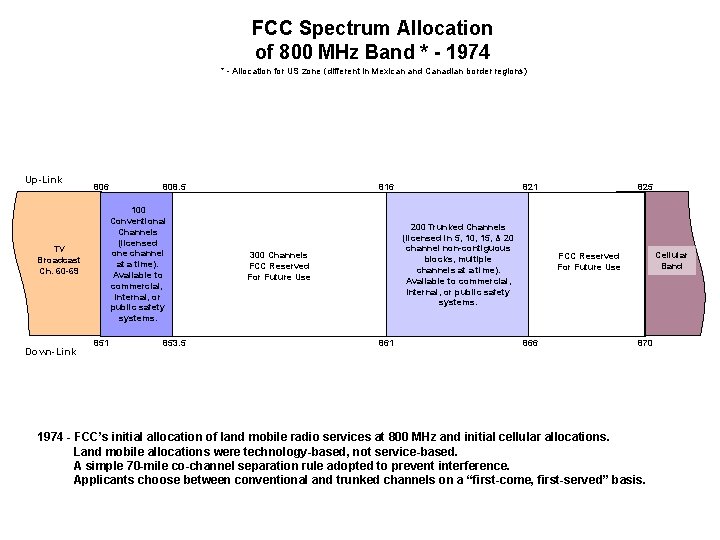
FCC Spectrum Allocation of 800 MHz Band * - 1974 * - Allocation for US zone (different in Mexican and Canadian border regions) Up-Link 806 100 Conventional Channels (licensed one channel at a time). Available to commercial, internal, or public safety systems. TV Broadcast Ch. 60 -69 Down-Link 808. 5 851 853. 5 816 821 200 Trunked Channels (licensed in 5, 10, 15, & 20 channel non-contiguous blocks, multiple channels at a time). Available to commercial, internal, or public safety systems. 800 MHz Interleaved Band 300 Channels (including Bus/ILT/PS/SMR) FCC Reserved For Future Use 861 825 Cellular Band FCC Reserved For Future Use 866 870 1974 - FCC’s initial allocation of land mobile radio services at 800 MHz and initial cellular allocations. Land mobile allocations were technology-based, not service-based. A simple 70 -mile co-channel separation rule adopted to prevent interference. Applicants choose between conventional and trunked channels on a “first-come, first-served” basis.

FCC Spectrum Allocation of 800 MHz Band * - 1978 * - Allocation for US zone (different in Mexican and Canadian border regions) Up-Link 806 100 Conventional Channels 50 (licensed Convenone channel tional at a time). Chan. Available to nels commercial, internal, or public safety systems. TV Broadcast Ch. 60 -69 Down-Link 808. 5 809. 75 851 853. 5 854. 75 816 821 200 Trunked Channels (licensed in 5, 10, 15, & 20 channel non-contiguous blocks, multiple channels at a time). Available to commercial, internal, or public safety systems. 800 MHz Interleaved Band 250 Bus/ILT/PS/SMR) Channels (including FCC Reserved For Future Use 861 825 Cellular Band FCC Reserved For Future Use 866 1978 - Major market depletion caused the FCC to release 50 reserved channels for conventional use. Waiting lists developed for trunked channels. 870
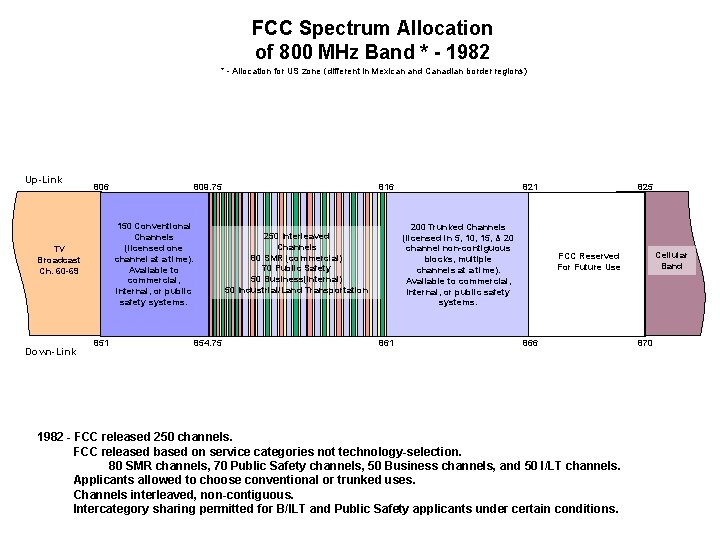
FCC Spectrum Allocation of 800 MHz Band * - 1982 * - Allocation for US zone (different in Mexican and Canadian border regions) Up-Link 150 Conventional Channels (licensed one channel at a time). Available to commercial, internal, or public safety systems. TV Broadcast Ch. 60 -69 Down-Link 809. 75 806 851 816 200 Trunked Channels (licensed in 5, 10, 15, & 20 channel non-contiguous blocks, multiple channels at a time). Available to commercial, internal, or public safety systems. 250 Interleaved Channels 80 SMR (commercial) 70 Public Safety 50 Business(internal) 50 Industrial/Land Transportation 854. 75 821 861 825 Cellular Band FCC Reserved For Future Use 866 1982 - FCC released 250 channels. FCC released based on service categories not technology-selection. 80 SMR channels, 70 Public Safety channels, 50 Business channels, and 50 I/LT channels. Applicants allowed to choose conventional or trunked uses. Channels interleaved, non-contiguous. Intercategory sharing permitted for B/ILT and Public Safety applicants under certain conditions. 870
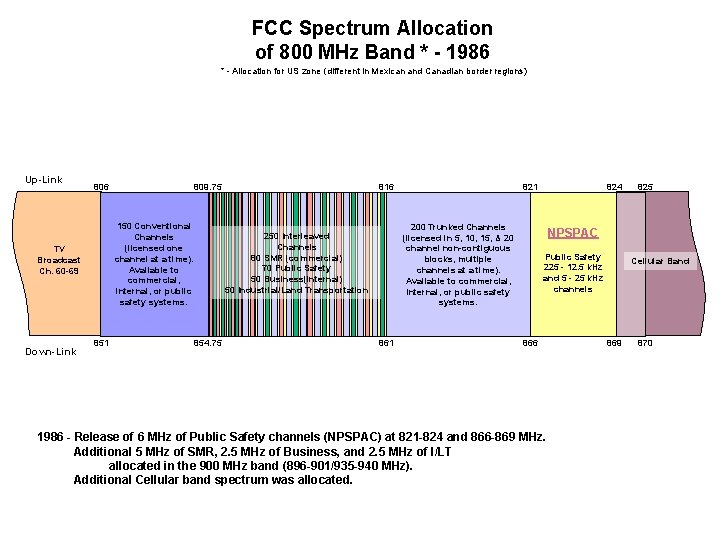
FCC Spectrum Allocation of 800 MHz Band * - 1986 * - Allocation for US zone (different in Mexican and Canadian border regions) Up-Link 150 Conventional Channels (licensed one channel at a time). Available to commercial, internal, or public safety systems. TV Broadcast Ch. 60 -69 Down-Link 809. 75 806 851 816 200 Trunked Channels (licensed in 5, 10, 15, & 20 channel non-contiguous blocks, multiple channels at a time). Available to commercial, internal, or public safety systems. 250 Interleaved Channels 80 SMR (commercial) 70 Public Safety 50 Business(internal) 50 Industrial/Land Transportation 854. 75 821 861 824 825 NPSPAC Public Safety 225 - 12. 5 k. Hz and 5 - 25 k. Hz channels 866 1986 - Release of 6 MHz of Public Safety channels (NPSPAC) at 821 -824 and 866 -869 MHz. Additional 5 MHz of SMR, 2. 5 MHz of Business, and 2. 5 MHz of I/LT allocated in the 900 MHz band (896 -901/935 -940 MHz). Additional Cellular band spectrum was allocated. Cellular Band 869 870

FCC Spectrum Allocation of 800 MHz Band * - Today * - Allocation for US zone (different in Mexican and Canadian border regions) - SMR (80 channels)* - Business/SMR (50 channels)* - Industrial (ILT)/SMR (50 channels)* - Public Safety (70 channels)* Up-Link 809. 75 806 General Category TV Broadcast Ch. 60 -69 Down-Link 816 150 Channels (EA block licenses in 25 channels each for SMR. Incumbent operators remain on commercial, internal, or public safety systems. 250 Interleaved Channels 80 SMR (EA & incumbent) 70 Public Safety 50 Business(internal) 50 Industrial/Land Transportation (Due to intercategory sharing & 11/2000 Order, SMR operations permitted as well). [7. 5 MHz] [12. 5 MHz] 851 854. 75 821 Upper 200 SMR NPSPAC 200 Channels (EA block licenses in 20, 60, & 120 channels each, mandatory retuning for remaining incumbents). Public Safety 225 - 12. 5 k. Hz and 5 - 25 k. Hz channels [10 MHz] 861 824 825 Cellular Band [6 MHz] 866 869 General Category SMR/Bus/ILT and Public Safety incumbents operate conventional and trunked systems. EA Auction winners authorized over-layed 25 channel contiguous blocks (SMR only). Interleaved Area (including Middle 80 SMR) SMR, Bus/ILT and Public Safety incumbents operate conventional and trunked systems. SMR use on Bus/ILT spectrum is approximately 50% of Business channels and 67% of ILT channels. EA Auction winners authorized on 16 five-channel non-contiguous blocks (SMR only). Upper 200 SMR Three block licenses (20, 60 and 120 channels each) per EA with rights to relocate incumbents. Nextel predominant licensee of EA spectrum and has relocated or cleared over 95% of spectrum. 870

Exhibit B
![Proposed FCC Re-Allocation 800 MHz Up-Link [MHz] 806 700 MHz Public Safety/ Aviation Air.](http://slidetodoc.com/presentation_image_h/dfd4d5974898592d16d6d2f76e07826d/image-8.jpg "Proposed FCC Re-Allocation 800 MHz Up-Link [MHz] 806 700 MHz Public Safety/ Aviation Air.")
Proposed FCC Re-Allocation 800 MHz Up-Link [MHz] 806 700 MHz Public Safety/ Aviation Air. Ground [MHz] 851 Down-Link 816 Public Safety 20 MHz (10 + 10 MHz) Low Site, Low Power Digital SMR 16 MHz (8 + 8 MHz) [Optional Guard Band As Needed] 861 824 821 [Former NPSPAC Channels Reallocated To Digital SMR] 866 Cellular A&B Band 869
![700 MHz Up-Link [MHz] 762 Wide. Band 3 G 700 MHz Guard-Band Block B](http://slidetodoc.com/presentation_image_h/dfd4d5974898592d16d6d2f76e07826d/image-9.jpg "700 MHz Up-Link [MHz] 762 Wide. Band 3 G 700 MHz Guard-Band Block B")
700 MHz Up-Link [MHz] 762 Wide. Band 3 G 700 MHz Guard-Band Block B (4 MHz) is reallocated to Mixed-use Analog Bus/ILT/SMR use. 800 MHz Up-Link [MHz] 764 700 MHz B/ILT/SMR [MHz] 792 Down-Link Proposed FCC Re-Allocation 800 MHz channels 1 -400 (10 MHz) is reallocated to Public Safety use by existing 800 MHz Public Safety users and NPSPAC Public Safety users. NPSPAC spectrum (6 MHz) is reallocated to SMR use. Public Safety users start migrating to new 800 MHz allocation. 806 700 MHz Public Safety/ Aviation Air. Ground 700 MHz Public Safety 794 Public Safety (Including Buffer Guard-Band) Guard Band to be determined on base to mobile only [MHz] 851 Down-Link 900 MHz 824 816 Cellular A&B Band Digital SMR 869 861 2100 MHz Mixed-use Analog Bus/ILT/SMR (400 -12. 5 k. Hz chs. )* Up-Link [MHz] 896 Aviation Air. Ground/ Fixed Microwave [MHz] 935 Down-Link 901 NTIA has identified 1710 -1770 MHz and 2110 -2170 MHz as possible 3 G spectrum. Up-Link [MHz] 2020 2025 1990 Nextel SMR 900 MHz SMR/Bus. /ILT Narrow. Band PCS/ Other Services MSS Other Services Nextel SMR 940 [MHz] 2165 2170 2175 Down-Link 2200
- Slides: 9