
EXFAC 03 AAS v 11 Language q 5

- Slides: 20
EXFAC 03 -AAS v 11 Language q 5: Language death and endangered languages Steve Pepper <pepper. steve@gmail. com>
Course contents 1. Universals 2. Typology 3. Language families 4. Language contact 5. Language death 6. Language variation 2> Institutt for kulturstudier og orientalske språk (IKOS)
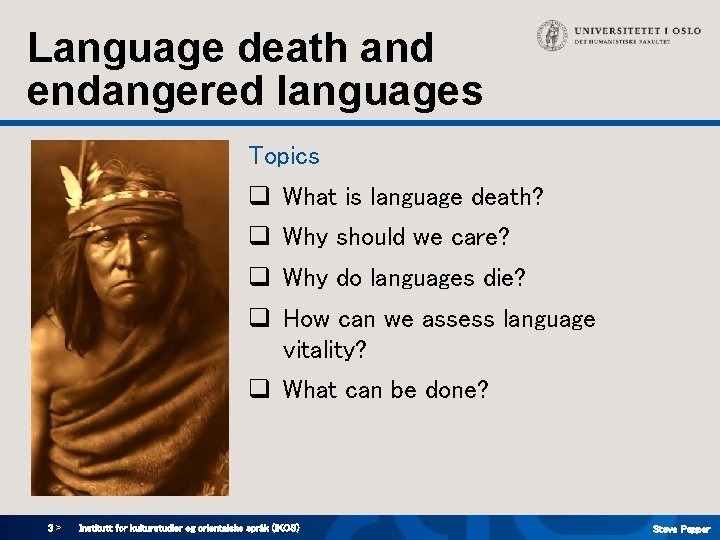
Language death and endangered languages Topics q What is language death? q Why should we care? q Why do languages die? q How can we assess language vitality? q What can be done? 3> Institutt for kulturstudier og orientalske språk (IKOS) Steve Pepper
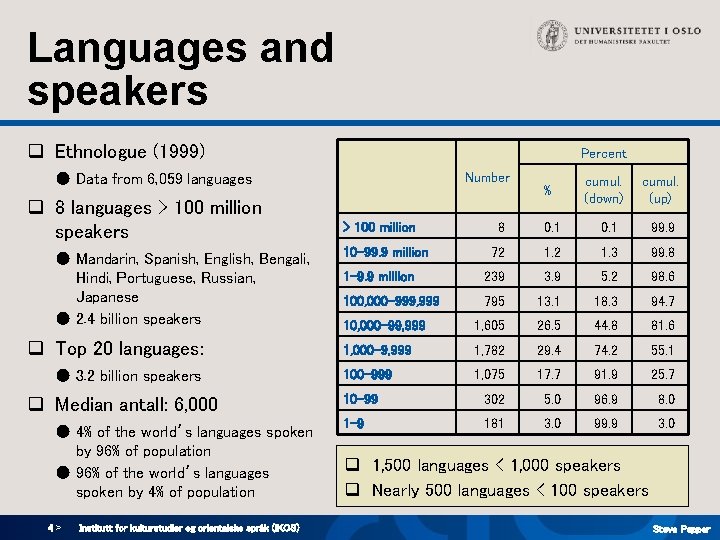
Languages and speakers q Ethnologue (1999) Percent ● Data from 6, 059 languages q 8 languages > 100 million speakers ● Mandarin, Spanish, English, Bengali, Hindi, Portuguese, Russian, Japanese ● 2. 4 billion speakers q Top 20 languages: ● 3. 2 billion speakers q Median antall: 6, 000 ● 4% of the world’s languages spoken by 96% of population ● 96% of the world’s languages spoken by 4% of population 4> Institutt for kulturstudier og orientalske språk (IKOS) Number > 100 million % cumul. (down) cumul. (up) 8 0. 1 99. 9 72 1. 3 99. 8 1– 9. 9 million 239 3. 9 5. 2 98. 6 100, 000– 999, 999 795 13. 1 18. 3 94. 7 10, 000 -99, 999 1, 605 26. 5 44. 8 81. 6 1, 000 -9, 999 1, 782 29. 4 74. 2 55. 1 100– 999 1, 075 17. 7 91. 9 25. 7 10– 99 302 5. 0 96. 9 8. 0 1 -9 181 3. 0 99. 9 3. 0 10– 99. 9 million q 1, 500 languages < 1, 000 speakers q Nearly 500 languages < 100 speakers Steve Pepper
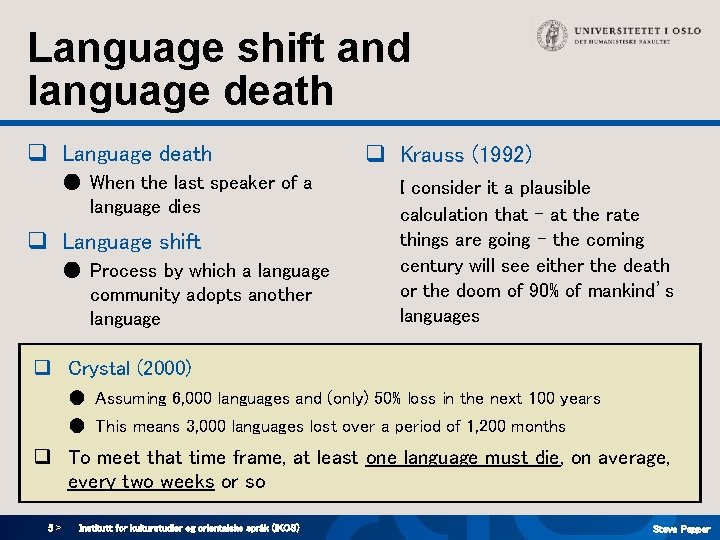
Language shift and language death q Language death ● When the last speaker of a language dies q Language shift ● Process by which a language community adopts another language q Krauss (1992) I consider it a plausible calculation that – at the rate things are going – the coming century will see either the death or the doom of 90% of mankind’s languages q Crystal (2000) ● Assuming 6, 000 languages and (only) 50% loss in the next 100 years ● This means 3, 000 languages lost over a period of 1, 200 months q To meet that time frame, at least one language must die, on average, every two weeks or so 5> Institutt for kulturstudier og orientalske språk (IKOS) Steve Pepper
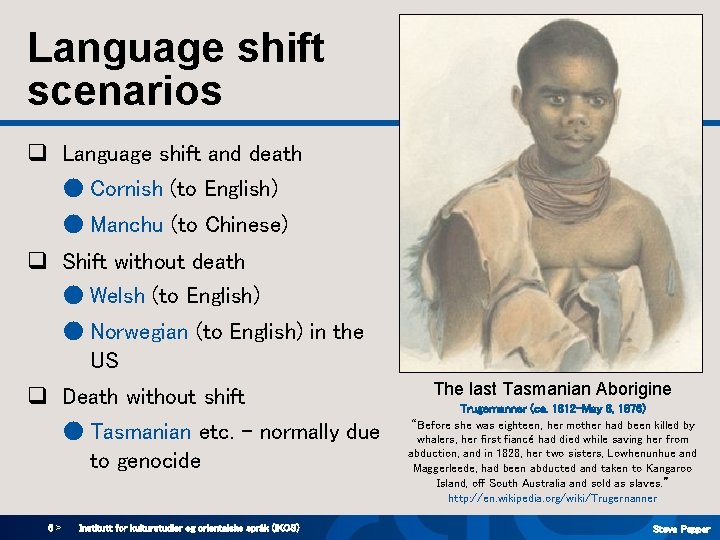
Language shift scenarios q Language shift and death ● Cornish (to English) ● Manchu (to Chinese) q Shift without death ● Welsh (to English) ● Norwegian (to English) in the US q Death without shift ● Tasmanian etc. – normally due to genocide 6> Institutt for kulturstudier og orientalske språk (IKOS) The last Tasmanian Aborigine Trugernanner (ca. 1812–May 8, 1876) “Before she was eighteen, her mother had been killed by whalers, her first fiancé had died while saving her from abduction, and in 1828, her two sisters, Lowhenunhue and Maggerleede, had been abducted and taken to Kangaroo Island, off South Australia and sold as slaves. ” http: //en. wikipedia. org/wiki/Trugernanner Steve Pepper
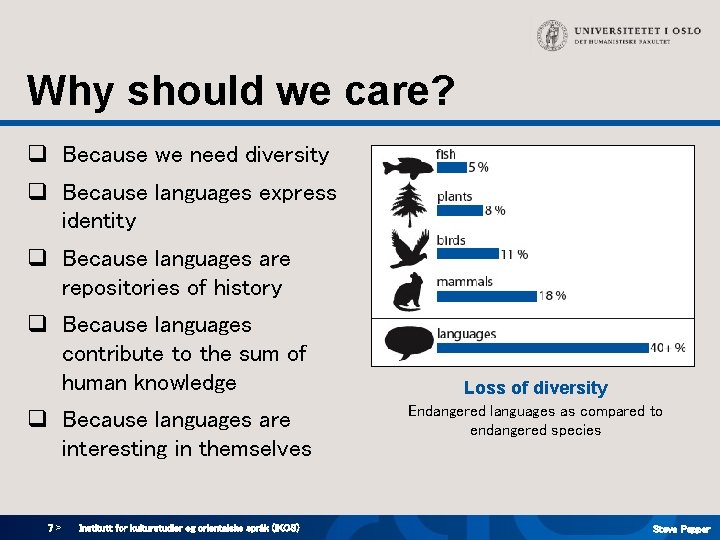
Why should we care? q Because we need diversity q Because languages express identity q Because languages are repositories of history q Because languages contribute to the sum of human knowledge q Because languages are interesting in themselves 7> Institutt for kulturstudier og orientalske språk (IKOS) Loss of diversity Endangered languages as compared to endangered species Steve Pepper
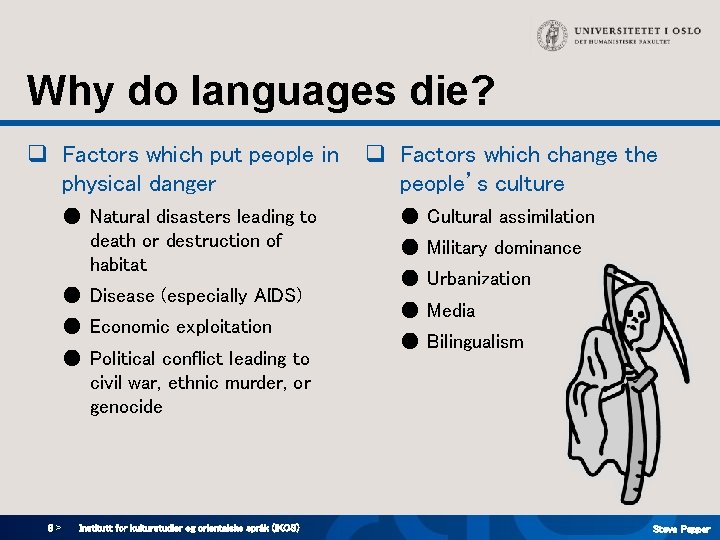
Why do languages die? q Factors which put people in physical danger ● Natural disasters leading to death or destruction of habitat ● Disease (especially AIDS) ● Economic exploitation ● Political conflict leading to civil war, ethnic murder, or genocide 8> Institutt for kulturstudier og orientalske språk (IKOS) q Factors which change the people’s culture ● Cultural assimilation ● Military dominance ● Urbanization ● Media ● Bilingualism Steve Pepper
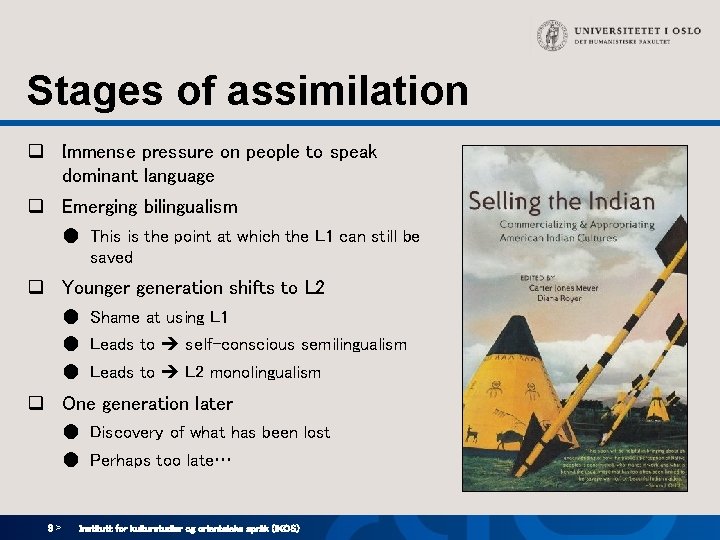
Stages of assimilation q Immense pressure on people to speak dominant language q Emerging bilingualism ● This is the point at which the L 1 can still be saved q Younger generation shifts to L 2 ● Shame at using L 1 ● Leads to self-conscious semilingualism ● Leads to L 2 monolingualism q One generation later ● Discovery of what has been lost ● Perhaps too late… 9> Institutt for kulturstudier og orientalske språk (IKOS)
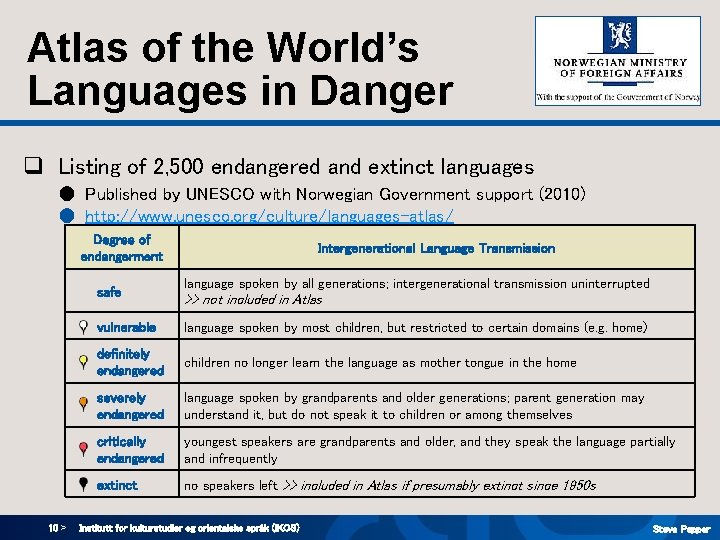
Atlas of the World’s Languages in Danger q Listing of 2, 500 endangered and extinct languages ● Published by UNESCO with Norwegian Government support (2010) ● http: //www. unesco. org/culture/languages-atlas/ Degree of endangerment safe 10 > Intergenerational Language Transmission language spoken by all generations; intergenerational transmission uninterrupted >> not included in Atlas vulnerable language spoken by most children, but restricted to certain domains (e. g. home) definitely endangered children no longer learn the language as mother tongue in the home severely endangered language spoken by grandparents and older generations; parent generation may understand it, but do not speak it to children or among themselves critically endangered youngest speakers are grandparents and older, and they speak the language partially and infrequently extinct no speakers left >> included in Atlas if presumably extinct since 1950 s Institutt for kulturstudier og orientalske språk (IKOS) Steve Pepper
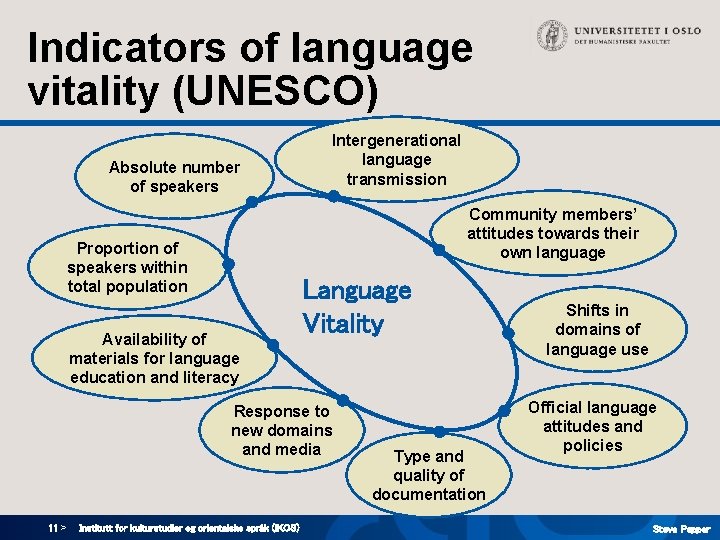
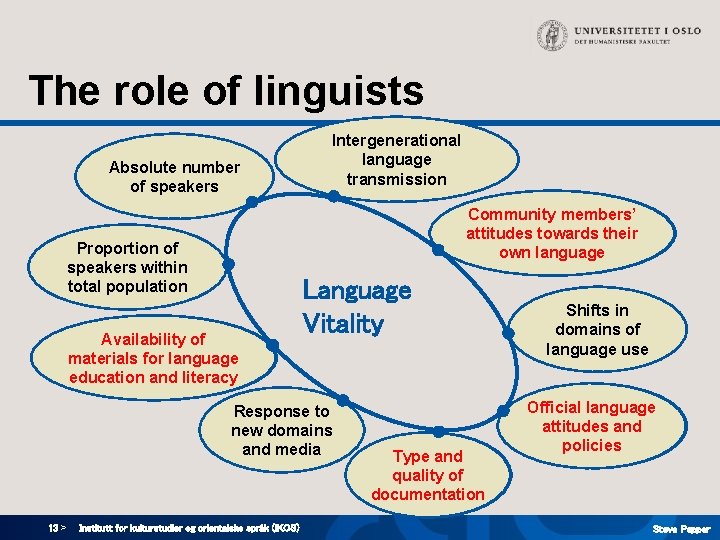
Indicators of language vitality (UNESCO) Absolute number of speakers Intergenerational language transmission Community members’ attitudes towards their own language Proportion of speakers within total population Availability of materials for language education and literacy Language Vitality Response to new domains and media 11 > Institutt for kulturstudier og orientalske språk (IKOS) Type and quality of documentation Shifts in domains of language use Official language attitudes and policies Steve Pepper
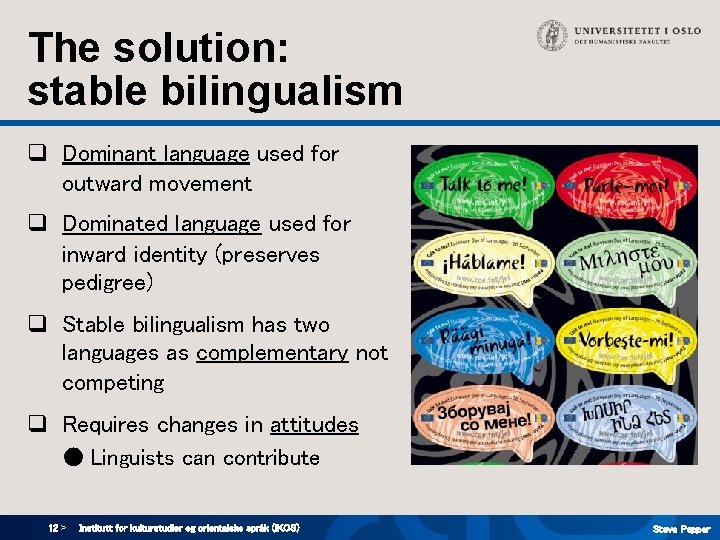
The solution: stable bilingualism q Dominant language used for outward movement q Dominated language used for inward identity (preserves pedigree) q Stable bilingualism has two languages as complementary not competing q Requires changes in attitudes ● Linguists can contribute 12 > Institutt for kulturstudier og orientalske språk (IKOS) Steve Pepper
The role of linguists Absolute number of speakers Intergenerational language transmission Community members’ attitudes towards their own language Proportion of speakers within total population Availability of materials for language education and literacy Language Vitality Response to new domains and media 13 > Institutt for kulturstudier og orientalske språk (IKOS) Type and quality of documentation Shifts in domains of language use Official language attitudes and policies Steve Pepper
Conclusion q Linguists have a role to play ● Describing, documenting, creating language resources ● Need for linguistics departments to make language rescue an intrinsic part of training of students q Time is running out q Links ● http: //www. unesco. org/culture/languages-atlas/ ● http: //www. livingtongues. org/ ● http: //www. sil. org/sociolx/ndg-lg-home. html ● http: //travel. nationalgeographic. com/travel/enduring-voices/ 14 > Institutt for kulturstudier og orientalske språk (IKOS) Steve Pepper
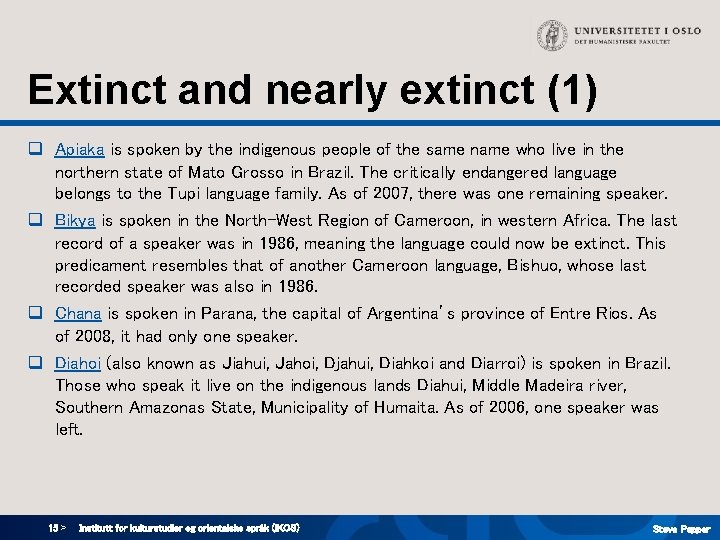
Extinct and nearly extinct (1) q Apiaka is spoken by the indigenous people of the same name who live in the northern state of Mato Grosso in Brazil. The critically endangered language belongs to the Tupi language family. As of 2007, there was one remaining speaker. q Bikya is spoken in the North-West Region of Cameroon, in western Africa. The last record of a speaker was in 1986, meaning the language could now be extinct. This predicament resembles that of another Cameroon language, Bishuo, whose last recorded speaker was also in 1986. q Chana is spoken in Parana, the capital of Argentina’s province of Entre Rios. As of 2008, it had only one speaker. q Diahoi (also known as Jiahui, Jahoi, Djahui, Diahkoi and Diarroi) is spoken in Brazil. Those who speak it live on the indigenous lands Diahui, Middle Madeira river, Southern Amazonas State, Municipality of Humaita. As of 2006, one speaker was left. 15 > Institutt for kulturstudier og orientalske språk (IKOS) Steve Pepper
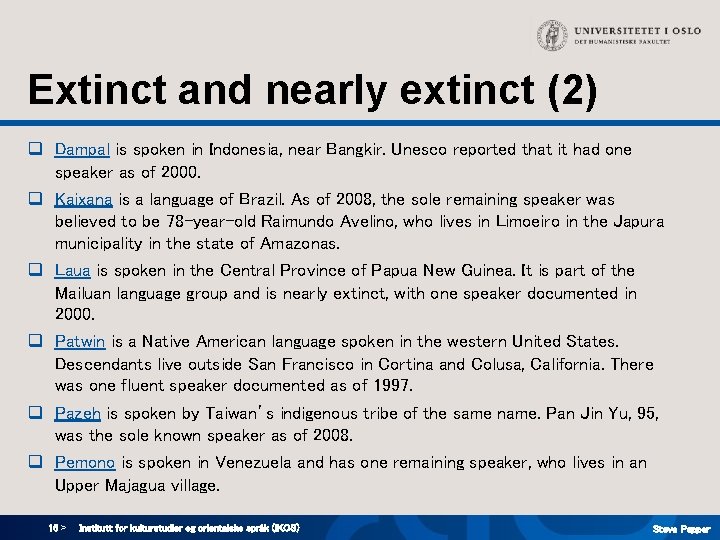
Extinct and nearly extinct (2) q Dampal is spoken in Indonesia, near Bangkir. Unesco reported that it had one speaker as of 2000. q Kaixana is a language of Brazil. As of 2008, the sole remaining speaker was believed to be 78 -year-old Raimundo Avelino, who lives in Limoeiro in the Japura municipality in the state of Amazonas. q Laua is spoken in the Central Province of Papua New Guinea. It is part of the Mailuan language group and is nearly extinct, with one speaker documented in 2000. q Patwin is a Native American language spoken in the western United States. Descendants live outside San Francisco in Cortina and Colusa, California. There was one fluent speaker documented as of 1997. q Pazeh is spoken by Taiwan’s indigenous tribe of the same name. Pan Jin Yu, 95, was the sole known speaker as of 2008. q Pemono is spoken in Venezuela and has one remaining speaker, who lives in an Upper Majagua village. 16 > Institutt for kulturstudier og orientalske språk (IKOS) Steve Pepper
Extinct and nearly extinct (3) q Taje is one of the endangered languages spoken in Indonesia. As of 2000, there was one speaker remaining in Sulawesi. q Taushiro (also known as Pinche, or Tausiro in Spanish) is an isolated language spoken in Peru. The speakers, who were from the Loreto Province and Tigre River basin, married non-Taushiro speakers and adopted Spanish or other languages. There was one speaker documented in 2008. q Tinigua is a nearly extinct language from Colombia. While originally from the Yari River, most of descendants now live in the Sierra de la Macarena and do not speak the language anymore. As of 2008, the last speaker lived near the Guayabero River. q Tolowa, the language of the Tolowa Native American tribe, is spoken by a few members located in the Smith River Rancheria, a sovereign nation, near Crescent City, California. Tolowa is part of the Athabaskan language family. One speaker remained as of 2008. 17 > Institutt for kulturstudier og orientalske språk (IKOS) Steve Pepper
Extinct and nearly extinct (4) q Volow (or Valuwa) is spoken on Motalava Island, a part of the Republic of Vanuatu. The Republic of Vanuatu is located near the east coast of Australia. One speaker remained as of 2008. q Wintu-Nomlaki is spoken by the Wintu tribe in California. The language has two dialects: Nomlaki, which is spoken along the Sacramento River south of Red Bluff, and the other is Wintu. As of 2008, there was one fluent speaker and several speakers with moderate command of the language. q Yaghan is spoken in Chile, in the community of Villa Ukika on Navarino Island, located in the Magallanes Territory. As of 2005, the last remaining speaker and pureblood member of the Yaghan tribe was an elderly woman named Cristina Calderon. q Yarawi (or Suena) is spoken in Papua New Guinea, near Morobe town in Morobe Province. One speaker was documented in 2000. http: //blogs. news 24. com/duarte/saving-a-dying-language 18 > Institutt for kulturstudier og orientalske språk (IKOS) Steve Pepper
Next week: Language variation q Further reading on language death ● Crystal, David. 2000. Language death. Cambridge: Cambridge University Press ● Dixon, R. M. W. 1997. The rise and fall of languages. Cambridge: Cambridge University Press (esp. chapters 8 & 9) ● Evans, Nicholas. 2010. Dying words. Endangered languages and what they have to tell us. Oxford: Wiley-Blackwell ● Fishman, Joshua. 1991. Reversing language shift. Clevedon: Multilingual Matters ● Fishman, Joshua. 2001. Can Threatened Languages Be Saved? Clevedon, Multilingual Matters ● Hagège, Claude. 2009. On the life and death of languages. New Haven, CT: Yale University Press 19 > Institutt for kulturstudier og orientalske språk (IKOS) Steve Pepper
Flervalgstest og eksamen q Flervalgstest (uke 15) q Eksamen 19. mai (4 timer) ● To deler: språk og kultur ● Obligatorisk. Fronter. q Språkdel og kulturdel q Språkdelen ● 8 spørsmål, alle må besvares ● 15 spørsmål i hver ● 10 riktig: bestått q Eksempler ● 2. forsøk uke 17 v Forklar kva vi meiner med pidginspråk og kreol-språk v Forklar hva det innebærer at det nordindiske språket hindi tilhører samme språkfamilie som norsk, og samme språkbunt (linguistic area) som det sydindiske språket tamil q Hvert spørsmål ● Multiple choice: ● Enkle faktaspørsmål med tre svaralternativer ● Alternativt velge hvilke av tre utsagn som er riktige 20 > Institutt for kulturstudier og orientalske språk (IKOS) Steve Pepper