
Exercises on Chomsky Normal Form and CYK parsing

![Exercise 3(c) – Solution [Cont. ] •](https://slidetodoc.com/presentation_image_h2/c9cdc0fc363b5aa7780d96843d02e791/image-13.jpg "Exercise 3(c) – Solution [Cont. ] •")
![Exercise 3(d) - Solution [Cont. ] •](https://slidetodoc.com/presentation_image_h2/c9cdc0fc363b5aa7780d96843d02e791/image-15.jpg "Exercise 3(d) - Solution [Cont. ] •")
![Exercise 4 –Solution [Cont. ] •](https://slidetodoc.com/presentation_image_h2/c9cdc0fc363b5aa7780d96843d02e791/image-18.jpg "Exercise 4 –Solution [Cont. ] •")
![Exercise 6 –Solution [Cont. ] S -> AB (p 1) | BA (p 2)](https://slidetodoc.com/presentation_image_h2/c9cdc0fc363b5aa7780d96843d02e791/image-22.jpg "Exercise 6 –Solution [Cont. ] S -> AB (p 1) | BA (p 2)")
![Exercise 6 –solution [Cont. ] Algorithm for generating one parse tree starting from a](https://slidetodoc.com/presentation_image_h2/c9cdc0fc363b5aa7780d96843d02e791/image-23.jpg "Exercise 6 –solution [Cont. ] Algorithm for generating one parse tree starting from a")
- Slides: 23
Exercises on Chomsky Normal Form and CYK parsing 1. Convert the following grammar to CNF S -> A ( S ) B | “” A -> S | S B | x | “” B -> S B | y This is exercise is available in the “grammar tutoring system” http: //laraserver 3. epfl. ch: 9000 • Select exercise type “CNF Conversion” -> choose the problem “Exercise 1 of lecturecise 12” • Make sure you create a new start symbol S 1 and add the production S 1 -> S | “” to your grammar before CNF conversion as the start symbol ‘S’ is nullable and also appears on the right hand side
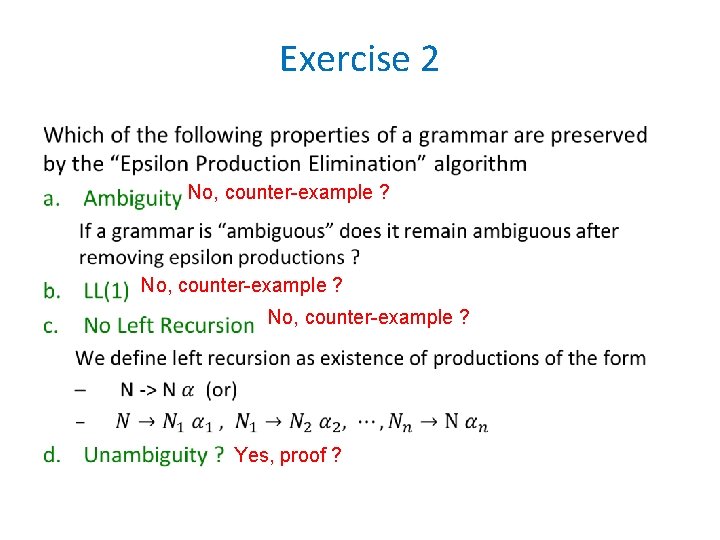
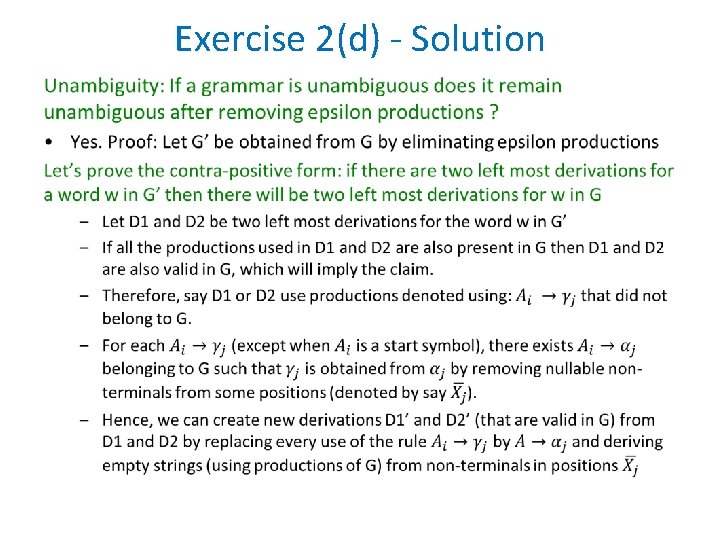
Exercise 2 • No, counter-example ? Yes, proof ?
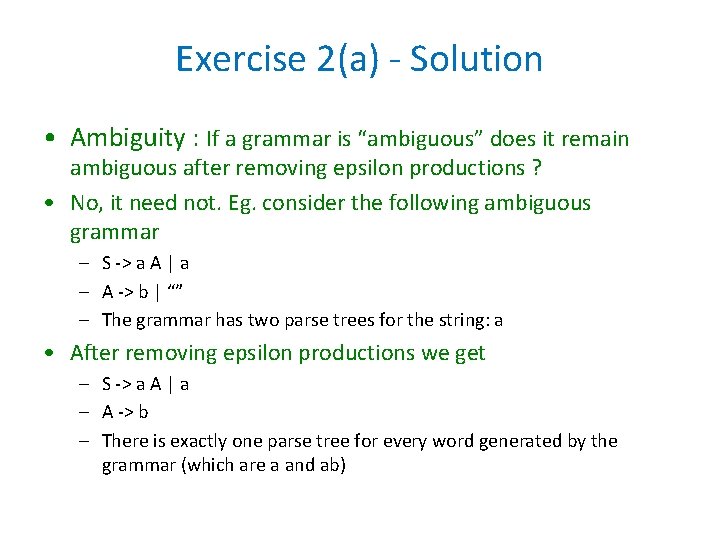
Exercise 2(a) - Solution • Ambiguity : If a grammar is “ambiguous” does it remain ambiguous after removing epsilon productions ? • No, it need not. Eg. consider the following ambiguous grammar – S -> a A | a – A -> b | “” – The grammar has two parse trees for the string: a • After removing epsilon productions we get – S -> a A | a – A -> b – There is exactly one parse tree for every word generated by the grammar (which are a and ab)
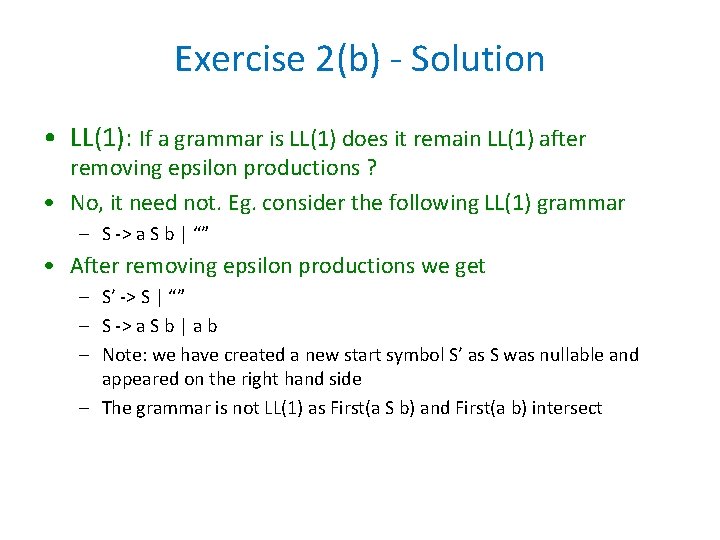
Exercise 2(b) - Solution • LL(1): If a grammar is LL(1) does it remain LL(1) after removing epsilon productions ? • No, it need not. Eg. consider the following LL(1) grammar – S -> a S b | “” • After removing epsilon productions we get – S’ -> S | “” – S -> a S b | a b – Note: we have created a new start symbol S’ as S was nullable and appeared on the right hand side – The grammar is not LL(1) as First(a S b) and First(a b) intersect
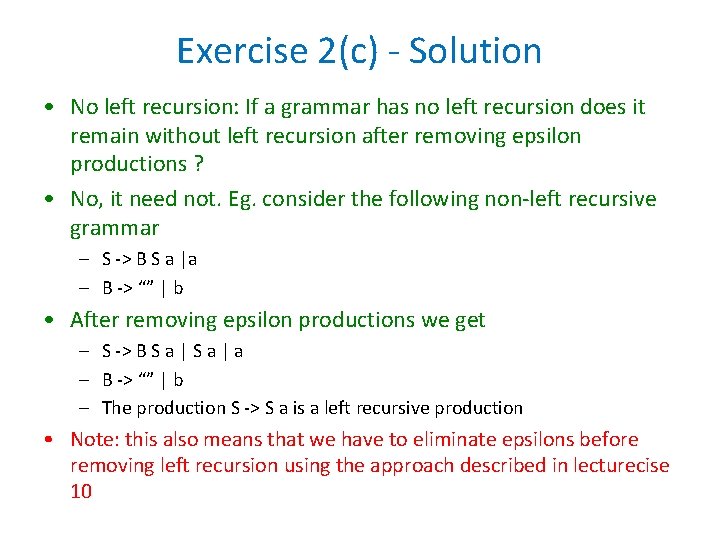
Exercise 2(c) - Solution • No left recursion: If a grammar has no left recursion does it remain without left recursion after removing epsilon productions ? • No, it need not. Eg. consider the following non-left recursive grammar – S -> B S a |a – B -> “” | b • After removing epsilon productions we get – S -> B S a | a – B -> “” | b – The production S -> S a is a left recursive production • Note: this also means that we have to eliminate epsilons before removing left recursion using the approach described in lecturecise 10
Exercise 2(d) - Solution •
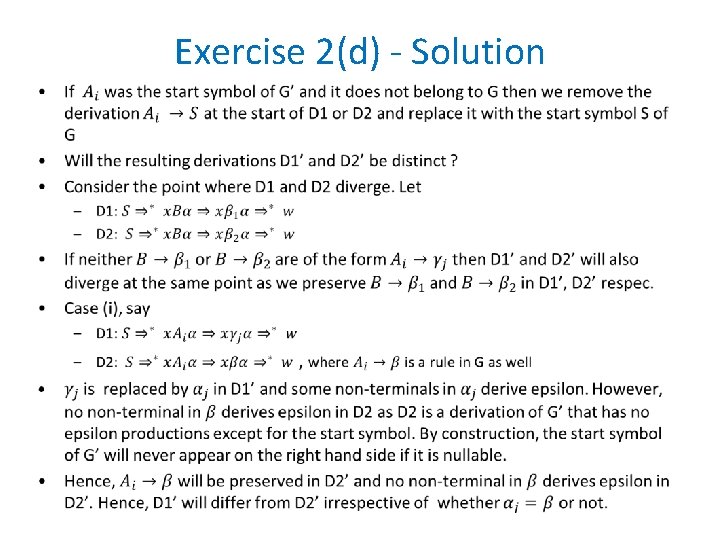
Exercise 2(d) - Solution •
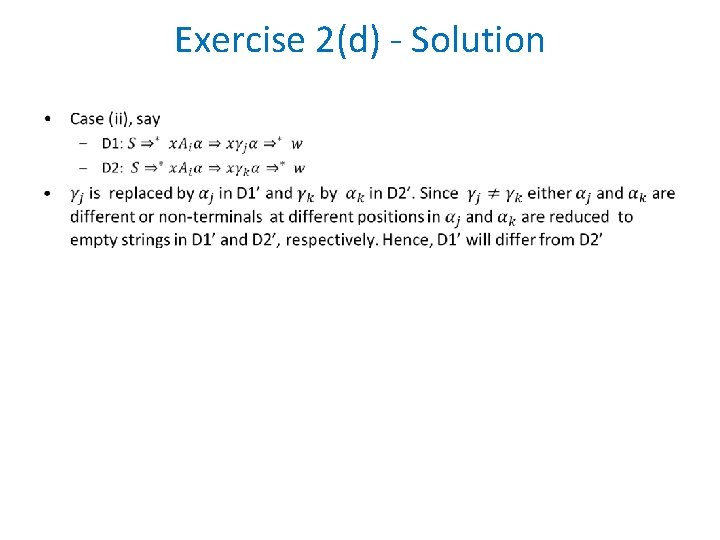
Exercise 2(d) - Solution •
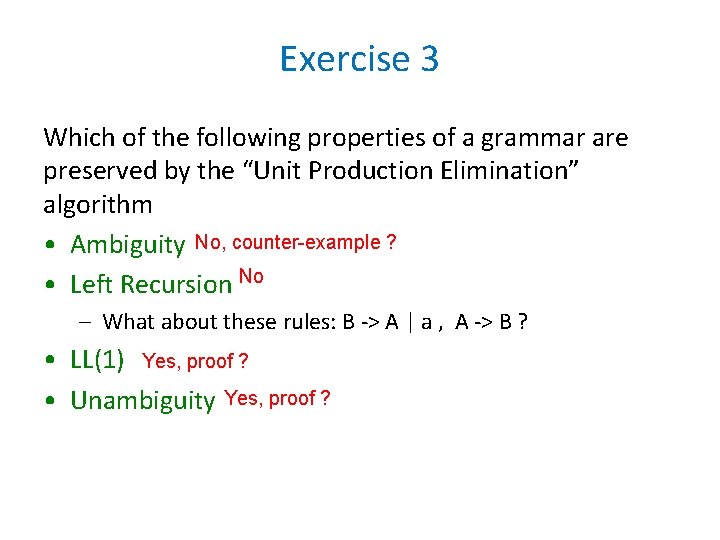
Exercise 3 Which of the following properties of a grammar are preserved by the “Unit Production Elimination” algorithm • Ambiguity No, counter-example ? • Left Recursion No – What about these rules: B -> A | a , A -> B ? • LL(1) Yes, proof ? • Unambiguity Yes, proof ?
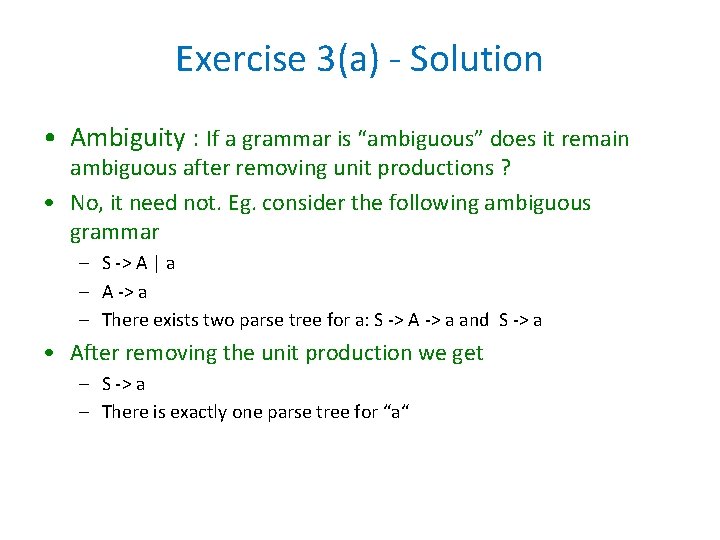
Exercise 3(a) - Solution • Ambiguity : If a grammar is “ambiguous” does it remain ambiguous after removing unit productions ? • No, it need not. Eg. consider the following ambiguous grammar – S -> A | a – A -> a – There exists two parse tree for a: S -> A -> a and S -> a • After removing the unit production we get – S -> a – There is exactly one parse tree for “a“
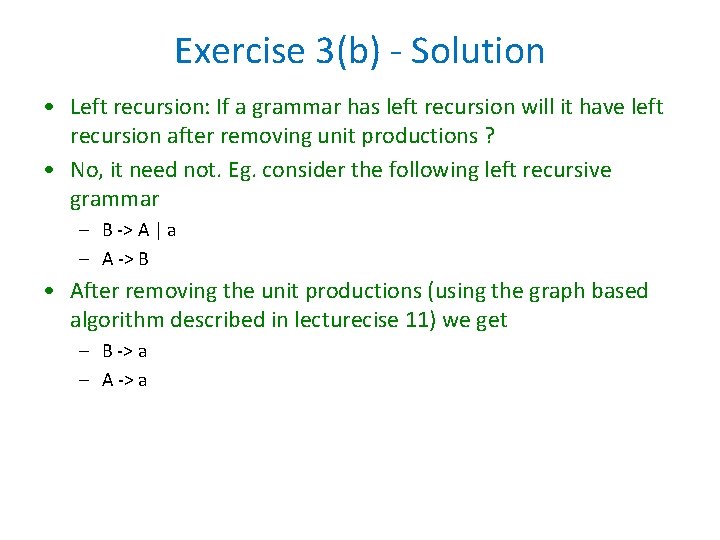
Exercise 3(b) - Solution • Left recursion: If a grammar has left recursion will it have left recursion after removing unit productions ? • No, it need not. Eg. consider the following left recursive grammar – B -> A | a – A -> B • After removing the unit productions (using the graph based algorithm described in lecturecise 11) we get – B -> a – A -> a
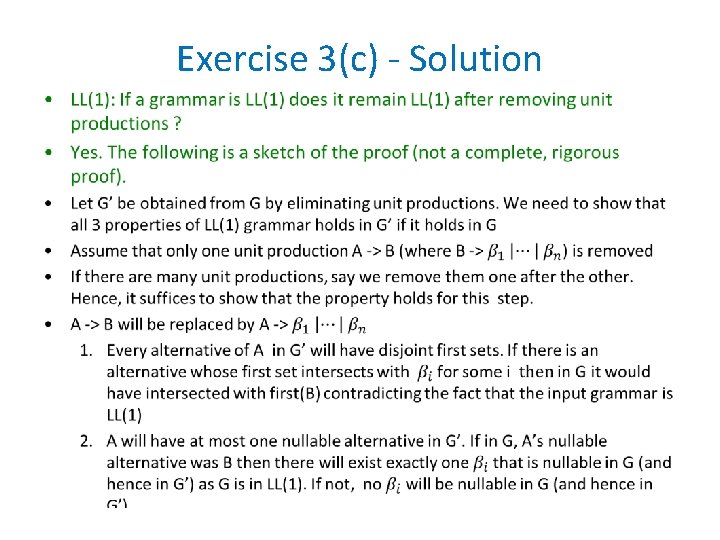
Exercise 3(c) - Solution •
Exercise 3(c) – Solution [Cont. ] •
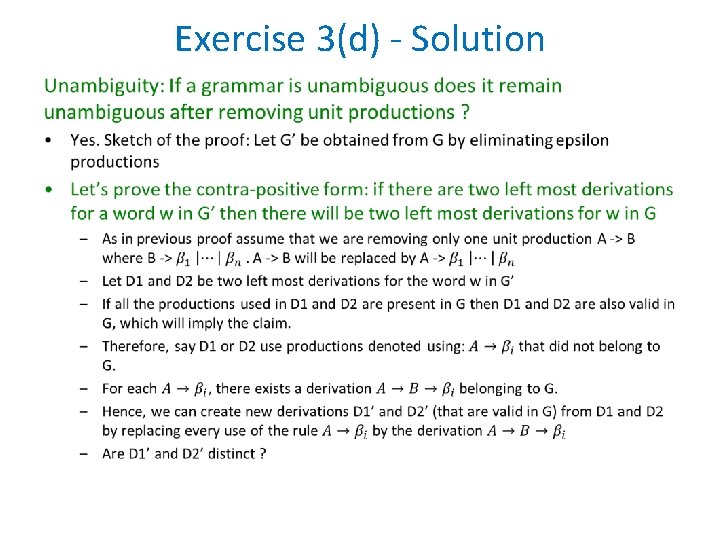
Exercise 3(d) - Solution •
Exercise 3(d) - Solution [Cont. ] •
Exercise 4 Given a grammar G in CNF, how many steps does it require to derive a string of size n.
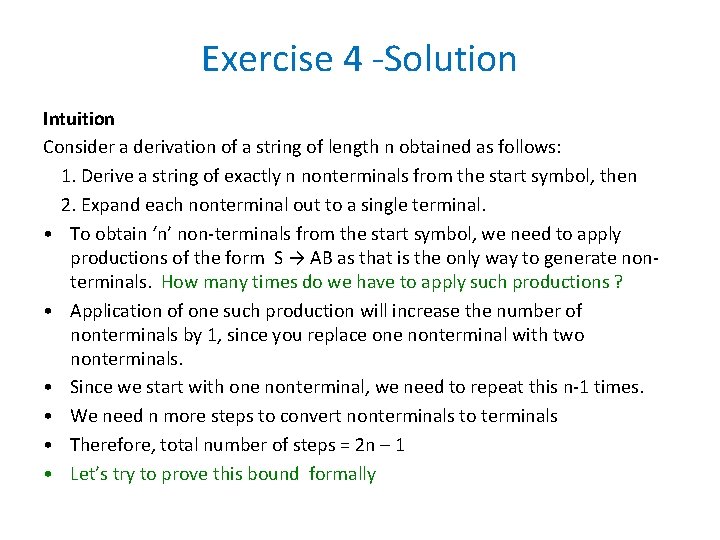
Exercise 4 -Solution Intuition Consider a derivation of a string of length n obtained as follows: 1. Derive a string of exactly n nonterminals from the start symbol, then 2. Expand each nonterminal out to a single terminal. • To obtain ‘n’ non-terminals from the start symbol, we need to apply productions of the form S → AB as that is the only way to generate nonterminals. How many times do we have to apply such productions ? • Application of one such production will increase the number of nonterminals by 1, since you replace one nonterminal with two nonterminals. • Since we start with one nonterminal, we need to repeat this n-1 times. • We need n more steps to convert nonterminals to terminals • Therefore, total number of steps = 2 n – 1 • Let’s try to prove this bound formally
Exercise 4 –Solution [Cont. ] •
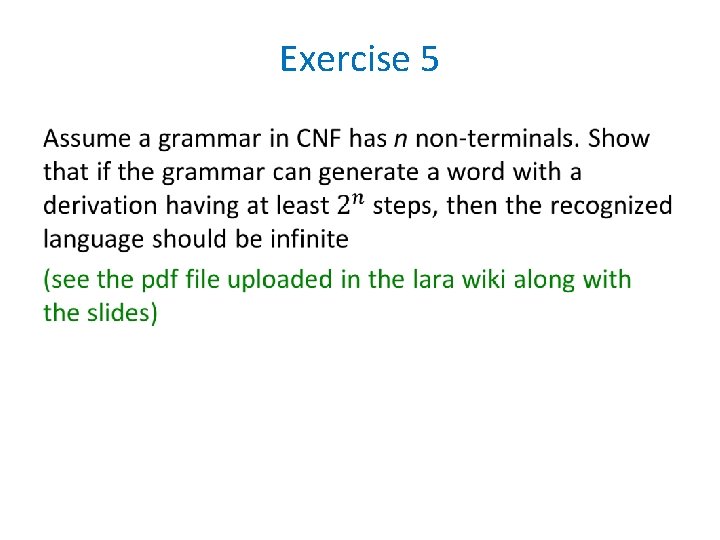
Exercise 5 •
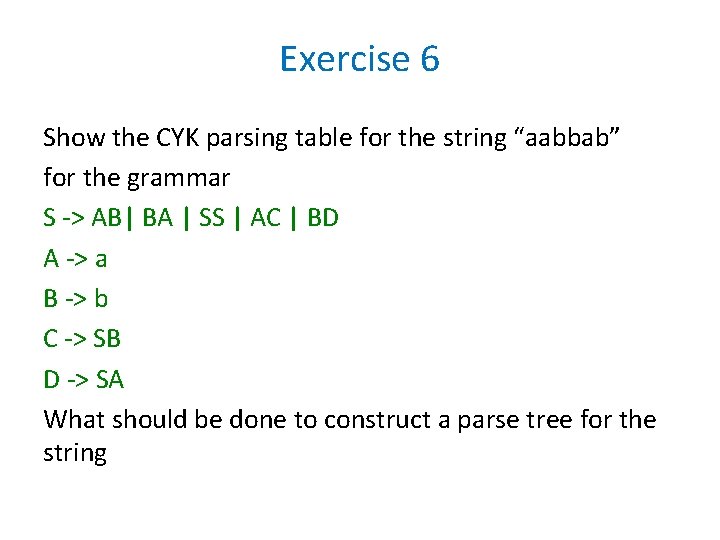
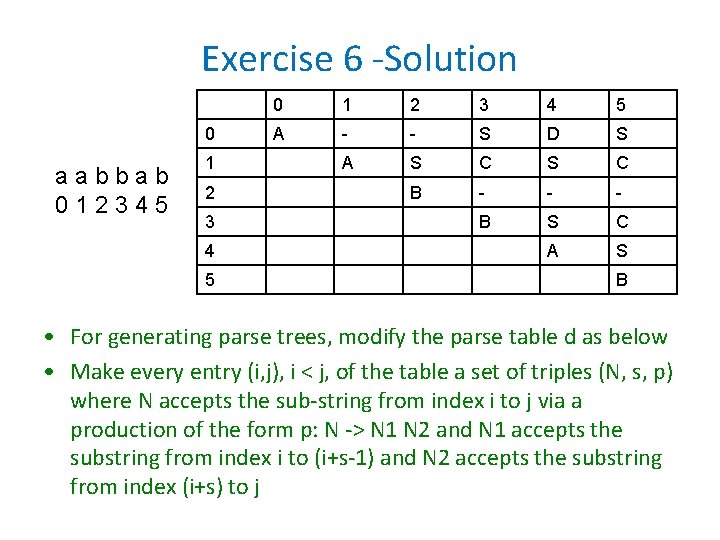
Exercise 6 Show the CYK parsing table for the string “aabbab” for the grammar S -> AB| BA | SS | AC | BD A -> a B -> b C -> SB D -> SA What should be done to construct a parse tree for the string
Exercise 6 -Solution 0 aabbab 012345 1 2 3 4 5 0 1 2 3 4 5 A - - S D S A S C B - - - B S C A S B • For generating parse trees, modify the parse table d as below • Make every entry (i, j), i < j, of the table a set of triples (N, s, p) where N accepts the sub-string from index i to j via a production of the form p: N -> N 1 N 2 and N 1 accepts the substring from index i to (i+s-1) and N 2 accepts the substring from index (i+s) to j
Exercise 6 –Solution [Cont. ] S -> AB (p 1) | BA (p 2) | SS (p 3) | AC (p 4) | BD (p 5) A -> a (p 6) B -> b (p 7) 0 1 2 3 4 C -> SB (p 8) 0 A (S, 1, p 4) (D, 4, p 9) D -> SA (p 9) 1 A (S, 1, p 1) (C, 2, p 8) (S, 2, p 3) 2 3 4 5 B 5 (S, 4, p 3) (C, 4, p 8) - - - B (S, 1, p 2) (C, 2, p 8) A (S, 1, p 1) B See next slide for an algorithm for generating one parse tree given a table of the above form
Exercise 6 –solution [Cont. ] Algorithm for generating one parse tree starting from a nonterminal N for a sub-string (i, j) Parse. Tree(N, i, j) • If i = j, if N is in parse. Table(i, j) return Leaf(N, w(i, j)) else report parse error • Otherwise, pick an entry (N, s, p) from parse. Table(i, j) • If no such entry exist report that the sub-string cannot be parsed and return • Let p: N -> N 1 N 2 • left. Child= Parse. Tree(N 1, i, i+s-1) • right. Child = Parse. Tree(N 2, i+s, j) • Return Node(N, left. Child, right. Child)