
Exercises 25 26 Taste Olfaction Hearing Equilibrium Copyright
Exercises 25 & 26 Taste, Olfaction, Hearing & Equilibrium Copyright © 2004 Pearson Education, Inc. , publishing as Benjamin Cummings
Chemical Senses § Chemical senses – gustation (taste) and olfaction (smell) § Their chemoreceptors respond to chemicals in aqueous solution § Taste – to substances dissolved in saliva § Smell – to substances dissolved in fluids of the nasal membranes Copyright © 2004 Pearson Education, Inc. , publishing as Benjamin Cummings
Taste Buds § Most of the 10, 000 or so taste buds are found on the tongue § Taste buds are found in papillae of the tongue mucosa § Papillae come in three types: filiform, fungiform, and circumvallate § Fungiform and circumvallate papillae contain taste buds Copyright © 2004 Pearson Education, Inc. , publishing as Benjamin Cummings
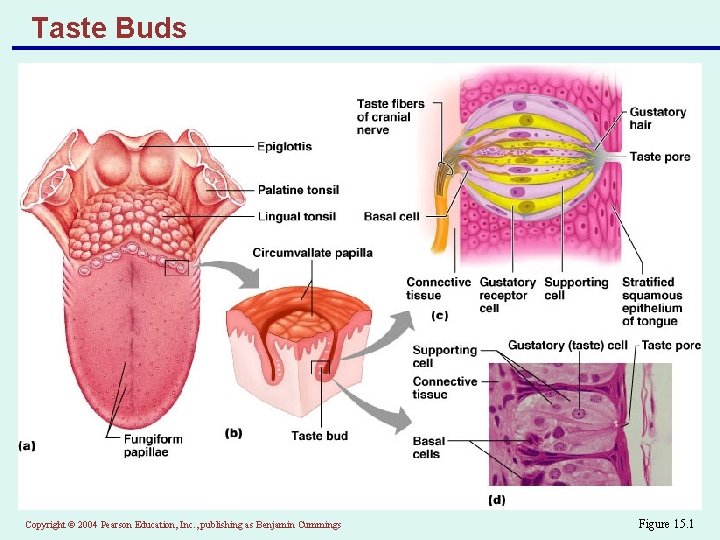
Taste Buds Copyright © 2004 Pearson Education, Inc. , publishing as Benjamin Cummings Figure 15. 1
Anatomy of a Taste Bud § Each gourd-shaped taste bud consists of three major cell types § Supporting cells – insulate the receptor § Basal cells – dynamic stem cells § Gustatory cells – taste cells Copyright © 2004 Pearson Education, Inc. , publishing as Benjamin Cummings
Taste Sensations § There are five basic taste sensations § Sweet – sugars, saccharin, alcohol, and some amino acids § Salt – metal ions § Sour – hydrogen ions § Bitter – alkaloids such as quinine and nicotine § Umami – elicited by the amino acid glutamate Copyright © 2004 Pearson Education, Inc. , publishing as Benjamin Cummings
Taste Transduction § The stimulus energy of taste is converted into a nerve impulse by: § Na+ influx in salty tastes § H+ in sour tastes (by directly entering the cell, by opening cation channels, or by blockade of K+ channels) § Gustducin in sweet and bitter tastes Copyright © 2004 Pearson Education, Inc. , publishing as Benjamin Cummings
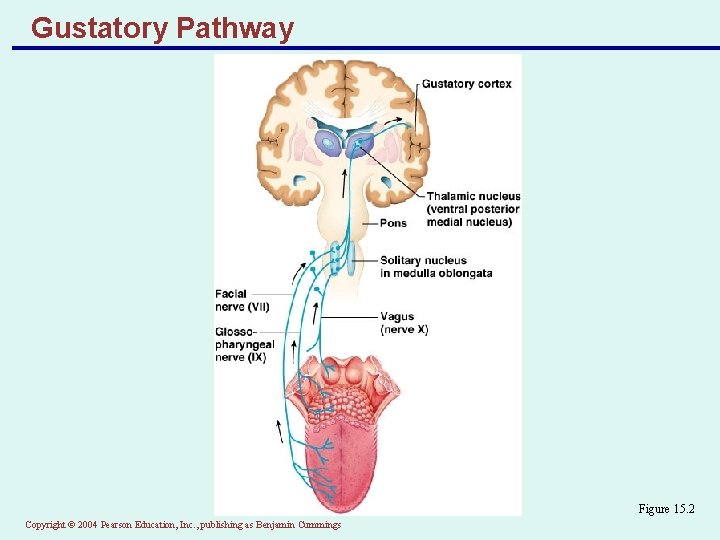
Gustatory Pathway Figure 15. 2 Copyright © 2004 Pearson Education, Inc. , publishing as Benjamin Cummings
Influence of Other Sensations on Taste § Taste is 80% smell § Thermoreceptors, mechanoreceptors, nociceptors also influence tastes § Temperature and texture enhance or detract from taste Copyright © 2004 Pearson Education, Inc. , publishing as Benjamin Cummings
Sense of Smell § The organ of smell is the olfactory epithelium, which covers the superior nasal concha § Olfactory receptor cells are bipolar neurons with radiating olfactory cilia § Olfactory receptors are surrounded and cushioned by supporting cells § Basal cells lie at the base of the epithelium Copyright © 2004 Pearson Education, Inc. , publishing as Benjamin Cummings
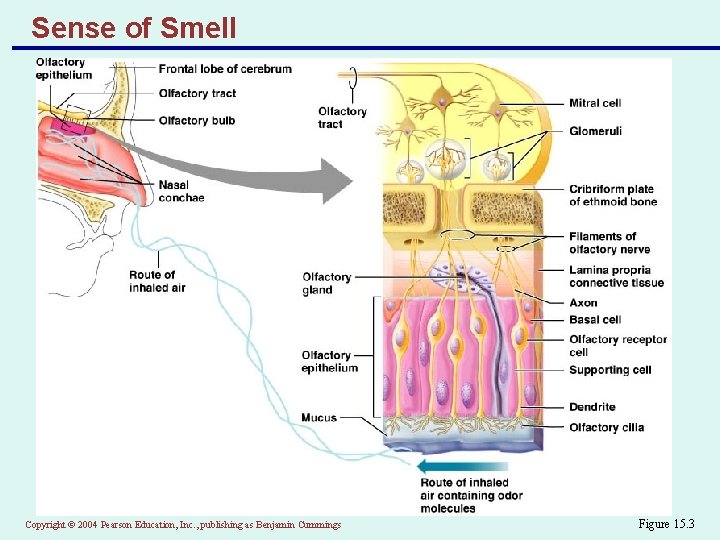
Sense of Smell Copyright © 2004 Pearson Education, Inc. , publishing as Benjamin Cummings Figure 15. 3
Olfactory Pathway § Olfactory receptor cells synapse with mitral cells § Glomerular mitral cells process odor signals § Mitral cells send impulses to: § The olfactory cortex § The hypothalamus, amygdala, and limbic system Copyright © 2004 Pearson Education, Inc. , publishing as Benjamin Cummings
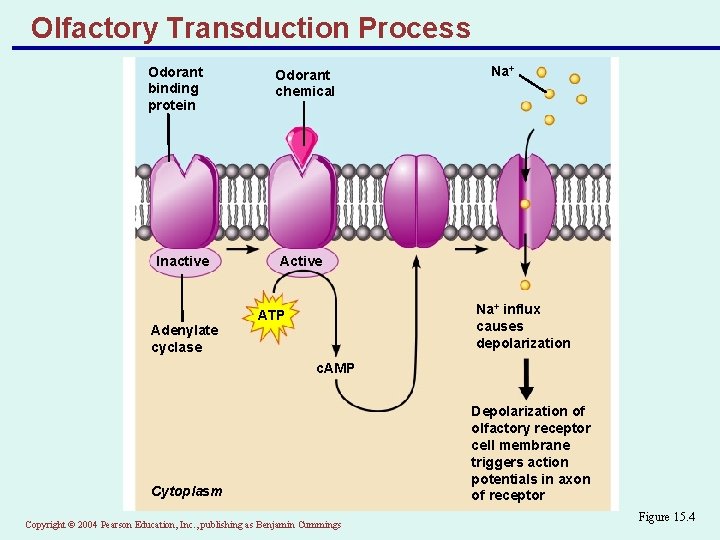
Olfactory Transduction Process Odorant binding protein Inactive Adenylate cyclase Odorant chemical Na+ Active Na+ influx causes depolarization ATP c. AMP Cytoplasm Copyright © 2004 Pearson Education, Inc. , publishing as Benjamin Cummings Depolarization of olfactory receptor cell membrane triggers action potentials in axon of receptor Figure 15. 4
The Ear: Hearing and Balance § The three parts of the ear are the inner, outer, and middle ear § The outer and middle ear are involved with hearing § The inner ear functions in both hearing and equilibrium § Receptors for hearing and balance: § Respond to separate stimuli § Are activated independently Copyright © 2004 Pearson Education, Inc. , publishing as Benjamin Cummings
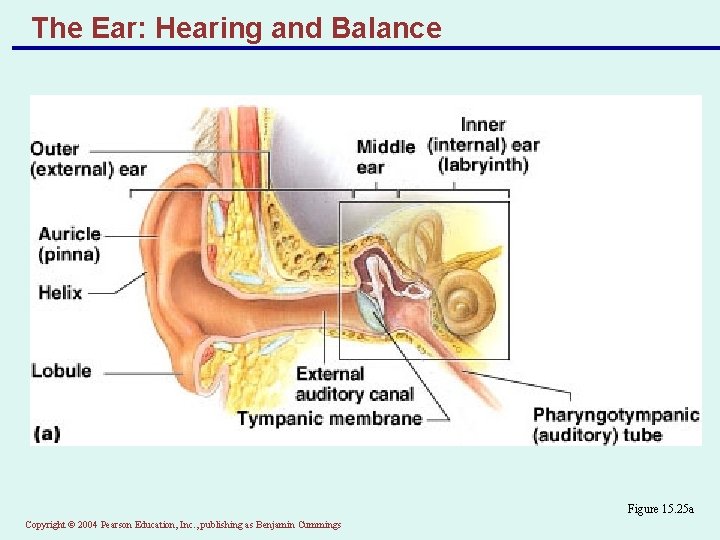
The Ear: Hearing and Balance Figure 15. 25 a Copyright © 2004 Pearson Education, Inc. , publishing as Benjamin Cummings
Outer Ear § The auricle (pinna) is composed of: § The helix (rim) § The lobule (earlobe) § External auditory canal § Short, curved tube filled with ceruminous glands Copyright © 2004 Pearson Education, Inc. , publishing as Benjamin Cummings
Outer Ear § Tympanic membrane (eardrum) § Thin connective tissue membrane that vibrates in response to sound § Transfers sound energy to the middle ear ossicles § Boundary between outer and middle ears Copyright © 2004 Pearson Education, Inc. , publishing as Benjamin Cummings
Middle Ear (Tympanic Cavity) § A small, air-filled, mucosa-lined cavity § Flanked laterally by the eardrum § Flanked medially by the oval and round windows § Epitympanic recess – superior portion of the middle ear § Pharyngotympanic tube – connects the middle ear to the nasopharynx § Equalizes pressure in the middle ear cavity with the external air pressure Copyright © 2004 Pearson Education, Inc. , publishing as Benjamin Cummings
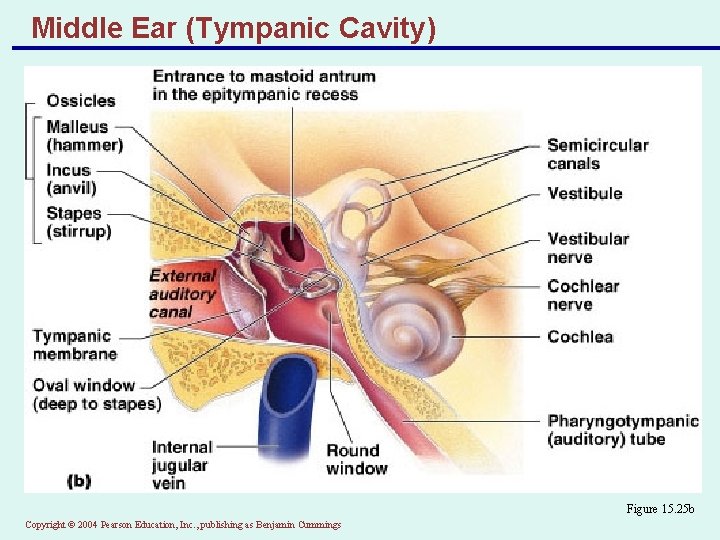
Middle Ear (Tympanic Cavity) Figure 15. 25 b Copyright © 2004 Pearson Education, Inc. , publishing as Benjamin Cummings
Ear Ossicles § The tympanic cavity contains three small bones: the malleus, incus, and stapes § Transmit vibratory motion of the eardrum to the oval window § Dampened by the tensor tympani and stapedius muscles Copyright © 2004 Pearson Education, Inc. , publishing as Benjamin Cummings
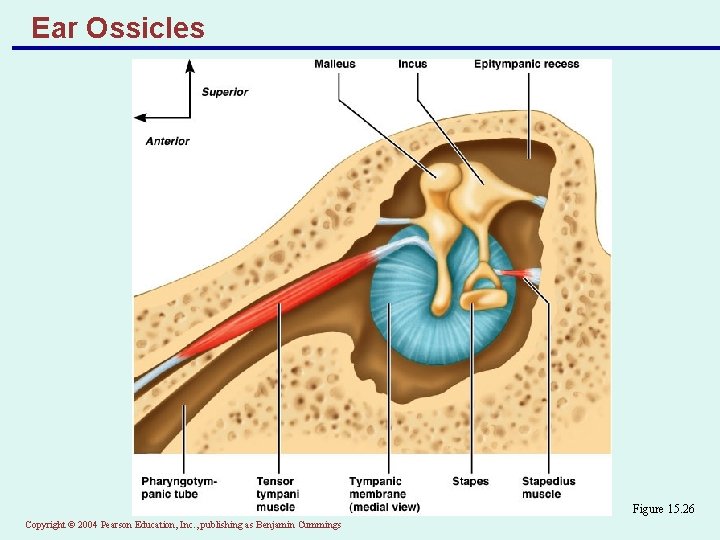
Ear Ossicles Figure 15. 26 Copyright © 2004 Pearson Education, Inc. , publishing as Benjamin Cummings
Inner Ear § Bony labyrinth § Tortuous channels worming their way through the temporal bone § Contains the vestibule, the cochlea, and the semicircular canals § Filled with perilymph § Membranous labyrinth § Series of membranous sacs within the bony labyrinth § Filled with a potassium-rich fluid Copyright © 2004 Pearson Education, Inc. , publishing as Benjamin Cummings
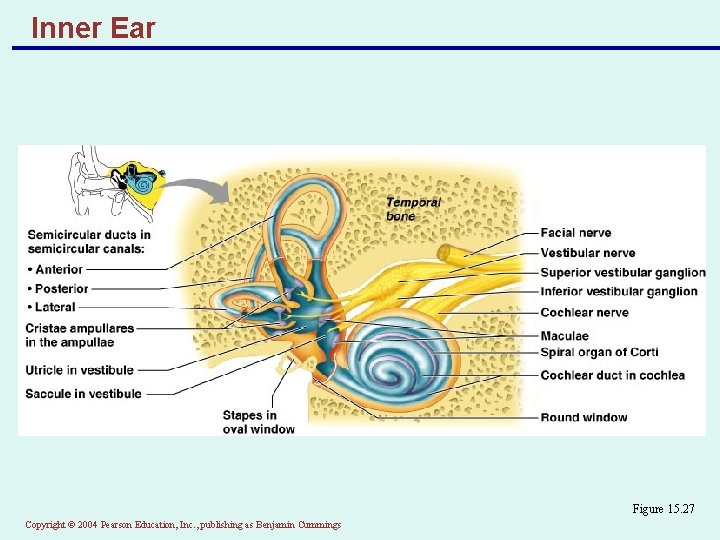
Inner Ear Figure 15. 27 Copyright © 2004 Pearson Education, Inc. , publishing as Benjamin Cummings
The Vestibule § The central egg-shaped cavity of the bony labyrinth § Suspended in its perilymph are two sacs: the saccule and utricle § The saccule extends into the cochlea § The utricle extends into the semicircular canals § These sacs: § House equilibrium receptors called maculae § Respond to gravity and changes in the position of the head Copyright © 2004 Pearson Education, Inc. , publishing as Benjamin Cummings
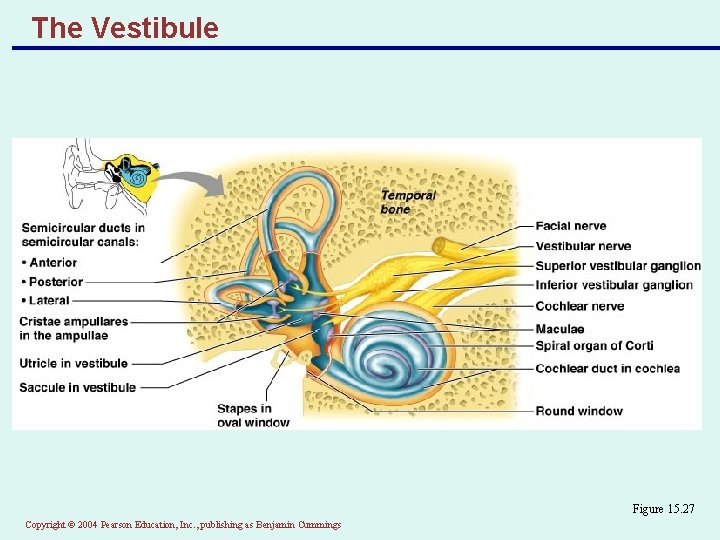
The Vestibule Figure 15. 27 Copyright © 2004 Pearson Education, Inc. , publishing as Benjamin Cummings
The Semicircular Canals § Three canals that each define two-thirds of a circle and lie in the three planes of space § Membranous semicircular ducts line each canal and communicate with the utricle § The ampulla is the swollen end of each canal and it houses equilibrium receptors in a region called the crista ampullaris § These receptors respond to angular movements of the head Copyright © 2004 Pearson Education, Inc. , publishing as Benjamin Cummings
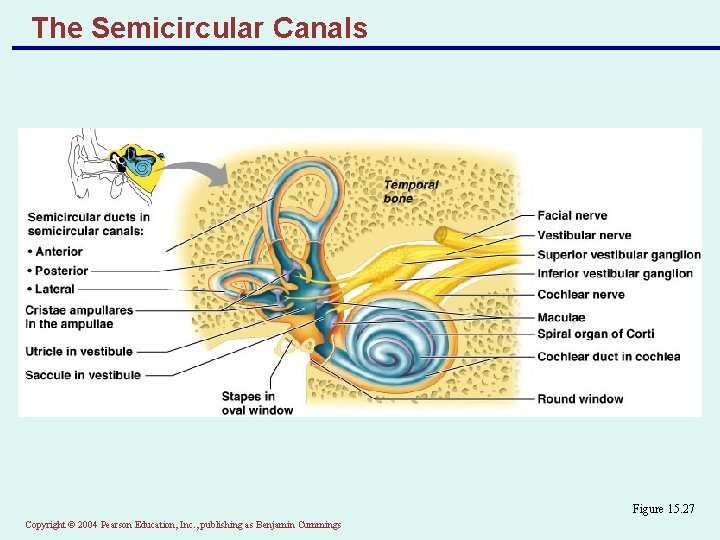
The Semicircular Canals Figure 15. 27 Copyright © 2004 Pearson Education, Inc. , publishing as Benjamin Cummings
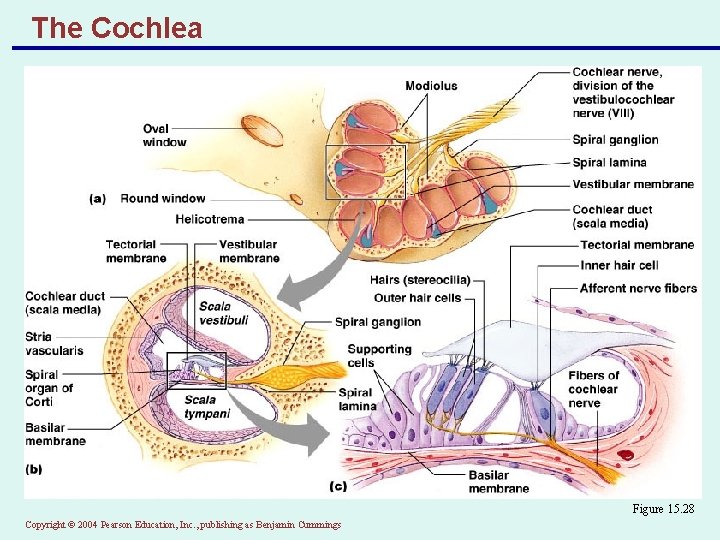
The Cochlea § A spiral, conical, bony chamber that: § Extends from the anterior vestibule § Coils around a bony pillar called the modiolus § Contains the cochlear duct, which ends at the cochlear apex § Contains the organ of Corti (hearing receptor) Copyright © 2004 Pearson Education, Inc. , publishing as Benjamin Cummings
The Cochlea § The cochlea is divided into three chambers: § Scala vestibuli § Scala media § Scala tympani Copyright © 2004 Pearson Education, Inc. , publishing as Benjamin Cummings
The Cochlea § The scala tympani terminates at the round window § The scalas tympani and vestibuli: § Are filled with perilymph § Are continuous with each other via the helicotrema § The scala media is filled with endolymph Copyright © 2004 Pearson Education, Inc. , publishing as Benjamin Cummings
The Cochlea § The “floor” of the cochlear duct is composed of: § The bony spiral lamina § The basilar membrane, which supports the organ of Corti § The cochlear branch of nerve VIII runs from the organ of Corti to the brain Copyright © 2004 Pearson Education, Inc. , publishing as Benjamin Cummings
The Cochlea Figure 15. 28 Copyright © 2004 Pearson Education, Inc. , publishing as Benjamin Cummings
Sound and Mechanisms of Hearing § Sound vibrations beat against the eardrum § The eardrum pushes against the ossicles, which presses fluid in the inner ear against the oval and round windows § This movement sets up shearing forces that pull on hair cells § Moving hair cells stimulates the cochlear nerve that sends impulses to the brain Copyright © 2004 Pearson Education, Inc. , publishing as Benjamin Cummings
Properties of Sound § Sound is: § A pressure disturbance (alternating areas of high and low pressure) originating from a vibrating object § Composed of areas of rarefaction and compression § Represented by a sine wave in wavelength, frequency, and amplitude Copyright © 2004 Pearson Education, Inc. , publishing as Benjamin Cummings
Properties of Sound § Frequency – the number of waves that pass a given point in a given time § Pitch – perception of different frequencies (we hear from 20– 20, 000 Hz) Copyright © 2004 Pearson Education, Inc. , publishing as Benjamin Cummings
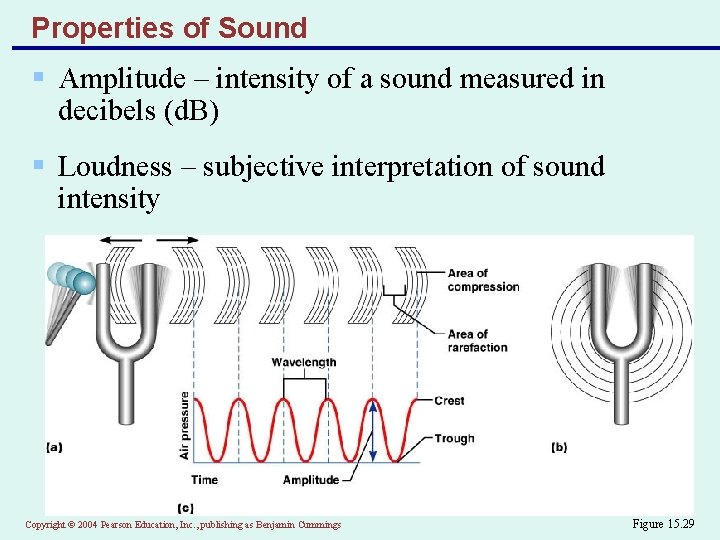
Properties of Sound § Amplitude – intensity of a sound measured in decibels (d. B) § Loudness – subjective interpretation of sound intensity Copyright © 2004 Pearson Education, Inc. , publishing as Benjamin Cummings Figure 15. 29
Transmission of Sound to the Inner Ear § The route of sound to the inner ear follows this pathway: § Outer ear – pinna, auditory canal, eardrum § Middle ear – malleus, incus, and stapes to the oval window § Inner ear – scalas vestibuli and tympani to the cochlear duct § Stimulation of the organ of Corti § Generation of impulses in the cochlear nerve Copyright © 2004 Pearson Education, Inc. , publishing as Benjamin Cummings
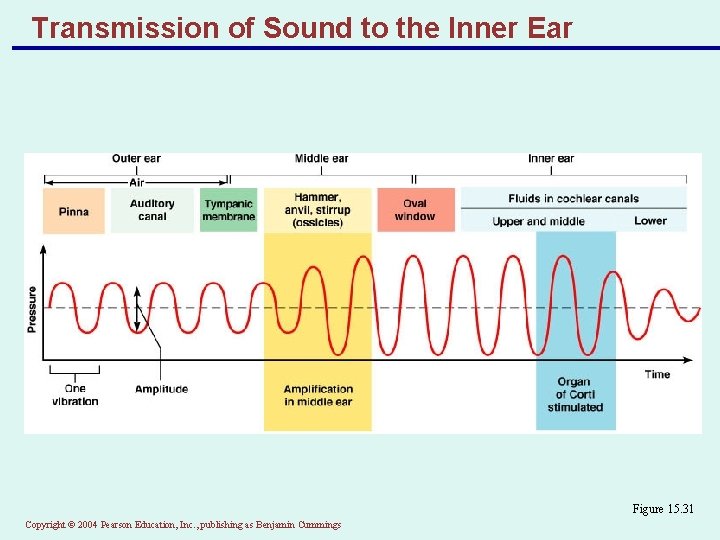
Transmission of Sound to the Inner Ear Figure 15. 31 Copyright © 2004 Pearson Education, Inc. , publishing as Benjamin Cummings
Resonance of the Basilar Membrane § Sound waves of low frequency (inaudible): § Travel around the helicotrema § Do not excite hair cells § Audible sound waves: § Penetrate through the cochlear duct § Vibrate the basilar membrane § Excite specific hair cells according to frequency of the sound Copyright © 2004 Pearson Education, Inc. , publishing as Benjamin Cummings
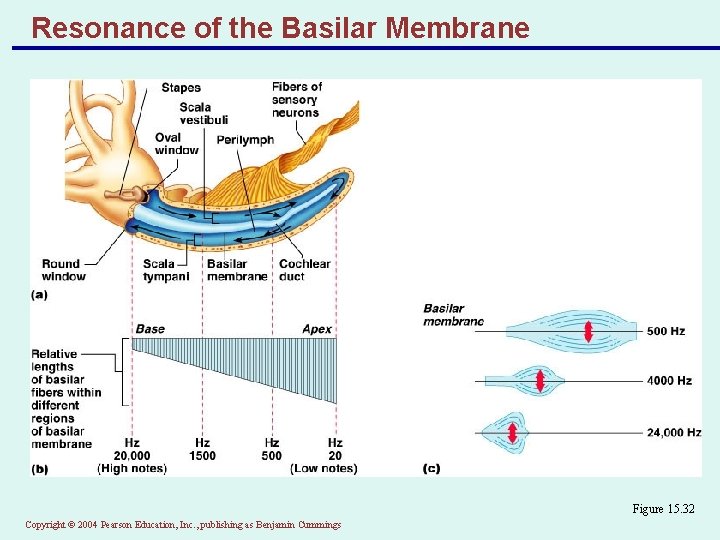
Resonance of the Basilar Membrane Figure 15. 32 Copyright © 2004 Pearson Education, Inc. , publishing as Benjamin Cummings
The Organ of Corti § Is composed of supporting cells and outer and inner hair cells § Afferent fibers of the cochlear nerve attach to the base of hair cells § The stereocilia (hairs): § Protrude into the endolymph § Touch the tectorial membrane Copyright © 2004 Pearson Education, Inc. , publishing as Benjamin Cummings
Excitation of Hair Cells in the Organ of Corti § Bending cilia: § Opens mechanically gated ion channels § Causes a graded potential and the release of a neurotransmitter (probably glutamate) § The neurotransmitter causes cochlear fibers to transmit impulses to the brain, where sound is perceived Copyright © 2004 Pearson Education, Inc. , publishing as Benjamin Cummings
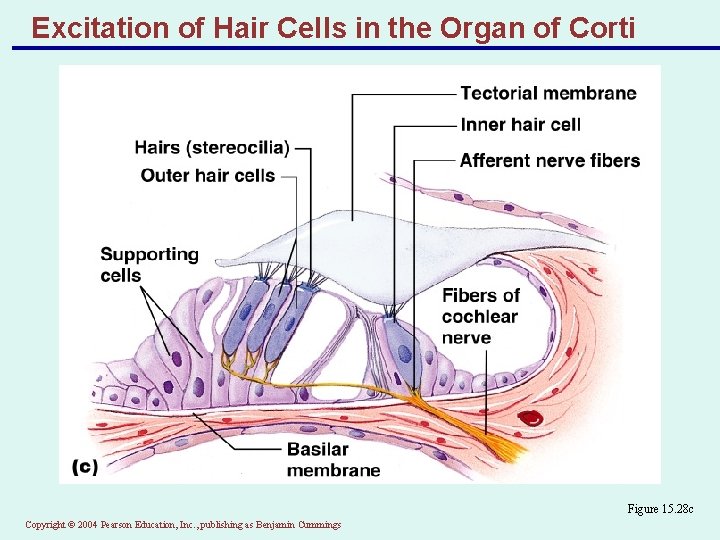
Excitation of Hair Cells in the Organ of Corti Figure 15. 28 c Copyright © 2004 Pearson Education, Inc. , publishing as Benjamin Cummings
Deafness § Conduction deafness – something hampers sound conduction to the fluids of the inner ear (e. g. , impacted earwax, perforated eardrum, osteosclerosis of the ossicles) § Sensorineural deafness – results from damage to the neural structures at any point from the cochlear hair cells to the auditory cortical cells § Tinnitus – ringing or clicking sound in the ears in the absence of auditory stimuli § Meniere’s syndrome – labyrinth disorder that affects the cochlea and the semicircular canals, causing vertigo, nausea, and vomiting Copyright © 2004 Pearson Education, Inc. , publishing as Benjamin Cummings
Mechanisms of Equilibrium and Orientation § Vestibular apparatus – equilibrium receptors in the semicircular canals and vestibule § Maintains our orientation and balance in space § Vestibular receptors monitor static equilibrium § Semicircular canal receptors monitor dynamic equilibrium Copyright © 2004 Pearson Education, Inc. , publishing as Benjamin Cummings
Anatomy of Maculae § Maculae are the sensory receptors for static equilibrium § Contain supporting cells and hair cells § Each hair cell has stereocilia and kinocilium embedded in the otolithic membrane § Otolithic membrane – jellylike mass studded with tiny Ca. CO 3 stones called otoliths § Utricular hairs respond to horizontal movement § Saccular hairs respond to vertical movement Copyright © 2004 Pearson Education, Inc. , publishing as Benjamin Cummings
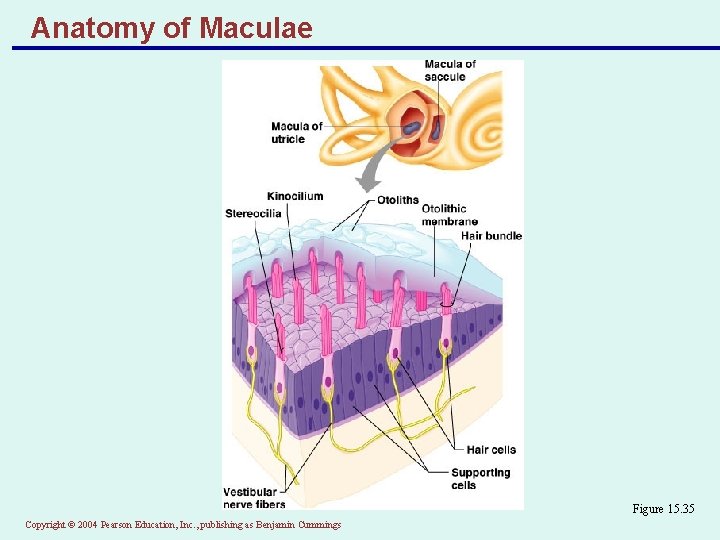
Anatomy of Maculae Figure 15. 35 Copyright © 2004 Pearson Education, Inc. , publishing as Benjamin Cummings
Effect of Gravity on Utricular Receptor Cells § Otolithic movement in the direction of the kinocilia: § Depolarizes vestibular nerve fibers § Increases the number of action potentials generated § Movement in the opposite direction: § Hyperpolarizes vestibular nerve fibers § Reduces the rate of impulse propagation § From this information, the brain is informed of the changing position of the head Copyright © 2004 Pearson Education, Inc. , publishing as Benjamin Cummings
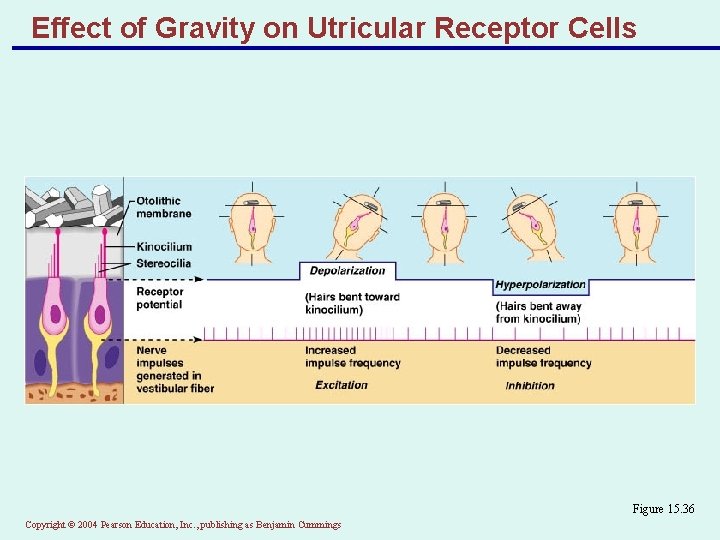
Effect of Gravity on Utricular Receptor Cells Figure 15. 36 Copyright © 2004 Pearson Education, Inc. , publishing as Benjamin Cummings
Crista Ampullaris and Dynamic Equilibrium § The crista ampullaris (or crista): § Is the receptor for dynamic equilibrium § Is located in the ampulla of each semicircular canal § Responds to angular movements § Each crista has support cells and hair cells that extend into a gel-like mass called the cupula § Dendrites of vestibular nerve fibers encircle the base of the hair cells Copyright © 2004 Pearson Education, Inc. , publishing as Benjamin Cummings
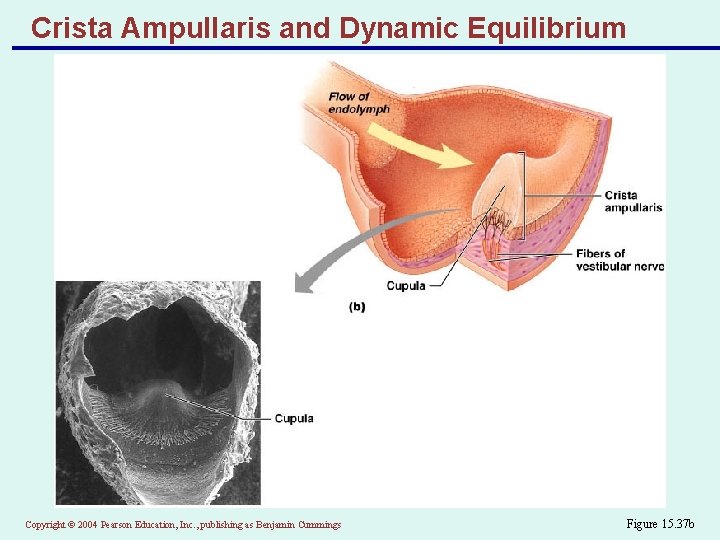
Crista Ampullaris and Dynamic Equilibrium Copyright © 2004 Pearson Education, Inc. , publishing as Benjamin Cummings Figure 15. 37 b
Activating Crista Ampullaris Receptors § Cristae respond to changes in velocity of rotatory movements of the head § Directional bending of hair cells in the cristae causes: § Depolarizations, and rapid impulses reach the brain at a faster rate § Hyperpolarizations, and fewer impulses reach the brain § The result is that the brain is informed of rotational movements of the head Copyright © 2004 Pearson Education, Inc. , publishing as Benjamin Cummings
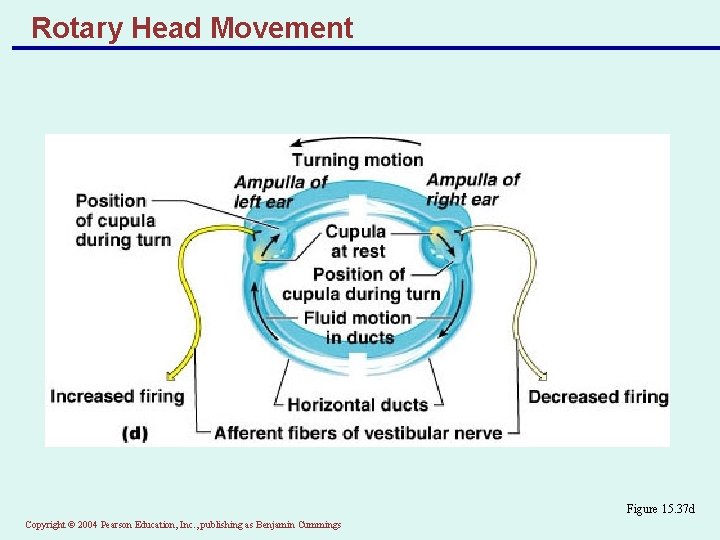
Rotary Head Movement Figure 15. 37 d Copyright © 2004 Pearson Education, Inc. , publishing as Benjamin Cummings

Now shut up and get to work Copyright © 2004 Pearson Education, Inc. , publishing as Benjamin Cummings
- Slides: 54