
Exercise Metabolism The use of oxygen by cells
Exercise Metabolism

• The use of oxygen by cells is called oxygen uptake (VO 2). • Oxygen uptake rises rapidly during the first minute of exercise. • Between 3 rd and 4 th minute a plateau is reached and VO 2 remains relatively stable. • Plateau of oxygen uptake is known as steady rate.
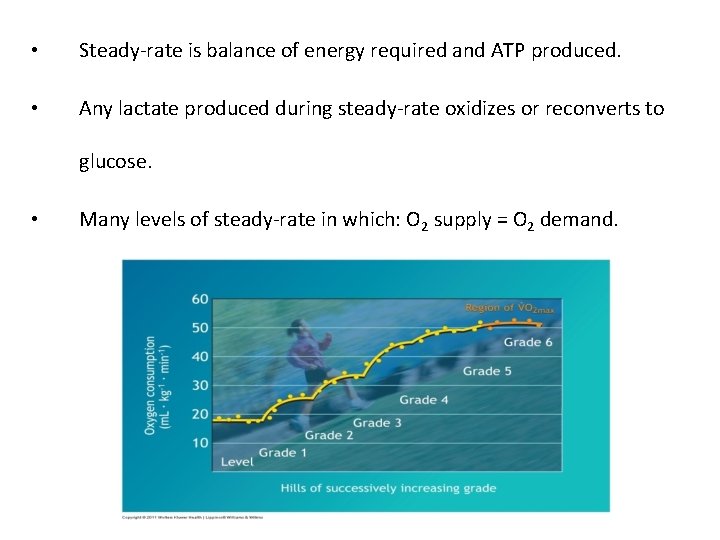
• Steady-rate is balance of energy required and ATP produced. • Any lactate produced during steady-rate oxidizes or reconverts to glucose. • Many levels of steady-rate in which: O 2 supply = O 2 demand.
Energy Requirements at Rest • Almost 100% of ATP produced by aerobic metabolism • Blood lactate levels are low (<1. 0 mmol/L) • Resting O 2 consumption (=index of ATP production): – 0. 25 L/min – 3. 5 ml/kg/min
Rest-to-Exercise Transitions • As muscular exercise increases, so will ATP production • From rest to light/ mod exercise O 2 uptake increases rapidly – Initial ATP production through anaerobic pathways: 1. PC system – 10 sec 2. Glycolysis/ TCA – 3 mins • After steady state is reached, ATP requirement is met through aerobic ATP production O 2 consumption reaches steady state within 1– 4 minutes oxygen supply is meeting the oxygen demand by way of aerobic metabolism
The Aerobic System • Oxygen Deficit: is the difference between the total amount of oxygen required to perform an activity and the actual amount of oxygen initially available until steady state is reached • Oxygen deficit = Lag in oxygen uptake at the beginning of exercise…

Oxygen Deficit • Steady-rate oxygen uptake during light & moderate intensity exercise is similar for trained & untrained.
Comparison of Trained and Untrained Subjects • Trained: reach steady-rate quicker, have lower oxygen deficit – Better developed aerobic energy capacity Due to cardiovascular or muscular adaptations =Results in less lactic acid produced
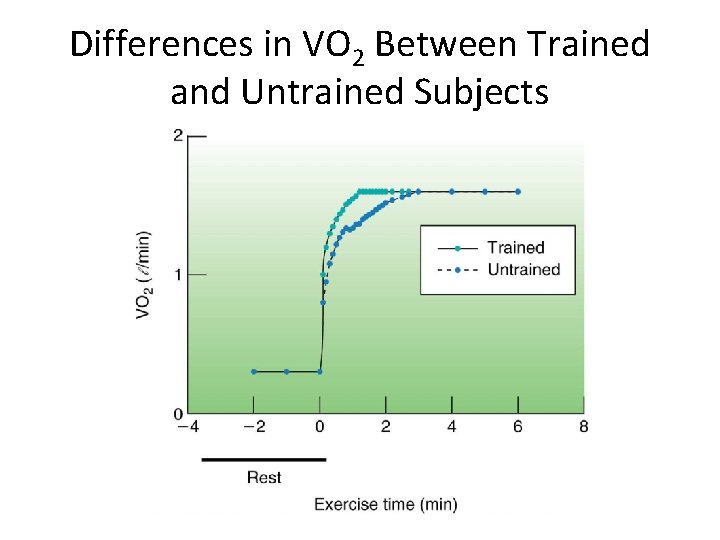
Differences in VO 2 Between Trained and Untrained Subjects
Rest-to-Exercise Transitions Therefore… § The failure of oxygen uptake to increase instantly at the beginning of exercise = anaerobic pathways contribute to overall production on ATP early in exercise. § After a steady state is reached, the body’s ATP requirement is met by aerobic metabolism.

Recovery From Exercise: Metabolic Responses Recovery From Exercise • Oxygen uptake remains elevated above rest into recovery = Oxygen debt {Term used by A. V. Hill} • Repayment for O 2 deficit at onset of exercise • Excess post-exercise oxygen consumption (EPOC) – elevated O 2 consumption used to “repay” O 2 deficit • Many scientists use these terms interchangeably
Recovery From Exercise: Metabolic Responses Importance of Oxygen Debt • “Rapid” portion of O 2 debt – Resynthesis of stored PC – Replenishing muscle and blood O 2 stores • “Slow” portion of O 2 debt – Elevated heart rate and breathing = energy need – Elevated body temperature = metabolic rate – Elevated epinephrine and norepinephrine = metabolic rate – Conversion of lactic acid to glucose (gluconeogenesis)

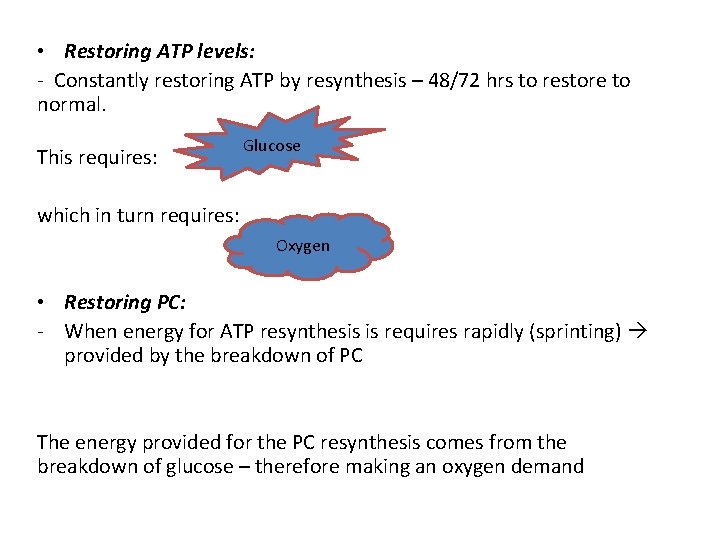
• Restoring ATP levels: - Constantly restoring ATP by resynthesis – 48/72 hrs to restore to normal. This requires: Glucose which in turn requires: Oxygen • Restoring PC: - When energy for ATP resynthesis is requires rapidly (sprinting) provided by the breakdown of PC The energy provided for the PC resynthesis comes from the breakdown of glucose – therefore making an oxygen demand
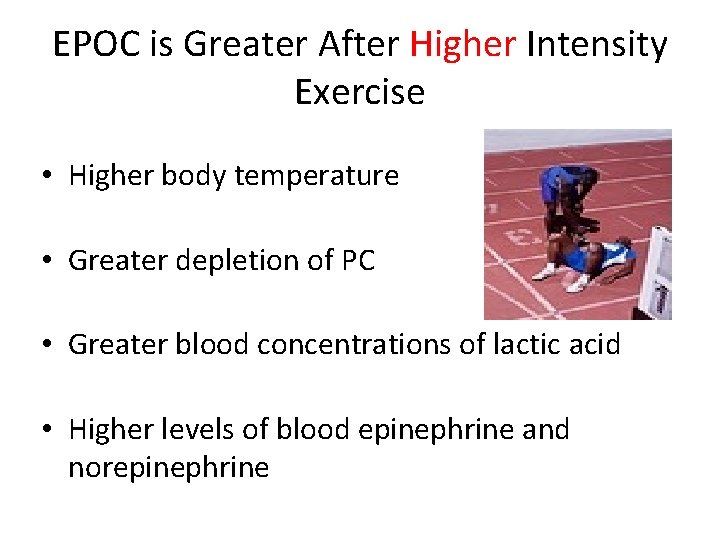
EPOC is Greater After Higher Intensity Exercise • Higher body temperature • Greater depletion of PC • Greater blood concentrations of lactic acid • Higher levels of blood epinephrine and norepinephrine
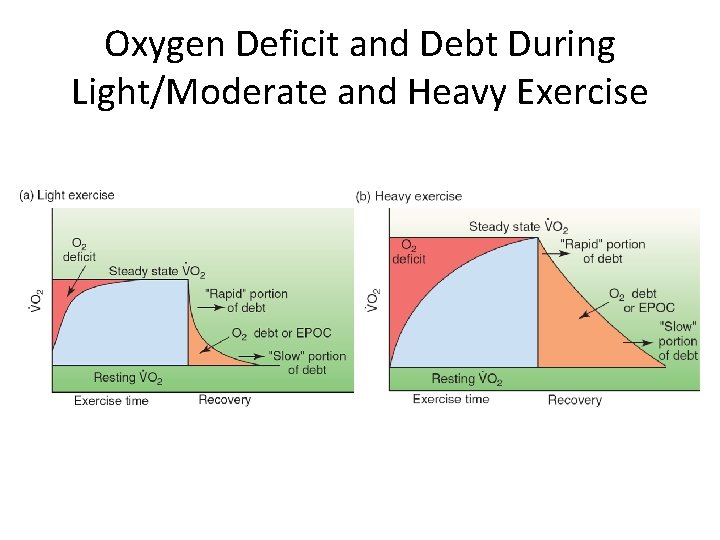
Oxygen Deficit and Debt During Light/Moderate and Heavy Exercise
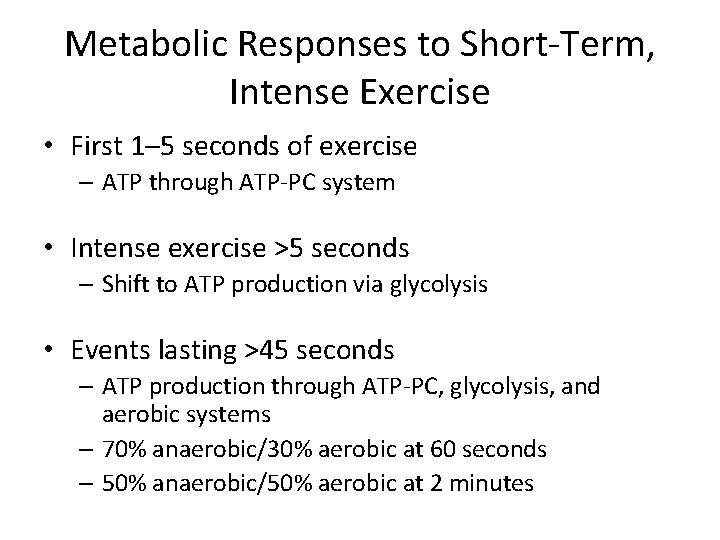
Metabolic Responses to Short-Term, Intense Exercise • First 1– 5 seconds of exercise – ATP through ATP-PC system • Intense exercise >5 seconds – Shift to ATP production via glycolysis • Events lasting >45 seconds – ATP production through ATP-PC, glycolysis, and aerobic systems – 70% anaerobic/30% aerobic at 60 seconds – 50% anaerobic/50% aerobic at 2 minutes
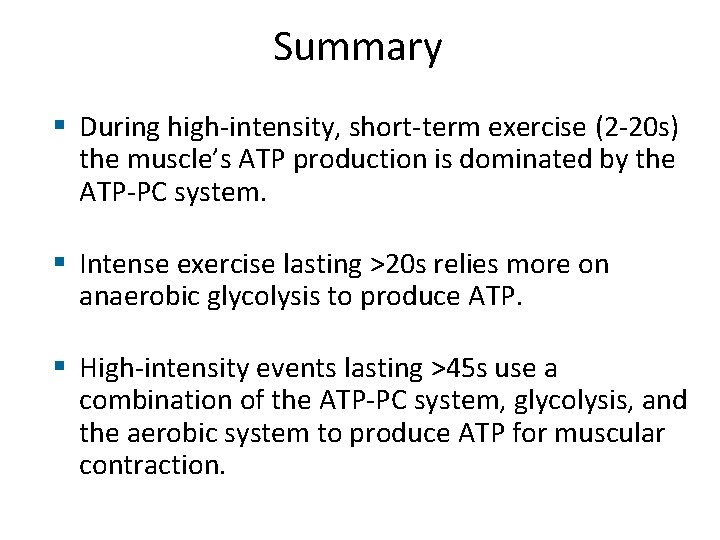
Summary § During high-intensity, short-term exercise (2 -20 s) the muscle’s ATP production is dominated by the ATP-PC system. § Intense exercise lasting >20 s relies more on anaerobic glycolysis to produce ATP. § High-intensity events lasting >45 s use a combination of the ATP-PC system, glycolysis, and the aerobic system to produce ATP for muscular contraction.
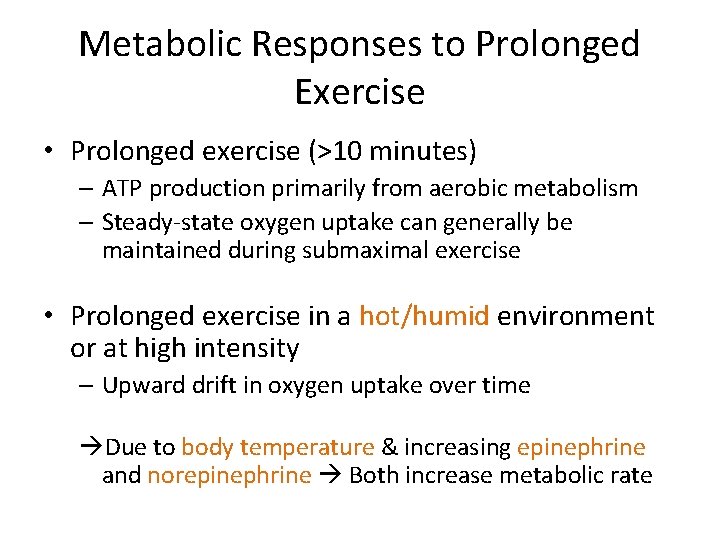
Metabolic Responses to Prolonged Exercise • Prolonged exercise (>10 minutes) – ATP production primarily from aerobic metabolism – Steady-state oxygen uptake can generally be maintained during submaximal exercise • Prolonged exercise in a hot/humid environment or at high intensity – Upward drift in oxygen uptake over time Due to body temperature & increasing epinephrine and norepinephrine Both increase metabolic rate
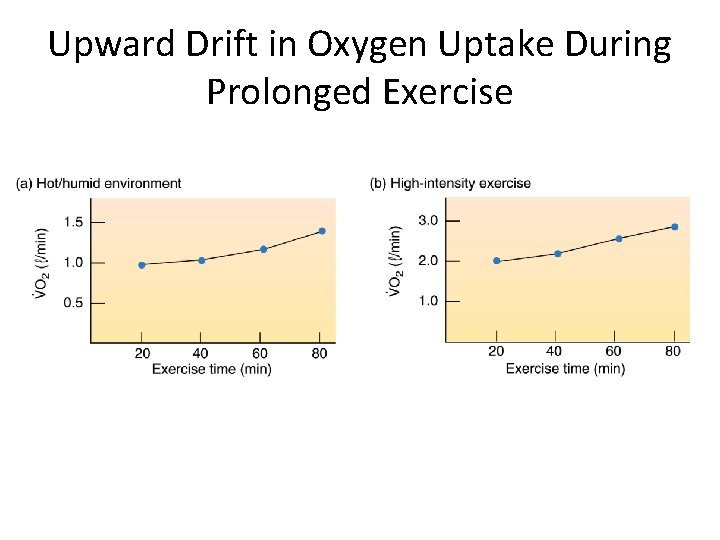
Upward Drift in Oxygen Uptake During Prolonged Exercise
Metabolic Responses to Incremental Exercise • Oxygen uptake increases linearly until maximal oxygen uptake (VO 2 max) is reached – No further increase in VO 2 with increasing work rate • VO 2 max: – “Physiological ceiling” for delivery of O 2 to muscle – Affected by genetics & training • Physiological factors influencing VO 2 max: 1. Ability of cardio-respiratory system to deliver O 2 to muscle 2. Ability of muscles to use oxygen and produce ATP aerobically

Changes in Oxygen Uptake During Incremental Exercise
Lactate Threshold • The point at which blood lactic acid rises systematically during incremental exercise – Appears at ~50– 60% VO 2 max in untrained subjects – At higher work rates (65– 80% VO 2 max) in trained subjects • Also called: – Anaerobic threshold – Onset of blood lactate accumulation (OBLA) • Blood lactate levels reach 4 mmol/L
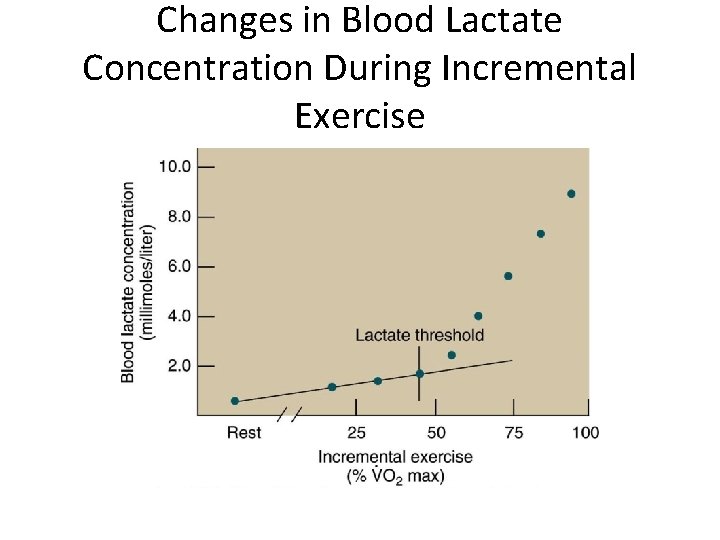
Changes in Blood Lactate Concentration During Incremental Exercise
• The amount of LA accumulating depends on HOW LONG you work above threshold. This has to be monitored because: 1) It will cause muscle fatigue 2) Lactic Acid can be a useful source of energy
Lactate as a Fuel Source During Exercise • Can be used as a fuel source by skeletal muscle and the heart – Converted to acetyl-Co. A and enters Krebs cycle • Can be converted to glucose in the liver – Cori cycle • Lactate shuttle – Lactate produced in one tissue and transported to another
The Cori Cycle: Lactate as a Fuel Source • Lactic acid produced by skeletal muscle is transported to the liver • Liver converts lactate to glucose – Gluconeogenesis • Glucose is transported back to muscle and used as a fuel
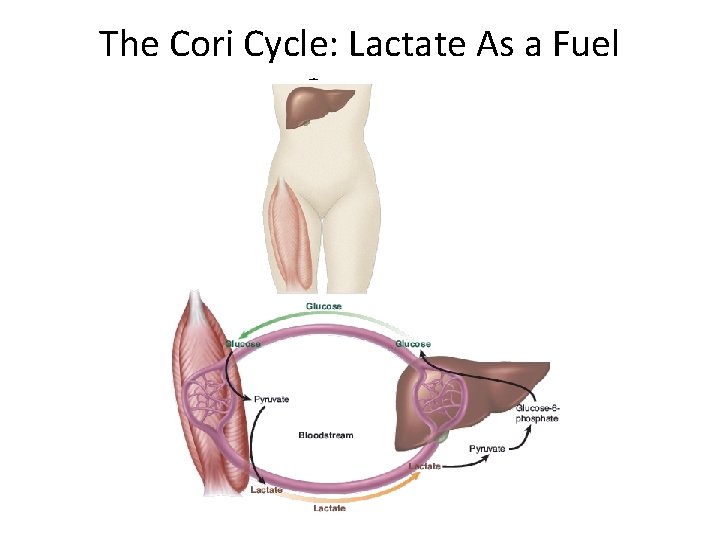
The Cori Cycle: Lactate As a Fuel Source
Reasons for Lactate Threshold 1. Low muscle oxygen (hypoxia) = increased reliance on anaerobic metabolism 2. Accelerated glycolysis – NADH produced faster than it is shuttled into mitochondria – Excess NADH in cytoplasm converts pyruvic acid to lactic acid 3. Recruitment of fast-twitch muscle fibers – LDH enzyme in fast fibers promotes lactic acid formation 4. Reduced rate of lactate removal from the blood
Practical Uses of the Lactate Threshold • Prediction of performance – Combined with VO 2 max • Planning training programmes – Marker of training intensity
Exercise Intensity and Fuel Selection • Low-intensity exercise (<30% VO 2 max) – Fats are primary fuel • High-intensity exercise (>70% VO 2 max) – Carbohydrates are primary fuel • “Crossover” concept – Describes the shift from fat to CHO metabolism as exercise intensity increases Due to: • Recruitment of fast muscle fibers • Increasing blood levels of epinephrine
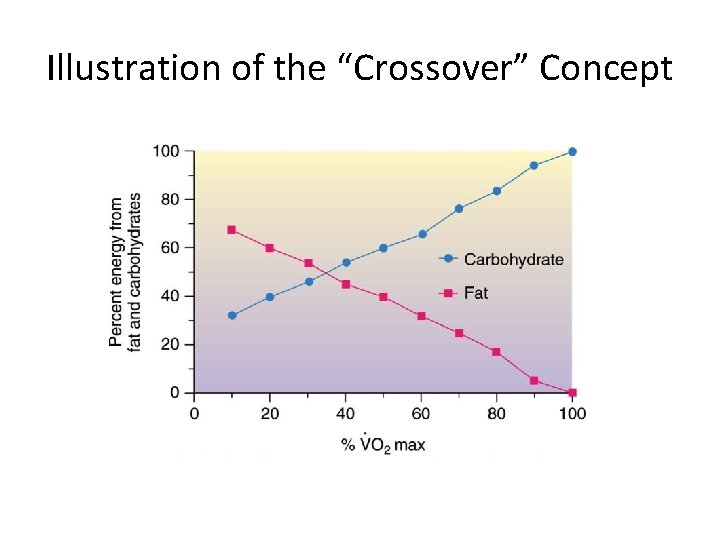
Illustration of the “Crossover” Concept
Exercise Duration and Fuel Selection • Prolonged, low-intensity exercise – Shift from carbohydrate metabolism toward fat metabolism Due to an increased rate of lipolysis – Breakdown of triglycerides (fats) glycerol + FFA *By enzymes called lipase Stimulated by rising blood levels of epinephrine
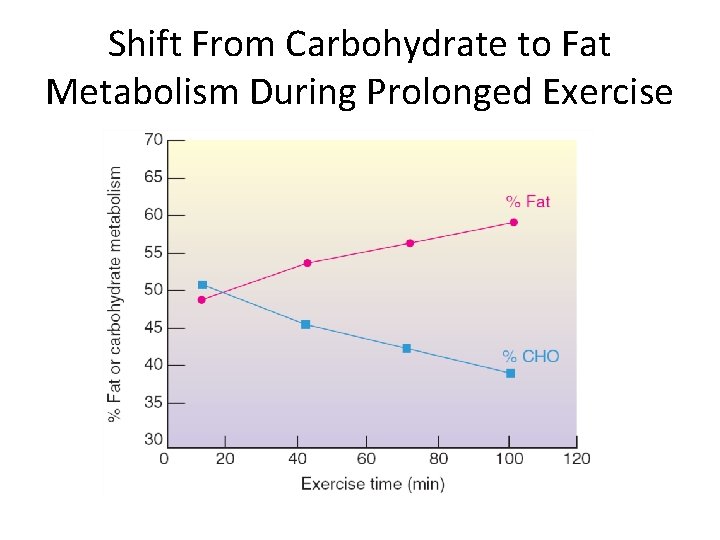
Shift From Carbohydrate to Fat Metabolism During Prolonged Exercise
Interaction of Fat and CHO Metabolism During Exercise • “Fats burn in the flame of carbohydrates” • Glycogen is depleted during prolonged highintensity exercise – Reduced rate of glycolysis and production of pyruvate – Reduced Krebs cycle intermediates – Reduced fat oxidation • Fats are metabolized by Krebs cycle
Carbohydrate Feeding via Sports Drinks Improves Endurance Performance? • The depletion of muscle and blood carbohydrate stores contributes to fatigue • Ingestion of carbohydrates can improve endurance performance – During submaximal (<70% VO 2 max), long-duration (>90 minutes) exercise – 30– 60 g of carbohydrate per hour are required • May also improve performance in shorter, higher intensity events
Sources of Carbohydrate During Exercise • Muscle glycogen – Primary source of carbohydrate during high-intensity exercise – Supplies much of the carbohydrate in the first hour of exercise • Blood glucose – From liver glycogenolysis – Primary source of carbohydrate during low-intensity exercise – Important during long-duration exercise • As muscle glycogen levels decline
Sources of Fat During Exercise • Intramuscular triglycerides – Primary source of fat during higher intensity exercise • Plasma FFA – From adipose tissue lipolysis • Triglycerides glycerol + FFA – FFA converted to acetyl-Co. A and enters Krebs cycle – Primary source of fat during low-intensity exercise – Becomes more important as muscle triglyceride levels decline in long-duration exercise
Sources of Protein During Exercise • Proteins broken down into amino acids – Muscle can directly metabolize branch chain amino acids and alanine – Liver can convert alanine to glucose • Only a small contribution (~2%) to total energy production during exercise – May increase to 5– 10% late in prolonged-duration exercise
- Slides: 39