
Exercise Metabolism Concepts Dr Suzan Ayers Western Michigan
Exercise Metabolism Concepts Dr. Suzan Ayers Western Michigan University
Lecture Overview Energy production p Oxygen supply during sustained exercise p Measuring exercise capacity p Cardiorespiratory system and oxygen supply during exercise p Human skeletal muscle cells p Activity’s energy cost p Dietary considerations p Sport-specific training NOTE: throughout this presentation, the use of [] connotes “concentration” p
Energy Production Adenosine triphosphate (ATP) p 3 ATP-resynthesizing energy systems p n (Fig 10. 4) Immediate energy system (stored energy, high-energy phosphagen, ATP-PCr system) 0 -30 s n Anaerobic glycolytic system (lactic acid system) 20 -180 s n Aerobic or oxidative system >3 min (see Table 10. 1) All work along a continuum (fig 10. 4) constantly Body breaks down nutrients (fats, proteins, carbs) to release energy from chemical bonds, which is then used to synthesize ATP Max exercise can produce 15 -fold ↑ [lactic acid] n n n p p 20 -40 mins required to fully remove this lactic acid build-up Light jog @ 30 -60% max pace best active recovery
Oxygen Supply: Sustained Exercise Oxygen consumption: VO 2 p O 2 deficit p n n n p Submaximal, [↔] exercise n p initial few mins of exercise, insufficient O 2 uptake ATP provided by 2 anaerobic systems Period of adjustment for increased energy demand VO 2 steady state reached Continually [>] exercise n VO 2 increases steadily to max value/exercise capacity
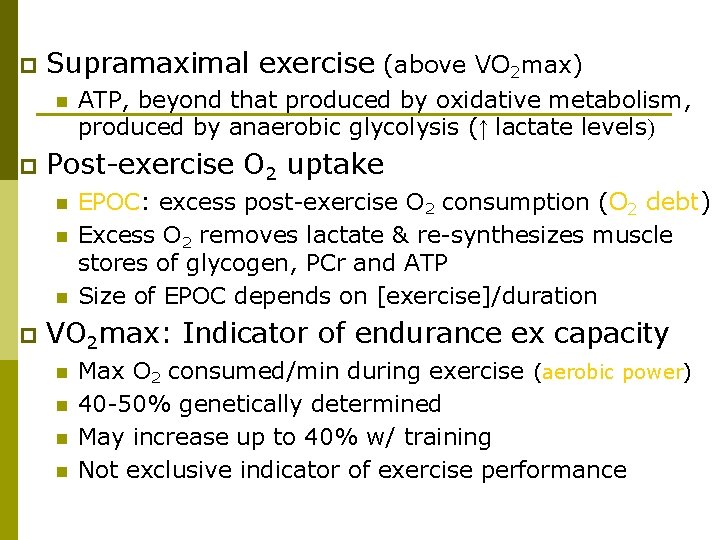
p Supramaximal exercise (above VO 2 max) n p Post-exercise O 2 uptake n n n p ATP, beyond that produced by oxidative metabolism, produced by anaerobic glycolysis (↑ lactate levels) EPOC: excess post-exercise O 2 consumption (O 2 debt) Excess O 2 removes lactate & re-synthesizes muscle stores of glycogen, PCr and ATP Size of EPOC depends on [exercise]/duration VO 2 max: Indicator of endurance ex capacity n n Max O 2 consumed/min during exercise (aerobic power) 40 -50% genetically determined May increase up to 40% w/ training Not exclusive indicator of exercise performance
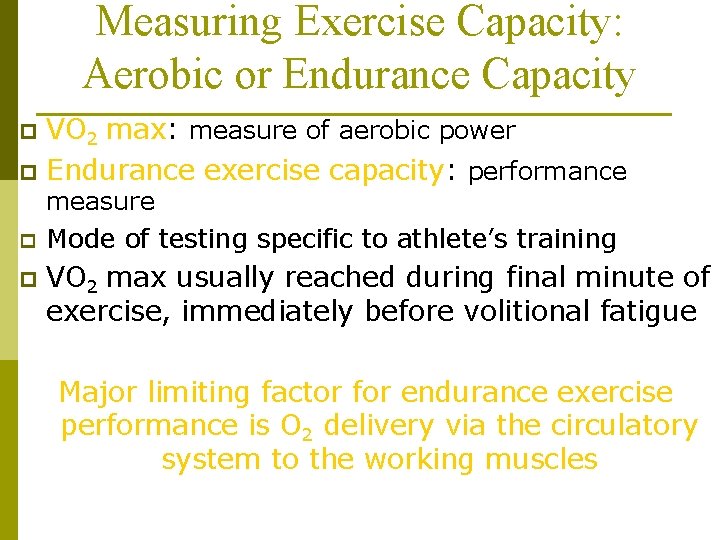
Measuring Exercise Capacity: Aerobic or Endurance Capacity VO 2 max: measure of aerobic power p Endurance exercise capacity: performance p p p measure Mode of testing specific to athlete’s training VO 2 max usually reached during final minute of exercise, immediately before volitional fatigue Major limiting factor for endurance exercise performance is O 2 delivery via the circulatory system to the working muscles
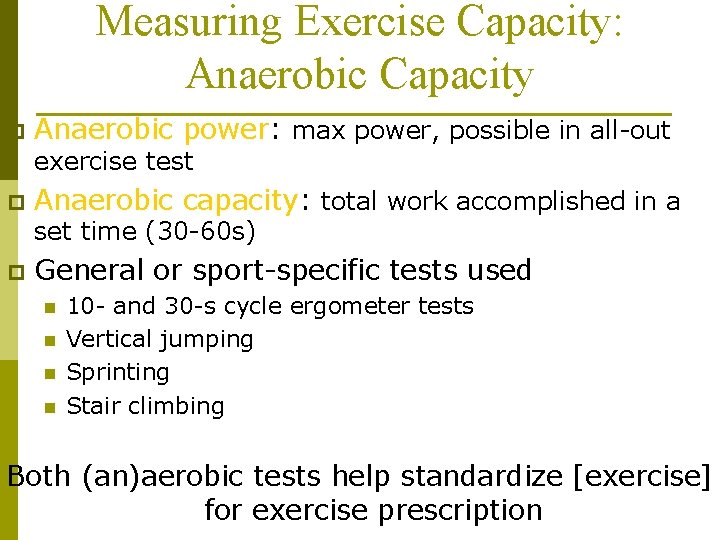
Measuring Exercise Capacity: Anaerobic Capacity p Anaerobic power: max power, possible in all-out exercise test p Anaerobic capacity: total work accomplished in a set time (30 -60 s) p General or sport-specific tests used n n 10 - and 30 -s cycle ergometer tests Vertical jumping Sprinting Stair climbing Both (an)aerobic tests help standardize [exercise] for exercise prescription
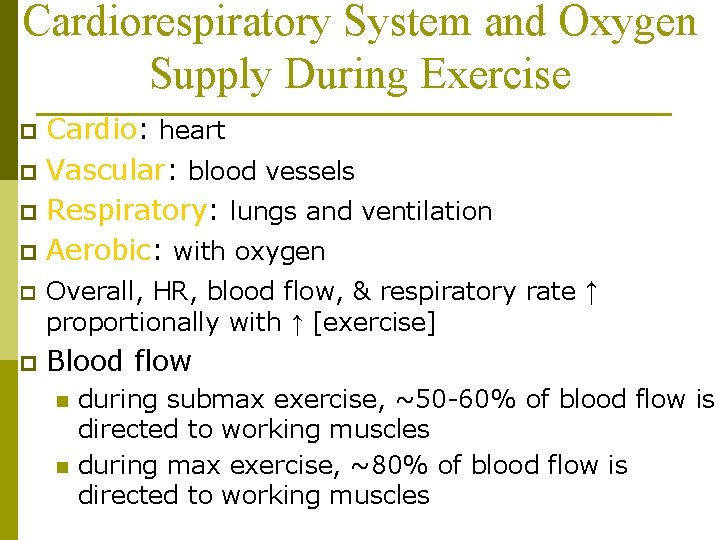
Cardiorespiratory System and Oxygen Supply During Exercise Cardio: heart p Vascular: blood vessels p Respiratory: lungs and ventilation p Aerobic: with oxygen p p Overall, HR, blood flow, & respiratory rate ↑ proportionally with ↑ [exercise] p Blood flow n n during submax exercise, ~50 -60% of blood flow is directed to working muscles during max exercise, ~80% of blood flow is directed to working muscles
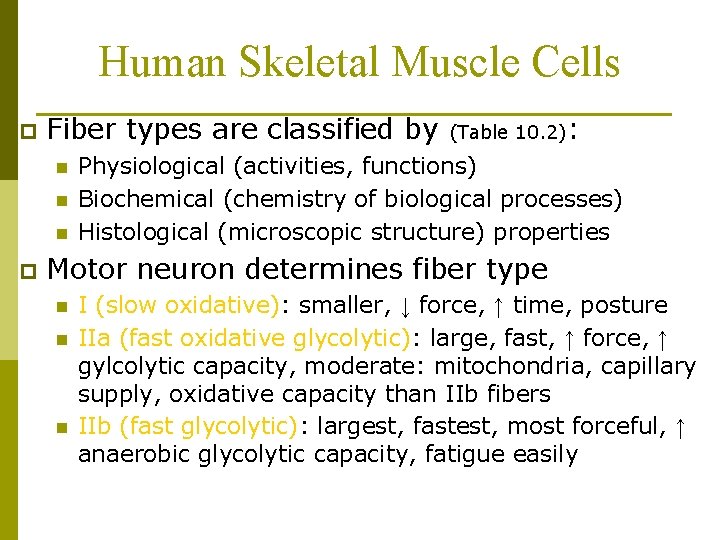
Human Skeletal Muscle Cells p Fiber types are classified by n n n p (Table 10. 2): Physiological (activities, functions) Biochemical (chemistry of biological processes) Histological (microscopic structure) properties Motor neuron determines fiber type n n n I (slow oxidative): smaller, ↓ force, ↑ time, posture IIa (fast oxidative glycolytic): large, fast, ↑ force, ↑ gylcolytic capacity, moderate: mitochondria, capillary supply, oxidative capacity than IIb fibers IIb (fast glycolytic): largest, fastest, most forceful, ↑ anaerobic glycolytic capacity, fatigue easily
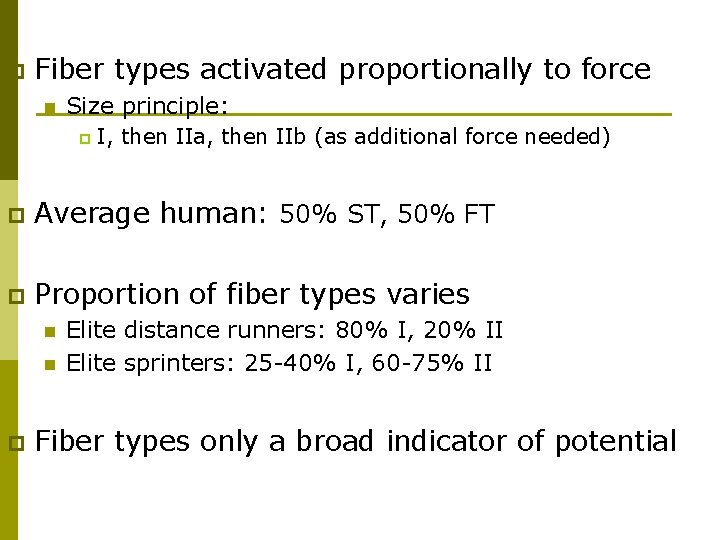
p Fiber types activated proportionally to force n Size principle: p I, then IIa, then IIb (as additional force needed) p Average human: 50% ST, 50% FT p Proportion of fiber types varies n n p Elite distance runners: 80% I, 20% II Elite sprinters: 25 -40% I, 60 -75% II Fiber types only a broad indicator of potential
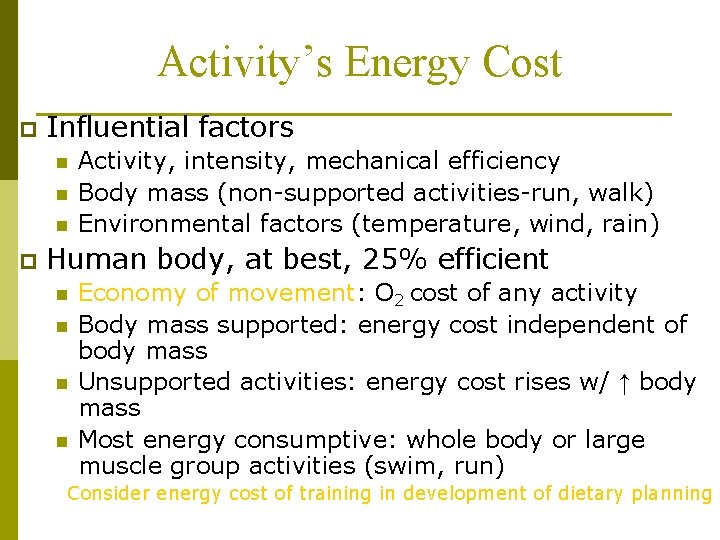
Activity’s Energy Cost p Influential factors n n n p Activity, intensity, mechanical efficiency Body mass (non-supported activities-run, walk) Environmental factors (temperature, wind, rain) Human body, at best, 25% efficient n n Economy of movement: O 2 cost of any activity Body mass supported: energy cost independent of body mass Unsupported activities: energy cost rises w/ ↑ body mass Most energy consumptive: whole body or large muscle group activities (swim, run) Consider energy cost of training in development of dietary planning
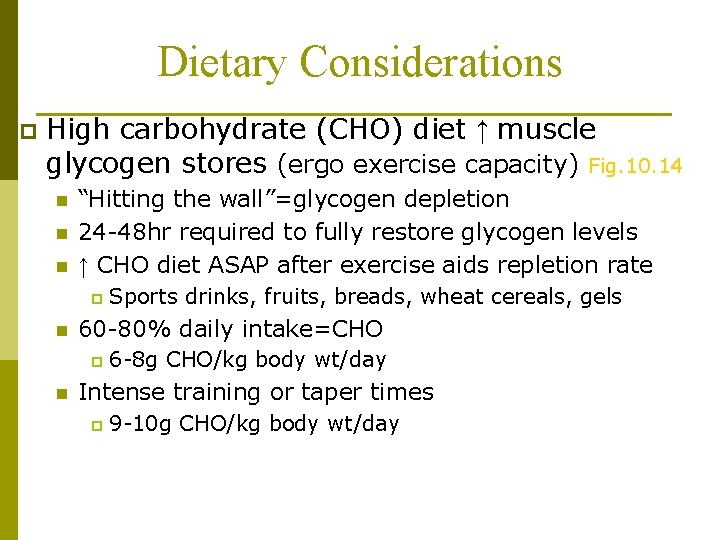
Dietary Considerations p High carbohydrate (CHO) diet ↑ muscle glycogen stores (ergo exercise capacity) Fig. 10. 14 n n n “Hitting the wall”=glycogen depletion 24 -48 hr required to fully restore glycogen levels ↑ CHO diet ASAP after exercise aids repletion rate p n 60 -80% daily intake=CHO p n Sports drinks, fruits, breads, wheat cereals, gels 6 -8 g CHO/kg body wt/day Intense training or taper times p 9 -10 g CHO/kg body wt/day
p Protein Tables 10. 4, 10. 5 n Well-balance diet adequate for most athletes n 12 -15% daily intake=protein (0. 8 g protein/kg/day) n Strength/Power/Speed athletes p n 1. 5 -2 g protein/kg body wt/day Endurance athletes p 1. 5 -1. 6 g protein/kg body wt/day EXCESS PROTEIN = EXPENSIVE URINE
p Water n n 70 -80% energy produced during ex is heat (sweat) Depending on factors, 0. 5 -3 L/hr sweat can be lost Losing 4 -5% body mass impacts thermoregulation and exercise capacity Prolonged exercise w/o H 20 replacement Blood volume may drop significantly p Heat loss slows/stops p Body temp can ↑ dangerously p n Guidelines 500 -1000 ml pts plain H 20 1 hr before activity p 250 -500 ml 20 mins before p 250 ml every 15 mins during p Intense exercise > 60 mins: add glucose & electrolytes p § 6% glucose in solution--[low electrolyte] promotes faster H 20 absorption p Several hrs may be needed to completely replace H 20
Sport-Specific Training p Anaerobic n Max force production (Abernathy: 0 -30 sec) p Stored n ATP and PCr, muscle glycogen breakdown Anaerobic glycolysis p Up n Energy Training to 2 min events (Abernathy: 20 -180 sec) Limited support for training benefits here
p Aerobic Energy Training (Abernathy: 0 -30 sec) n Evidence clear, dramatic, specific n Endurance training has specific benefits volume in muscle p ↑enzyme activity in aerobic pathways p ↑fiber’s ATP generating ability aerobically p ↑# capillaries fueling each muscle fiber p ↑intramuscular fat stores p improves fat burning ability p Improves muscle’s ability to access & utilize fat p ↑mitochondrial
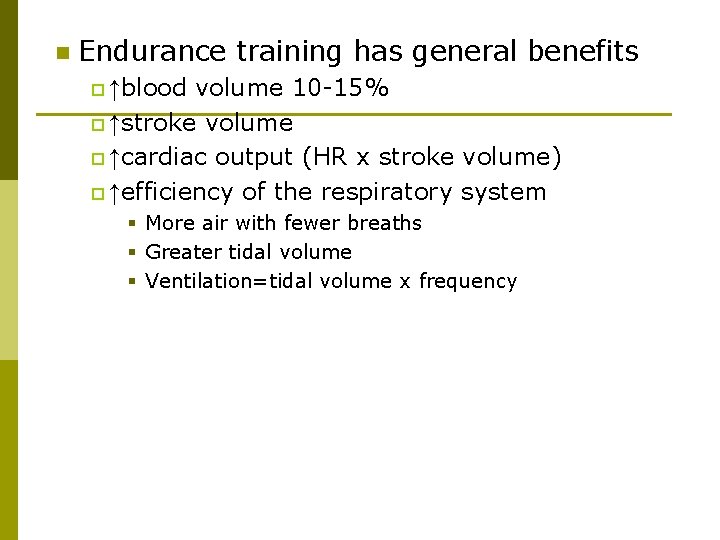
n Endurance training has general benefits volume 10 -15% p ↑stroke volume p ↑cardiac output (HR x stroke volume) p ↑efficiency of the respiratory system p ↑blood § More air with fewer breaths § Greater tidal volume § Ventilation=tidal volume x frequency
- Slides: 17