
Exercise E Isolated Smooth Muscle Opioid Receptors In


- Slides: 12
Exercise E Isolated Smooth Muscle Opioid Receptors In vitro Techniques, Lab and Tutorials Fall 2018 Mikael Palner mikael. palner@sund. ku. dk
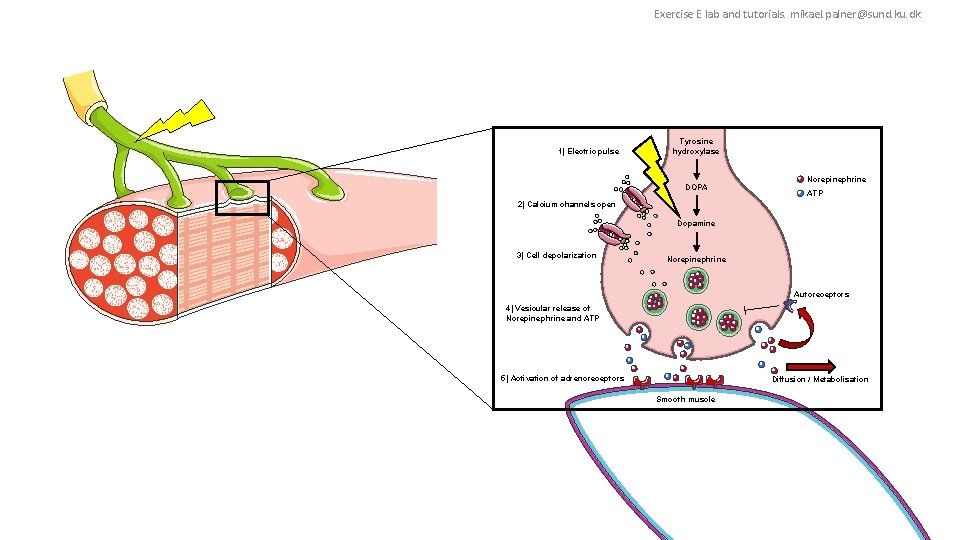
Exercise E lab and tutorials. mikael. palner@sund. ku. dk 1) Electric pulse Tyrosine hydroxylase DOPA Norepinephrine ATP 2) Calcium channels open Dopamine 3) Cell depolarization Norepinephrine Autoreceptors 4) Vesicular release of Norepinephrine and ATP 5) Activation of adrenoreceptors Diffusion / Metabolisation Smooth muscle
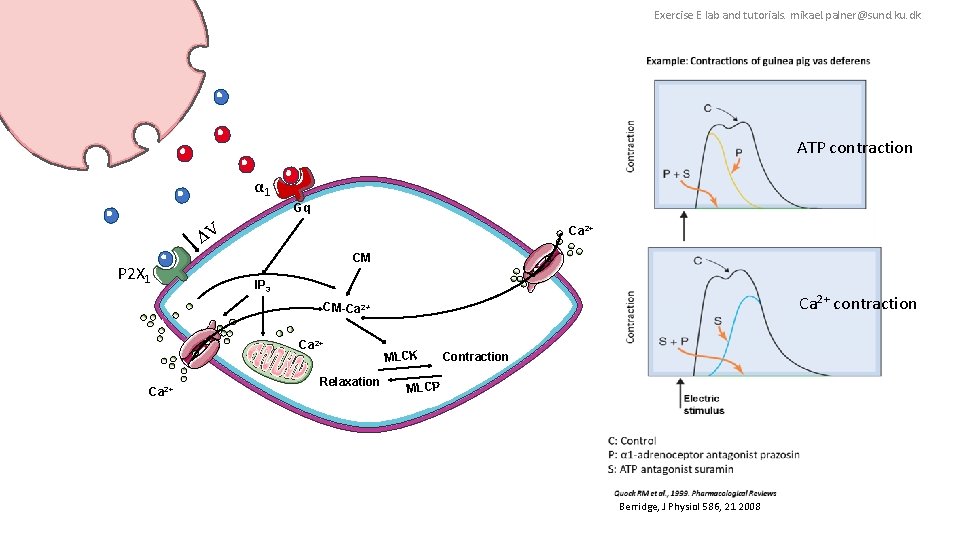
Exercise E lab and tutorials. mikael. palner@sund. ku. dk ATP contraction α 1 Gq ΔV P 2 X 1 Ca 2+ CM IP 3 Ca 2+ contraction CM-Ca 2+ Relaxation MLCK Contraction MLCP Berridge, J Physiol 586, 21 2008
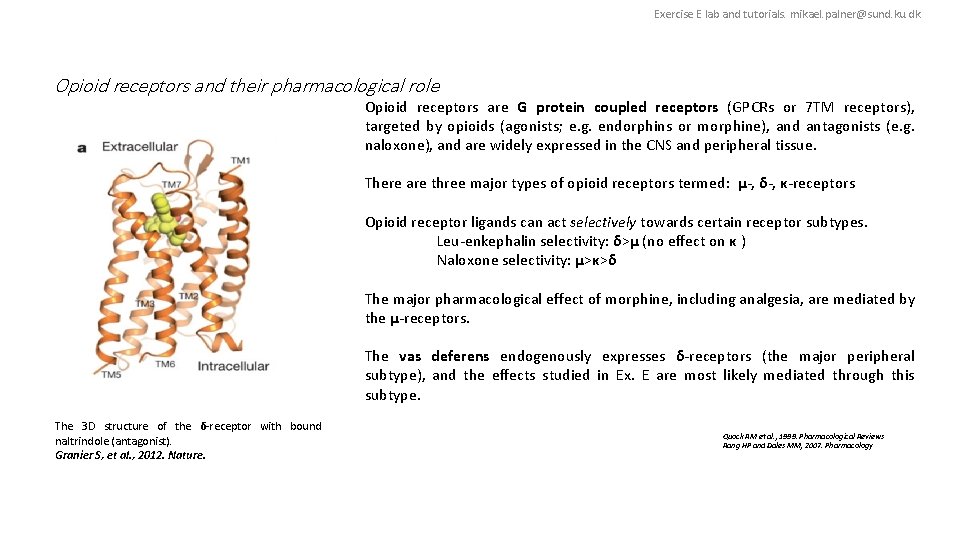
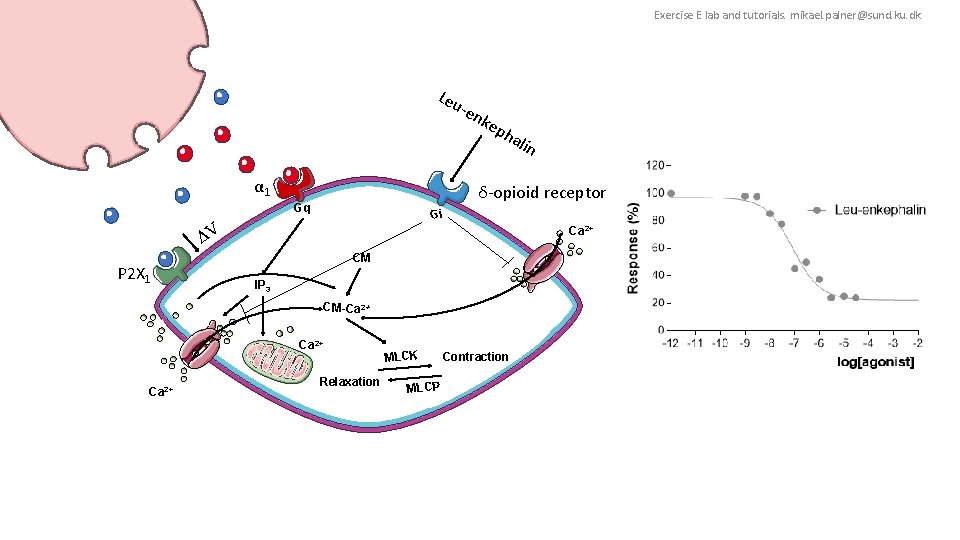
Exercise E lab and tutorials. mikael. palner@sund. ku. dk Opioid receptors and their pharmacological role Opioid receptors are G protein coupled receptors (GPCRs or 7 TM receptors), targeted by opioids (agonists; e. g. endorphins or morphine), and antagonists (e. g. naloxone), and are widely expressed in the CNS and peripheral tissue. There are three major types of opioid receptors termed: μ-, δ-, κ-receptors Opioid receptor ligands can act selectively towards certain receptor subtypes. Leu-enkephalin selectivity: δ>μ (no effect on κ ) Naloxone selectivity: μ>κ>δ The major pharmacological effect of morphine, including analgesia, are mediated by the μ-receptors. The vas deferens endogenously expresses δ-receptors (the major peripheral subtype), and the effects studied in Ex. E are most likely mediated through this subtype. The 3 D structure of the δ-receptor with bound naltrindole (antagonist). Granier S, et al. , 2012. Nature. Quock RM et al. , 1999. Pharmacological Reviews Rang HP and Dales MM, 2007. Pharmacology
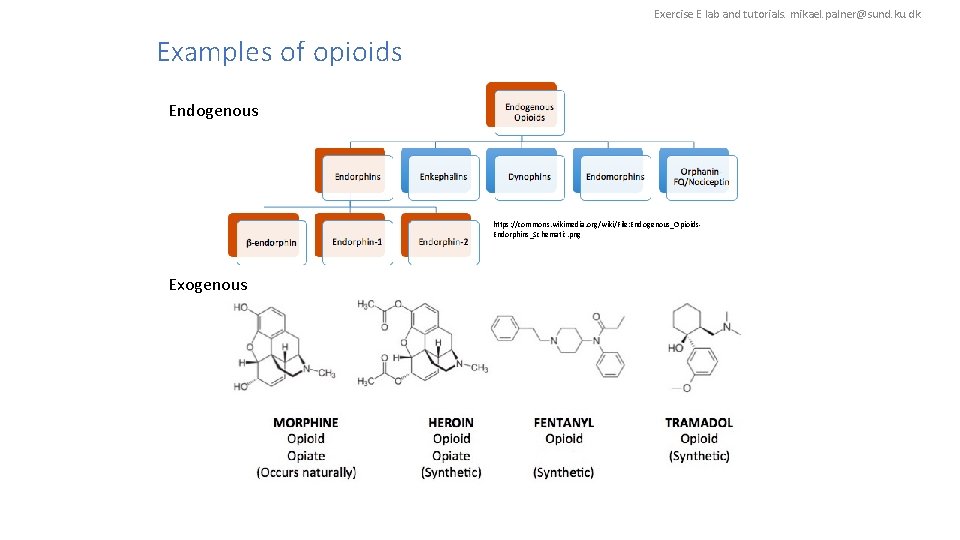
Exercise E lab and tutorials. mikael. palner@sund. ku. dk Examples of opioids Endogenous https: //commons. wikimedia. org/wiki/File: Endogenous_Opioids. Endorphins_Schematic. png Exogenous
Exercise E lab and tutorials. mikael. palner@sund. ku. dk Leu -en α 1 ha Gi ΔV Ca 2+ CM IP 3 CM-Ca 2+ lin δ-opioid receptor Gq P 2 X 1 kep Relaxation MLCK MLCP Contraction
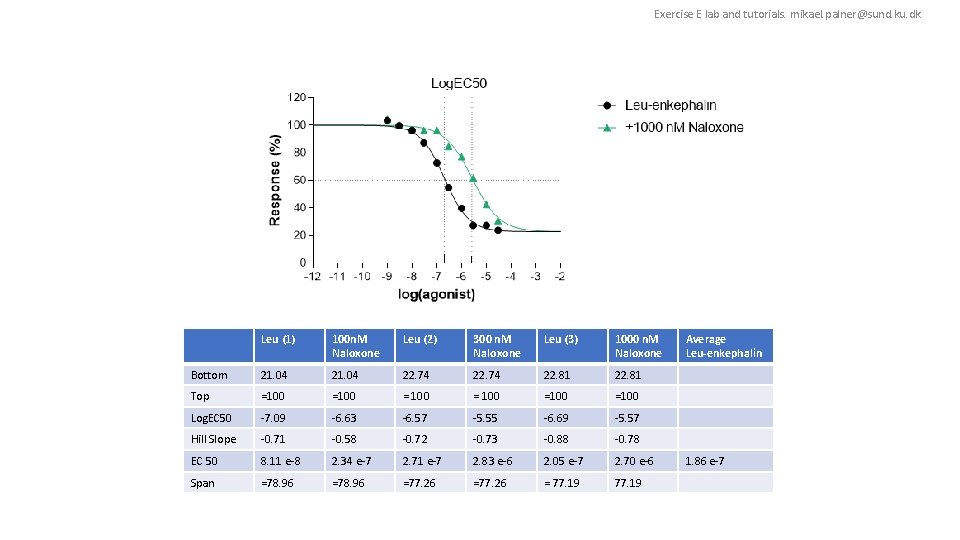
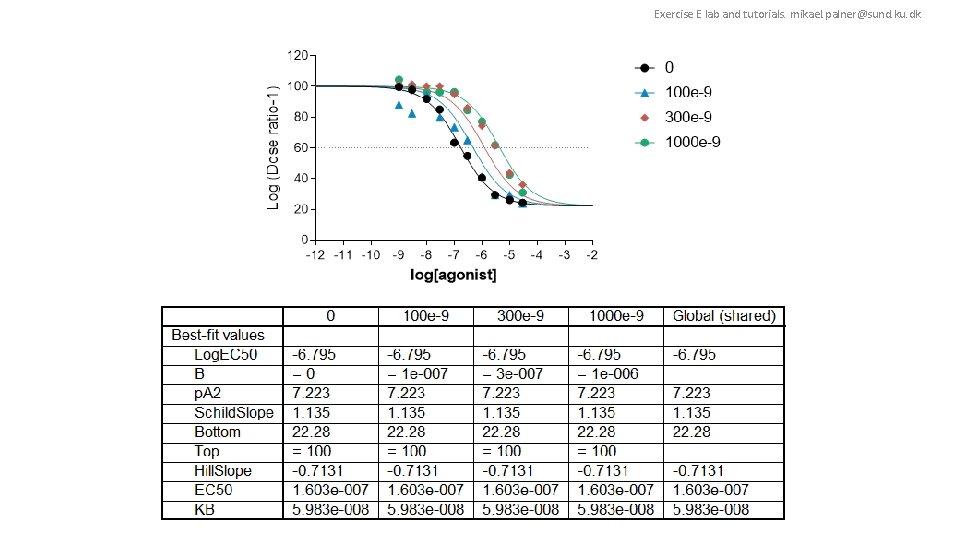
Exercise E lab and tutorials. mikael. palner@sund. ku. dk Leu (1) 100 n. M Naloxone Leu (2) 300 n. M Naloxone Leu (3) 1000 n. M Naloxone Bottom 21. 04 22. 74 22. 81 Top =100 =100 Log. EC 50 -7. 09 -6. 63 -6. 57 -5. 55 -6. 69 -5. 57 Hill Slope -0. 71 -0. 58 -0. 72 -0. 73 -0. 88 -0. 78 EC 50 8. 11 e-8 2. 34 e-7 2. 71 e-7 2. 83 e-6 2. 05 e-7 2. 70 e-6 Span =78. 96 =77. 26 = 77. 19 Average Leu-enkephalin 1. 86 e-7
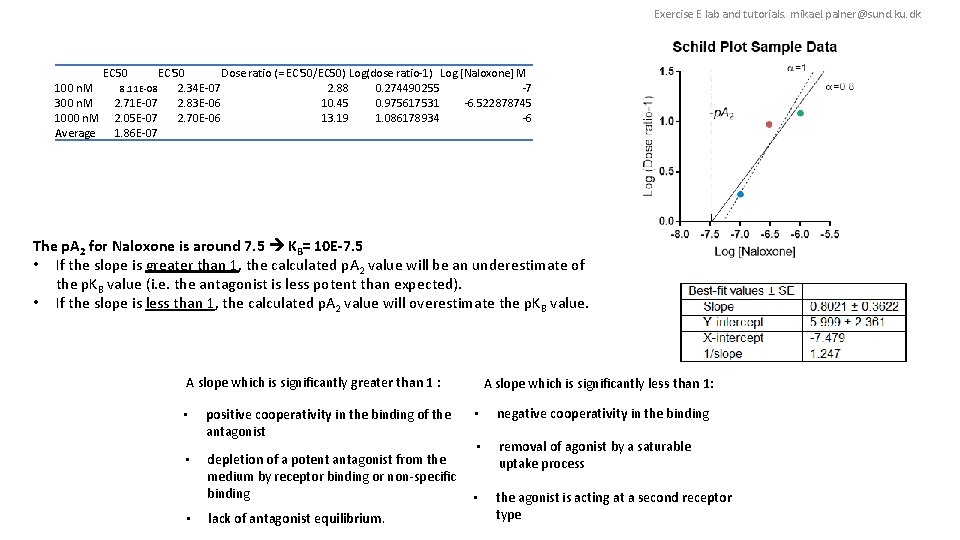
Exercise E lab and tutorials. mikael. palner@sund. ku. dk EC 50 100 n. M 300 n. M 1000 n. M Average EC'50 Dose ratio (= EC'50/EC 50) Log(dose ratio-1) Log [Naloxone] M 2. 34 E-07 2. 88 0. 274490255 -7 8. 11 E-08 2. 71 E-07 2. 83 E-06 10. 45 0. 975617531 -6. 522878745 2. 05 E-07 2. 70 E-06 13. 19 1. 086178934 -6 1. 86 E-07 The p. A 2 for Naloxone is around 7. 5 KB= 10 E-7. 5 • If the slope is greater than 1, the calculated p. A 2 value will be an underestimate of the p. KB value (i. e. the antagonist is less potent than expected). • If the slope is less than 1, the calculated p. A 2 value will overestimate the p. KB value. A slope which is significantly greater than 1 : • • • positive cooperativity in the binding of the antagonist depletion of a potent antagonist from the medium by receptor binding or non-specific binding lack of antagonist equilibrium. A slope which is significantly less than 1: • negative cooperativity in the binding • removal of agonist by a saturable uptake process • the agonist is acting at a second receptor type
Exercise E lab and tutorials. mikael. palner@sund. ku. dk
Exercise E lab and tutorials. mikael. palner@sund. ku. dk Unknown Compound
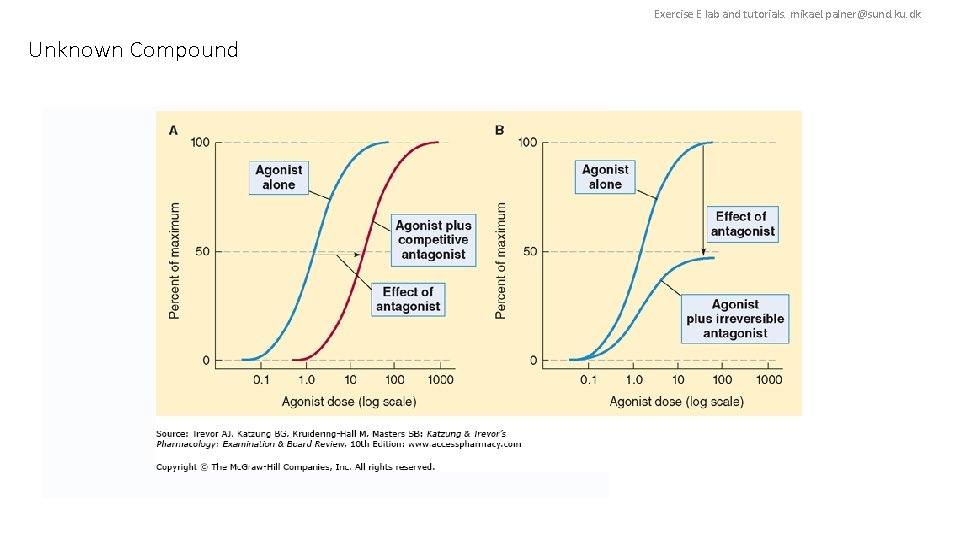
Exercise E lab and tutorials. mikael. palner@sund. ku. dk Exercise E - curriculum Concentration-response curves and Schild-analysis Questions to be discussed during the tutorial: 1. Describe the experimental procedures, before and after antagonist application. 2. How did your concentration-response curve look like and what is your explanation for the relationship? 3. How does competitive reversible and irreversible antagonism affect the concentrationresponse curve? 4. Explain the purpose of the Schild plot. 5. What are the characteristic values that can be calculated/estimated from the Schild plot and what do they indicate? 6. What kind of antagonism was observed in Ex. E and how else could we have determined that (other experiments)?