
Exercise and Academic Performance Introduction We are interested
- Slides: 1
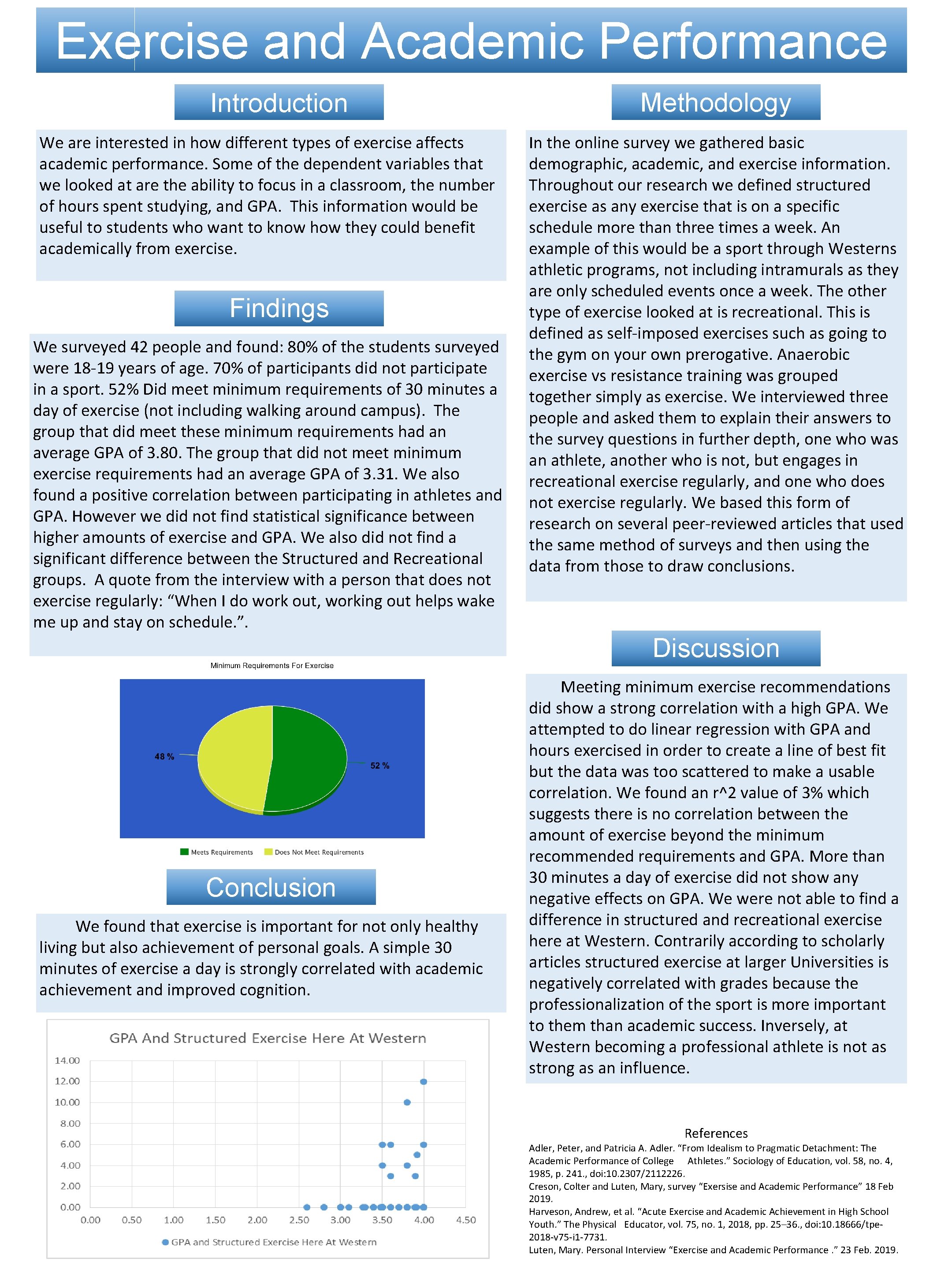
Exercise and Academic Performance Introduction We are interested in how different types of exercise affects academic performance. Some of the dependent variables that we looked at are the ability to focus in a classroom, the number of hours spent studying, and GPA. This information would be useful to students who want to know how they could benefit academically from exercise. Findings We surveyed 42 people and found: 80% of the students surveyed were 18 -19 years of age. 70% of participants did not participate in a sport. 52% Did meet minimum requirements of 30 minutes a day of exercise (not including walking around campus). The group that did meet these minimum requirements had an average GPA of 3. 80. The group that did not meet minimum exercise requirements had an average GPA of 3. 31. We also found a positive correlation between participating in athletes and GPA. However we did not find statistical significance between higher amounts of exercise and GPA. We also did not find a significant difference between the Structured and Recreational groups. A quote from the interview with a person that does not exercise regularly: “When I do work out, working out helps wake me up and stay on schedule. ”. Methodology In the online survey we gathered basic demographic, academic, and exercise information. Throughout our research we defined structured exercise as any exercise that is on a specific schedule more than three times a week. An example of this would be a sport through Westerns athletic programs, not including intramurals as they are only scheduled events once a week. The other type of exercise looked at is recreational. This is defined as self-imposed exercises such as going to the gym on your own prerogative. Anaerobic exercise vs resistance training was grouped together simply as exercise. We interviewed three people and asked them to explain their answers to the survey questions in further depth, one who was an athlete, another who is not, but engages in recreational exercise regularly, and one who does not exercise regularly. We based this form of research on several peer-reviewed articles that used the same method of surveys and then using the data from those to draw conclusions. Discussion Conclusion We found that exercise is important for not only healthy living but also achievement of personal goals. A simple 30 minutes of exercise a day is strongly correlated with academic achievement and improved cognition. Meeting minimum exercise recommendations did show a strong correlation with a high GPA. We attempted to do linear regression with GPA and hours exercised in order to create a line of best fit but the data was too scattered to make a usable correlation. We found an r^2 value of 3% which suggests there is no correlation between the amount of exercise beyond the minimum recommended requirements and GPA. More than 30 minutes a day of exercise did not show any negative effects on GPA. We were not able to find a difference in structured and recreational exercise here at Western. Contrarily according to scholarly articles structured exercise at larger Universities is negatively correlated with grades because the professionalization of the sport is more important to them than academic success. Inversely, at Western becoming a professional athlete is not as strong as an influence. References Adler, Peter, and Patricia A. Adler. “From Idealism to Pragmatic Detachment: The Academic Performance of College Athletes. ” Sociology of Education, vol. 58, no. 4, 1985, p. 241. , doi: 10. 2307/2112226. Creson, Colter and Luten, Mary, survey “Exersise and Academic Performance” 18 Feb 2019. Harveson, Andrew, et al. “Acute Exercise and Academic Achievement in High School Youth. ” The Physical Educator, vol. 75, no. 1, 2018, pp. 25– 36. , doi: 10. 18666/tpe 2018 -v 75 -i 1 -7731. Luten, Mary. Personal Interview “Exercise and Academic Performance. ” 23 Feb. 2019.