
EXERCISE 8 WAVES SOUND AND LIGHT PAGE 179
- Slides: 18
EXERCISE 8 WAVES, SOUND AND LIGHT PAGE 179
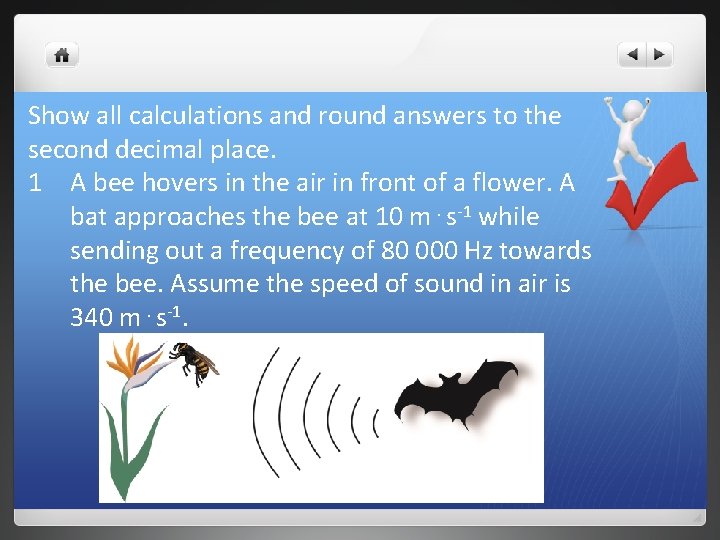
Show all calculations and round answers to the second decimal place. 1 A bee hovers in the air in front of a flower. A bat approaches the bee at 10 m⋅s-1 while sending out a frequency of 80 000 Hz towards the bee. Assume the speed of sound in air is 340 m⋅s-1.
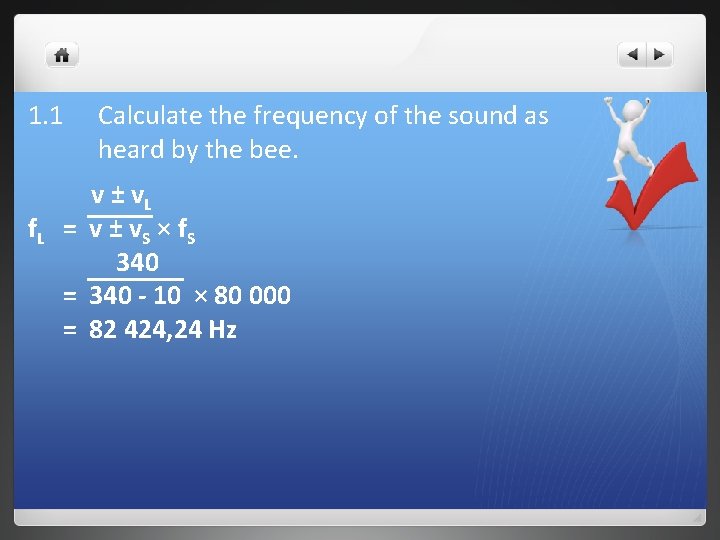
1. 1 Calculate the frequency of the sound as heard by the bee. v ± v. L f. L = v ± v S × f. S 340 = 340 - 10 × 80 000 = 82 424, 24 Hz
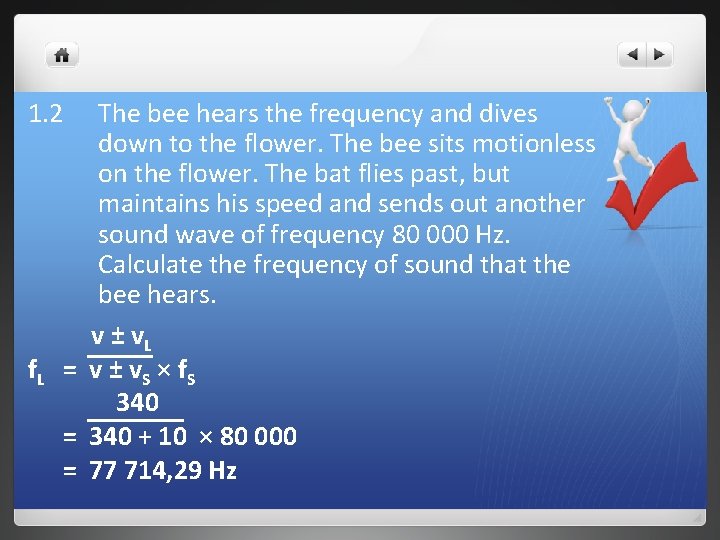
1. 2 The bee hears the frequency and dives down to the flower. The bee sits motionless on the flower. The bat flies past, but maintains his speed and sends out another sound wave of frequency 80 000 Hz. Calculate the frequency of sound that the bee hears. v ± v. L f. L = v ± v S × f. S 340 = 340 + 10 × 80 000 = 77 714, 29 Hz
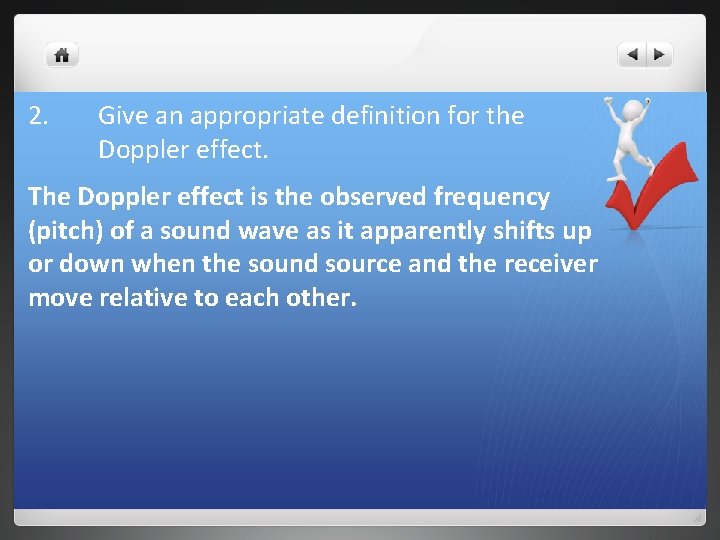
2. Give an appropriate definition for the Doppler effect. The Doppler effect is the observed frequency (pitch) of a sound wave as it apparently shifts up or down when the sound source and the receiver move relative to each other.
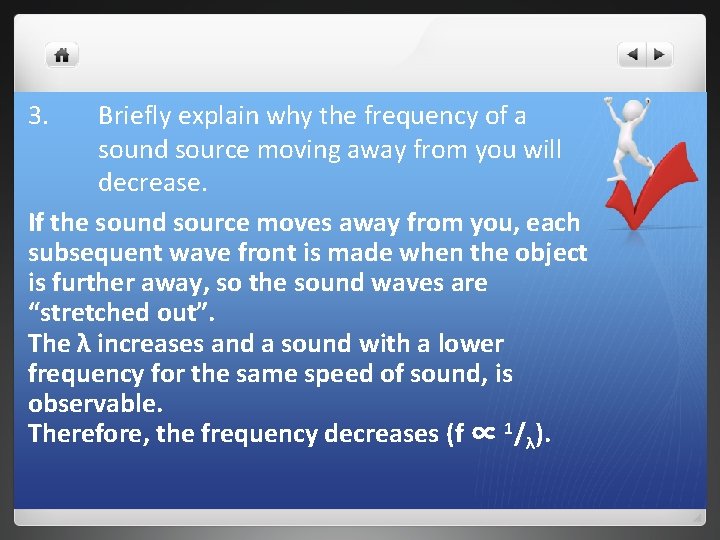
3. Briefly explain why the frequency of a sound source moving away from you will decrease. If the sound source moves away from you, each subsequent wave front is made when the object is further away, so the sound waves are “stretched out”. The λ increases and a sound with a lower frequency for the same speed of sound, is observable. Therefore, the frequency decreases (f ∝ 1/λ).
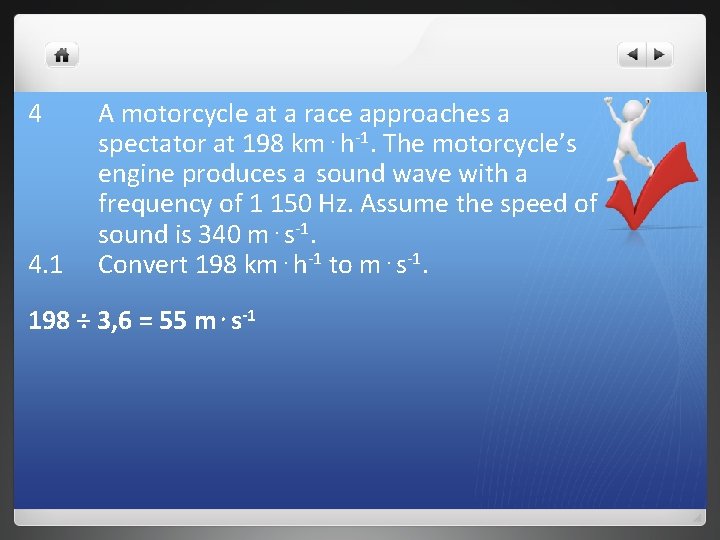
4 4. 1 A motorcycle at a race approaches a spectator at 198 km⋅h-1. The motorcycle’s engine produces a sound wave with a frequency of 1 150 Hz. Assume the speed of sound is 340 m⋅s-1. Convert 198 km⋅h-1 to m⋅s-1. 198 ÷ 3, 6 = 55 m⋅s-1
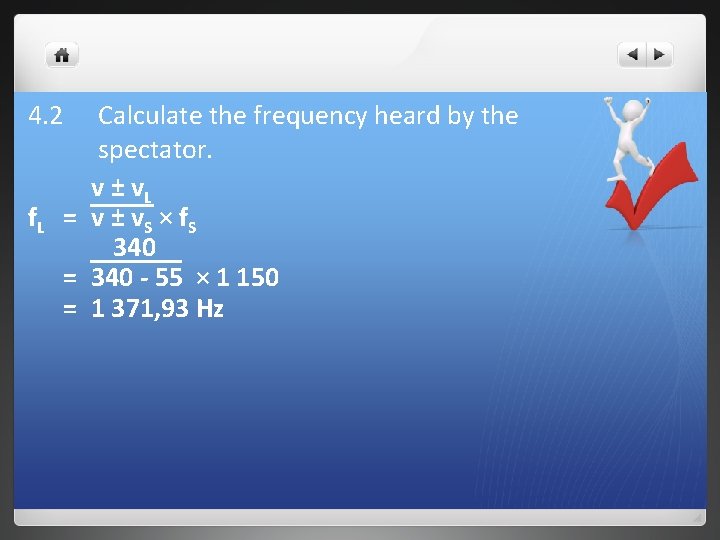
4. 2 Calculate the frequency heard by the spectator. v ± v. L f L = v ± v. S × f S 340 = 340 - 55 × 1 150 = 1 371, 93 Hz
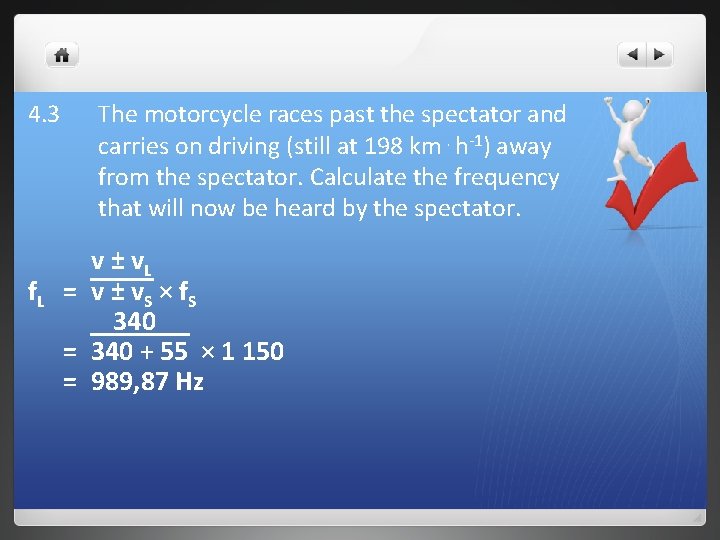
4. 3 The motorcycle races past the spectator and carries on driving (still at 198 km⋅h-1) away from the spectator. Calculate the frequency that will now be heard by the spectator. v ± v. L f L = v ± v. S × f S 340 = 340 + 55 × 1 150 = 989, 87 Hz
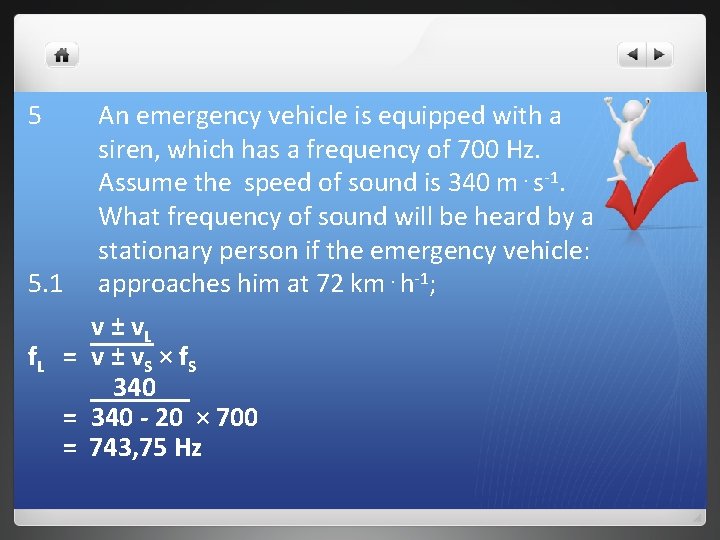
5 5. 1 An emergency vehicle is equipped with a siren, which has a frequency of 700 Hz. Assume the speed of sound is 340 m⋅s-1. What frequency of sound will be heard by a stationary person if the emergency vehicle: approaches him at 72 km⋅h-1; v ± v. L f L = v ± v. S × f S 340 = 340 - 20 × 700 = 743, 75 Hz
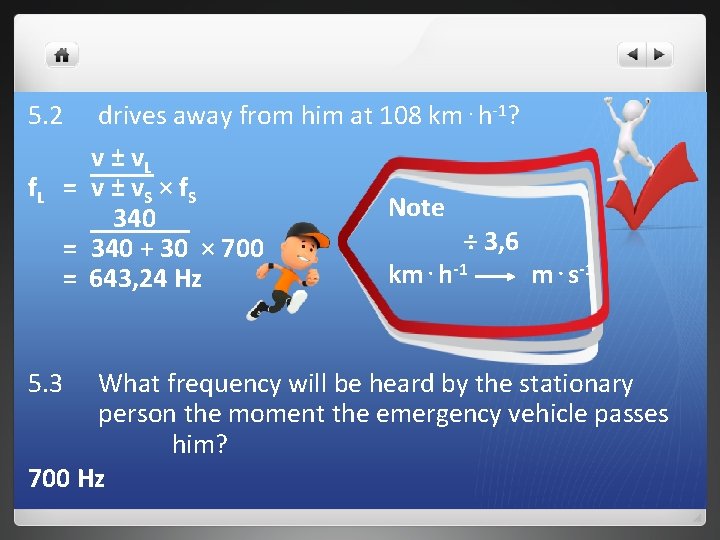
5. 2 drives away from him at 108 km⋅h-1? v ± v. L f L = v ± v. S × f S Note 340 ÷ 3, 6 = 340 + 30 × 700 km⋅h-1 m⋅s-1 = 643, 24 Hz 5. 3 What frequency will be heard by the stationary person the moment the emergency vehicle passes him? 700 Hz
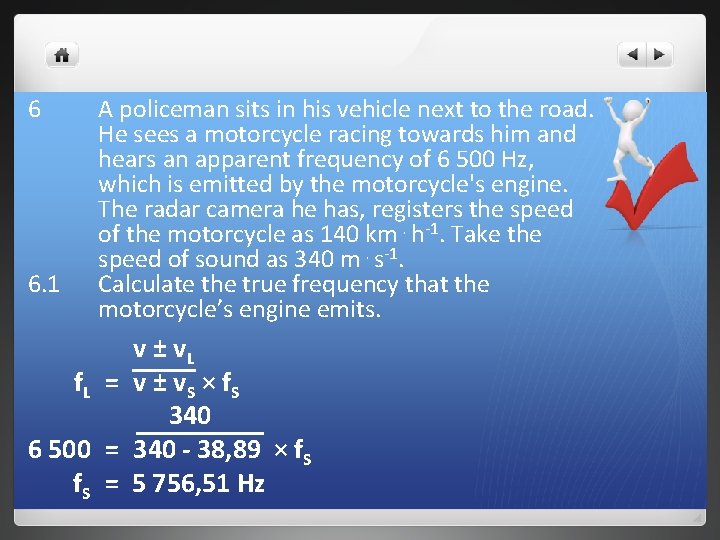
6 6. 1 A policeman sits in his vehicle next to the road. He sees a motorcycle racing towards him and hears an apparent frequency of 6 500 Hz, which is emitted by the motorcycle's engine. The radar camera he has, registers the speed of the motorcycle as 140 km⋅h-1. Take the speed of sound as 340 m⋅s-1. Calculate the true frequency that the motorcycle’s engine emits. v ± v. L f L = v ± v. S × f S 340 6 500 = 340 - 38, 89 × f. S = 5 756, 51 Hz
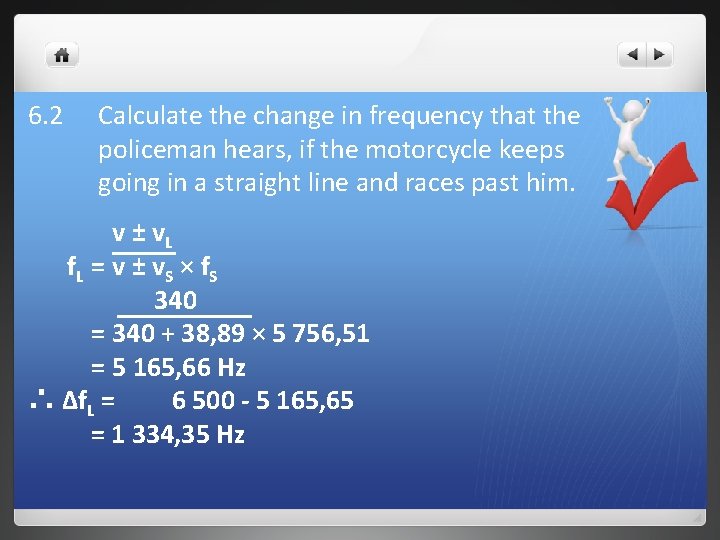
6. 2 Calculate the change in frequency that the policeman hears, if the motorcycle keeps going in a straight line and races past him. v ± v. L f L = v ± v. S × f S 340 = 340 + 38, 89 × 5 756, 51 = 5 165, 66 Hz ∴ Δf. L = 6 500 - 5 165, 65 = 1 334, 35 Hz
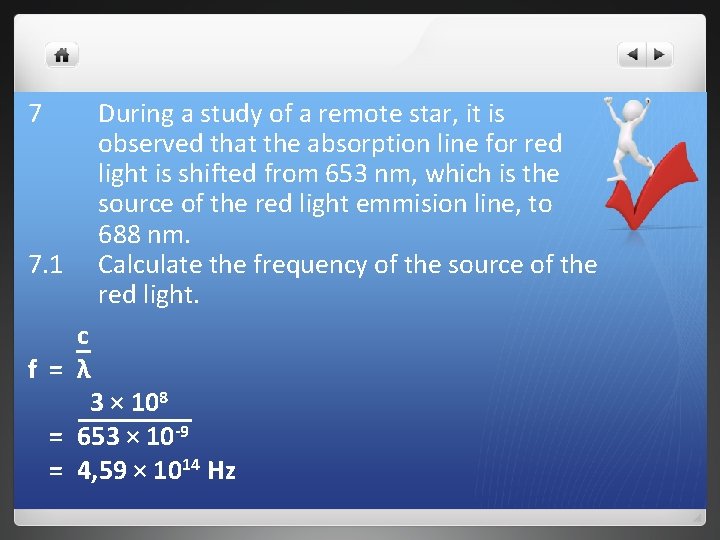
7 7. 1 During a study of a remote star, it is observed that the absorption line for red light is shifted from 653 nm, which is the source of the red light emmision line, to 688 nm. Calculate the frequency of the source of the red light. c f = λ 3 × 108 = 653 × 10 -9 = 4, 59 × 1014 Hz
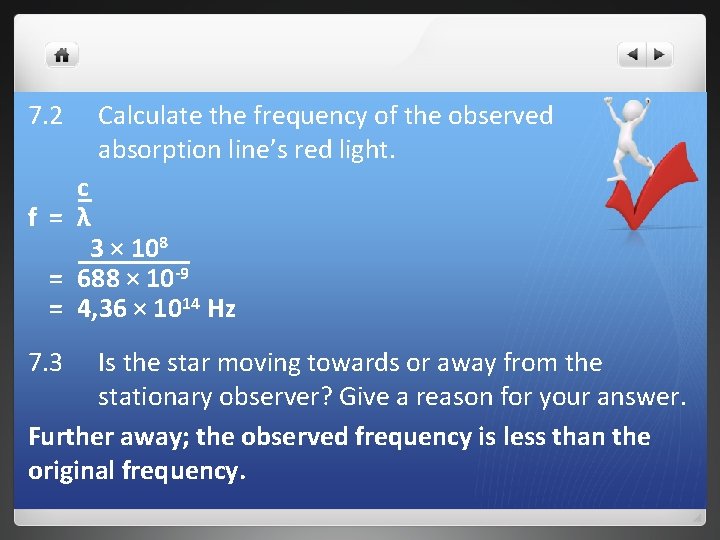
7. 2 Calculate the frequency of the observed absorption line’s red light. c f = λ 3 × 108 = 688 × 10 -9 = 4, 36 × 1014 Hz 7. 3 Is the star moving towards or away from the stationary observer? Give a reason for your answer. Further away; the observed frequency is less than the original frequency.
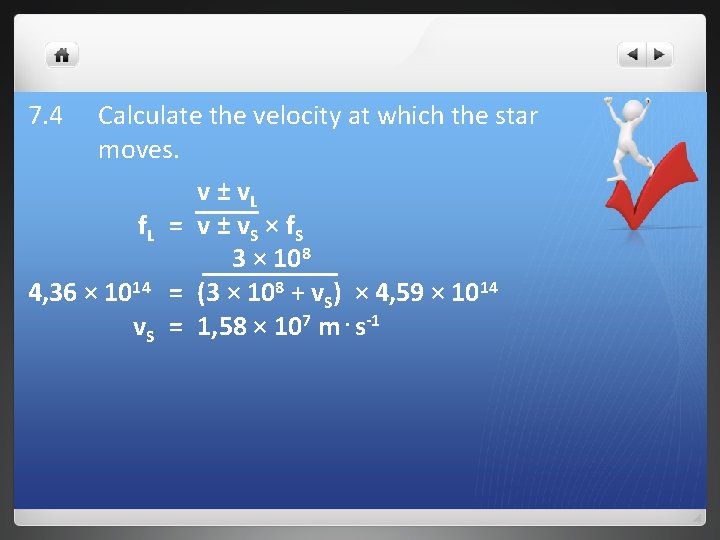
7. 4 Calculate the velocity at which the star moves. v ± v. L f L = v ± v. S × f S 3 × 10⁸ 4, 36 × 1014 = (3 × 10⁸ + v. S) × 4, 59 × 1014 v. S = 1, 58 × 107 m⋅s-1
8. 1 Refer to the Doppler effect and explain how a bat can determine the magnitude and direction of an insect’s velocity at night. The bat sends out a signal at a certain frequency. If the insect moves, the frequency that is reflected from it, changes. The changed frequency provides the bat with information about the movement of the insect. If the frequency is higher, the insect is moving closer; if the frequency is lower, the insect is moving away; if the frequency is the same; neither is moving or the insect is moving at the same velocity as the bat.
8. 2 Blind people can use echolocation to find their way without the help of others or even without a cane. The person regularly and continuously clicks with their tongue and then listens for the echo. There are even blind people who ride mountain bikes using this method. Explain how it is possible for blind people to “see” this way. The blind person observes the reflected frequency. The changed frequency then gives the person information about the environment. If the frequency is higher; the object is moving closer, if the frequency is lower; the object is moving further away. If the frequency remains the same; the object is not moving or moving at the same velocity as the person.