
Exercise 2 7 Regression artefact Lords paradox Recapitulation

- Slides: 20
Exercise 2 -7: Regression artefact: Lord’s paradox
Recapitulation I: Memory Judgments q Judging of stability and change: Ø Assessment of former attitudes is influenced by actual attitudes. Ø Biased assessments of previous states (capabilities, pain) in order to explain «effect» of treatments. q Hindsight bias: Biased retrospective evaluation of previous knowledge: «I knew it all along!»
Recapitulation II: Memory Judgments q Basic Mechanism: Anchoring and adjustment: Actual state serves as an anchor that is adjusted due to subjective theories. q Open mindedness as an important aspect of critical thinking: Taking different perspectives.
Recapitulation III: Retrospective evaluation of episodes q Central Result: A negative event of greater duration is preferred to a shorter negative event that is part of the longer event. q Experiences and memory of experiences can differ. q Snapshot model.
Recapitulation IV: Heuristics and Biases Program q Availability Heuristic: The frequency of events is judged due to the easiness of how particluar instances can be generated (or come to mind). q Examples: Ø Memory and availability: Famous people Ø Death rates. Ø Influence of imagination.
Availability heuristic: Personal experience and exampels q Ex. 4 6: Influence of personal experiences and examples. q Central lession to be learned: Beware of arguments based on examples.
Probability Judgments: Representativeness Heuristic I q Functioning: Assessment of the frequency of events according to similarity. q Example: Evaluation of the probability of random sequences
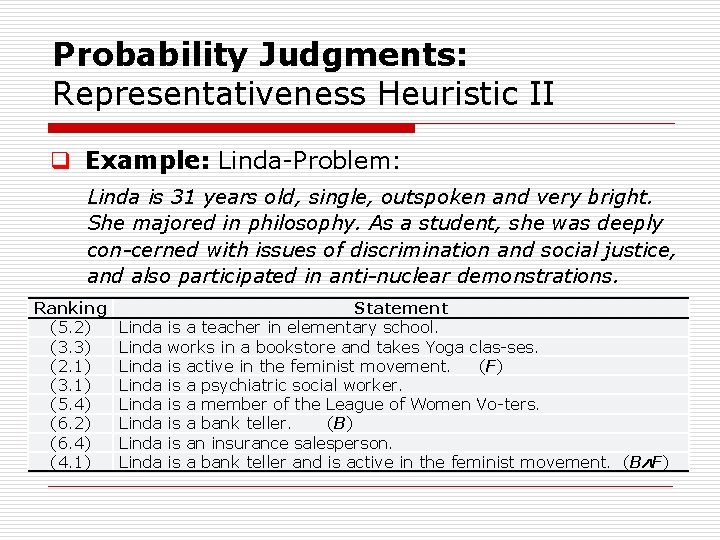
Probability Judgments: Representativeness Heuristic II q Example: Linda Problem: Linda is 31 years old, single, outspoken and very bright. She majored in philosophy. As a student, she was deeply con cerned with issues of discrimination and social justice, and also participated in anti nuclear demonstrations. Ranking (5. 2) (3. 3) (2. 1) (3. 1) (5. 4) (6. 2) (6. 4) (4. 1) Linda Linda Statement is a teacher in elementary school. works in a bookstore and takes Yoga clas ses. is active in the feminist movement. (F) is a psychiatric social worker. is a member of the League of Women Vo ters. is a bank teller. (B) is an insurance salesperson. is a bank teller and is active in the feminist movement. (B F)
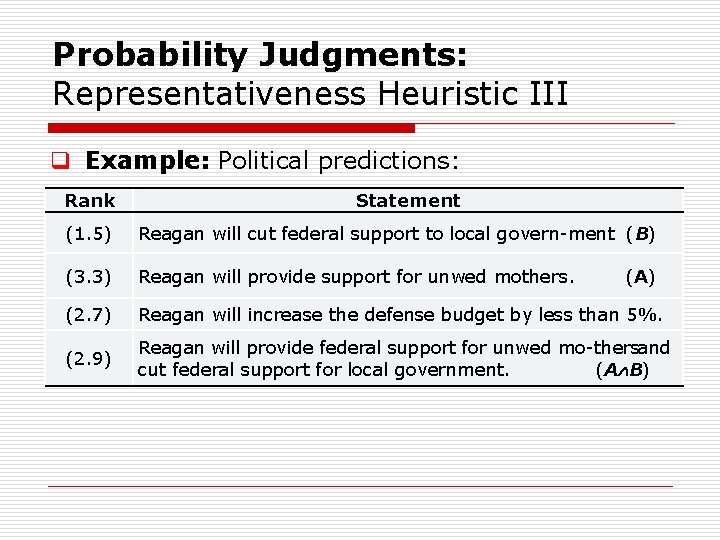
Probability Judgments: Representativeness Heuristic III q Example: Political predictions: Rank Statement (1. 5) Reagan will cut federal support to local govern ment. (B) (3. 3) Reagan will provide support for unwed mothers. (2. 7) Reagan will increase the defense budget by less than 5%. (2. 9) Reagan will provide federal support for unwed mo thersand cut federal support for local government. (A B) (A)
Probability Judgments: Representativeness Heuristic IV q Conclusion (Basic lession): Ø Beware of detailed internally coherent and plausible scenarios (those concerning the future as well as those concerning the past). Ø More detailed scenarios appear as more plausible. However more detailed scenarios are less probable since each added de tail reduces the probability of the scenario.
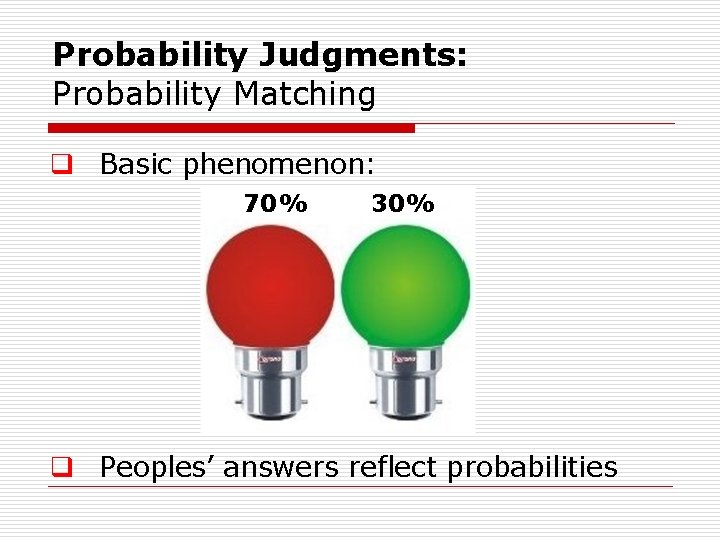
Probability Judgments: Probability Matching q Basic phenomenon: 70% 30% q Peoples’ answers reflect probabilities
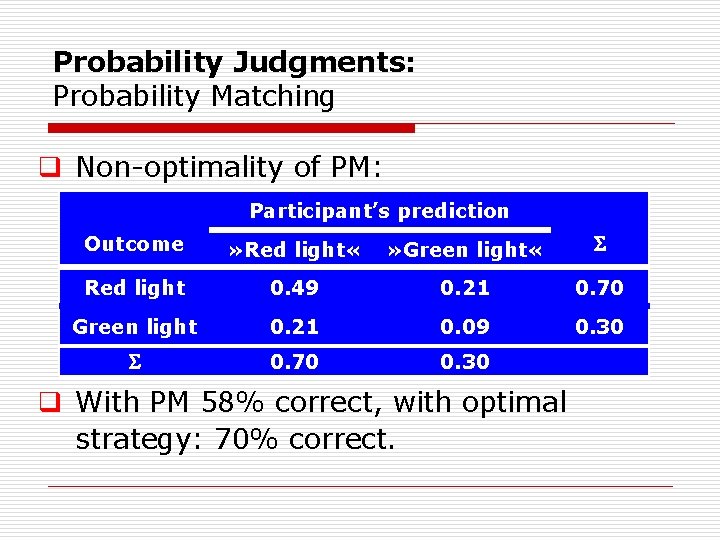
Probability Judgments: Probability Matching q Non optimality of PM: Participant’s prediction Outcome » Red light « » Green light « Red light 0. 49 0. 21 0. 70 Green light 0. 21 0. 09 0. 30 0. 70 0. 30 q With PM 58% correct, with optimal strategy: 70% correct.
Probability Judgments: Probability Matching (PM) q Humans and animals: Ø Rats and students Ø Animals: birds Ø Animals: ducks q Individual differences: Ø Intelligence and PM Ø Gender differences
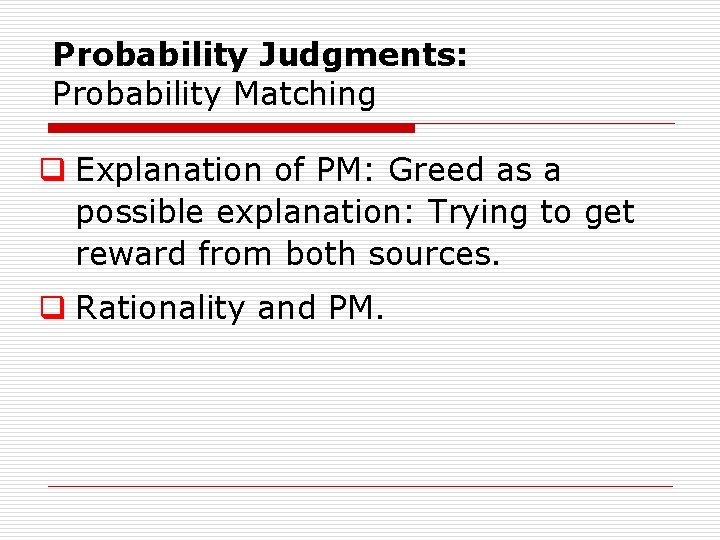
Probability Judgments: Probability Matching q Explanation of PM: Greed as a possible explanation: Trying to get reward from both sources. q Rationality and PM.
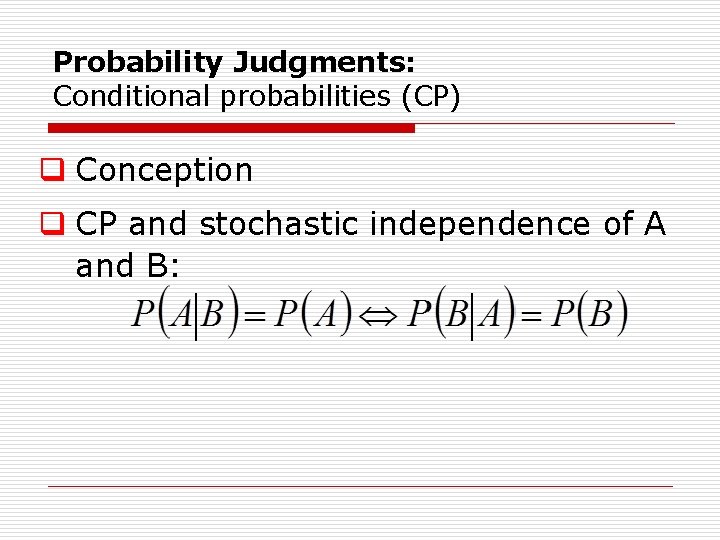
Probability Judgments: Conditional probabilities (CP) q Conception q CP and stochastic independence of A and B:
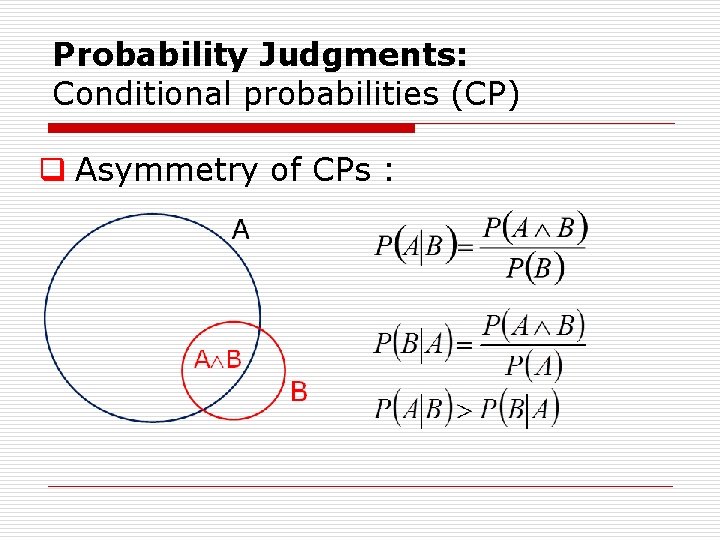
Probability Judgments: Conditional probabilities (CP) q Asymmetry of CPs :
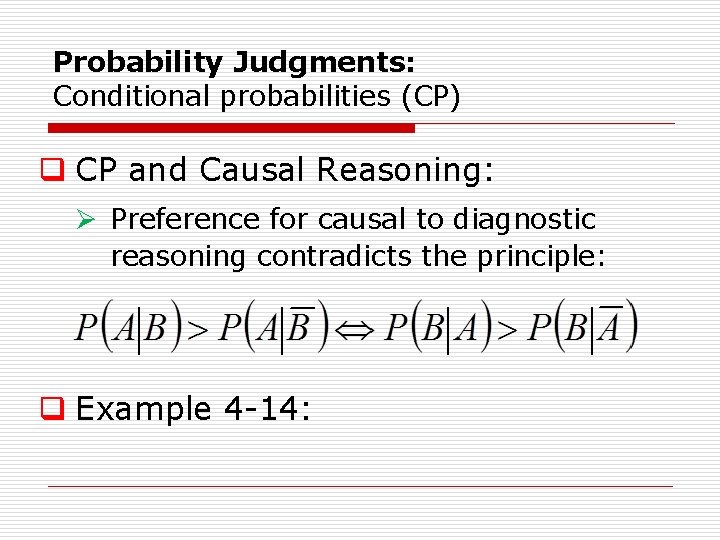
Probability Judgments: Conditional probabilities (CP) q CP and Causal Reasoning: Ø Preference for causal to diagnostic reasoning contradicts the principle: q Example 4 14:
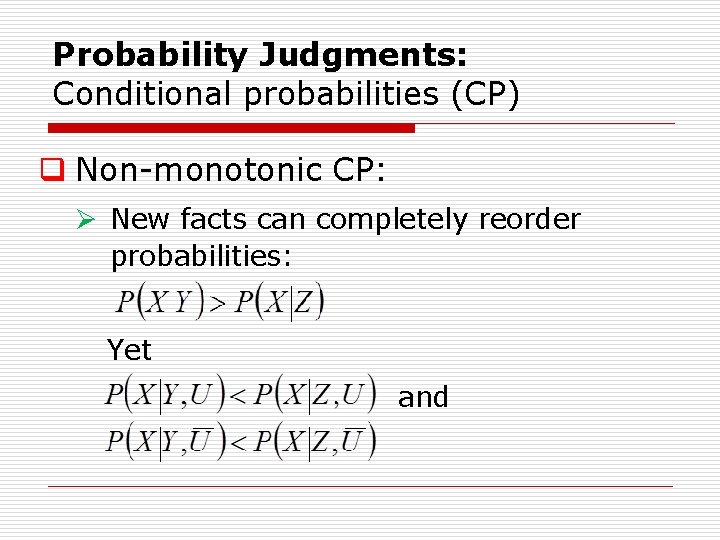
Probability Judgments: Conditional probabilities (CP) q Non monotonic CP: Ø New facts can completely reorder probabilities: Yet and
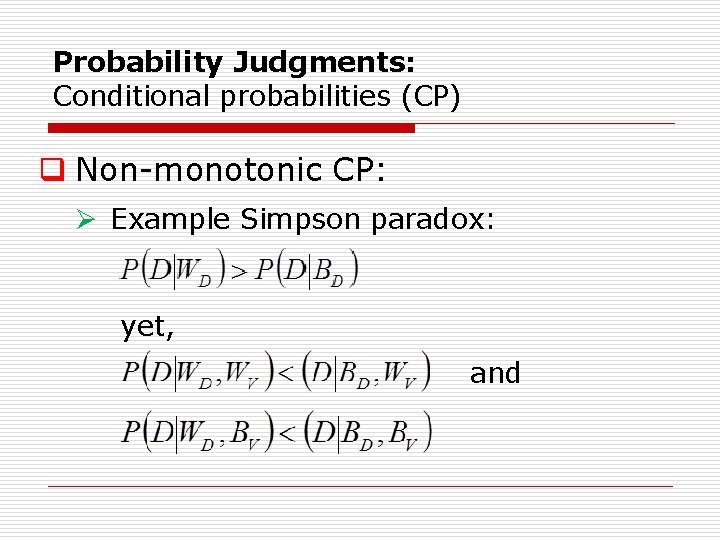
Probability Judgments: Conditional probabilities (CP) q Non monotonic CP: Ø Example Simpson paradox: yet, and
Probability Judgments: Base rate neglect q Ignoring base rates Ø What is base rate information? Ø Example: Base rate neglect Ø Causal base rates