
Executive Doctorate in Business Administration EDBA EDBA Taskforce
Executive Doctorate in Business Administration (EDBA)

EDBA Taskforce • • Wes Davenport Doug Barrett Erin Gillespie Diane Kutz Jason Imbrogno Jana Beaver Barry Cumbie
What is the EDBA? • DBA and EDBA degrees have been growing in popularity in Europe and now in the US in recent years. • The degree is a terminal degree, similar to the Ph. D, but often for a different demographic group and with a different career path. • Thus the DBA is a popular choice for those making a career shift later in life or seeking a new challenge. • Although both degrees qualify the recipient to teach at the college level and conduct research, the Ph. D degree is usually more research focused and theoretical while the DBA is more applied.
Why an EDBA? • Existing market demand recent growth • • Higher Education (e. g. , instructors/non-tenure track faculty) Executives Military Future consultants and academics
Sample Student Profiles from University of Wisconsin Whitewater • Global Head of Strategic Affairs for Accuity • Chief Audit Officer of Illinois Municipal Retirement Fund • Executive Director of Safety US Air Force Global Strike Command • Senior Assoc. Instructor at Western Illinois University • Assoc. Professor at Rockford University • Executive Director of Cardiac Service Line for Children’s Hospital • Senior Lecturer at University of Wisconsin-Oshkosh • IT Executive at Thermo Fisher Scientific
Why an EDBA? Fit within the COB at UNA • • • Growth/Success of the MBA and Exec. MBA Applied focus vs. traditional Ph. D University decision to pursue two doctoral programs at UNA
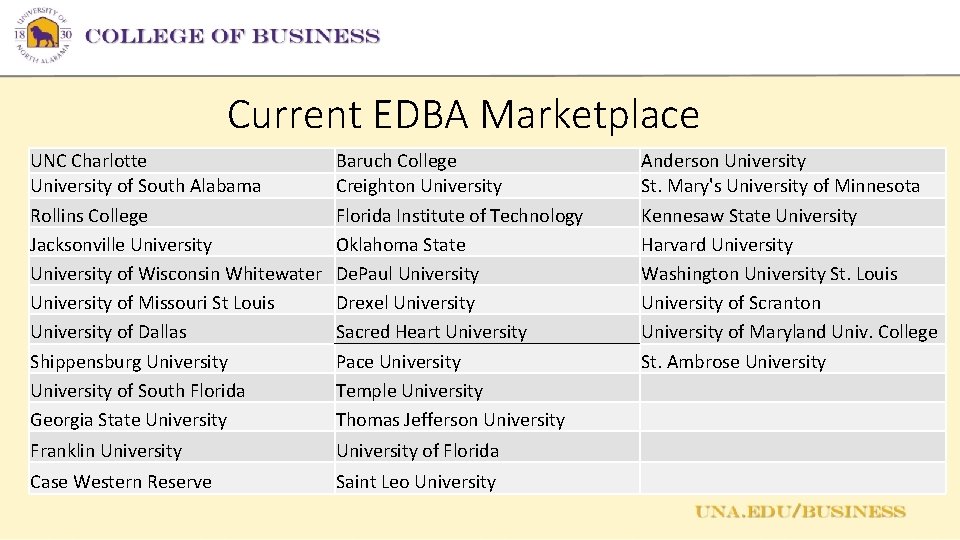
Current EDBA Marketplace UNC Charlotte University of South Alabama Rollins College Jacksonville University of Wisconsin Whitewater University of Missouri St Louis University of Dallas Shippensburg University of South Florida Georgia State University Baruch College Creighton University Florida Institute of Technology Oklahoma State De. Paul University Drexel University Sacred Heart University Pace University Temple University Thomas Jefferson University Franklin University of Florida Case Western Reserve Saint Leo University Anderson University St. Mary's University of Minnesota Kennesaw State University Harvard University Washington University St. Louis University of Scranton University of Maryland Univ. College St. Ambrose University
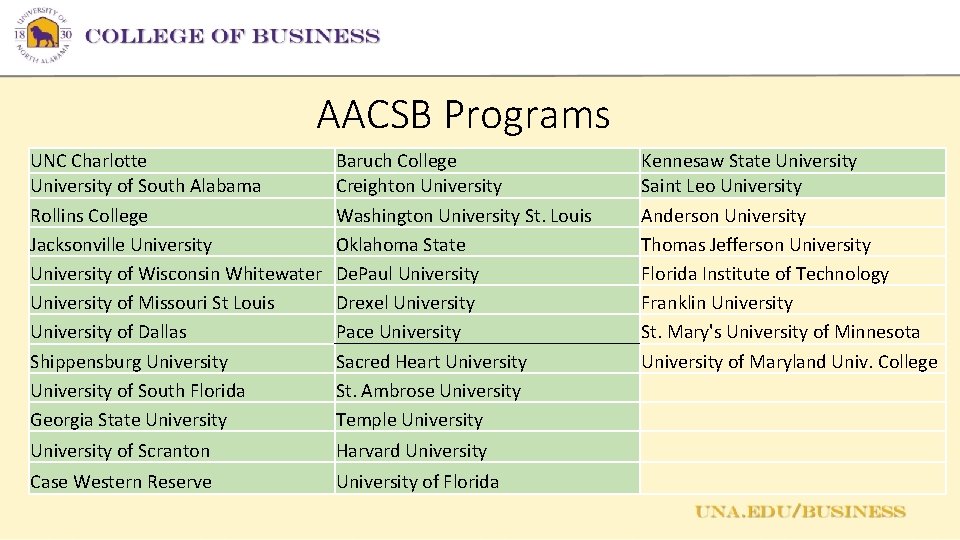
AACSB Programs UNC Charlotte University of South Alabama Rollins College Jacksonville University of Wisconsin Whitewater University of Missouri St Louis University of Dallas Shippensburg University of South Florida Georgia State University Baruch College Creighton University Washington University St. Louis Oklahoma State De. Paul University Drexel University Pace University Sacred Heart University St. Ambrose University Temple University of Scranton Harvard University Case Western Reserve University of Florida Kennesaw State University Saint Leo University Anderson University Thomas Jefferson University Florida Institute of Technology Franklin University St. Mary's University of Minnesota University of Maryland Univ. College
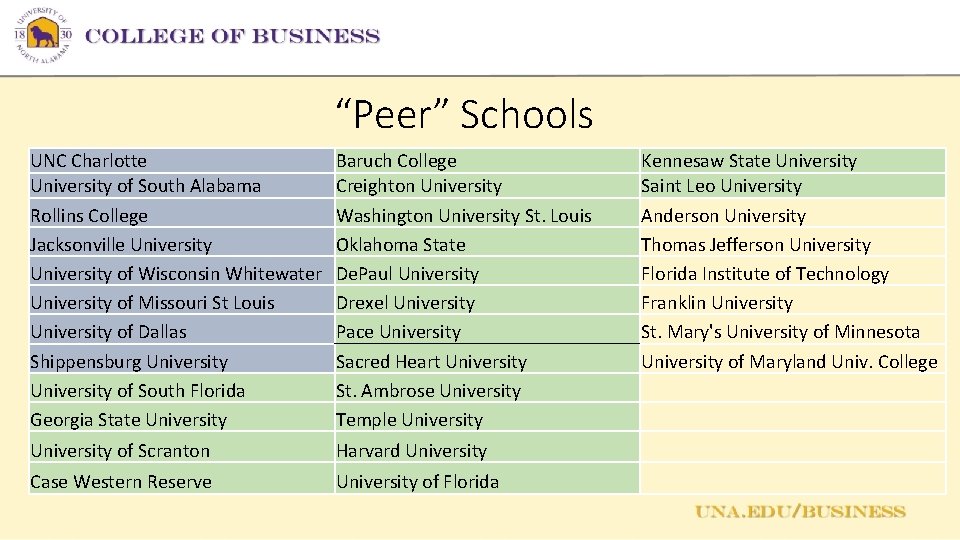
“Peer” Schools UNC Charlotte University of South Alabama Rollins College Jacksonville University of Wisconsin Whitewater University of Missouri St Louis University of Dallas Shippensburg University of South Florida Georgia State University Baruch College Creighton University Washington University St. Louis Oklahoma State De. Paul University Drexel University Pace University Sacred Heart University St. Ambrose University Temple University of Scranton Harvard University Case Western Reserve University of Florida Kennesaw State University Saint Leo University Anderson University Thomas Jefferson University Florida Institute of Technology Franklin University St. Mary's University of Minnesota University of Maryland Univ. College

Common Elements of AACSB Accredited EDBA Programs • 3 Year Program with Dissertation in Year 3 • Online work with residency requirements (7 -15 per year) • Cohorts (15 -30 students) with admission once per year • Price includes 3 years tuition ($75 k—$150 K+)
Proposed EDBA Program • First class enrolled in Fall of 2020; admission once per year • Cohort size of approximately 15 students • 3 Year Program with Dissertation in Year 3 • Online work with residency requirements (8 -10 per year) • Required participation at one academic conference • Optional trip abroad to meet “global business” requirement • Summer Welcome Event and common read

Proposed EDBA Coursework Methods/Statistics (16 hr) UNA Unique (12 hr) Hot Topics (9 hr) Discovering Applied Research (3) Becoming Data Smart (3) Innovation System Solutions (1) Dissertation Design (3) Exploring Statistical Relationships in Business (3) Emerging Issues in Business (3) Prediction and Planning for Business Futures (1) Dissertation (12) Advanced Quantitative Analysis (3) Applied Decision Making and Optimization (2) Integrating GIS to Optimize Business Performance (1) Developing Applied Research Skills (2) Advanced Qualitative Analysis (3) Exploring Trends in the Global Economy (1) Applications of Disruptive Technology (3) Organizational Problem Solving: Design and Measurement (3) Creative and Innovative Thinking (3) Designing Technology for User Experience (1) Engaging with Applied Statistics Lab (1) Emerging Methodologies for Organizations (1) Project Management for Applied Research (1) Dissertation (17 hr)
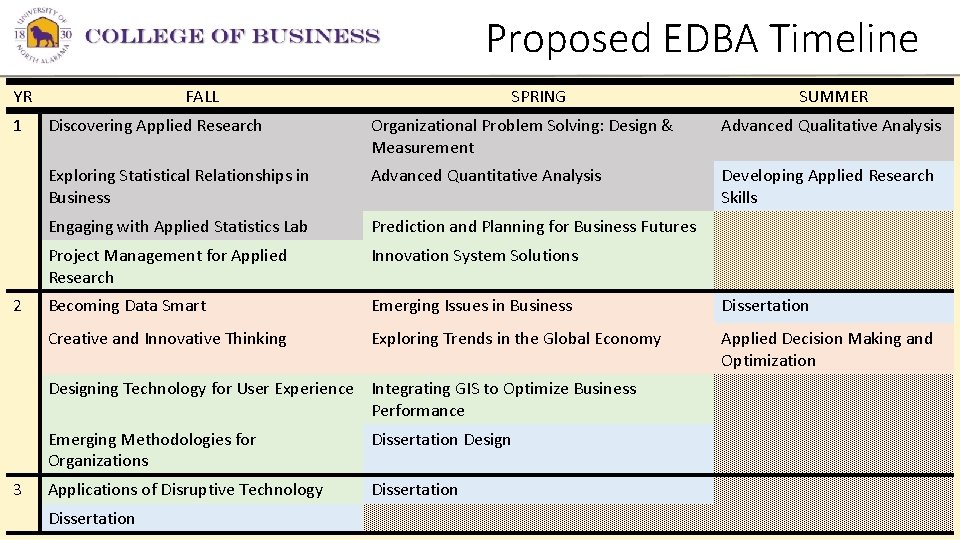
Proposed EDBA Timeline YR 1 2 FALL SPRING Discovering Applied Research Organizational Problem Solving: Design & Measurement Advanced Qualitative Analysis Exploring Statistical Relationships in Business Advanced Quantitative Analysis Developing Applied Research Skills Engaging with Applied Statistics Lab Prediction and Planning for Business Futures Project Management for Applied Research Innovation System Solutions Becoming Data Smart Emerging Issues in Business Dissertation Creative and Innovative Thinking Exploring Trends in the Global Economy Applied Decision Making and Optimization Designing Technology for User Experience Integrating GIS to Optimize Business Performance 3 SUMMER Emerging Methodologies for Organizations Dissertation Design Applications of Disruptive Technology Dissertation
Proposed Admission Requirements • MBA or master’s in related field • Some minimum level of experience (both quantity and quality) • Writing sample/Letter of intent • Interviews
- Slides: 14