
Executive Decision Making Collaborative Decision Making Not Everything
Executive Decision Making/ Collaborative Decision Making Not Everything That Counts Can Be Counted (Measured) and Not Everything That Can Be Counted (Measured), Counts Albert Einstein Forman@gwu. edu http: //Professor. Forman. com
Session 1 • Introduction to decision making concepts, theory and practice. • Intuition (Emotion) and Reason (Rationality) • Intuitive irrationalities • Cognitive limitations and bounded rationality
Executive/Collaborative Decision Making • Prioritize for making decisions • Choice • Selecting the ‘best’ alternative • Resource Allocation • • • Selecting the ‘best’ combination of alternatives Justify/defend recommendations Improve communications Achieve consensus Make meetings more effective Deliver powerful presentations
Need for Better Decision Making • Executives rate decision-making ability as the most important business skill, but few people have the training they need to make good decisions consistently. – from Russo and Schoemaker -- Decision Traps • Becoming a good decision maker requires coaching just like becoming a good athlete
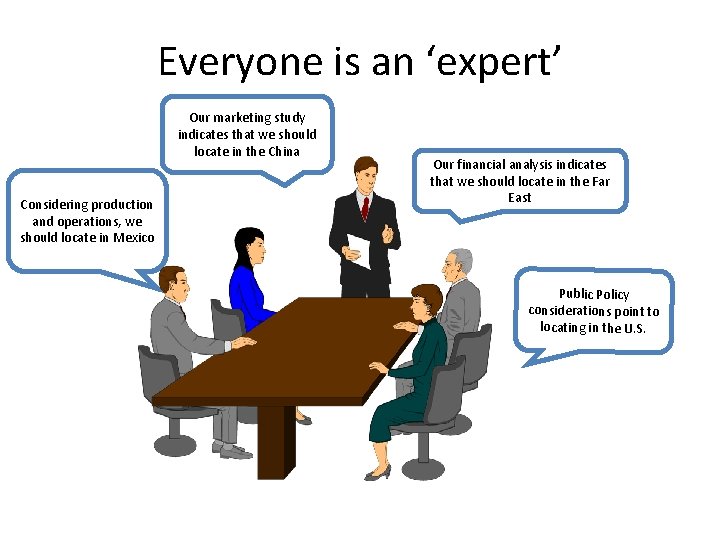
Everyone is an ‘expert’ Our marketing study indicates that we should locate in the China Considering production and operations, we should locate in Mexico Our financial analysis indicates that we should locate in the Far East Public Policy considerations point to locating in the U. S.
What is the challenge decision- makers have today? • Complexity • Competing Objectives • Tradeoffs • Cognitive Limitations • Data Overload • Multiple Perspectives • Constraints • Uncertainty and Risk
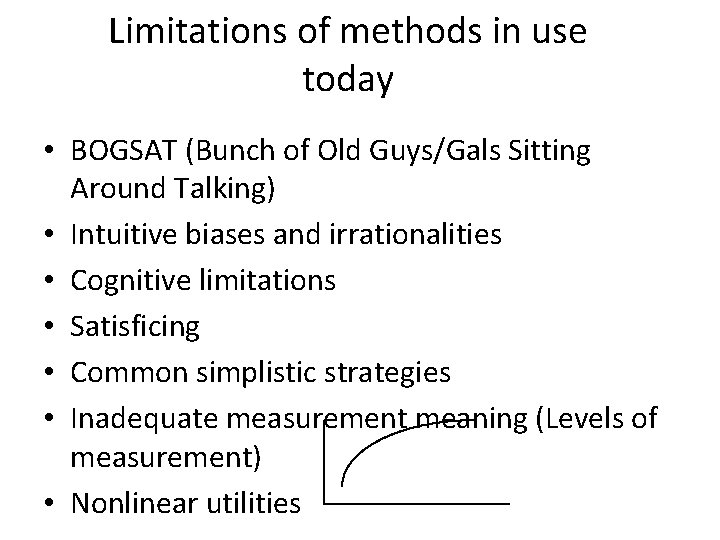
Limitations of methods in use today • BOGSAT (Bunch of Old Guys/Gals Sitting Around Talking) • Intuitive biases and irrationalities • Cognitive limitations • Satisficing • Common simplistic strategies • Inadequate measurement meaning (Levels of measurement) • Nonlinear utilities
How do we make decisions? • • • Intuition and Reason Emotion and Reason Unconscious and Conscious System 1 and System 2 (Fast and Slow) Id and Ego Amygdala and Prefrontal Cortex
Intuition/Emotion Reason/Rationality • Intuition/Emotion Vs. & Reason – Plato… – Classical (Standard) Economics – Behavioral Economists – Brain research • Pathology • f. MRI – How We Decide (Lehrer)* (Withdrawn from market) – Thinking, Fast and Slow (Kahneman) • System 1 and System 2 Thinking – Predictably Irrational (Ariely) – Misbehaving (Thaler)
Rationality/Reason • Prefrontal Cortex » https: //www. thescienceofpsychotherapy. com/prefrontalcortex/ » https: //www. thescienceofpsychotherapy. com/glossary/a mygdala/
Intuition/Emotion – Vast majority of decisions (BOGGSAT) – Amygdala • Unconscious • Very Powerful • Constantly learning • Thinking Fast – or not even thinking • Conflicting signals – Flaws • Prone to biases and errors • Flaws (irrationalities) are predictable – Questionable under new circumstances – Difficult to synthesize different individuals intuitions
Intuition/Emotion • Behavioral Economics – Very interesting to study – We will look at some first week • But that won’t be the focus of the course • Our intuitions, while quite powerful – often don’t conform to what economists or economists would say is ‘rational’ – can be misleading or ‘biased’ • Intuition about best alternative – Not reliable for important decisions – Will see why next • Intuition/Emotion for specific parts of a decision – Emotions will be a big part of our rational decision-making approach • Preferences for alternatives with respect to objectives • Importance of objectives
If we could wrap a wire around the earth… • If the earth were a perfect sphere, and we wrapped a wire tightly around the equator, approximately how long would the wire be? • about 25, 000 miles • If we cut the wire, spliced in another 12 feet (not miles) and distributed the slack evenly around the earth, would there be enough slack for a mouse to crawl under the wire?
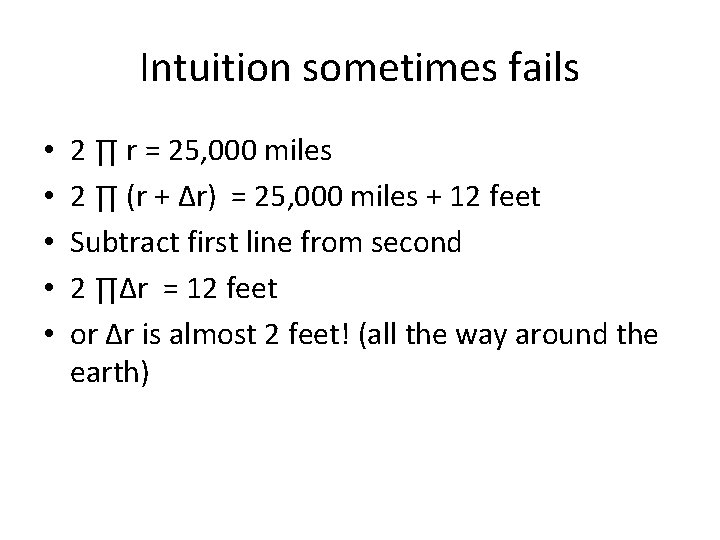
Intuition sometimes fails • • • 2 ∏ r = 25, 000 miles 2 ∏ (r + ∆r) = 25, 000 miles + 12 feet Subtract first line from second 2 ∏∆r = 12 feet or ∆r is almost 2 feet! (all the way around the earth)
Behavioral Economics Two kinds of theories • The organizing principle of Behavioral Economics was the existence of two different kinds of theories – Normative (Prescriptive) • Normative theories tell you the right way to think about some problem. – logically consistent, as prescribed by the optimizing model at the heart of economic reasoning, » sometimes called rational choice theory. – For instance, the Pythagorean theorem is a normative theory of how to calculate the length of one side of a right triangle if you know the length of the other two sides. If you use any other formula you will be wrong. – Descriptive • Describes how people actually think and choose/decide Thaler, Richard H. (2015 -05 -11). Misbehaving: The Making of Behavioral Economics (Kindle Locations 495 -500). W. W. Norton & Company. Kindle Edition.
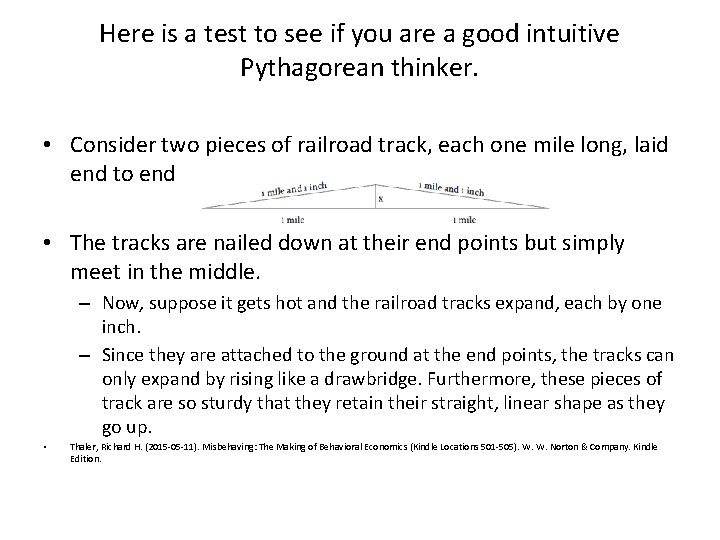
Here is a test to see if you are a good intuitive Pythagorean thinker. • Consider two pieces of railroad track, each one mile long, laid end to end • The tracks are nailed down at their end points but simply meet in the middle. – Now, suppose it gets hot and the railroad tracks expand, each by one inch. – Since they are attached to the ground at the end points, the tracks can only expand by rising like a drawbridge. Furthermore, these pieces of track are so sturdy that they retain their straight, linear shape as they go up. • Thaler, Richard H. (2015 -05 -11). Misbehaving: The Making of Behavioral Economics (Kindle Locations 501 -505). W. W. Norton & Company. Kindle Edition.
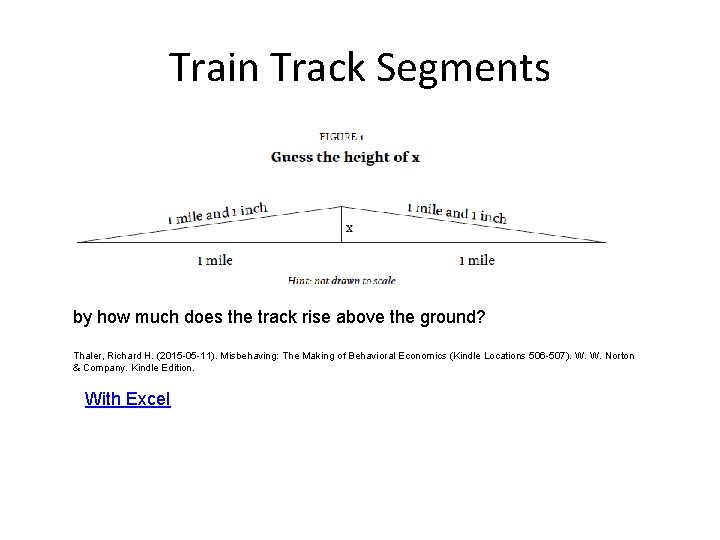
Train Track Segments by how much does the track rise above the ground? Thaler, Richard H. (2015 -05 -11). Misbehaving: The Making of Behavioral Economics (Kindle Locations 506 -507). W. W. Norton & Company. Kindle Edition. With Excel
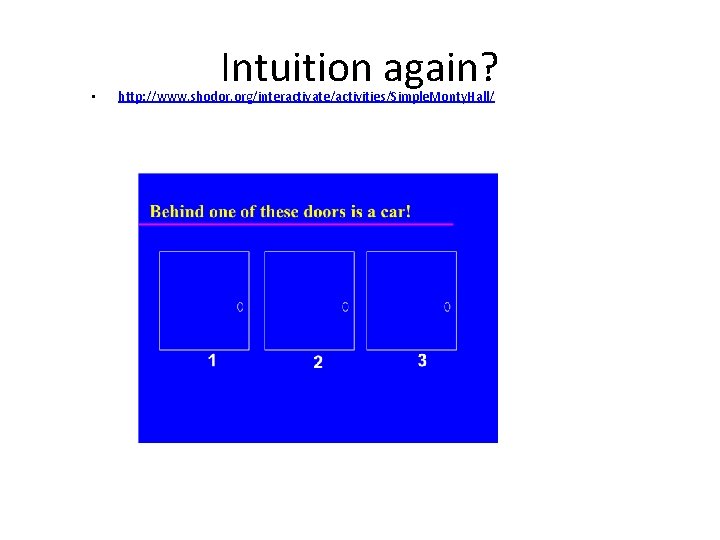
• Intuition again? http: //www. shodor. org/interactivate/activities/Simple. Monty. Hall/
More Illusions and Biases • Visual Illusions • Cognitive Illusions
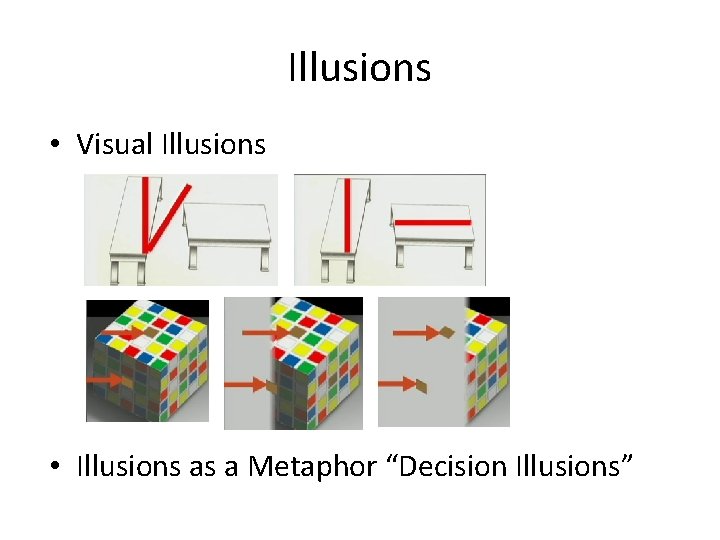
Illusions • Visual Illusions • Illusions as a Metaphor “Decision Illusions”

More visual illusions • Some from www. ilusaodeotica. com
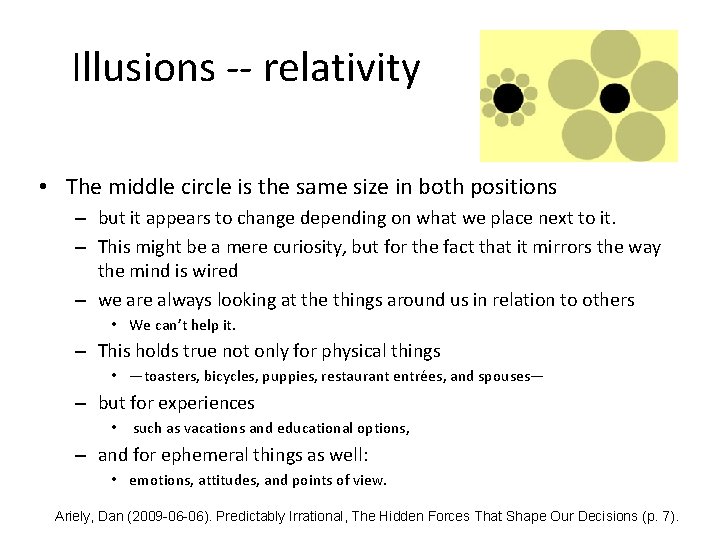
Illusions -- relativity • The middle circle is the same size in both positions – but it appears to change depending on what we place next to it. – This might be a mere curiosity, but for the fact that it mirrors the way the mind is wired – we are always looking at the things around us in relation to others • We can’t help it. – This holds true not only for physical things • —toasters, bicycles, puppies, restaurant entrées, and spouses— – but for experiences • such as vacations and educational options, – and for ephemeral things as well: • emotions, attitudes, and points of view. Ariely, Dan (2009 -06 -06). Predictably Irrational, The Hidden Forces That Shape Our Decisions (p. 7).
Relativity • RELATIVITY IS (RELATIVELY) easy to understand. • But there’s one aspect of relativity that consistently trips us up. It’s this: – we not only tend to compare things with one another – but also tend to focus on comparing things that are easily comparable (thinking fast) – and avoid comparing things that cannot be compared easily (thinking slow)
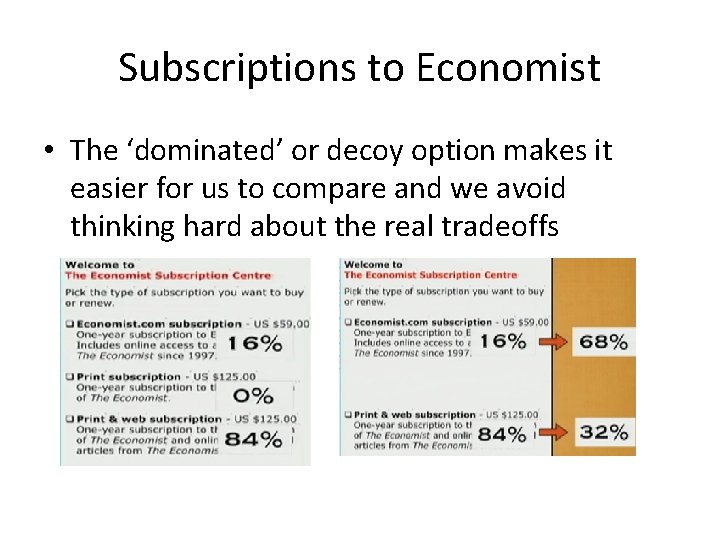
Subscriptions to Economist • The ‘dominated’ or decoy option makes it easier for us to compare and we avoid thinking hard about the real tradeoffs
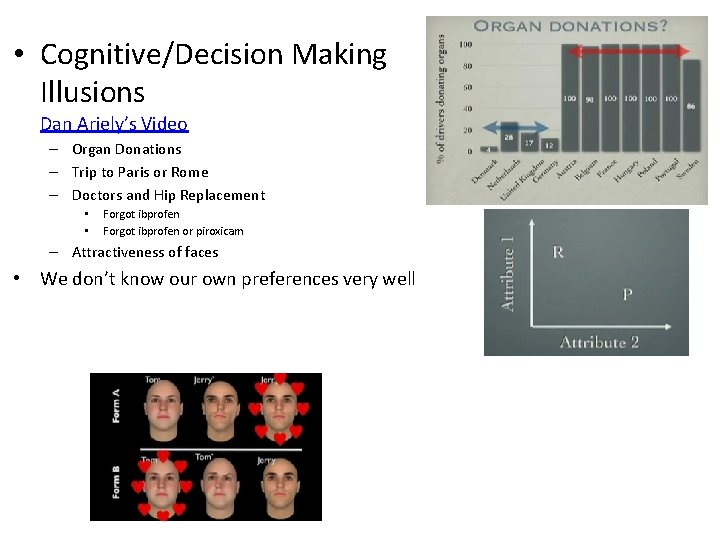
• Cognitive/Decision Making Illusions Dan Ariely’s Video – Organ Donations – Trip to Paris or Rome – Doctors and Hip Replacement • • Forgot ibprofen or piroxicam – Attractiveness of faces • We don’t know our own preferences very well
TAPPS • Thinking aloud paired problem solving… • Behavioral Economics – Kahneman and Tversky – Spend 5 - 10 minutes to find out what you can about • Behavioral Economics • Kahneman and Tversky • Prospect Theory – Post a reply to this thread with what you think might be the most useful and include links (URL's) to information that you find. – Podcast interview with Kahnerman Aug 2016
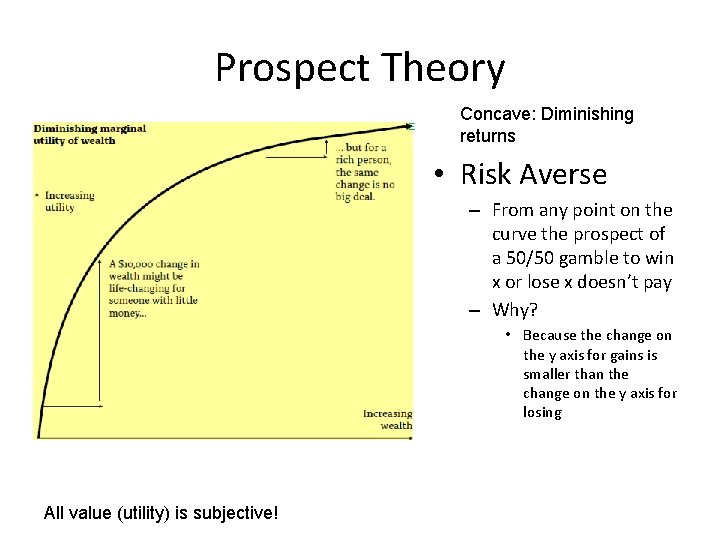
Prospect Theory Concave: Diminishing returns • Risk Averse – From any point on the curve the prospect of a 50/50 gamble to win x or lose x doesn’t pay – Why? • Because the change on the y axis for gains is smaller than the change on the y axis for losing All value (utility) is subjective!
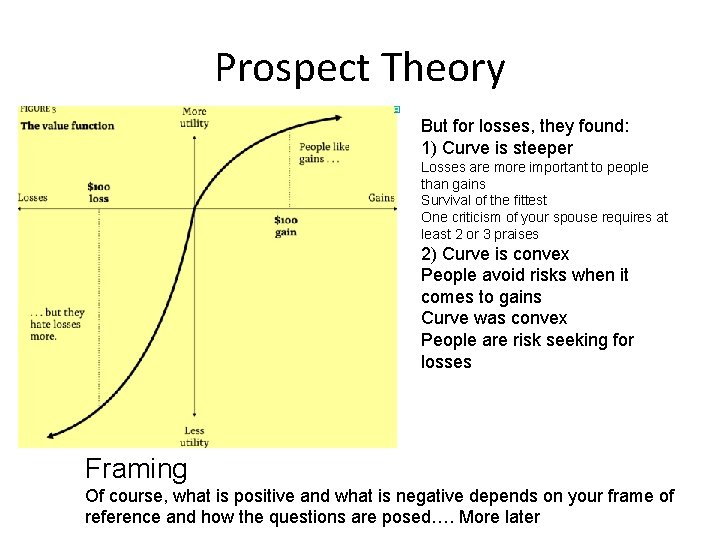
Prospect Theory But for losses, they found: 1) Curve is steeper Losses are more important to people than gains Survival of the fittest One criticism of your spouse requires at least 2 or 3 praises 2) Curve is convex People avoid risks when it comes to gains Curve was convex People are risk seeking for losses Framing Of course, what is positive and what is negative depends on your frame of reference and how the questions are posed…. More later
Loss aversion • . . . when a person was offered a gamble on the toss of a coin – and was told that losing would cost twenty dollars – the player demanded, on average, around forty dollars for winning • The pain of a loss was approximately twice as potent as the pleasure generated by a gain
• Kahneman and Tversky: • "In human decision making losses loom larger than gains. " • Loss aversion is an innate flaw – Everyone who experiences emotion is vulnerable to its effects – It's part of a larger psychological phenomenon known as negativity bias • which means that, for the human mind, bad is stronger than good.
• This is why in marital interactions, it generally takes at least five kind comments to compensate for one critical comment • Loss aversion is now recognized as a powerful mental habit with widespread implications. • The desire to avoid anything that smacks of loss often shapes our behavior, leading us to do foolish things
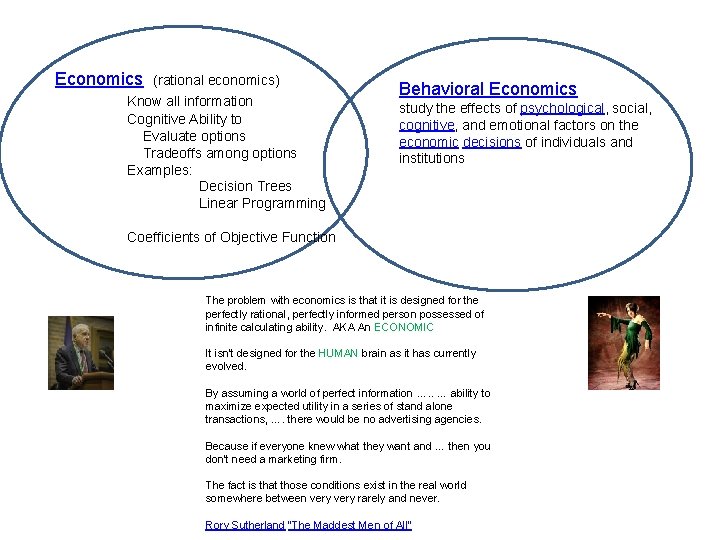
Economics (rational economics) Know all information Cognitive Ability to Evaluate options Tradeoffs among options Examples: Decision Trees Linear Programming Behavioral Economics study the effects of psychological, social, cognitive, and emotional factors on the economic decisions of individuals and institutions Coefficients of Objective Function The problem with economics is that it is designed for the perfectly rational, perfectly informed person possessed of infinite calculating ability. AKA An ECONOMIC It isn't designed for the HUMAN brain as it has currently evolved. By assuming a world of perfect information …. . … ability to maximize expected utility in a series of stand alone transactions, …. there would be no advertising agencies. Because if everyone knew what they want and … then you don't need a marketing firm. The fact is that those conditions exist in the real world somewhere between very rarely and never. Rory Sutherland “The Maddest Men of All”
Bayes Rule • … and base rates – Wikipedia Base Rates • Imagine that there is a type of cancer that afflicts 1% of all people • A doctor then says there is a test for that cancer which is about 80% reliable – He also says that the test provides a positive result for 100% of people who have the cancer, – but it is also results in a 'false positive' for 20% of people - who actually do not have the cancer. • Now, if we test positive, we may be tempted to think it is 80% likely that we have the cancer. • in fact, our odds are less than 5%.
Ariely -- Predictably Irrational • Standard Economics Assumes Rationality – 1) That we know all relevant information – 2) that we can compute the utility of each option, and – 3) we are cognitively capable weighing the ramifications of each potential choice
• The result is that we are presumed to be making logical and sensible decisions. • And even if we make a wrong decision from time to time, the standard economics perspective suggests that we will quickly learn from our mistakes either on our own or with the help of “market forces. ” • On the basis of these assumptions, economists draw far-reaching conclusions about everything from shopping trends to law to public policy.
• But, as the results presented in this book (and others) show, we are all far less rational in our decision making than standard economic theory assumes. • Our irrational behaviors are neither random nor senseless— – they are systematic and predictable. – We all make the same types of mistakes • over and over, because of the basic wiring of our brains.
• But there is a silver lining • the fact that we make mistakes also means that – there are ways to improve our decisions— • and therefore that there are opportunities for “free lunches. ”
• What is a ‘free lunch’ in this context? – According to the assumptions of standard economics, • all human decisions are rational and informed, motivated by an accurate concept of the worth of all goods and services and the amount of happiness (utility) all decisions are likely to produce. • Under this set of assumptions, everyone in the marketplace is trying to maximize profit and striving to optimize his experiences. • As a consequence, economic theory asserts that there are no free lunches—if there were any, someone would have already found them and extracted all their value.
• Behavioral economists… – believe that people are susceptible to irrelevant influences from their immediate environment (which we call context effects), – irrelevant emotions, – shortsightedness, and – other forms of irrationality • …. Loss aversion; anchoring; …
• The good news is that these mistakes also provide opportunities for improvement • If we all make systematic mistakes in our decisions, then – why not develop new • strategies, • tools, and • methods – to help us make better decisions and improve our overall well-being?
• That’s exactly the meaning of free lunches from the perspective of behavioral economics – —the idea that there are tools, methods, and policies that can help all of us make better decisions and as a consequence achieve what we desire • And that is what we will be doing in this course!
• Each of the chapters in this (Aerelli’s) book describes a force (emotions, relativity, social norms, etc. ) that influences our behavior. – our natural tendency is to vastly underestimate or completely ignore this power. – These influences have an effect on us not because we lack knowledge, lack practice, or are weakminded. – On the contrary, they repeatedly affect experts as well as novices in systematic and predictable ways.
• Just as we can’t help being fooled by visual illusions, we fall for the “decision illusions” our minds show us. • our visual and decision environments are filtered to us courtesy of our eyes, our ears, our senses of smell and touch, and • the master of it all, our brain. • By the time we comprehend and digest information, it is not necessarily a true reflection of reality.
• In essence, we are limited to the tools nature has given us, and the natural way in which we make decisions is limited by the quality and accuracy of these tools. • although irrationality is commonplace, it does not necessarily mean that we are helpless • we can – try to be more vigilant, force ourselves to think differently about these decisions, or – use technology to overcome our inherent shortcomings ***Technology meaning techniques, including processes, mathematics, software, …

58 cognitive biases that screw up everything we do • https: //www. businessinsider. com/cognitivebiases-2015 -10 • Skip to slide 66 – May return here if time permits – Otherwise read at home
Decision Traps • In their original book, Decision Traps, Russo and Shoemaker focus on 10 decision traps • These traps are based on some ‘defects’ in human emotional/intuitive responses…
Decision Traps • Most Decision-Makers Commit the Same Kinds of Errors • Decision research has shown that people in numerous fields tend to make the same kinds of decision-making mistakes. • Here is a summary of the ten most dangerous decision traps:
• 1. Plunging In—Beginning to gather information and reach conclusions without first taking a few minutes to think about the crux of the issue you’re facing or to think through how you believe decisions like this one should be made. • 2. Frame Blindness—Setting out to solve the wrong problem because you have created a mental framework for your decision, with little thought, that causes you to overlook the best options or lose sight of important objectives. • 3. Lack of Frame control—Failing to consciously define the problem in more ways than one or being unduly influenced by the frames of others.
• 4. Overconfidence in Your Judgment—Failing to collect key factual information because you are too sure of your assumptions and opinions. • 5. Shortsighted Shortcuts—Relying inappropriately on “rules of thumb” such as implicitly trusting the most readily available information or anchoring too much on convenient facts. • 6. Shooting From the hip—Believing you can keep straight in your head all the information you’ve discovered, and therefore “winging it” rather than following a systematic procedure when making the final choice.
• 7. Group Failure—Assuming that with many smart people involved, good choices will follow automatically, and therefore failing to manage the group decisionmaking process. • 8. Fooling Yourself About Feedback—Failing to interpret the evidence from past outcomes for what it really says, either because you are protecting your ego or because you are tricked by hindsight. • 9. Not Keeping Track—Assuming that experience will make its lessons available automatically, and therefore failing to keep systematic records to track the results of your decisions and failing to analyze these results in ways that reveal their key lessons. • 10. Failure to Audit Your Decision process—Failing to create an organized approach to understanding your own.
Some thoughts from How We Decide • We've been exploring the surprising intelligence of our emotions. – how fluctuations of dopamine are translated into prophetic feelings • But emotions aren't perfect. – they are a crucial cognitive tool but even the most useful tools can't solve every problem.
• there are certain conditions that consistently short circuit the emotional brain – causing people to make bad decisions • the best decision makers know which situations require less intuitive responses
• When emotions get out of control– and there are certain things that reliably make this happen- – the results can be just as devastating as not having any emotions at all. • The brain is so eager to maximize rewards – that it ends up pushing its owner off a cliff.
• a main cause of financial bubbles. . • When the market keeps going up, – people are led to make larger and larger investments in the boom. Their greedy brains are convinced that they've solved the stock market, and so they don't think about the possibility of losses. • And when investors are convinced that the bubble isn't a bubble- and have put most of their money into the booming market… • The bubble bursts… – People just can't wait to get out » because the brain doesn't want to regret staying in » loss aversion – That's when you get a financial panic.
Evaluating Gains and Loses As we’ve already seen…. • Evaluating Gains – Loss aversion leads to risk aversion when people evaluate a possible gains • Evaluating Loses – Loss aversion leads to risk seeking when people evaluate possible losses • But what constitutes a gain vs. a loss? – Where is the zero? • Depends on how you look at it or phrase the question
Framing Trap related to Loss Aversion • You are a marine property adjuster charged with minimizing the loss of cargo on three insured barges that sank yesterday. Each barge holds $200 K of cargo. • The owner of a local marine-salvage company gives you two plans, both of which cost the same
Framing Trap (continued) • Plan A: Will save the cargo of one of the three barges, worth $200 K • Plan B: Has a one third probability of saving the cargo on all three barges, worth $600 K, but has a two-thirds probability of saving nothing. • Which of these two plans would you choose?
Framing Trap (continued) • Plan C: Will result in the loss of two of the three cargoes, worth $400 K • Plan D: Has a two-thirds probability of resulting in the loss of all three cargoes and the entire $600 K, but a one-third probability of losing no cargo.
Framing Trap (continued) • Plan A is equivalent to Plan C and Plan B is equivalent to Plan D • People are risk averse when a problem is posed to them in the form of gains (save), but risk seeking when posed to them in the form of losses!
• Economists have long been perplexed by a phenomenon known as the premium equity puzzle – Since 1926, the annual return on stocks after inflation has been 6. 4 percent – while the return on Treasury bills has been less than 0. 5 percent.
• In simulations over the long term, stock portfolios always generated higher returns than bond portfolios – stocks typically earned more than seven times as much as bonds • Question: if investors are such rational agents, – why don't all of them invest in stocks? – Why are low-yield bonds so popular?
• Answer: Loss Aversion – Behavioral economists Richard Thaler and Shlomo Benartzi realized that the key to solving the premium equity puzzle was loss aversion. – Investors buy bonds because • they hate losing money, and • bonds are a safe bet. – Instead of making financial decisions that reflect all the relevant statistical information • they depend on their emotional instincts and seek the certain safety of bonds.
Anchoring • Suppose you purchased a stock for $100 per share • Suppose the stock dropped precipitously to $5 per share • If someone offered to buy the stock from you at $6 per share, would you sell it?
Anchoring and arbitrary coherence • People who are willing to pay a certain price for one product, are willing to pay for other items in the same product category based on the price relative to that first price (the anchor). • This is called arbitrary coherence. • Initial prices are largely “arbitrary” and can be influenced by responses to random questions; – but once those prices are established in our minds, – they shape not only what we are willing to pay for an item, – but also how much we are willing to pay for related products (this makes them coherent).
Irrelevant Information • The anchoring effect is about the brain's spectacular inability to dismiss irrelevant information. • The fragility of the prefrontal cortex means that we all have to be extremely vigilant about not paying attention to unnecessary information. • The anchoring effect demonstrates how a single additional fact can systematically distort the reasoning process
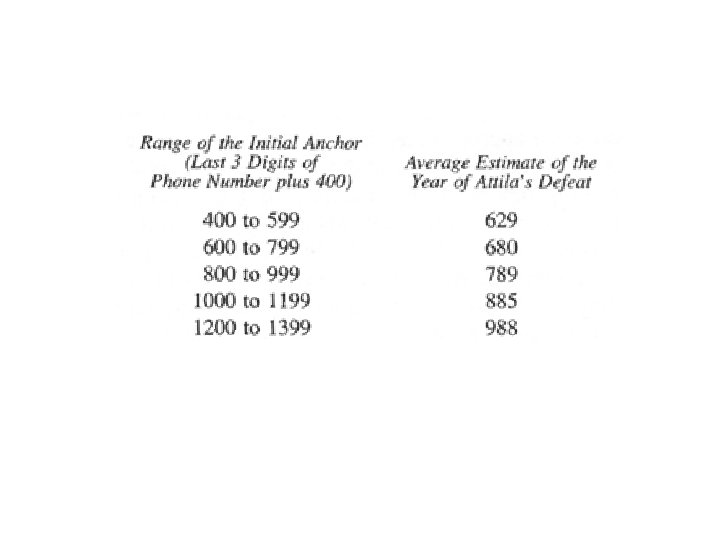
Even random anchors may change people’s opinions as much as credible anchors For example, Russo and Shoemaker asked people to provide their own anchor. They asked: “What are the last three digits of your home phone number? ” If the last three digits for a particular person were XYZ, they said, “We are going to add 400 to your answer. Now -- Do you think Attila the Hun was defeated in Europe before or after A. D. [XYZ + 400]? ” After they had answered (and without telling them whether they were right), they asked “In what year would you guess Attila the Hun was actually defeated? ”
From Thaler, Misbehaving • • I had composed an exam that was designed to distinguish among three broad groups of students: the stars who really mastered the material, the middle group who grasped the basic concepts, and the bottom group who just didn’t get it. To successfully accomplish this task, the exam had to have some questions that only the top students would get right, which meant that the exam was hard. The exam succeeded in my goal —there was a wide dispersion of scores— but when the students got their results they were in an uproar. Their principal complaint was that the average score was only 72 points out of a possible 100. I had anticipated the possibility that a low average numerical score might cause some confusion on this front, so I had reported how the numerical scores would be translated into actual grades in the class. …. but this announcement had no apparent effect on the students ’ mood. They still hated my exam, and they were none too happy with me either. On the next exam, I made the total number of points available 137 instead of 100. This exam turned out to be slightly harder than the first, with students getting only 70% of the answers right, but the average numerical score was a cheery 96 points. The students were delighted! No one’s actual grade was affected by this change, but everyone was happy.
Need better ways than only relying on our intuition/emotions. . . • "Our emotions are like software programs that evolved to solve important and recurring problems in our distant past” • "They are not always well suited to the decisions we make in modern life” • “It's important to know how our emotions lead us astray so that we can find ways to compensate for these flaws. " George Loewenstein, the neuroeconomist, thinks that understanding the errors of the emotional brain will help policymakers develop plans that encourage people to make better decisions: . . .
Other reasons why we can’t just rely on emotions for important, complex decisions • Intuition/emotions reflect accumulated experience under similar circumstances • Emotions reflect the past – most important decisions have to consider different future environments • Most important decisions involve data and judgments from many sources and people – No one person’s emotions can capture it all – There is a need to synthesize this data and judgment from a variety of people
What can we do? • Use reason – instead of – or in addition to intuition/emotion…
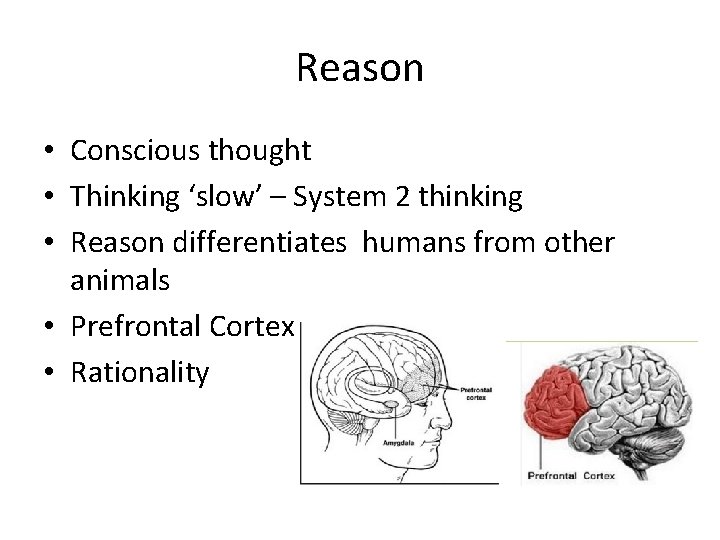
Reason • Conscious thought • Thinking ‘slow’ – System 2 thinking • Reason differentiates humans from other animals • Prefrontal Cortex • Rationality
Executive Function • Wikipedia – Prefrontal Cortex of the brain • Prefrontal cortex carries out executive function – Ability to differentiate among • Conflicting thoughts • Good, bad, better, best – Future consequences of current activities • Prediction of outcomes • Expectations based on actions – Working toward a defined goal – Social control
Executive Function • The most typical psychological term for functions carried out by the prefrontal cortex area is executive function. • Executive function relates to – abilities to differentiate among conflicting thoughts, – determine good and bad, better and best, same and different, – future consequences of current activities, – working toward a defined goal, – prediction of outcomes, expectation based on actions, and social "control" (the ability to suppress urges that , if not suppressed, could lead to socially-unacceptable outcomes)
But reason can produce mistakes…
The Reasoning part of our brains is very limited! • Reason takes effort – Thinking slow – and we are lazy and impatient • Many limitations – Overwhelms our cognitive capabilities • Prefrontal Cortex – Much less capacity than amygdala (intuition) – Mediates our intuitive/emotional feelings and reactions • Overcoming these limitations will be the focus of the course!
Benefit/Cost Ratios • A) If you were to give me $1 and I promised to return $10 (tomorrow, for certain), what would the benefit/cost ratio be? • B) If you were to give me $50 and I promised to return $100 (tomorrow, for certain), what would the benefit cost/ratio be? • If you could choose, A or B, and reasoned using the b/c ratios, which would you choose?
Cognitive limitations • Short term memory limitations – The Magical Number Seven…. – 7 +/- 2 • Fruit or Cake? • Limited channel capacity • Selective Attention – Selective Attention Test G. A. Miller "The Magical Number Seven, Plus or Minus Two: Some Limits on Our Capacity for Information Processing, " Psychological Review, Vol. 63, No. 2, 8197, March 1956.
Bounded Rationality • The term is thought to have been coined by Herbert Simon. In Models of My Life, Herbert Simon points out that most people are only partly rational, and are in fact emotional/irrational in the remaining part of their actions. • In another work, he states "boundedly rational agents experience limits in formulating and solving complex problems and in processing (receiving, storing, retrieving, transmitting) information“ • <http: //en. wikipedia. org/wiki/Bounded_rationality>
Satisficing • humans lack both the knowledge and computational skills necessary to make decisions in a manner compatible with economic notions of rational behavior • aspiration levels – The use of aspiration levels is the primary mechanism by which people can reduce the costs of information processing and yet still act in a purposeful manner. – However, the use of aspiration levels is not without its costs Its use suggests a willingness to balance the quality of a decision against the cost, and frequently impossibility, of being able to engage in more extensive analysis Sources: Simon, Herbert A. , The New Science of Management Decision, Harder and Brothers, New York, N. Y. . , 1960, and Hogarth, Robin Judgment and Choice, John Wiley & Sons, New York, 1987.
There is such a thing as too much analysis • The dangers of always relying on the rational brain – you cut yourself off from the wisdom of your emotions • at the same time the rational brain is overloaded • When people are shopping for real estate, they often fall victim to what Dijhesterhuis calls a "weighting mistake. “ – deliberative homeowners focused on less important details like square footage and number of bathrooms – rather than on commute time
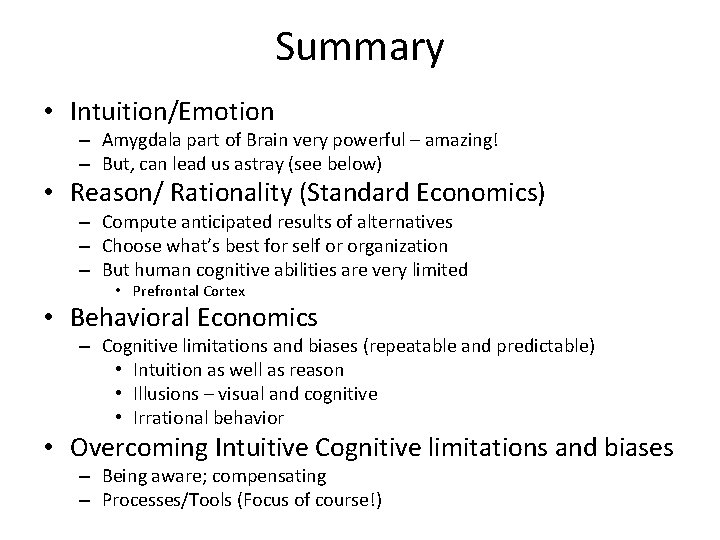
Summary • Intuition/Emotion – Amygdala part of Brain very powerful – amazing! – But, can lead us astray (see below) • Reason/ Rationality (Standard Economics) – Compute anticipated results of alternatives – Choose what’s best for self or organization – But human cognitive abilities are very limited • Prefrontal Cortex • Behavioral Economics – Cognitive limitations and biases (repeatable and predictable) • Intuition as well as reason • Illusions – visual and cognitive • Irrational behavior • Overcoming Intuitive Cognitive limitations and biases – Being aware; compensating – Processes/Tools (Focus of course!)
• In the physical world, we understand our limitations, and work around them, e. g. using steps to reach something high • In the cognitive world we forget that we are limited and don't know how to work around them • The focus of this course will be finding ways to work around them • The principle theory we will use is called The Analytic Hierarch Process (AHP)
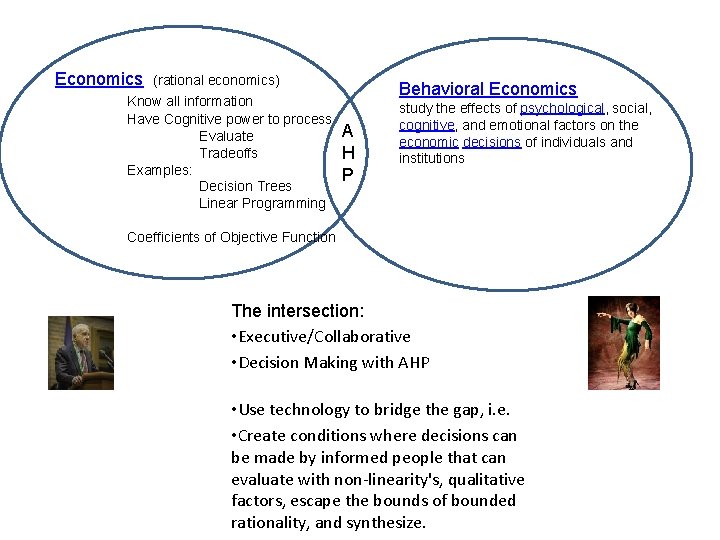
Economics (rational economics) Know all information Have Cognitive power to process Evaluate Tradeoffs Examples: Decision Trees Linear Programming Behavioral Economics A H P study the effects of psychological, social, cognitive, and emotional factors on the economic decisions of individuals and institutions Coefficients of Objective Function The intersection: • Executive/Collaborative • Decision Making with AHP • Use technology to bridge the gap, i. e. • Create conditions where decisions can be made by informed people that can evaluate with non-linearity's, qualitative factors, escape the bounds of bounded rationality, and synthesize.
Terminology • • Rationality – our definition… Subjective, Objectives, Criteria, Attributes Alternatives – Pros – Cons • Musts and Wants • Constraints • Feasibility
Crucial/Important Decisions • Our definition of rationality will be a decision that best achieves an individual’s or group’s objectives • This isn’t always easy to do because – Every ‘important’ or ‘crucial’ decision has multiple objectives, which often conflict with one another – Challenge – try to think of an ‘important’ or ‘crucial’ decision with only one objective
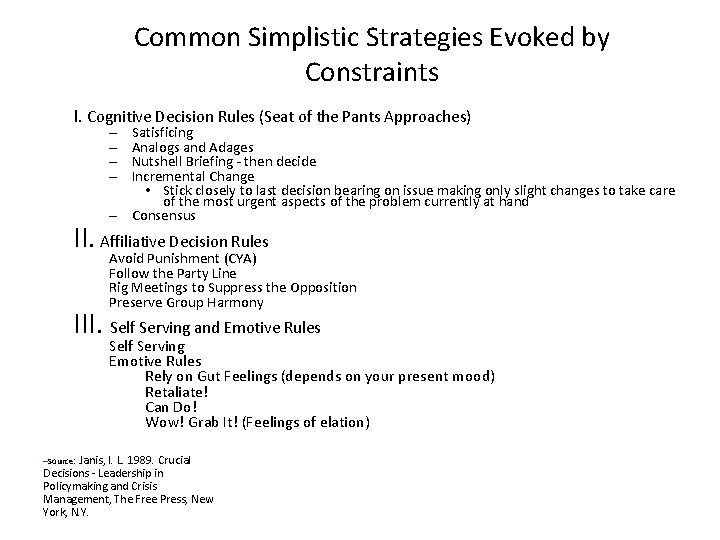
Common Simplistic Strategies Evoked by Constraints I. Cognitive Decision Rules (Seat of the Pants Approaches) Satisficing Analogs and Adages Nutshell Briefing - then decide Incremental Change • Stick closely to last decision bearing on issue making only slight changes to take care of the most urgent aspects of the problem currently at hand – Consensus – – II. Affiliative Decision Rules Avoid Punishment (CYA) Follow the Party Line Rig Meetings to Suppress the Opposition Preserve Group Harmony III. Self Serving and Emotive Rules Self Serving Emotive Rules Rely on Gut Feelings (depends on your present mood) Retaliate! Can Do! Wow! Grab It! (Feelings of elation) –Source: Janis, I. L. 1989. Crucial Decisions - Leadership in Policymaking and Crisis Management, The Free Press, New York, N. Y.
Common Simplistic Strategies for Crucial Decisions? • Relying on. . . rules of thumb might generally work out fairly well when making routine choices or dealing with minor relatively unimportant decisions; • however, when executives rely upon such rules to make important decisions, they save time and effort at the cost of risking being stuck with an illconceived choice entailing disastrous consequences that could have been avoided. – Janis, Ibid.
Rational, Irrational, Non-Rational • Rational Decision – A rational decision is made on the basis of the (anticipated) achievement of objectives • An individual’s or group’s • What do we ‘want’ – Incorporates experience – intuition and emotion • Non-rational decision – No basis for decision. You would almost have to be mentally defective to make non-rational decisions • Irrational Decision – I don’t agree with your objectives
Subjectivity vs. Objectivity • Objective (adjective) : The same result, plus or minus some error term, will hold no matter who (subject) is involved in the ‘experiment’. – – – Free of bias Based on facts Observable Existing independently of mind (Objective as a noun means a goal or purpose). • Subjective: The result is dependent on the subject(s). – Not impartial – existing by perception
All important decisions are subjective! • Proof: • All important decisions have multiple objectives – e. g. , time and money • The relative importance of time and money is subjective – To someone who is old and rich, time is more important than money – To a struggling blue collar worker, money is usually more important than time
Choice Decision Project • Blackboard Discussion Forum for proposals – Post one or more ideas for your choice decision project. – We will use another forum once approved. • The decision should be real – – as opposed to hypothetical important rather than trivial. Try to think of important or controversial decisions in your workplace. Avoid decisions that have already been made. • Projects that ‘Make Things Happen’ are the best candidates for an ‘excellent’ evaluation. – It doesn’t have to be earth-shattering • Could be multi-million or multi-dollar decision --- but it has to be important
Choice Decision Project (continued) • The decision should be a ‘choice’ of one alternative (option), rather than more than one. – The alternatives can consist of ‘bundles’ or ‘packages’ of alternatives. – For example: • • Alternative designs for a costly project (never just 1 design!) Alternative plans for fixing health care Alternative plans for fixing social security Alternative plans for reducing the budget deficit Alternative plans for creating jobs Alternative plans for improving sales in your organization Alternative plans for increasing customer satisfaction in your organization – Are any of the above good topics for a project? • Only if the results have a chance of ‘making things happen’ • Who will see the results and what action might it lead to?
Choice Decision Project (continued) • There may be more than two or more decisions that are related – Don’t confuse different decisions with alternatives for one decision • For example. . • Should we replace our Excel spreadsheet process for. . – What is the best COTS software for … • Should we move our office to …. – What would be the best location for our office? • Each of the above can be modeled as one decision with ‘all of the alternatives’, or as two separate decisions – If two separate decisions, which should be done first?
Timeline for Decision Project • After Session 2: – Brainstorm for project ideas • Between Sessions 2 and 3: – Post ideas to Blackboard and form partnerships and submit decision project proposals to Blackboard – Between Sessions 2 and 3 receive my feedback and revise and resubmit if necessary • After Session 3: Structure Comparion Decision Project; Complete Monday before Session 4 – Receive feedback about your decision project structure and begin eliciting judgments (measurement, synthesis, iteration) after responding to my feedback if necessary. • After Session 4 – Request feedback for your project/results as soon as possible and receive my feedback
Suggested Readings Not necessarily during the course • • Daniel Kahneman, Thinking, Fast and Slow, Farar, Straus and Giroux, 2011 Richard Thaler, Misbehaving: The Making of Behavioral Economics, 2015 Dan Ariely, Predictably Irrational -- The Hidden Forces That Shape our Decisions, Harper Perennial, 2010 Johan Lehrer, How We Decide – Removed from market • • James Surowiecki, The Wisdom of Crowds, Anchor Books, 2005 Deepak Malhotra and Max Bazerman, Negotiation Genius, Bantam, 2008 • Other recommended books – – The Brain That Changes Itself: Personal Triumphs from the Frontiers of Brain Science by Normal Doidge The Brain's Way of Healing: Remarkable Discoveries and Recoveries from the Frontiers of Neuroplasticity by Norman Doidge The Organized Mind: Thinking Straight in the Age of Information Overload, by Daniel Levitin Rewire Your Brain: Think Your Way to a Better Life, by John Arden
- Slides: 97