
Execution Control in FORTRAN l l l l


- Slides: 8
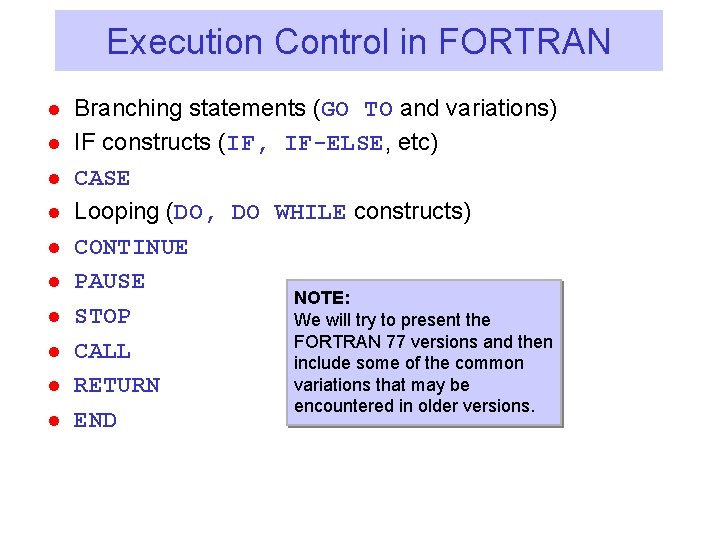
Execution Control in FORTRAN l l l l l Branching statements (GO TO and variations) IF constructs (IF, IF-ELSE, etc) CASE Looping (DO, DO WHILE constructs) CONTINUE PAUSE NOTE: STOP We will try to present the FORTRAN 77 versions and then CALL include some of the common variations that may be RETURN encountered in older versions. END
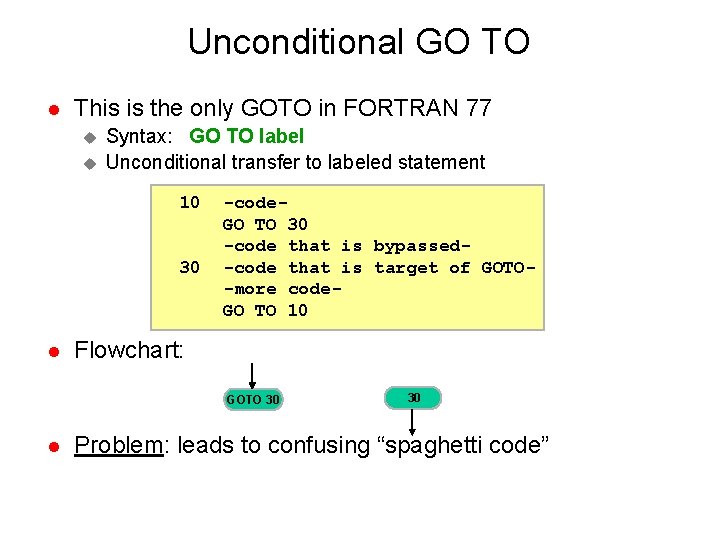
Unconditional GO TO l This is the only GOTO in FORTRAN 77 u u Syntax: GO TO label Unconditional transfer to labeled statement 10 30 l -code. GO TO 30 -code that is bypassed-code that is target of GOTO-more code. GO TO 10 Flowchart: GOTO 30 l 30 Problem: leads to confusing “spaghetti code”
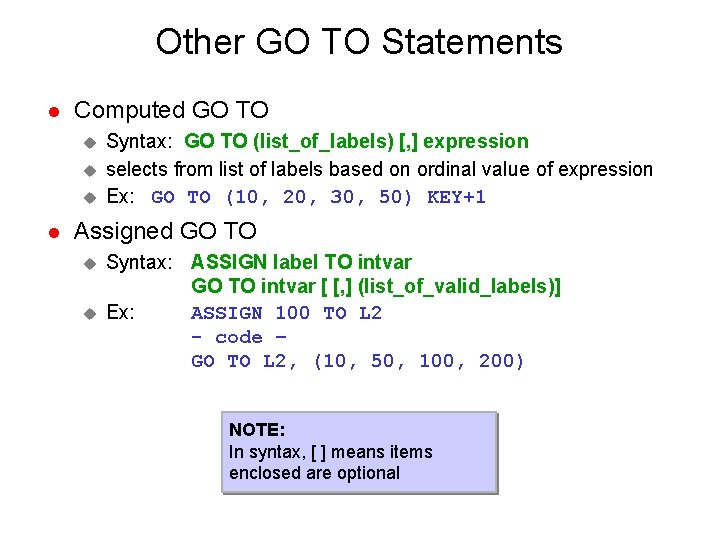
Other GO TO Statements l Computed GO TO u u u l Syntax: GO TO (list_of_labels) [, ] expression selects from list of labels based on ordinal value of expression Ex: GO TO (10, 20, 30, 50) KEY+1 Assigned GO TO u u Syntax: ASSIGN label TO intvar GO TO intvar [ [, ] (list_of_valid_labels)] Ex: ASSIGN 100 TO L 2 - code – GO TO L 2, (10, 50, 100, 200) NOTE: In syntax, [ ] means items enclosed are optional
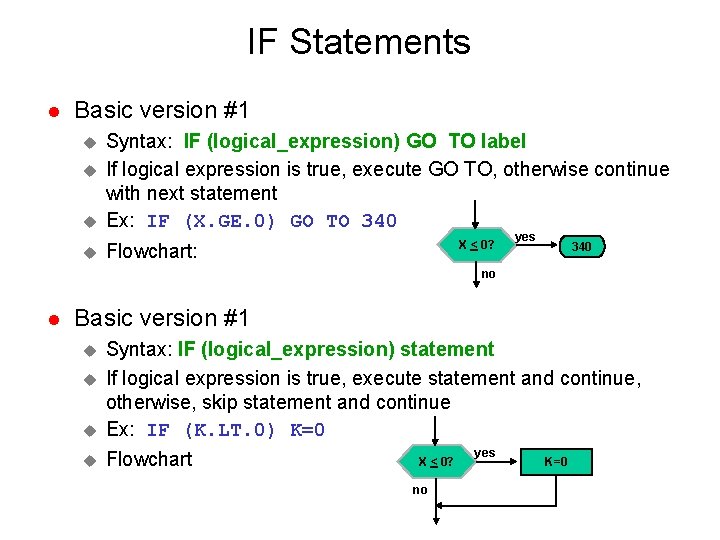
IF Statements l Basic version #1 u u Syntax: IF (logical_expression) GO TO label If logical expression is true, execute GO TO, otherwise continue with next statement Ex: IF (X. GE. 0) GO TO 340 X < 0? Flowchart: yes 340 no l Basic version #1 u Syntax: IF (logical_expression) statement If logical expression is true, execute statement and continue, otherwise, skip statement and continue Ex: IF (K. LT. 0) K=0 u Flowchart u u X < 0? no yes K=0
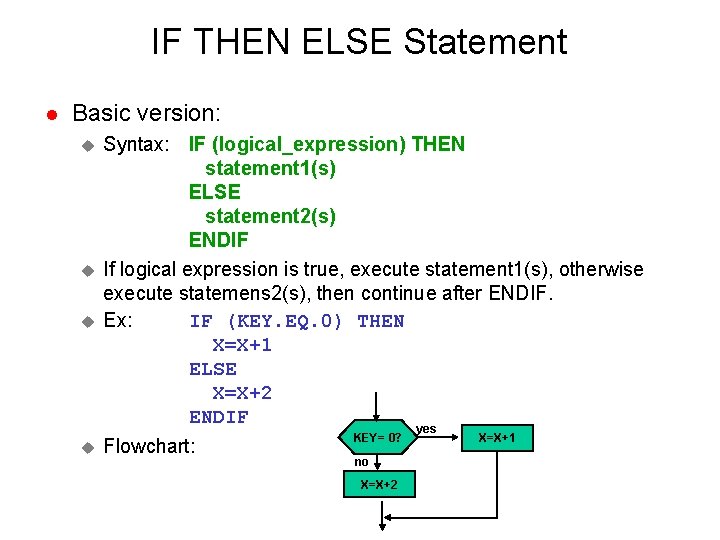
IF THEN ELSE Statement l Basic version: u u Syntax: IF (logical_expression) THEN statement 1(s) ELSE statement 2(s) ENDIF If logical expression is true, execute statement 1(s), otherwise execute statemens 2(s), then continue after ENDIF. Ex: IF (KEY. EQ. 0) THEN X=X+1 ELSE X=X+2 ENDIF Flowchart: KEY= 0? no X=X+2 yes X=X+1
IF ELSE IF Statement l Basic version: u u u KEY= 1? yes X=X+1 no Syntax: IF (logical_expr 1) THEN yes KEY= 2? X=X+2 statement 1(s) no ELSE IF (logical_expr 2) THEN … statement 2(s) yes X=X+N KEY= N? ELSE no statement 3(s) X=-1 ENDIF If logical expr 1 is true, execute statement 1(s), if logical expr 2 is true, execute statement 2(s), otherwise execute statemens 3(s). Ex: 10 IF (KSTAT. EQ. 1) THEN CLASS=‘FRESHMAN’ ELSE IF (KSTAT. EQ. 2) THEN CLASS=‘SOPHOMORE’ ELSE IF (KSTAT. EQ. 3) THEN CLASS=‘JUNIOR’ ELSE IF (KSTAT. EQ. 4) THEN CLASS=‘SENIOR’ ELSE CLASS=‘UNKNOWN’ ENDIF
Notes on IF Statements l l l Avoid using IF with GO TO which leads to complex code Statement blocks in IF THEN and IF ELSE IF statements can contain almost any other executable FORTRAN statements, including other IF’s and loop statements. CANNOT transfer control into an IF statement block from outside (e. g. , using a GO TO) CAN transfer control out of an IF statement block (e. g. , using an IF ( ) GO TO N statement) Use indenting to make code readable.
Old IF Statements l Arithmetic IF statement (3 -branch) u u u l Arithmetic IF statement (2 -branch) u u u l Syntax: IF (num_expr) label 1, label 2, label 3 If num expr is <0 then go to label 1, if =0 then label 2, and if >0 then go to label 3 Ex: IF (THETA) 10, 20, 100 Syntax: IF (num _ expr) label 1, label 2 If num expr is <0 then go to label 1, if >0 then go to label 2 Ex: IF (ALPHA-BETA) 120, 16 Notes: u u Avoid whenever possible! Leads to very confusing and hard to understand code. .