
Excursion 2 We shall meet the chiral anomalies
- Slides: 18
Excursion #2 We shall meet the chiral anomalies as they appear already in simplest, MF or BCS types, models particularly at finite temperatures when normal excitations are present. The resulting effective Ginzburg-Landau theory will prove to be quite different from what is commonly expected. After collaboration with Natasha Kirova in 1999 and 2018 -9 Inspired by experimental studies in Grenoble by P. Monceau et al and at Cornell, R. Thorne group 1
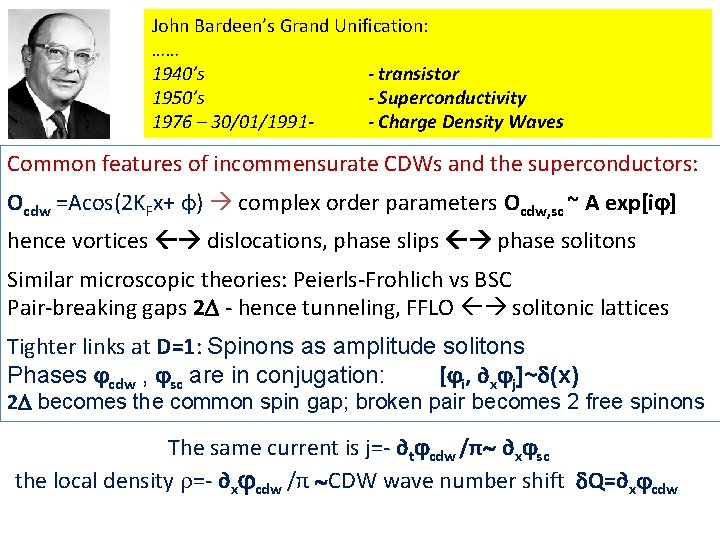
John Bardeen’s Grand Unification: …… 1940’s - transistor 1950’s - Superconductivity 1976 – 30/01/1991 - Charge Density Waves Common features of incommensurate CDWs and the superconductors: Ocdw =Acos(2 KFx+ φ) complex order parameters Ocdw, sc ~ A exp[i ] hence vortices dislocations, phase slips phase solitons Similar microscopic theories: Peierls-Frohlich vs BSC Pair-breaking gaps 2 - hence tunneling, FFLO solitonic lattices Tighter links at D=1: Spinons as amplitude solitons Phases cdw , sc are in conjugation: [ i, ∂x j]~ (x) 2 becomes the common spin gap; broken pair becomes 2 free spinons The same current is j=- ∂t cdw /π ∂x sc the local density =- ∂x cdw /π CDW wave number shift Q=∂x cdw
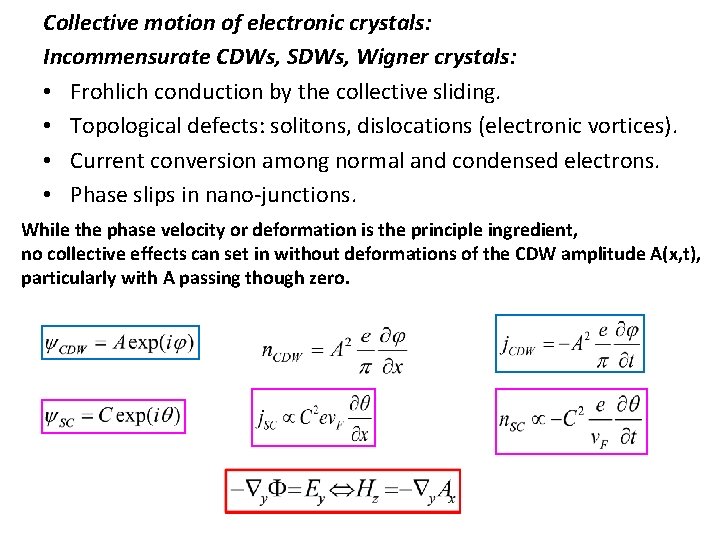
Collective motion of electronic crystals: Incommensurate CDWs, SDWs, Wigner crystals: • Frohlich conduction by the collective sliding. • Topological defects: solitons, dislocations (electronic vortices). • Current conversion among normal and condensed electrons. • Phase slips in nano-junctions. While the phase velocity or deformation is the principle ingredient, no collective effects can set in without deformations of the CDW amplitude A(x, t), particularly with A passing though zero.
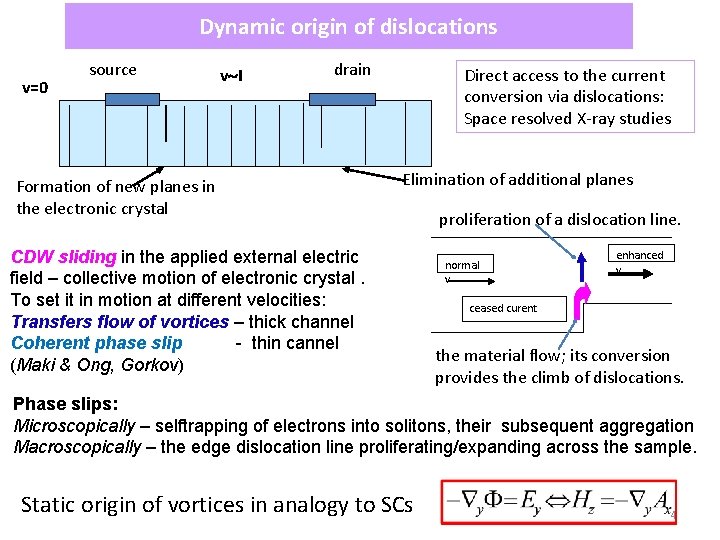
Dynamic origin of dislocations v=0 source v I drain Formation of new planes in the electronic crystal Direct access to the current conversion via dislocations: Space resolved X-ray studies Elimination of additional planes CDW sliding in the applied external electric field – collective motion of electronic crystal. To set it in motion at different velocities: Transfers flow of vortices – thick channel Coherent phase slip - thin cannel (Maki & Ong, Gorkov) proliferation of a dislocation line. normal v enhanced v ceased curent the material flow; its conversion provides the climb of dislocations. Phase slips: Microscopically – selftrapping of electrons into solitons, their subsequent aggregation Macroscopically – the edge dislocation line proliferating/expanding across the sample. Static origin of vortices in analogy to SCs 4
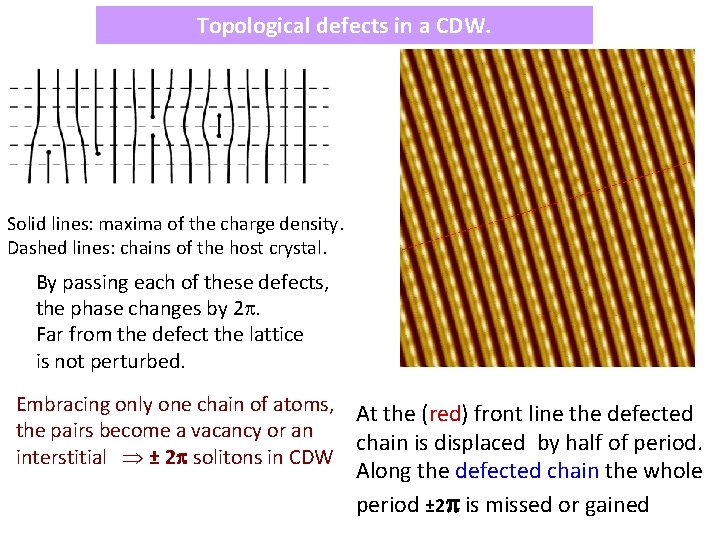
Topological defects in a CDW. Solid lines: maxima of the charge density. Dashed lines: chains of the host crystal. By passing each of these defects, the phase changes by 2 p. Far from the defect the lattice is not perturbed. Embracing only one chain of atoms, At the (red) front line the defected the pairs become a vacancy or an chain is displaced by half of period. interstitial ± 2 solitons in CDW Along the defected chain the whole period ± 2 is missed or gained
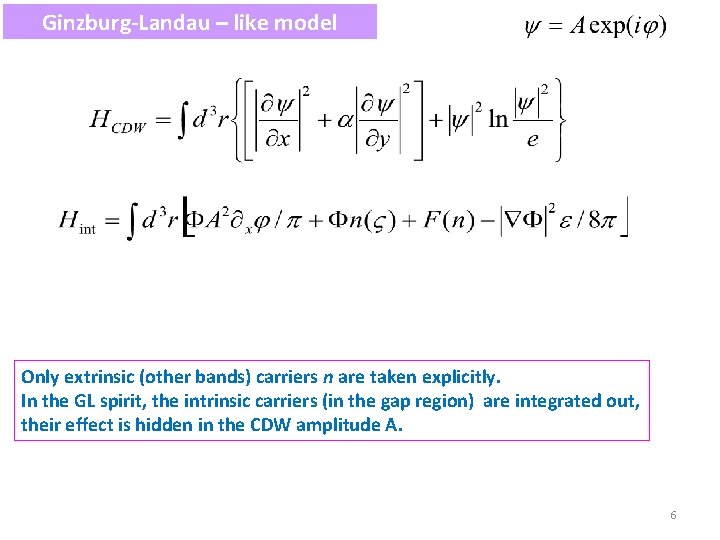
Ginzburg-Landau – like model Only extrinsic (other bands) carriers n are taken explicitly. In the GL spirit, the intrinsic carriers (in the gap region) are integrated out, their effect is hidden in the CDW amplitude A. 6
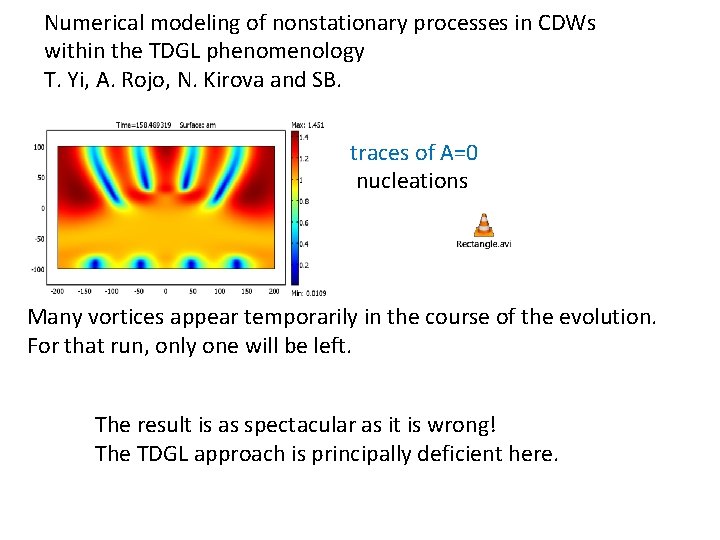
Numerical modeling of nonstationary processes in CDWs within the TDGL phenomenology T. Yi, A. Rojo, N. Kirova and SB. traces of A=0 nucleations Many vortices appear temporarily in the course of the evolution. For that run, only one will be left. The result is as spectacular as it is wrong! The TDGL approach is principally deficient here.
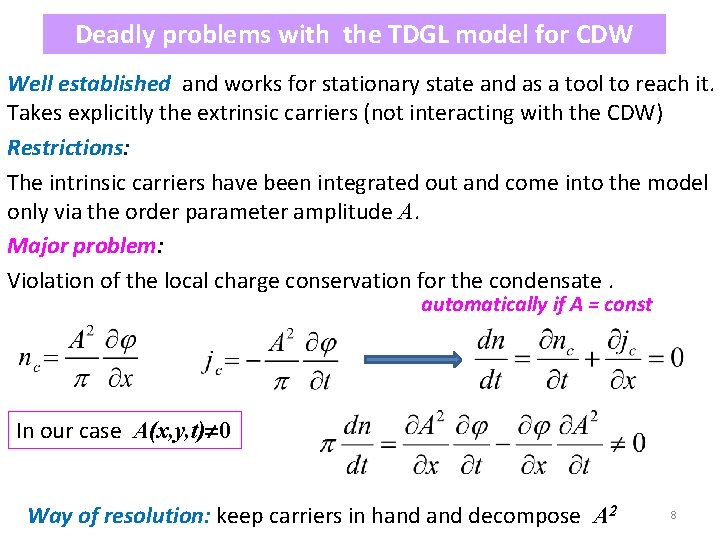
Deadly problems with the TDGL model for CDW Well established and works for stationary state and as a tool to reach it. Takes explicitly the extrinsic carriers (not interacting with the CDW) Restrictions: The intrinsic carriers have been integrated out and come into the model only via the order parameter amplitude A. Major problem: Violation of the local charge conservation for the condensate. automatically if A = const In our case A(x, y, t) 0 Way of resolution: keep carriers in hand decompose A 2 8
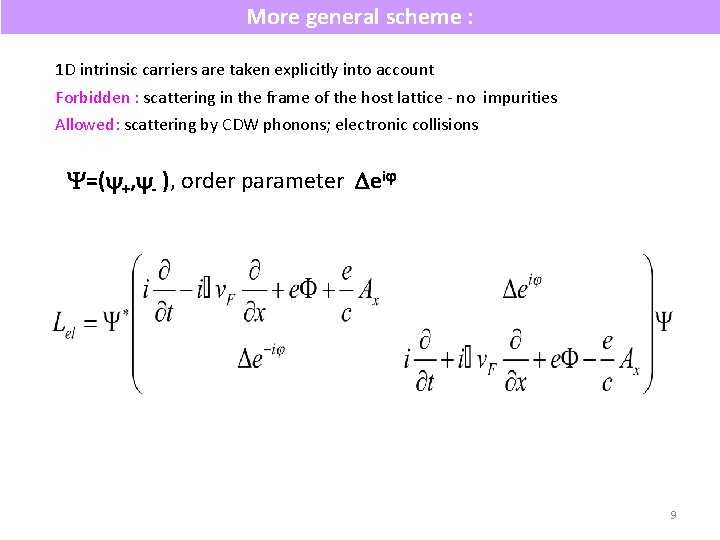
More general scheme : 1 D intrinsic carriers are taken explicitly into account Forbidden : scattering in the frame of the host lattice - no impurities Allowed: scattering by CDW phonons; electronic collisions =( +, - ), order parameter ei 9
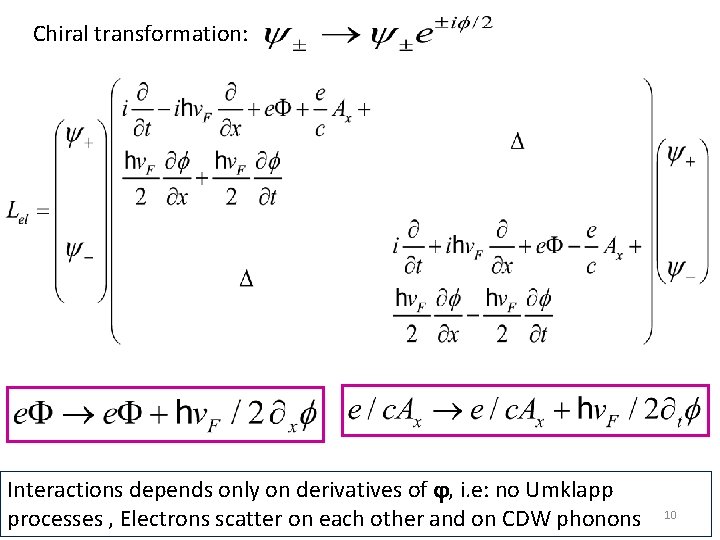
Chiral transformation: Interactions depends only on derivatives of , i. e: no Umklapp processes , Electrons scatter on each other and on CDW phonons 10
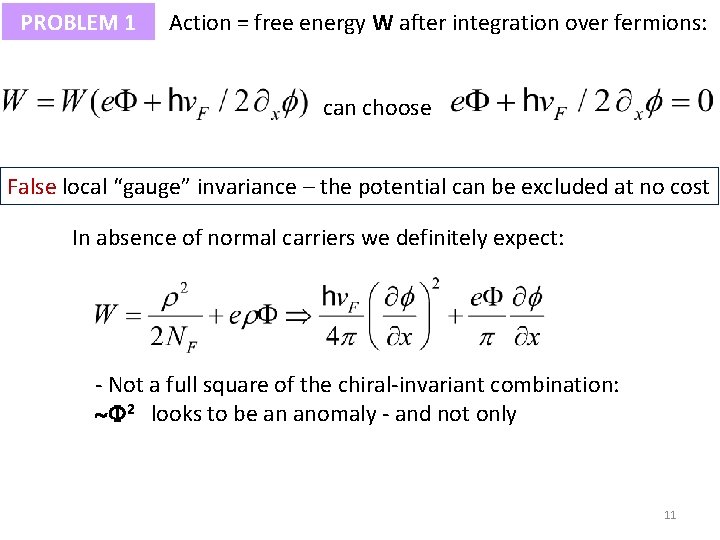
PROBLEM 1 Action = free energy W after integration over fermions: can choose False local “gauge” invariance – the potential can be excluded at no cost In absence of normal carriers we definitely expect: - Not a full square of the chiral-invariant combination: 2 looks to be an anomaly - and not only 11
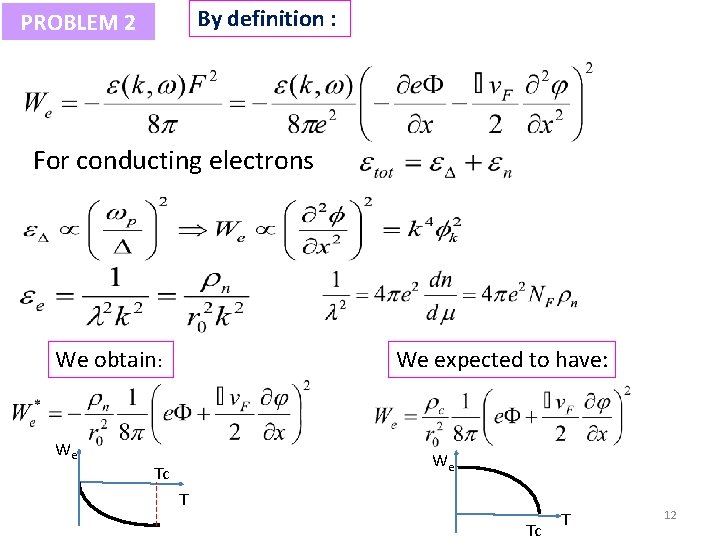
By definition : PROBLEM 2 For conducting electrons We obtain: We We expected to have: We Tc T 12
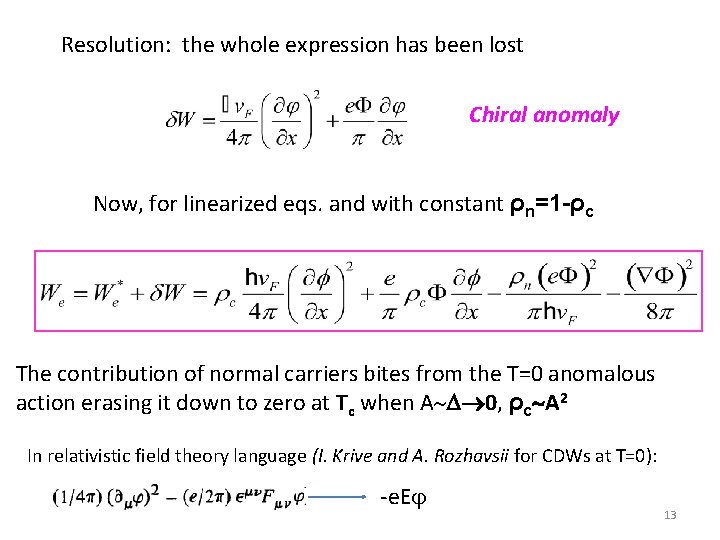
Resolution: the whole expression has been lost Chiral anomaly Now, for linearized eqs. and with constant ρn=1 -ρc The contribution of normal carriers bites from the T=0 anomalous action erasing it down to zero at Tc when A 0, ρc A 2 In relativistic field theory language (I. Krive and A. Rozhavsii for CDWs at T=0): -e. E 13
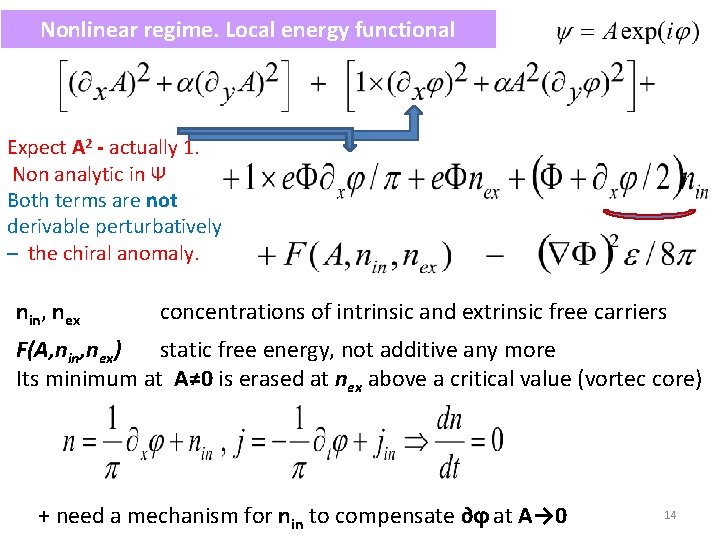
Nonlinear regime. Local energy functional Expect A 2 - actually 1. Non analytic in Ψ Both terms are not derivable perturbatively – the chiral anomaly. nin, nex concentrations of intrinsic and extrinsic free carriers F(A, nin, nex) static free energy, not additive any more Its minimum at A≠ 0 is erased at nex above a critical value (vortec core) + need a mechanism for nin to compensate ∂ at A→ 0 14
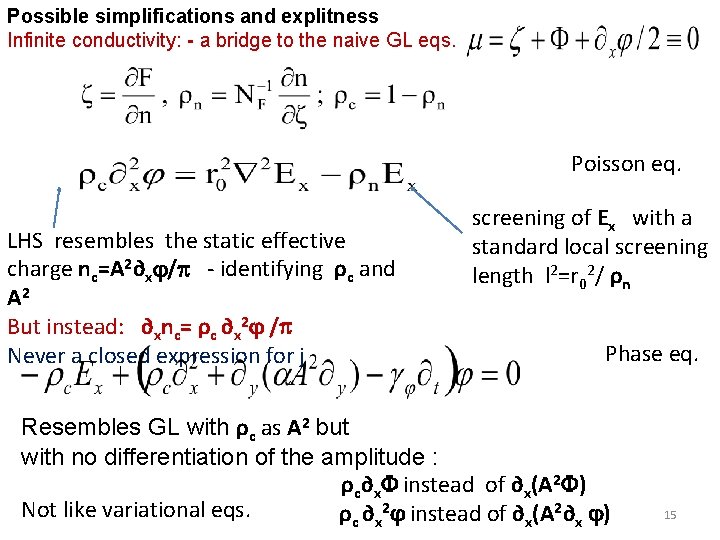
Possible simplifications and explitness Infinite conductivity: - a bridge to the naive GL eqs. Poisson eq. LHS resembles the static effective charge nc=A 2∂x / - identifying ρc and A 2 But instead: ∂xnc= ρc ∂x 2 / Never a closed expression for j screening of Ex with a standard local screening length l 2=r 02/ ρn Phase eq. Resembles GL with ρc as A 2 but with no differentiation of the amplitude : ρc∂x instead of ∂x(A 2 ) Not like variational eqs. ρc ∂x 2 instead of ∂x(A 2∂x ) 15
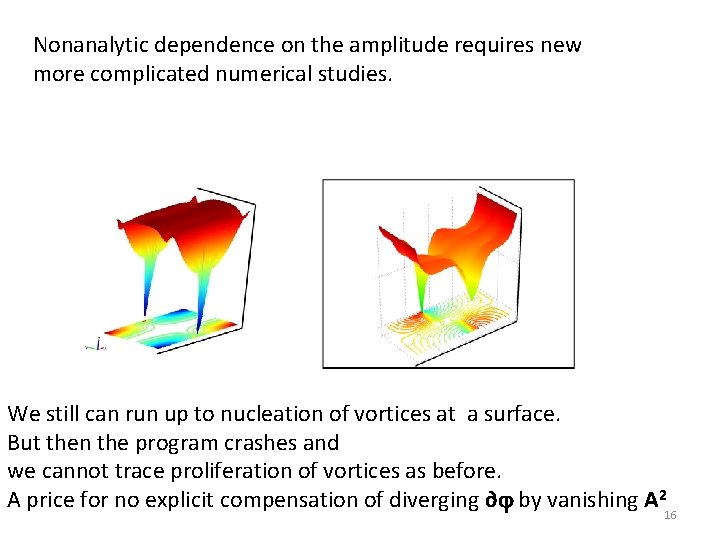
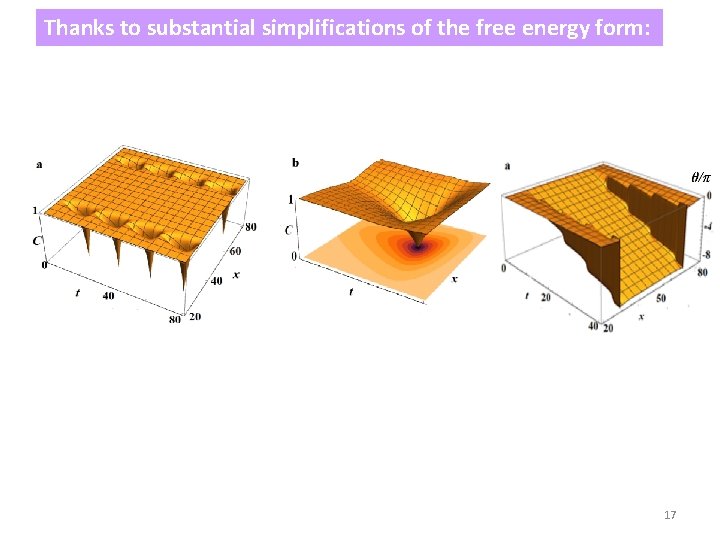
Nonanalytic dependence on the amplitude requires new more complicated numerical studies. We still can run up to nucleation of vortices at a surface. But then the program crashes and we cannot trace proliferation of vortices as before. A price for no explicit compensation of diverging ∂ by vanishing A 216
Thanks to substantial simplifications of the free energy form: 17
Conclusion and perspective. Ø Chiral transformations with account for chiral anomaly were applied to the CDW model Ø Two-fluid hydrodynamics was constructed for the order parameter and the normal liquid Ø Topologically nontrivial dynamics appears under applied fields or charge injection Ø Spontaneous space-time vorticity under the driving current was modeled numerically some under simplifications, periodic sequence of amplitude nodes with 2π phase increments was demonstrated Ø The numeric procedure needs to be stabilized for the nonanalytic eqs. Ø The problems of glide and climb should be considered 18