
Excretory System VID The removal of metabolic wastes
Excretory System VID • The removal of metabolic wastes. • Metabolic wastes include: water, salts, CO 2, nitrogenous wastes. • Main organs are: Kidneys, Ureters, and Bladder, Skin, and Lungs
• Includes many systems such as respiratory, skin, and urinary system. • Each gets rid of waste in its own way. Respiratory System: Part of excretory system • Oxygen in • Carbon dioxide and water out Skin: Salt and some organic substances out
Excretion: removal of waste products of metabolism. I. Kinds of Waste Metabolic Activity……………. Waste Produced A. Respiration…………. . CO 2, H 2 O B. Dehydration Synthesis. ………. . . H 2 O C. Protein metabolism……………. N 2 waste (urea, uric acid, ammonia) D. Other………………Mineral salts
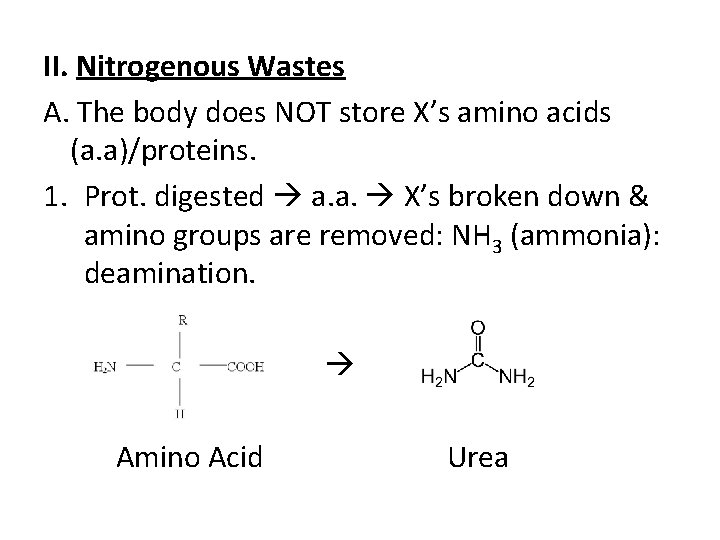
II. Nitrogenous Wastes A. The body does NOT store X’s amino acids (a. a)/proteins. 1. Prot. digested a. a. X’s broken down & amino groups are removed: NH 3 (ammonia): deamination. Amino Acid Urea
2. NH 3 is highly toxic. • NH 3 can be removed from animals that live in H 2 O • Higher animals convert NH 3 to uric acid or urea (less toxic); uric acid is not toxic, but insoluble in H 2 O [exception Dalmatians]. B. Forms of N 2 waste 1. NH 3: very toxic: requires > amt of H 2 O; aquatic animals. 2. Urea: < toxic but requires > amt of H 2 O; mammals, amphibians. 3. Uric Acid: “harmless”; insoluble w/limited H 2 O. Insects, reptiles, birds. III. Inorganic Salts: Na. Cl, KCl, excreted from cells by diffusion or active transport. *** Not all waste is toxic but can become so if there’s too much eg. H 2 O. Too much can cause bursting of cells, etc.
IV. Human Excretion A. Excretory Organs: see h. o. 12 -1 • liver • kidney’s • lungs • skin B. Wastes: • H 2 O • Urea NH 2 – C – NH 2 • CO 2 • Mineral salts • Creatin: waste products of msl’r activity
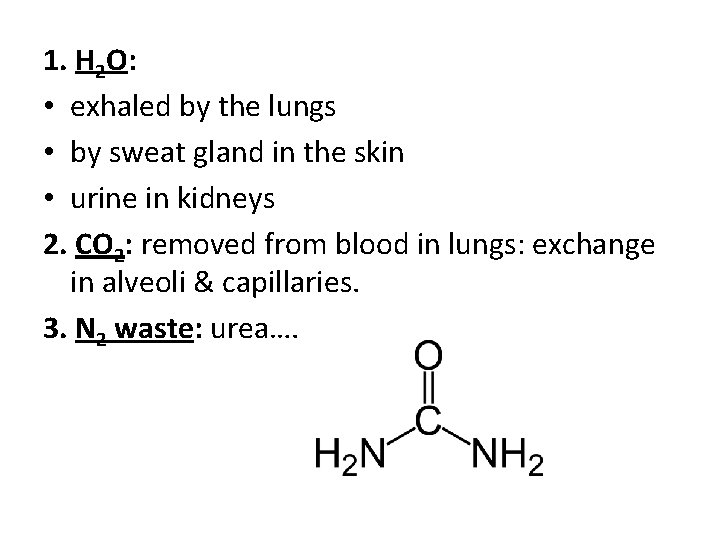
1. H 2 O: • exhaled by the lungs • by sweat gland in the skin • urine in kidneys 2. CO 2: removed from blood in lungs: exchange in alveoli & capillaries. 3. N 2 waste: urea….
V. Process A. Deamination: too much protein X’s a. a. which is NOT stored but changed to N 2 waste. 1. Liver: where deamination occurs. NH 2 NH 3. VERY toxic & is changed to urea (< toxic) & removed in large amts of H 2 O. Urea is in urine & sweat.
2. Kidneys: 2 bean shaped organs at the back of the abdominal wall. VID • Located at back of abdomen near waist level • Kidney filters blood of waste products, creates waste product called urine • All of your blood is filtered through your kidneys in about 5 minutes • Connected to bladder through two ducts called ureters: drains urine into your bladder
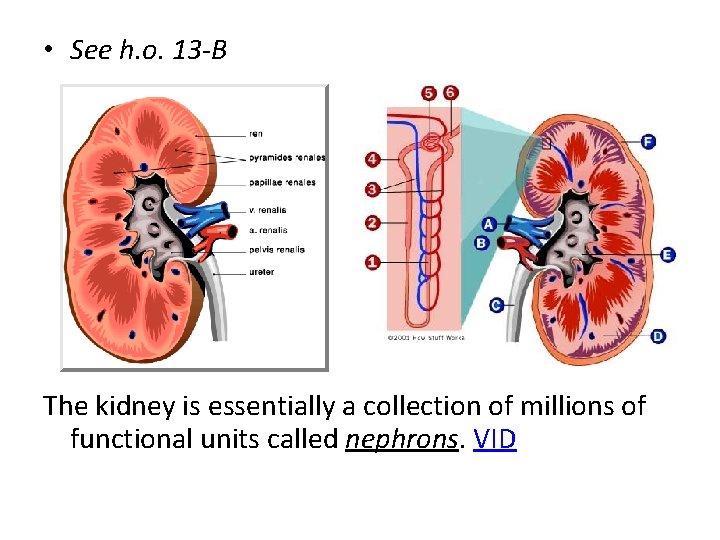
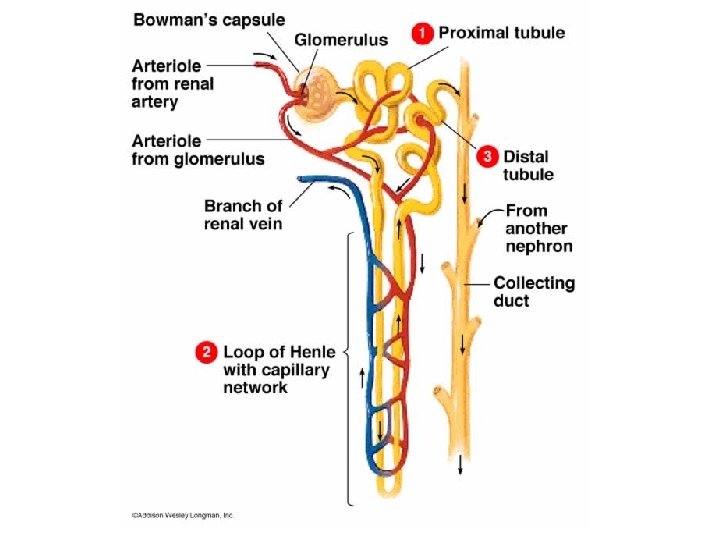
• See h. o. 13 -B The kidney is essentially a collection of millions of functional units called nephrons. VID
• Each nephron consists of a network of capillaries & renal tubules: each tubule originates in the Bowman’s Capsule, which surrounds a network of capillaries called the glomerulus: blood filtration starts here & filtrate moves thru the renal tubule. • Re-absorption of RBC, WBC, platelets, glucose, & a. a. occurs in the proximal convoluted tubule. • Fats, H 2 O, ions are absorbed in all parts of the tubule (by active transport, diffusion, & osmosis).
4. ADH: a hormone produced in the brain (hypothalamus) that regulates H 2 O reabsorption & urine concentration. VID Urinary System • Water and salts in • Excess water, metabolic wastes and salts out • Controls blood volume (blood pressure) • Works in conjunction with hypothalamus to balance fluid levels in blood
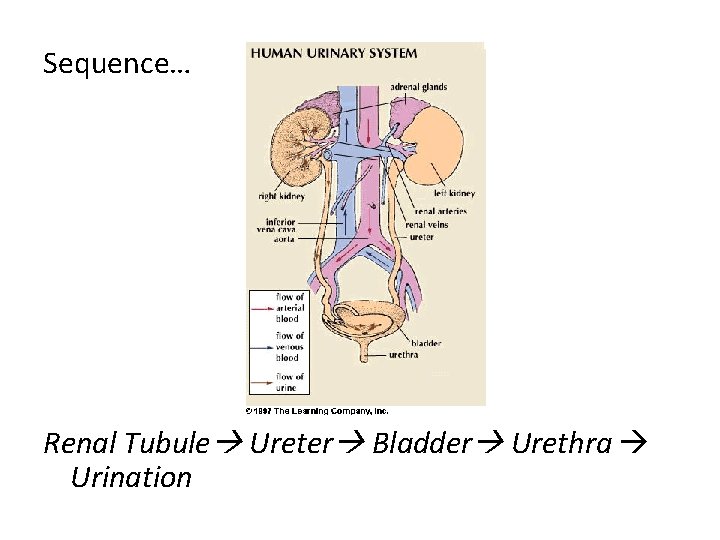
Sequence… Renal Tubule Ureter Bladder Urethra Urination

5. Bladder • Bladder is where urine is held until you release it (voiding). • Bladder is an elastic, muscular organ that can stretch to hold. 5 liter of urine. • Avg. human produces approximately 1 liter of urine daily 1. Micturition: the “wanting” to urinate. VID 2. Urination: process of voiding (ridding) the urine.
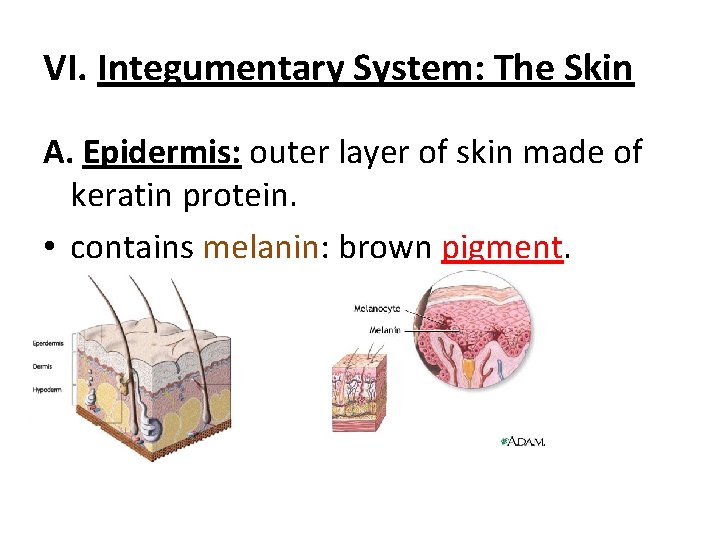
VI. Integumentary System: The Skin A. Epidermis: outer layer of skin made of keratin protein. • contains melanin: brown pigment.

B. Dermis: inner layer of skin, composed of • sensory neurons, bld vsls • msl fibers, hair follicles, & glands C. Nails: • protects fingers & toes. • made of keratin D. Hair: protects & insulates the body. color due to melanin
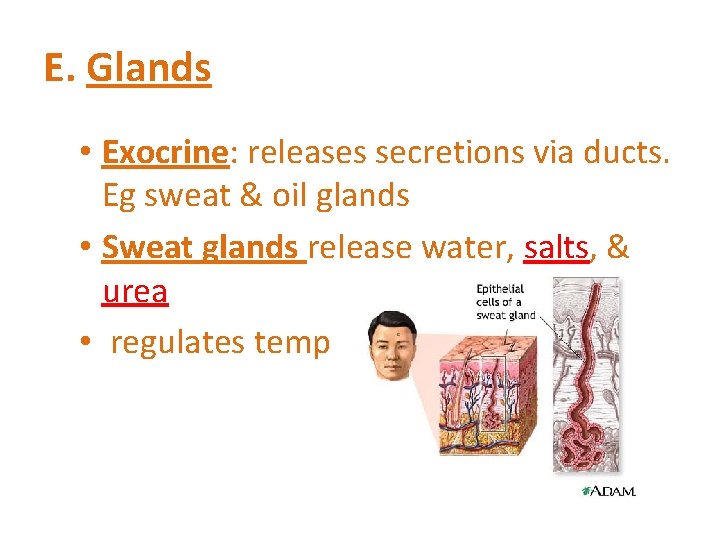
E. Glands • Exocrine: releases secretions via ducts. Eg sweat & oil glands • Sweat glands release water, salts, & urea • regulates temp
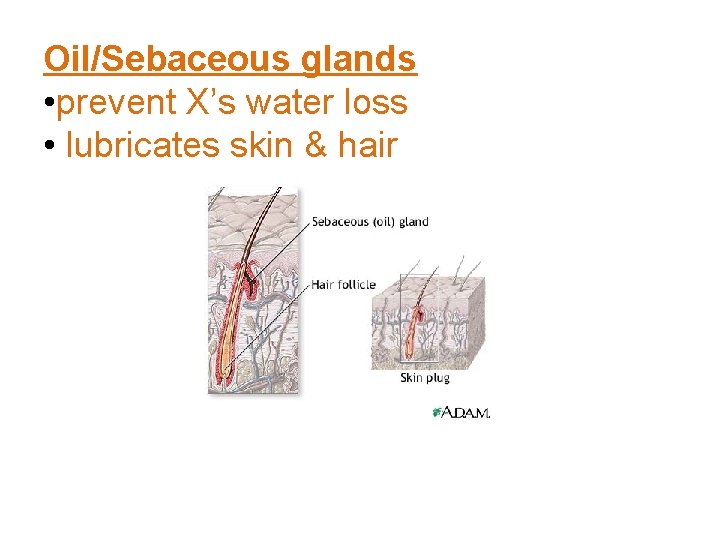
Oil/Sebaceous glands • prevent X’s water loss • lubricates skin & hair
VI. Disorders: bladder infxn is the most common urinary disorder; usually they’re not serious if treated promptly. Any disorder that severely reduces the effectiveness of the kidneys is life threatening. A. Obstructive Disorders: are abnormalities that interfere w/normal urine flow. Obstruction of urine flow results in “backing up” of the urine, perhaps all the way to the kidney itself, causing swelling of the renal pelvis. Some obstructive causes:
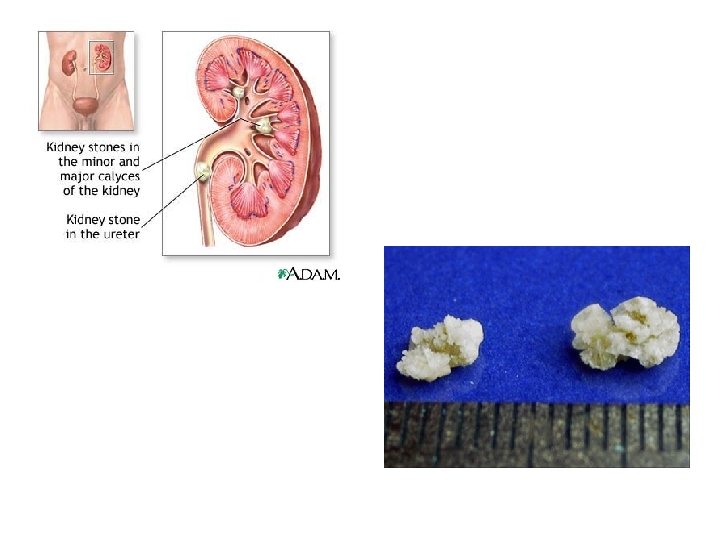
1. Renal Calculi: kidney stones, which are crystallized mineral chunks. VID • They develop when Ca+2 & other minerals crystallize & then break off into the urine. • If the stones are small enough, they’ll pass w/the urine. • Larger stones may block the ureters, causing intense pain. • Drugs that increases urine flow may be used w/drugs to dissolve the stones. • Laser, surgery, & ultrasound have also been used to break up the stones VID
2. Tumors: typically obstruct urine flow; most kidney tumors are malignant & usually occur in 1 kidney, which may have to be removed. A person can live normally with ¼ of one kidney VID • If both kidneys fail, a person must use a dialysis machine to filter wastes out of the blood to prevent death VID • Bladder cancer occurs about as frequently as renal cancer. • Both types of cancers have few symptoms early on other than traces of blood in the urine. • As the cancer develops, pelvic pain & urinary obstruction may occur.
B. Urinary Tract Infxns: most are caused by bacteria & can involve the urethra, bladder, ureters, & kidneys. Common types involve the following: 1. Urethritis: inflammation of the urethra resulting from bacterial infxn, often gonorrhea; males suffer from this more often than females. 2. Cystitis: inflammation of the bladder usually the result of infxns but can also be due to stones, tumors, or other conditions. • Bacteria usually enter the bladder thru the urethra. • Occurs more often in women b/c the women’s urethra is shorter & closer to the anus than in men. • Bladder infxns symptoms include pelvic pain, & an urge to urinate frequently.
C. Incontinence: person voids urine involuntarily. Usually due to a stroke or spinal cord injury D. Kidney Failure: or renal failure: the failure of the kidney to properly process blood & form urine. 2 categories: 1. Acute Renal Failure: an abrupt reduction in kidney fxn, which can be caused by a variety of factors. If the cause is successfully treated, recovery is usually rapid & complete. 2. Chronic Renal Failure: a slow, progressive condition resulting from loss of nephrons. Dozen of diseases may cause this. Chronic renal failure progress thru 3 stages: VID
• Stage 1: nephrons are lost but remaining ones compensate by enlarging. • Stage 2: kidney can no longer adapt to loss of nephrons. • Stage 3: final stage. There’s a high blood urea & total loss of kidney fxn. Fluids are retained by the body instead of being excreted. Unless there is a kidney transplant or dialysis, the loss of kidney fxn eventually causes death. *** End For Exam ***
- Slides: 27