
Excretory System GETTING RID OF METABOLIC WASTES Excretion
Excretory System GETTING RID OF METABOLIC WASTES
Excretion � The process of removing wastes from the body
Concept Review: Homeostasis �it is the body’s (or the cell’s) ability to maintain a steady internal environment even though the external environment is constantly changing.
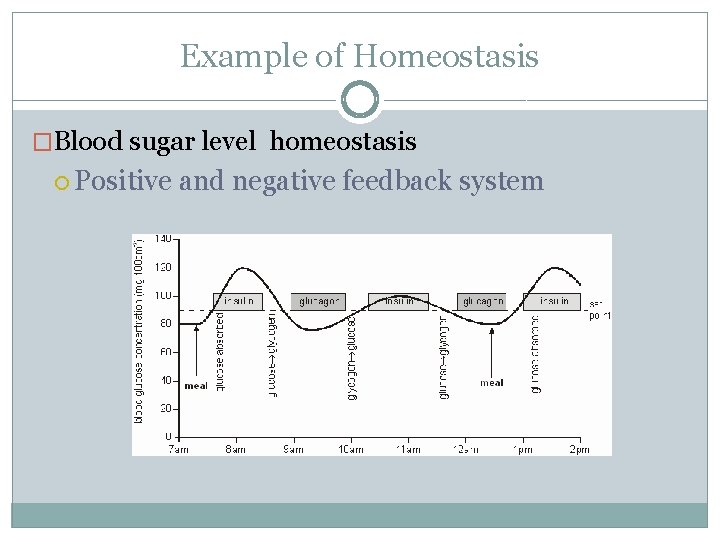
Example of Homeostasis �Blood sugar level homeostasis Positive and negative feedback system
Excretion is part of Homeostasis �Excretion refers to the wastes that cells produce, and the waste that organisms produce �How is this part of homeostasis? � Think about what would happen at home if you never took out the trash?
WHY IS EXCRETION IMPORTANT? �Wastes include toxic chemicals, as well as excess amounts of nontoxic materials. �If these wastes are not eliminated, the ability of an organism to function is drastically reduced.
How Does Excretion Happen? At the cellular level 2. At the organismal level 1.
Excretion in a single cell �WHAT WASTES DO CELLS EXCRETE? Water, carbon dioxide, salts, urea, etc �ORGANELLES INVOLVED: cell membrane �i. e. diffusion, osmosis, active transport, etc
Excretion in Multicellular Organisms (i. e. humans and other mammals) �WHAT WASTES DO ORGANISMS EXCRETE? Water, urea, carbon dioxide, salts �BTW: What is Urea? �Urea is a less toxic package of wastes produced by the liver when it breaks down other compounds. Urea enters the blood at the liver and is removed from the blood by the kidneys � ORGANS INVOLVED: Kidneys, skin, lungs, liver � Together, these organs make up the EXCRETORY SYSTEM
Which other organ systems help with excretion? �The Circulatory System plays an important role in the elimination of wastes. �Wastes are carried BY THE BLOOD (circulation) to THE KIDNEYS (for diffusion and filtration) and LUNGS (for elimination of CO 2 and excess H 2 O)
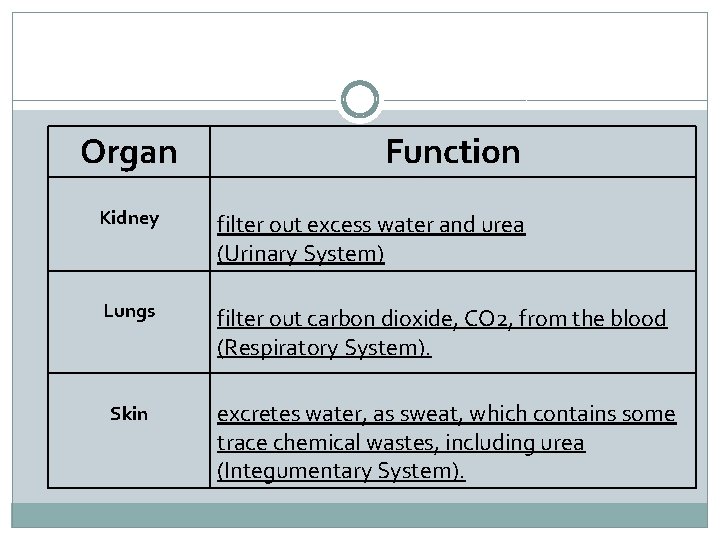
Organ Function Kidney filter out excess water and urea (Urinary System) Lungs filter out carbon dioxide, CO 2, from the blood (Respiratory System). Skin excretes water, as sweat, which contains some trace chemical wastes, including urea (Integumentary System).
The Kidneys • Every drop of blood in your body is filtered by your kidneys more than 300 times per day! • Kidneys eliminate urea, minerals and excess water. • Kidneys regulate the amount of water we need to maintain in our bodies.
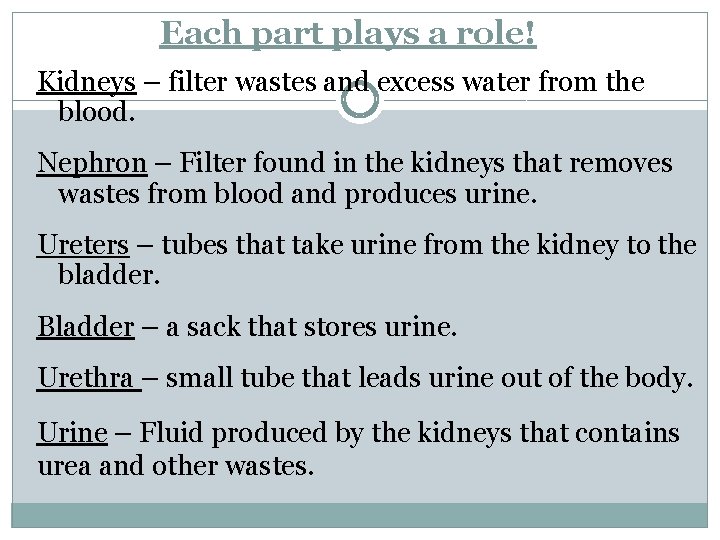
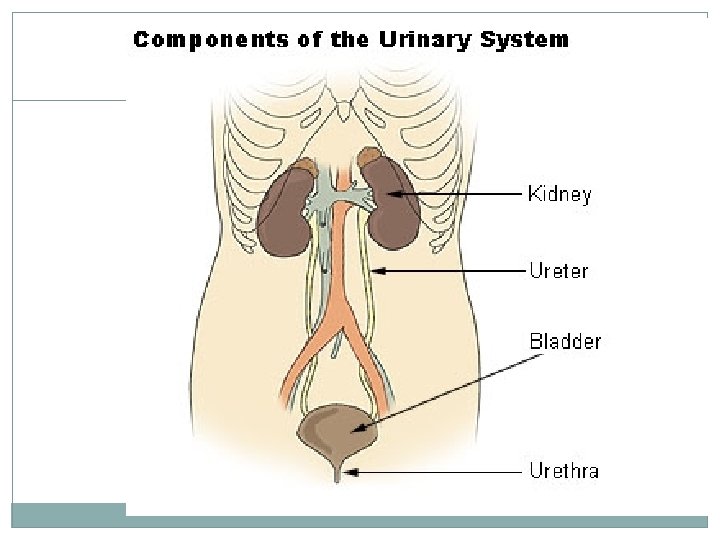
Each part plays a role! Kidneys – filter wastes and excess water from the blood. Nephron – Filter found in the kidneys that removes wastes from blood and produces urine. Ureters – tubes that take urine from the kidney to the bladder. Bladder – a sack that stores urine. Urethra – small tube that leads urine out of the body. Urine – Fluid produced by the kidneys that contains urea and other wastes.
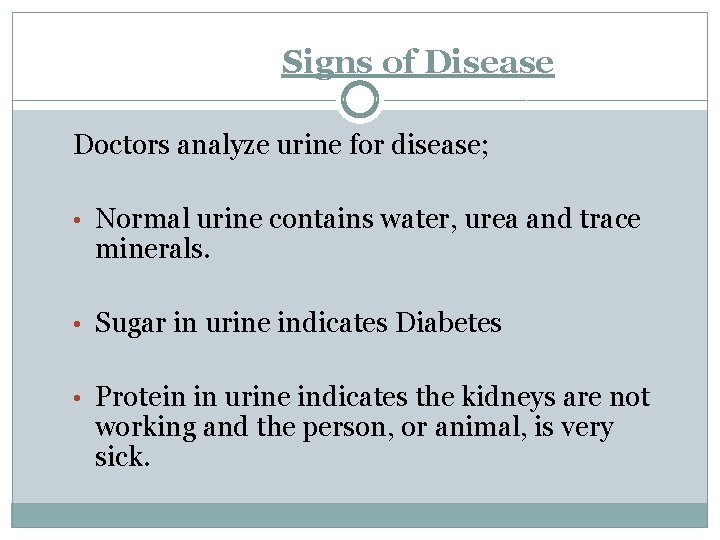
Signs of Disease Doctors analyze urine for disease; • Normal urine contains water, urea and trace minerals. • Sugar in urine indicates Diabetes • Protein in urine indicates the kidneys are not working and the person, or animal, is very sick.
- Slides: 15