
Excretory System Chapter 36 BIOL 1000 Dr Mohamad
Excretory System Chapter 36 BIOL 1000 Dr. Mohamad H. Termos
Body Fluid Regulation • An excretory system regulates body fluid concentrations • Osmoregulation – maintenance of ion concentrations (in blood) -Homeostasis! The concentration of urine produced by an animal varies depending on its environment, as well as water and salt intake 2
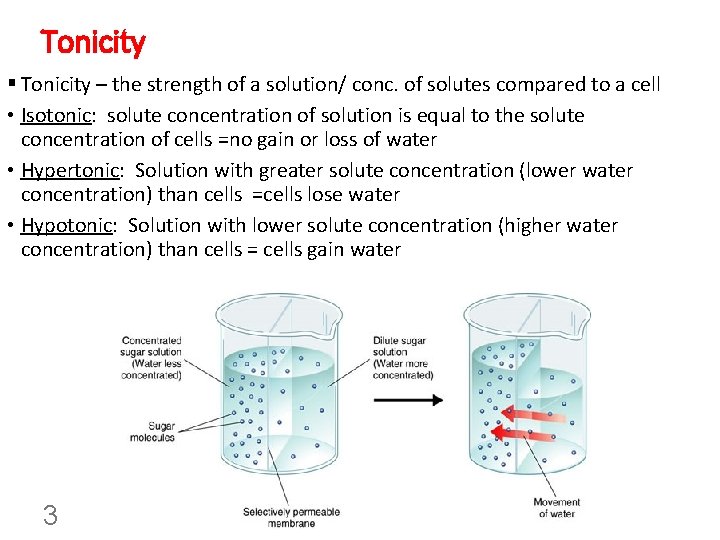
Tonicity § Tonicity – the strength of a solution/ conc. of solutes compared to a cell • Isotonic: solute concentration of solution is equal to the solute concentration of cells =no gain or loss of water • Hypertonic: Solution with greater solute concentration (lower water concentration) than cells =cells lose water • Hypotonic: Solution with lower solute concentration (higher water concentration) than cells = cells gain water 3
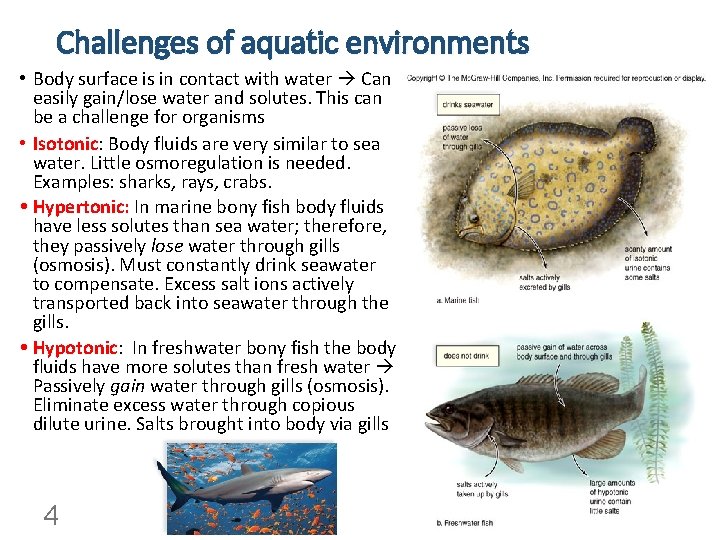
Challenges of aquatic environments • Body surface is in contact with water Can easily gain/lose water and solutes. This can be a challenge for organisms • Isotonic: Body fluids are very similar to sea water. Little osmoregulation is needed. Examples: sharks, rays, crabs. Hypertonic: In marine bony fish body fluids have less solutes than sea water; therefore, they passively lose water through gills (osmosis). Must constantly drink seawater to compensate. Excess salt ions actively transported back into seawater through the gills. Hypotonic: In freshwater bony fish the body fluids have more solutes than fresh water Passively gain water through gills (osmosis). Eliminate excess water through copious dilute urine. Salts brought into body via gills 4
Terrestrial Animals • Terrestrial animals lose water through: Sweat, urine, feces, breathing, insensible perspiration. Must consume water to make up for loss. Water loss is reduced by skin covering, concentrated urine, dry fecal material, and specialized nasal passages 5
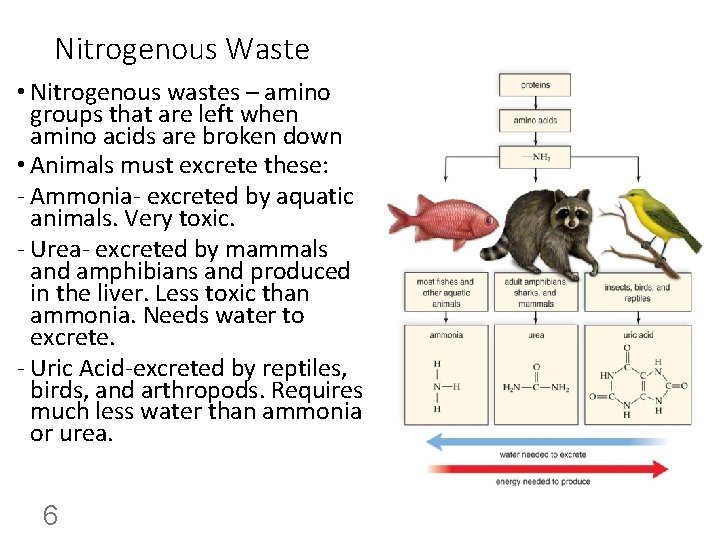
Nitrogenous Waste • Nitrogenous wastes – amino groups that are left when amino acids are broken down • Animals must excrete these: - Ammonia- excreted by aquatic animals. Very toxic. - Urea- excreted by mammals and amphibians and produced in the liver. Less toxic than ammonia. Needs water to excrete. - Uric Acid-excreted by reptiles, birds, and arthropods. Requires much less water than ammonia or urea. 6
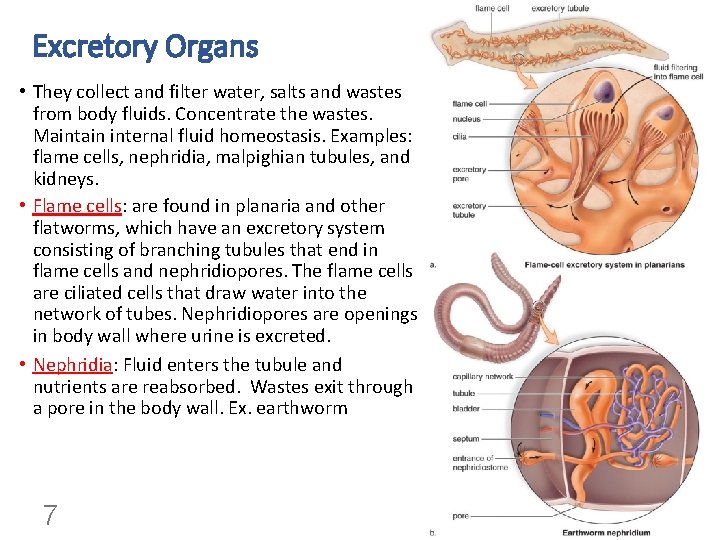
Excretory Organs • They collect and filter water, salts and wastes from body fluids. Concentrate the wastes. Maintain internal fluid homeostasis. Examples: flame cells, nephridia, malpighian tubules, and kidneys. • Flame cells: are found in planaria and other flatworms, which have an excretory system consisting of branching tubules that end in flame cells and nephridiopores. The flame cells are ciliated cells that draw water into the network of tubes. Nephridiopores are openings in body wall where urine is excreted. • Nephridia: Fluid enters the tubule and nutrients are reabsorbed. Wastes exit through a pore in the body wall. Ex. earthworm 7
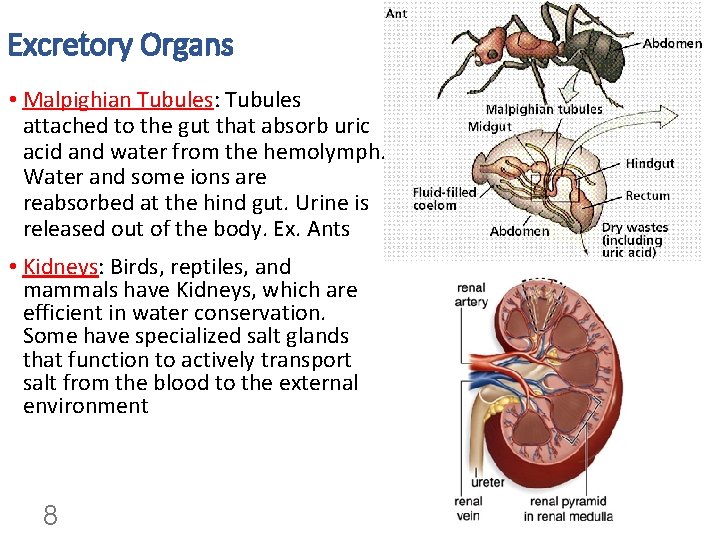
Excretory Organs • Malpighian Tubules: Tubules attached to the gut that absorb uric acid and water from the hemolymph. Water and some ions are reabsorbed at the hind gut. Urine is released out of the body. Ex. Ants • Kidneys: Birds, reptiles, and mammals have Kidneys, which are efficient in water conservation. Some have specialized salt glands that function to actively transport salt from the blood to the external environment 8
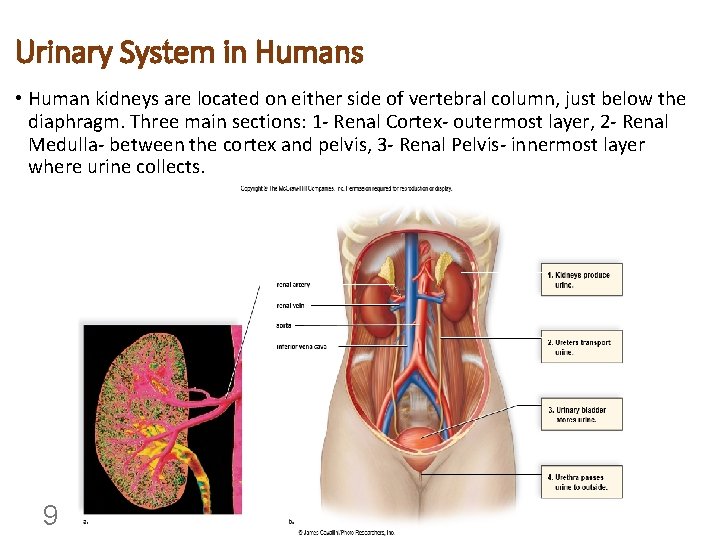
Urinary System in Humans • Human kidneys are located on either side of vertebral column, just below the diaphragm. Three main sections: 1 - Renal Cortex- outermost layer, 2 - Renal Medulla- between the cortex and pelvis, 3 - Renal Pelvis- innermost layer where urine collects. 9
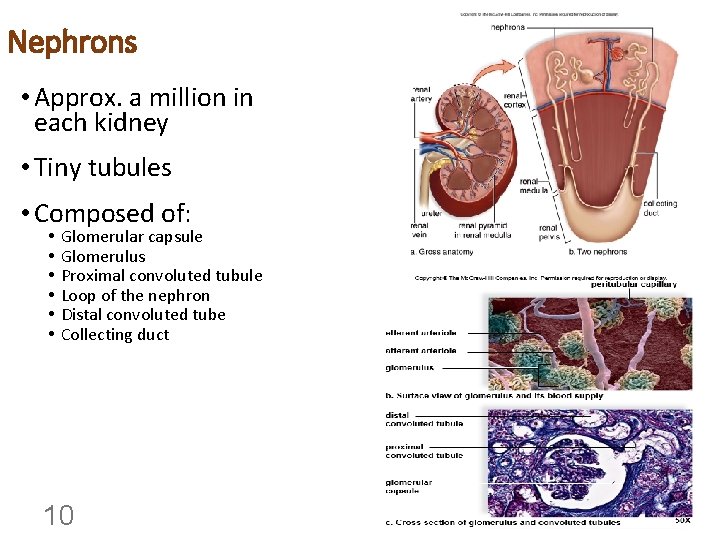
Nephrons • Approx. a million in each kidney • Tiny tubules • Composed of: Glomerular capsule Glomerulus Proximal convoluted tubule Loop of the nephron Distal convoluted tube Collecting duct 10
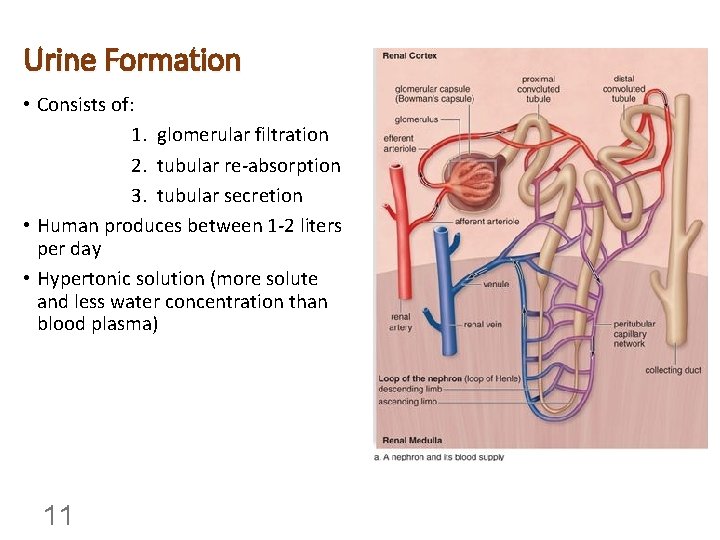
Urine Formation • Consists of: 1. glomerular filtration 2. tubular re-absorption 3. tubular secretion • Human produces between 1 -2 liters per day • Hypertonic solution (more solute and less water concentration than blood plasma) 11
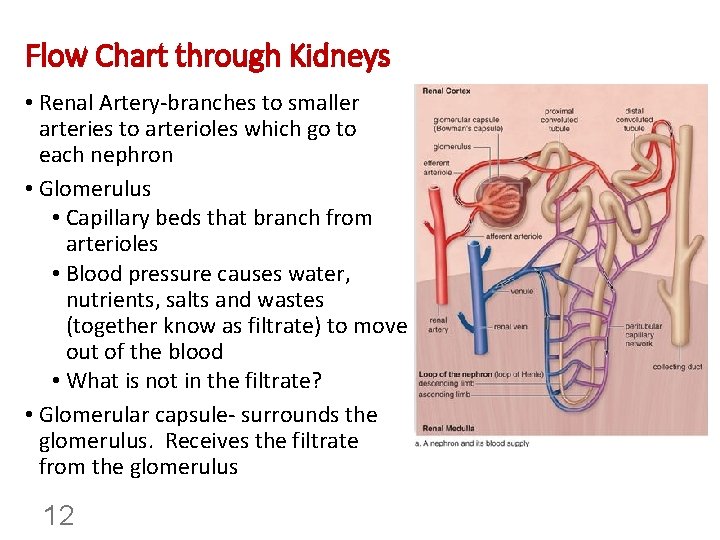
Flow Chart through Kidneys • Renal Artery-branches to smaller arteries to arterioles which go to each nephron • Glomerulus • Capillary beds that branch from arterioles • Blood pressure causes water, nutrients, salts and wastes (together know as filtrate) to move out of the blood • What is not in the filtrate? • Glomerular capsule- surrounds the glomerulus. Receives the filtrate from the glomerulus 12
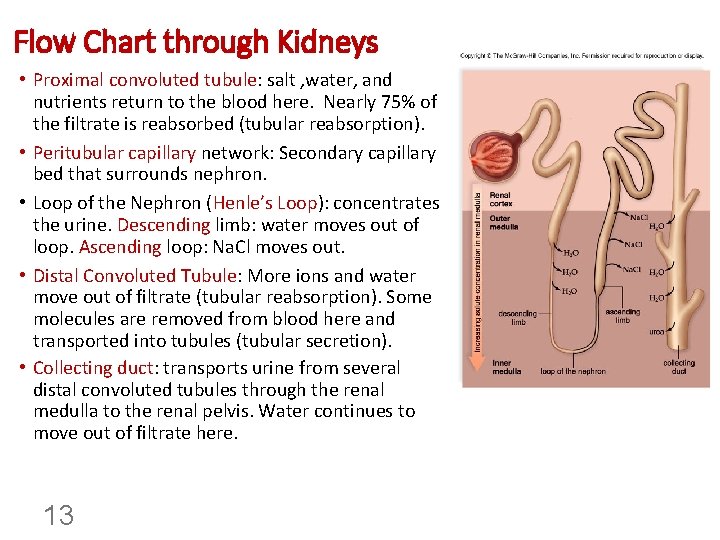
Flow Chart through Kidneys • Proximal convoluted tubule: salt , water, and nutrients return to the blood here. Nearly 75% of the filtrate is reabsorbed (tubular reabsorption). • Peritubular capillary network: Secondary capillary bed that surrounds nephron. • Loop of the Nephron (Henle’s Loop): concentrates the urine. Descending limb: water moves out of loop. Ascending loop: Na. Cl moves out. • Distal Convoluted Tubule: More ions and water move out of filtrate (tubular reabsorption). Some molecules are removed from blood here and transported into tubules (tubular secretion). • Collecting duct: transports urine from several distal convoluted tubules through the renal medulla to the renal pelvis. Water continues to move out of filtrate here. 13
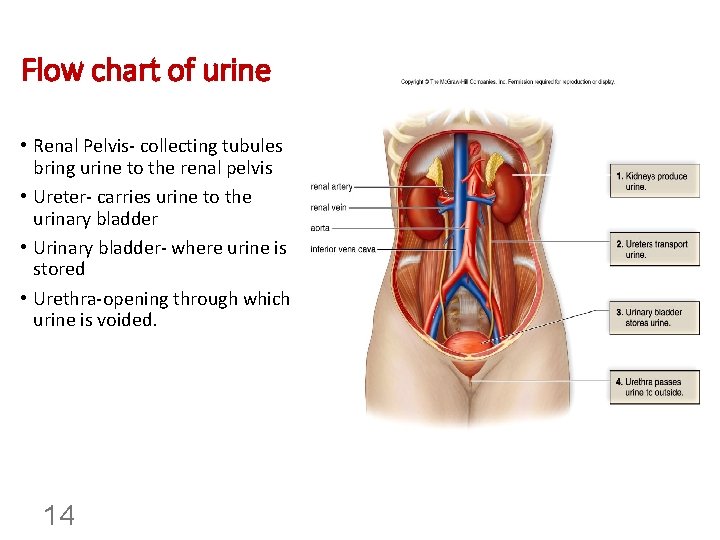
Flow chart of urine • Renal Pelvis- collecting tubules bring urine to the renal pelvis • Ureter- carries urine to the urinary bladder • Urinary bladder- where urine is stored • Urethra-opening through which urine is voided. 14
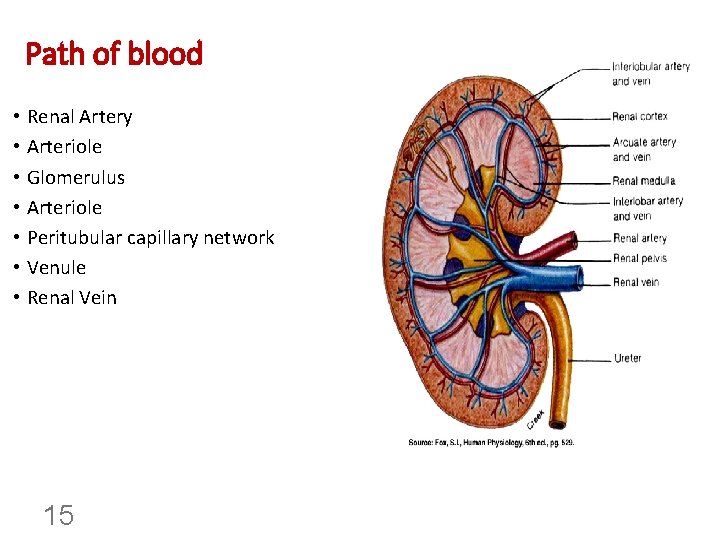
Path of blood • Renal Artery • Arteriole • Glomerulus • Arteriole • Peritubular capillary network • Venule • Renal Vein 15
Functions of the Kidneys – Homeostatic functions through: • Excretion of metabolic wastes • Maintenance of water-salt balance • Maintenance of acid-base balance (p. H balance) • Secretion of hormones: Erythropoietin to stimulate red blood cell production – Maintaining Water Balance. – Hormones: ADH-antidiuretic hormone- increases the amount of water reabsorbed, decreases amount of urine produced (more concentrated). • Maintenance of p. H: p. H is regulated by the bicarbonate buffer system by either the reabsorption of the bicarbonate ions, or the secretion of hydrogen ions. It is also regulated by breathing: Excretion of carbon dioxide by the lungs affects bicarbonate levels in the blood • Note: Kidney structures adapted to environments. Beaver- short loop of henle and dilute urine. Dessert Rodents- very long loop of henle, concentrated urine. 16
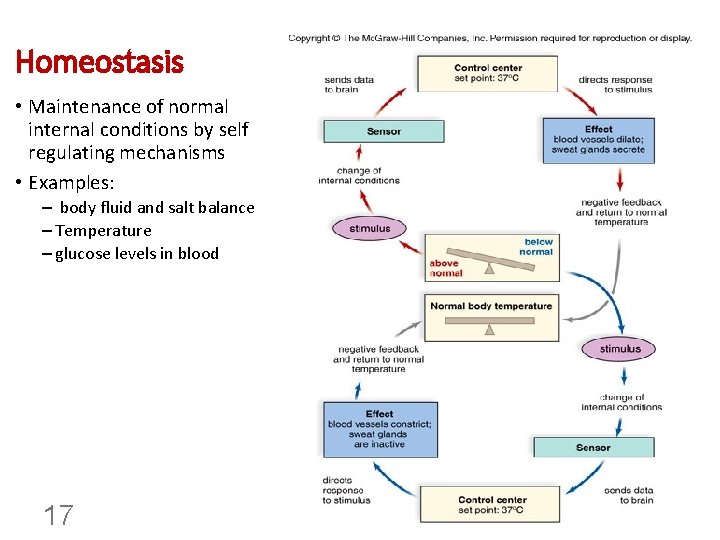
Homeostasis • Maintenance of normal internal conditions by self regulating mechanisms • Examples: – body fluid and salt balance – Temperature – glucose levels in blood 17
- Slides: 17