
Excretion of Drugs Prof Hanan Hagar Pharmacology Department
- Slides: 30
Excretion of Drugs Prof. Hanan Hagar Pharmacology Department
Excretion of Drugs By the end of this lecture, students should be able to n n Identify main and minor routes of Excretion including renal elimination and biliary excretion Describe enterohepatic circulation and its consequences on duration of drugs. Describe some pharmacokinetics terms including clearance of drugs. Biological half-life (t ½), multiple dosing, steady state levels, maintenance dose and Loading dose.
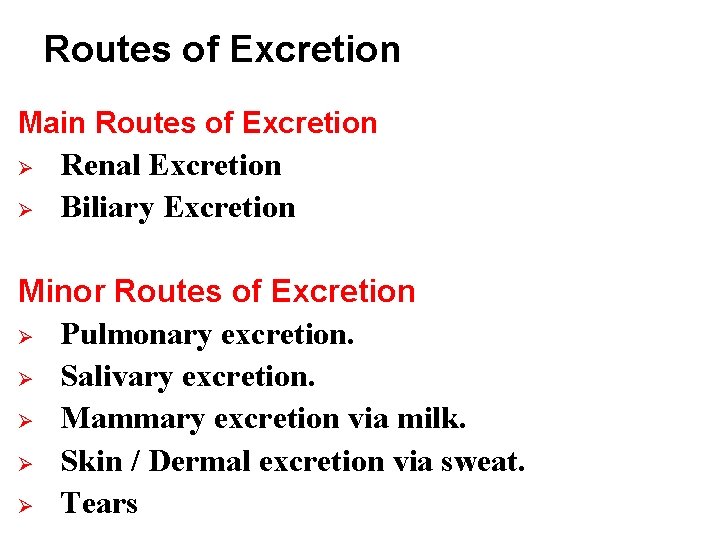
Routes of Excretion Main Routes of Excretion Ø Ø Renal Excretion Biliary Excretion Minor Routes of Excretion Ø Pulmonary excretion. Ø Salivary excretion. Ø Mammary excretion via milk. Ø Skin / Dermal excretion via sweat. Ø Tears
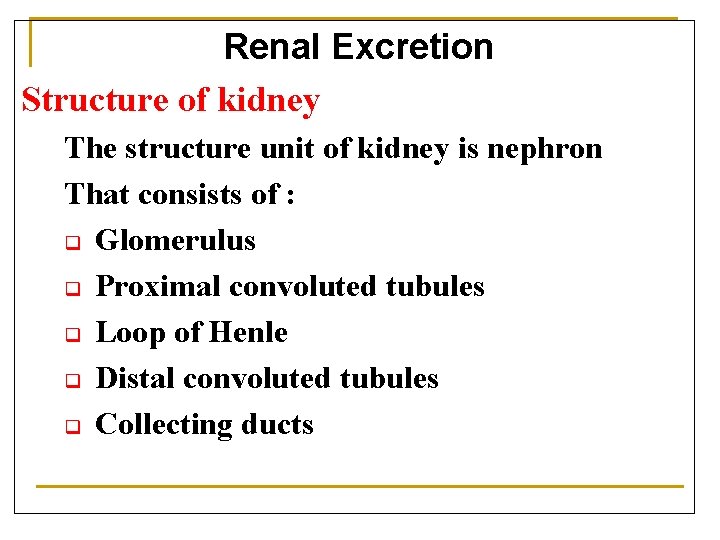
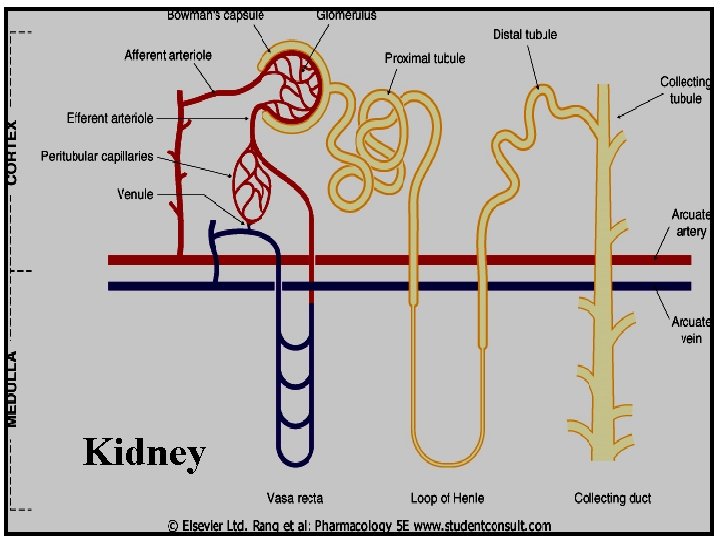
Renal Excretion Structure of kidney The structure unit of kidney is nephron That consists of : q Glomerulus q Proximal convoluted tubules q Loop of Henle q Distal convoluted tubules q Collecting ducts
Kidney
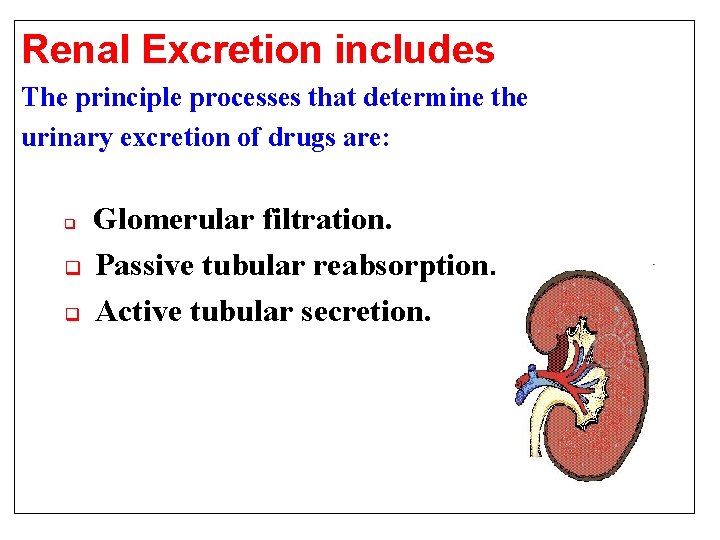
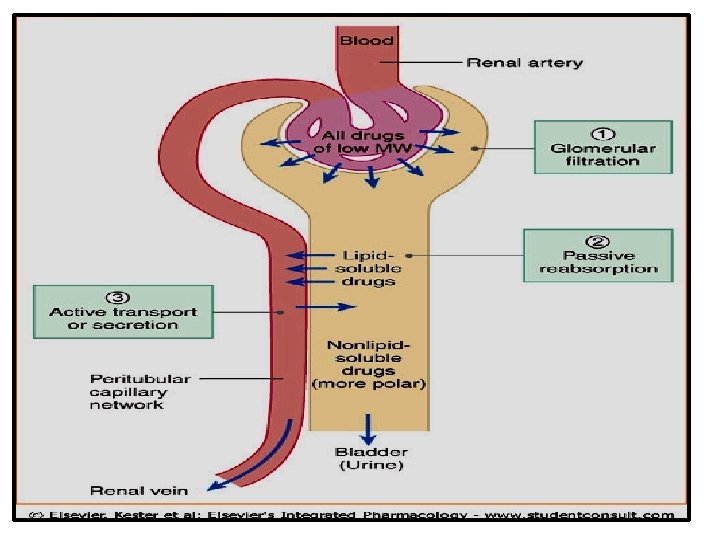
Renal Excretion includes The principle processes that determine the urinary excretion of drugs are: q q q Glomerular filtration. Passive tubular reabsorption. Active tubular secretion.
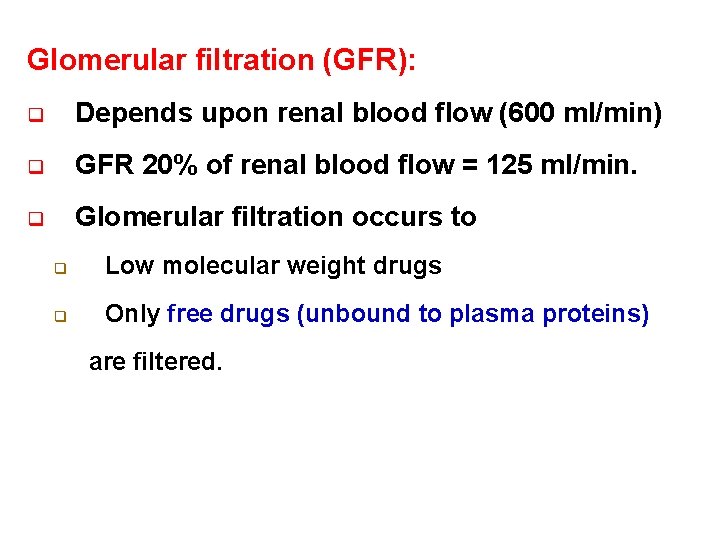
Glomerular filtration (GFR): q Depends upon renal blood flow (600 ml/min) q GFR 20% of renal blood flow = 125 ml/min. q Glomerular filtration occurs to q Low molecular weight drugs q Only free drugs (unbound to plasma proteins) are filtered.
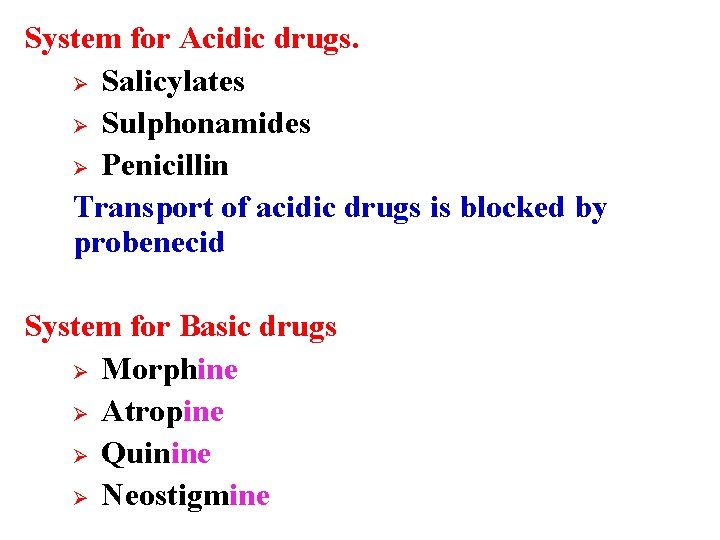
Active tubular secretion: n occurs mainly in proximal tubules; increases drug concentration in lumen n organic anionic and cationic tranporters mediate active secretion of anionic and cationic drugs. n can transport drugs against conc. gradients. n Penicillin is an example of actively secreted drug.
System for Acidic drugs. Ø Salicylates Ø Sulphonamides Ø Penicillin Transport of acidic drugs is blocked by probenecid System for Basic drugs Ø Morphine Ø Atropine Ø Quinine Ø Neostigmine
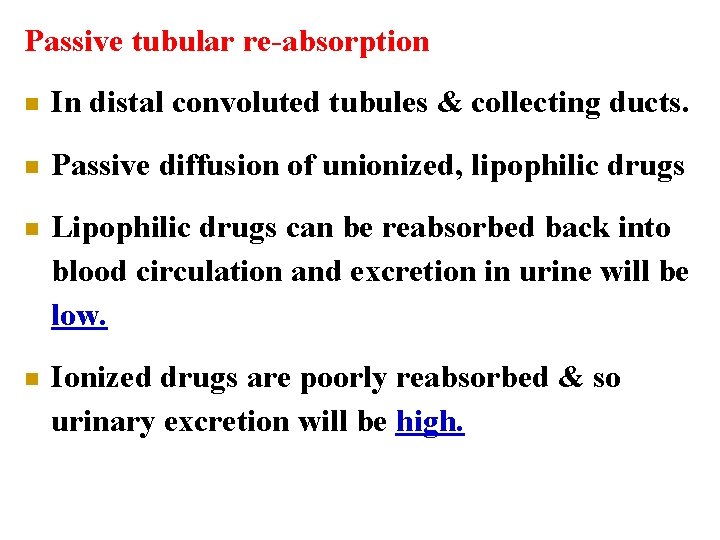
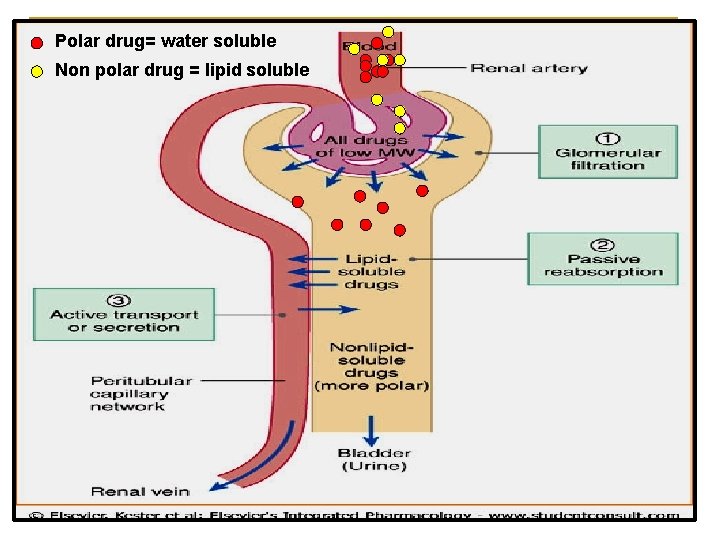
Passive tubular re-absorption n In distal convoluted tubules & collecting ducts. n Passive diffusion of unionized, lipophilic drugs n Lipophilic drugs can be reabsorbed back into blood circulation and excretion in urine will be low. n Ionized drugs are poorly reabsorbed & so urinary excretion will be high.
Polar drug= water soluble Non polar drug = lipid soluble
Urinary p. H trapping (Ion trapping) n Changing p. H of urine by chemicals can inhibit or enhance the tubular drug reabsorption back into blood. n Ion trapping is used to enhance renal clearance of drugs during toxicity. n Urine is normally slightly acidic and favors excretion of basic drugs.
Urinary p. H trapping (Ion trapping) n Acidification of urine using ammonium chloride (NH 4 Cl) increases excretion of basic drugs as amphetamine. n Alkalinization of urine using sodium bicarbonate Na. HCO 3 increases excretion of acidic drugs as aspirin.
Renal Excretion Drugs excreted mainly by the kidney include: n Aminoglycosides antibiotics (as gentamycin) n Penicillin n Lithium These drugs should be prescribed carefully in q patients with renal disease. q Elderly people
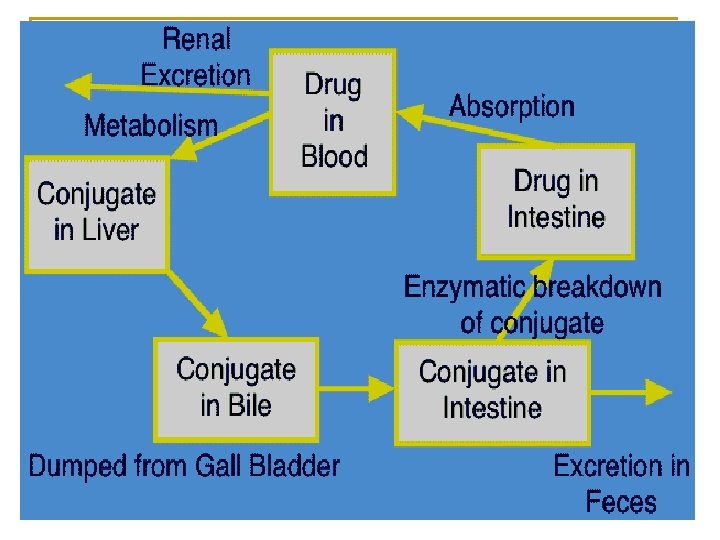
Biliary Excretion Ø Occurs to few drugs that are excreted into feces. Ø Such drugs are secreted from the liver into bile by active transporters, then into duodenum. Ø Some drugs undergo enterohepatic circulation back into systemic blood circulation.
Enterohepatic circulation q Drugs excreted in the bile in the form of glucouronides will be hydrolyzed in intestine by bacterial flora liberating free drugs that can be reabsorbed back into blood if lipid soluble. q This prolongs the duration of action of drugs e. g. digoxin, morphine, thyroxine.
Plasma half-life (t ½) is the time required for the plasma concentration of a drug to fall to half of its initial concentration. n Is a measure of duration of action. n Determine the dosing interval Drugs of short plasma half life Ø Penicillin, tubocurarine. n Drugs of long plasma half life Ø Digoxin, thyroxine.
Factors that may increase half-life (t ½ ) Decreased metabolism q Liver disease. q Microsomal inhibitors. Decreased clearance q Renal disease. q Congestive heart failure. High binding of drugs q Plasma proteins. q Tissue binding. Enterohepatic recycling
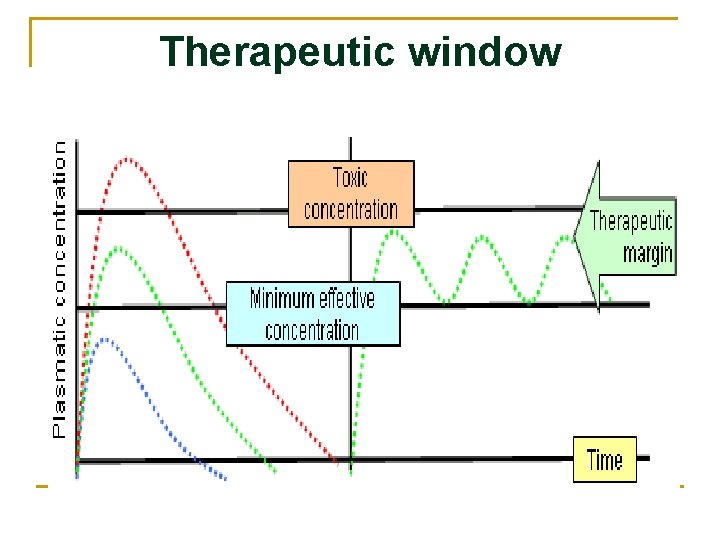
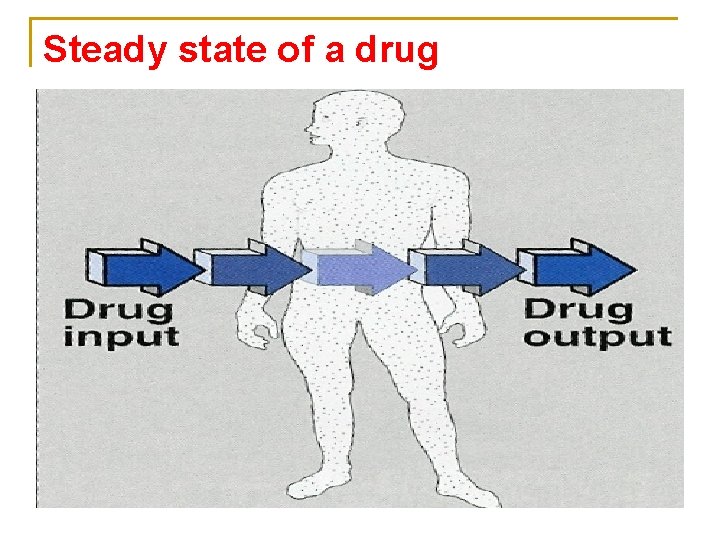
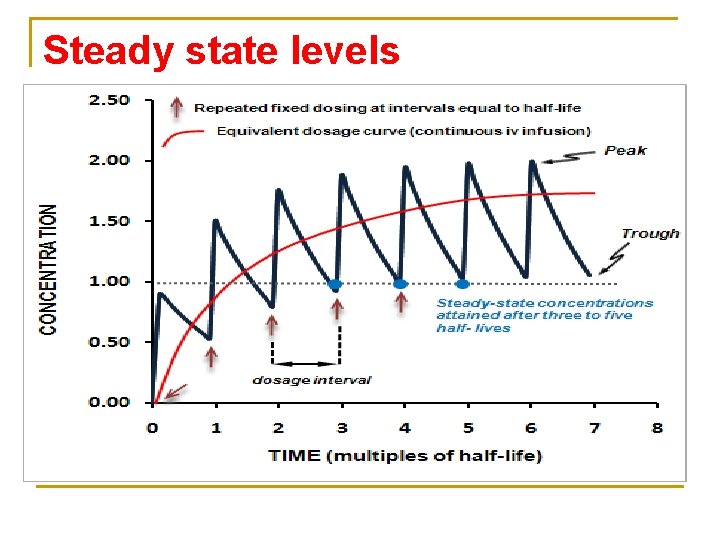
Steady state level. q q A state at which therapeutic plasma concentration of the drug remains constant with therapeutic window (the range between effective and toxic levels of drugs). Units are mg/ml. At steady state: rate of drug administration = elimination rate
Therapeutic window
Steady state of a drug
How many half-lives would be necessary to reach steady state? Steady state concentration is attained after 3 -5 half lives E. g. Morphine
Steady state levels
Loading dose Ø is the large initial dose that is given to achieve rapid therapeutic plasma level. Ø After administration of the drug, the plasma concentration decreases due to distribution of drug to other tissues. Ø These doses balances the drug distribution. Ø This is important for drugs with long halve lives.
Clinical applications of Loading dose n n n A loading dose may be desirable if the time required to attain steady state of drug (4 elimination t 1/2 values) is long and rapid relief is required in the condition being treated. E. g. t 1/2 of lidocaine (antiarrhythmic drug) is usually 1 -2 hours. Arrhythmias after myocardial infarction are life-threatening, and one cannot wait 48 hours to achieve a therapeutic concentration. Use of a loading dose of lidocaine in the coronary care unit is standard.
Maintenance doses n are the doses required to maintain therapeutic level of the drug constant or the steady state of the drug. n These doses balance the amount of drug lost during metabolism and clearance. n The patient needs to take regular doses of a drug such as amoxicillin ( 500 mg) / 8 hours to maintain therapeutic level.
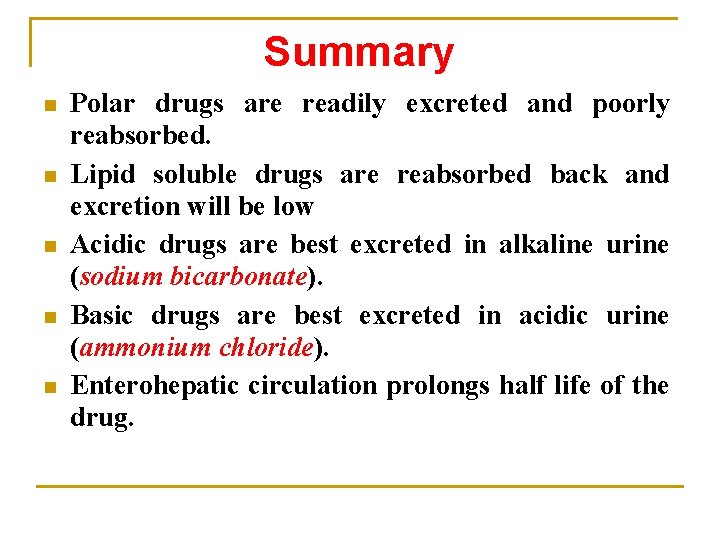
Summary n n n Polar drugs are readily excreted and poorly reabsorbed. Lipid soluble drugs are reabsorbed back and excretion will be low Acidic drugs are best excreted in alkaline urine (sodium bicarbonate). Basic drugs are best excreted in acidic urine (ammonium chloride). Enterohepatic circulation prolongs half life of the drug.
Questions?