
Exclusion and sustainability measures New developments Presentation by
Exclusion and sustainability measures: New developments Presentation by Mihail Peleah, UNDP BRC Andrey Ivanov, EU FRA for UNECE Conference, 2 -4 December 2013
Lorem ipsum dolor sit amet, consectetur adipiscing elit. Vivamus quis sem gravida, viverra tortor non, dignissim quam. Mauris ullamcorper suscipit vestibulum. Pellentesque commodo turpis at viverra pharetra. Nullam molestie quam sed mattis egestas. Vivamus justo sapien, fermentum et pulvinar id, scelerisque at nulla. http: //fotky. sme. sk/fotka/299648/ciganska-osada-muranska-dlha-luka
Going beyond monetary poverty: where? • How affordable (sustainable) is our wellbeing Affordable Human Development Index • Multidimensional wellbeing Social Exclusion Index • Qualitative and Quantitative data nexus ‘Micronarratives’
MULTIDIMENSIONAL WELLBEING: SOCIAL EXCLUSION INDEX

Why this index? • Objective and multidimensional measure of social exclusion • Measures status of exclusion or non-exclusion, rather than ‘perceptions’ or ‘risks’ • Applicable for Europe and Central Asia region • Useful for policymaking

Social Exclusion Chain Individual characteristics interact with Drivers of social exclusion Structures and institutions; values and behavior patterns; policies Drivers are external factors, influenced by legacies, that either speed up or slow down the process of individual vulnerabilities turning into social exclusion (social exclusion risk factors), like poor education, disability, minority status Specific local conditions Predominant industry, single or multiple employment opportunities, local infrastructures, history of violent conflict or environmental disaster in context of …and result in Social exclusion status of the individual in three dimensions— exclusion from economic life, social services, and civic and social participation
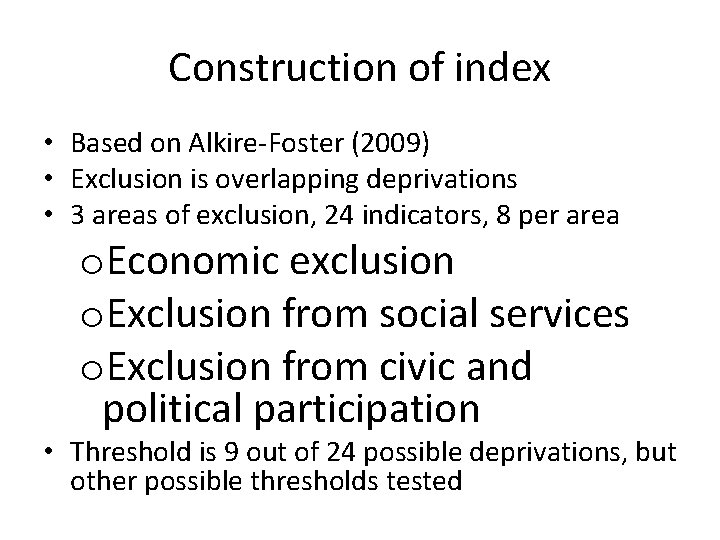
Construction of index • Based on Alkire-Foster (2009) • Exclusion is overlapping deprivations • 3 areas of exclusion, 24 indicators, 8 per area o. Economic exclusion o. Exclusion from social services o. Exclusion from civic and political participation • Threshold is 9 out of 24 possible deprivations, but other possible thresholds tested
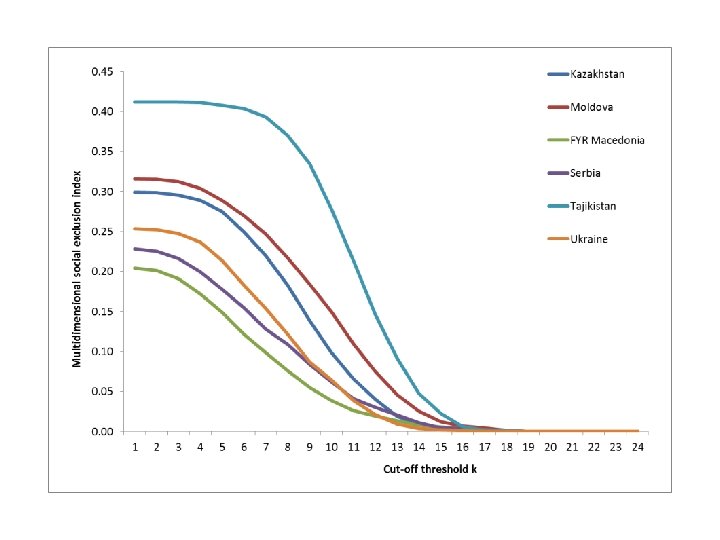

Profiles of exclusion
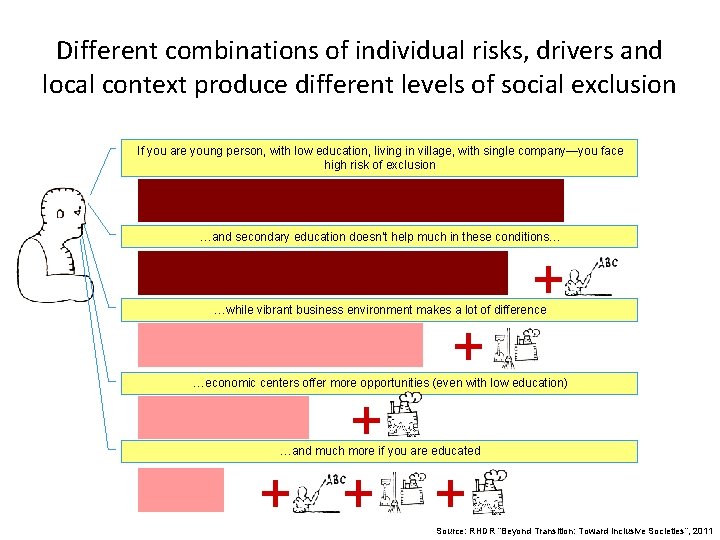
Different combinations of individual risks, drivers and local context produce different levels of social exclusion If you are young person, with low education, living in village, with single company—you face high risk of exclusion …and secondary education doesn’t help much in these conditions… + …while vibrant business environment makes a lot of difference + …economic centers offer more opportunities (even with low education) + + …and much more if you are educated Source: RHDR “Beyond Transition: Toward Inclusive Societies”, 2011

QUALITATIVE AND QUANTITATIVE DATA NEXUS: ‘MICRONARRATIVES’
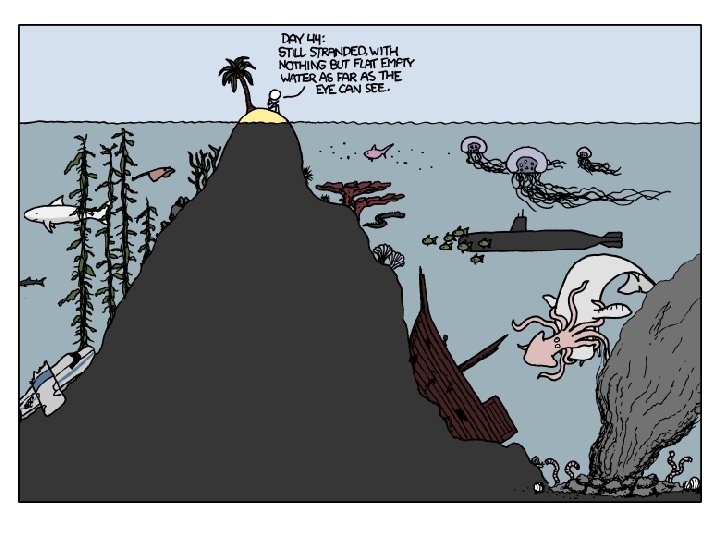
Why the ‘micronarratives’? • Qx. Q—combine the best from Qualitative and Quantitative research • Zoom in and Zoom out—see the pattern and investigate a case study • Suitable for all stage of policy process: o o Understanding Planning Implementation Monitoring and Evaluation • Could be a tool of empowerment and trust building
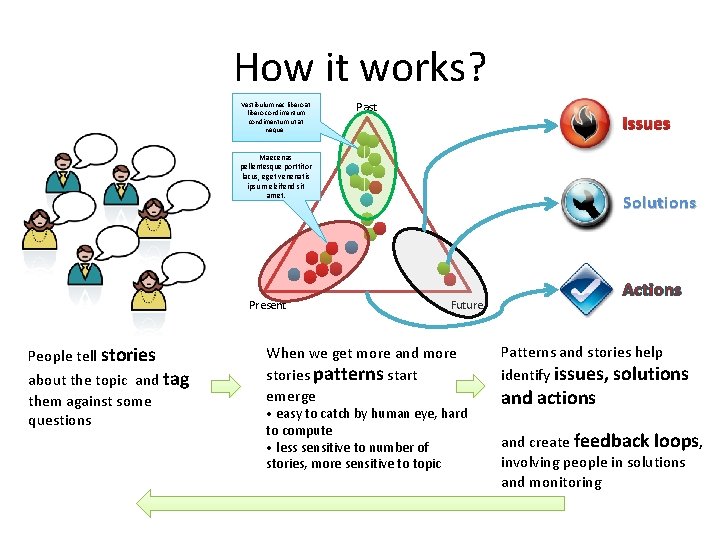
How it works? Vestibulum nec libero at libero condimentum ut at neque. Past Issues Maecenas pellentesque porttitor lacus, eget venenatis ipsum eleifend sit amet. Present People tell stories about the topic and tag them against some questions Solutions Actions Future When we get more and more stories patterns start emerge • easy to catch by human eye, hard to compute • less sensitive to number of stories, more sensitive to topic Patterns and stories help identify issues, solutions and actions and create feedback loops, involving people in solutions and monitoring
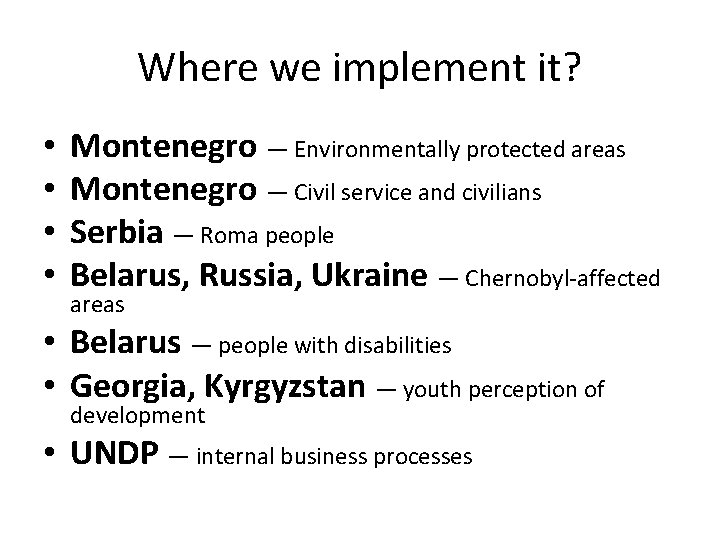
Where we implement it? • • Montenegro — Environmentally protected areas Montenegro — Civil service and civilians Serbia — Roma people Belarus, Russia, Ukraine — Chernobyl-affected areas • Belarus — people with disabilities • Georgia, Kyrgyzstan — youth perception of development • UNDP — internal business processes
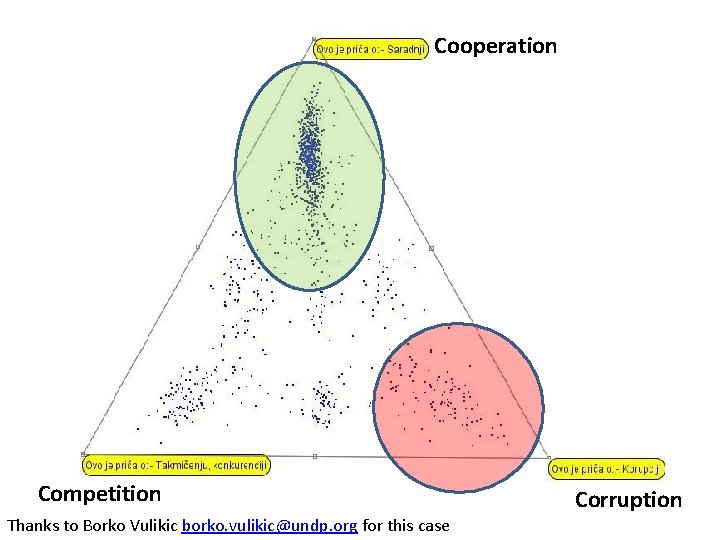
Cooperation Competition Thanks to Borko Vulikic borko. vulikic@undp. org for this case Corruption
Jeeps and Sheeps • Cluster of stories re: o o Communities Revenues Source of incomes Limitations of income or business activities o o Jeep tours were organized to protected areas …but they raise dust clouds …which spoil milk, the raw material for cheese …cheese is major local commodity and source of incomes • Dig into the stories • Solution o Move jeep trail 500 m from village Thanks to Borko Vulikic borko. vulikic@undp. org for this case
Mihail Peleah, UNDP Bratislava Regional Center mihail. peleah@undp. org Andrey Ivanov, EU Fundamental Rights Agency Andrey. IVANOV@fra. europa. eu
- Slides: 18