
Excitatory Pavlovian Conditioning Pavlovs original experiment is an
- Slides: 26
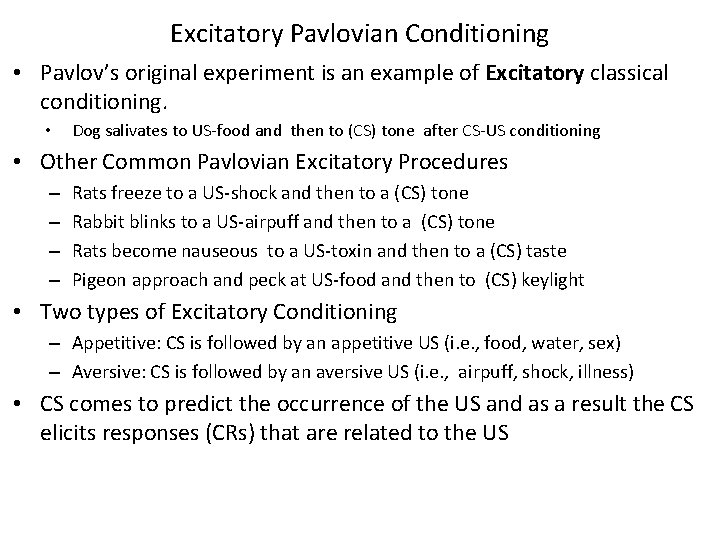
Excitatory Pavlovian Conditioning • Pavlov’s original experiment is an example of Excitatory classical conditioning. • Dog salivates to US-food and then to (CS) tone after CS-US conditioning • Other Common Pavlovian Excitatory Procedures – – Rats freeze to a US-shock and then to a (CS) tone Rabbit blinks to a US-airpuff and then to a (CS) tone Rats become nauseous to a US-toxin and then to a (CS) taste Pigeon approach and peck at US-food and then to (CS) keylight • Two types of Excitatory Conditioning – Appetitive: CS is followed by an appetitive US (i. e. , food, water, sex) – Aversive: CS is followed by an aversive US (i. e. , airpuff, shock, illness) • CS comes to predict the occurrence of the US and as a result the CS elicits responses (CRs) that are related to the US
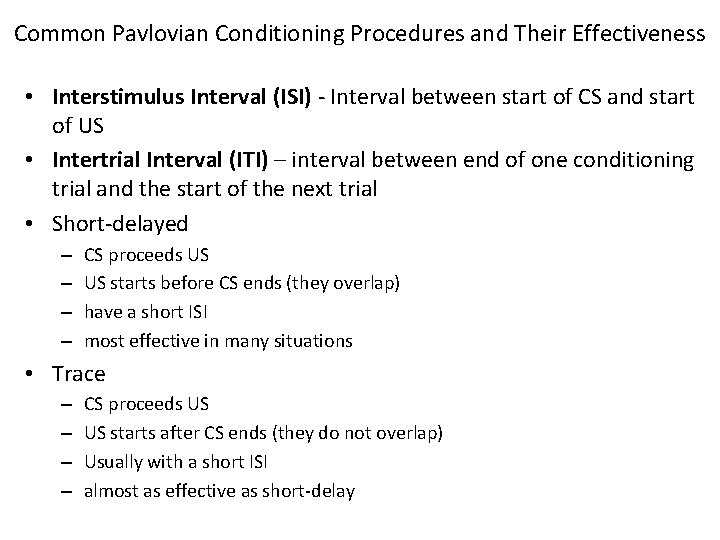
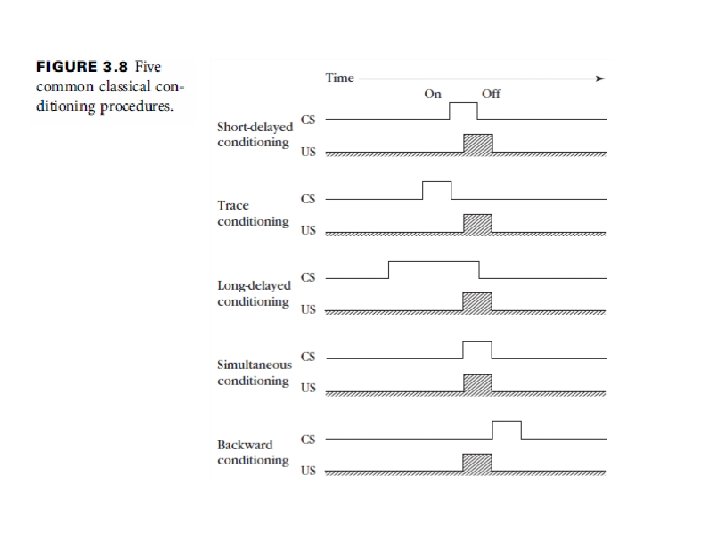
Common Pavlovian Conditioning Procedures and Their Effectiveness • Interstimulus Interval (ISI) - Interval between start of CS and start of US • Intertrial Interval (ITI) – interval between end of one conditioning trial and the start of the next trial • Short-delayed – – CS proceeds US US starts before CS ends (they overlap) have a short ISI most effective in many situations • Trace – – CS proceeds US US starts after CS ends (they do not overlap) Usually with a short ISI almost as effective as short-delay
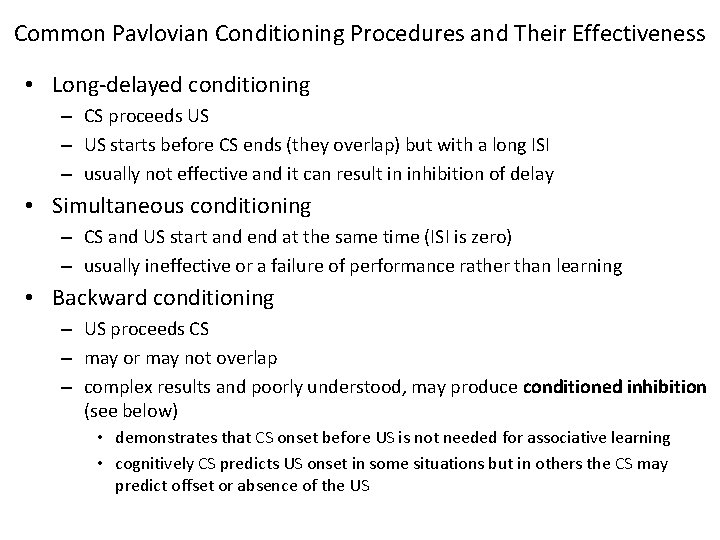
Common Pavlovian Conditioning Procedures and Their Effectiveness • Long-delayed conditioning – CS proceeds US – US starts before CS ends (they overlap) but with a long ISI – usually not effective and it can result in inhibition of delay • Simultaneous conditioning – CS and US start and end at the same time (ISI is zero) – usually ineffective or a failure of performance rather than learning • Backward conditioning – US proceeds CS – may or may not overlap – complex results and poorly understood, may produce conditioned inhibition (see below) • demonstrates that CS onset before US is not needed for associative learning • cognitively CS predicts US onset in some situations but in others the CS may predict offset or absence of the US
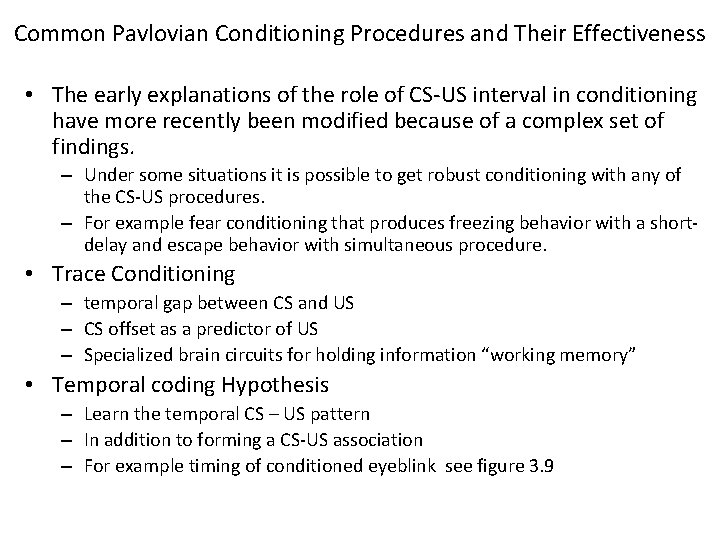
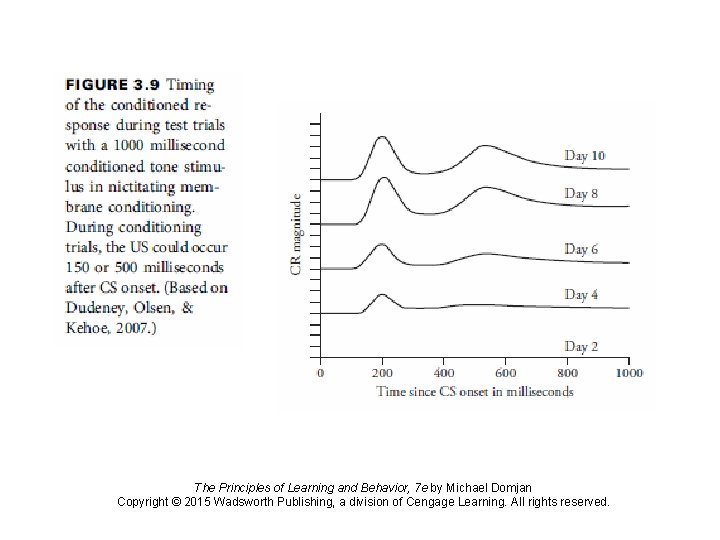
Common Pavlovian Conditioning Procedures and Their Effectiveness • The early explanations of the role of CS-US interval in conditioning have more recently been modified because of a complex set of findings. – Under some situations it is possible to get robust conditioning with any of the CS-US procedures. – For example fear conditioning that produces freezing behavior with a shortdelay and escape behavior with simultaneous procedure. • Trace Conditioning – temporal gap between CS and US – CS offset as a predictor of US – Specialized brain circuits for holding information “working memory” • Temporal coding Hypothesis – Learn the temporal CS – US pattern – In addition to forming a CS-US association – For example timing of conditioned eyeblink see figure 3. 9
The Principles of Learning and Behavior, 7 e by Michael Domjan Copyright © 2015 Wadsworth Publishing, a division of Cengage Learning. All rights reserved.
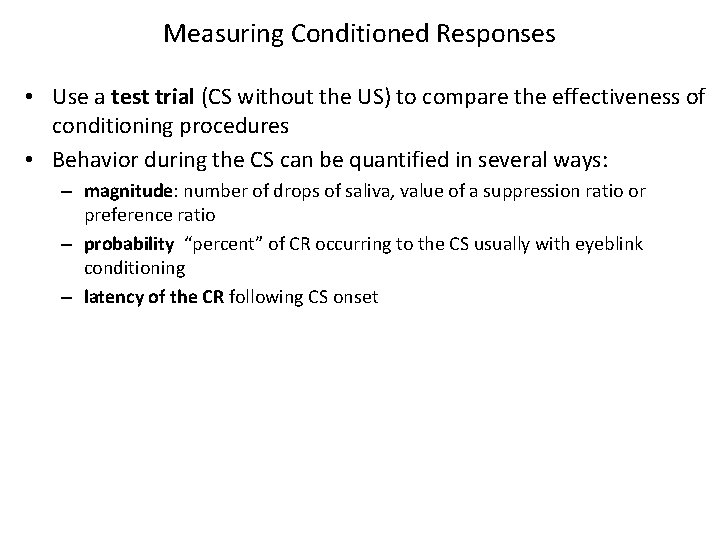
Measuring Conditioned Responses • Use a test trial (CS without the US) to compare the effectiveness of conditioning procedures • Behavior during the CS can be quantified in several ways: – magnitude: number of drops of saliva, value of a suppression ratio or preference ratio – probability “percent” of CR occurring to the CS usually with eyeblink conditioning – latency of the CR following CS onset
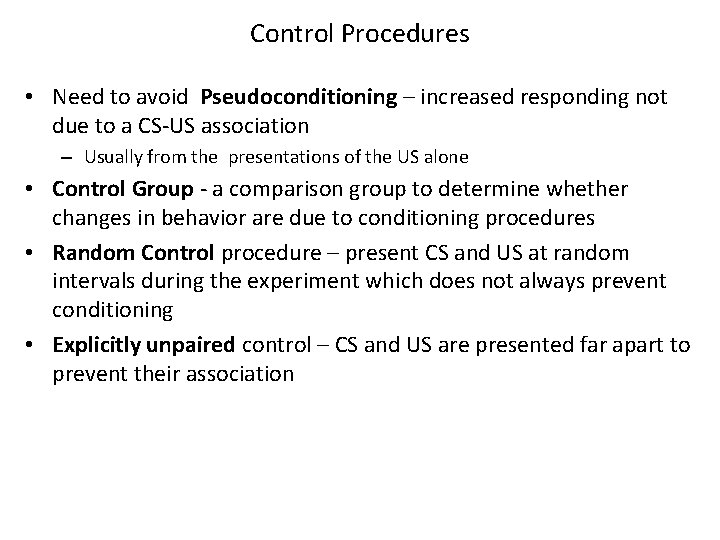
Control Procedures • Need to avoid Pseudoconditioning – increased responding not due to a CS-US association – Usually from the presentations of the US alone • Control Group - a comparison group to determine whether changes in behavior are due to conditioning procedures • Random Control procedure – present CS and US at random intervals during the experiment which does not always prevent conditioning • Explicitly unpaired control – CS and US are presented far apart to prevent their association
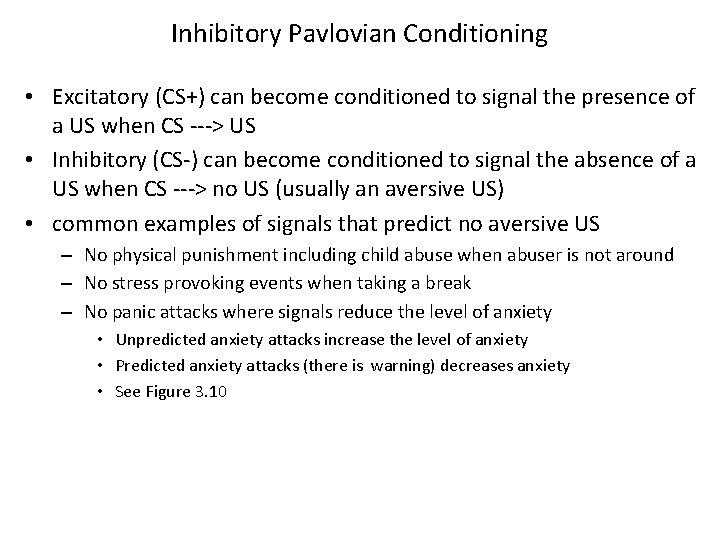
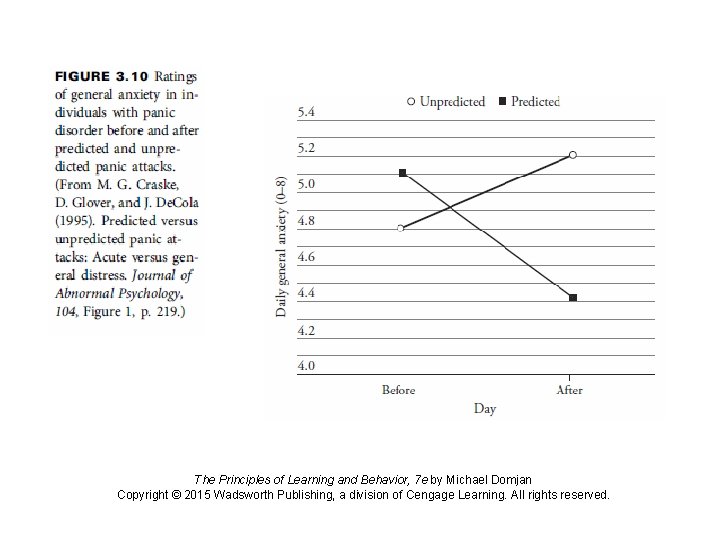
Inhibitory Pavlovian Conditioning • Excitatory (CS+) can become conditioned to signal the presence of a US when CS ---> US • Inhibitory (CS-) can become conditioned to signal the absence of a US when CS ---> no US (usually an aversive US) • common examples of signals that predict no aversive US – No physical punishment including child abuse when abuser is not around – No stress provoking events when taking a break – No panic attacks where signals reduce the level of anxiety • Unpredicted anxiety attacks increase the level of anxiety • Predicted anxiety attacks (there is warning) decreases anxiety • See Figure 3. 10
The Principles of Learning and Behavior, 7 e by Michael Domjan Copyright © 2015 Wadsworth Publishing, a division of Cengage Learning. All rights reserved.
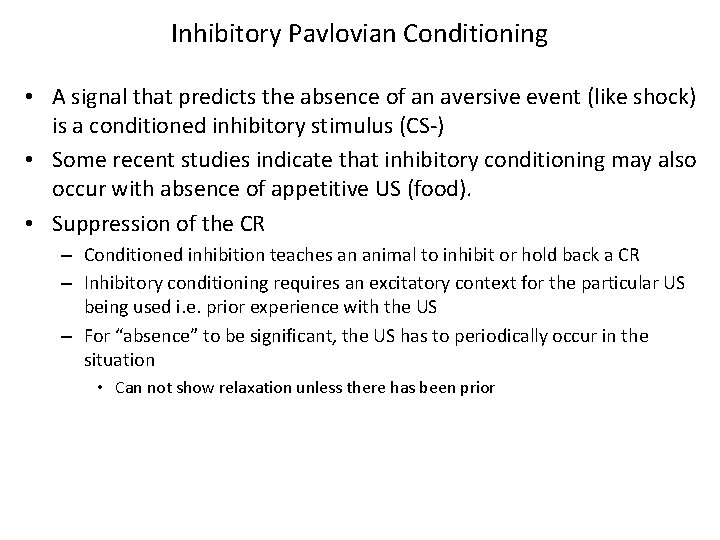
Inhibitory Pavlovian Conditioning • A signal that predicts the absence of an aversive event (like shock) is a conditioned inhibitory stimulus (CS-) • Some recent studies indicate that inhibitory conditioning may also occur with absence of appetitive US (food). • Suppression of the CR – Conditioned inhibition teaches an animal to inhibit or hold back a CR – Inhibitory conditioning requires an excitatory context for the particular US being used i. e. prior experience with the US – For “absence” to be significant, the US has to periodically occur in the situation • Can not show relaxation unless there has been prior
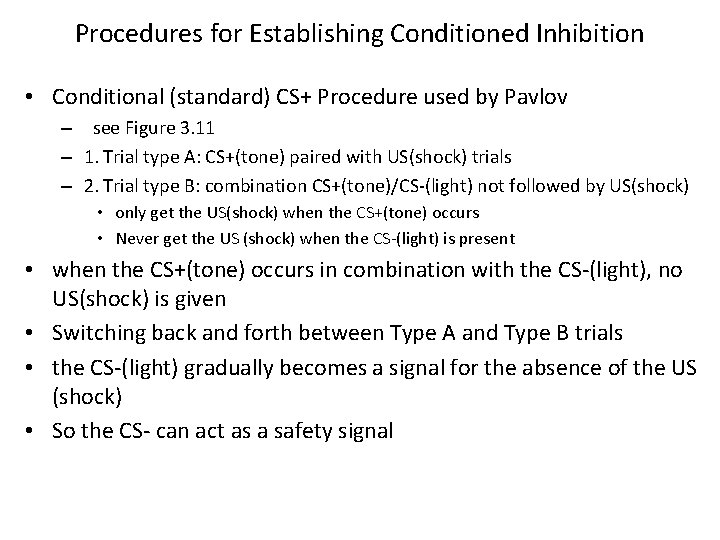
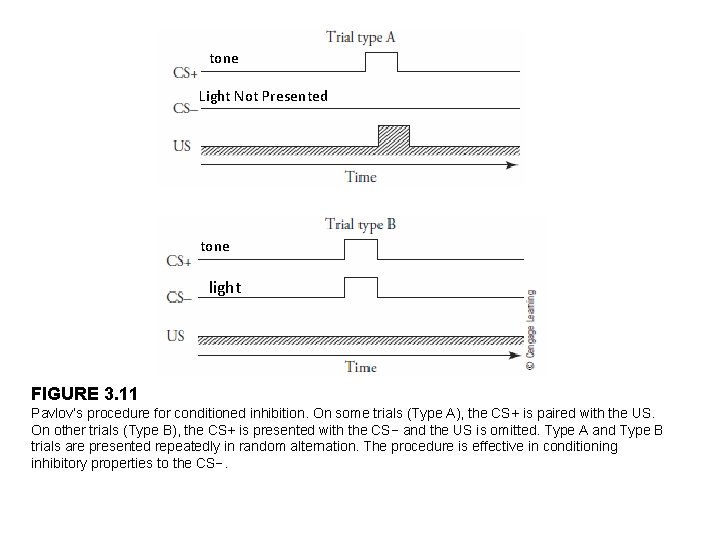
Procedures for Establishing Conditioned Inhibition • Conditional (standard) CS+ Procedure used by Pavlov – see Figure 3. 11 – 1. Trial type A: CS+(tone) paired with US(shock) trials – 2. Trial type B: combination CS+(tone)/CS-(light) not followed by US(shock) • only get the US(shock) when the CS+(tone) occurs • Never get the US (shock) when the CS-(light) is present • when the CS+(tone) occurs in combination with the CS-(light), no US(shock) is given • Switching back and forth between Type A and Type B trials • the CS-(light) gradually becomes a signal for the absence of the US (shock) • So the CS- can act as a safety signal
tone Light Not Presented tone light FIGURE 3. 11 Pavlov’s procedure for conditioned inhibition. On some trials (Type A), the CS+ is paired with the US. On other trials (Type B), the CS+ is presented with the CS− and the US is omitted. Type A and Type B trials are presented repeatedly in random alternation. The procedure is effective in conditioning inhibitory properties to the CS−.
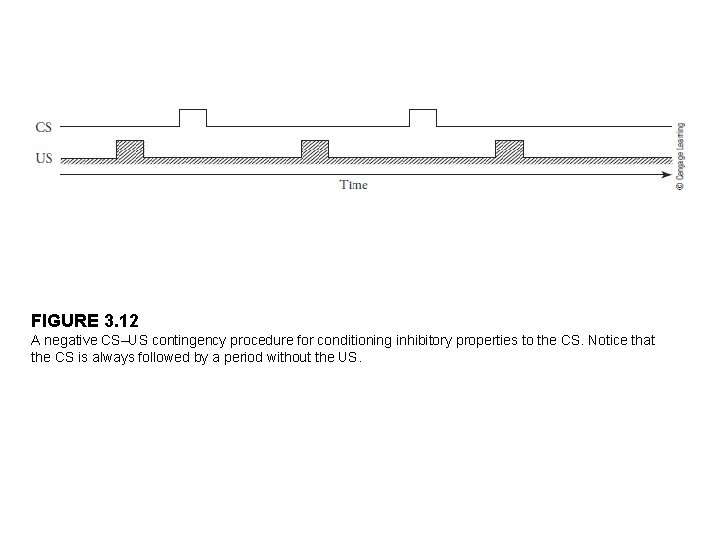
Procedures for Establishing Conditioned Inhibition • Negative CS-US contingency “negative correlation” Figure 3. 12 • Explicit CS+ training is not necessary for inhibitory conditioning • Procedure – US (shock) is never paired with a CS- (bell) – US and CS- alternate with long ISI • Example – If a child is bullied (US) in a classroom (context) but not when the teacher (CS-) is present – There is no explicit cues (i. e. , no CS Tone) – get some conditioning to the classroom (context) so the classroom predicts bullying • Can be stated as a probability: If p(US/CS-) < p(US/no CS-) – Do not need to know this formula
FIGURE 3. 12 A negative CS–US contingency procedure for conditioning inhibitory properties to the CS. Notice that the CS is always followed by a period without the US.
Measurement of Conditioned Inhibition • Bi-directional response systems – Possible to directly observe inhibition with some bi-directional response systems – If baseline responding is above zero, deflections in both directions from baseline (indicative of excitatory and inhibitory learning) can be detected – sign tracking or approach vs avoidance behavior • Non-Bidirectional Response Systems – Compound-stimulus (Summation) test • Present the CS- in compound with the CS+ • CS- should reduce the size of the CR elicited by the CS+ – Retardation-of-acquisition test • Try and convert the CS- to a CS+ • This should take longer than trying to convert a neutral stimulus into a CS+
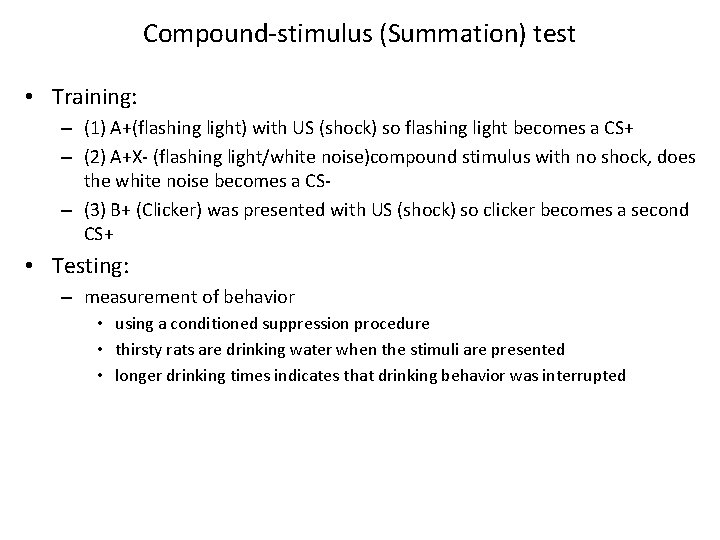
Compound-stimulus (Summation) test • Training: – (1) A+(flashing light) with US (shock) so flashing light becomes a CS+ – (2) A+X- (flashing light/white noise)compound stimulus with no shock, does the white noise becomes a CS– (3) B+ (Clicker) was presented with US (shock) so clicker becomes a second CS+ • Testing: – measurement of behavior • using a conditioned suppression procedure • thirsty rats are drinking water when the stimuli are presented • longer drinking times indicates that drinking behavior was interrupted
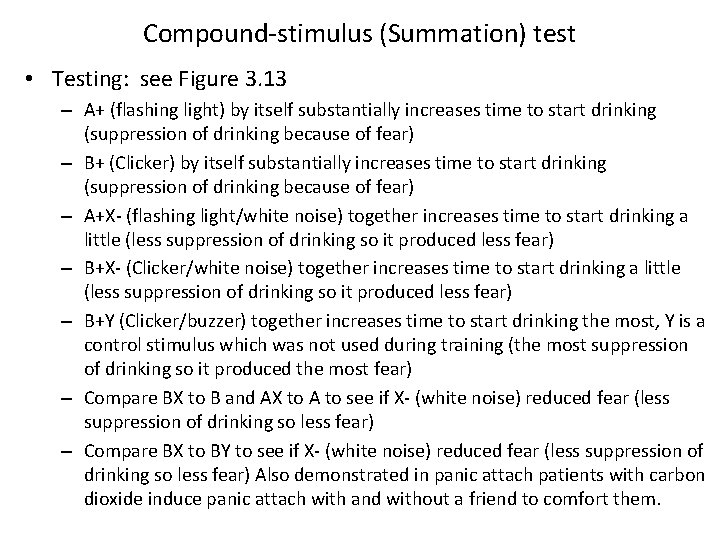
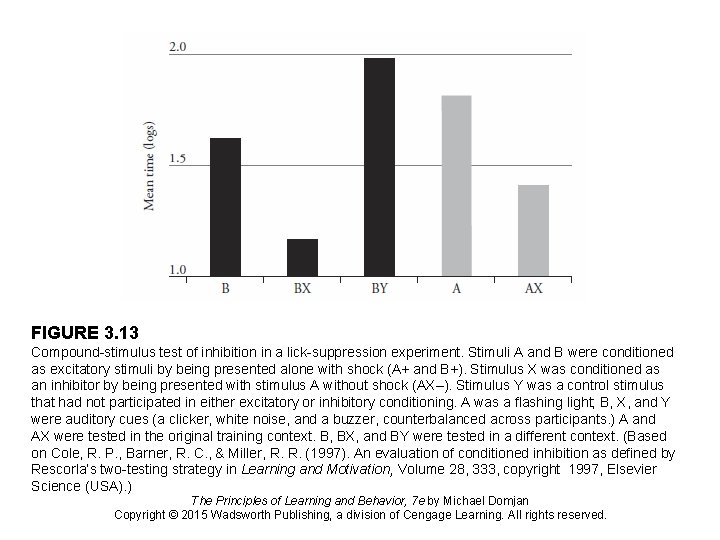
Compound-stimulus (Summation) test • Testing: see Figure 3. 13 – A+ (flashing light) by itself substantially increases time to start drinking (suppression of drinking because of fear) – B+ (Clicker) by itself substantially increases time to start drinking (suppression of drinking because of fear) – A+X- (flashing light/white noise) together increases time to start drinking a little (less suppression of drinking so it produced less fear) – B+X- (Clicker/white noise) together increases time to start drinking a little (less suppression of drinking so it produced less fear) – B+Y (Clicker/buzzer) together increases time to start drinking the most, Y is a control stimulus which was not used during training (the most suppression of drinking so it produced the most fear) – Compare BX to B and AX to A to see if X- (white noise) reduced fear (less suppression of drinking so less fear) – Compare BX to BY to see if X- (white noise) reduced fear (less suppression of drinking so less fear) Also demonstrated in panic attach patients with carbon dioxide induce panic attach with and without a friend to comfort them.
FIGURE 3. 13 Compound-stimulus test of inhibition in a lick-suppression experiment. Stimuli A and B were conditioned as excitatory stimuli by being presented alone with shock (A+ and B+). Stimulus X was conditioned as an inhibitor by being presented with stimulus A without shock (AX–). Stimulus Y was a control stimulus that had not participated in either excitatory or inhibitory conditioning. A was a flashing light; B, X, and Y were auditory cues (a clicker, white noise, and a buzzer, counterbalanced across participants. ) A and AX were tested in the original training context. B, BX, and BY were tested in a different context. (Based on Cole, R. P. , Barner, R. C. , & Miller, R. R. (1997). An evaluation of conditioned inhibition as defined by Rescorla’s two-testing strategy in Learning and Motivation, Volume 28, 333, copyright 1997, Elsevier Science (USA). ) The Principles of Learning and Behavior, 7 e by Michael Domjan Copyright © 2015 Wadsworth Publishing, a division of Cengage Learning. All rights reserved.
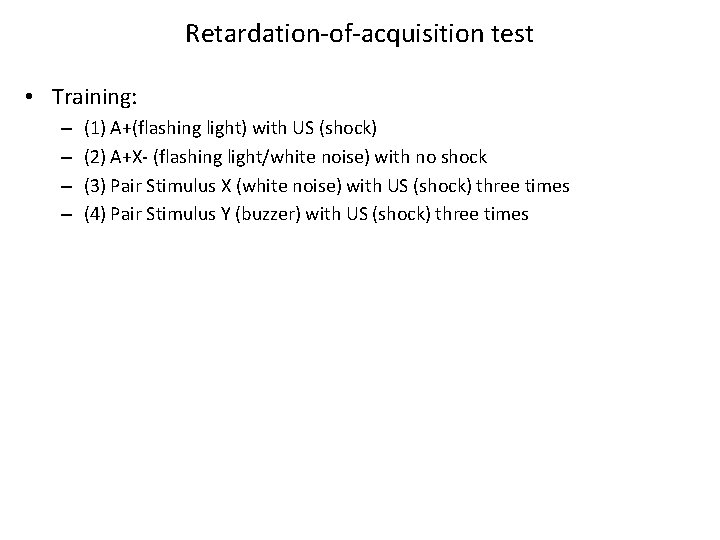
Retardation-of-acquisition test • Training: – – (1) A+(flashing light) with US (shock) (2) A+X- (flashing light/white noise) with no shock (3) Pair Stimulus X (white noise) with US (shock) three times (4) Pair Stimulus Y (buzzer) with US (shock) three times
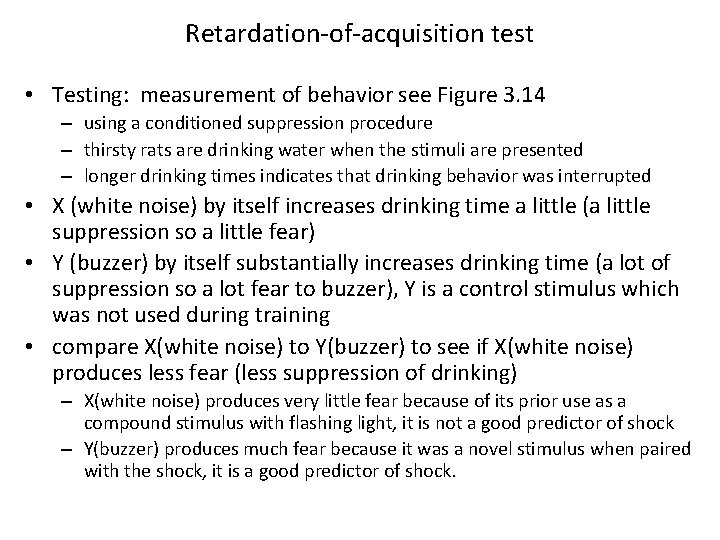
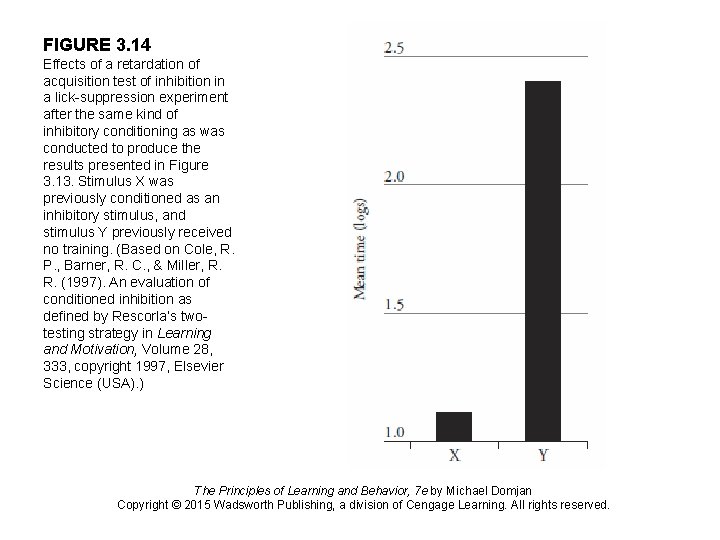
Retardation-of-acquisition test • Testing: measurement of behavior see Figure 3. 14 – using a conditioned suppression procedure – thirsty rats are drinking water when the stimuli are presented – longer drinking times indicates that drinking behavior was interrupted • X (white noise) by itself increases drinking time a little (a little suppression so a little fear) • Y (buzzer) by itself substantially increases drinking time (a lot of suppression so a lot fear to buzzer), Y is a control stimulus which was not used during training • compare X(white noise) to Y(buzzer) to see if X(white noise) produces less fear (less suppression of drinking) – X(white noise) produces very little fear because of its prior use as a compound stimulus with flashing light, it is not a good predictor of shock – Y(buzzer) produces much fear because it was a novel stimulus when paired with the shock, it is a good predictor of shock.
FIGURE 3. 14 Effects of a retardation of acquisition test of inhibition in a lick-suppression experiment after the same kind of inhibitory conditioning as was conducted to produce the results presented in Figure 3. 13. Stimulus X was previously conditioned as an inhibitory stimulus, and stimulus Y previously received no training. (Based on Cole, R. P. , Barner, R. C. , & Miller, R. R. (1997). An evaluation of conditioned inhibition as defined by Rescorla’s twotesting strategy in Learning and Motivation, Volume 28, 333, copyright 1997, Elsevier Science (USA). ) The Principles of Learning and Behavior, 7 e by Michael Domjan Copyright © 2015 Wadsworth Publishing, a division of Cengage Learning. All rights reserved.
Traditional View of Classical Conditioning • Simple and primitive form of learning involving only glandular and visceral responses like salivation • CS-US associations occur automatically through the pairing of a CS and US, such as ring bell before giving food. • Has no relevance in explaining the complexity and richness of animal and human experience
Modern View of Classical Conditioning • Involves numerous complex processes that control a wide variety of responses including locomotor movements and emotional behavior • It does not occur automatically with the pairing of a CS and US. • It depends on: the prior experience with these stimuli the presence of other stimuli during conditioning the relevance of the CS and US to each other • Classical conditioning is not limited to CS-US pairings, it can occur: Between two biologically weak stimuli (sensory preconditioning)
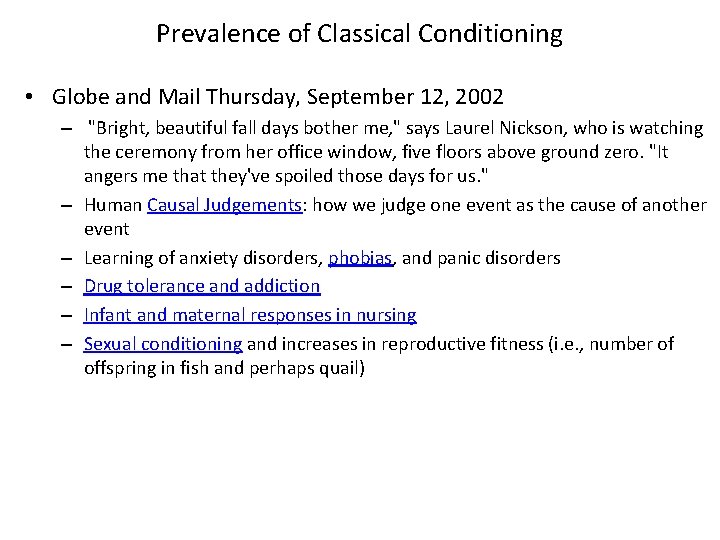
Prevalence of Classical Conditioning • Globe and Mail Thursday, September 12, 2002 – "Bright, beautiful fall days bother me, " says Laurel Nickson, who is watching the ceremony from her office window, five floors above ground zero. "It angers me that they've spoiled those days for us. " – Human Causal Judgements: how we judge one event as the cause of another event – Learning of anxiety disorders, phobias, and panic disorders – Drug tolerance and addiction – Infant and maternal responses in nursing – Sexual conditioning and increases in reproductive fitness (i. e. , number of offspring in fish and perhaps quail)
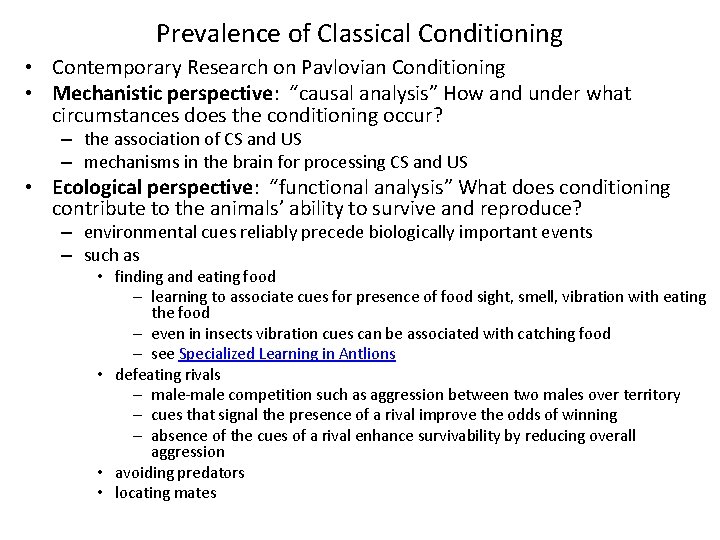
Prevalence of Classical Conditioning • Contemporary Research on Pavlovian Conditioning • Mechanistic perspective: “causal analysis” How and under what circumstances does the conditioning occur? – the association of CS and US – mechanisms in the brain for processing CS and US • Ecological perspective: “functional analysis” What does conditioning contribute to the animals’ ability to survive and reproduce? – environmental cues reliably precede biologically important events – such as • finding and eating food – learning to associate cues for presence of food sight, smell, vibration with eating the food – even in insects vibration cues can be associated with catching food – see Specialized Learning in Antlions • defeating rivals – male-male competition such as aggression between two males over territory – cues that signal the presence of a rival improve the odds of winning – absence of the cues of a rival enhance survivability by reducing overall aggression • avoiding predators • locating mates