
Exchange Rate Factors that Affect Exchange Rates The
- Slides: 5
Exchange Rate
Factors that Affect Exchange Rates The Law of One Price If the costs of transportation are small, the price of the same good in different countries should be roughly the same. If the low of one price held for all goods, and if each country consumed the same market basket of goods, the exchange rate between the two currencies would be determined simply by the relative price levels in the two countries.
Factors that Affect Exchange Rates The theory that exchange rates are set so that the price of similar goods in different countries is the same is known as the purchasing-power parity. If it takes ten times as many pesos to buy a pound of salt in Mexico as it takes U. S. dollars to buy a pound of salt in the United States, then the equilibrium exchange rate should be 10 pesos per dollar.
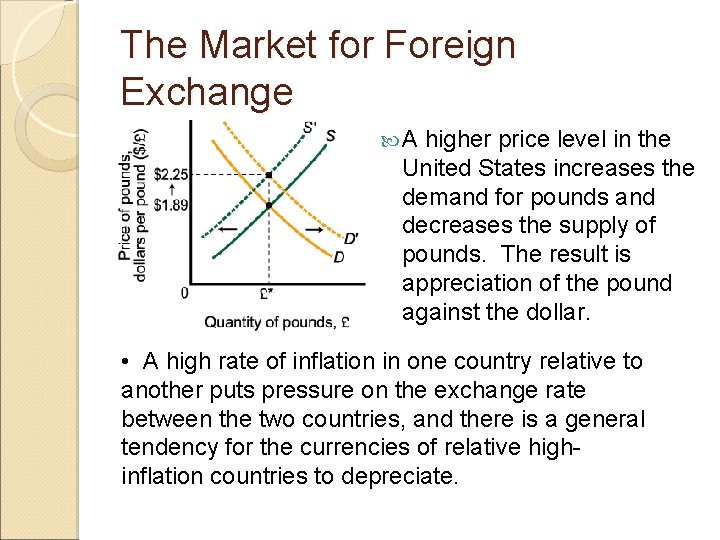
The Market for Foreign Exchange A higher price level in the United States increases the demand for pounds and decreases the supply of pounds. The result is appreciation of the pound against the dollar. • A high rate of inflation in one country relative to another puts pressure on the exchange rate between the two countries, and there is a general tendency for the currencies of relative highinflation countries to depreciate.
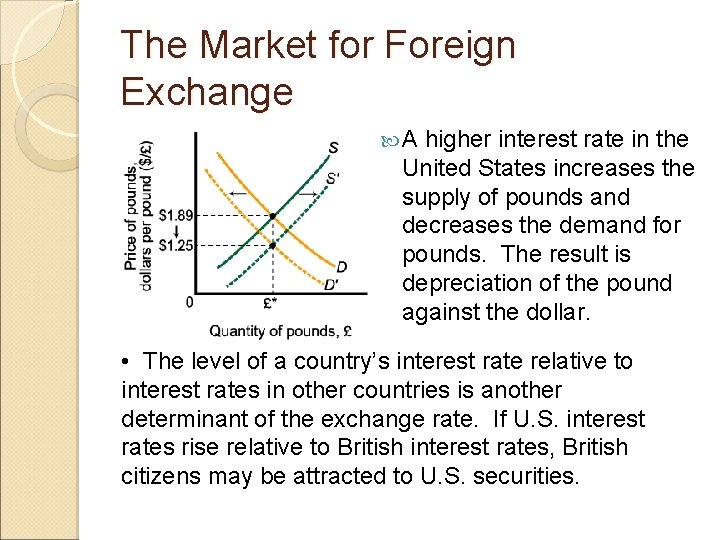
The Market for Foreign Exchange A higher interest rate in the United States increases the supply of pounds and decreases the demand for pounds. The result is depreciation of the pound against the dollar. • The level of a country’s interest rate relative to interest rates in other countries is another determinant of the exchange rate. If U. S. interest rates rise relative to British interest rates, British citizens may be attracted to U. S. securities.