
Exchange and Transport 13 4 Gas exchange in
- Slides: 11
Exchange and Transport 13. 4 Gas exchange in the leaf of a plant
Learning outcomes Students should be able to understand the following: How plants exchange gases? How the leaf of a dicotyledonous plant is adapted for efficient gas exchange Comparisons between gas exchange in plants and insects Candidates should be able to: Use their knowledge and understanding of the principles of diffusion to explain the adaptations of gas exchange surfaces
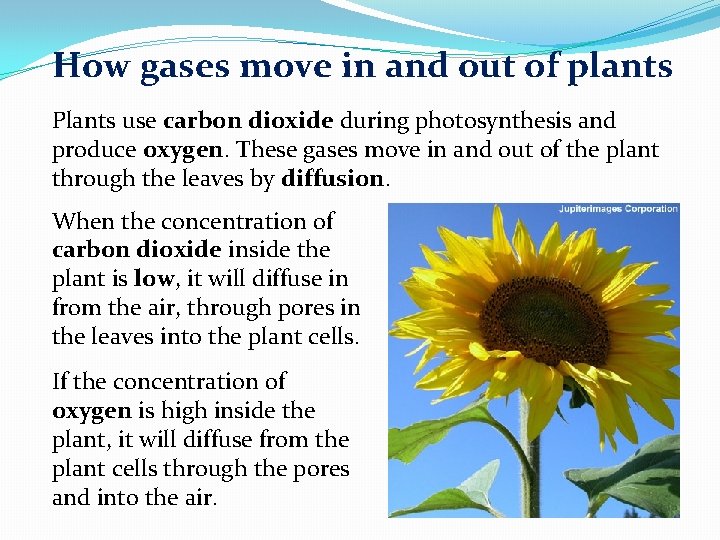
How gases move in and out of plants Plants use carbon dioxide during photosynthesis and produce oxygen. These gases move in and out of the plant through the leaves by diffusion. When the concentration of carbon dioxide inside the plant is low, it will diffuse in from the air, through pores in the leaves into the plant cells. If the concentration of oxygen is high inside the plant, it will diffuse from the plant cells through the pores and into the air.
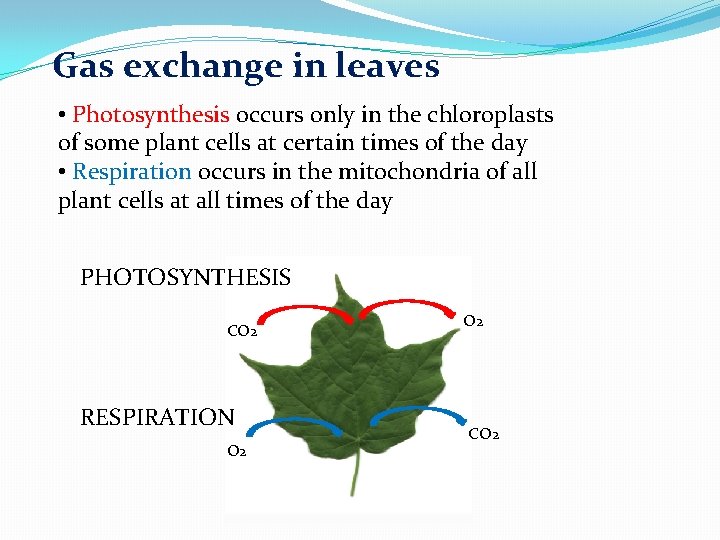
Gas exchange in leaves • Photosynthesis occurs only in the chloroplasts of some plant cells at certain times of the day • Respiration occurs in the mitochondria of all plant cells at all times of the day PHOTOSYNTHESIS CO 2 RESPIRATION O 2 CO 2
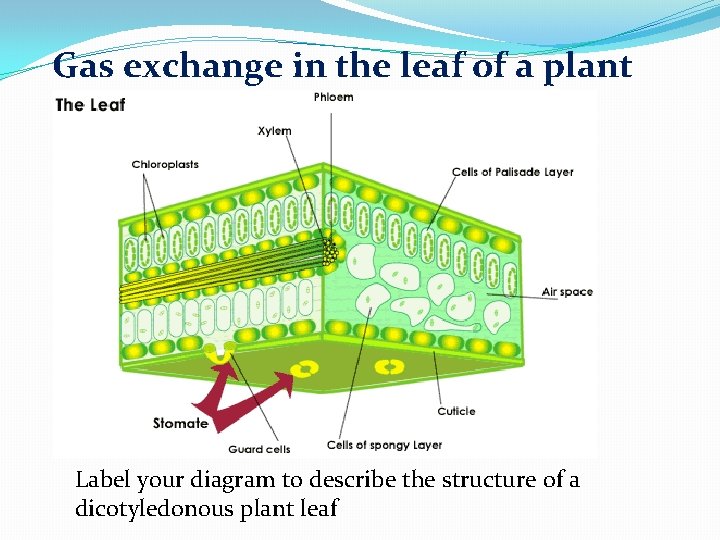
Gas exchange in the leaf of a plant Label your diagram to describe the structure of a dicotyledonous plant leaf
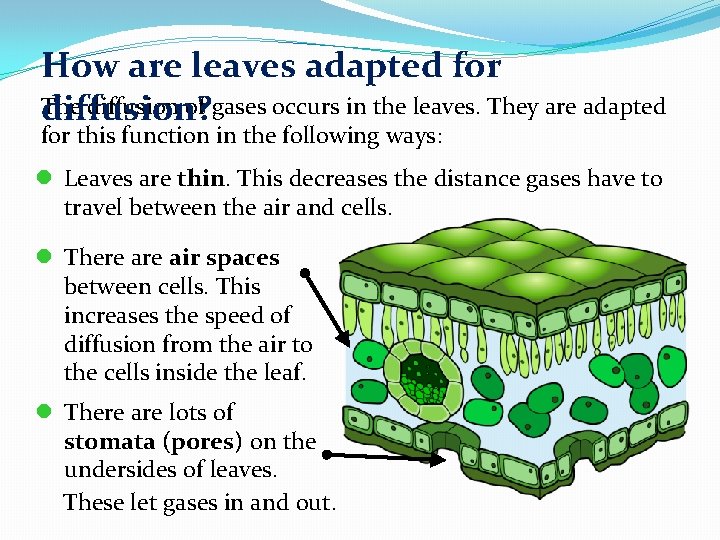
How are leaves adapted for The diffusion of gases occurs in the leaves. They are adapted diffusion? for this function in the following ways: l Leaves are thin. This decreases the distance gases have to travel between the air and cells. l There air spaces between cells. This increases the speed of diffusion from the air to the cells inside the leaf. l There are lots of stomata (pores) on the undersides of leaves. These let gases in and out.
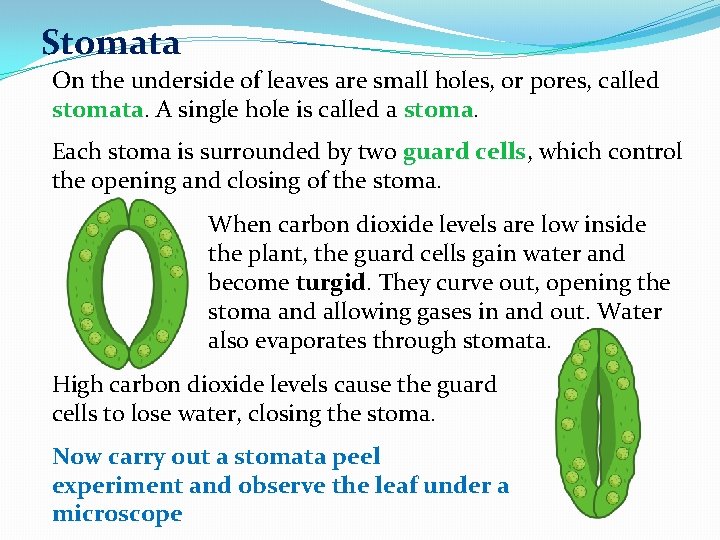
Stomata On the underside of leaves are small holes, or pores, called stomata. A single hole is called a stoma. Each stoma is surrounded by two guard cells, which control the opening and closing of the stoma. When carbon dioxide levels are low inside the plant, the guard cells gain water and become turgid. They curve out, opening the stoma and allowing gases in and out. Water also evaporates through stomata. High carbon dioxide levels cause the guard cells to lose water, closing the stoma. Now carry out a stomata peel experiment and observe the leaf under a microscope
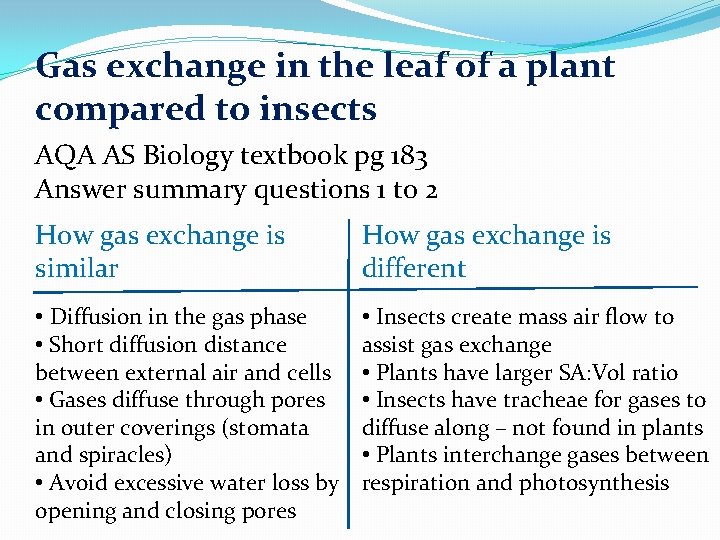
Gas exchange in the leaf of a plant compared to insects AQA AS Biology textbook pg 183 Answer summary questions 1 to 2 How gas exchange is similar How gas exchange is different • Diffusion in the gas phase • Short diffusion distance • Insects create mass air flow to assist gas exchange between external air and cells • Plants have larger SA: Vol ratio • Gases diffuse through pores • Insects have tracheae for gases to in outer coverings (stomata diffuse along – not found in plants and spiracles) • Plants interchange gases between • Avoid excessive water loss by respiration and photosynthesis opening and closing pores
Extension and Homework 1. AQA AS Biology textbook pg 183 Application questions 1 -4 2. Complete the exam style question about gas exchange in the leaf of a plant 3. Write a brief report including diagrams to explain how and why a plant opens and closes the stomata on its leaves
Learning outcomes Students should be able to understand the following: How plants exchange gases? How the leaf of a dicotyledonous plant is adapted for efficient gas exchange Comparisons between gas exchange in plants and insects Candidates should be able to: Use their knowledge and understanding of the principles of diffusion to explain the adaptations of gas exchange surfaces
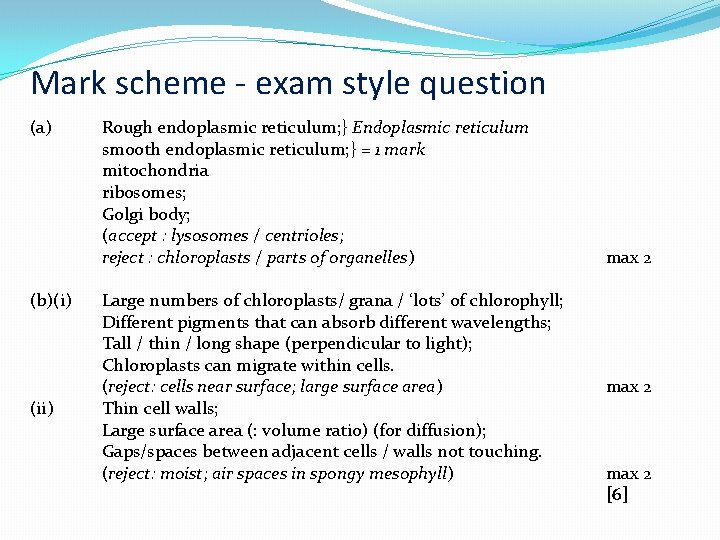
Mark scheme - exam style question (a) (b)(i) (ii) Rough endoplasmic reticulum; } Endoplasmic reticulum smooth endoplasmic reticulum; } = 1 mark mitochondria ribosomes; Golgi body; (accept : lysosomes / centrioles; reject : chloroplasts / parts of organelles) Large numbers of chloroplasts/ grana / ‘lots’ of chlorophyll; Different pigments that can absorb different wavelengths; Tall / thin / long shape (perpendicular to light); Chloroplasts can migrate within cells. (reject: cells near surface; large surface area) Thin cell walls; Large surface area (: volume ratio) (for diffusion); Gaps/spaces between adjacent cells / walls not touching. (reject: moist; air spaces in spongy mesophyll) max 2 [6]