
Excess Burden u u u The First Fundamental
Excess Burden u u u The First Fundamental Theorem of Welfare Economics says that, under ideal conditions, the behavior of producers and consumers will automatically lead to efficiency. Thus when taxes distort economic decisions, they reduce efficiency and create what is called the excess burden of the tax. This excess burden is a welfare loss beyond the tax revenue collected. It is also referred to as the welfare cost or deadweight loss. v For example, if I stopped buying beer because of a tax on beer, no taxes would be collected but there would still be a welfare loss. Terrel Gallaway: Public Finance 1
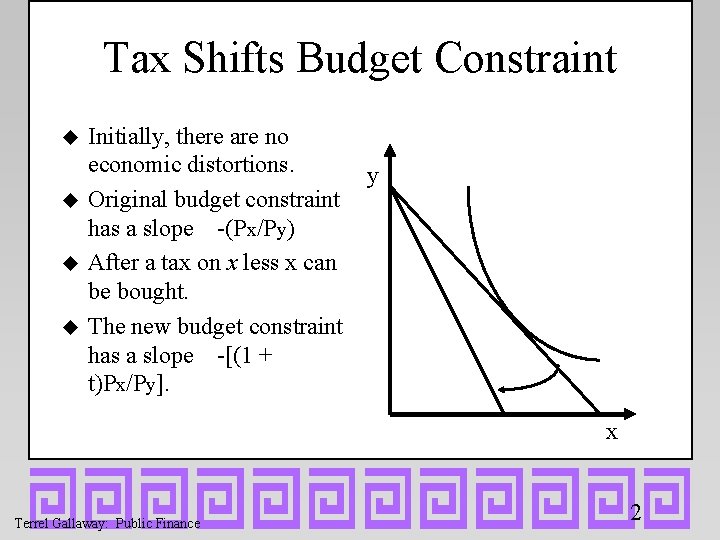
Tax Shifts Budget Constraint u u Initially, there are no economic distortions. y Original budget constraint has a slope -(Px/Py) After a tax on x less x can be bought. The new budget constraint has a slope -[(1 + t)Px/Py]. x Terrel Gallaway: Public Finance 2
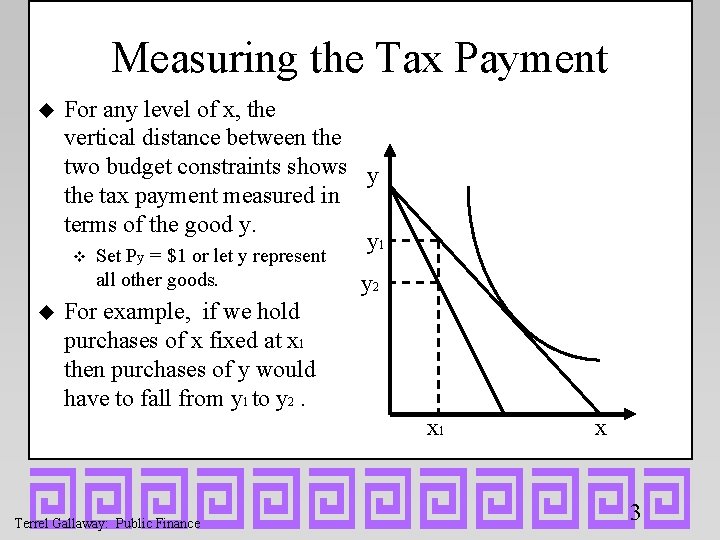
Measuring the Tax Payment u For any level of x, the vertical distance between the two budget constraints shows y the tax payment measured in terms of the good y. y 1 v u Set Py = $1 or let y represent all other goods. y 2 For example, if we hold purchases of x fixed at x 1 then purchases of y would have to fall from y 1 to y 2. x 1 Terrel Gallaway: Public Finance x 3
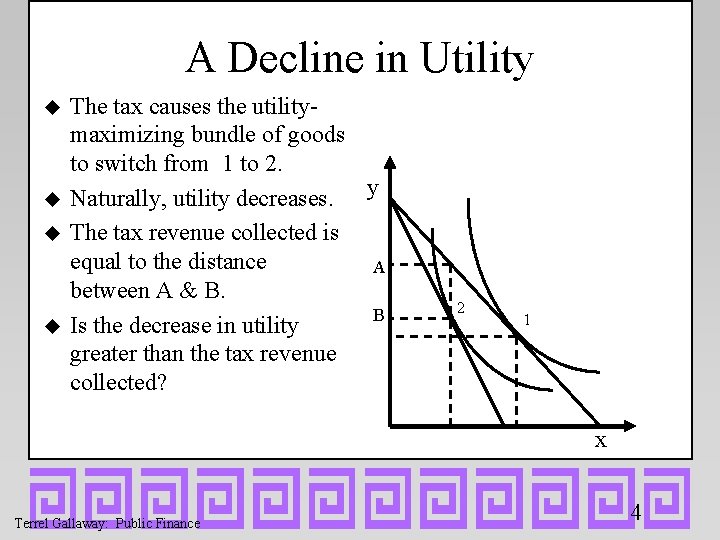
A Decline in Utility u u The tax causes the utilitymaximizing bundle of goods to switch from 1 to 2. Naturally, utility decreases. y The tax revenue collected is equal to the distance A between A & B. B Is the decrease in utility greater than the tax revenue collected? 2 1 x Terrel Gallaway: Public Finance 4
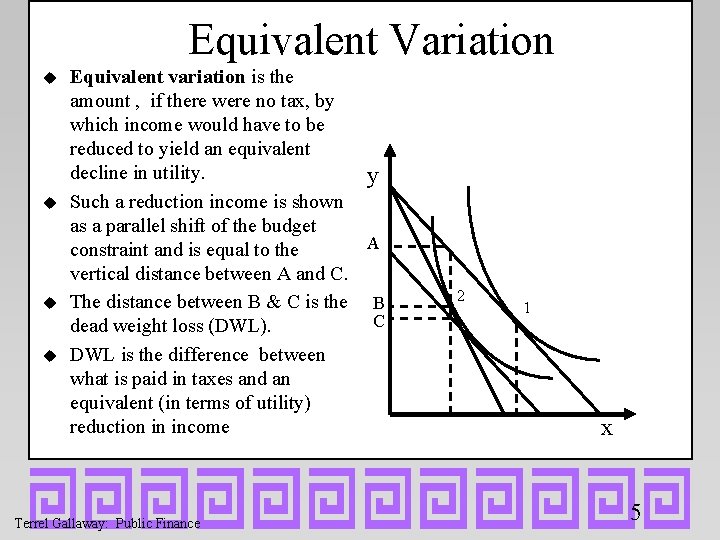
Equivalent Variation u u Equivalent variation is the amount , if there were no tax, by which income would have to be reduced to yield an equivalent decline in utility. y Such a reduction income is shown as a parallel shift of the budget A constraint and is equal to the vertical distance between A and C. The distance between B & C is the B C dead weight loss (DWL). DWL is the difference between what is paid in taxes and an equivalent (in terms of utility) reduction in income Terrel Gallaway: Public Finance 2 1 x 5
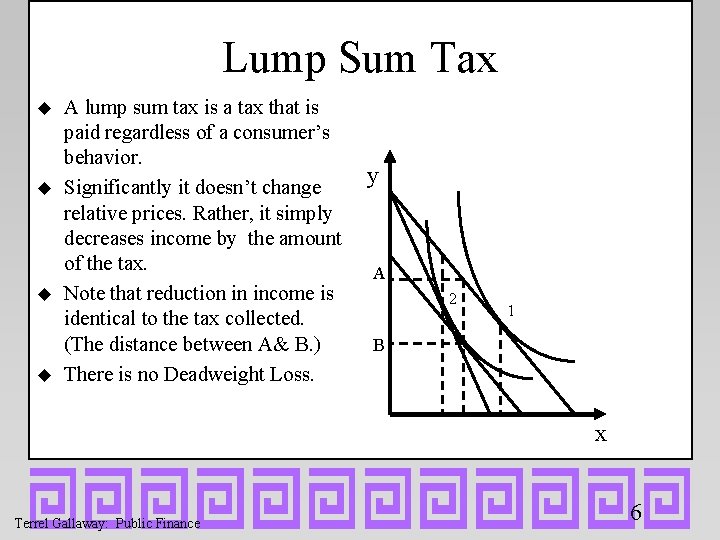
Lump Sum Tax u u A lump sum tax is a tax that is paid regardless of a consumer’s behavior. Significantly it doesn’t change relative prices. Rather, it simply decreases income by the amount of the tax. Note that reduction in income is identical to the tax collected. (The distance between A& B. ) There is no Deadweight Loss. y A 2 1 B x Terrel Gallaway: Public Finance 6
Why no Lump Sum Taxes? u An example of such a tax is a head tax. u Such taxes are regressive. u If everybody has to pay $100, this is much more of a burden to a poor person than it is to a billionaire. u Margaret Thatcher replaced property taxes with a head tax and was subsequently booted out of office. Terrel Gallaway: Public Finance 7
Wherefore Excess Burden? u Remember, allocative efficiency requires that MRSxy = MRTxy u However, after the tax, the consumer faces a new budget constraint such that utility is maximized where MRSxy = (1 + tx)Px/Py. u For producers, the important thing is price net of taxes. Thus, profit-maximizing producers will still set MRTxy = Px/Py. u Since tx > 0, MRSxy > MRTxy. That is, the necessary condition for allocative efficiency is not satisfied. Terrel Gallaway: Public Finance 8
Intuitive Explanation u u As long as consumers are willing to cover the economic costs of producing a good, then economic efficiency dictates that the good should be produced. However when a tax, rather than production costs, pushes a good beyond a consumer’s price range, then too few resources will be dedicated to the production of a good for which consumers would have been willing to pay. v Basically economists want decisions to reflect opportunity costs rather than the tax structure. Terrel Gallaway: Public Finance 9
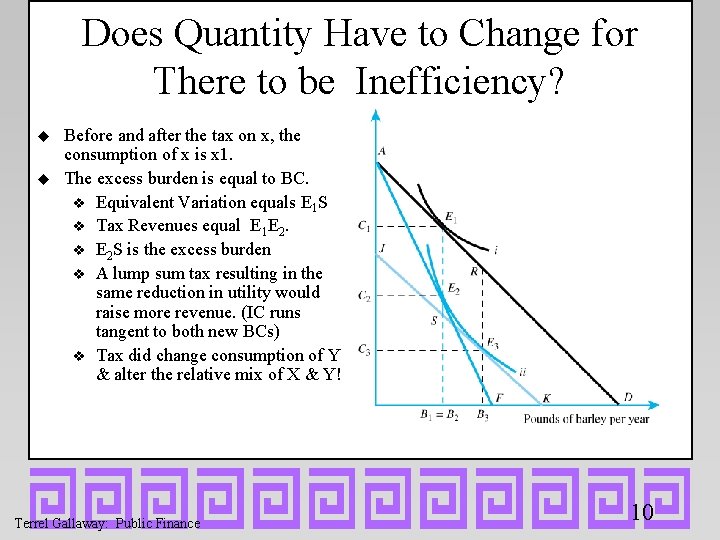
Does Quantity Have to Change for There to be Inefficiency? u u Before and after the tax on x, the consumption of x is x 1. The excess burden is equal to BC. v Equivalent Variation equals E 1 S v Tax Revenues equal E 1 E 2. v E 2 S is the excess burden v A lump sum tax resulting in the same reduction in utility would raise more revenue. (IC runs tangent to both new BCs) v Tax did change consumption of Y & alter the relative mix of X & Y! Terrel Gallaway: Public Finance 10
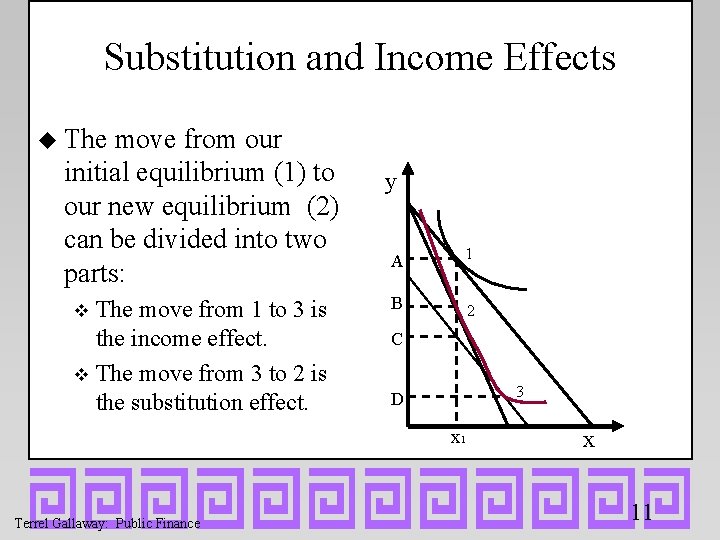
Substitution and Income Effects u The move from our initial equilibrium (1) to our new equilibrium (2) can be divided into two parts: The move from 1 to 3 is the income effect. v The move from 3 to 2 is the substitution effect. v y A 1 B 2 C 3 D x 1 Terrel Gallaway: Public Finance x 11
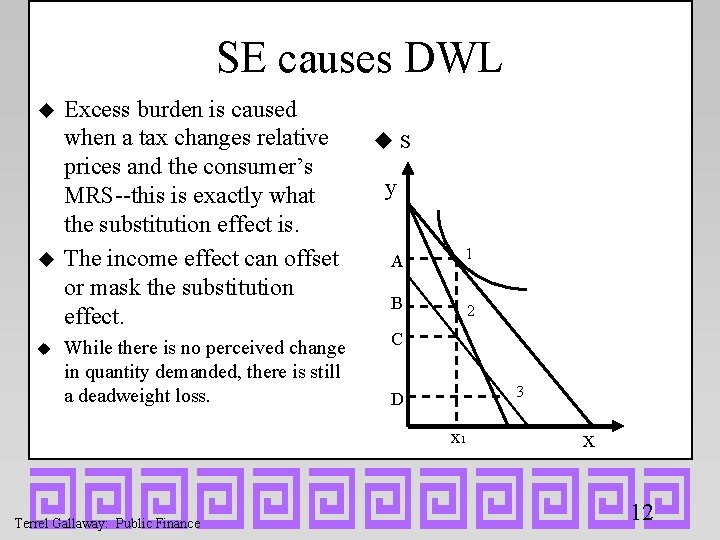
SE causes DWL u u u Excess burden is caused when a tax changes relative prices and the consumer’s MRS--this is exactly what the substitution effect is. The income effect can offset or mask the substitution effect. While there is no perceived change in quantity demanded, there is still a deadweight loss. us y A 1 B 2 C 3 D x 1 Terrel Gallaway: Public Finance x 12
- Slides: 12