
Exceptions cs 1043 Program Exceptions When a program
- Slides: 19
Exceptions cs 1043
Program Exceptions • When a program detects an error, what should it do? – Nothing, simply allow the program to fail. – Implement a course of action to correct the error.
Example: • A user enters an incorrect URL into a web browser. – Should the browser crash? – Should the browser request another URL?
Exception Handling • Software is designed to detect and correct most failures. • Detection and correction of an error is known as exception handling.
Java Exceptions • The Java compiler places exceptions into two categories: – Checked exceptions – Unchecked exceptions
Checked Exceptions • The compiler requires the programmer to either: 1. write a competent exception handler (CEH) for any checked exceptions. - Example: Input-output operations (reading and writing files and data streams). 2. Throw the exception hoping another method in the calling-tree will be able to handle the exception. This require throws keyword.
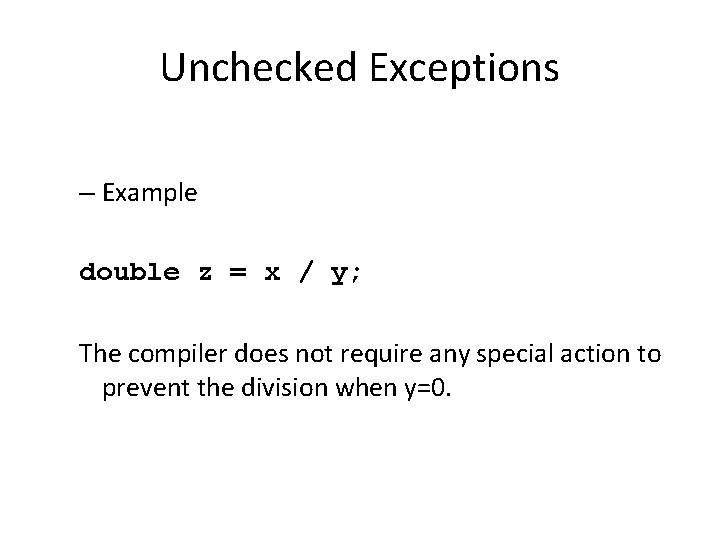
Unchecked Exceptions – Example double z = x / y; The compiler does not require any special action to prevent the division when y=0.
Unchecked Exceptions • The programmer can choose to: 1. Ignore the exception and hope for the best. 2. Catch the exception and implement an action to recover from the exception. Note: if the program cannot recover from an exception, the program exits with a fatal exception runtime error.
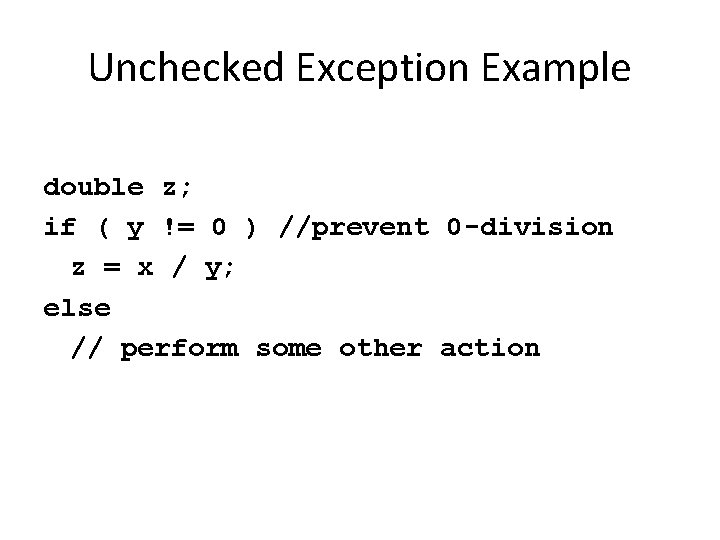
Unchecked Exception Example double z; if ( y != 0 ) //prevent 0 -division z = x / y; else // perform some other action
Checked Exception • Two choices for the programmer: 1. Throw the exception to the referencing method and hope for recovery. 2. Catch the exception with a competent exception handler
Java Keywords for Exception Handling • An unchecked exception could use the keyword “throw”. • Checked exceptions can use any of these: – throws – throw – try, catch, & finally
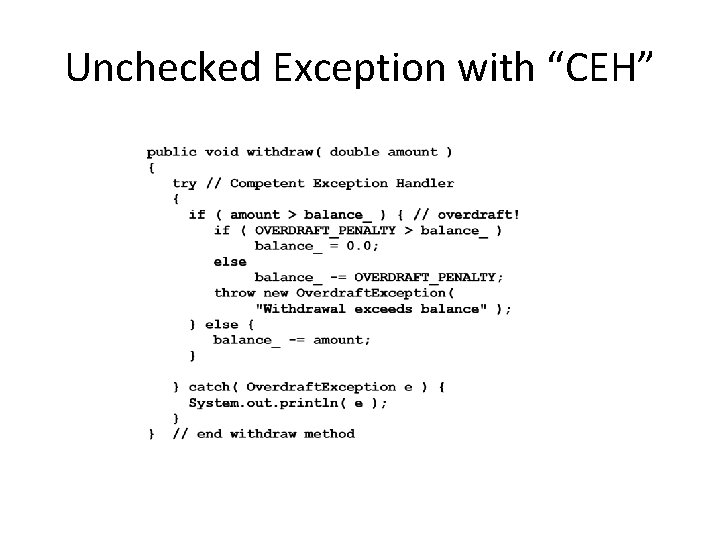
The Competent Exception Handler • The competent exception handler uses a combination of these three keywords: try, catch, and finally. • If the programmer wishes to send the exception to the referencing method, then use throws keyword.
Syntax for CEH • In order: 1. try-block – one per CEH 2. catch-blocks - zero or more per CEH 3. finally-block – zero or one per CEH
1. CEH try-Block • A CEH must have a try-block • The try-block consists of the try keyword followed by a body of code.
2. CEH catch-Blocks • The try-block is followed by zero or more catch blocks. – Each catch block will perform an action based on the exception type
3. CEH finally-Block • The finally-block is required if there are zero catch blocks. • The finally-block is optional if there is at least one catch-block.
CEH • The CEH can be nested just like other control structures.
Unchecked Exception with “CEH”
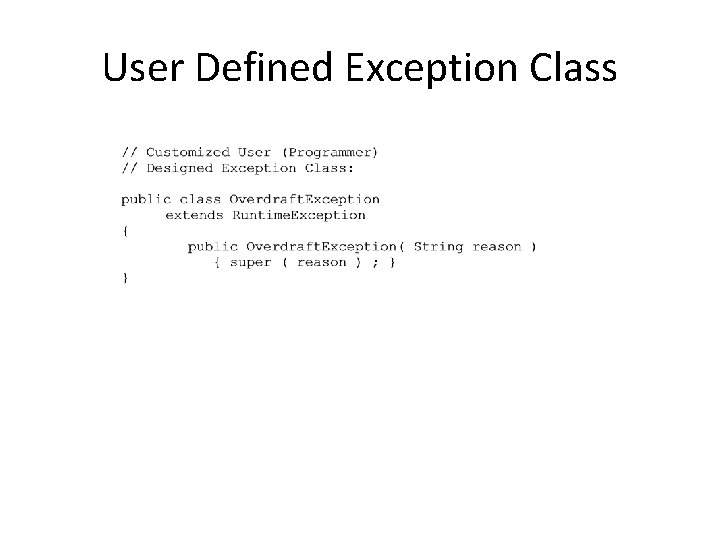
User Defined Exception Class