
Exceptional Student Education ESE Special Education SPED Early
- Slides: 31
Exceptional Student Education (ESE) Special Education (SPED) Early Childhood Education
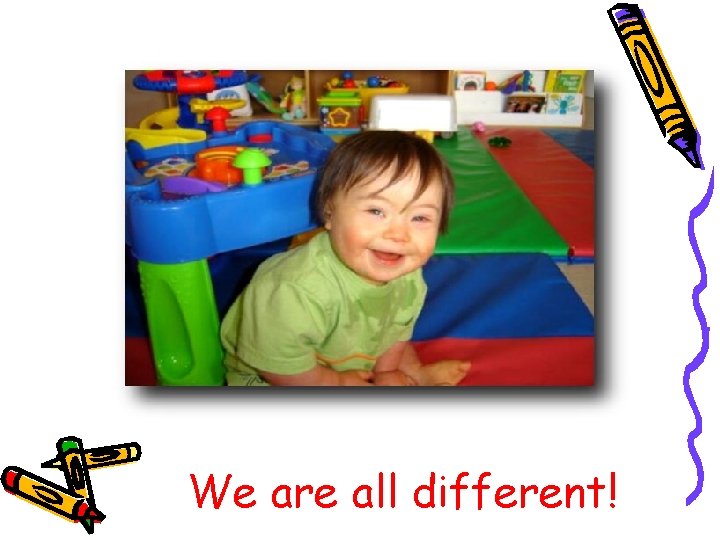
We are all different!
What is a disability? An individual with a disability is a person who: • Has a ________, and/or ____ impairment that substantially limits one or more major life activities; • Has a record of such an ____; or • Is regarded as having such an ____.
Different Exceptionalities • Cognitive Exceptionalities – Attention Deficit Disorder – Attention Deficit Hyperactivity Disorder – Learning Disability – Autism – Intellectual Disability (IND) – Giftedness • Emotional Exceptionalities – Emotionally and Behaviorally Disturbed (EBD) – Emotionally Handicapped • Physical Exceptionalities – Visual Impairments/Blindness – Hearing Impairments/Deafness – Spina Bifida – Muscular Dystrophy – Speech/Language Disabilities – Cerebral Palsy • Physical & Cognitive Exceptionalities – Down Syndrome
Attention Deficit Disorder (ADD) • ADD is distinguished by a basic ____ pattern. • These children do not have the ability to ____ for long periods of time and are easily ____.
Attention Deficit Hyperactivity Disorder(ADHD) • ADHD is generally a more complex and serious attention disorder that involves the hyperactivity component. • The three core behaviors are – ________ – ____
Learning Disability (LD) • A learning disability is a neurological condition that interferes with a person’s ability to ________, or ____ information. • Learning disabilities can affect one’s ability to – ________ -________ -____
Autism (ASD) Autism Spectrum Disorder • is a developmental disability characterized by difficulties and abnormalities in several areas: – – – ________ ____
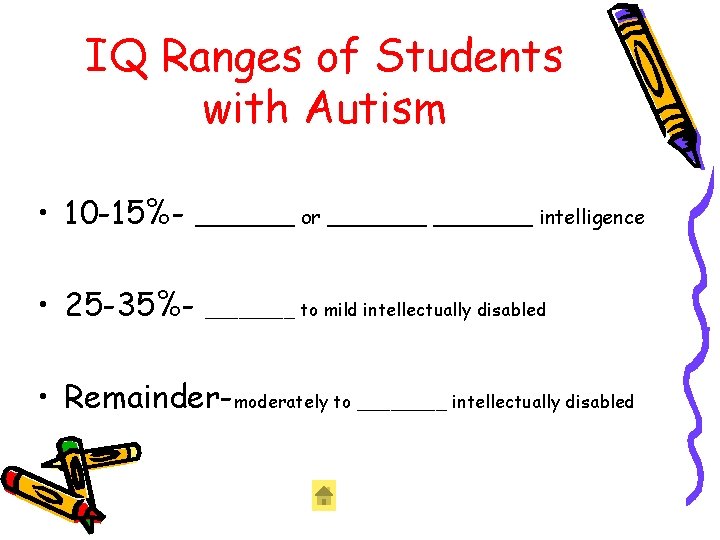
IQ Ranges of Students with Autism • 10 -15%- ____ or ________ intelligence • 25 -35%- ____ to mild intellectually disabled • Remainder-moderately to ____ intellectually disabled
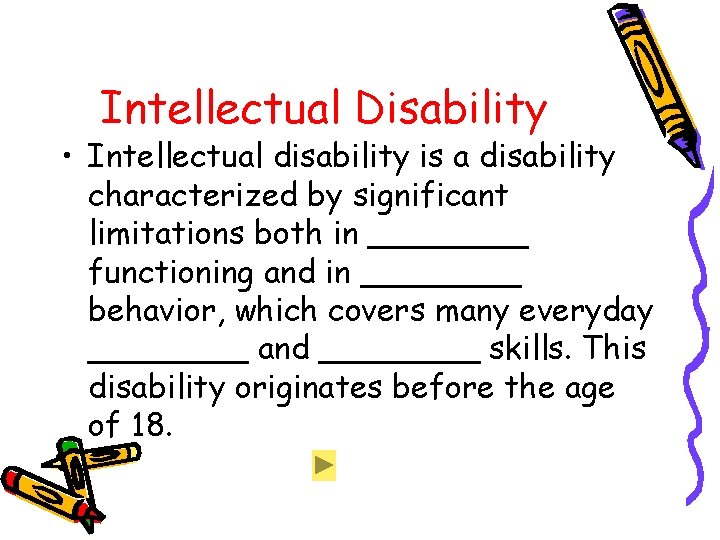
Intellectual Disability • Intellectual disability is a disability characterized by significant limitations both in ____ functioning and in ____ behavior, which covers many everyday ____ and ____ skills. This disability originates before the age of 18.
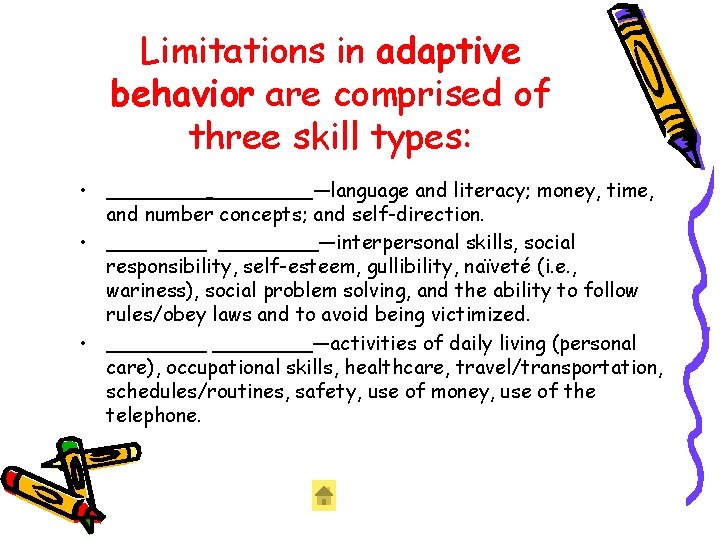
Limitations in adaptive behavior are comprised of three skill types: • ________—language and literacy; money, time, and number concepts; and self-direction. • ________—interpersonal skills, social responsibility, self-esteem, gullibility, naïveté (i. e. , wariness), social problem solving, and the ability to follow rules/obey laws and to avoid being victimized. • ________—activities of daily living (personal care), occupational skills, healthcare, travel/transportation, schedules/routines, safety, use of money, use of the telephone.
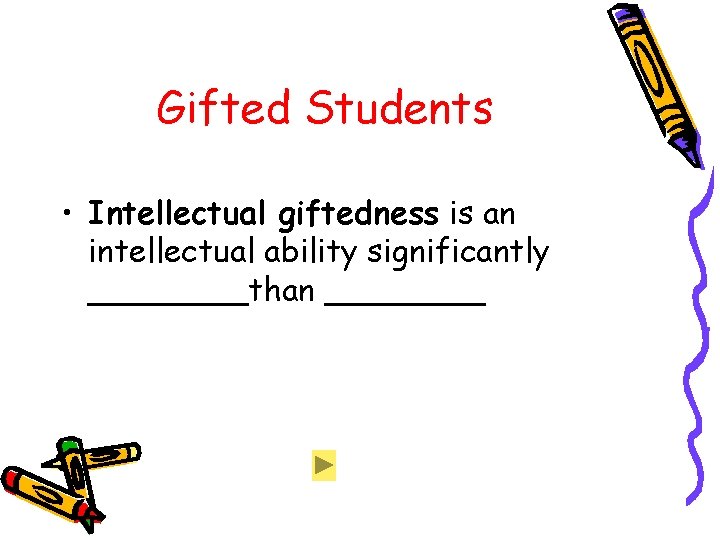
Gifted Students • Intellectual giftedness is an intellectual ability significantly ____than ____
IQ and Identification • • • Bright: ____ Moderately gifted: ____ Highly gifted: ____ Exceptionally gifted: ____ Profoundly gifted: ____
Emotionally and Behaviorally Disturbed (EBD) • A severe emotional disturbance is defined as an ________, the severity of which results in the need for a program for the full school week and ________. These students lack ____ control which ultimately effects their ____.
Emotionally Handicapped (EH) • An emotional handicap is a condition which results in improper behavior that interferes with the individual's ability to learn and function under normal circumstances. • Who are they? – – ____ or ________ intelligence ____ instability disrupts ____ process difficulty identifying and expressing appropriate ____ and ____
Visual Impairments/Blindness • Visual impairments are defined as ____in the structure and ____ of the eye that, even with best correction and treatment, interfere with ____. • Students who are ____ sighted or ____have to rely primarily on touch and ____ for learning but they can lead relatively normal lives.
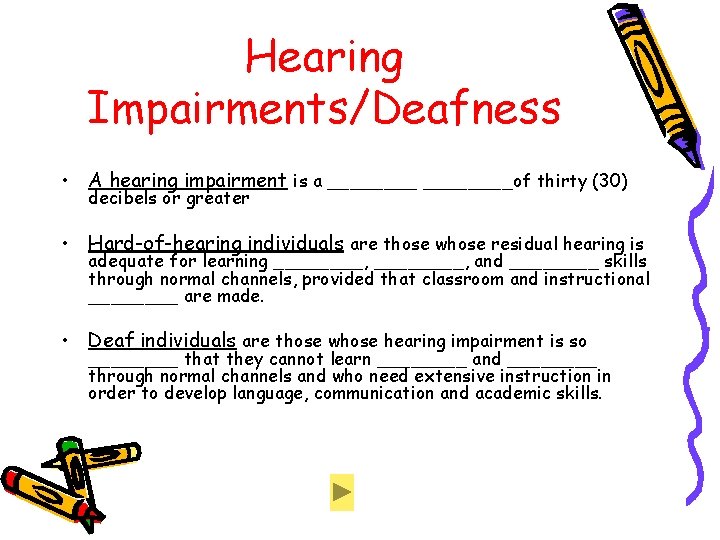
Hearing Impairments/Deafness • A hearing impairment is a ________of thirty (30) decibels or greater • Hard-of-hearing individuals are those whose residual hearing is adequate for learning ________, and ____ skills through normal channels, provided that classroom and instructional ____ are made. • Deaf individuals are those whose hearing impairment is so ____ that they cannot learn ____ and ____ through normal channels and who need extensive instruction in order to develop language, communication and academic skills.
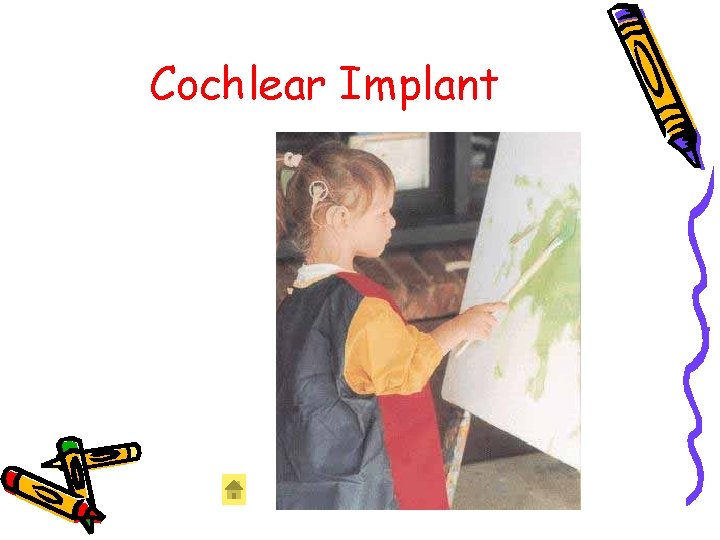
Cochlear Implant
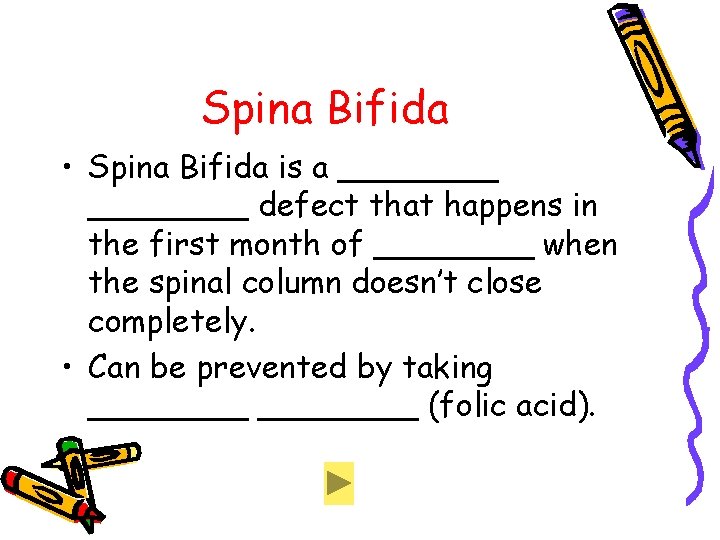
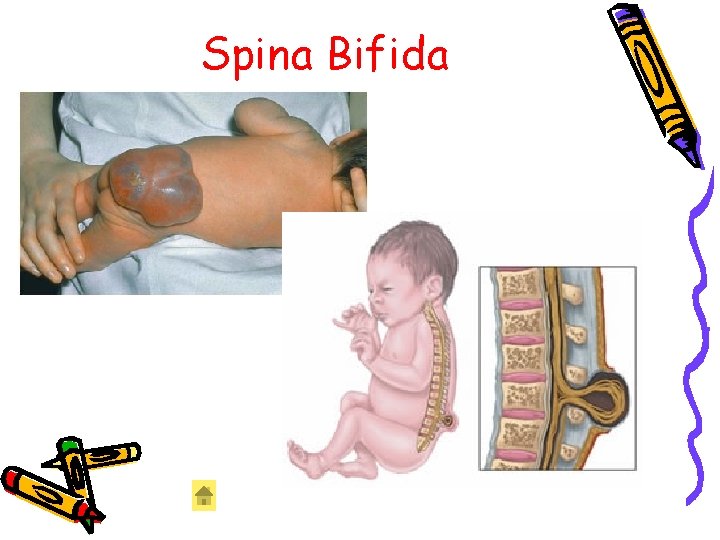
Spina Bifida • Spina Bifida is a ________ defect that happens in the first month of ____ when the spinal column doesn’t close completely. • Can be prevented by taking ________ (folic acid).
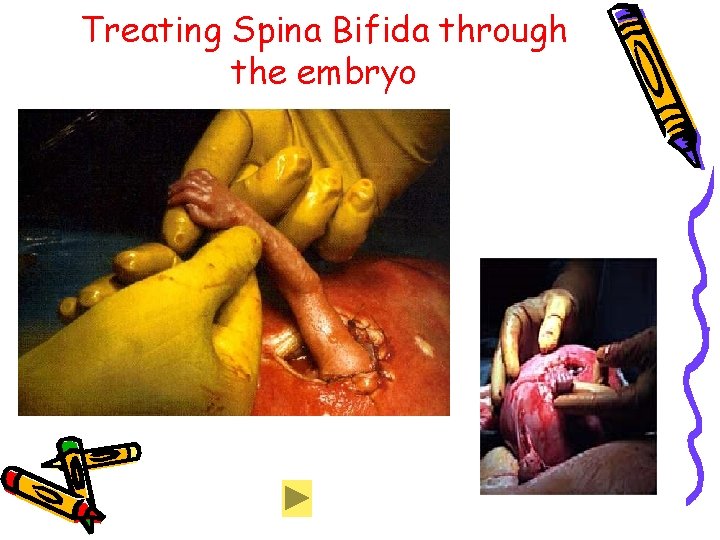
Treating Spina Bifida through the embryo
Spina Bifida
Muscular Dystrophy • Muscular dystrophy (MD) is a ____ disorder that gradually ____ the body's muscles. • A child who is diagnosed with MD gradually ____ the ability to do things like ____, sit ____, ____easily, and move the arms and hands.
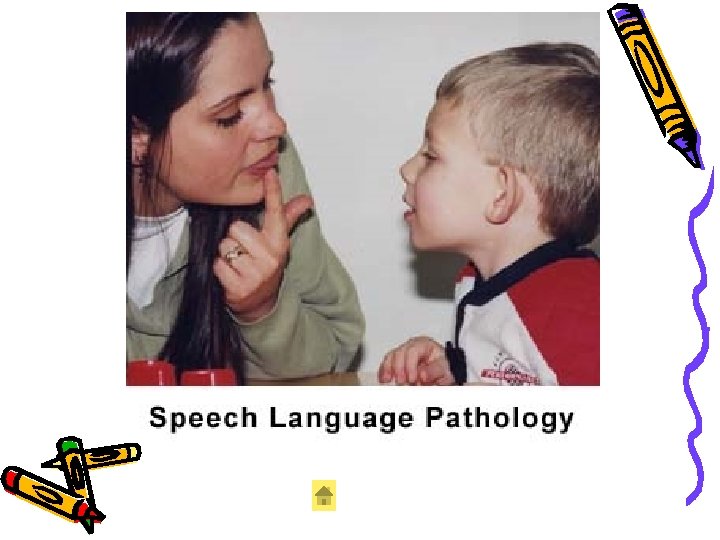
What’s the difference between speech and language? • ____ is the sound that comes out of our mouths. • ____ has to do with meanings, rather than sounds.
Speech and/or Language Delay • Although problems in speech and language differ, they frequently ____. A child with a language problem may be able to ____ words well but be unable to put more than two ____ together.
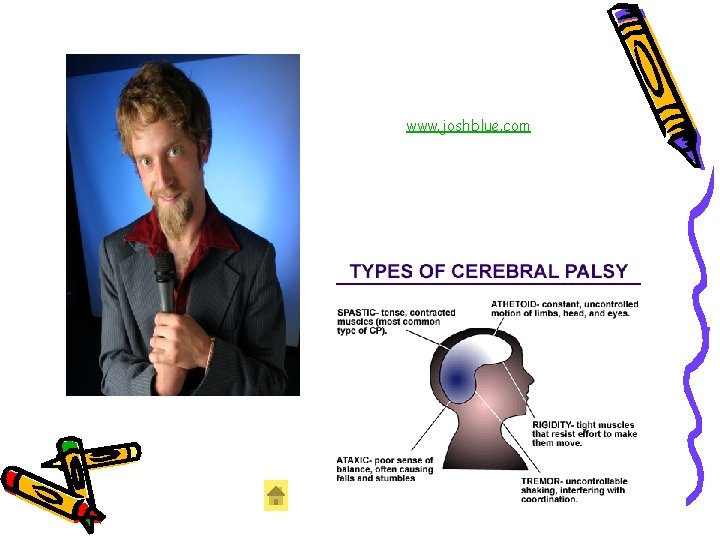
Cerebral Palsy (CP) • Cerebral palsy (CP) is a disorder that affects ________, and ____ skills (the ability to move in a coordinated and purposeful way). • Cerebral Palsy effects the brain which does not allow the ____ and ____ to move as they should. The problem does not lie in the muscles and nerves themselves.
The three types of CP are: • ________— causes stiffness and movement difficulties • ________— leads to involuntary and uncontrolled movements • ________— causes a disturbed sense of balance and depth perception
www. joshblue. com
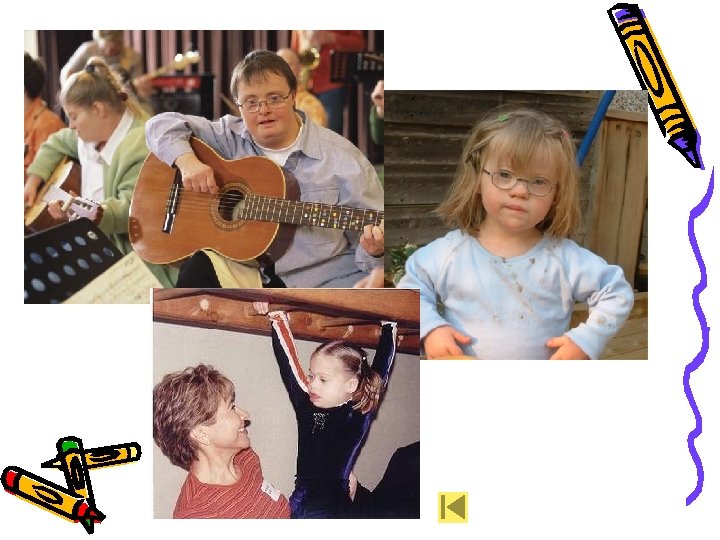
Down Syndrome • Down syndrome (DS) is a condition in which extra ____material causes delays in the way a child ____, and often leads to an ________ (IND).
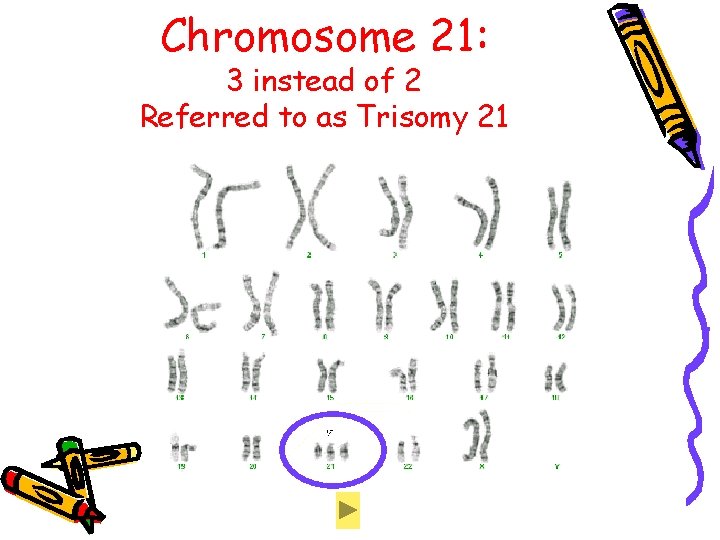
Chromosome 21: 3 instead of 2 Referred to as Trisomy 21