
EXCEPTIONAL LEARNER PARENT AND FAMILY PRESENTATION BY JESSAMINE
EXCEPTIONAL LEARNER PARENT AND FAMILY PRESENTATION BY: JESSAMINE GAINES
CONTENT 3 – Individuals with Disabilities Education Act (IDEA) 4 – Americans with Disabilities Act (ADA) 5 – Individualized Education Program (IEP) 6 – Response to Intervention (RTI) 7 – Inclusion vs. Pull Out 8 – Inclusion 9 – Pull Out 10 – Outside Support 11 – Closing 12 – Reflection 13 – References
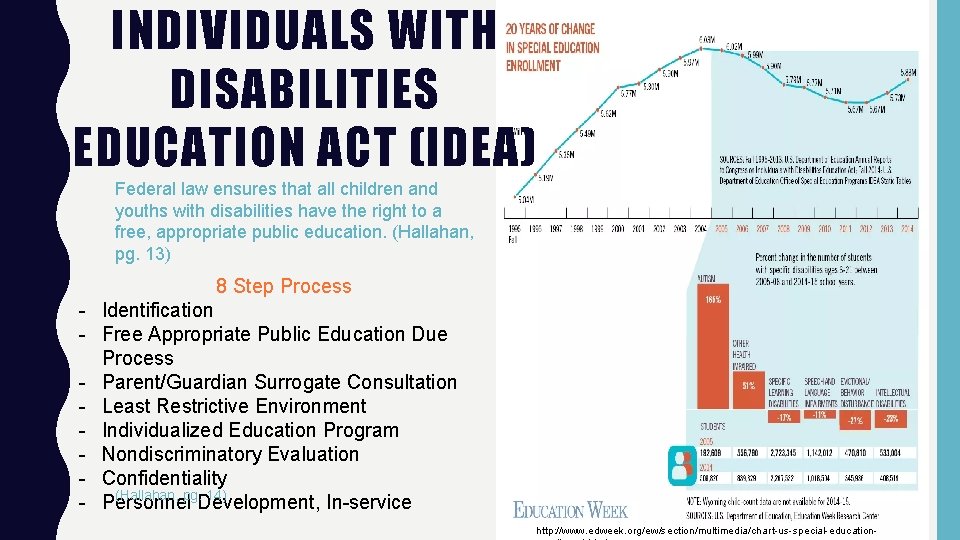
INDIVIDUALS WITH DISABILITIES EDUCATION ACT (IDEA) Federal law ensures that all children and youths with disabilities have the right to a free, appropriate public education. (Hallahan, pg. 13) 8 Step Process - Identification - Free Appropriate Public Education Due Process - Parent/Guardian Surrogate Consultation - Least Restrictive Environment - Individualized Education Program - Nondiscriminatory Evaluation - Confidentiality (Hallahan, pg. 14) - Personnel Development, In-service http: //www. edweek. org/ew/section/multimedia/chart-us-special-education-
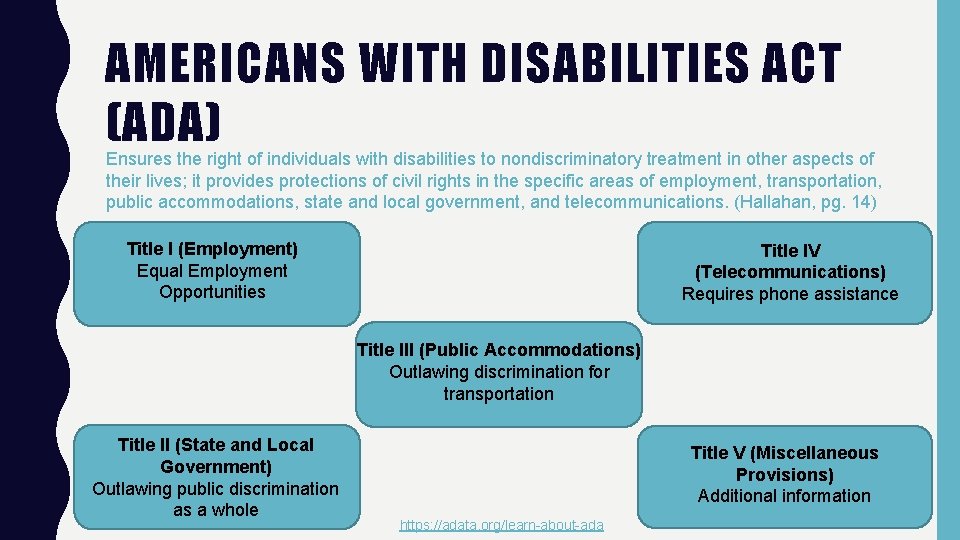
AMERICANS WITH DISABILITIES ACT (ADA) Ensures the right of individuals with disabilities to nondiscriminatory treatment in other aspects of their lives; it provides protections of civil rights in the specific areas of employment, transportation, public accommodations, state and local government, and telecommunications. (Hallahan, pg. 14) Title I (Employment) Equal Employment Opportunities Title IV (Telecommunications) Requires phone assistance Title III (Public Accommodations) Outlawing discrimination for transportation Title II (State and Local Government) Outlawing public discrimination as a whole Title V (Miscellaneous Provisions) Additional information https: //adata. org/learn-about-ada
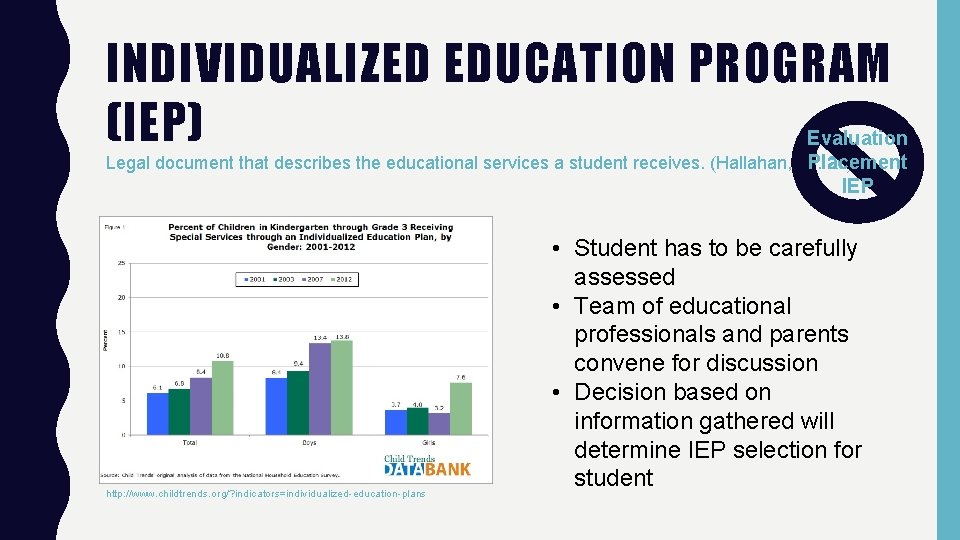
INDIVIDUALIZED EDUCATION PROGRAM (IEP) Evaluation Legal document that describes the educational services a student receives. (Hallahan, pg. 26) Placement IEP http: //www. childtrends. org/? indicators=individualized-education-plans • Student has to be carefully assessed • Team of educational professionals and parents convene for discussion • Decision based on information gathered will determine IEP selection for student
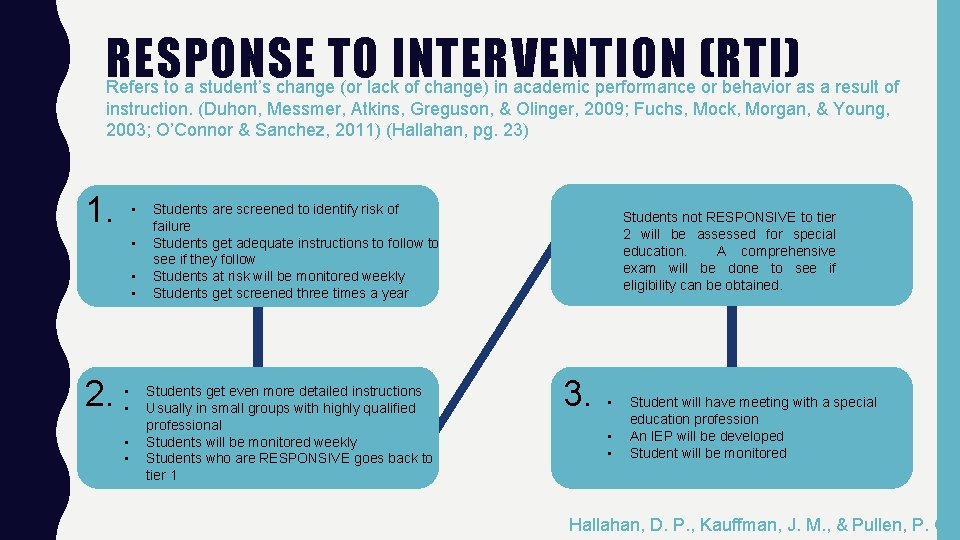
RESPONSE TO INTERVENTION (RTI) Refers to a student’s change (or lack of change) in academic performance or behavior as a result of instruction. (Duhon, Messmer, Atkins, Greguson, & Olinger, 2009; Fuchs, Mock, Morgan, & Young, 2003; O’Connor & Sanchez, 2011) (Hallahan, pg. 23) 1. • • 2. • • • • Students are screened to identify risk of failure Students get adequate instructions to follow to see if they follow Students at risk will be monitored weekly Students get screened three times a year Students get even more detailed instructions Usually in small groups with highly qualified professional Students will be monitored weekly Students who are RESPONSIVE goes back to tier 1 Students not RESPONSIVE to tier 2 will be assessed for special education. A comprehensive exam will be done to see if eligibility can be obtained. 3. • • • Student will have meeting with a special education profession An IEP will be developed Student will be monitored Hallahan, D. P. , Kauffman, J. M. , & Pullen, P. C. (

INCLUSION VS PULL OUT
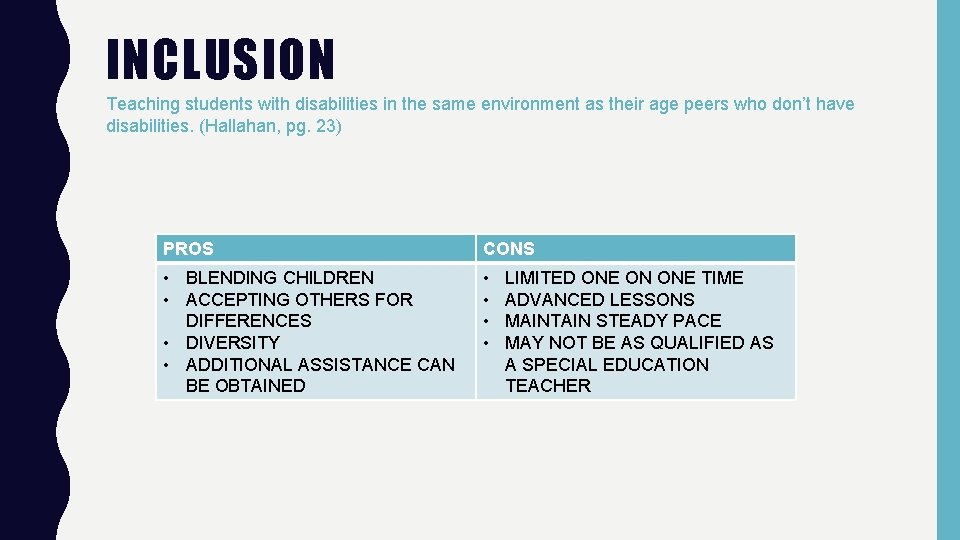
INCLUSION Teaching students with disabilities in the same environment as their age peers who don’t have disabilities. (Hallahan, pg. 23) PROS CONS • BLENDING CHILDREN • ACCEPTING OTHERS FOR DIFFERENCES • DIVERSITY • ADDITIONAL ASSISTANCE CAN BE OBTAINED • • LIMITED ONE ON ONE TIME ADVANCED LESSONS MAINTAIN STEADY PACE MAY NOT BE AS QUALIFIED AS A SPECIAL EDUCATION TEACHER
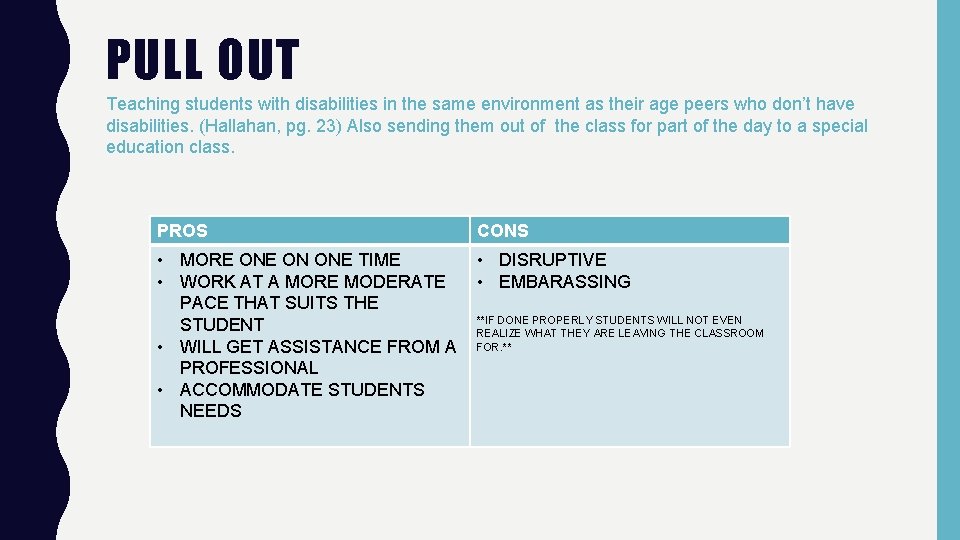
PULL OUT Teaching students with disabilities in the same environment as their age peers who don’t have disabilities. (Hallahan, pg. 23) Also sending them out of the class for part of the day to a special education class. PROS CONS • MORE ON ONE TIME • WORK AT A MORE MODERATE PACE THAT SUITS THE STUDENT • WILL GET ASSISTANCE FROM A PROFESSIONAL • ACCOMMODATE STUDENTS NEEDS • DISRUPTIVE • EMBARASSING **IF DONE PROPERLY STUDENTS WILL NOT EVEN REALIZE WHAT THEY ARE LEAVING THE CLASSROOM FOR. **

OUTSIDE SUPPORT Department of Education – Indiana Email: specialeducation@doe. in. gov Phone: (317)232 -0570 Toll Free: (877) 851 -4106 Helpful Websites http: //idea. ed. gov/explore/view/p/% 2 Croot%2 Cdynamic%2 CTopical. Are a%2 C 1%2 C http: //www 2. ed. gov/programs/osepi dea/618 -data/static-
CLOSING As your child enters my classroom, it is my duty to identify with the needs of your child. I will make sure that they will get the additional assistance needed for them to succeed. I am proud to call your child my student. Together we will remain motivated and will achieve growth in their learning abilities. Thank you for allowing me to be included in this experience as we grow together this school year.
Reflection As I was working on this particular assignment, I found myself creating a product I would want to see if my child was a part of the special education program. I worked hard to dig deep and find what I thought was the most beneficial information for others who know nothing. I want it to be an easy transition of the parents of students who enter my classroom. The information I provided seemed the most helpful and stood out to me as I began. Although IDEA and ADA are very similar it is important to me that parents know that there are ALWAYS options once the student enters the real world outside of the school system. There are so many great opportunities for people with special needs, and discriminating against them could get someone in trouble. That right there, is so reassuring as one goes through the walks of life.
RESOURCES Chart: U. S. Special Education Enrollment. (n. d. ). Retrieved June 23, 2016, from http: //www. edweek. org/ew/section/multimedia/chart-us-special-education-enrollment. html Do Special Education Students Fare Better in Pull-Outs or Full Inclusion Classes? (n. d. ). Retrieved June 23, 2016, from http: //oureverydaylife. com/special-education-students-fare-better-pullouts-fullinclusion-classes-14638. html Hallahan, D. P. , Kauffman, J. M. , & Pullen, P. C. (n. d. ). Exceptional learners: An Introduction to Special Education. Individualized Education Plans. (2015). Retrieved June 23, 2016, from http: //www. childtrends. org/? indicators=individualized-education-plans What is the Americans with Disabilities Act (ADA)? (n. d. ). Retrieved June 23, 2016, from https: //adata. org/learn-about-ada What is RTI? (n. d. ). Retrieved June 23, 2016, from http: //www. rtinetwork. org/learn/whatisrti
- Slides: 13