
Exception Handling Advanced Programming ICOM 4015 Lecture 15
- Slides: 65
Exception Handling Advanced Programming ICOM 4015 Lecture 15 Reading: Java Concepts Chapter 15 Fall 2006 Adapted from Java Concepts Companion Slides 1
Chapter Goals • To learn how to throw exceptions • To be able to design your own exception classes • To understand the difference between checked and unchecked exceptions • To learn how to catch exceptions • To know when and where to catch an exception Fall 2006 Adapted from Java Concepts Companion Slides 2
Error Handling • Traditional approach: Method returns error code • Problem: Forget to check for error code Failure notification may go undetected • Problem: Calling method may not be able to do anything about failure Program must fail too and let its caller worry about it Many method calls would need to be checked Continued… Fall 2006 Adapted from Java Concepts Companion Slides 3
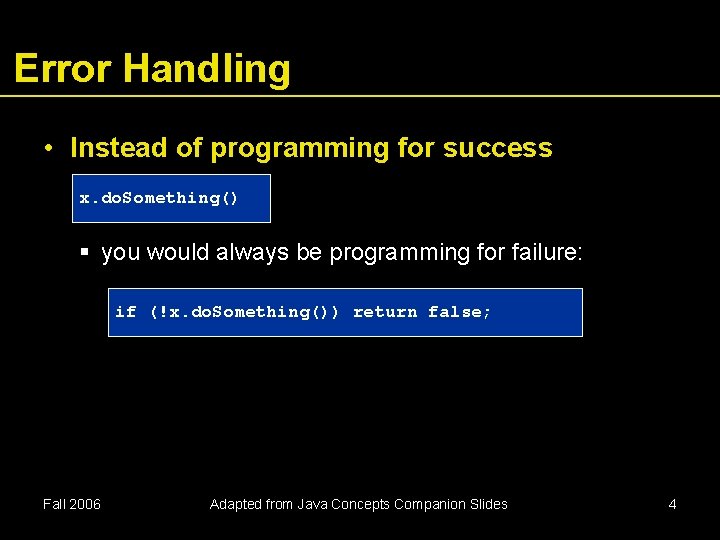
Error Handling • Instead of programming for success x. do. Something() you would always be programming for failure: if (!x. do. Something()) return false; Fall 2006 Adapted from Java Concepts Companion Slides 4
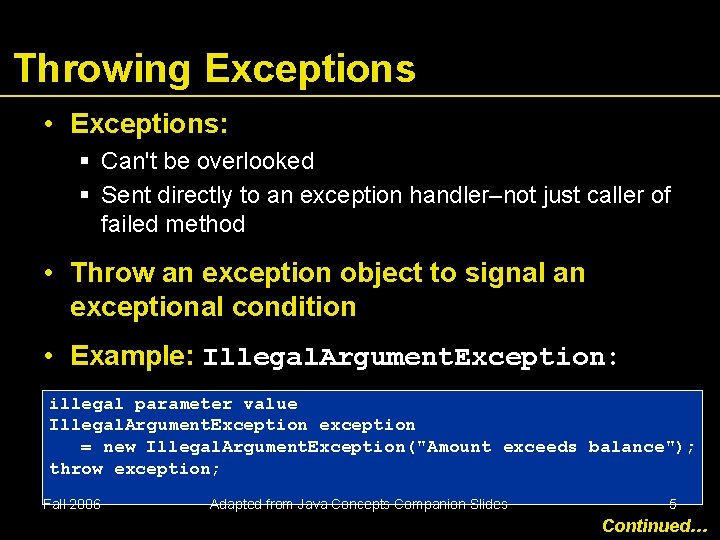
Throwing Exceptions • Exceptions: Can't be overlooked Sent directly to an exception handler–not just caller of failed method • Throw an exception object to signal an exceptional condition • Example: Illegal. Argument. Exception: illegal parameter value Illegal. Argument. Exception exception = new Illegal. Argument. Exception("Amount exceeds balance"); throw exception; Fall 2006 Adapted from Java Concepts Companion Slides 5 Continued…
Throwing Exceptions • No need to store exception object in a variable: throw new Illegal. Argument. Exception("Amount exceeds balance"); • When an exception is thrown, method terminates immediately Execution continues with an exception handler Fall 2006 Adapted from Java Concepts Companion Slides 6
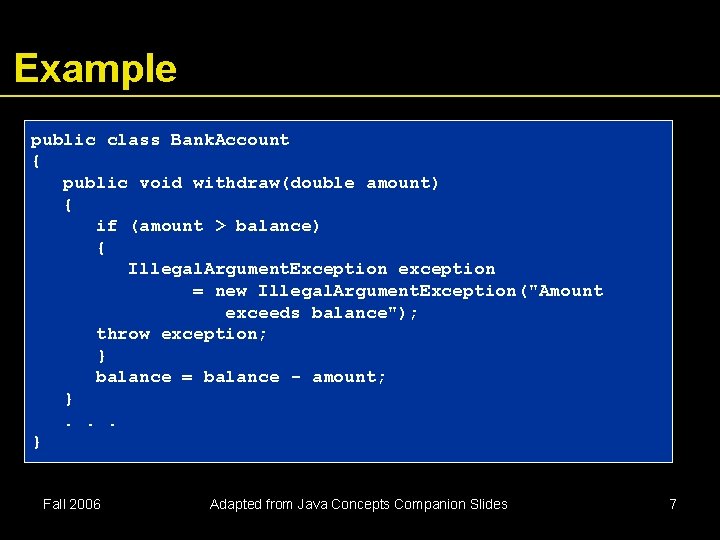
Example public class Bank. Account { public void withdraw(double amount) { if (amount > balance) { Illegal. Argument. Exception exception = new Illegal. Argument. Exception("Amount exceeds balance"); throw exception; } balance = balance - amount; }. . . } Fall 2006 Adapted from Java Concepts Companion Slides 7
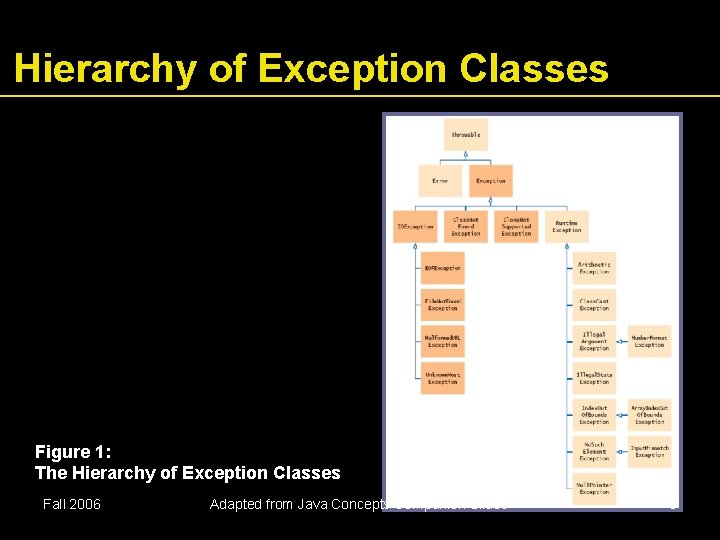
Hierarchy of Exception Classes Figure 1: The Hierarchy of Exception Classes Fall 2006 Adapted from Java Concepts Companion Slides 8
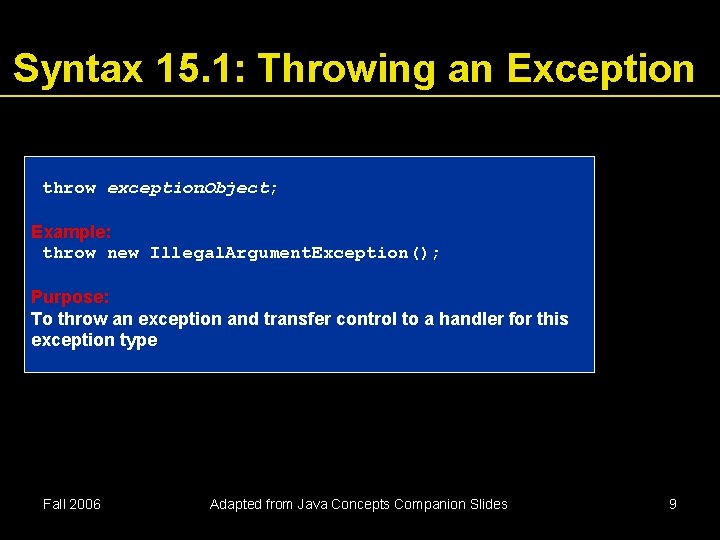
Syntax 15. 1: Throwing an Exception throw exception. Object; Example: throw new Illegal. Argument. Exception(); Purpose: To throw an exception and transfer control to a handler for this exception type Fall 2006 Adapted from Java Concepts Companion Slides 9
Self Check 1. How should you modify the deposit method to ensure that the balance is never negative? 2. Suppose you construct a new bank account object with a zero balance and then call withdraw(10). What is the value of balance afterwards? Fall 2006 Adapted from Java Concepts Companion Slides 10
Answers 1. Throw an exception if the amount being deposited is less than zero. 2. The balance is still zero because the last statement of the withdraw method was never executed. Fall 2006 Adapted from Java Concepts Companion Slides 11
Checked and Unchecked Exceptions • Two types of exceptions: Checked • The compiler checks that you don't ignore them • Due to external circumstances that the programmer cannot prevent • Majority occur when dealing with input and output • For example, IOException Fall 2006 Adapted from Java Concepts Companion Slides 12
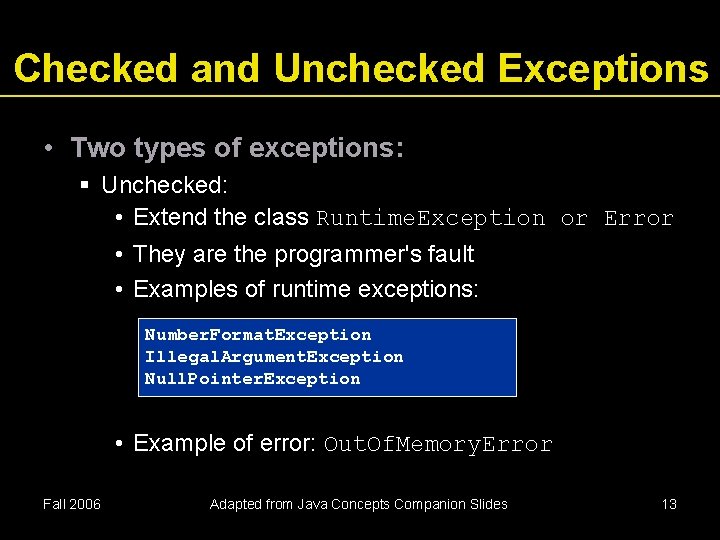
Checked and Unchecked Exceptions • Two types of exceptions: Unchecked: • Extend the class Runtime. Exception or Error • They are the programmer's fault • Examples of runtime exceptions: Number. Format. Exception Illegal. Argument. Exception Null. Pointer. Exception • Example of error: Out. Of. Memory. Error Fall 2006 Adapted from Java Concepts Companion Slides 13
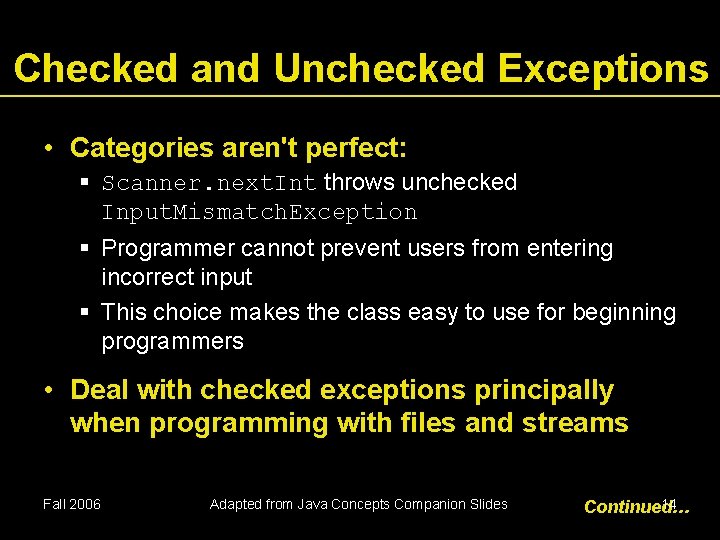
Checked and Unchecked Exceptions • Categories aren't perfect: Scanner. next. Int throws unchecked Input. Mismatch. Exception Programmer cannot prevent users from entering incorrect input This choice makes the class easy to use for beginning programmers • Deal with checked exceptions principally when programming with files and streams Fall 2006 Adapted from Java Concepts Companion Slides 14 Continued…
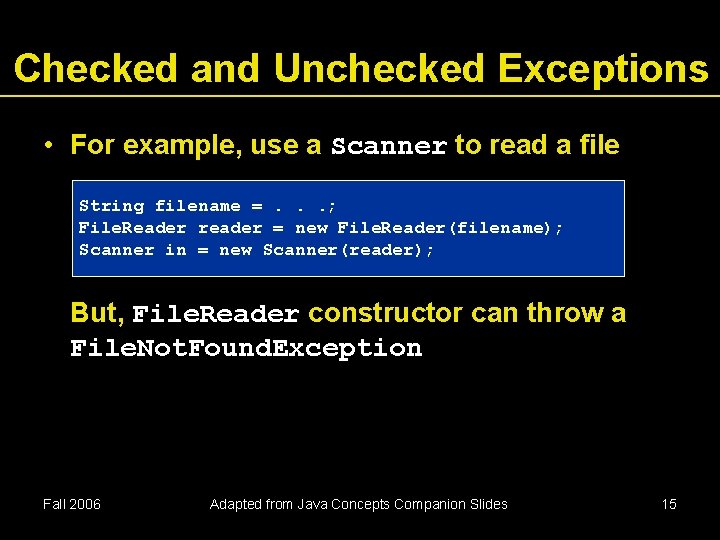
Checked and Unchecked Exceptions • For example, use a Scanner to read a file String filename =. . . ; File. Reader reader = new File. Reader(filename); Scanner in = new Scanner(reader); But, File. Reader constructor can throw a File. Not. Found. Exception Fall 2006 Adapted from Java Concepts Companion Slides 15
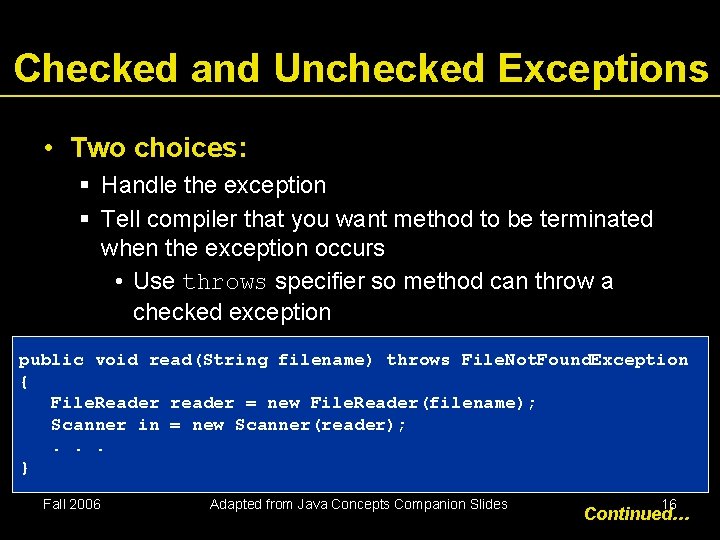
Checked and Unchecked Exceptions • Two choices: Handle the exception Tell compiler that you want method to be terminated when the exception occurs • Use throws specifier so method can throw a checked exception public void read(String filename) throws File. Not. Found. Exception { File. Reader reader = new File. Reader(filename); Scanner in = new Scanner(reader); . . . } Fall 2006 Adapted from Java Concepts Companion Slides 16 Continued…
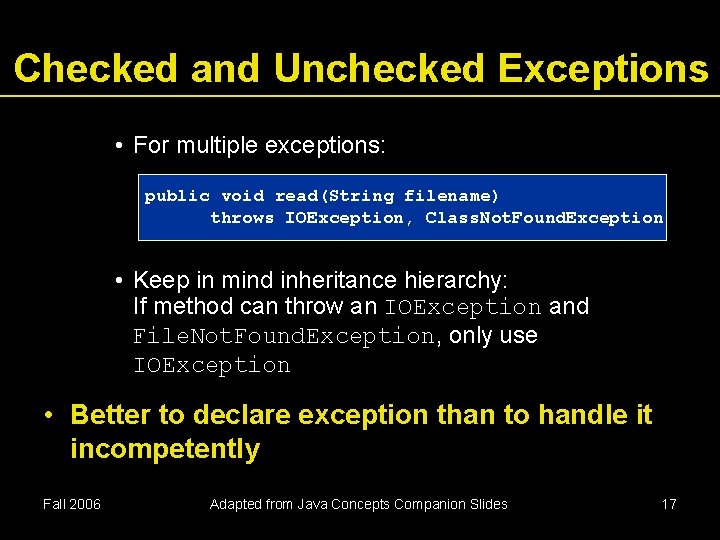
Checked and Unchecked Exceptions • For multiple exceptions: public void read(String filename) throws IOException, Class. Not. Found. Exception • Keep in mind inheritance hierarchy: If method can throw an IOException and File. Not. Found. Exception, only use IOException • Better to declare exception than to handle it incompetently Fall 2006 Adapted from Java Concepts Companion Slides 17
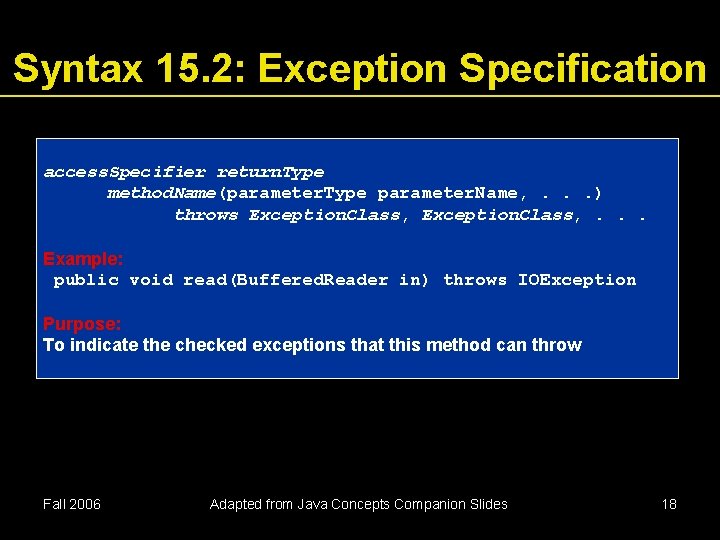
Syntax 15. 2: Exception Specification access. Specifier return. Type method. Name(parameter. Type parameter. Name, . . . ) throws Exception. Class, . . . Example: public void read(Buffered. Reader in) throws IOException Purpose: To indicate the checked exceptions that this method can throw Fall 2006 Adapted from Java Concepts Companion Slides 18
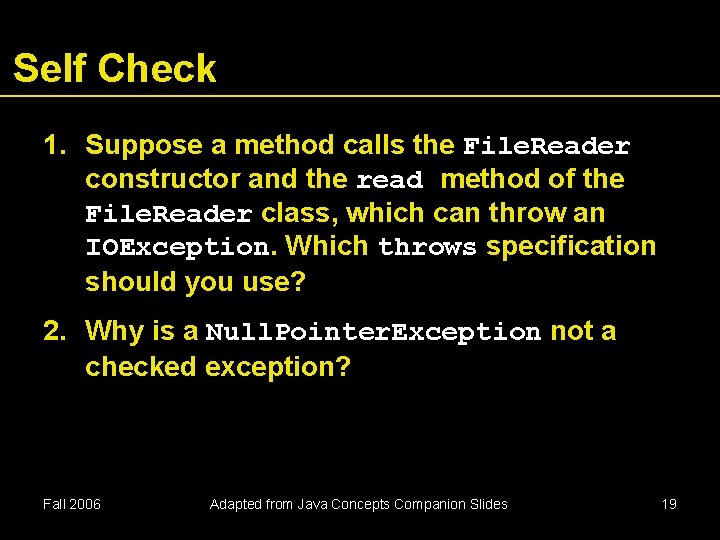
Self Check 1. Suppose a method calls the File. Reader constructor and the read method of the File. Reader class, which can throw an IOException. Which throws specification should you use? 2. Why is a Null. Pointer. Exception not a checked exception? Fall 2006 Adapted from Java Concepts Companion Slides 19
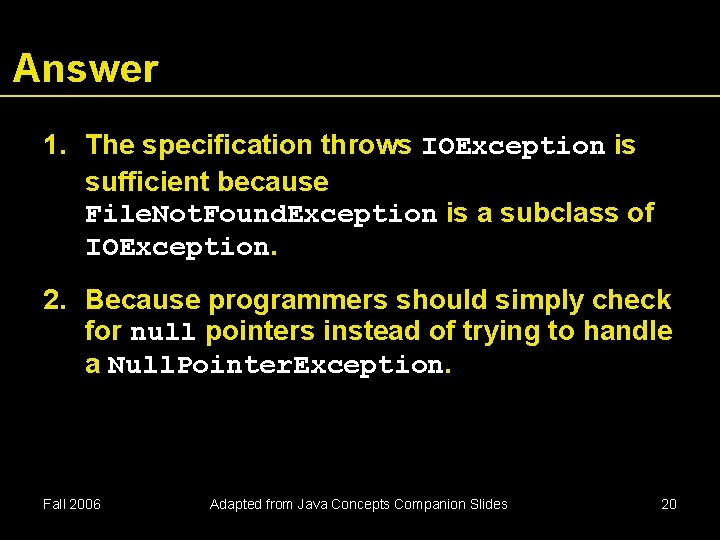
Answer 1. The specification throws IOException is sufficient because File. Not. Found. Exception is a subclass of IOException. 2. Because programmers should simply check for null pointers instead of trying to handle a Null. Pointer. Exception. Fall 2006 Adapted from Java Concepts Companion Slides 20
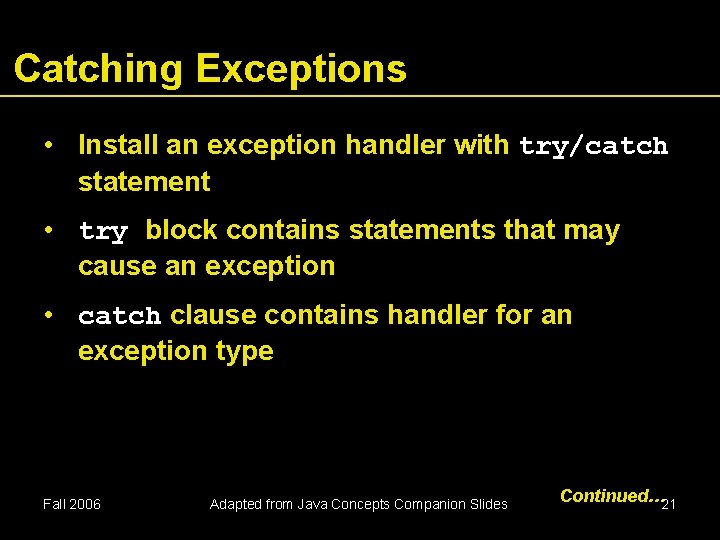
Catching Exceptions • Install an exception handler with try/catch statement • try block contains statements that may cause an exception • catch clause contains handler for an exception type Fall 2006 Adapted from Java Concepts Companion Slides Continued… 21
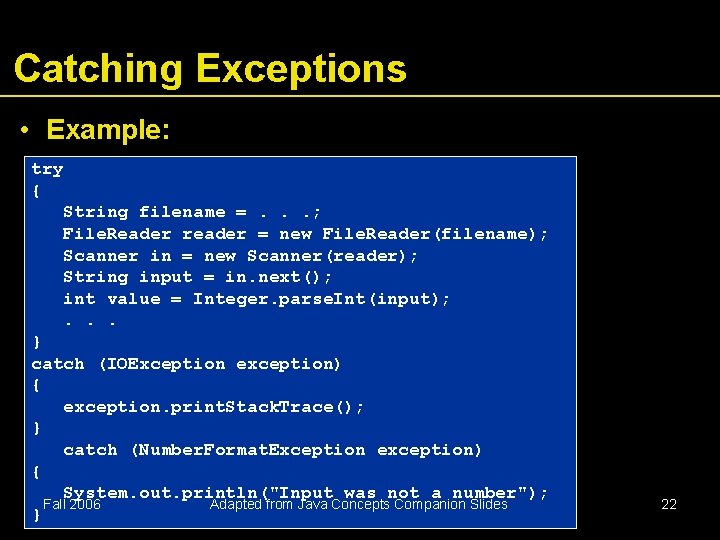
Catching Exceptions • Example: try { String filename =. . . ; File. Reader reader = new File. Reader(filename); Scanner in = new Scanner(reader); String input = in. next(); int value = Integer. parse. Int(input); . . . } catch (IOException exception) { exception. print. Stack. Trace(); } catch (Number. Format. Exception exception) { System. out. println("Input was not a number"); Fall 2006 Adapted from Java Concepts Companion Slides } 22
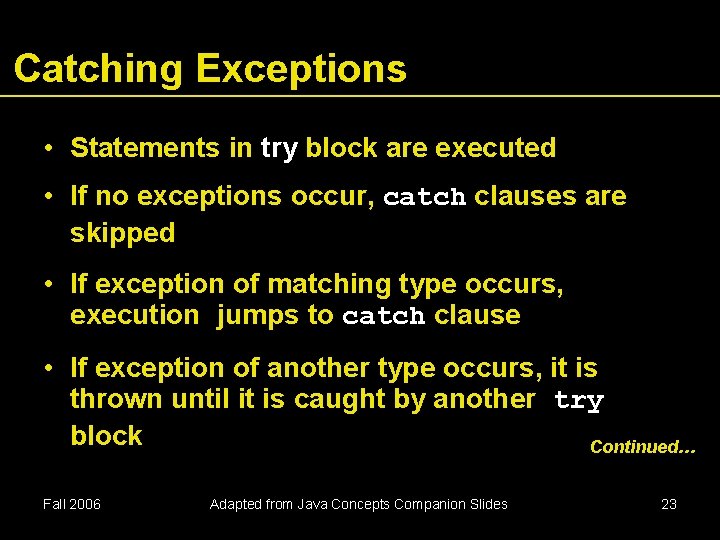
Catching Exceptions • Statements in try block are executed • If no exceptions occur, catch clauses are skipped • If exception of matching type occurs, execution jumps to catch clause • If exception of another type occurs, it is thrown until it is caught by another try block Continued… Fall 2006 Adapted from Java Concepts Companion Slides 23
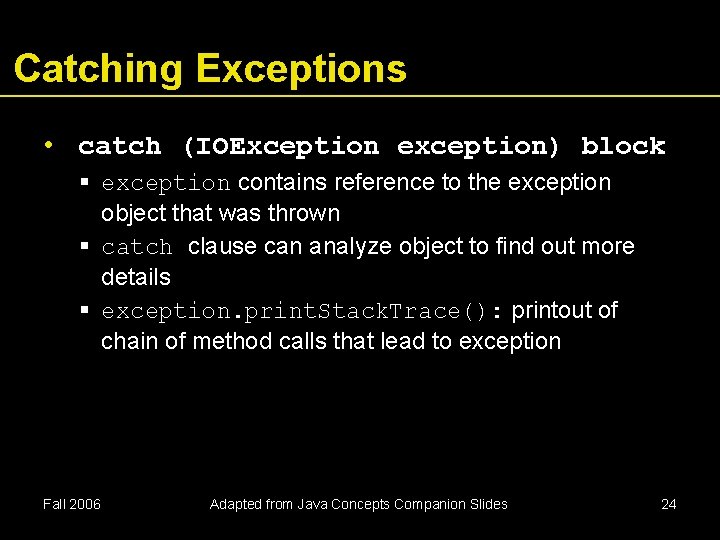
Catching Exceptions • catch (IOException exception) block exception contains reference to the exception object that was thrown catch clause can analyze object to find out more details exception. print. Stack. Trace(): printout of chain of method calls that lead to exception Fall 2006 Adapted from Java Concepts Companion Slides 24
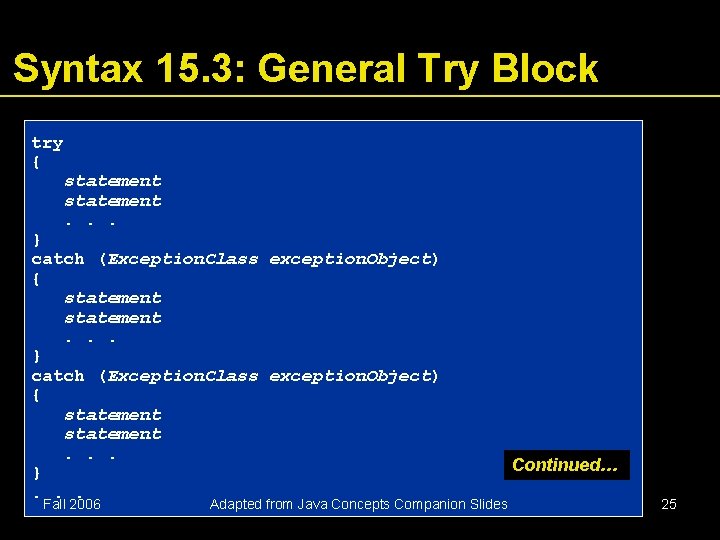
Syntax 15. 3: General Try Block try { statement. . . } catch (Exception. Class exception. Object) { statement. . . }. . . Fall 2006 Adapted from Java Concepts Companion Slides Continued… 25
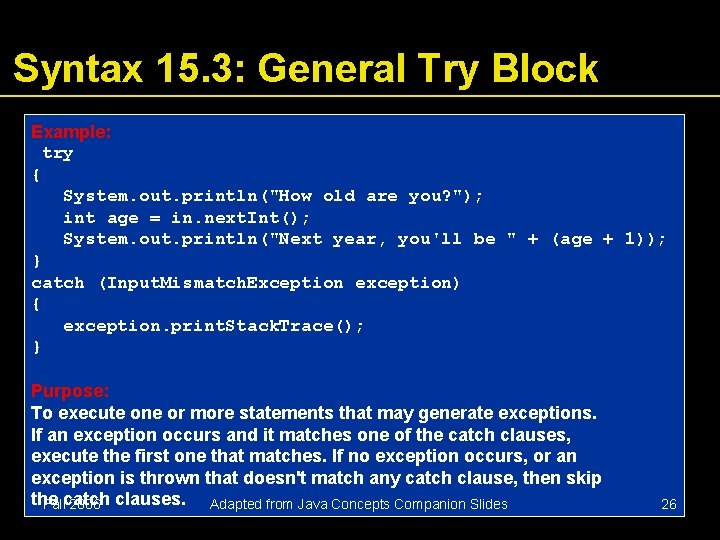
Syntax 15. 3: General Try Block Example: try { System. out. println("How old are you? "); int age = in. next. Int(); System. out. println("Next year, you'll be " + (age + 1)); } catch (Input. Mismatch. Exception exception) { exception. print. Stack. Trace(); } Purpose: To execute one or more statements that may generate exceptions. If an exception occurs and it matches one of the catch clauses, execute the first one that matches. If no exception occurs, or an exception is thrown that doesn't match any catch clause, then skip the Fallcatch 2006 clauses. Adapted from Java Concepts Companion Slides 26
Self Check 1. Suppose the file with the given file name exists and has no contents. Trace the flow of execution in the try block in this section. 2. Is there a difference between catching checked and unchecked exceptions? Fall 2006 Adapted from Java Concepts Companion Slides 27
Answers 1. The File. Reader constructor succeeds, and in is constructed. Then the call in. next() throws a No. Such. Element. Exception, and the try block is aborted. None of the catch clauses match, so none are executed. If none of the enclosing method calls catch the exception, the program terminates. Fall 2006 Adapted from Java Concepts Companion Slides 28 Continued…
Answers 2. No–you catch both exception types in the same way, as you can see from the code example on page 558. Recall that IOException is a checked exception and Number. Format. Exception is an unchecked exception. Fall 2006 Adapted from Java Concepts Companion Slides 29
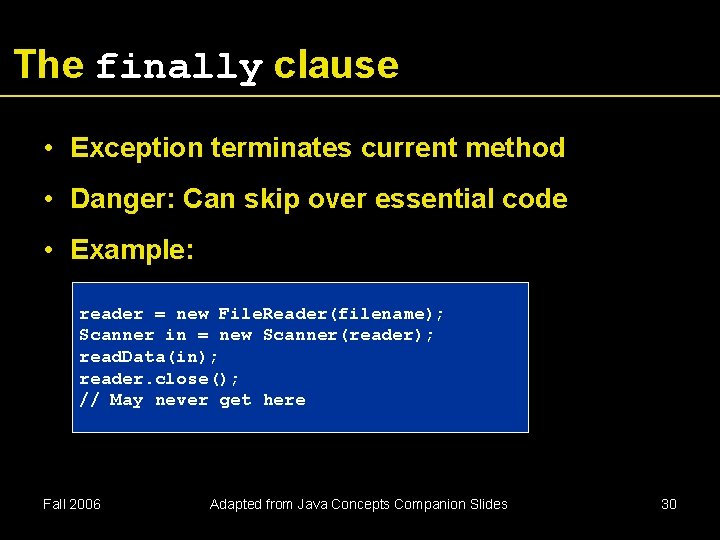
The finally clause • Exception terminates current method • Danger: Can skip over essential code • Example: reader = new File. Reader(filename); Scanner in = new Scanner(reader); read. Data(in); reader. close(); // May never get here Fall 2006 Adapted from Java Concepts Companion Slides 30
The finally clause • Must execute reader. close() even if exception happens • Use finally clause for code that must be executed "no matter what" Fall 2006 Adapted from Java Concepts Companion Slides 31
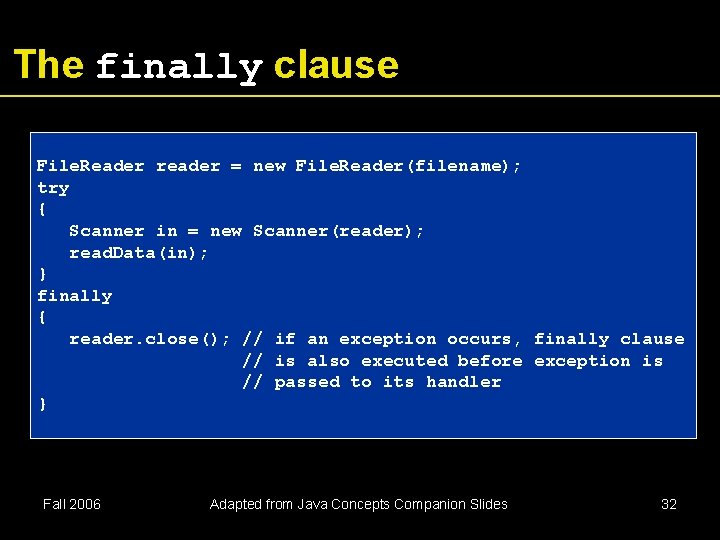
The finally clause File. Reader reader = new File. Reader(filename); try { Scanner in = new Scanner(reader); read. Data(in); } finally { reader. close(); // if an exception occurs, finally clause // is also executed before exception is // passed to its handler } Fall 2006 Adapted from Java Concepts Companion Slides 32
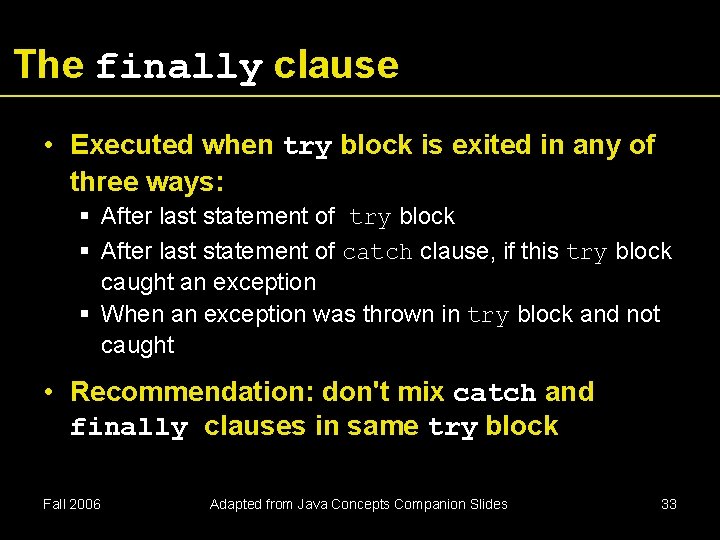
The finally clause • Executed when try block is exited in any of three ways: After last statement of try block After last statement of catch clause, if this try block caught an exception When an exception was thrown in try block and not caught • Recommendation: don't mix catch and finally clauses in same try block Fall 2006 Adapted from Java Concepts Companion Slides 33
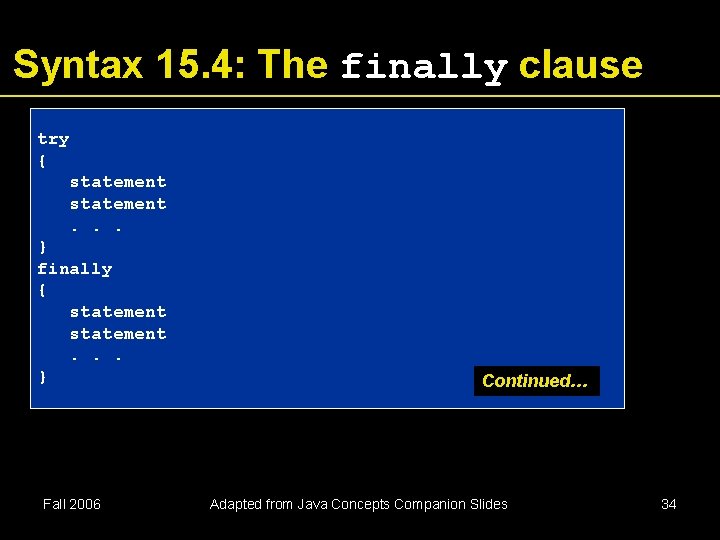
Syntax 15. 4: The finally clause try { statement. . . } finally { statement. . . } Fall 2006 Continued… Adapted from Java Concepts Companion Slides 34
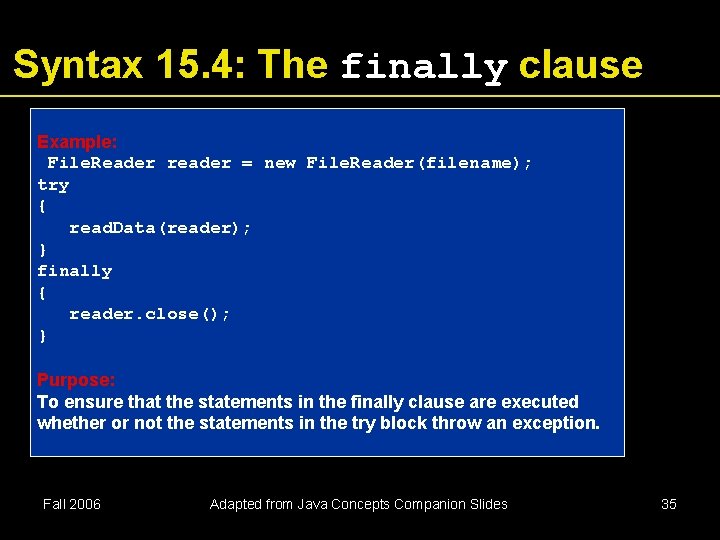
Syntax 15. 4: The finally clause Example: File. Reader reader = new File. Reader(filename); try { read. Data(reader); } finally { reader. close(); } Purpose: To ensure that the statements in the finally clause are executed whether or not the statements in the try block throw an exception. Fall 2006 Adapted from Java Concepts Companion Slides 35
Self Check 1. Why was the reader variable declared outside the try block? 2. Suppose the file with the given name does not exist. Trace the flow of execution of the code segment in this section. Fall 2006 Adapted from Java Concepts Companion Slides 36
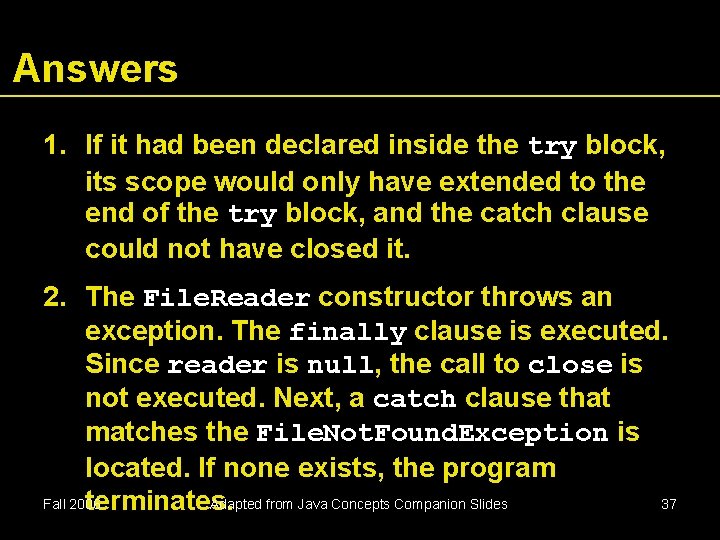
Answers 1. If it had been declared inside the try block, its scope would only have extended to the end of the try block, and the catch clause could not have closed it. 2. The File. Reader constructor throws an exception. The finally clause is executed. Since reader is null, the call to close is not executed. Next, a catch clause that matches the File. Not. Found. Exception is located. If none exists, the program Fall 2006 Adapted from Java Concepts Companion Slides 37 terminates.
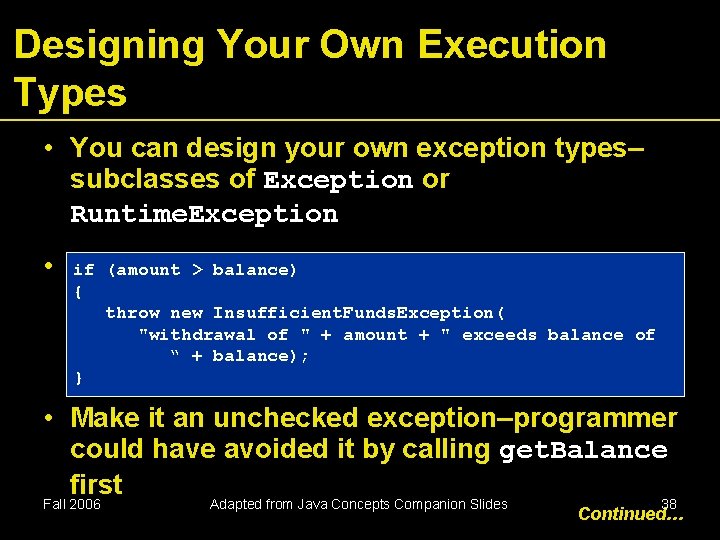
Designing Your Own Execution Types • You can design your own exception types– subclasses of Exception or Runtime. Exception • if (amount > balance) { throw new Insufficient. Funds. Exception( "withdrawal of " + amount + " exceeds balance of “ + balance); } • Make it an unchecked exception–programmer could have avoided it by calling get. Balance first Fall 2006 Adapted from Java Concepts Companion Slides 38 Continued…
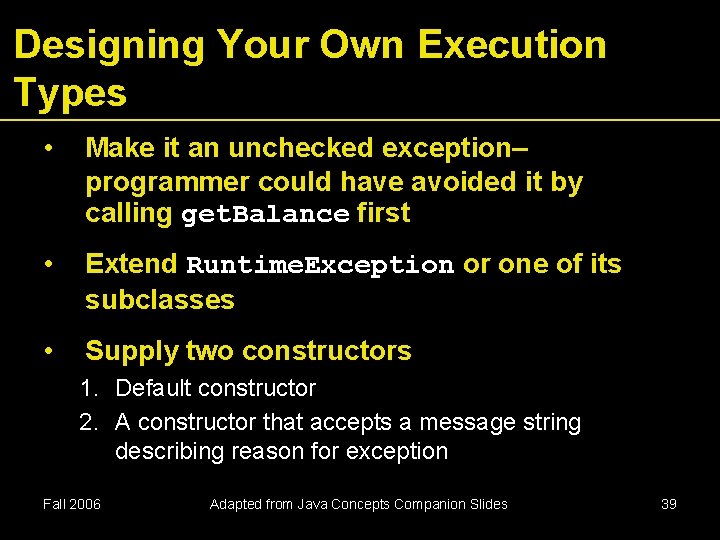
Designing Your Own Execution Types • Make it an unchecked exception– programmer could have avoided it by calling get. Balance first • Extend Runtime. Exception or one of its subclasses • Supply two constructors 1. Default constructor 2. A constructor that accepts a message string describing reason for exception Fall 2006 Adapted from Java Concepts Companion Slides 39
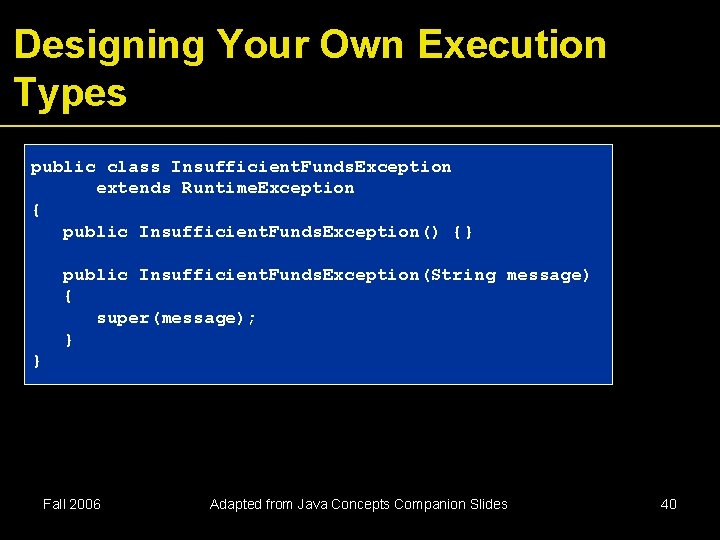
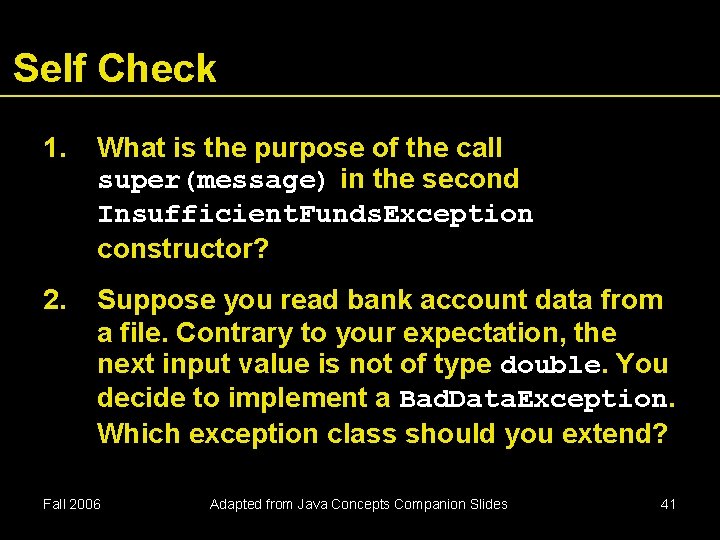
Designing Your Own Execution Types public class Insufficient. Funds. Exception extends Runtime. Exception { public Insufficient. Funds. Exception() {} public Insufficient. Funds. Exception(String message) { super(message); } } Fall 2006 Adapted from Java Concepts Companion Slides 40
Self Check 1. What is the purpose of the call super(message) in the second Insufficient. Funds. Exception constructor? 2. Suppose you read bank account data from a file. Contrary to your expectation, the next input value is not of type double. You decide to implement a Bad. Data. Exception. Which exception class should you extend? Fall 2006 Adapted from Java Concepts Companion Slides 41
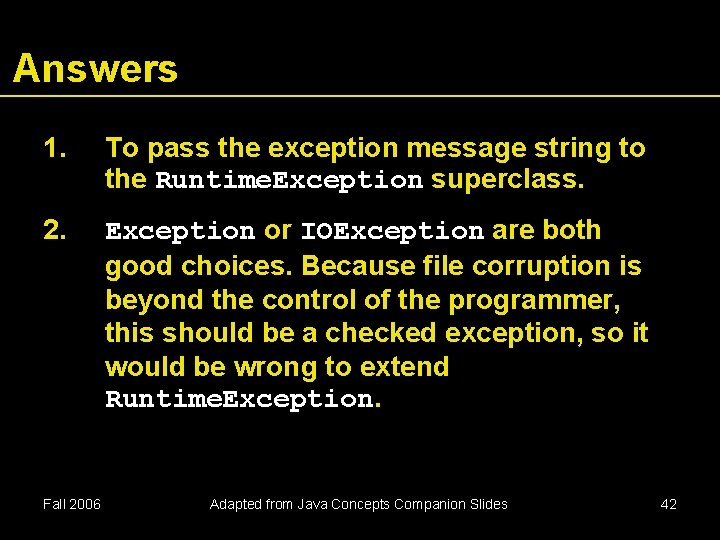
Answers 1. To pass the exception message string to the Runtime. Exception superclass. 2. Exception or IOException are both good choices. Because file corruption is beyond the control of the programmer, this should be a checked exception, so it would be wrong to extend Runtime. Exception. Fall 2006 Adapted from Java Concepts Companion Slides 42
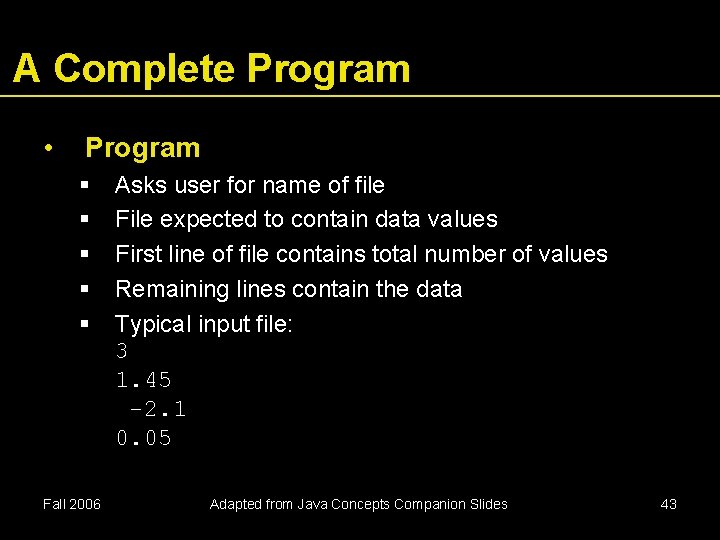
A Complete Program • Program Fall 2006 Asks user for name of file File expected to contain data values First line of file contains total number of values Remaining lines contain the data Typical input file: 3 1. 45 -2. 1 0. 05 Adapted from Java Concepts Companion Slides 43
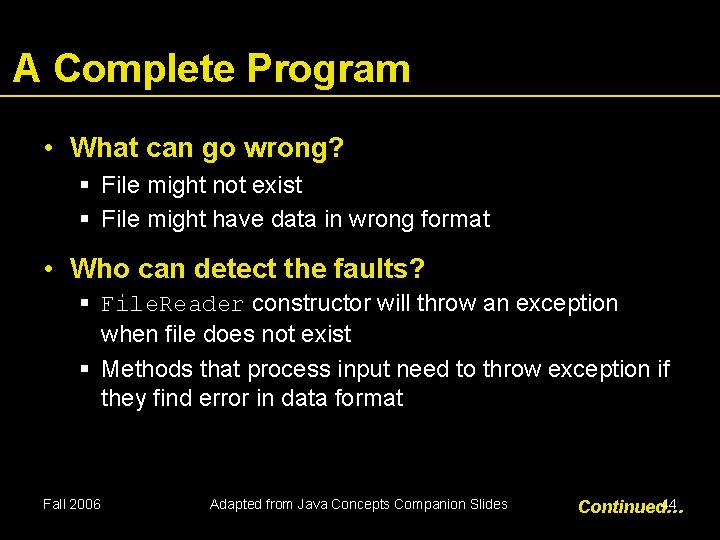
A Complete Program • What can go wrong? File might not exist File might have data in wrong format • Who can detect the faults? File. Reader constructor will throw an exception when file does not exist Methods that process input need to throw exception if they find error in data format Fall 2006 Adapted from Java Concepts Companion Slides 44 Continued…
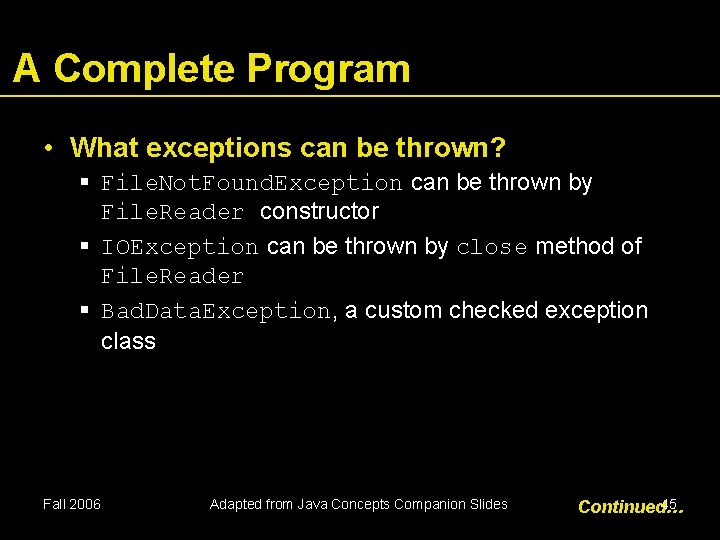
A Complete Program • What exceptions can be thrown? File. Not. Found. Exception can be thrown by File. Reader constructor IOException can be thrown by close method of File. Reader Bad. Data. Exception, a custom checked exception class Fall 2006 Adapted from Java Concepts Companion Slides 45 Continued…
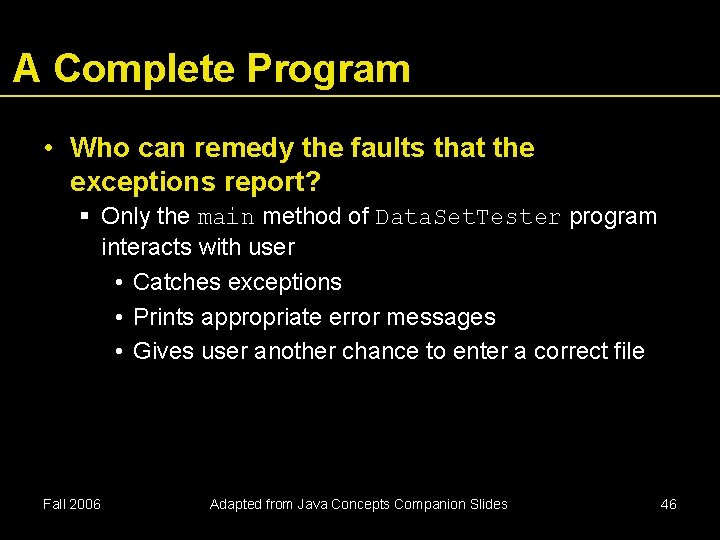
A Complete Program • Who can remedy the faults that the exceptions report? Only the main method of Data. Set. Tester program interacts with user • Catches exceptions • Prints appropriate error messages • Gives user another chance to enter a correct file Fall 2006 Adapted from Java Concepts Companion Slides 46
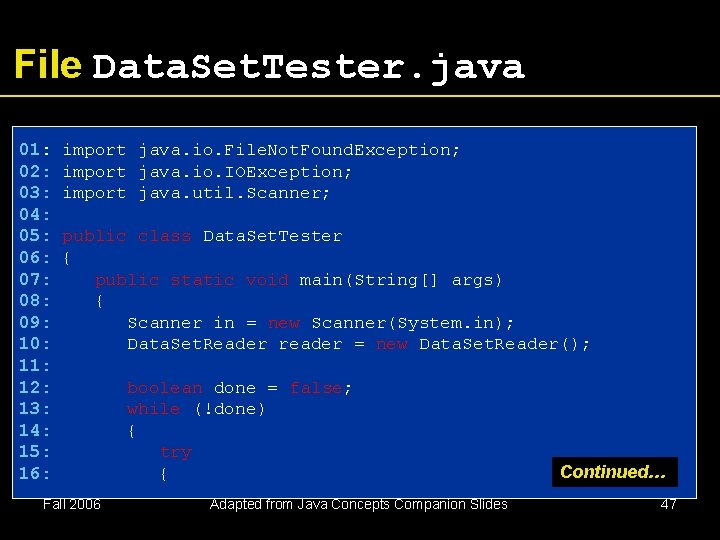
File Data. Set. Tester. java 01: 02: 03: 04: 05: 06: 07: 08: 09: 10: 11: 12: 13: 14: 15: 16: import java. io. File. Not. Found. Exception; import java. io. IOException; import java. util. Scanner; public class Data. Set. Tester { public static void main(String[] args) { Scanner in = new Scanner(System. in); Data. Set. Reader reader = new Data. Set. Reader(); Fall 2006 boolean done = false; while (!done) { try { Adapted from Java Concepts Companion Slides Continued… 47
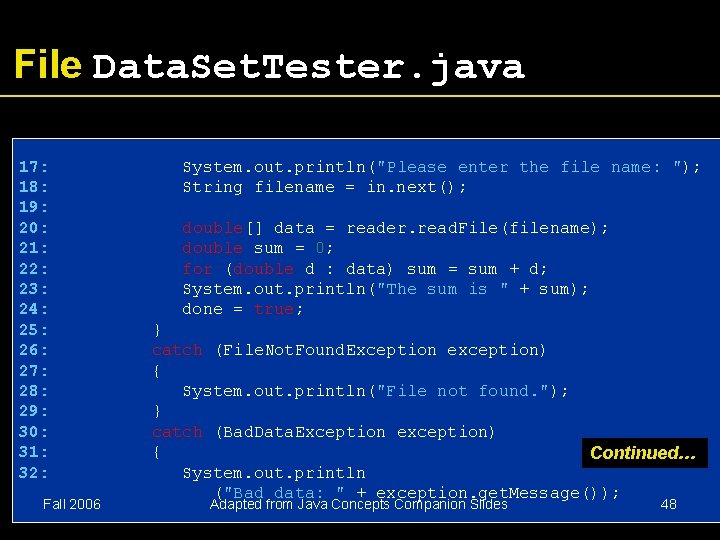
File Data. Set. Tester. java 17: 18: 19: 20: 21: 22: 23: 24: 25: 26: 27: 28: 29: 30: 31: 32: Fall 2006 System. out. println("Please enter the file name: "); String filename = in. next(); double[] data = reader. read. File(filename); double sum = 0; for (double d : data) sum = sum + d; System. out. println("The sum is " + sum); done = true; } catch (File. Not. Found. Exception exception) { System. out. println("File not found. "); } catch (Bad. Data. Exception exception) { Continued… System. out. println ("Bad data: " + exception. get. Message()); Adapted from Java Concepts Companion Slides 48
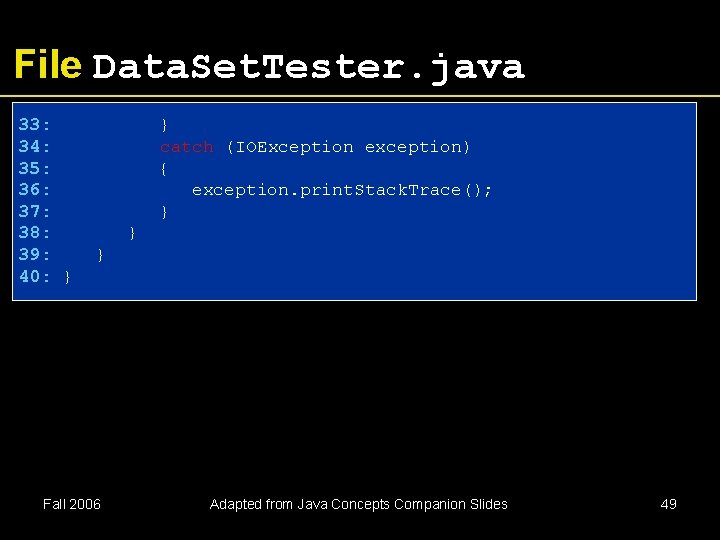
File Data. Set. Tester. java 33: 34: 35: 36: 37: 38: 39: 40: } } catch (IOException exception) { exception. print. Stack. Trace(); } } } Fall 2006 Adapted from Java Concepts Companion Slides 49
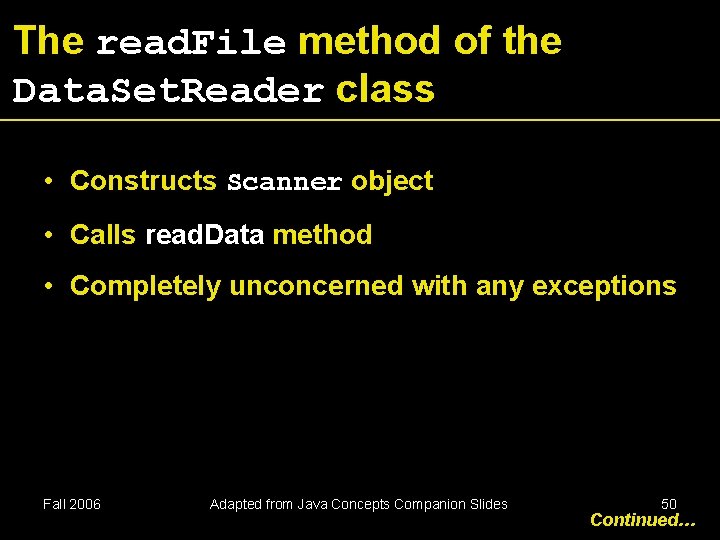
The read. File method of the Data. Set. Reader class • Constructs Scanner object • Calls read. Data method • Completely unconcerned with any exceptions Fall 2006 Adapted from Java Concepts Companion Slides 50 Continued…
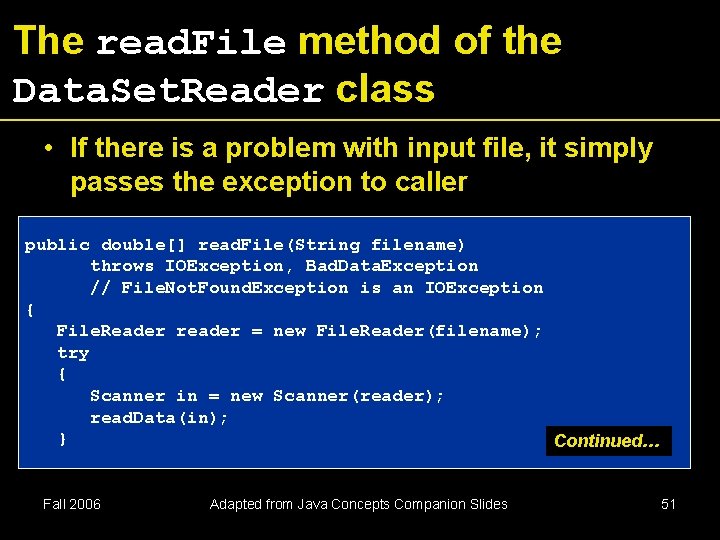
The read. File method of the Data. Set. Reader class • If there is a problem with input file, it simply passes the exception to caller public double[] read. File(String filename) throws IOException, Bad. Data. Exception // File. Not. Found. Exception is an IOException { File. Reader reader = new File. Reader(filename); try { Scanner in = new Scanner(reader); read. Data(in); } Continued… Fall 2006 Adapted from Java Concepts Companion Slides 51
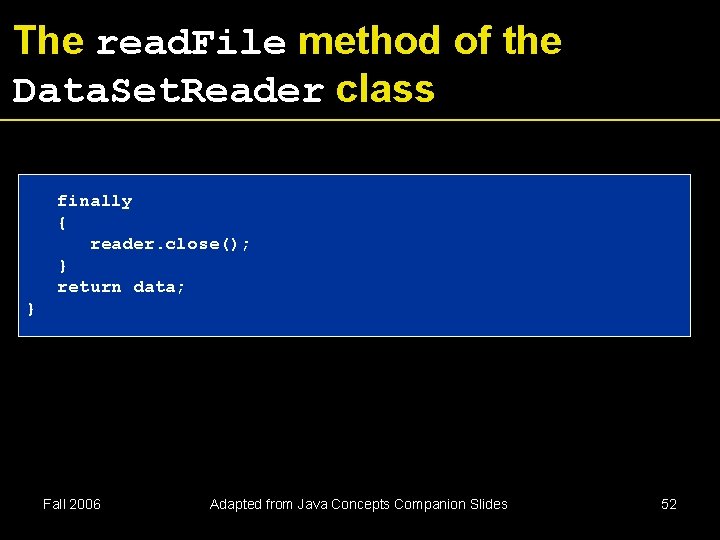
The read. File method of the Data. Set. Reader class finally { reader. close(); } return data; } Fall 2006 Adapted from Java Concepts Companion Slides 52
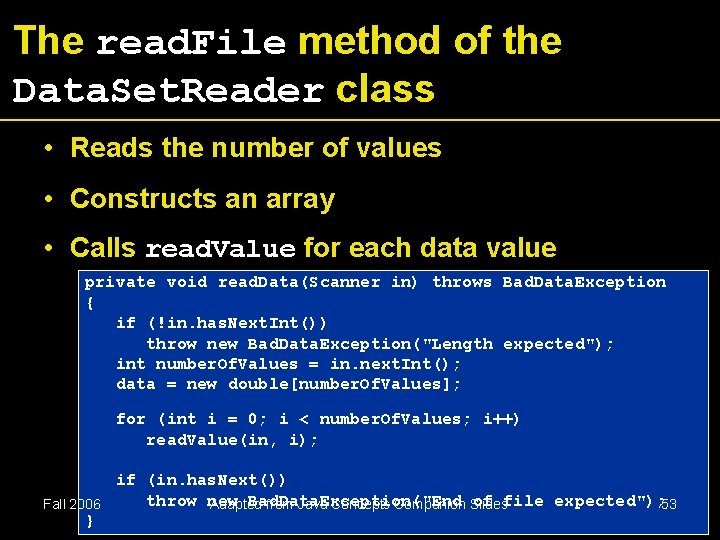
The read. File method of the Data. Set. Reader class • Reads the number of values • Constructs an array • Calls read. Value for each data value private void read. Data(Scanner in) throws Bad. Data. Exception { if (!in. has. Next. Int()) throw new Bad. Data. Exception("Length expected"); int number. Of. Values = in. next. Int(); data = new double[number. Of. Values]; for (int i = 0; i < number. Of. Values; i++) read. Value(in, i); if (in. has. Next()) throw new Bad. Data. Exception("End of file expected"); 53 Fall 2006 Adapted from Java Concepts Companion Slides }
The read. File method of the Data. Set. Reader class • Checks for two potential errors 1. File might not start with an integer 2. File might have additional data after reading all values • Makes no attempt to catch any exceptions Fall 2006 Adapted from Java Concepts Companion Slides 54
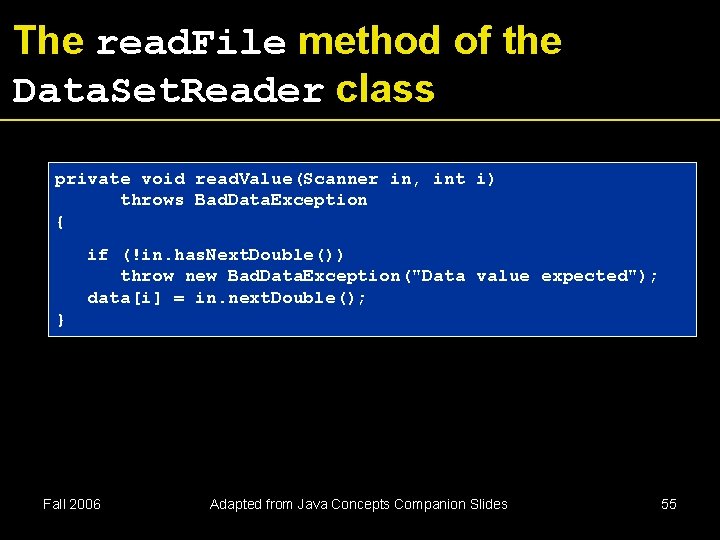
The read. File method of the Data. Set. Reader class private void read. Value(Scanner in, int i) throws Bad. Data. Exception { if (!in. has. Next. Double()) throw new Bad. Data. Exception("Data value expected"); data[i] = in. next. Double(); } Fall 2006 Adapted from Java Concepts Companion Slides 55
Scenario 1. Data. Set. Tester. main calls Data. Set. Reader. read. File 2. read. File calls read. Data 3. read. Data calls read. Value 4. read. Value doesn't find expected value and throws Bad. Data. Exception 5. read. Value has no handler for exception and terminates Fall 2006 Adapted from Java Concepts Companion Slides 56 Continued…
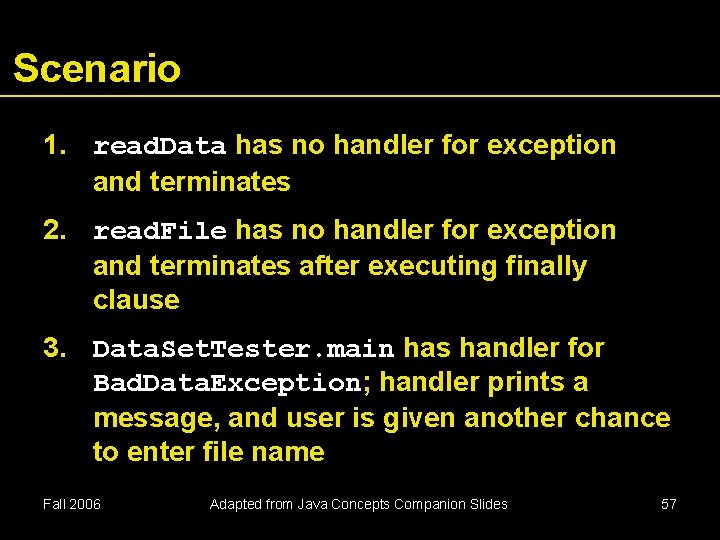
Scenario 1. read. Data has no handler for exception and terminates 2. read. File has no handler for exception and terminates after executing finally clause 3. Data. Set. Tester. main has handler for Bad. Data. Exception; handler prints a message, and user is given another chance to enter file name Fall 2006 Adapted from Java Concepts Companion Slides 57
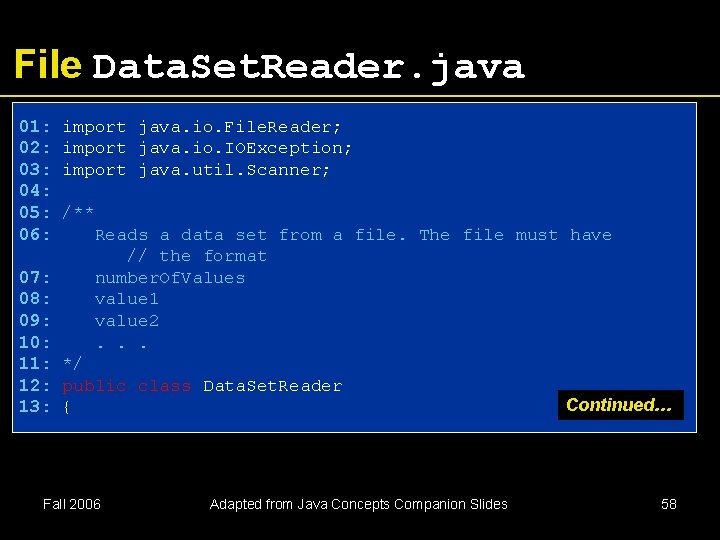
File Data. Set. Reader. java 01: 02: 03: 04: 05: 06: import java. io. File. Reader; import java. io. IOException; import java. util. Scanner; /** Reads a data set from a file. The file must have // the format number. Of. Values value 1 value 2. . . 07: 08: 09: 10: 11: */ 12: public class Data. Set. Reader 13: { Fall 2006 Adapted from Java Concepts Companion Slides Continued… 58
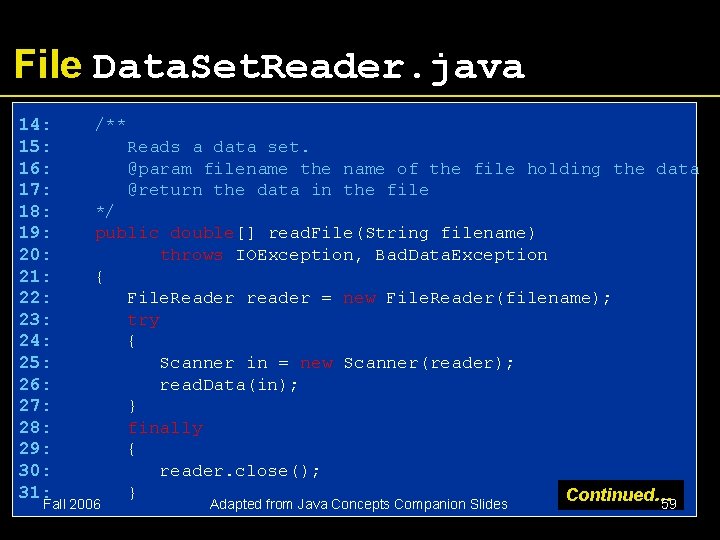
File Data. Set. Reader. java 14: 15: 16: 17: 18: 19: 20: 21: 22: 23: 24: 25: 26: 27: 28: 29: 30: 31: /** Reads a data set. @param filename the name of the file holding the data @return the data in the file */ public double[] read. File(String filename) throws IOException, Bad. Data. Exception { File. Reader reader = new File. Reader(filename); try { Scanner in = new Scanner(reader); read. Data(in); } finally { reader. close(); } Continued… Fall 2006 Adapted from Java Concepts Companion Slides 59
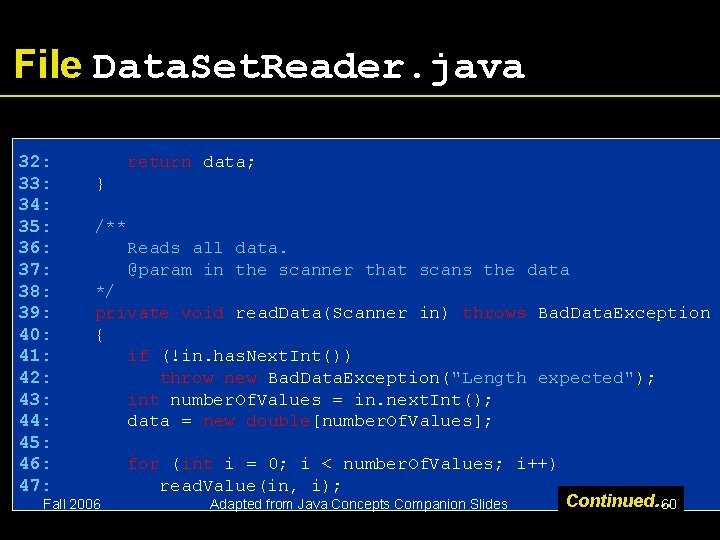
File Data. Set. Reader. java 32: 33: 34: 35: 36: 37: 38: 39: 40: 41: 42: 43: 44: 45: 46: 47: return data; } /** Reads all data. @param in the scanner that scans the data */ private void read. Data(Scanner in) throws Bad. Data. Exception { if (!in. has. Next. Int()) throw new Bad. Data. Exception("Length expected"); int number. Of. Values = in. next. Int(); data = new double[number. Of. Values]; Fall 2006 for (int i = 0; i < number. Of. Values; i++) read. Value(in, i); Adapted from Java Concepts Companion Slides Continued… 60
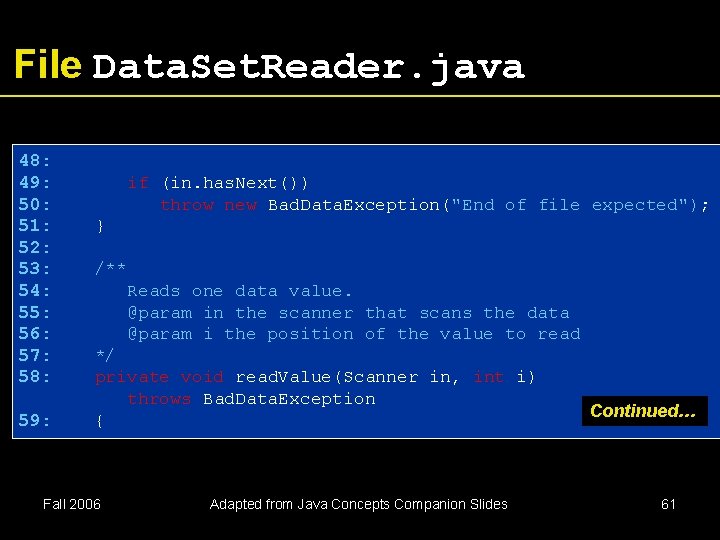
File Data. Set. Reader. java 48: 49: 50: 51: 52: 53: 54: 55: 56: 57: 58: 59: if (in. has. Next()) throw new Bad. Data. Exception("End of file expected"); } /** Reads one data value. @param in the scanner that scans the data @param i the position of the value to read */ private void read. Value(Scanner in, int i) throws Bad. Data. Exception { Fall 2006 Adapted from Java Concepts Companion Slides Continued… 61
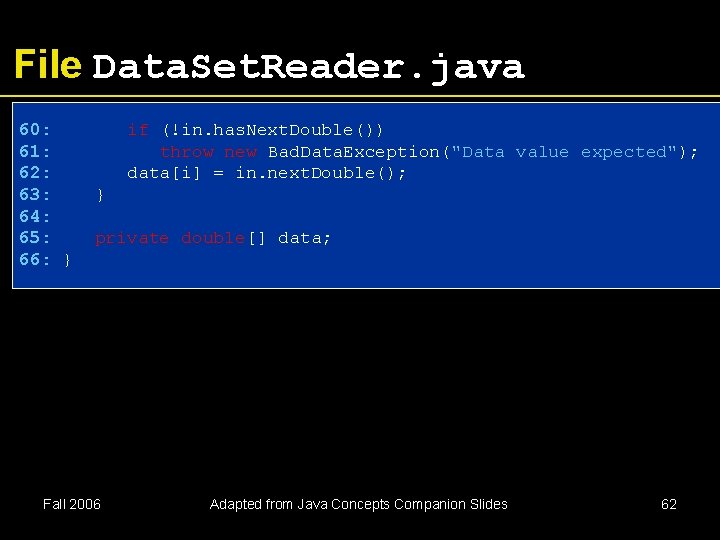
File Data. Set. Reader. java 60: 61: 62: 63: 64: 65: 66: } if (!in. has. Next. Double()) throw new Bad. Data. Exception("Data value expected"); data[i] = in. next. Double(); } private double[] data; Fall 2006 Adapted from Java Concepts Companion Slides 62
Self Check 1. Why doesn't the Data. Set. Reader. read. File method catch any exceptions? 2. Suppose the user specifies a file that exists and is empty. Trace the flow of execution. Fall 2006 Adapted from Java Concepts Companion Slides 63
Answers 1. It would not be able to do much with them. The Data. Set. Reader class is a reusable class that may be used for systems with different languages and different user interfaces. Thus, it cannot engage in a dialog with the program user. Fall 2006 Adapted from Java Concepts Companion Slides Continued… 64
Answers 2. Fall 2006 Data. Set. Tester. main calls Data. Set. Reader. read. File, which calls read. Data. The call in. has. Next. Int() returns false, and read. Data throws a Bad. Data. Exception. The read. File method doesn't catch it, so it propagates back to main, where it is caught. Adapted from Java Concepts Companion Slides 65