
Excellence for All The International Baccalaureate Diploma Program
Excellence for All: The International Baccalaureate Diploma Program 4 October 2011 Page 1
Education ‘fit for purpose’ for the 21 st century life and work, in an interconnected, globalized world will require active use of critical thinking skills and a sense of international-mindedness, skills and habits of mind learned and understood by International Baccalaureate (IB) Diploma students
The IB Difference The IB provides: • A continuum of education • A high-quality education sustained for over 40 years • An international perspective for all students • A positive attitude to learning by encouraging students to ask challenging questions, to critically reflect and to develop research skills • Accessibility to our programmes to students in a wide variety of schools: national, international, public and private, urban and rural. Page 3
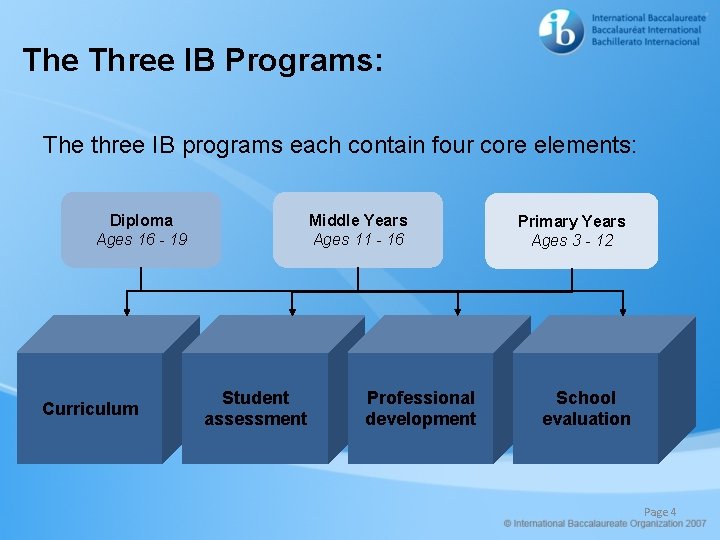
The Three IB Programs: The three IB programs each contain four core elements: Diploma Ages 16 - 19 Curriculum Middle Years Ages 11 - 16 Student assessment Professional development Primary Years Ages 3 - 12 School evaluation Page 4
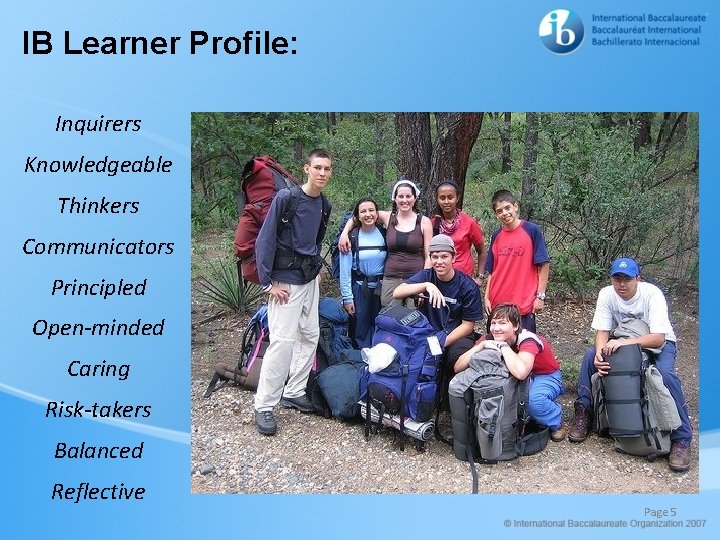
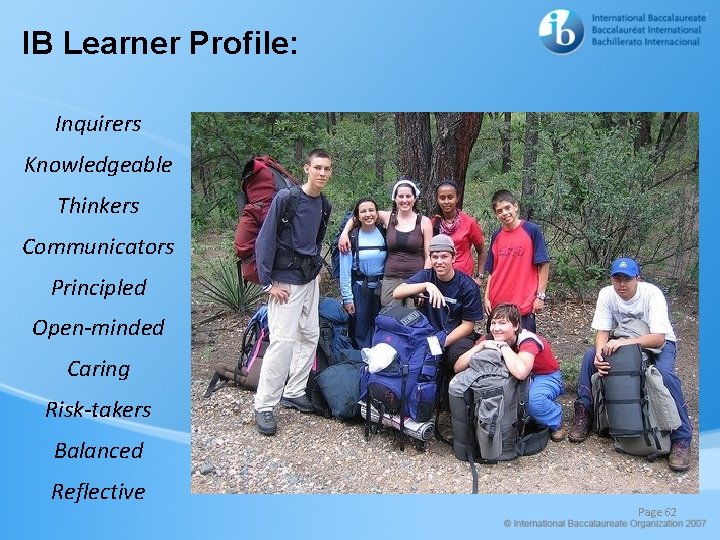
IB Learner Profile: Inquirers Knowledgeable Thinkers Communicators Principled Open-minded Caring Risk-takers Balanced Reflective Page 5
Diploma Programme prepares students from diverse backgrounds for success in university and life in the 21 stcentury. • There are currently 3, 291 schools and 969, 000 students in the IB community, representing 141 countries. • Nearly 60% of these IB Programmes are in public or state-funded schools. In the US, over 90% of the programmes are in public. • By the year 2020, there will be more than 12, 000 schools offering IB Programmes. • By the year 2020, there will be 250, 000 IB students in the Diploma program alone taking 1 million exams each year.
The International Baccalaureate Diploma • • © IBO Pre-university Diploma Based on an integrated curriculum International admissions credential Utilizes international standards External board examinations and assessments Students are college ready Students are prepared to live in, to compete successfully in, and to lead in an increasingly interdependent world
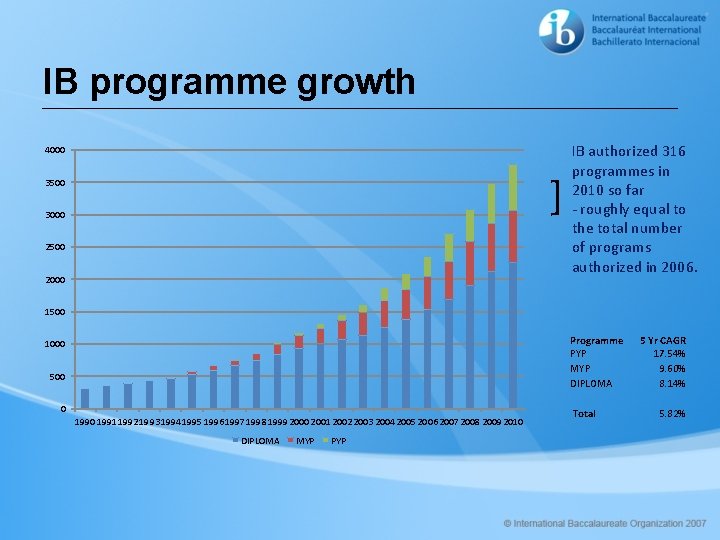
IB programme growth IB authorized 316 programmes in 2010 so far - roughly equal to the total number of programs authorized in 2006. 4000 3500 3000 2500 2000 1500 Programme PYP MYP DIPLOMA 1000 500 0 1991 1992 1993 1994 1995 1996 1997 1998 1999 2000 2001 2002 2003 2004 2005 2006 2007 2008 2009 2010 DIPLOMA MYP PYP Total 5 Yr CAGR 17. 54% 9. 60% 8. 14% 5. 82%
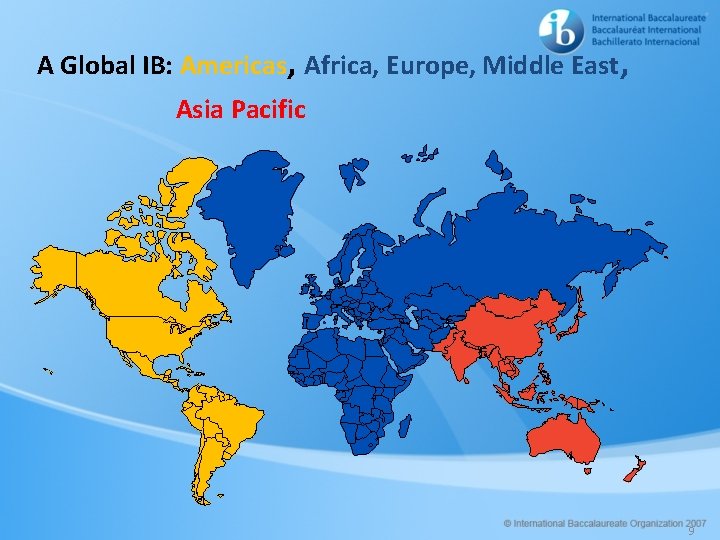
A Global IB: Americas, Africa, Europe, Middle East, Asia Pacific 9
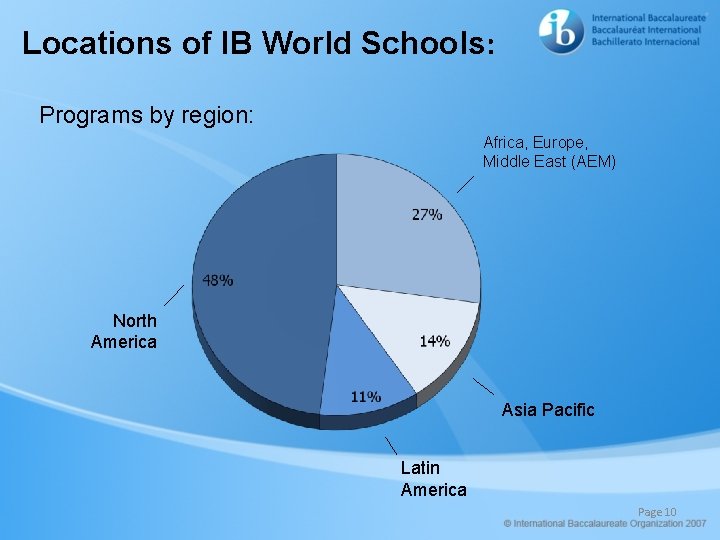
Locations of IB World Schools: Programs by region: Africa, Europe, Middle East (AEM) North America Asia Pacific Latin America Page 10
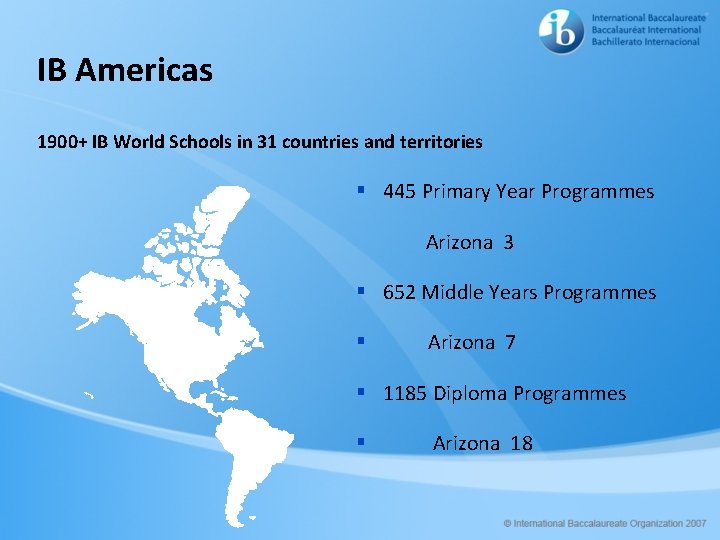
IB Americas 1900+ IB World Schools in 31 countries and territories § 445 Primary Year Programmes Arizona 3 § 652 Middle Years Programmes § Arizona 7 § 1185 Diploma Programmes § Arizona 18
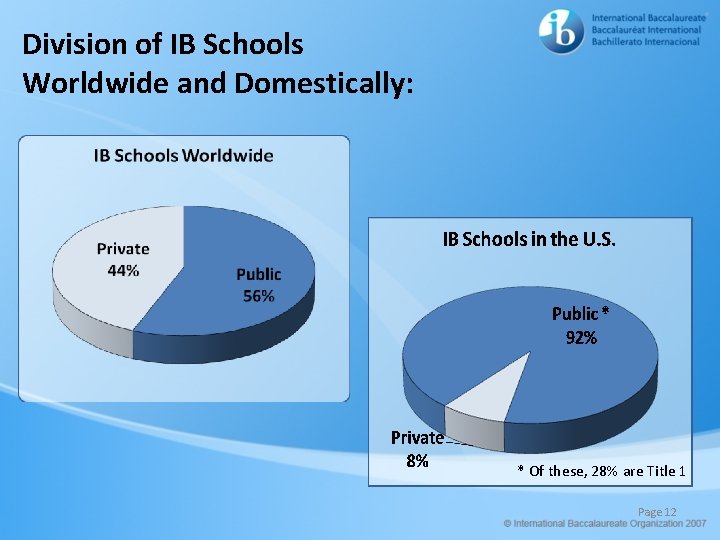
Division of IB Schools Worldwide and Domestically: * Of these, 28% are Title 1 Page 12
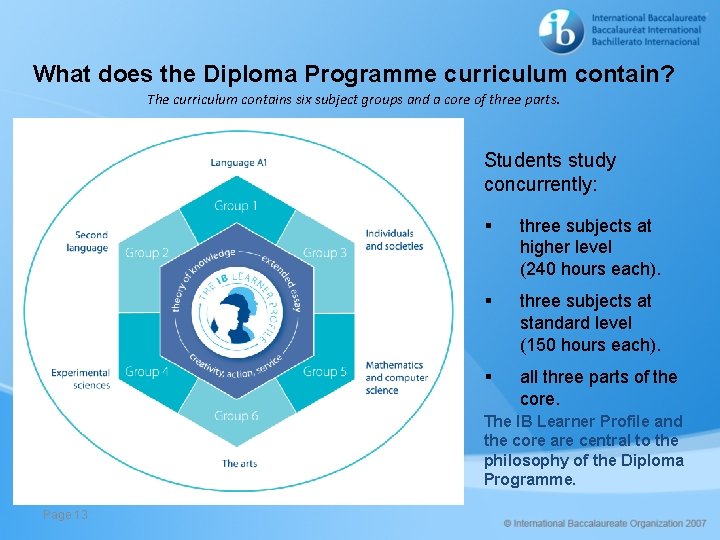
What does the Diploma Programme curriculum contain? The curriculum contains six subject groups and a core of three parts. Students study concurrently: § three subjects at higher level (240 hours each). § three subjects at standard level (150 hours each). § all three parts of the core. The IB Learner Profile and the core are central to the philosophy of the Diploma Programme. Page 13
What subjects are offered within the six groups? The Diploma Programme has a large range of subjects and many more options • Group 1 - 46 languages are regularly available for Literature and Language& literature • Group 2 – 25 or more modern and classical languages for all abilities from complete beginner (ab initio), with some experience (language B) Page 14 • Group 3 - business and management, economics, geography, history, information technology in a global society, Islamic history, philosophy, psychology, social and cultural anthropology, environmental systems & societies. • Group 4 - biology, chemistry, design technology, environmental systems & societies, physics. • Group 5 - mathematical studies SL, mathematics, further mathematics SL, computer science. • Group 6 - music, theatre, visual arts, film, dance, literature and performance
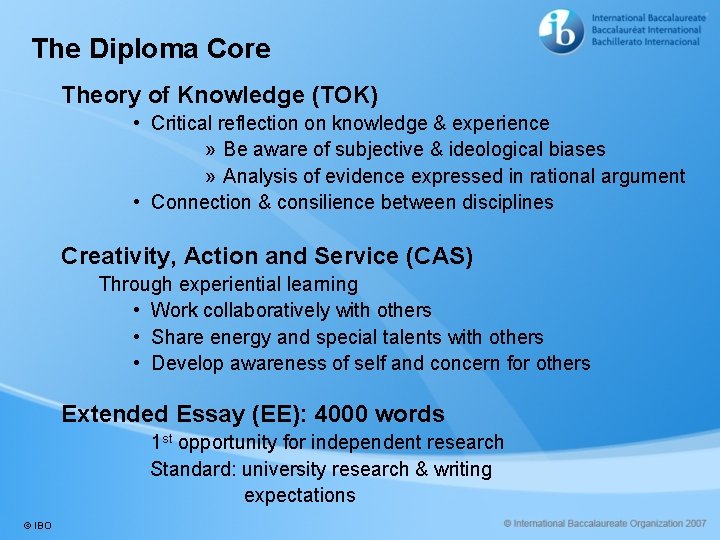
The Diploma Core Theory of Knowledge (TOK) • Critical reflection on knowledge & experience » Be aware of subjective & ideological biases » Analysis of evidence expressed in rational argument • Connection & consilience between disciplines Creativity, Action and Service (CAS) Through experiential learning • Work collaboratively with others • Share energy and special talents with others • Develop awareness of self and concern for others Extended Essay (EE): 4000 words 1 st opportunity for independent research Standard: university research & writing expectations © IBO
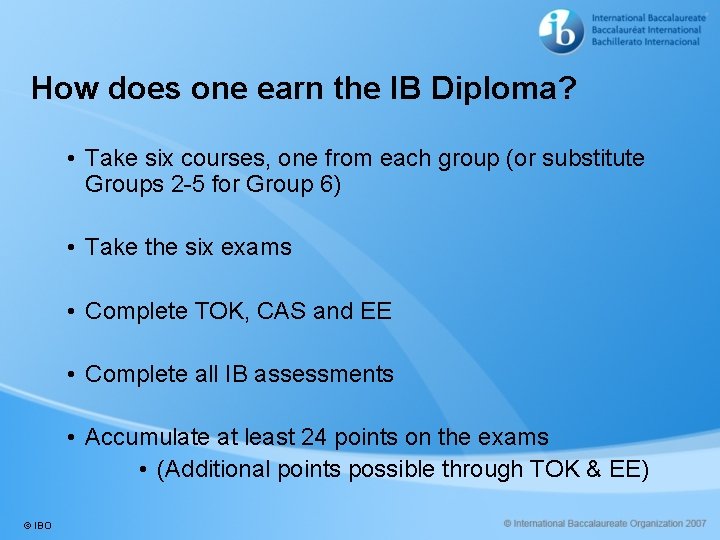
How does one earn the IB Diploma? • Take six courses, one from each group (or substitute Groups 2 -5 for Group 6) • Take the six exams • Complete TOK, CAS and EE • Complete all IB assessments • Accumulate at least 24 points on the exams • (Additional points possible through TOK & EE) © IBO
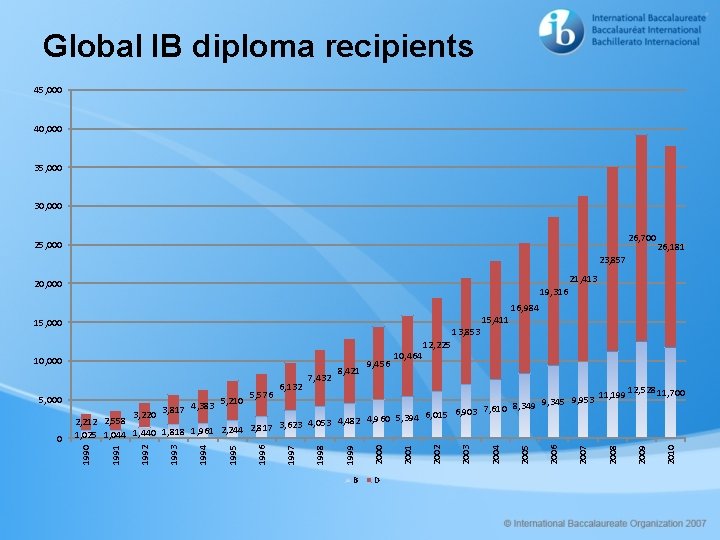
Global IB diploma recipients 45, 000 40, 000 35, 000 30, 000 26, 700 25, 000 26, 181 23, 857 21, 413 20, 000 19, 316 15, 000 13, 853 D 2008 2007 2006 2005 2004 2003 2002 2001 2000 1998 1999 B 12, 528 11, 700 2010 6, 132 1997 1996 1995 1994 1993 1992 1991 0 5, 576 8, 421 10, 464 12, 225 11, 199 9, 345 9, 953 8, 349 4, 383 7, 610 3, 817 3, 220 6, 015 6, 903 4, 482 4, 960 5, 394 2, 212 2, 558 4, 053 3, 623 2, 817 1, 025 1, 044 1, 440 1, 818 1, 961 2, 244 5, 210 1990 5, 000 7, 432 9, 456 16, 984 2009 10, 000 15, 411
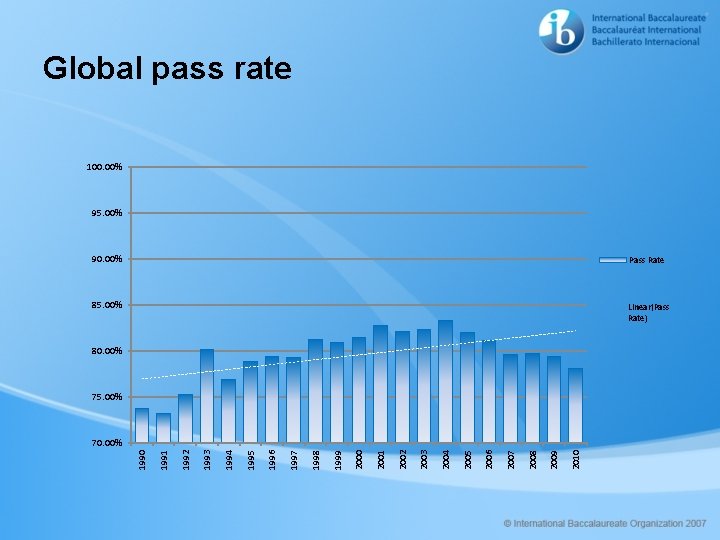
Global pass rate 100. 00% 95. 00% 90. 00% Pass Rate 85. 00% Linear(Pass Rate) 80. 00% 75. 00% 2010 2009 2008 2007 2006 2005 2004 2003 2002 2001 2000 1999 1998 1997 1996 1995 1994 1993 1992 1991 1990 70. 00%
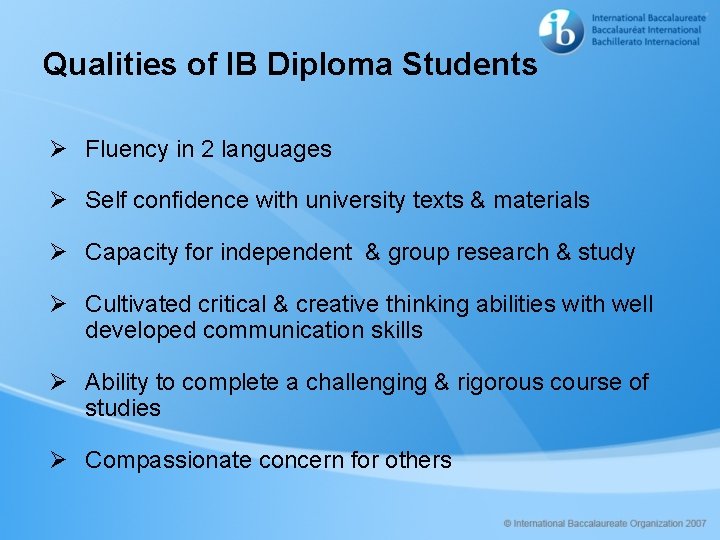
Qualities of IB Diploma Students Ø Fluency in 2 languages Ø Self confidence with university texts & materials Ø Capacity for independent & group research & study Ø Cultivated critical & creative thinking abilities with well developed communication skills Ø Ability to complete a challenging & rigorous course of studies Ø Compassionate concern for others
Curriculum And Assessment Page 20
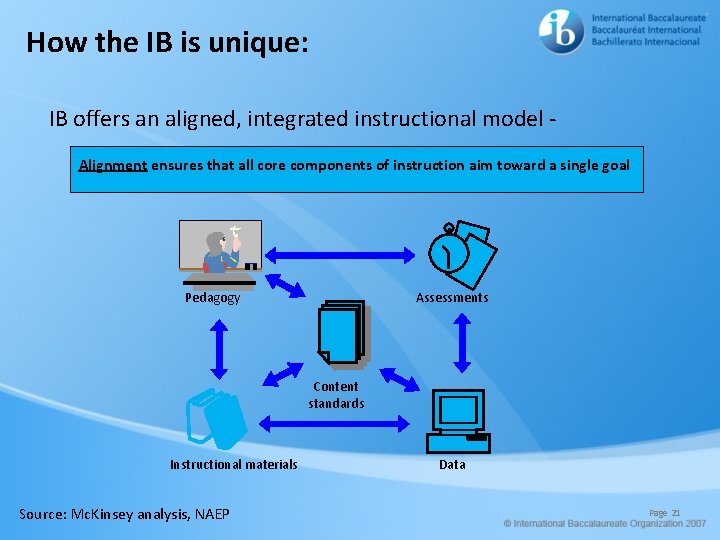
How the IB is unique: IB offers an aligned, integrated instructional model Alignment ensures that all core components of instruction aim toward a single goal Pedagogy Assessments Content standards Instructional materials Source: Mc. Kinsey analysis, NAEP Data Page 21
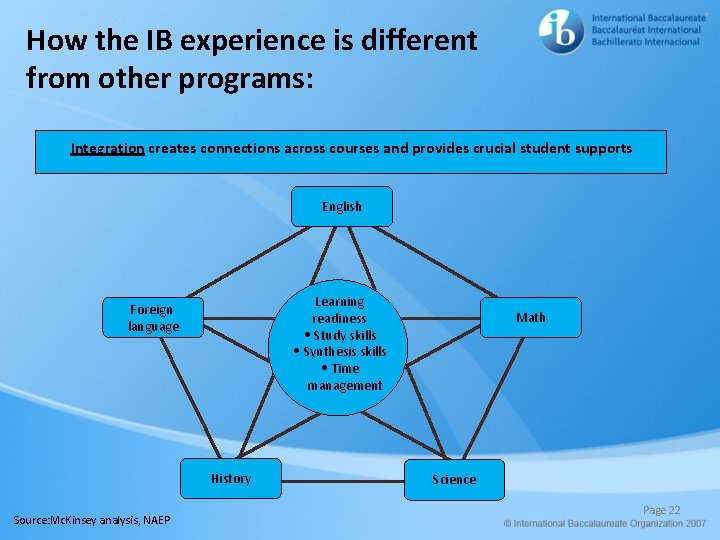
How the IB experience is different from other programs: Integration creates connections across courses and provides crucial student supports English Learning readiness • Study skills • Synthesis skills • Time management Foreign language History Source: Mc. Kinsey analysis, NAEP Math Science Page 22
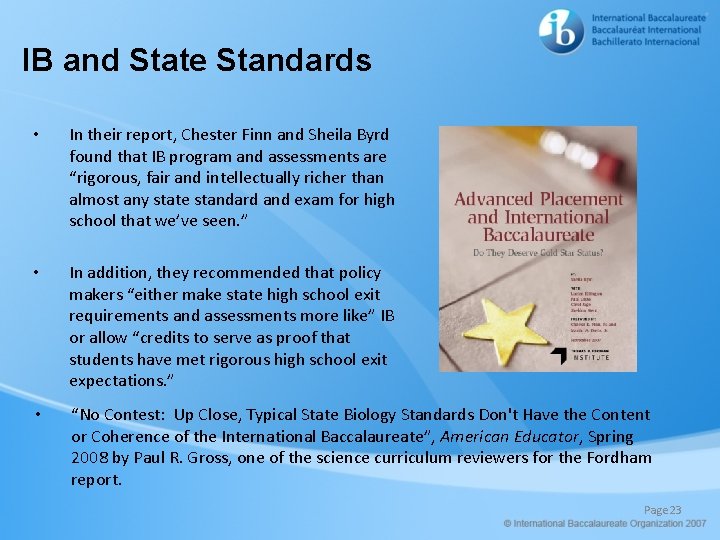
IB and State Standards • In their report, Chester Finn and Sheila Byrd found that IB program and assessments are “rigorous, fair and intellectually richer than almost any state standard and exam for high school that we’ve seen. ” • In addition, they recommended that policy makers “either make state high school exit requirements and assessments more like” IB or allow “credits to serve as proof that students have met rigorous high school exit expectations. ” • “No Contest: Up Close, Typical State Biology Standards Don't Have the Content or Coherence of the International Baccalaureate”, American Educator, Spring 2008 by Paul R. Gross, one of the science curriculum reviewers for the Fordham report. Page 23
IB Standards and College Readiness Conley (EPIC) Alignment Study • Develop and define academic content standards for the IB Diploma Program • Align IB’s academic content standards with the Knowledge and Skills for University Success (KSUS) • Align the IB standards with several states Copyright 2010. All rights reserved. For use within the IB school community. No material from this slide may be used for any commercial gain.
EPIC findings The conclusion of the studies undertaken for this project is that students who are exposed to the IB curriculum are learning material that is highly aligned with the expectations of university faculty and that in many cases IB standards exceed those expectations. Source: International Baccalaureate Standards Development and Alignment Project: Final Report, 2009
EPIC findings: new phase EPIC–in consultation with IB–is now using the new IB standards for additional alignment work with educational standards in four states and one Canadian province. As part of this new phase, EPIC is developing an online alignment tool that will allow IB to carry forward the work after this initial alignment with the states and province. Source: https: //www. epiconline. org/ib
IB and Common Core IB standards and Common Core standards are currently being compared by David Conley and the Educational Policy Improvement Center (EPIC). The analysis is expected to report alignment with and extension beyond Common Core standards. A preliminary report is anticipated shortly. Page 27
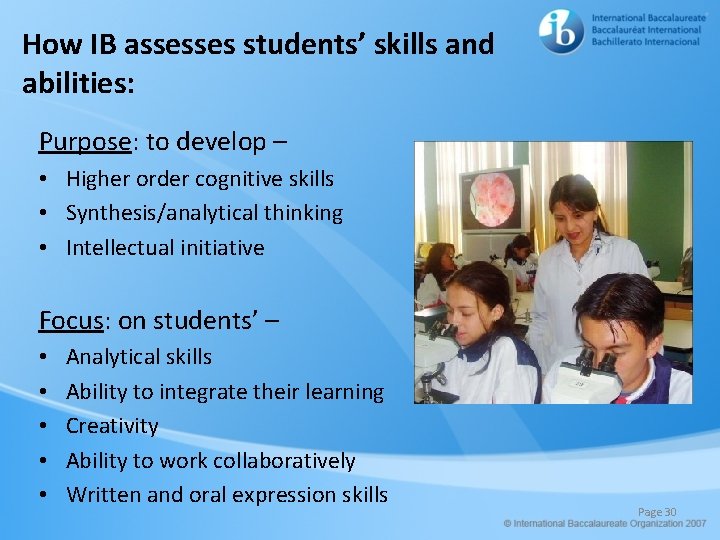
How IB assesses students’ skills and abilities: Purpose: to develop – • Higher order cognitive skills • Synthesis/analytical thinking • Intellectual initiative Focus: on students’ – • • • Analytical skills Ability to integrate their learning Creativity Ability to work collaboratively Written and oral expression skills Page 30
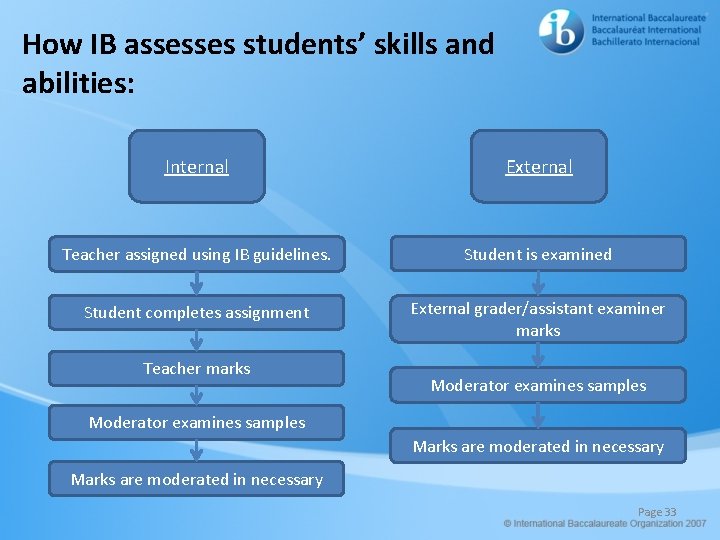
How IB assesses students’ skills and abilities: Internal External Teacher assigned using IB guidelines. Student is examined Student completes assignment External grader/assistant examiner marks Teacher marks Moderator examines samples Marks are moderated in necessary Page 33
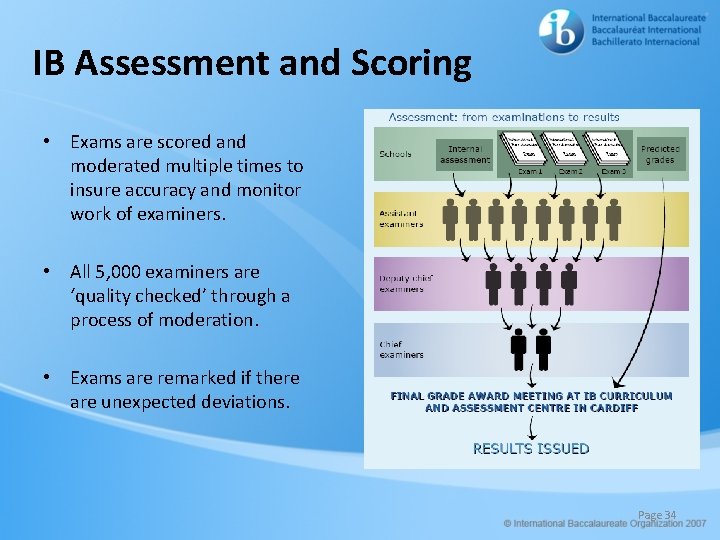
IB Assessment and Scoring • Exams are scored and moderated multiple times to insure accuracy and monitor work of examiners. • All 5, 000 examiners are ‘quality checked’ through a process of moderation. • Exams are remarked if there are unexpected deviations. Page 34
Special Educational Needs Support Page 35
IB and special educational needs IB embraces inclusive practices where developing the learning of all students is the shared responsibility of the classroom teacher and specialist support teachers. IB acknowledges the issues this commitment raises for teachers within all three programmes and provide the following: • A full-time SEN manager • Development of publications and resources for administrators and teachers • Continuous regional workshops to address specific needs in particular areas. Page 36
IB and special educational needs The SEN manager acts as a clear point of reference for administrators and teachers on a number of issues, including: • Personal and direct contact to discuss sensitive issues related to individual students' needs in all three programme • Administrative queries related to the granting of special arrangements for the examination sessions in the Diploma Programme • Consultation on delivery, resources and the use of assistive technology by SEN students to access many aspects of each programme. Page 37
Teacher Professional Development Page 38
Who receives professional development? • • For Administrators For IB Programme Coordinators For Subject teachers Based on assessment criteria For Theory of Knowledge teachers For Counselors and career guidance For Librarians For Creativity, Action and Service Coordinators Go to http: //www. ibo. org/iba/workshops/diploma 2011. cfm for details of the workshop architecture & current workshop schedule Page 39
How IB provides professional development Travel to 3 -4 day workshops • IB Professional Development workshop offerings • IB Partner providers On-line Professional Development offerings District arranged Professional Development workshops Ongoing teacher support Page 40
What we know IB produces outstanding results for a diverse mix of students IB students are engaged, college ready, graduate on time and with higher cumulative GPA’s
IB and access for high-needs students The Diploma Program (the “DP”) stands out among other high school curricula available today in the U. S. public education system because it offers a rigorous, aligned, integrated instructional system that is both appropriate and valuable for students of average skill proficiency, and transformative for minority and low-income, i. e. , “high-needs, ” students. Source: “Understanding and Closing the IB Diploma Gap for High-Needs Students in the United States” by Mc. Kinsey for the Diploma Gap Study, September 2008 Page 42
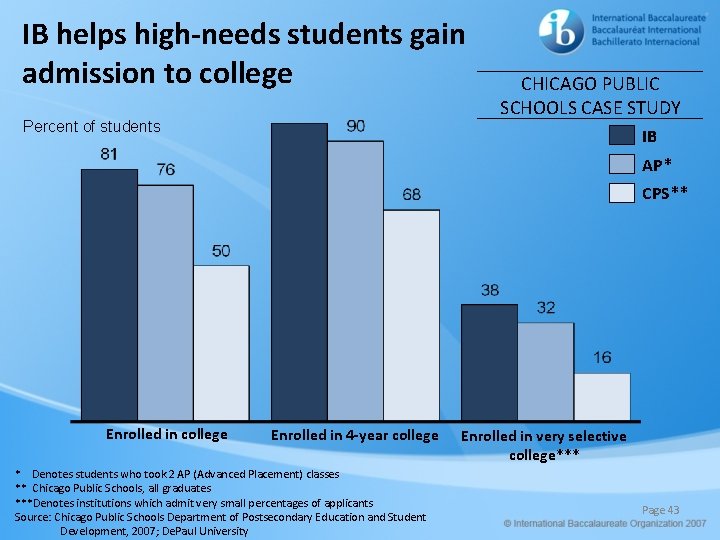
IB helps high-needs students gain admission to college Percent of students CHICAGO PUBLIC SCHOOLS CASE STUDY IB AP* CPS** Enrolled in college Enrolled in 4 -year college * Denotes students who took 2 AP (Advanced Placement) classes ** Chicago Public Schools, all graduates ***Denotes institutions which admit very small percentages of applicants Source: Chicago Public Schools Department of Postsecondary Education and Student Development, 2007; De. Paul University Enrolled in very selective college*** Page 43
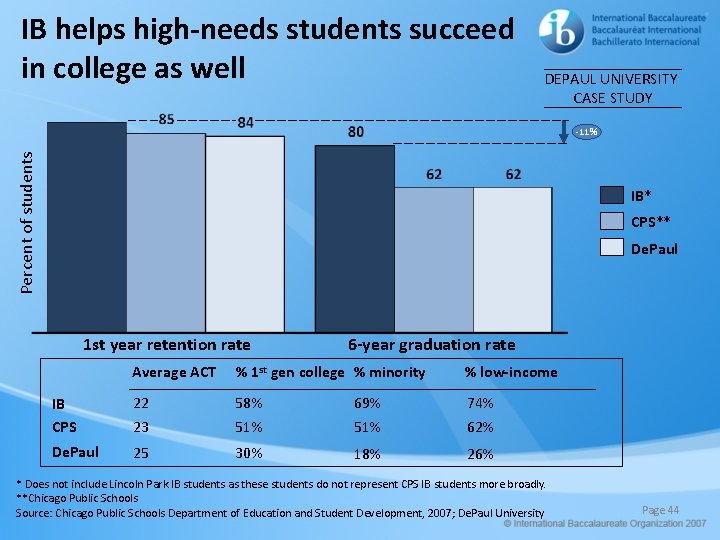
IB helps high-needs students succeed in college as well DEPAUL UNIVERSITY CASE STUDY Percent of students -11% IB* CPS** De. Paul 1 st year retention rate 6 -year graduation rate Average ACT % 1 st gen college % minority % low-income IB CPS 22 23 58% 51% 69% 51% 74% 62% De. Paul 25 30% 18% 26% * Does not include Lincoln Park IB students as these students do not represent CPS IB students more broadly. **Chicago Public Schools Source: Chicago Public Schools Department of Education and Student Development, 2007; De. Paul University Page 44
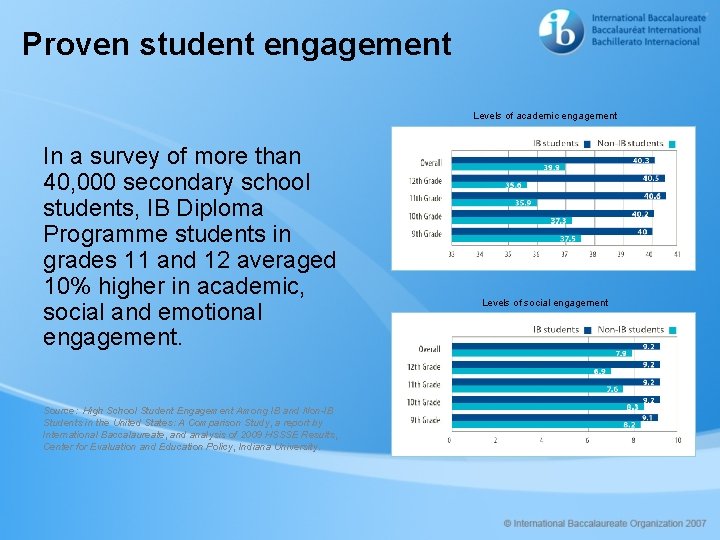
Proven student engagement Levels of academic engagement In a survey of more than 40, 000 secondary school students, IB Diploma Programme students in grades 11 and 12 averaged 10% higher in academic, social and emotional engagement. Source: High School Student Engagement Among IB and Non-IB Students in the United States: A Comparison Study, a report by International Baccalaureate, and analysis of 2009 HSSSE Results, Center for Evaluation and Education Policy, Indiana University. Levels of social engagement
Transition to University Goal Students completing the DP will have multiple options for further advanced study, and their IB experience and the strength of preparation it offers will be recognized by universities. Priorities • Recruitment, admissions and placement processes • Favorable higher education policies by governments • Scholarships, credit, advanced standing.
Post secondary outcomes Page 47
Four components for university preparedness • Key cognitive strategies: ways of thinking necessary for university-level work. • Key content knowledge: the need for students to master writing skills, algebraic concepts, key conditional content and “big ideas” from core subjects. • Academic behaviors: consist largely of study skills and selfmonitoring, e. g. , time management, awareness of one’s current level of mastery and the selection of learning strategies. • Contextual skills and awareness, or “campus knowledge”: understanding of university admissions processes, university culture, tuition and financial aid, and university-level academic expectations.
EPIC findings The conclusion of the studies undertaken for this project is that students who are exposed to the IB curriculum are learning material that is highly aligned with the expectations of university faculty and that in many cases IB standards exceed those expectations. Source: International Baccalaureate Standards Development and Alignment Project: Final Report, 2009
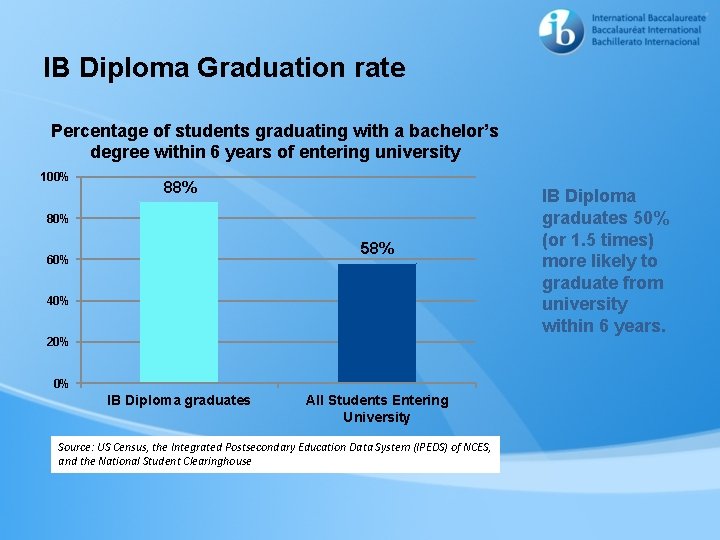
IB Diploma Graduation rate Percentage of students graduating with a bachelor’s degree within 6 years of entering university 100% 88% 80% 58% 60% 40% 20% 0% IB Diploma graduates All Students Entering University Source: US Census, the Integrated Postsecondary Education Data System (IPEDS) of NCES, and the National Student Clearinghouse IB Diploma graduates 50% (or 1. 5 times) more likely to graduate from university within 6 years.
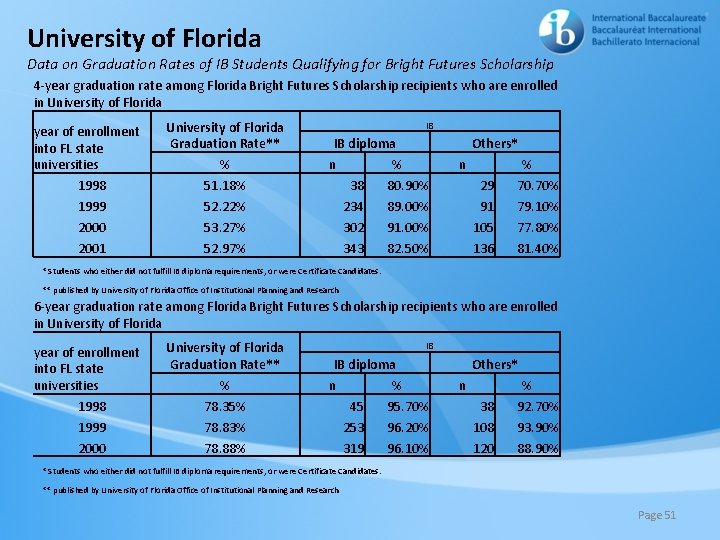
University of Florida Data on Graduation Rates of IB Students Qualifying for Bright Futures Scholarship 4 -year graduation rate among Florida Bright Futures Scholarship recipients who are enrolled in University of Florida year of enrollment into FL state universities 1998 1999 2000 2001 University of Florida Graduation Rate** % 51. 18% 52. 22% 53. 27% 52. 97% IB IB diploma n % 38 80. 90% 234 89. 00% 302 91. 00% 343 82. 50% Others* n 29 91 105 136 % 70. 70% 79. 10% 77. 80% 81. 40% * Students who either did not fulfill IB diploma requirements, or were Certificate Candidates. ** published by University of Florida Office of Institutional Planning and Research 6 -year graduation rate among Florida Bright Futures Scholarship recipients who are enrolled in University of Florida year of enrollment into FL state universities 1998 1999 2000 University of Florida Graduation Rate** % 78. 35% 78. 83% 78. 88% IB IB diploma n % 45 95. 70% 253 96. 20% 319 96. 10% Others* n 38 108 120 % 92. 70% 93. 90% 88. 90% * Students who either did not fulfill IB diploma requirements, or were Certificate Candidates. ** published by University of Florida Office of Institutional Planning and Research Page 51
IB students in the UC system An analysis of 1, 547 IB students in the system between 2000 and 2002 and a matched comparison group of 5, 253 non-IB students • IB students have higher GPAs than both the comparison group and the UC student population overall • IB students consistently have higher graduation rates at both 4 and 6 years • The strongest predictor of performance in university is the performance on the Diploma
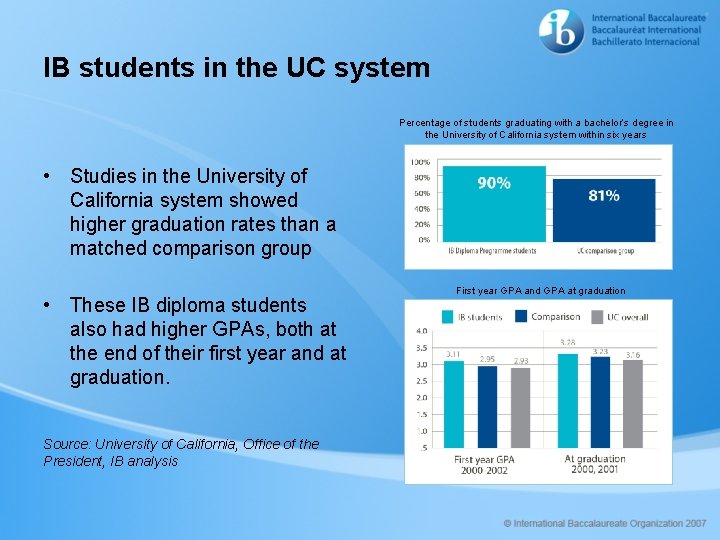
IB students in the UC system Percentage of students graduating with a bachelor’s degree in the University of California system within six years • Studies in the University of California system showed higher graduation rates than a matched comparison group • These IB diploma students also had higher GPAs, both at the end of their first year and at graduation. Source: University of California, Office of the President, IB analysis First year GPA and GPA at graduation
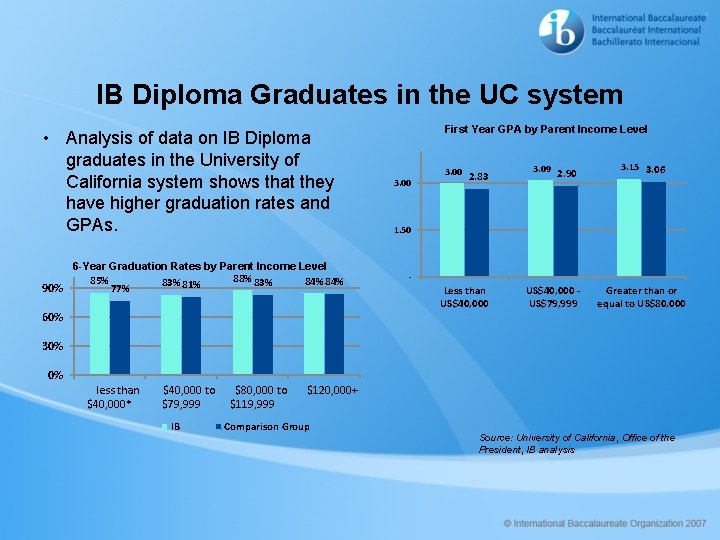
IB Diploma Graduates in the UC system • Analysis of data on IB Diploma graduates in the University of California system shows that they have higher graduation rates and GPAs. 6 -Year Graduation Rates by Parent Income Level 88% 83% 85% 84% 83% 81% 90% 77% 60% First Year GPA by Parent Income Level 3. 00 2. 83 3. 09 2. 90 3. 15 3. 06 1. 50 - Less than US$40, 000 US$79, 999 Greater than or equal to US$80, 000 30% 0% less than $40, 000 to $80, 000 to $120, 000+ $40, 000* $79, 999 $119, 999 IB Comparison Group Source: University of California, Office of the President, IB analysis
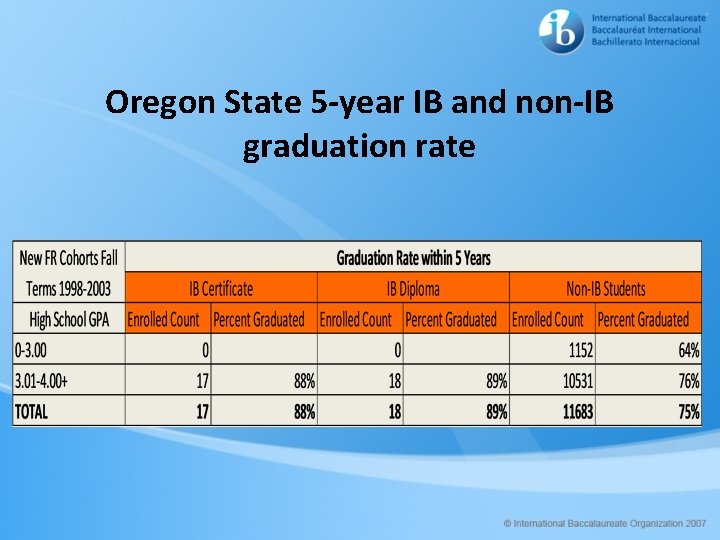
Oregon State 5 -year IB and non-IB graduation rate
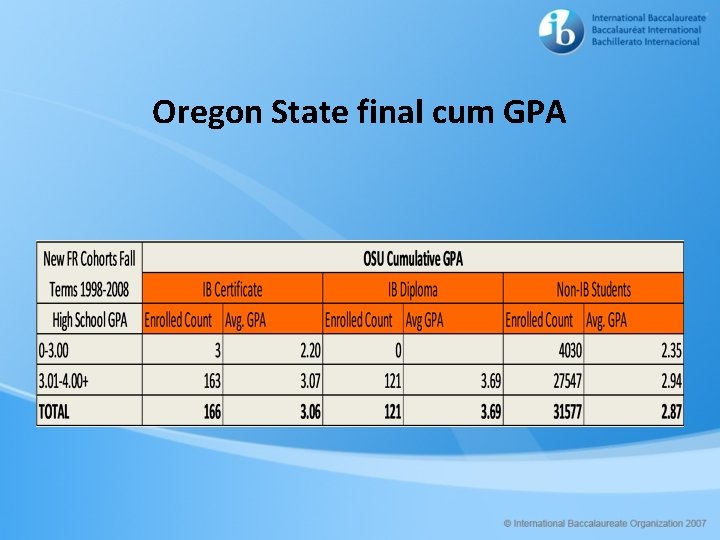
Oregon State final cum GPA
Targeted Recruitment of IB Students
Recognizing IB Students • Targeted Recruitment • Policy that distinguishes • IB Diploma recipients from • Students taking individual IB Diploma courses • Admission: has met State knowledge and skill requirements • Placement • Credit: general or specific • Scholarships • Honors college • Undergraduate research
Qualities of IB Diploma Students Ø Fluency in 2 languages Ø Self confidence with university texts & materials Ø Capacity for independent & group research & study Ø Cultivated critical & creative thinking abilities with well developed communication skills Ø Ability to complete a challenging & rigorous course of studies Ø Compassionate concern for others
IB Learner Profile: Inquirers Knowledgeable Thinkers Communicators Principled Open-minded Caring Risk-takers Balanced Reflective Page 62
The IB Learner Profile: A singular capacity for invigorating campus life Informed by the IB mission to develop active, compassionate and lifelong learners, the IB programmes foster a distinctive set of attributes. These qualities – embodied in the IB learner profile- prepare IB students to make exceptional contributions on campus. Inquirers: University faculties regularly note IB students’ passion for discovery Knowledgeable: IB students are extraordinarily well prepared for the academic requirements of university coursework Thinkers: IB students contribute to discussions in a meaningful way. They do not shy away from challenging questions and, once they know the answer, follow up by asking “why”? Communicators: IB students regularly deliver stimulating presentations and drive excellence in group assignments Principled: IB students are infused with the academic integrity that is fundamental value of universities and colleges
The IB Learner Profile: Open-minded: IB students have a deep understanding of various cultures and views, bringing an appreciation of new views to both their academic study and their involvement in local and wider communities. Their international mindedness complements the missions of the best tertiary institutions. Caring: IB students tell us they bring this commitment to community and others to their activities and leadership roles at university and carry it throughout their lives. Risk-takers: IB students transition well to challenging university settings and show resilience and determination in their work. In academics, they have the confidence to approach new or unfamiliar subjects or material. Balanced: IB students are active participants in a wide range of aspects of campus life, as well as focusing on their academic development. Reflective: IB students have developed an ability to reflect on their learning and to articulate how they learnt. They have learned that critical reflection is an important academic and life skill.
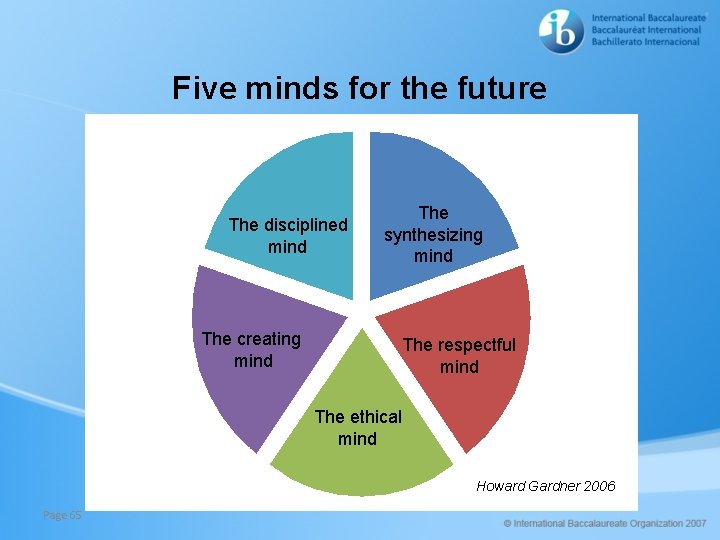
Five minds for the future The disciplined mind The synthesizing mind The creating mind The respectful mind The ethical mind Howard Gardner 2006 Page 65
Questions? Page 66
Contact Details Sandra Wade Pauly University & Government Liaison IB Vancouver 202 -1661 West 2 nd Avenue Vancouver, BC V 6 J 1 H 3 Canada Phone: 1. 604. 733. 8980 1. 866. 826. 4262 (toll free) Email: sandra. wadepauly@ibo. org Thank You!
- Slides: 61