
Excel in ME Nusselt numbers Loading an Addin

Excel in ME Nusselt numbers
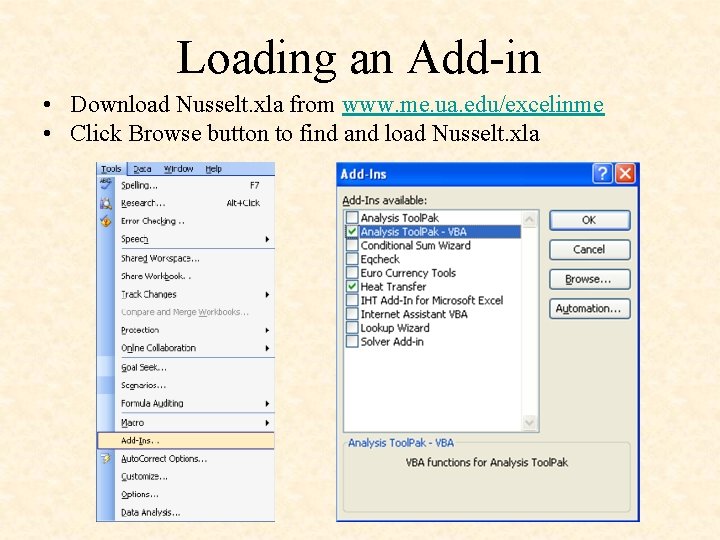
Loading an Add-in • Download Nusselt. xla from www. me. ua. edu/excelinme • Click Browse button to find and load Nusselt. xla

Functions • Functions return the local (Nu) or average (Nu. Bar) Nusselt number • The functions are reliable only over certain ranges. An answer will be returned, but it is up to the user to decide if it is adequate. • A warning will appear for values outside the reliable range for the function. • Quiet - Each function has an optional Quiet input. True or 1 will turn off the warnings. False if omitted.
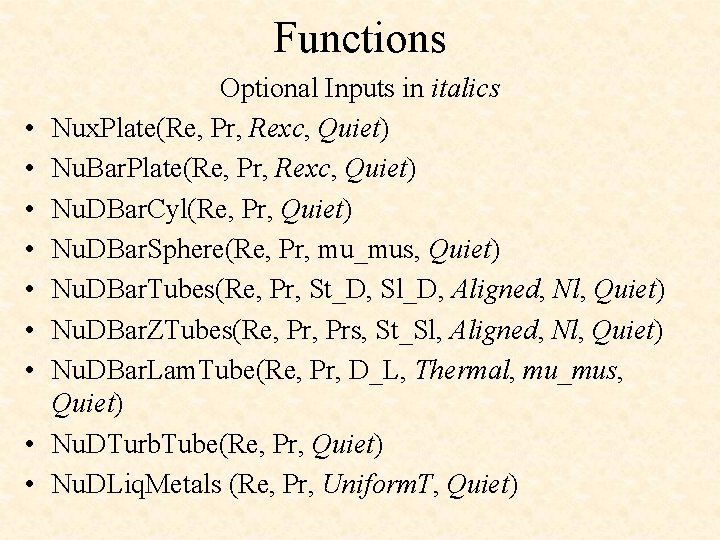
Functions • • • Optional Inputs in italics Nux. Plate(Re, Pr, Rexc, Quiet) Nu. Bar. Plate(Re, Pr, Rexc, Quiet) Nu. DBar. Cyl(Re, Pr, Quiet) Nu. DBar. Sphere(Re, Pr, mu_mus, Quiet) Nu. DBar. Tubes(Re, Pr, St_D, Sl_D, Aligned, Nl, Quiet) Nu. DBar. ZTubes(Re, Prs, St_Sl, Aligned, Nl, Quiet) Nu. DBar. Lam. Tube(Re, Pr, D_L, Thermal, mu_mus, Quiet) Nu. DTurb. Tube(Re, Pr, Quiet) Nu. DLiq. Metals (Re, Pr, Uniform. T, Quiet)
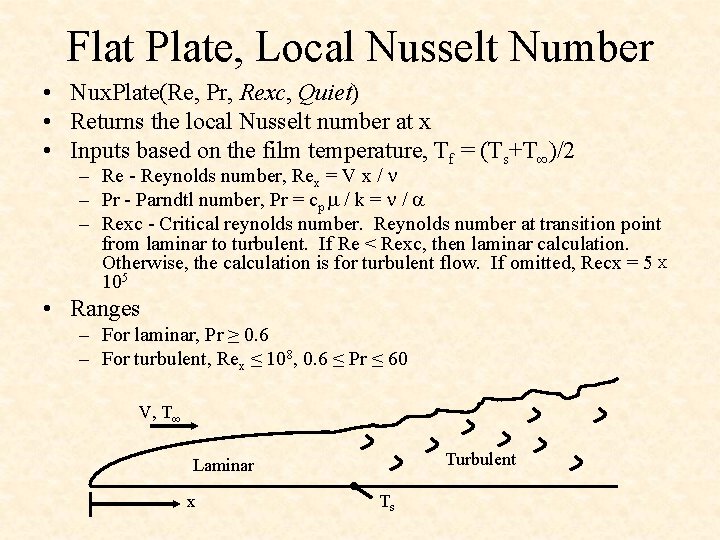
Flat Plate, Local Nusselt Number • Nux. Plate(Re, Pr, Rexc, Quiet) • Returns the local Nusselt number at x • Inputs based on the film temperature, Tf = (Ts+T∞)/2 – Re - Reynolds number, Rex = V x / n – Pr - Parndtl number, Pr = cp m / k = n / a – Rexc - Critical reynolds number. Reynolds number at transition point from laminar to turbulent. If Re < Rexc, then laminar calculation. Otherwise, the calculation is for turbulent flow. If omitted, Recx = 5 X 10⁵ • Ranges – For laminar, Pr ≥ 0. 6 – For turbulent, Rex ≤ 108, 0. 6 ≤ Pr ≤ 60 V, T∞ Turbulent Laminar x Ts
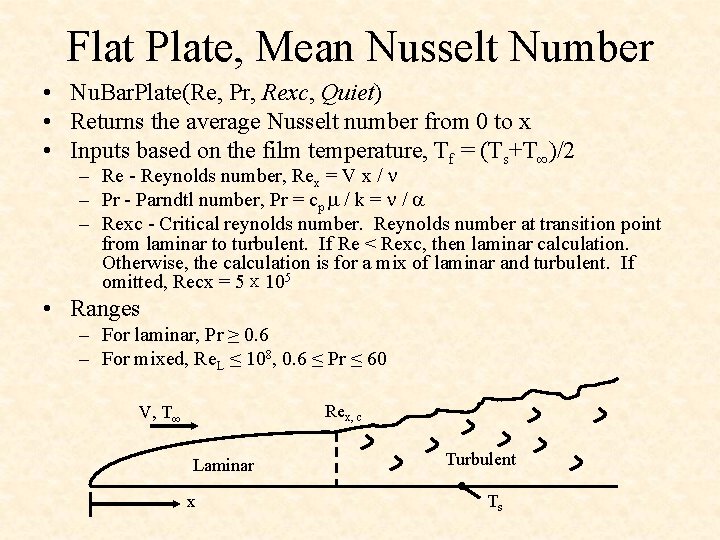
Flat Plate, Mean Nusselt Number • Nu. Bar. Plate(Re, Pr, Rexc, Quiet) • Returns the average Nusselt number from 0 to x • Inputs based on the film temperature, Tf = (Ts+T∞)/2 – Re - Reynolds number, Rex = V x / n – Pr - Parndtl number, Pr = cp m / k = n / a – Rexc - Critical reynolds number. Reynolds number at transition point from laminar to turbulent. If Re < Rexc, then laminar calculation. Otherwise, the calculation is for a mix of laminar and turbulent. If omitted, Recx = 5 X 10⁵ • Ranges – For laminar, Pr ≥ 0. 6 – For mixed, Re. L ≤ 108, 0. 6 ≤ Pr ≤ 60 Rex, c V, T∞ Laminar x Turbulent Ts
Cylinder in crossflow • Nu. DBar. Cyl(Re, Pr, Quiet) • Returns the average Nusselt number for crossflow over a cylinder • Inputs based on the film temperature, Tf = (Ts+T∞)/2 – Re - Reynolds number, Re. D = V D / n – Pr - Parndtl number, Pr = cp m / k = n / a • Range – Re. D Pr ≥ 0. 2
Sphere • Nu. DBar. Sphere(Re, Pr, mu_mus, Quiet) • Returns the average Nusselt number for flow over a sphere • Inputs based on the ambient fluid temperature, T∞, except ms – Re - Reynolds number, Re. D = V D / n – Pr - Parndtl number, Pr = cp m / k = n / a – mu_mus - m / ms; viscosity ratio calculated from T∞ and Ts at the surface • Range – 0. 71 ≤ Pr ≤ 380 – 3. 5 ≤ Re. D ≤ 7. 6 X 10⁴
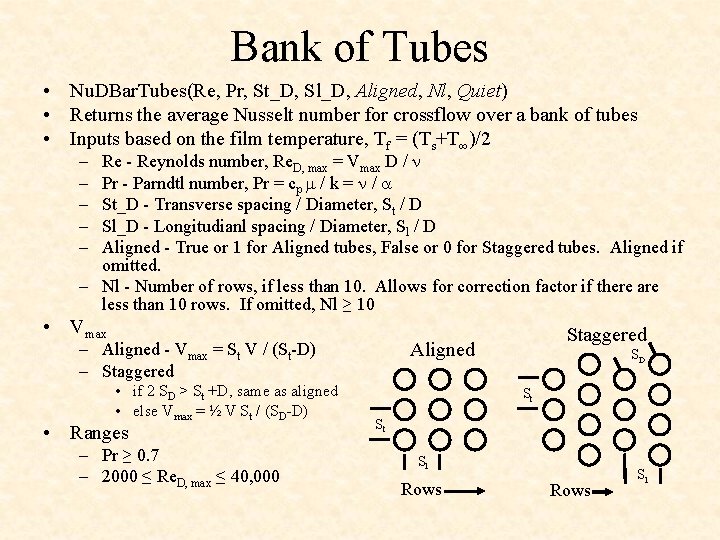
Bank of Tubes • Nu. DBar. Tubes(Re, Pr, St_D, Sl_D, Aligned, Nl, Quiet) • Returns the average Nusselt number for crossflow over a bank of tubes • Inputs based on the film temperature, Tf = (Ts+T∞)/2 Re - Reynolds number, Re. D, max = Vmax D / n Pr - Parndtl number, Pr = cp m / k = n / a St_D - Transverse spacing / Diameter, St / D Sl_D - Longitudianl spacing / Diameter, Sl / D Aligned - True or 1 for Aligned tubes, False or 0 for Staggered tubes. Aligned if omitted. – Nl - Number of rows, if less than 10. Allows for correction factor if there are less than 10 rows. If omitted, Nl ≥ 10 – – – • Vmax • if 2 SD > St +D, same as aligned • else Vmax = ½ V St / (SD-D) • Ranges – Pr ≥ 0. 7 – 2000 ≤ Re. D, max ≤ 40, 000 Staggered Aligned – Aligned - Vmax = St V / (St-D) – Staggered SD St St Sl Rows Sl
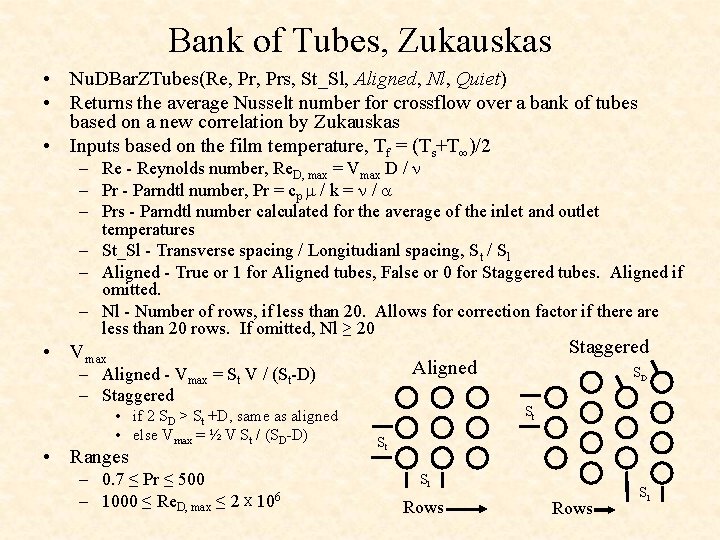
Bank of Tubes, Zukauskas • Nu. DBar. ZTubes(Re, Prs, St_Sl, Aligned, Nl, Quiet) • Returns the average Nusselt number for crossflow over a bank of tubes based on a new correlation by Zukauskas • Inputs based on the film temperature, Tf = (Ts+T∞)/2 – Re - Reynolds number, Re. D, max = Vmax D / n – Pr - Parndtl number, Pr = cp m / k = n / a – Prs - Parndtl number calculated for the average of the inlet and outlet temperatures – St_Sl - Transverse spacing / Longitudianl spacing, St / Sl – Aligned - True or 1 for Aligned tubes, False or 0 for Staggered tubes. Aligned if omitted. – Nl - Number of rows, if less than 20. Allows for correction factor if there are less than 20 rows. If omitted, Nl ≥ 20 • Vmax Aligned – Aligned - Vmax = St V / (St-D) – Staggered • if 2 SD > St +D, same as aligned • else Vmax = ½ V St / (SD-D) • Ranges – 0. 7 ≤ Pr ≤ 500 – 1000 ≤ Re. D, max ≤ 2 X 10⁶ Staggered SD St St Sl Rows Sl
Laminar Flow in a Tube • • Nu. Bar. Lam. Tube(Re, Pr, D_L, Thermal, mu_mus, Quiet) Returns the average Nusselt number for laminar flow through a circular tube Function based on uniform surface temperature Inputs based on the mean of the inlet and outlet temperatures, Tm = (Ti+To)/2, except ms – – Re - Reynolds number, Re. D = V D / n Pr - Parndtl number, Pr = cp m / k = n / a D_L - Diameter / Length, D / L Thermal - True or 1 for Thermal entry length, False or 0 for combined entry length. True if omitted. • Thermal entry assumes a fully developed velocity profile. For instance, if the tube is preceded by a section where there is no heat transfer. Also gives a good approximation for large Prandtl number fluids, like oil. • Combined entry has both the velocity and thermal profiles developing simultaneously. – mu_mus - m / ms; viscosity ratio calculated from Tm and Ts at the surface; only needed for combined entry with Pr ≤ 5. 0 if omitted • Ranges for combined entry – Pr ≥ 0. 6; For Pr ≥ 5, the answer is calculated with thermal entry formula – 0. 0044 ≤ (m/ms) ≤ 9. 75
Turbulent Flow in a Tube • Nu. DTurb. Tube(Re, Pr, Quiet) • Returns the Nusselt number for turbulent flow through a circular tube • Inputs based on the mean of the inlet and outlet temperatures, Tm = (Ti+To)/2 – Re - Reynolds number, Re. D = V D / n – Pr - Parndtl number, Pr = cp m / k = n / a • Range – 0. 5 ≤ Pr ≤ 2000 – 3000 ≤ Re. D ≤ 5 X 10⁶ – L/D ≥ 10
Liquid metal flow through a tube • Nu. DLiq. Metals (Re, Pr, Uniform. T, Quiet) • Returns the Nusselt number for liquid metal flow through a circular tube • Other correlations do not apply to liquid metals – (3 X 10 -3 ≤ Pr ≤ 5 X 10 -2) • Inputs based on the mean of the inlet and outlet temperatures, Tm = (Ti+To)/2 – Re - Reynolds number, Re. D = V D / n – Pr - Parndtl number, Pr = cp m / k = n / a – Uniform. T - True or 1 for uniform surface temperature, False or 0 for uniform heat flux at surface. True if omitted. • Ranges – For uniform surface temperature • Peclet number, Pe. D = Re. D X Pr ≥ 100 – For uniform surface heat flux • 3. 6 X 10³ ≤ Re. D ≤ 9. 05 X 105 • 102 ≤ Pe. D ≤ 104
- Slides: 13