
Exante evaluations 2014 2020 of ESF operational programmes
- Slides: 11
Ex-ante evaluations 2014 -2020 of ESF operational programmes Kamil Valica Unit A. 3 Impact Assessment and Evaluation DG Employment, Social Affairs and Inclusion 26 th Budapest September 2013 1
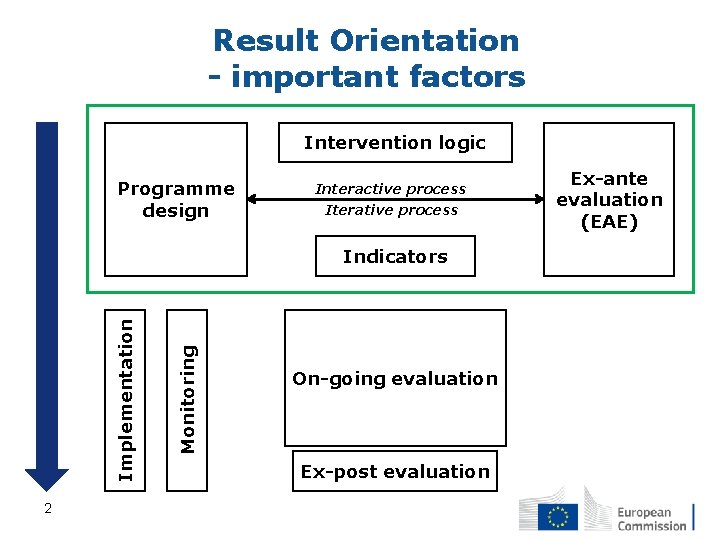
Result Orientation - important factors Intervention logic Programme design Interactive process Iterative process 2 Monitoring Implementation Indicators On-going evaluation Ex-post evaluation Ex-ante evaluation (EAE)
Ex-ante evaluation – a few major points • Intervention logic • Indicators • Timing
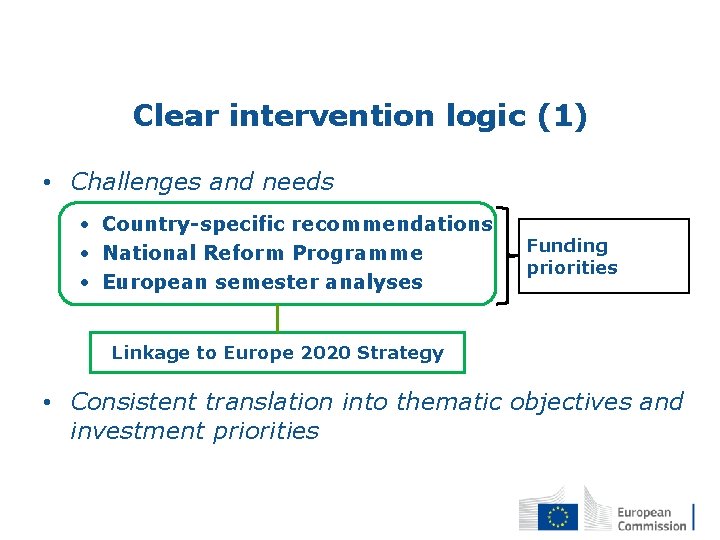
Clear intervention logic (1) • Challenges and needs • Country-specific recommendations • National Reform Programme • European semester analyses Funding priorities Linkage to Europe 2020 Strategy • Consistent translation into thematic objectives and investment priorities
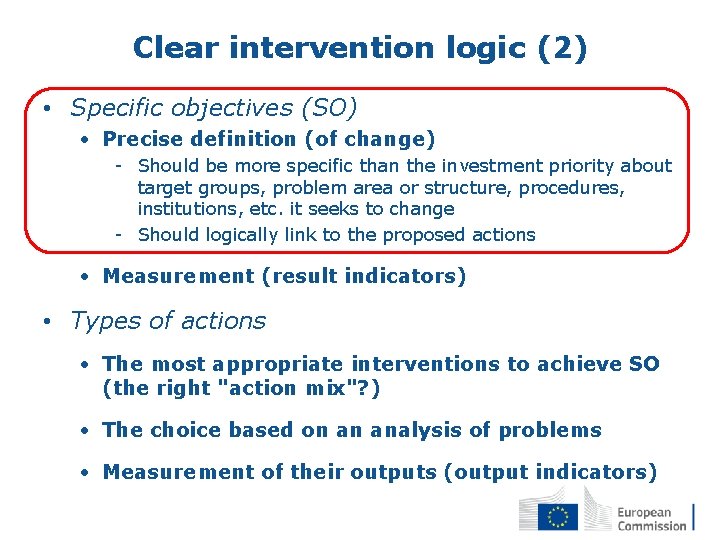
Clear intervention logic (2) • Specific objectives (SO) • Precise definition (of change) - Should be more specific than the investment priority about target groups, problem area or structure, procedures, institutions, etc. it seeks to change - Should logically link to the proposed actions • Measurement (result indicators) • Types of actions • The most appropriate interventions to achieve SO (the right "action mix"? ) • The choice based on an analysis of problems • Measurement of their outputs (output indicators)
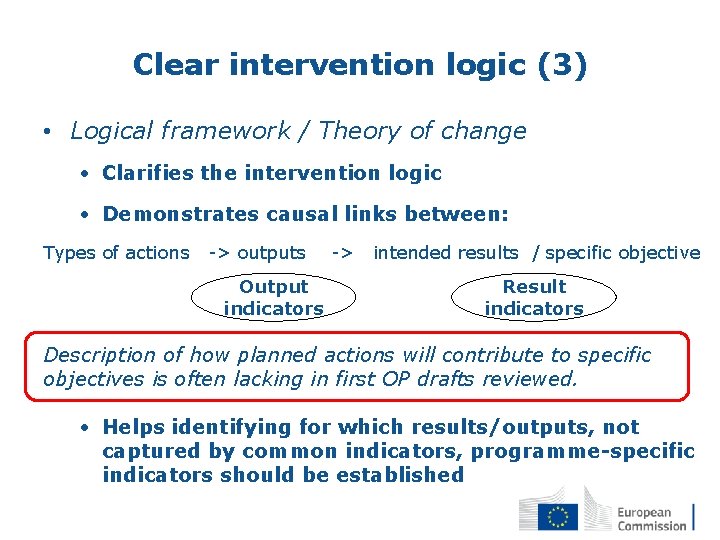
Clear intervention logic (3) • Logical framework / Theory of change • Clarifies the intervention logic • Demonstrates causal links between: Types of actions -> outputs Output indicators -> intended results / specific objective Result indicators Description of how planned actions will contribute to specific objectives is often lacking in first OP drafts reviewed. • Helps identifying for which results/outputs, not captured by common indicators, programme-specific indicators should be established
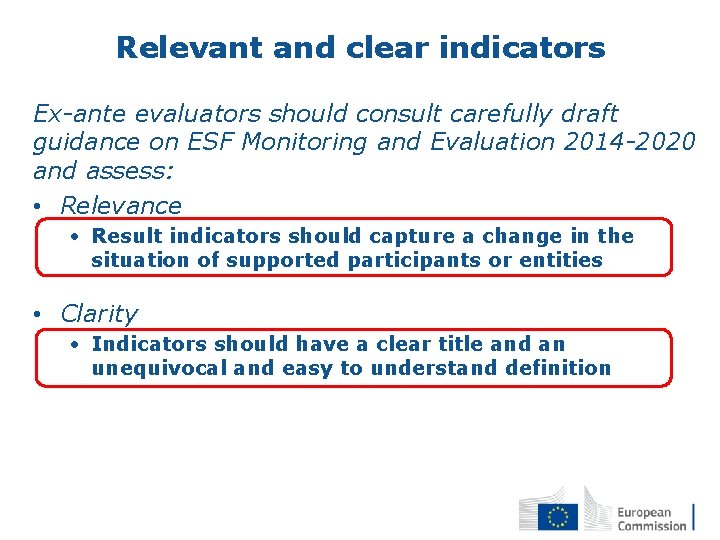
Relevant and clear indicators Ex-ante evaluators should consult carefully draft guidance on ESF Monitoring and Evaluation 2014 -2020 and assess: • Relevance • Result indicators should capture a change in the situation of supported participants or entities • Clarity • Indicators should have a clear title and an unequivocal and easy to understand definition
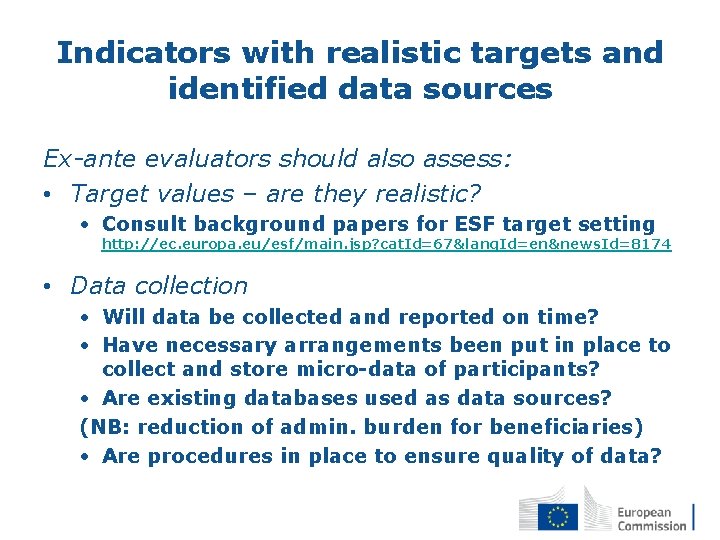
Indicators with realistic targets and identified data sources Ex-ante evaluators should also assess: • Target values – are they realistic? • Consult background papers for ESF target setting http: //ec. europa. eu/esf/main. jsp? cat. Id=67&lang. Id=en&news. Id=8174 • Data collection • Will data be collected and reported on time? • Have necessary arrangements been put in place to collect and store micro-data of participants? • Are existing databases used as data sources? (NB: reduction of admin. burden for beneficiaries) • Are procedures in place to ensure quality of data?
Good timing is necessary to allow for interactive and iterative process • To allow for an interactive process, contractors need to be found on time to accompany the design of programme from its first draft • To allow for an iterative process (work in stages, revisiting of earlier stages on basis of evaluation recommendations), also programme design should start on time to allow for sufficient time space to evaluate and take on board recommendations
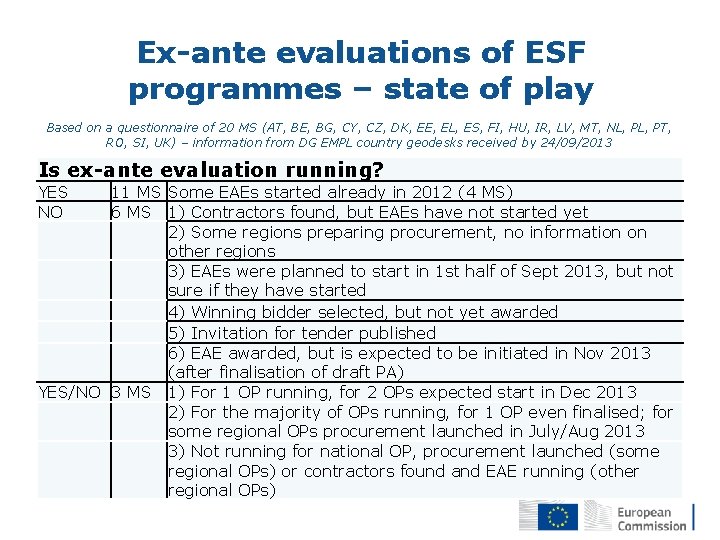
Ex-ante evaluations of ESF programmes – state of play Based on a questionnaire of 20 MS (AT, BE, BG, CY, CZ, DK, EE, EL, ES, FI, HU, IR, LV, MT, NL, PT, RO, SI, UK) – information from DG EMPL country geodesks received by 24/09/2013 Is ex-ante evaluation running? YES NO 11 MS Some EAEs started already in 2012 (4 MS) 6 MS 1) Contractors found, but EAEs have not started yet 2) Some regions preparing procurement, no information on other regions 3) EAEs were planned to start in 1 st half of Sept 2013, but not sure if they have started 4) Winning bidder selected, but not yet awarded 5) Invitation for tender published 6) EAE awarded, but is expected to be initiated in Nov 2013 (after finalisation of draft PA) YES/NO 3 MS 1) For 1 OP running, for 2 OPs expected start in Dec 2013 2) For the majority of OPs running, for 1 OP even finalised; for some regional OPs procurement launched in July/Aug 2013 3) Not running for national OP, procurement launched (some regional OPs) or contractors found and EAE running (other regional OPs)
Ex-ante evaluations of ESF programmes – other observations Based on a questionnaire of 20 MS (AT, BE, BG, CY, CZ, DK, EL, EE, ES, FI, HU, IR, LV, MT, NL, PT, RO, SI, UK) – information from DG EMPL country geodesks received by 24/09/2013 • In general, the EAEs carried out in an interactive way • Challenges: • Time constraints - Waiting for elaboration of other strategies • Parallel process of programming and EAE - Frequently changing OP drafts make preparation of EAE complicated and difficult to keep relevance of EAE interim reports; nevertheless valid EAE recommendations taken on board. • Delay in public procurement