
Exams Jenna Abhijeet Professor Johnson November 2019 We

Exams! Jenna Abhijeet & Professor Johnson November 2019
We might as well start here: Time management is everything.
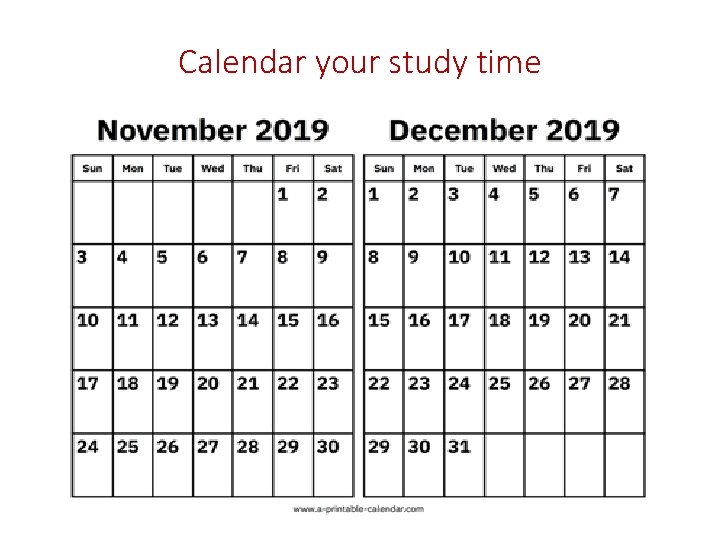
Calendar your study time
Studying is Most Effective When 1. You hit material many times at intervals with space between. 2. You interact with material in different ways. 3. You put the concepts out (speak & write), not just take them in (read & listen).
Early Study Goals • Catch up on reading • Finish your outlines • Fill in outline holes; bulk up outlines • Attend ASP review sessions • Add a study guide to your materials • Understand your exams Open vs. closed book In-school vs. take-home Professor’s exam style Any actual old exams
Later Study Goals Clear up nagging confusions Outline (condense) your outline Analyze hypos in writing Take practice exams and be sure to debrief • Answer multiple choice, short answer, or any questions you can find • Make cards, diagrams, drawings • Be creative with study methods • •
Most important: Don’t just read. Be active. Answer questions.
Avoid the open book trap Pretend the exam is closed book. You will not have much or any time to use your materials. Bring in less on paper and more in your head. Do spend time organizing what you will bring in, and work hard on your condensed outline.

What will exam ask of you? Most law school exams ask you to do what lawyers must do: apply established rules to new facts. The rules come from your participation in class and preparation for the exam. The facts are given to you in the exam.
An “Issue Spotter Exam”. . . is a story in which legal issues have been hidden. Your jobs are to 1) spot the issues, 2) write an essay answer analyzing each issue in a separate IRAC.
The Question Call(s). . . Really help you spot the issues. Read them first, then read them twice more, carefully, before you write. Answer the calls precisely! Do not change them or answer questions not asked.

Exercise
IRAC is your exam friend • This is general advice; if your professor wants something different, do that. • IRAC is CREAC/CRu. PAC without “E” (rule proof/cases). • Issue: Be direct: “The issue here is…” • Rule: State the rule relevant to the issue. Include key buzzwords and phrases, but use your own words to show you understand (not just can copy) the rule. Elements, factors, exceptions, competing approaches, policy? Usually, case names are not necessary. • Application: Put a lot of effort HERE. Spell out all the logical steps. Explain EVERYTHING that’s relevant— even if you find it obvious. No conclusory analysis. Put your analysis first, then consider counter-analysis. • Conclusion: Reach one, even if issue is close.
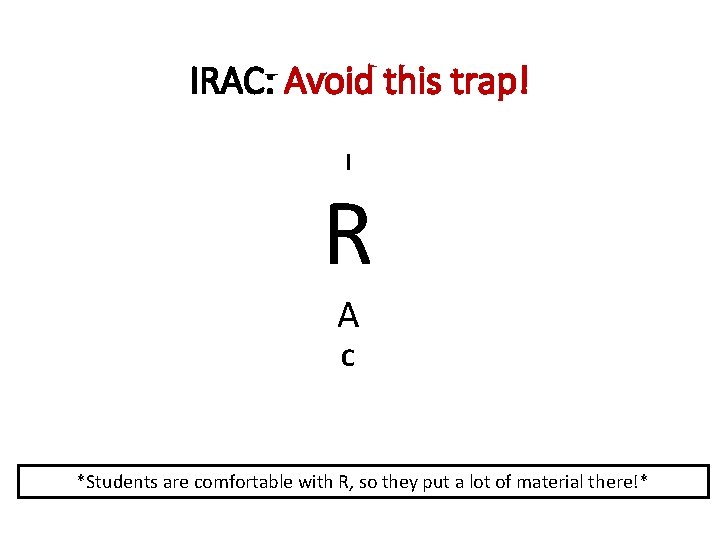
IRAC: Avoid this trap! I R A C *Students are comfortable with R, so they put a lot of material there!*
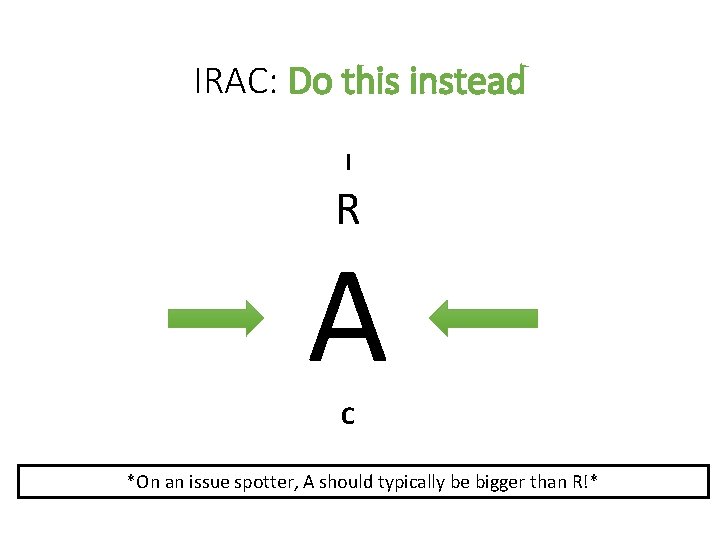
IRAC: Do this instead I R A C *On an issue spotter, A should typically be bigger than R!*
Envision the Grading Professor Your professor is grading a big pile of exams. She is looking to see that you 1) spotted the legal issues, 2) know the relevant rules, and 3) can apply the rules to the given facts in a lawyerly way. ( And while she’s willing to cut you some slack on the writing, extreme sloppiness will hurt you and writing that is unclear cannot capture points. )
Write a reader-friendly exam Don’t write giant blocks of text Don’t dive in without organizing Don’t use confusing abbreviations Don’t be sloppy with/make up facts Don’t leave relevant legal analysis out as unimportant Don’t bulk up answer by writing “stuff you know” that’s not relevant Don’t hand in something riddled with typos and misspellings Don’t mismanage time or leave it unused
Strategy & Mental Health • Know your most productive study hours and your best study environment. • Incentivize studying with rewards. It works. • Exercise, sleep and eat well. Stress is counterproductive. • Protect your attitude. Avoid panicky people, know-italls, and slackers. • Keep perspective. Grades are important, but they aren’t EVERYTHING. Whatever results from your best effort is good enough. • Remember that in giving your best effort to exam prep you are learning how to learn, which will serve you well throughout law school and practice.
And once more: Time management is everything.
- Slides: 20