
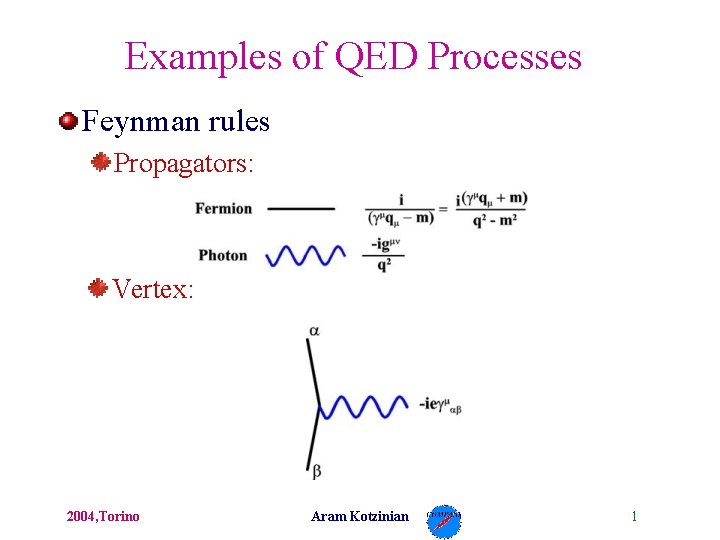
Examples of QED Processes Feynman rules Propagators Vertex
- Slides: 18
Examples of QED Processes Feynman rules Propagators: Vertex: 2004, Torino Aram Kotzinian 1
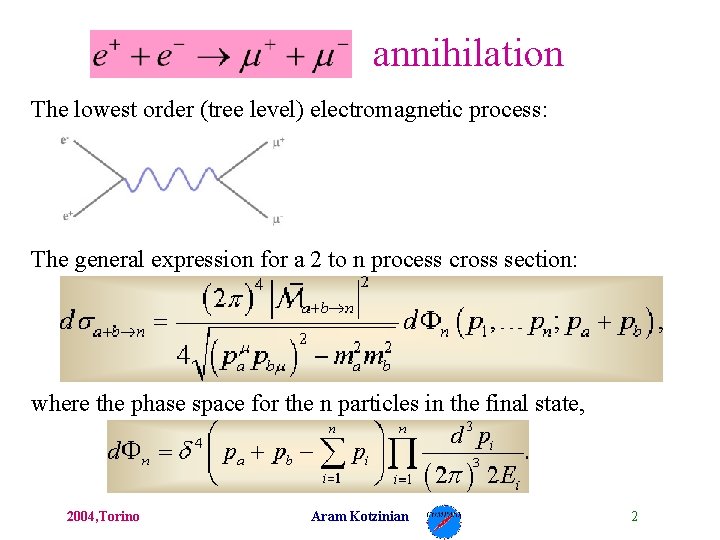
annihilation The lowest order (tree level) electromagnetic process: The general expression for a 2 to n process cross section: where the phase space for the n particles in the final state, 2004, Torino Aram Kotzinian 2
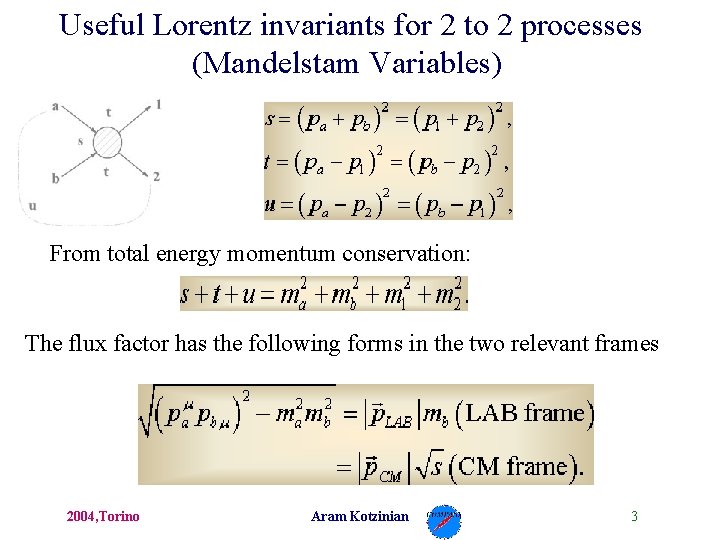
Useful Lorentz invariants for 2 to 2 processes (Mandelstam Variables) From total energy momentum conservation: The flux factor has the following forms in the two relevant frames 2004, Torino Aram Kotzinian 3
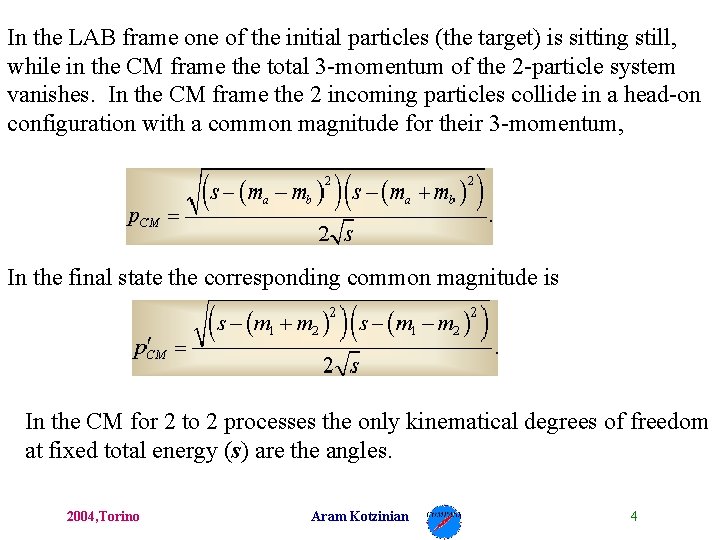
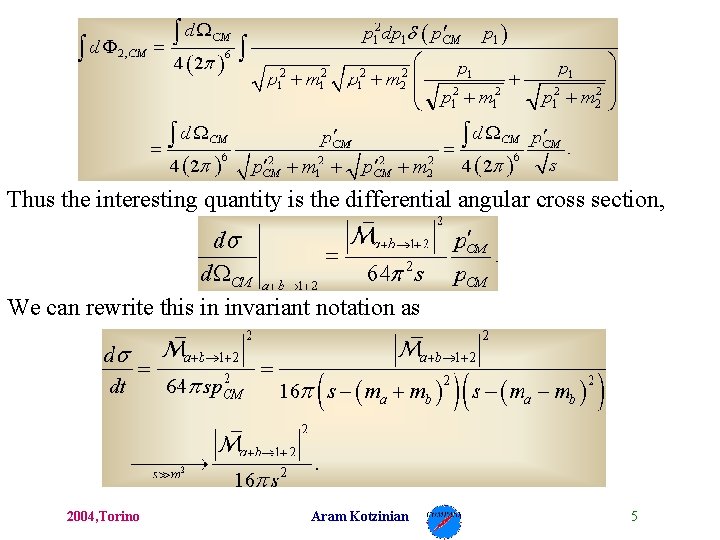
In the LAB frame one of the initial particles (the target) is sitting still, while in the CM frame the total 3 -momentum of the 2 -particle system vanishes. In the CM frame the 2 incoming particles collide in a head-on configuration with a common magnitude for their 3 -momentum, In the final state the corresponding common magnitude is In the CM for 2 to 2 processes the only kinematical degrees of freedom at fixed total energy (s) are the angles. 2004, Torino Aram Kotzinian 4
Thus the interesting quantity is the differential angular cross section, We can rewrite this in invariant notation as 2004, Torino Aram Kotzinian 5
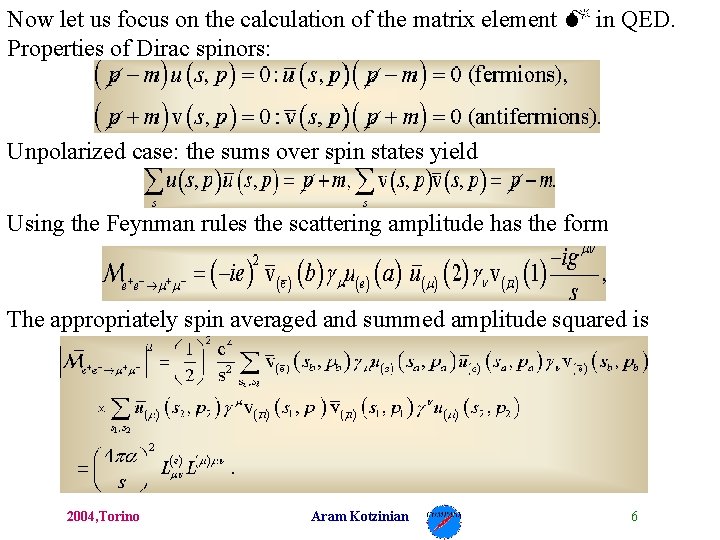
Now let us focus on the calculation of the matrix element M in QED. Properties of Dirac spinors: Unpolarized case: the sums over spin states yield Using the Feynman rules the scattering amplitude has the form The appropriately spin averaged and summed amplitude squared is 2004, Torino Aram Kotzinian 6
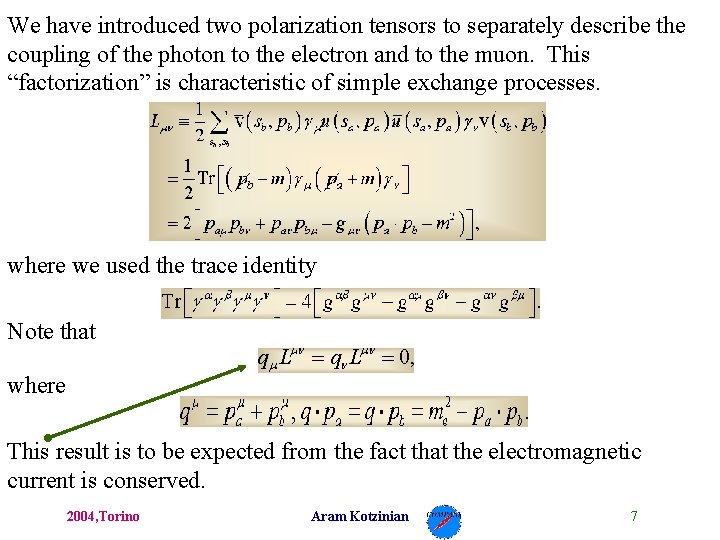
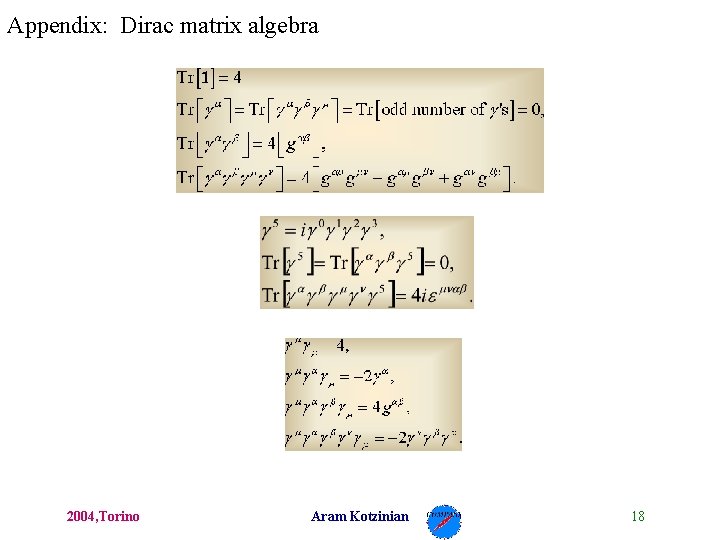
We have introduced two polarization tensors to separately describe the coupling of the photon to the electron and to the muon. This “factorization” is characteristic of simple exchange processes. where we used the trace identity Note that where This result is to be expected from the fact that the electromagnetic current is conserved. 2004, Torino Aram Kotzinian 7
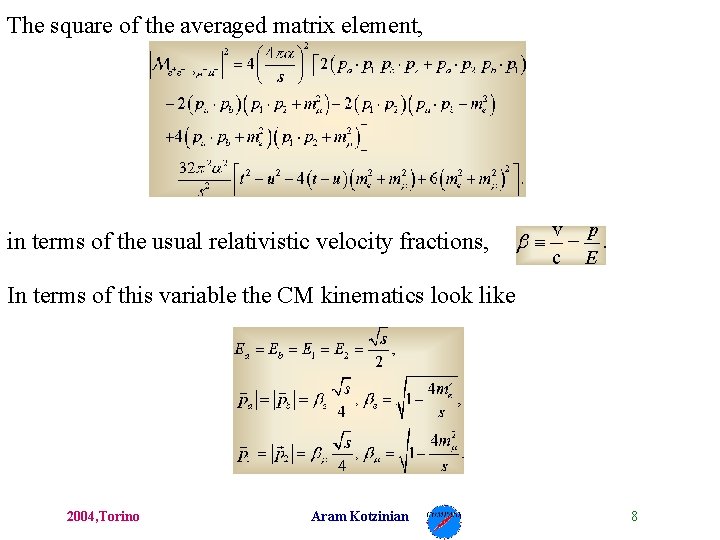
The square of the averaged matrix element, in terms of the usual relativistic velocity fractions, In terms of this variable the CM kinematics look like 2004, Torino Aram Kotzinian 8
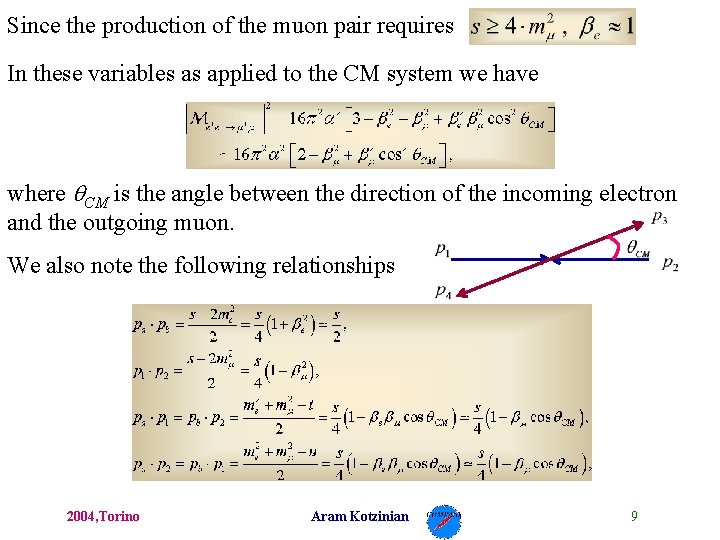
Since the production of the muon pair requires In these variables as applied to the CM system we have where q. CM is the angle between the direction of the incoming electron and the outgoing muon. We also note the following relationships 2004, Torino Aram Kotzinian 9
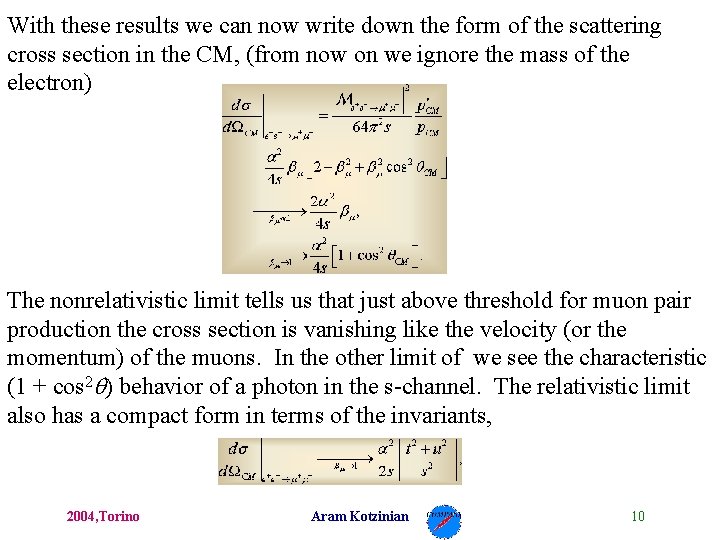
With these results we can now write down the form of the scattering cross section in the CM, (from now on we ignore the mass of the electron) The nonrelativistic limit tells us that just above threshold for muon pair production the cross section is vanishing like the velocity (or the momentum) of the muons. In the other limit of we see the characteristic (1 + cos 2 q) behavior of a photon in the s-channel. The relativistic limit also has a compact form in terms of the invariants, 2004, Torino Aram Kotzinian 10
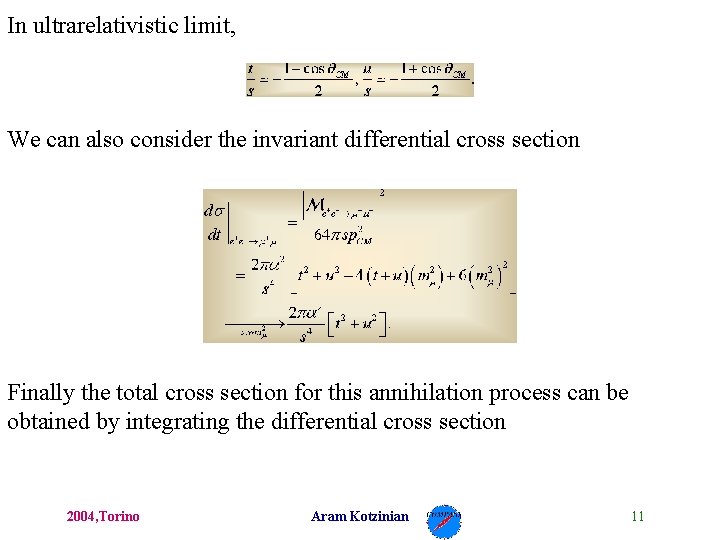
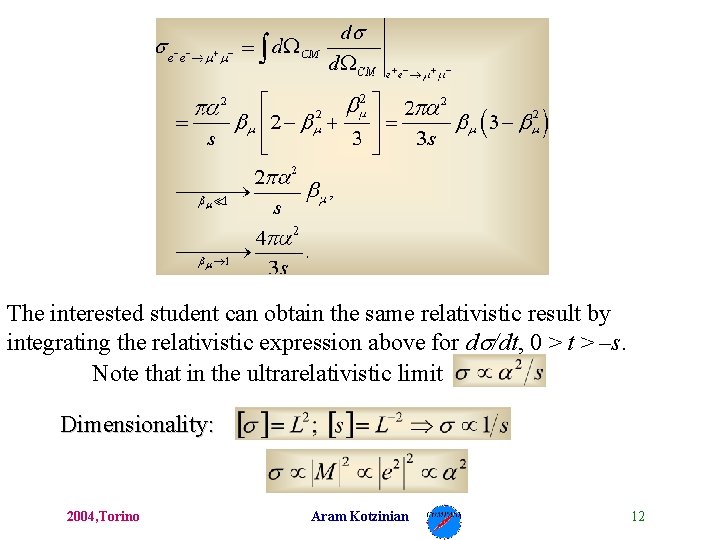
In ultrarelativistic limit, We can also consider the invariant differential cross section Finally the total cross section for this annihilation process can be obtained by integrating the differential cross section 2004, Torino Aram Kotzinian 11
The interested student can obtain the same relativistic result by integrating the relativistic expression above for ds/dt, 0 > t > –s. Note that in the ultrarelativistic limit Dimensionality: 2004, Torino Aram Kotzinian 12
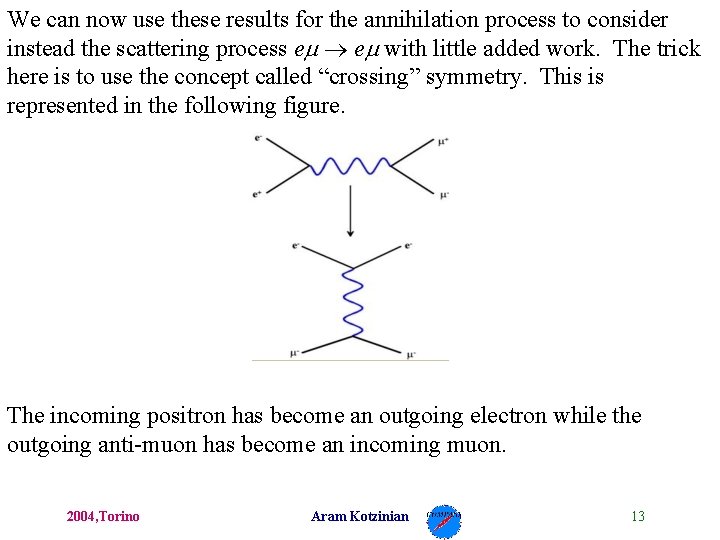
We can now use these results for the annihilation process to consider instead the scattering process em ® em with little added work. The trick here is to use the concept called “crossing” symmetry. This is represented in the following figure. The incoming positron has become an outgoing electron while the outgoing anti-muon has become an incoming muon. 2004, Torino Aram Kotzinian 13
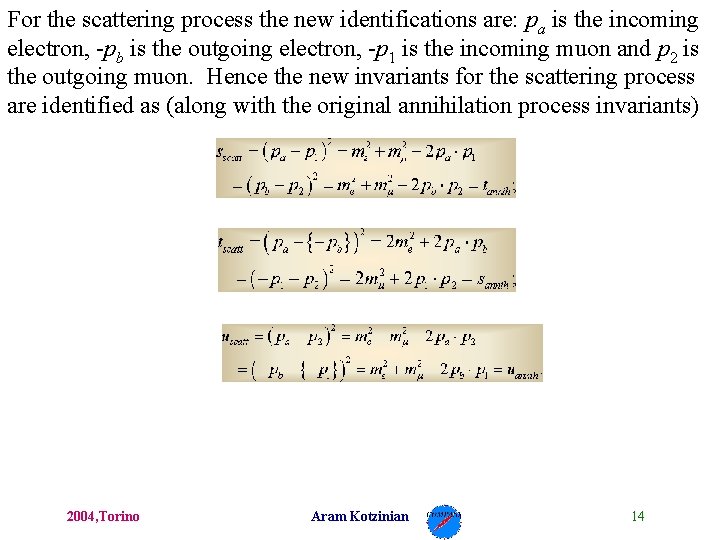
For the scattering process the new identifications are: pa is the incoming electron, -pb is the outgoing electron, -p 1 is the incoming muon and p 2 is the outgoing muon. Hence the new invariants for the scattering process are identified as (along with the original annihilation process invariants) 2004, Torino Aram Kotzinian 14
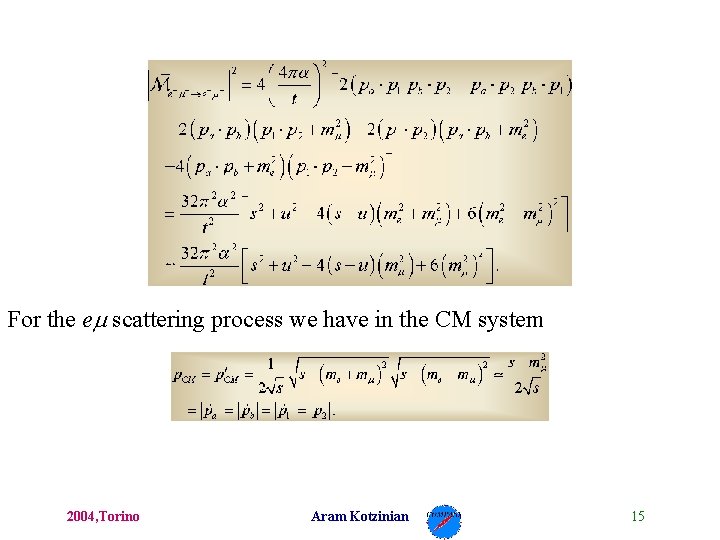
For the em scattering process we have in the CM system 2004, Torino Aram Kotzinian 15
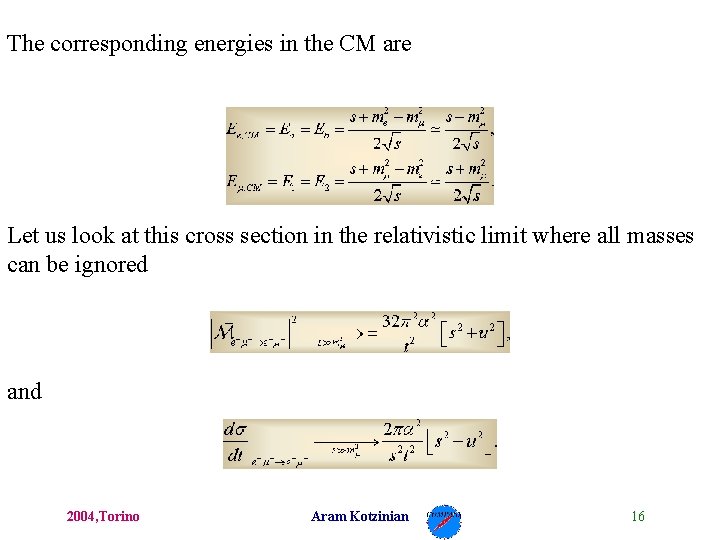
The corresponding energies in the CM are Let us look at this cross section in the relativistic limit where all masses can be ignored and 2004, Torino Aram Kotzinian 16
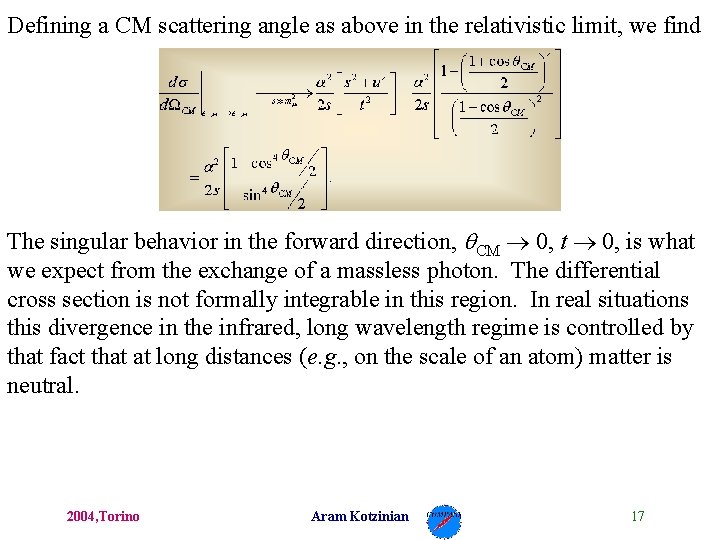
Defining a CM scattering angle as above in the relativistic limit, we find The singular behavior in the forward direction, q. CM ® 0, t ® 0, is what we expect from the exchange of a massless photon. The differential cross section is not formally integrable in this region. In real situations this divergence in the infrared, long wavelength regime is controlled by that fact that at long distances (e. g. , on the scale of an atom) matter is neutral. 2004, Torino Aram Kotzinian 17
Appendix: Dirac matrix algebra 2004, Torino Aram Kotzinian 18