
Examples of Passive Active Transport Warm Up Describe
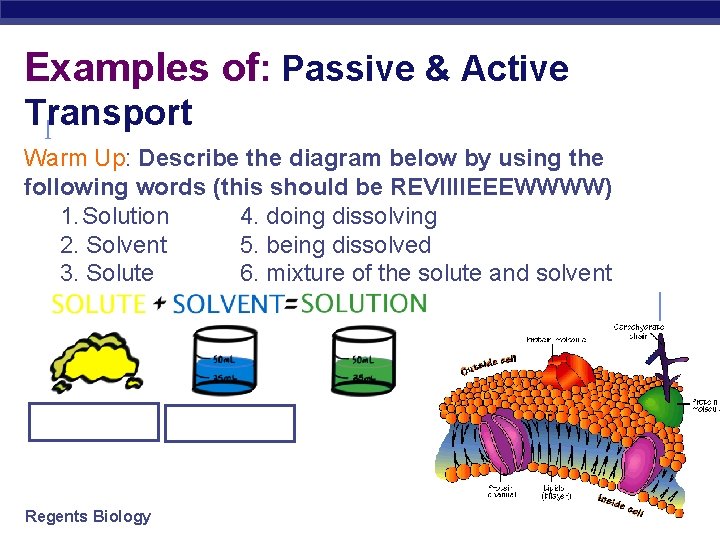
Examples of: Passive & Active Transport Warm Up: Describe the diagram below by using the following words (this should be REVIIIIEEEWWWW) 1. Solution 4. doing dissolving 2. Solvent 5. being dissolved 3. Solute 6. mixture of the solute and solvent Regents Biology 2006 -2007
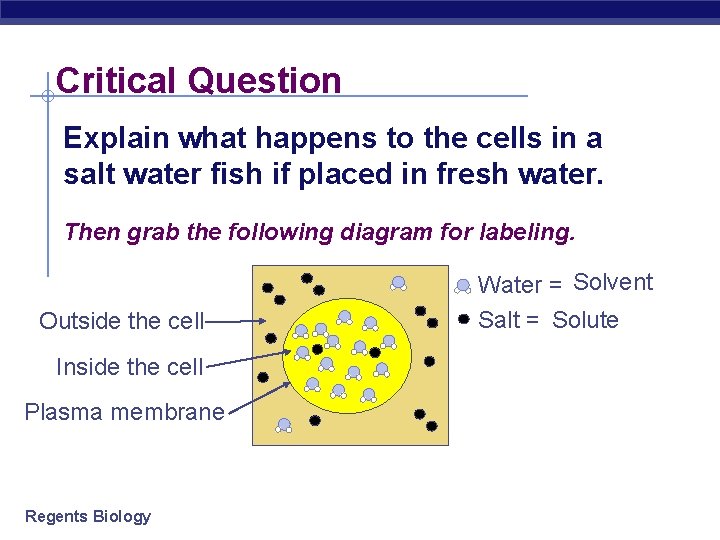
Critical Question Explain what happens to the cells in a salt water fish if placed in fresh water. Then grab the following diagram for labeling. Outside the cell Inside the cell Plasma membrane Regents Biology Water = Solvent Salt = Solute
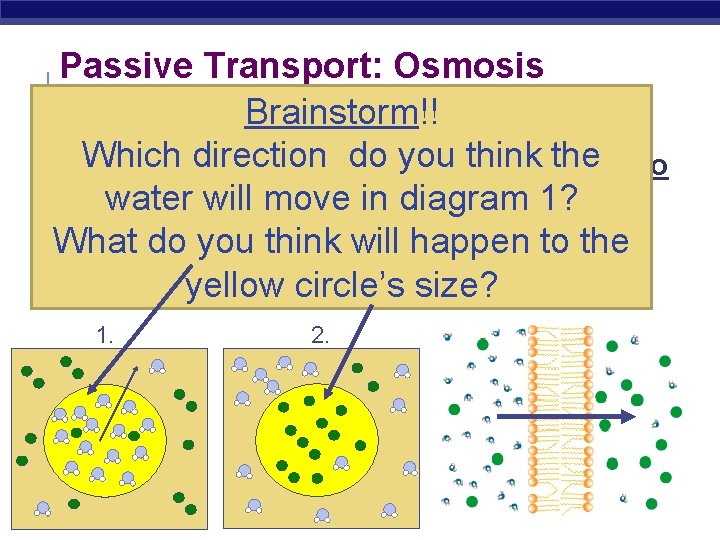
Passive Transport: Osmosis Brainstorm!! § Osmosis diffusion of water from Whichconcentration direction doofyou thinksolute) the to § HIGH H 20 (low water will move in § LOW concentration of diagram H 20 (high 1? solute) Labelyou the Cells (yellow circles) (1 & 2) – as What do think will happen toeither the high concentration water / low solute or yellow circle’s size? low concentration water / high solute 1. Regents Biology 2.
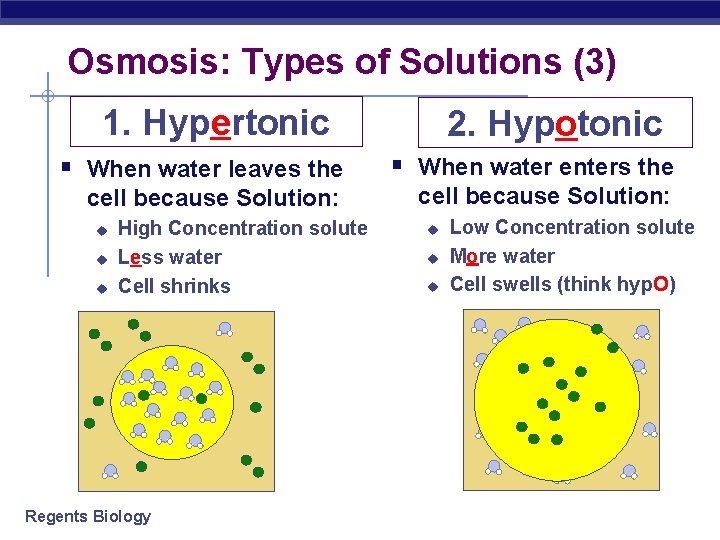
Osmosis: Types of Solutions (3) 1. Hypertonic § When water leaves the cell because Solution: u u u High Concentration solute Less water Cell shrinks Regents Biology 2. Hypotonic § When water enters the cell because Solution: u u u Low Concentration solute More water Cell swells (think hyp. O)
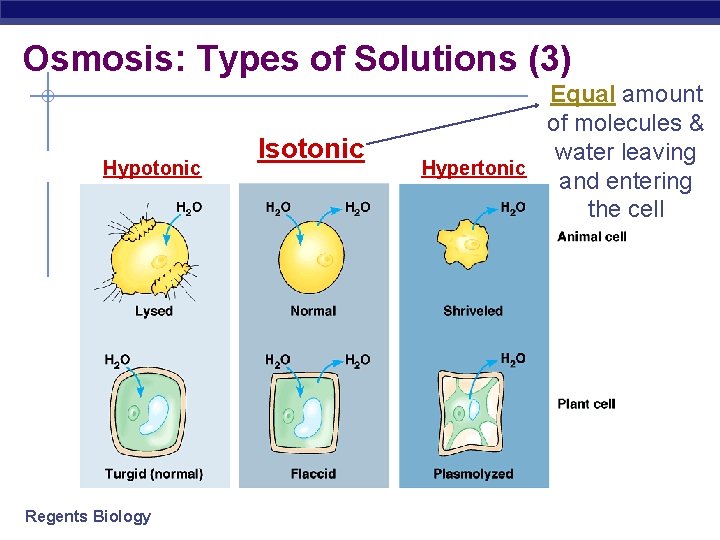
Osmosis: Types of Solutions (3) Hypotonic Regents Biology Isotonic Equal amount of molecules & water leaving Hypertonic and entering the cell
ALL CELLS (bacteria, archea, protists, fungi, plants, animals) depends on the movement of water for survival! For Example Regents Biology
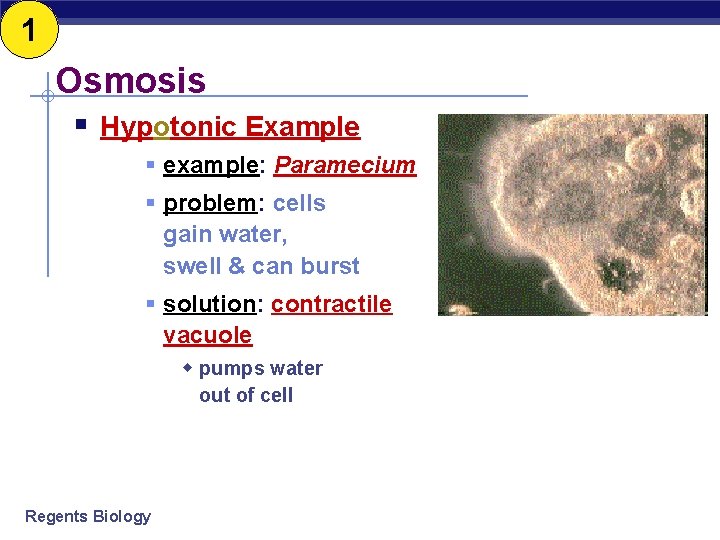
1 Osmosis § Hypotonic Example § example: Paramecium § problem: cells gain water, swell & can burst § solution: contractile vacuole w pumps water out of cell Regents Biology
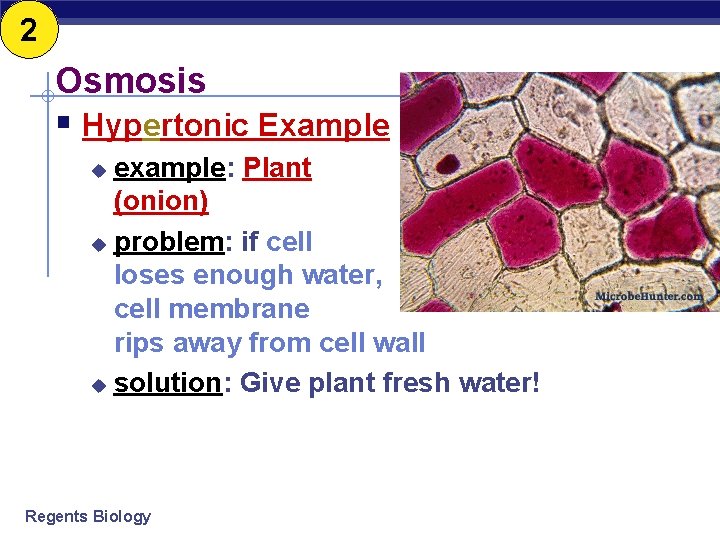
2 Osmosis § Hypertonic Example example: Plant (onion) u problem: if cell loses enough water, cell membrane rips away from cell wall u solution: Give plant fresh water! u Regents Biology
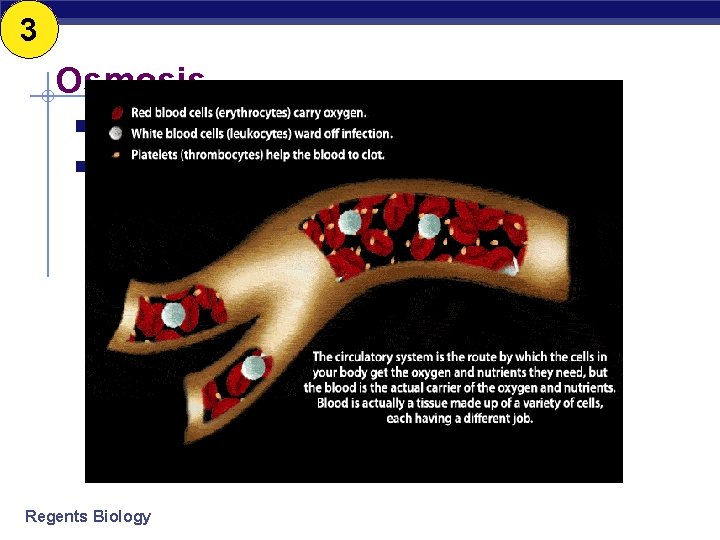
3 Osmosis § Isotonic Example § Equal amount water between cell & environment example: blood in arteries / veins u problem: none u § water flows equally, in both directions § volume of cell does’t change Regents Biology
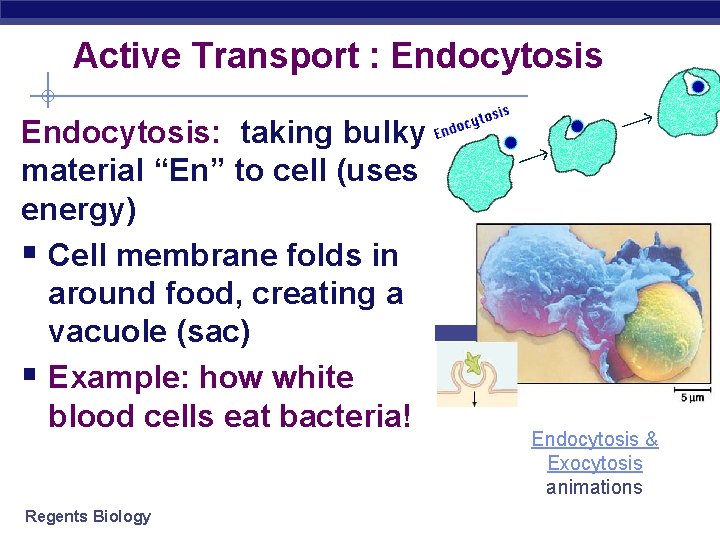
Active Transport : Endocytosis: taking bulky material “En” to cell (uses energy) § Cell membrane folds in around food, creating a vacuole (sac) § Example: how white blood cells eat bacteria! Regents Biology Endocytosis & Exocytosis animations
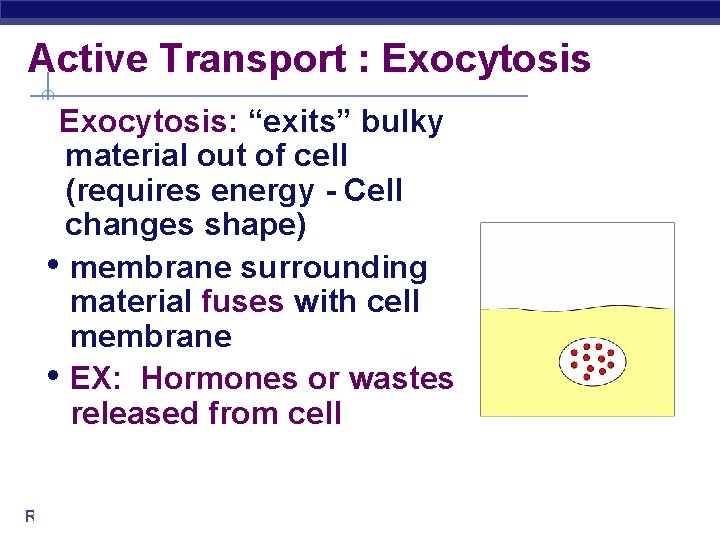
Active Transport : Exocytosis: “exits” bulky material out of cell (requires energy - Cell changes shape) • membrane surrounding material fuses with cell membrane • EX: Hormones or wastes released from cell Regents Biology
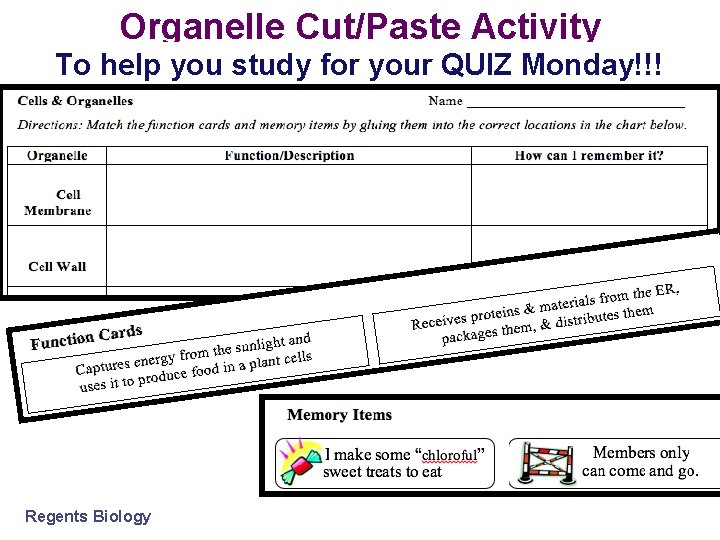
Organelle Cut/Paste Activity To help you study for your QUIZ Monday!!! Regents Biology
Exit Ticket OR Homework 1. What’s an example of passive transport? 2. What are the different types of solutions (3) a cell can be in? 3. What are the 2 examples of Active Transport? 4. What’s the key structure (organelle) all types of transport have in common? Regents Biology
Critical Question Explain what happens to the cells in a salt water fish if placed in fresh water. Regents Biology
Appling A young woman decides to go for a hike in Yellowstone National Park on a summer day. She brings: 1. a water bottle, 2. protein bar, 3. hat, 4. some sunscreen and 5. bear repellant. Before her hike, she has a very good breakfast including eggs, oatmeal, fruit, and orange juice. At the beginning the 9 am hike, the day is cool and she’s wearing shorts, a t-shirt, and a light jacket. By noon, she has hiked 5 miles, it is 95 degrees, and very sunny. Regents Biology Describe what cellular processes are occurring to the woman during the day. 1. What occurs inside her body after eating breakfast? 2. What occurs inside her body as she starts her hike? 3. What occurs inside her body as the day warms, and how might she respond to this? 4. At noon, what may be occurring at a cellular and body level, and why? Within your group, answer the questions, brainstorm, and create a list of what may be occurring at both the cellular & body level for this woman. Create your list in your Engage Student Handout. Once your group has completed your list, raise your hand.
- Slides: 15