
Examples of Organic Halides 2 3 dichloro2 3
- Slides: 16
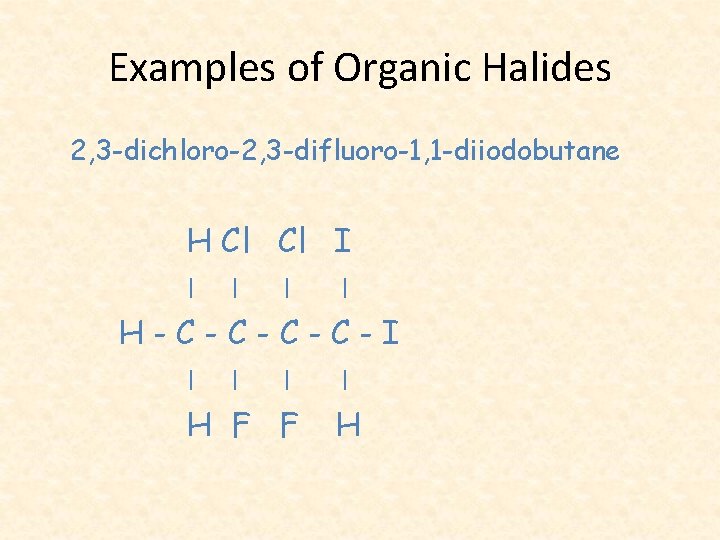
Examples of Organic Halides 2, 3 -dichloro-2, 3 -difluoro-1, 1 -diiodobutane H Cl Cl I I I H-C-C-I I I H F F H
Ozone Depletion • An environmental concern has been raised by this type of reaction, which ends up producing products known as chlorofluorocarbons (CFC’s). • These molecules have been used widely in foam products, as aerosol propellants and refrigerator/air conditioning coolants. • Their use has been banned in the last 10 years or so but they are still present in many older refrigerators and AC units. • Proper disposal of these appliances is essential to prevent further release of CFC’s.
• CFC’s react in the atmosphere to destroy ozone molecules. • As a result of this destruction, deadly UV radiation passes through our atmosphere and causes skin cancer. • CFC’s have also been identified as a greenhouse gas and are so contributing to global warming.
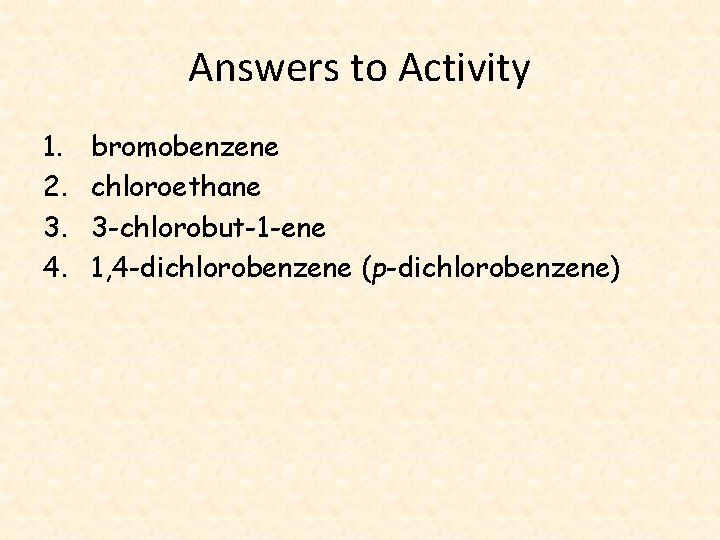
Answers to Activity 1. 2. 3. 4. bromobenzene chloroethane 3 -chlorobut-1 -ene 1, 4 -dichlorobenzene (p-dichlorobenzene)
Organic Halide Reactions • Halocarbons are chemically reactive. • They are involved in a number of different reactions such as addition, substitution and elimination. • We will look at elimination reactions after looking at alcohols.
Addition Reactions • These occur when a substance is added to double or triple bonds in alkenes or alkynes, since these bonds are reactive. • Addition reactions add a new functional group to a compound.
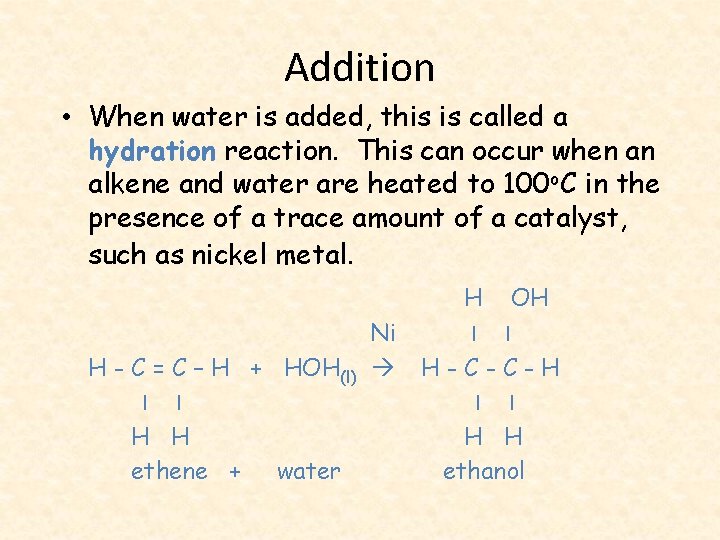
Addition • When water is added, this is called a hydration reaction. This can occur when an alkene and water are heated to 100 o. C in the presence of a trace amount of a catalyst, such as nickel metal. H - C = C – H + HOH(l) I I H H ethene + water Ni H OH I I H-C-C-H I I H H ethanol
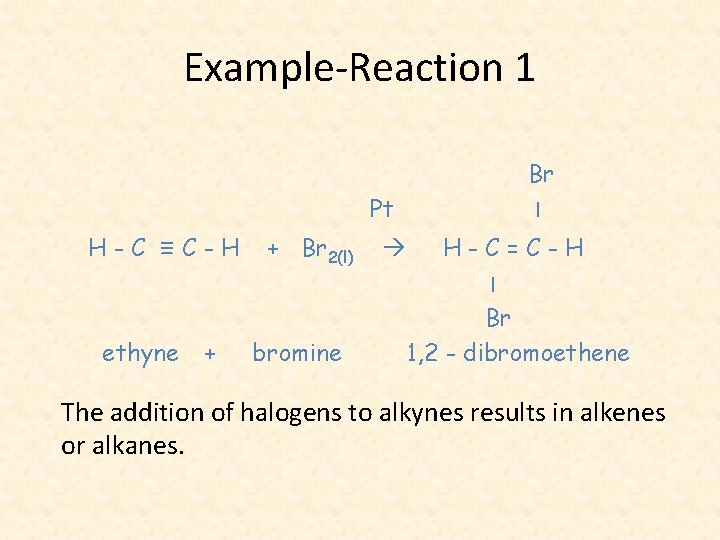
Test for Unsaturation • The addition of bromine to the carbon double or triple bonds is often used as a test for unsaturated organic molecules. • Bromine has a brownish-orange colour. • The loss of this colour when bromine is added to an organic compound is a positive test for unsaturation. • Although benzene has double bonds, it is stable and does not give a positive test for unsaturation with bromine.
Example-Reaction 1 Pt H-C ≡C-H ethyne + + Br 2(l) bromine Br I H-C=C-H I Br 1, 2 - dibromoethene The addition of halogens to alkynes results in alkenes or alkanes.
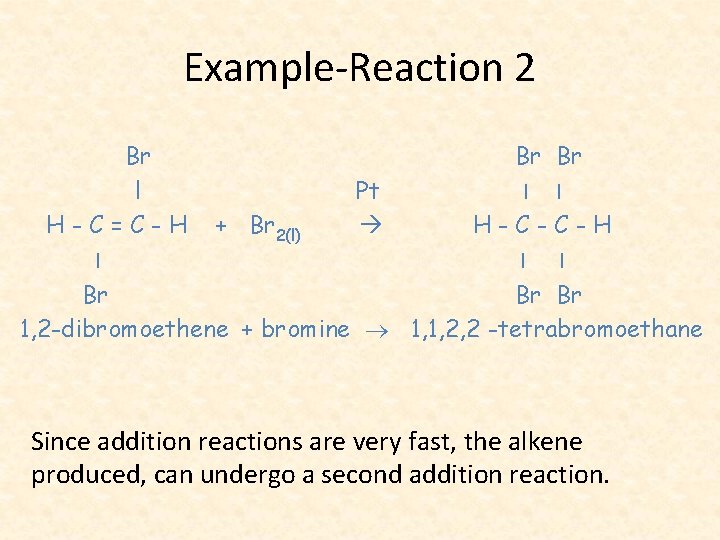
Example-Reaction 2 Br Br Br l Pt I I H - C = C - H + Br 2(l) H-C-C-H I I I Br Br Br 1, 2 -dibromoethene + bromine 1, 1, 2, 2 -tetrabromoethane Since addition reactions are very fast, the alkene produced, can undergo a second addition reaction.
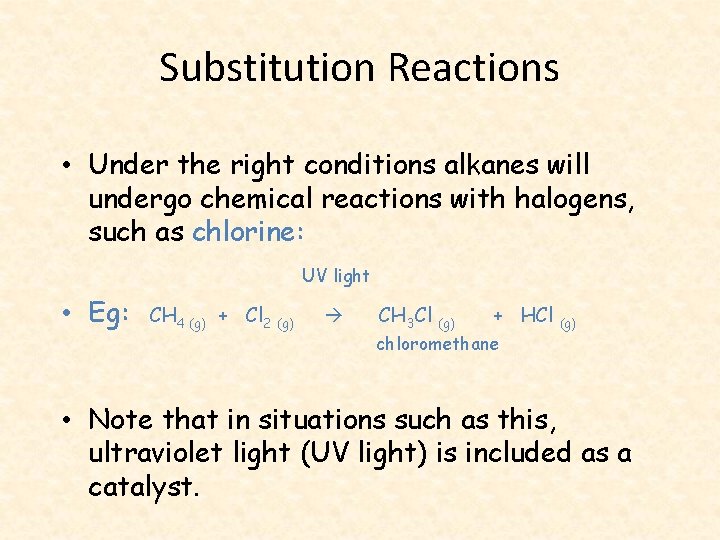
Substitution Reactions • Under the right conditions alkanes will undergo chemical reactions with halogens, such as chlorine: UV light • Eg: CH 4 (g) + Cl 2 (g) CH 3 Cl (g) + HCl chloromethane (g) • Note that in situations such as this, ultraviolet light (UV light) is included as a catalyst.
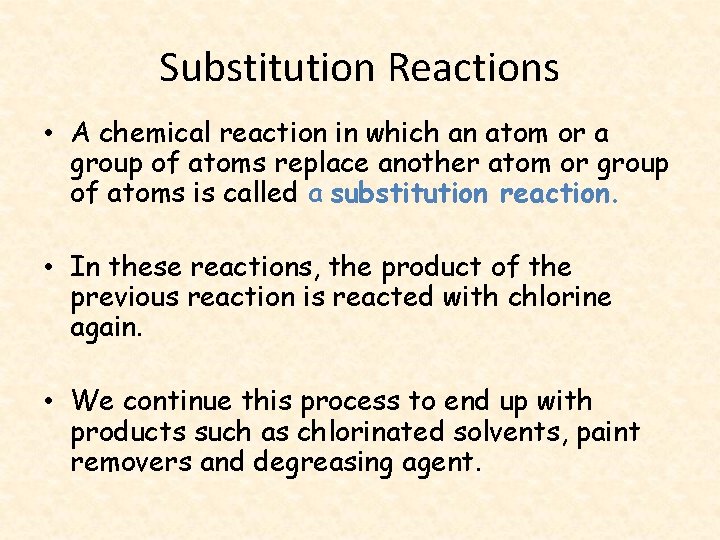
Substitution Reactions • A chemical reaction in which an atom or a group of atoms replace another atom or group of atoms is called a substitution reaction. • In these reactions, the product of the previous reaction is reacted with chlorine again. • We continue this process to end up with products such as chlorinated solvents, paint removers and degreasing agent.
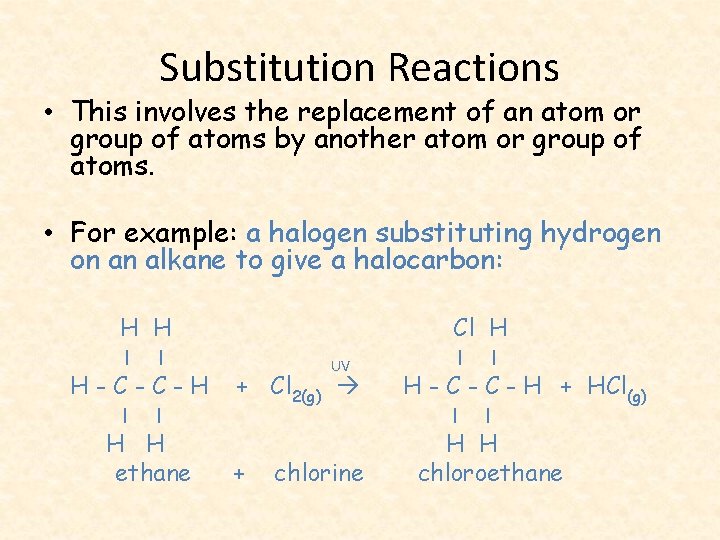
Substitution Reactions • This involves the replacement of an atom or group of atoms by another atom or group of atoms. • For example: a halogen substituting hydrogen on an alkane to give a halocarbon: H H I I H-C-C-H I I H H ethane UV + Cl 2(g) + chlorine Cl H I I H - C - H + HCl(g) I I H H chloroethane
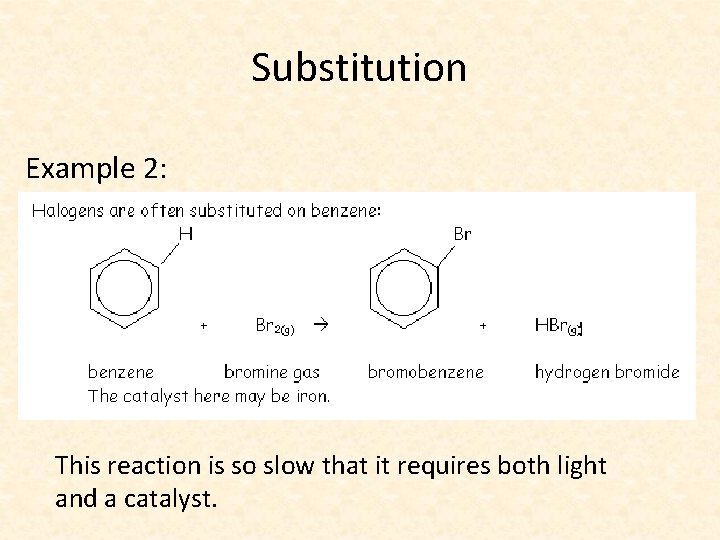
Substitution Example 2: This reaction is so slow that it requires both light and a catalyst.
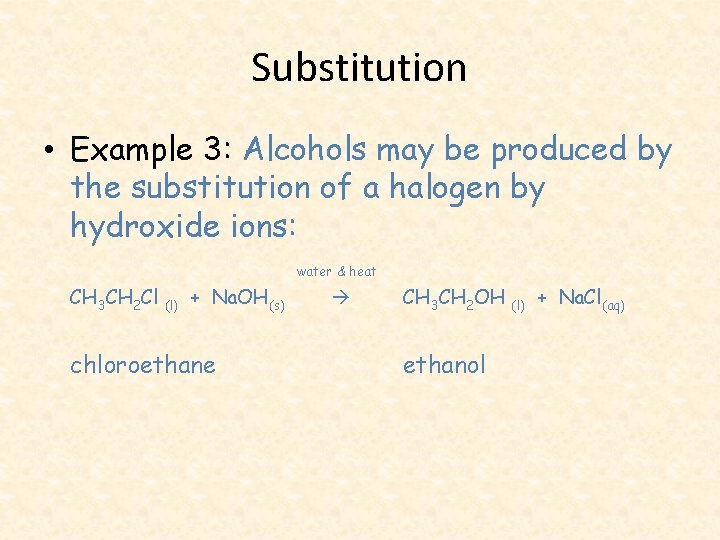
Substitution • Example 3: Alcohols may be produced by the substitution of a halogen by hydroxide ions: water & heat CH 3 CH 2 Cl (l) + Na. OH(s) chloroethane CH 3 CH 2 OH (l) + Na. Cl(aq) ethanol
Activity • Section 10. 2 Questions 2 -5 & 7.