
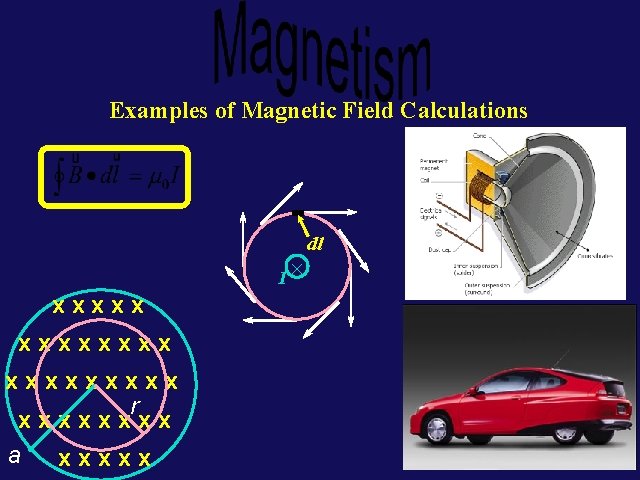
Examples of Magnetic Field Calculations I xxxxxxxx r



- Slides: 25
Examples of Magnetic Field Calculations I xxxxxxxx r xxxx a xxxxx ´ dl
Today. . . Example B-field Calculations: • Infinite Straight Wire revisited • Inside a Long Straight Wire • Infinite Current Sheet • Solenoid – with applications! • Toroid
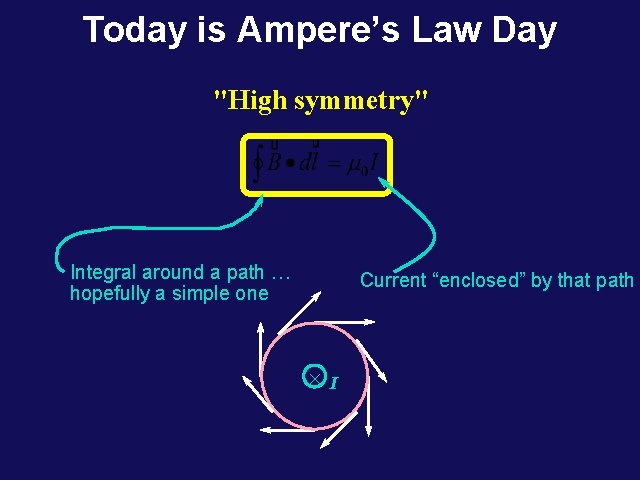
Today is Ampere’s Law Day "High symmetry" Integral around a path … hopefully a simple one Current “enclosed” by that path ´ I
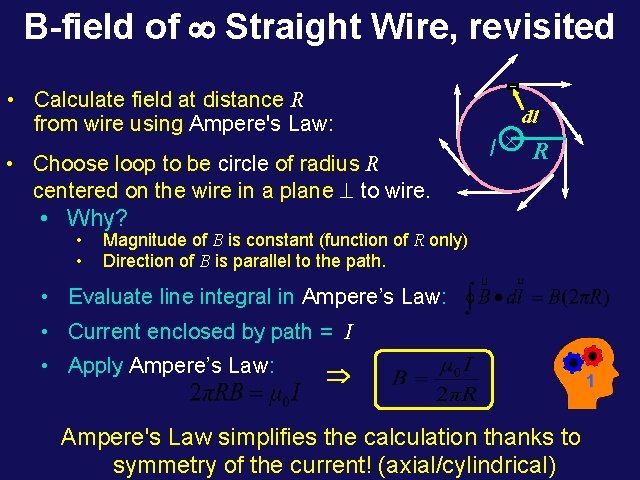
B-field of ¥ Straight Wire, revisited • Calculate field at distance R from wire using Ampere's Law: • Choose loop to be circle of radius R centered on the wire in a plane ^ to wire. dl I´ R • Why? • • Magnitude of B is constant (function of R only) Direction of B is parallel to the path. • Evaluate line integral in Ampere’s Law: • Current enclosed by path = I • Apply Ampere’s Law: Þ Ampere's Law simplifies the calculation thanks to symmetry of the current! (axial/cylindrical)
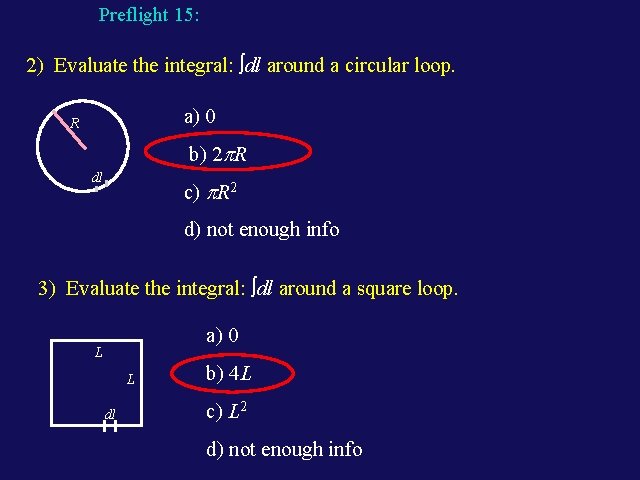
Preflight 15: 2) Evaluate the integral: dl around a circular loop. a) 0 R b) 2 R dl c) R 2 d) not enough info 3) Evaluate the integral: dl around a square loop. a) 0 L L dl b) 4 L c) L 2 d) not enough info
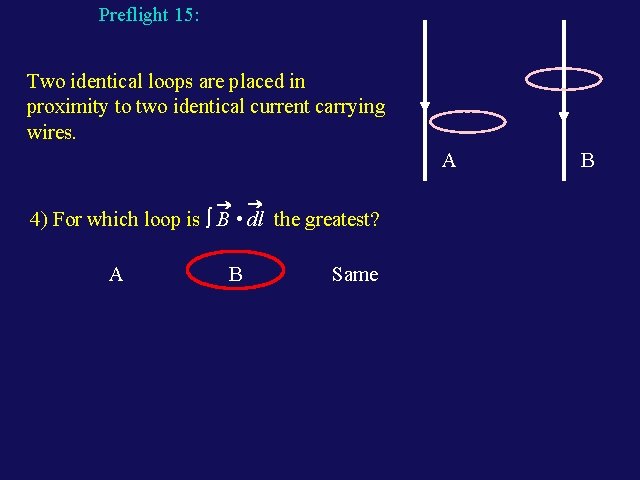
Preflight 15: Two identical loops are placed in proximity to two identical current carrying wires. A 4) For which loop is B • dl the greatest? A B Same B
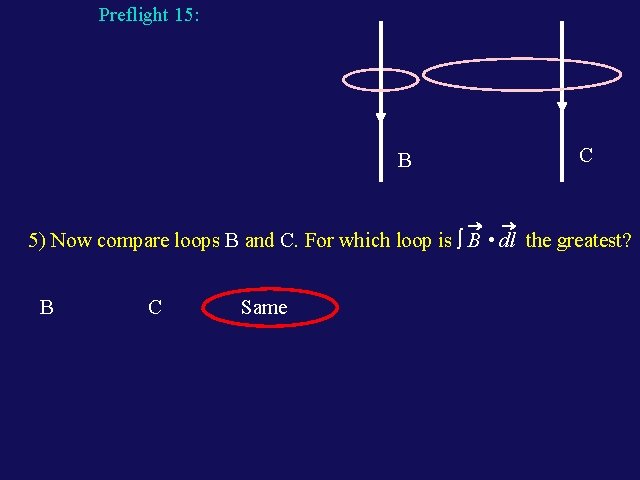
Preflight 15: C B 5) Now compare loops B and C. For which loop is B • dl the greatest? B C Same
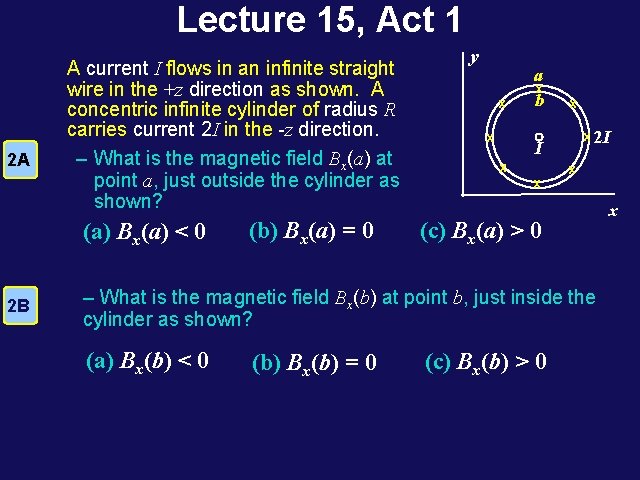
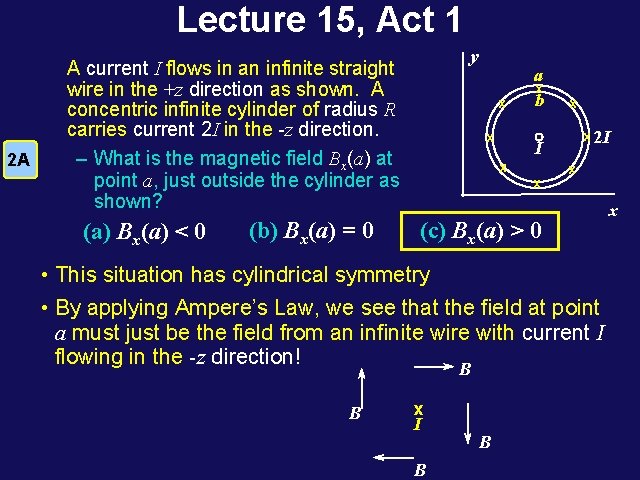
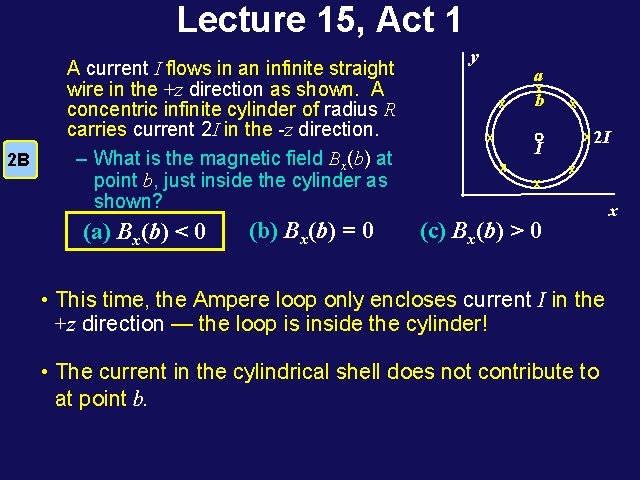
Lecture 15, Act 1 2 A A current I flows in an infinite straight wire in the +z direction as shown. A concentric infinite cylinder of radius R carries current 2 I in the -z direction. – What is the magnetic field Bx(a) at point a, just outside the cylinder as shown? (a) Bx(a) < 0 2 B (b) Bx(a) = 0 y x x a x b x x 2 I I x x x (c) Bx(a) > 0 – What is the magnetic field Bx(b) at point b, just inside the cylinder as shown? (a) Bx(b) < 0 (b) Bx(b) = 0 (c) Bx(b) > 0 x
Lecture 15, Act 1 2 A y A current I flows in an infinite straight wire in the +z direction as shown. A concentric infinite cylinder of radius R carries current 2 I in the -z direction. – What is the magnetic field Bx(a) at point a, just outside the cylinder as shown? (a) Bx(a) < 0 (b) Bx(a) = 0 x x a x b x x 2 I I x x x (c) Bx(a) > 0 • This situation has cylindrical symmetry • By applying Ampere’s Law, we see that the field at point a must just be the field from an infinite wire with current I flowing in the -z direction! B B x I B B x
Lecture 15, Act 1 2 B A current I flows in an infinite straight wire in the +z direction as shown. A concentric infinite cylinder of radius R carries current 2 I in the -z direction. – What is the magnetic field Bx(b) at point b, just inside the cylinder as shown? (a) Bx(b) < 0 (b) Bx(b) = 0 y x x a x b x x 2 I I x x x (c) Bx(b) > 0 • This time, the Ampere loop only encloses current I in the +z direction — the loop is inside the cylinder! • The current in the cylindrical shell does not contribute to at point b. x
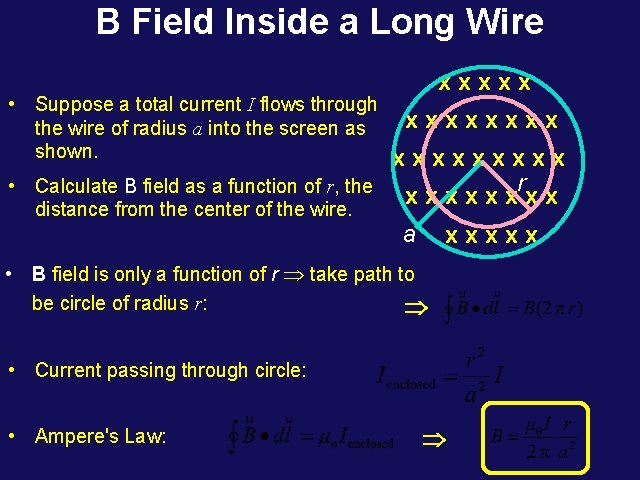
B Field Inside a Long Wire xxxxx • Suppose a total current I flows through xxxx the wire of radius a into the screen as shown. xxxxx r • Calculate B field as a function of r, the xxxx distance from the center of the wire. a xxxxx • B field is only a function of r Þ take path to be circle of radius r: Þ • Current passing through circle: • Ampere's Law: Þ
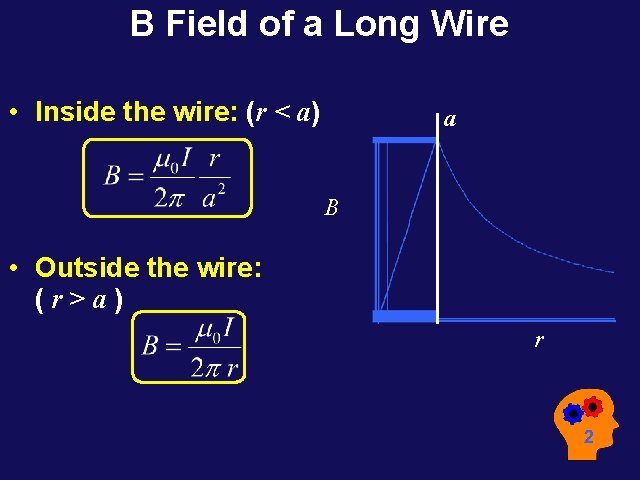
B Field of a Long Wire • Inside the wire: (r < a) a B • Outside the wire: (r>a) r
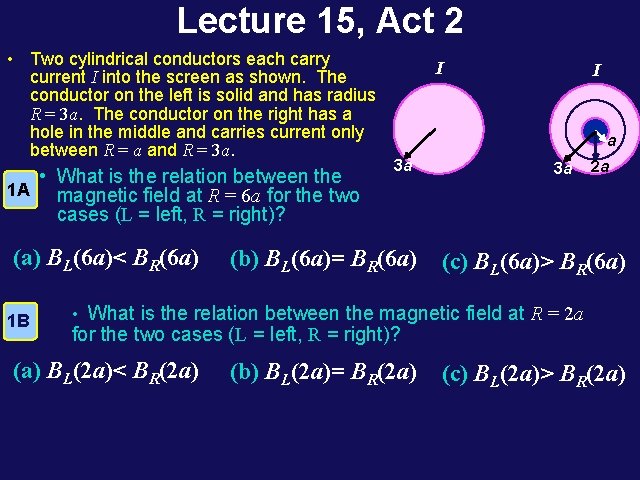
Lecture 15, Act 2 • Two cylindrical conductors each carry current I into the screen as shown. The conductor on the left is solid and has radius R = 3 a. The conductor on the right has a hole in the middle and carries current only between R = a and R = 3 a. • What is the relation between the 1 A magnetic field at R = 6 a for the two cases (L = left, R = right)? (a) BL(6 a)< BR(6 a) 1 B I I a 3 a (b) BL(6 a)= BR(6 a) 3 a 2 a (c) BL(6 a)> BR(6 a) • What is the relation between the magnetic field at R = 2 a for the two cases (L = left, R = right)? (a) BL(2 a)< BR(2 a) (b) BL(2 a)= BR(2 a) (c) BL(2 a)> BR(2 a)
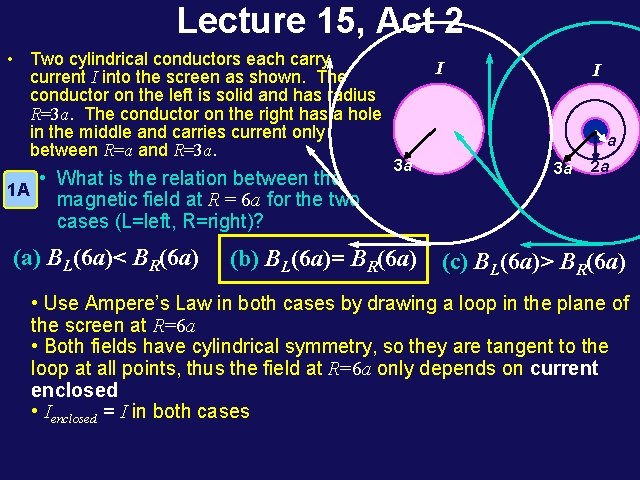
Lecture 15, Act 2 • Two cylindrical conductors each carry current I into the screen as shown. The conductor on the left is solid and has radius R=3 a. The conductor on the right has a hole in the middle and carries current only between R=a and R=3 a. 1 A • What is the relation between the magnetic field at R = 6 a for the two cases (L=left, R=right)? (a) BL(6 a)< BR(6 a) I I a 3 a (b) BL(6 a)= BR(6 a) 3 a 2 a (c) BL(6 a)> BR(6 a) • Use Ampere’s Law in both cases by drawing a loop in the plane of the screen at R=6 a • Both fields have cylindrical symmetry, so they are tangent to the loop at all points, thus the field at R=6 a only depends on current enclosed • Ienclosed = I in both cases
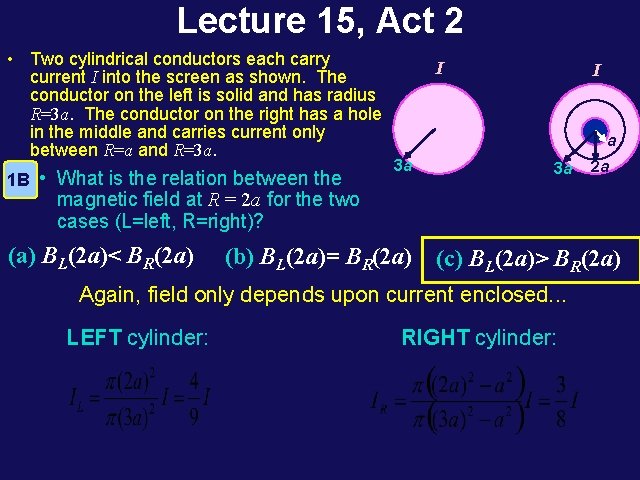
Lecture 15, Act 2 • Two cylindrical conductors each carry current I into the screen as shown. The conductor on the left is solid and has radius R=3 a. The conductor on the right has a hole in the middle and carries current only between R=a and R=3 a. 1 B • What is the relation between the I I a 3 a 3 a 2 a magnetic field at R = 2 a for the two cases (L=left, R=right)? (a) BL(2 a)< BR(2 a) (b) BL(2 a)= BR(2 a) (c) BL(2 a)> BR(2 a) Again, field only depends upon current enclosed. . . LEFT cylinder: RIGHT cylinder:
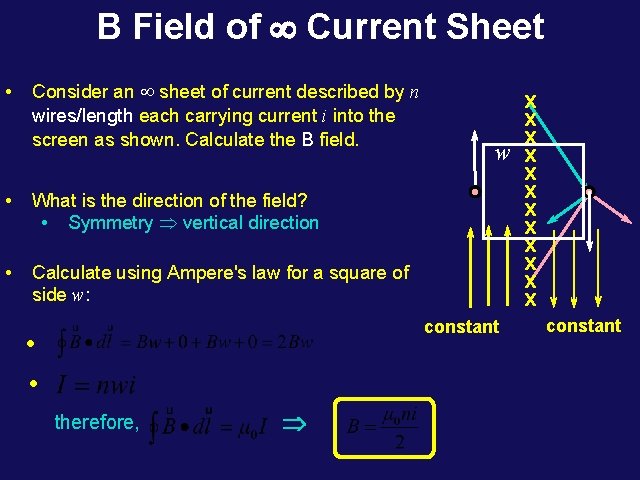
B Field of ¥ Current Sheet • Consider an ¥ sheet of current described by n wires/length each carrying current i into the screen as shown. Calculate the B field. • What is the direction of the field? • Symmetry Þ vertical direction • Calculate using Ampere's law for a square of side w: x x x w x x x x x constant • • therefore, Þ constant
B Field of a Solenoid • A constant magnetic field can (in principle) be produced by an ¥ sheet of current. In practice, however, a constant magnetic field is often produced by a solenoid. • A solenoid is defined by a current i flowing through a wire that is wrapped n turns per unit length on a cylinder of radius a and length L. L a • To correctly calculate the B-field, we should use Biot-Savart, and add up the field from the different loops. • If a << L, the B field is to first order contained within the solenoid, in the axial direction, and of constant magnitude. In this limit, we can calculate the field using Ampere's Law.
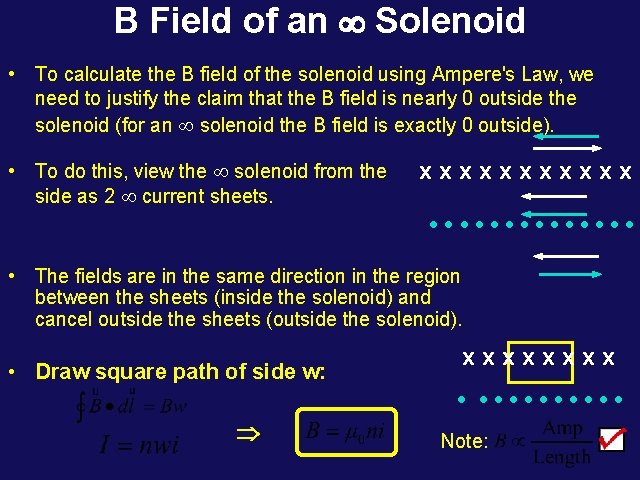
B Field of an ¥ Solenoid • To calculate the B field of the solenoid using Ampere's Law, we need to justify the claim that the B field is nearly 0 outside the solenoid (for an ¥ solenoid the B field is exactly 0 outside). • To do this, view the ¥ solenoid from the side as 2 ¥ current sheets. xxxxxx • • • • • The fields are in the same direction in the region between the sheets (inside the solenoid) and cancel outside the sheets (outside the solenoid). • Draw square path of side w: xxxx • • • • • • Þ Note:
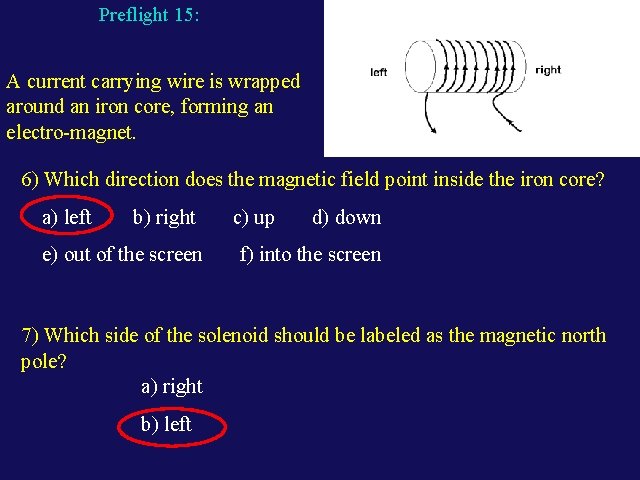
Preflight 15: A current carrying wire is wrapped around an iron core, forming an electro-magnet. 6) Which direction does the magnetic field point inside the iron core? a) left b) right e) out of the screen c) up d) down f) into the screen 7) Which side of the solenoid should be labeled as the magnetic north pole? a) right b) left
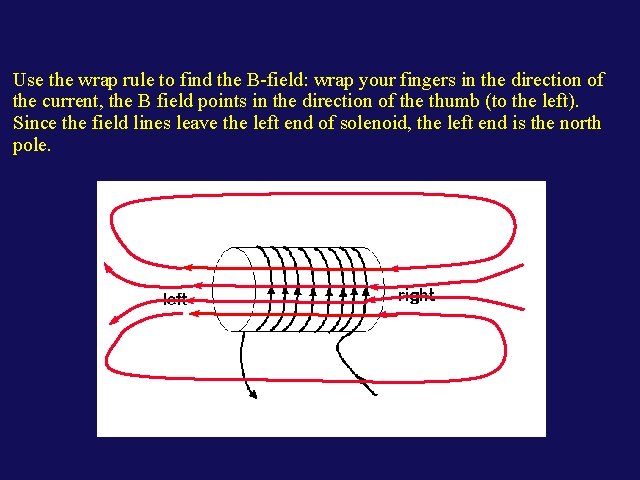
Use the wrap rule to find the B-field: wrap your fingers in the direction of the current, the B field points in the direction of the thumb (to the left). Since the field lines leave the left end of solenoid, the left end is the north pole.
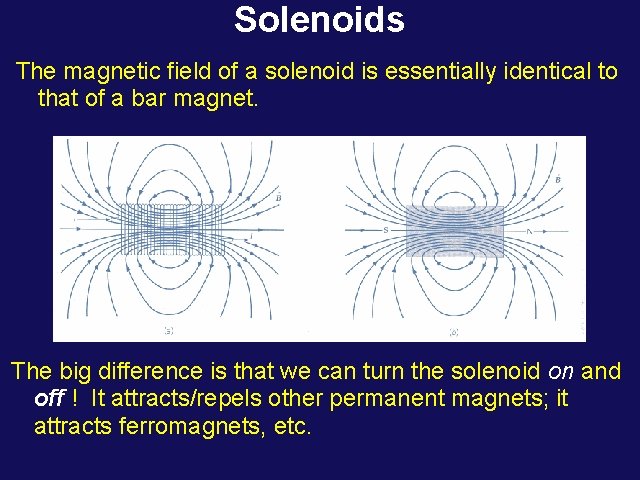
Solenoids The magnetic field of a solenoid is essentially identical to that of a bar magnet. The big difference is that we can turn the solenoid on and off ! It attracts/repels other permanent magnets; it attracts ferromagnets, etc.
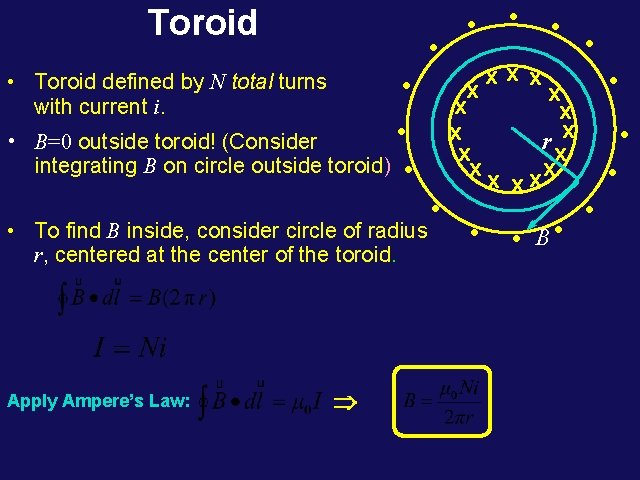
Toroid • • Toroid defined by N total turns with current i. • Apply Ampere’s Law: Þ • • • xx x x xx • • B=0 outside toroid! (Consider integrating B on circle outside toroid) • • To find B inside, consider circle of radius r, centered at the center of the toroid. • • • x x r x x xx • B • •
Solenoid Applications Digital [on/off]: • Doorbells Magnet off plunger held in place by spring Magnet on plunger expelled strikes bell • Power door locks • Magnetic cranes • Electronic Switch “relay” Close switch current magnetic field pulls in plunger closes larger circuit Advantage: A small current can be used to switch a much larger one – Starter in washer/dryer, car ignition, …
Solenoid Applications Analog (deflection µ I ): • Variable A/C valves • Speakers Solenoids are everywhere! In fact, a typical car has over 20 solenoids!
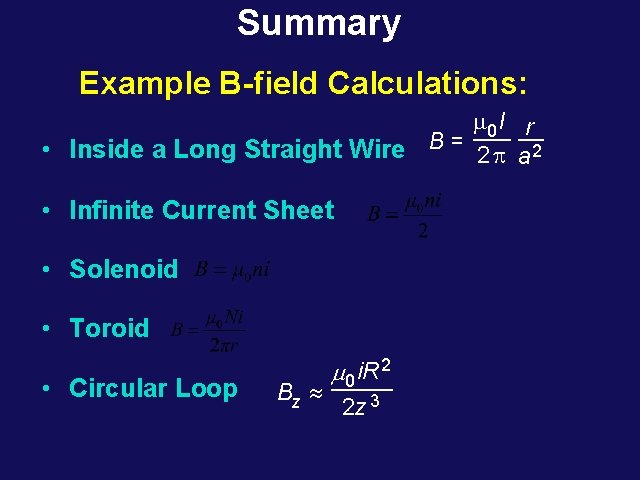
Summary Example B-field Calculations: • Inside a Long Straight Wire • Infinite Current Sheet • Solenoid • Toroid • Circular Loop Bz » m 0 i. R 2 2 z 3 m 0 I r B= 2 p a 2