
Examples of JI Track 1 procedures Zsolt Lengyel



- Slides: 12
Example(s) of JI Track 1 procedures Zsolt Lengyel Senter. Novem Carboncredits. nl UNFCCC Technical Workshop on JI, Bonn, 13 -14 February 2007 UNFCCC technical worskhop on JI - Bonn
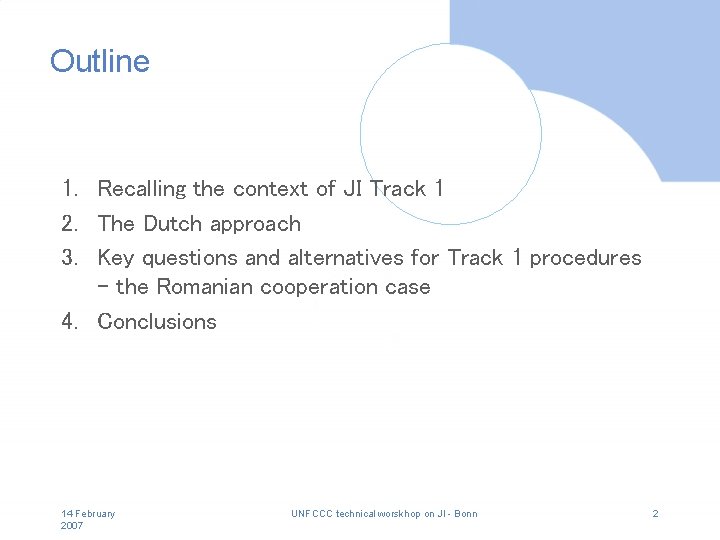
Outline 1. Recalling the context of JI Track 1 2. The Dutch approach 3. Key questions and alternatives for Track 1 procedures – the Romanian cooperation case 4. Conclusions 14 February 2007 UNFCCC technical worskhop on JI - Bonn 2
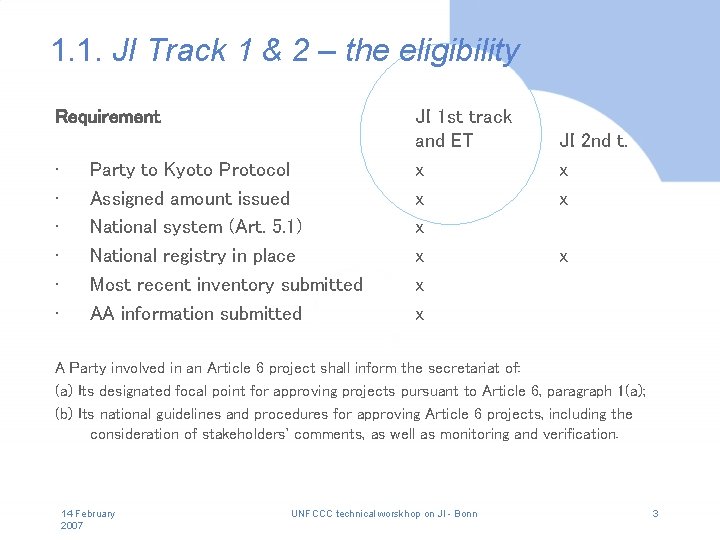
1. 1. JI Track 1 & 2 – the eligibility Requirement • • • Party to Kyoto Protocol Assigned amount issued National system (Art. 5. 1) National registry in place Most recent inventory submitted AA information submitted JI 1 st track and ET x x x JI 2 nd t. x x x A Party involved in an Article 6 project shall inform the secretariat of: (a) Its designated focal point for approving projects pursuant to Article 6, paragraph 1(a); (b) Its national guidelines and procedures for approving Article 6 projects, including the consideration of stakeholders' comments, as well as monitoring and verification. 14 February 2007 UNFCCC technical worskhop on JI - Bonn 3
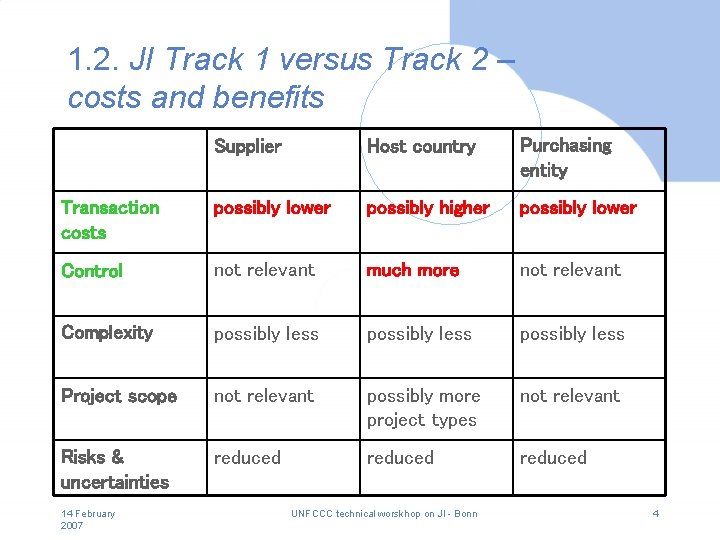
1. 2. JI Track 1 versus Track 2 – costs and benefits Supplier Host country Purchasing entity Transaction costs possibly lower possibly higher possibly lower Control not relevant much more not relevant Complexity possibly less Project scope not relevant possibly more project types not relevant Risks & uncertainties reduced 14 February 2007 UNFCCC technical worskhop on JI - Bonn 4
2. 1. A pragmatic approach from the purchaser’s perspective Strategic focus for investigating and facilitating the Track 1 route in countries where: • the ERU-AAU volumes are high, • where the projects that are at high Track 2 risk • where the preparedness and eligibility for Track 1 JI is at least medium and • where the host country itself is either willing or undecided about Track 1. 14 February 2007 UNFCCC technical worskhop on JI - Bonn 5
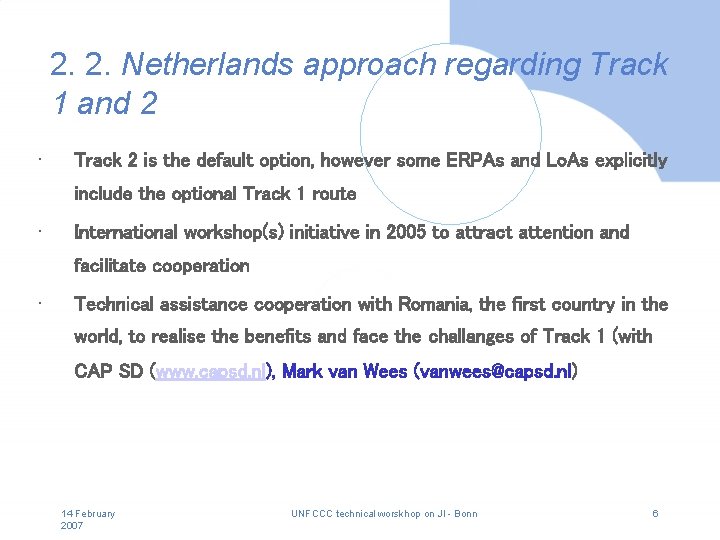
2. 2. Netherlands approach regarding Track 1 and 2 • Track 2 is the default option, however some ERPAs and Lo. As explicitly include the optional Track 1 route • International workshop(s) initiative in 2005 to attract attention and facilitate cooperation • Technical assistance cooperation with Romania, the first country in the world, to realise the benefits and face the challanges of Track 1 (with CAP SD (www. capsd. nl), Mark van Wees (vanwees@capsd. nl) 14 February 2007 UNFCCC technical worskhop on JI - Bonn 6
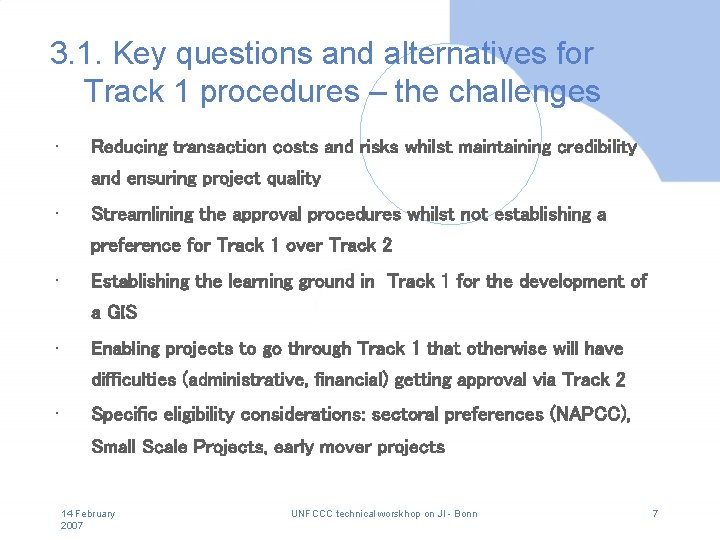
3. 1. Key questions and alternatives for Track 1 procedures – the challenges • Reducing transaction costs and risks whilst maintaining credibility and ensuring project quality • Streamlining the approval procedures whilst not establishing a preference for Track 1 over Track 2 • Establishing the learning ground in Track 1 for the development of a GIS • Enabling projects to go through Track 1 that otherwise will have difficulties (administrative, financial) getting approval via Track 2 • Specific eligibility considerations: sectoral preferences (NAPCC), Small Scale Projects, early mover projects 14 February 2007 UNFCCC technical worskhop on JI - Bonn 7
3. 2. Key questions and alternatives for Track 1 procedures – the procedural modality suggestions The 1188/2006 GD defines the governmental Lo. A issuance in a two stage (Lo. E and Lo. A) approval process for Track 2 projects not restricting “track switching”. Additional action and decision points after the Lo. A stage for Track 1 projects has to be established, these are as follows: 1. Review of monitoring and its verification (NEPA/NCCC) 2. Issuance of ERUs (MEWM) Track 1 = Track 2 without JISC? ! 14 February 2007 UNFCCC technical worskhop on JI - Bonn 8
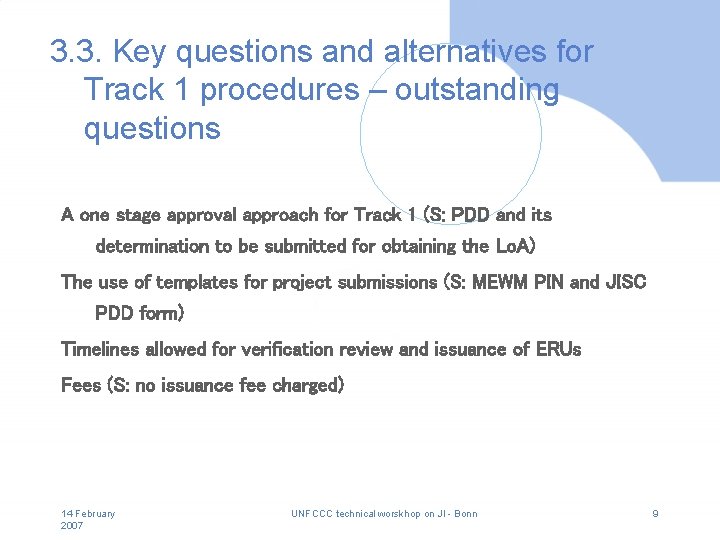
3. 3. Key questions and alternatives for Track 1 procedures – outstanding questions A one stage approval approach for Track 1 (S: PDD and its determination to be submitted for obtaining the Lo. A) The use of templates for project submissions (S: MEWM PIN and JISC PDD form) Timelines allowed for verification review and issuance of ERUs Fees (S: no issuance fee charged) 14 February 2007 UNFCCC technical worskhop on JI - Bonn 9
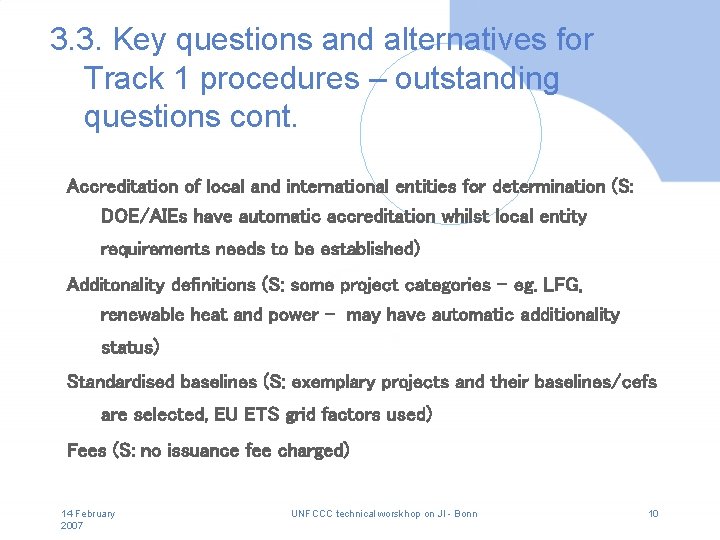
3. 3. Key questions and alternatives for Track 1 procedures – outstanding questions cont. Accreditation of local and international entities for determination (S: DOE/AIEs have automatic accreditation whilst local entity requirements needs to be established) Additonality definitions (S: some project categories – eg. LFG, renewable heat and power - may have automatic additionality status) Standardised baselines (S: exemplary projects and their baselines/cefs are selected, EU ETS grid factors used) Fees (S: no issuance fee charged) 14 February 2007 UNFCCC technical worskhop on JI - Bonn 10
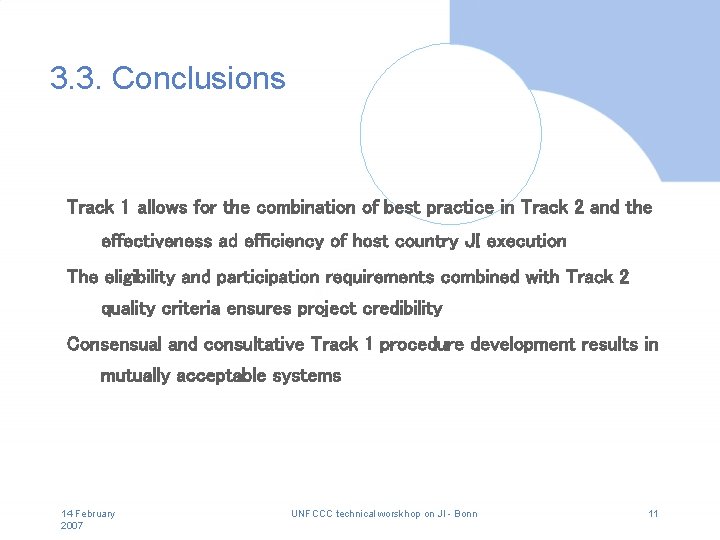
3. 3. Conclusions Track 1 allows for the combination of best practice in Track 2 and the effectiveness ad efficiency of host country JI execution The eligibility and participation requirements combined with Track 2 quality criteria ensures project credibility Consensual and consultative Track 1 procedure development results in mutually acceptable systems 14 February 2007 UNFCCC technical worskhop on JI - Bonn 11
Contact details: Visiting address: Postal address: Catharijnesingel 59 3511 GG Utrecht The Netherlands Postbus 8242 3503 RE Utrecht The Netherlands Zsolt Lengyel Tel: +31 30 214 7829 Fax: +31 30 231 6491 z. lengyel@senternovem. nl Homepage: www. carboncredits. nl www. senternovem. org 14 February 2007 UNFCCC technical worskhop on JI - Bonn 12