
Examples of ITER CODAC requirements for diagnostics S

- Slides: 11
Examples of ITER CODAC requirements for diagnostics S. Arshad Colloquium on ITER-CODAC Plant Control Design Handbook and EU Procurement of Control and Instrumentation for ITER 28 October 2008 Colloquium on ITER-CODAC 28/29 October 2008 1
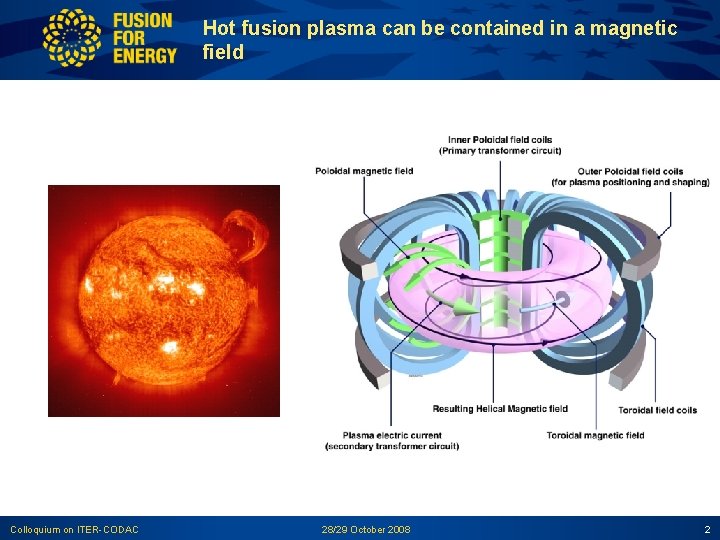
Hot fusion plasma can be contained in a magnetic field Colloquium on ITER-CODAC 28/29 October 2008 2
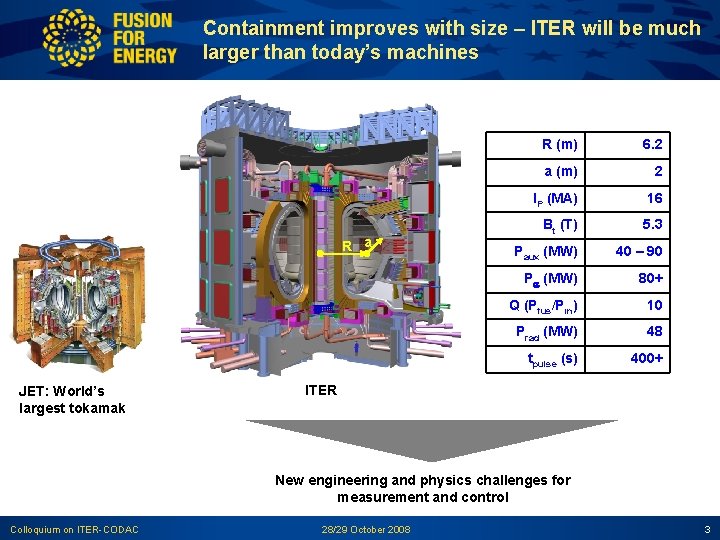
Containment improves with size – ITER will be much larger than today’s machines R a JET: World’s largest tokamak R (m) 6. 2 a (m) 2 IP (MA) 16 Bt (T) 5. 3 Paux (MW) 40 – 90 Pa (MW) 80+ Q (Pfus/Pin) 10 Prad (MW) 48 tpulse (s) 400+ ITER New engineering and physics challenges for measurement and control Colloquium on ITER-CODAC 28/29 October 2008 3
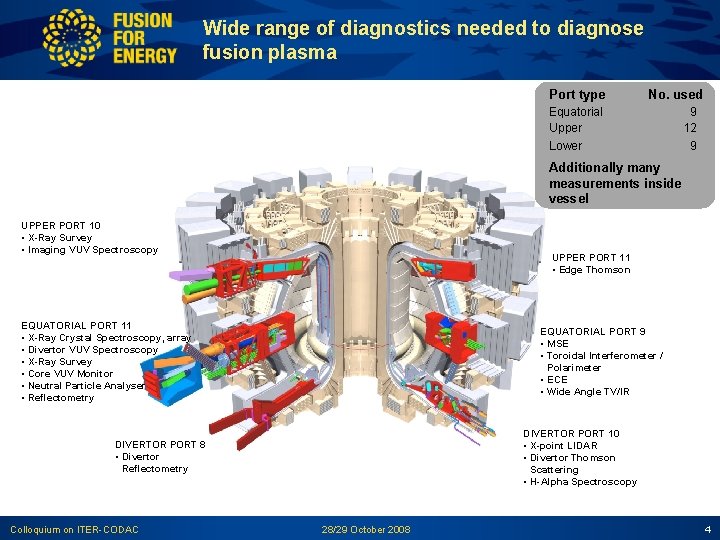
Wide range of diagnostics needed to diagnose fusion plasma Port type No. used Equatorial Upper Lower 9 12 9 Additionally many measurements inside vessel UPPER PORT 10 • X-Ray Survey • Imaging VUV Spectroscopy UPPER PORT 11 • Edge Thomson EQUATORIAL PORT 11 • X-Ray Crystal Spectroscopy, array • Divertor VUV Spectroscopy • X-Ray Survey • Core VUV Monitor • Neutral Particle Analyser • Reflectometry EQUATORIAL PORT 9 • MSE • Toroidal Interferometer / Polarimeter • ECE • Wide Angle TV/IR DIVERTOR PORT 10 • X-point LIDAR • Divertor Thomson Scattering • H-Alpha Spectroscopy DIVERTOR PORT 8 • Divertor Reflectometry Colloquium on ITER-CODAC 28/29 October 2008 4
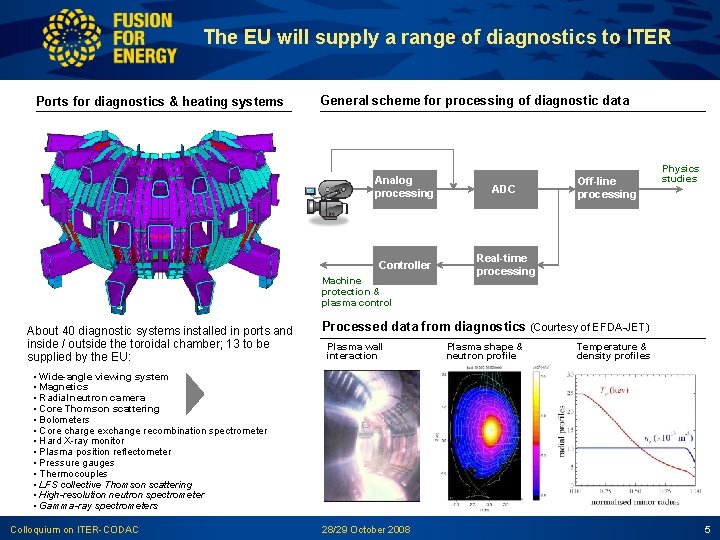
The EU will supply a range of diagnostics to ITER Ports for diagnostics & heating systems General scheme for processing of diagnostic data Analog processing ADC Controller Real-time processing Machine protection & plasma control About 40 diagnostic systems installed in ports and inside / outside the toroidal chamber; 13 to be supplied by the EU: Off-line processing Physics studies Processed data from diagnostics (Courtesy of EFDA-JET) Plasma wall interaction Plasma shape & neutron profile Temperature & density profiles • Wide-angle viewing system • Magnetics • Radial neutron camera • Core Thomson scattering • Bolometers • Core charge exchange recombination spectrometer • Hard X-ray monitor • Plasma position reflectometer • Pressure gauges • Thermocouples • LFS collective Thomson scattering • High-resolution neutron spectrometer • Gamma-ray spectrometers Colloquium on ITER-CODAC 28/29 October 2008 5
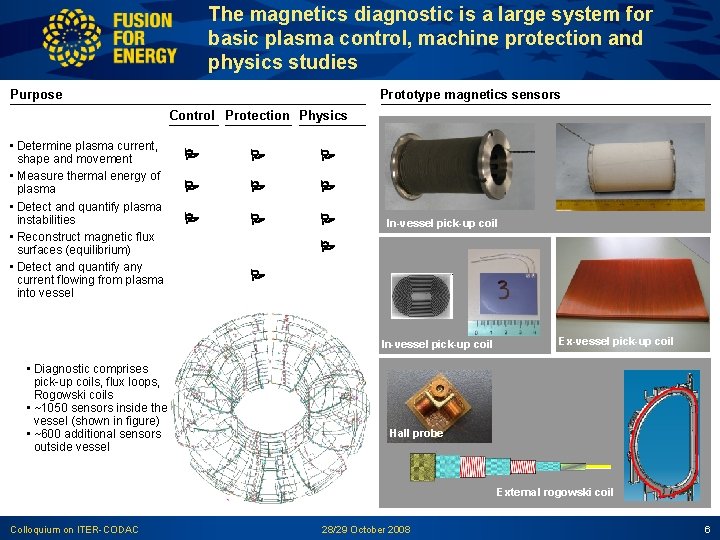
The magnetics diagnostic is a large system for basic plasma control, machine protection and physics studies Purpose Prototype magnetics sensors Control Protection Physics • Determine plasma current, shape and movement • Measure thermal energy of plasma • Detect and quantify plasma instabilities • Reconstruct magnetic flux surfaces (equilibrium) • Detect and quantify any current flowing from plasma into vessel In-vessel pick-up coil • Diagnostic comprises pick-up coils, flux loops, Rogowski coils • ~1050 sensors inside the vessel (shown in figure) • ~600 additional sensors outside vessel Ex-vessel pick-up coil Hall probe External rogowski coil Colloquium on ITER-CODAC 28/29 October 2008 6
Overview of magnetics signal processing Event triggers d. B/dt Int B Off-line processing Physics studies Real-time processing Control & protection ADC Amp • Around 1650 sensors in total • Digital or analogue integrators • Amplifiers d. B/dt • Slow (4 k. Hz) ADCs for basic equilibrium • Fast (1 MHz) ADCs for instabilities • Typically with optical isolation • Data stored for specialist off-line studies • Real-time signals distributed to other plant systems (power amplifiers for tokamak magnets, machine protection systems) ALL NUMBERS ARE INDICATIVE Colloquium on ITER-CODAC 28/29 October 2008 7
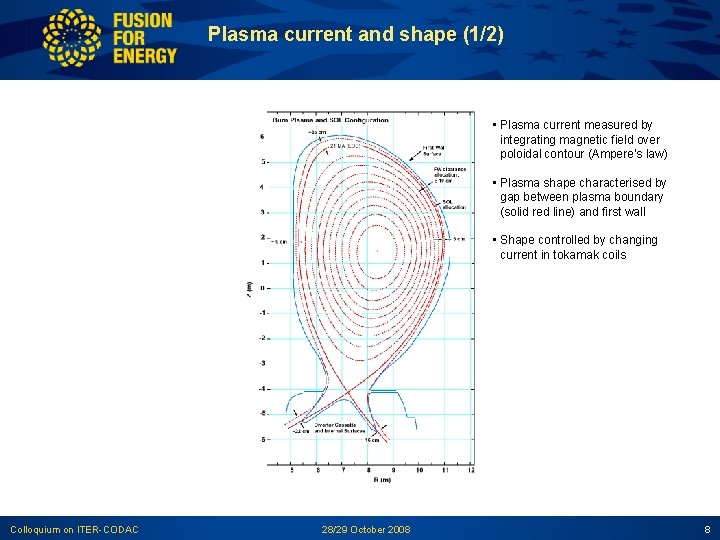
Plasma current and shape (1/2) • Plasma current measured by integrating magnetic field over poloidal contour (Ampere’s law) • Plasma shape characterised by gap between plasma boundary (solid red line) and first wall • Shape controlled by changing current in tokamak coils Colloquium on ITER-CODAC 28/29 October 2008 8
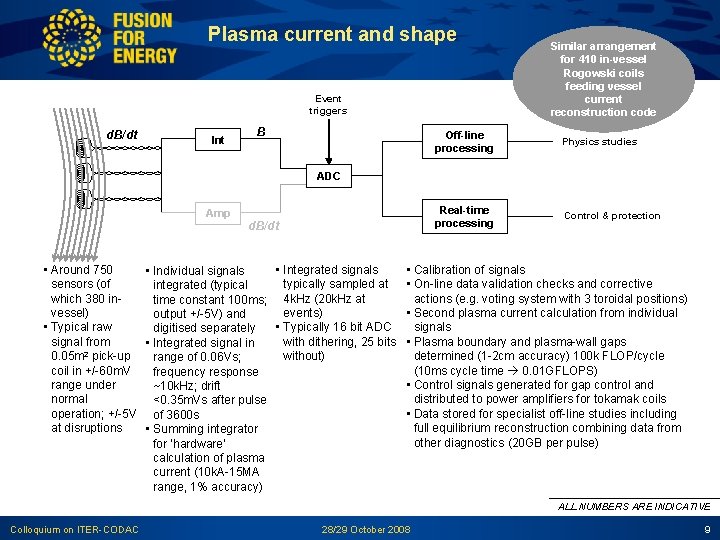
Plasma current and shape Event triggers d. B/dt Int B Similar arrangement for 410 in-vessel Rogowski coils feeding vessel current reconstruction code Off-line processing Physics studies Real-time processing Control & protection ADC Amp d. B/dt • Around 750 • Integrated signals • Individual signals sensors (of typically sampled at integrated (typical which 380 intime constant 100 ms; 4 k. Hz (20 k. Hz at vessel) events) output +/-5 V) and • Typical raw • Typically 16 bit ADC digitised separately signal from with dithering, 25 bits • Integrated signal in 2 0. 05 m pick-up without) range of 0. 06 Vs; coil in +/-60 m. V frequency response range under ~10 k. Hz; drift normal <0. 35 m. Vs after pulse operation; +/-5 V of 3600 s at disruptions • Summing integrator for ‘hardware’ calculation of plasma current (10 k. A-15 MA range, 1% accuracy) • Calibration of signals • On-line data validation checks and corrective actions (e. g. voting system with 3 toroidal positions) • Second plasma current calculation from individual signals • Plasma boundary and plasma-wall gaps determined (1 -2 cm accuracy) 100 k FLOP/cycle (10 ms cycle time 0. 01 GFLOPS) • Control signals generated for gap control and distributed to power amplifiers for tokamak coils • Data stored for specialist off-line studies including full equilibrium reconstruction combining data from other diagnostics (20 GB per pulse) ALL NUMBERS ARE INDICATIVE Colloquium on ITER-CODAC 28/29 October 2008 9
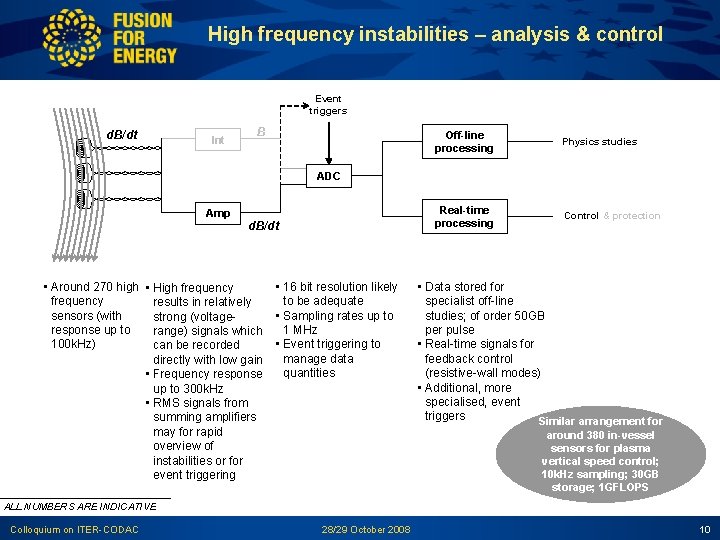
High frequency instabilities – analysis & control Event triggers d. B/dt Int B Off-line processing Physics studies Real-time processing Control & protection ADC Amp d. B/dt • Around 270 high • High frequency results in relatively sensors (with strong (voltageresponse up to range) signals which 100 k. Hz) can be recorded directly with low gain • Frequency response up to 300 k. Hz • RMS signals from summing amplifiers may for rapid overview of instabilities or for event triggering • 16 bit resolution likely to be adequate • Sampling rates up to 1 MHz • Event triggering to manage data quantities • Data stored for specialist off-line studies; of order 50 GB per pulse • Real-time signals for feedback control (resistive-wall modes) • Additional, more specialised, event triggers Similar arrangement for around 380 in-vessel sensors for plasma vertical speed control; 10 k. Hz sampling; 30 GB storage; 1 GFLOPS ALL NUMBERS ARE INDICATIVE Colloquium on ITER-CODAC 28/29 October 2008 10
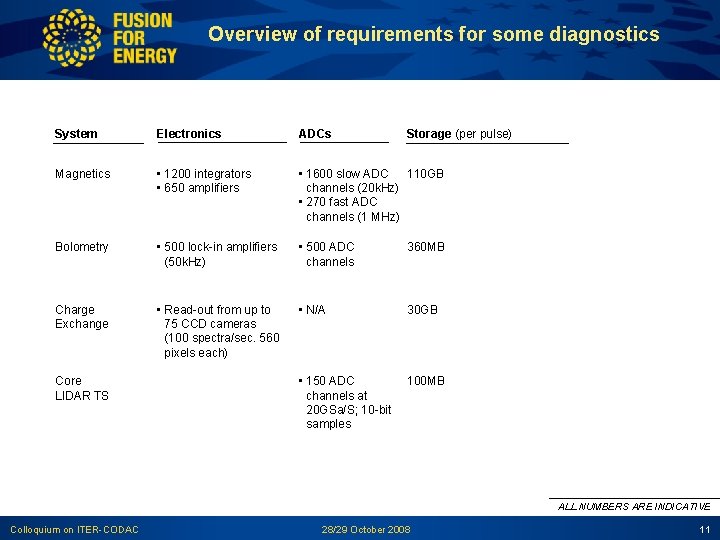
Overview of requirements for some diagnostics System Electronics ADCs Magnetics • 1200 integrators • 650 amplifiers • 1600 slow ADC 110 GB channels (20 k. Hz) • 270 fast ADC channels (1 MHz) Bolometry • 500 lock-in amplifiers (50 k. Hz) • 500 ADC channels 360 MB Charge Exchange • Read-out from up to 75 CCD cameras (100 spectra/sec. 560 pixels each) • N/A 30 GB • 150 ADC channels at 20 GSa/S; 10 -bit samples 100 MB Core LIDAR TS Storage (per pulse) ALL NUMBERS ARE INDICATIVE Colloquium on ITER-CODAC 28/29 October 2008 11