
Examples of Diffusion of Responsibility and Bystander Effect
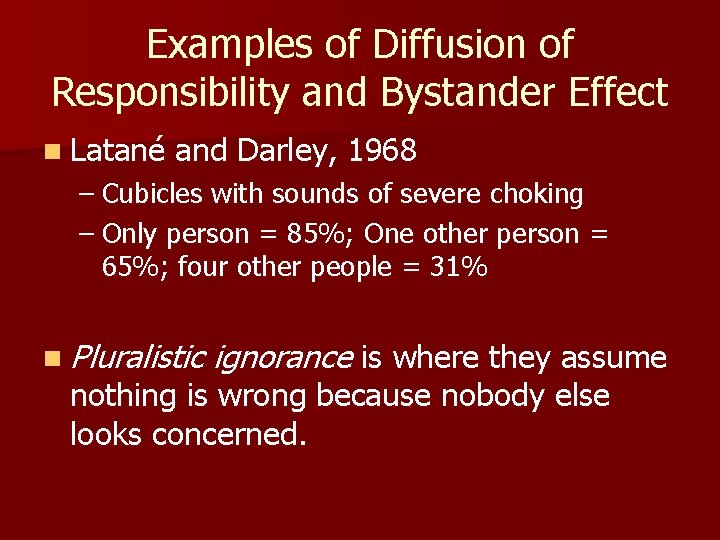
Examples of Diffusion of Responsibility and Bystander Effect n Latané and Darley, 1968 – Cubicles with sounds of severe choking – Only person = 85%; One other person = 65%; four other people = 31% n Pluralistic ignorance is where they assume nothing is wrong because nobody else looks concerned.

Conditions that strengthen conformity 1. Insecure, offering unwanted assistance or “losing face” in front bystanders § Behavior will be observed/judged 2. 3. 4. 5. Group that has at least three people The group is unanimous; look at other’s reactions in an emergency Group’s status is admirable No prior commitment to any response
Step 1 – Will the Bystander Help? n Is the incident noticeable for the bystander? n Are there a lot of people around? – Noise, distractions
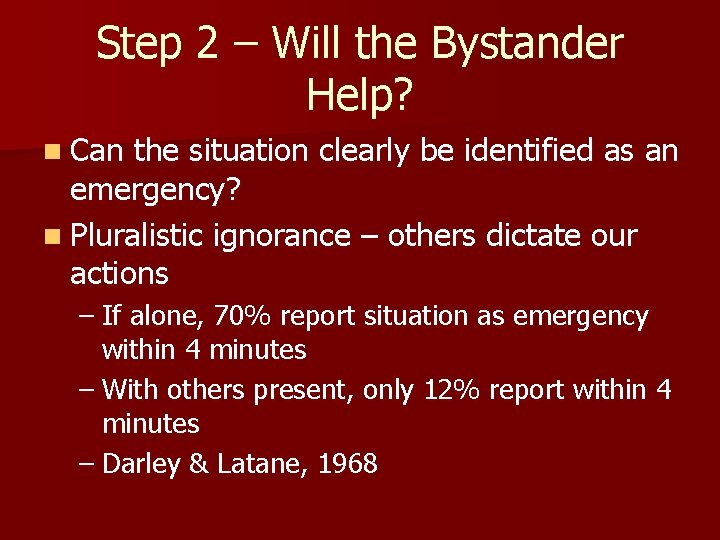
Step 2 – Will the Bystander Help? n Can the situation clearly be identified as an emergency? n Pluralistic ignorance – others dictate our actions – If alone, 70% report situation as emergency within 4 minutes – With others present, only 12% report within 4 minutes – Darley & Latane, 1968
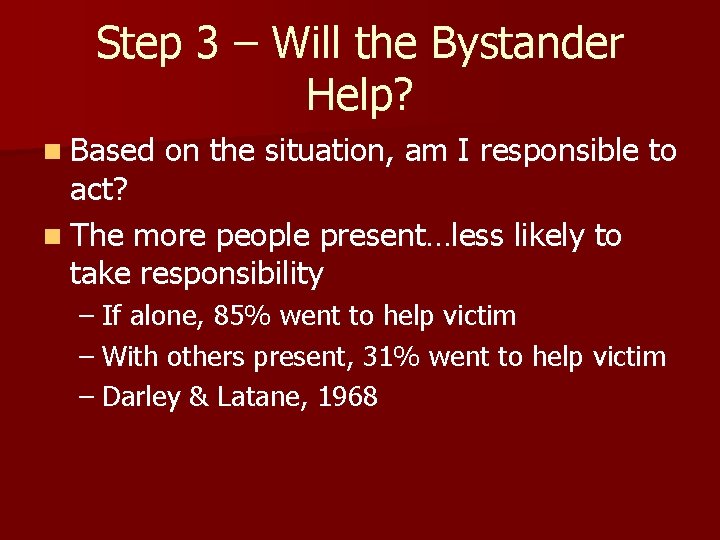
Step 3 – Will the Bystander Help? n Based on the situation, am I responsible to act? n The more people present…less likely to take responsibility – If alone, 85% went to help victim – With others present, 31% went to help victim – Darley & Latane, 1968
Step 4 – Will the Bystander Help? n Do I have skills/knowledge/some capacity to help the victim? n If answers to all steps are yes, then victim receives help – Situation noticeable? – Situation identified as emergency? – I have responsibility? – Can my actions help?
Actions to counter bystander apathy n As a victim, single out one person in the crowd and appeal directly to them n In this way the person cannot diffuse their responsibility; it is placed on their shoulders n This counters pluralistic ignorance as one person in the crowd does help
Examples n Stanford Prison Experiment – Diffusion of responsibility n Milgram’s Obedience Experiment – Prison Abuse in Iraq n Liverpool, England Murder

Surveillance Tape - February 12, 1993; Strand Shopping Center near Liverpool
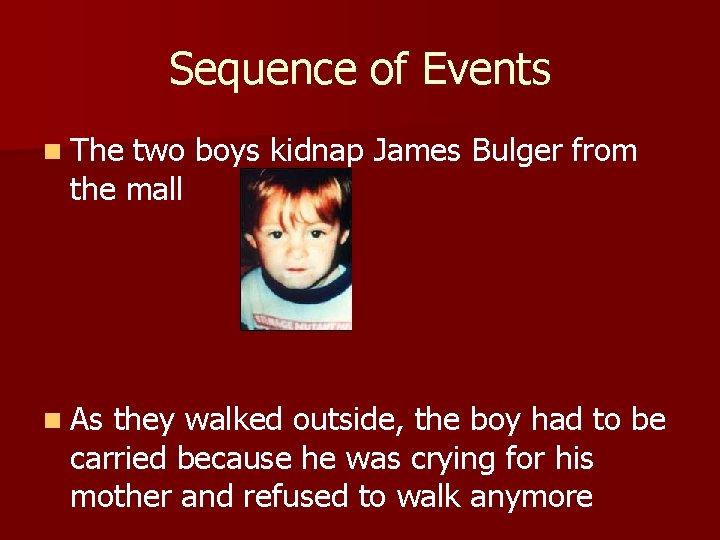
Sequence of Events n The two boys kidnap James Bulger from the mall n As they walked outside, the boy had to be carried because he was crying for his mother and refused to walk anymore
Sequence of Events n They continue to an isolated area under a bridge n The boys cover the injuries Many people notice the tears and blood but none intervene n James drags his feet, cries, and attempts to run away
Sequence of Events n They go into three stores and are questioned by over a 15 people n Many give them directions to the police station n 2 ½ hours after kidnapping James, they take him to an area by train tracks n The boys throw stones and bricks, kick, punch, and hit James with an iron bar
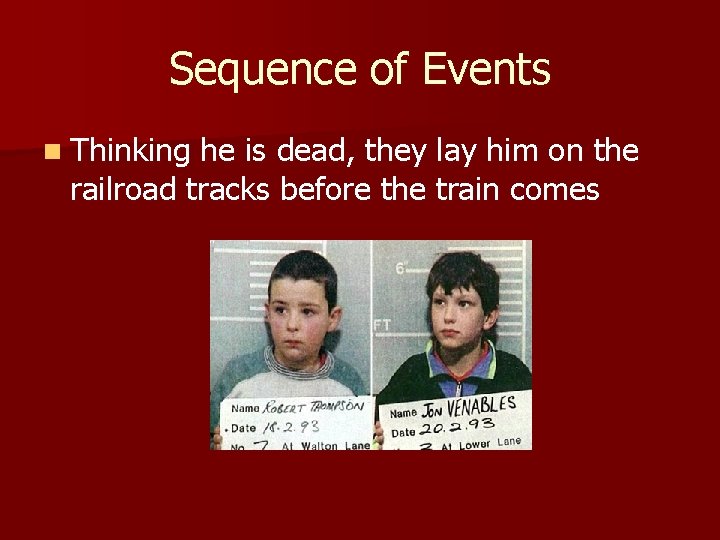
Sequence of Events n Thinking he is dead, they lay him on the railroad tracks before the train comes
References n Latané, B. and Darley, J. M. (1970) The unresponsive bystander: Why doesn’t he help? Englewood Cliffs, NJ: Prentice Hall n Gladwell, Malcolm. (2000). The Tipping Point: How Little Things Can Make a Big Difference. ISBN 0316316962. n http: //64. 233. 179. 104/search? q=cache: _k KV 8 k 7 Hvso. J: www. crimelibrary. com/classic s 3/bulger/+boy+in+England, +bystander& hl=en&ie=UTF-8 Court TV website
- Slides: 14