
EXAMPLES OF CHANGES OF TOXICITY LEVELS AS FUNCTION


- Slides: 35
EXAMPLES OF CHANGES OF TOXICITY LEVELS AS FUNCTION OF SPECIATION OF THE ELEMENTS ELEMENT LESS TOXIC MORE TOXIC As 5 As Cr Mo (as As 3 arsenate) organic inorganic Cr 3 Cr 6 (as chromate) Mo 2 Mo 6 (as molibdate) G. Cortecci – “Geologia e Salute”
SPECIFIC ABSOLUTE BIOAVAILABILITY Corresponds to the actual percentage of an element effectively assimilated by a specific organism, animal or vegetal. It is function of the form of occurrence of the elements, their speciation, interference with other elements, concentration, p. H, Eh, temperature, climate, granulometry, etc. Determined with analysis under a large number of conditional variables, not rarely including samples of vegetation and animals from the environment under study. To replicate possible human ingestion, “in vitro” assays are made under p. H of 1. 5. U. S. Naval Facilities Eng. Command; “Guide for Incorporating Bioavailability – UG-2041 -ENV”
EFFECTS OF NATURALLY ANOMALOUS DISTRIBUTION OF TRACE ELEMENTS IODINE - FLUORINE - ARSENIC - SELENIUM
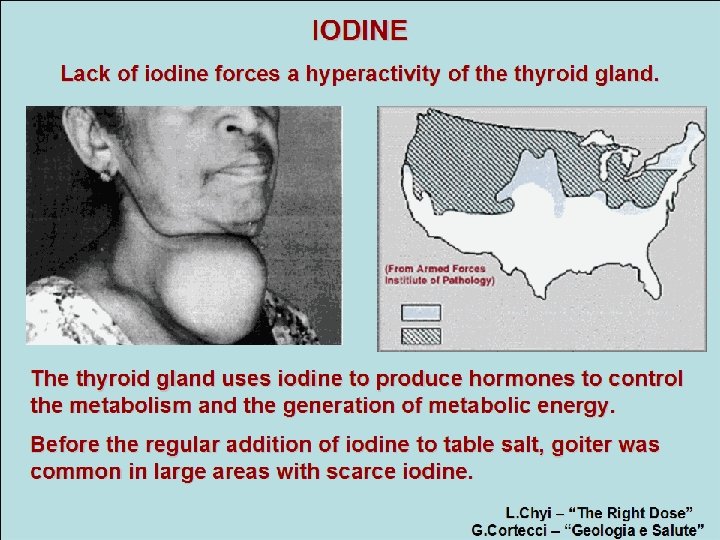
IODINE Lack of iodine forces a hyperactivity of the thyroid gland. natural waters with < 0, 23 ppm I > 5 / 1000 affected persons The thyroid gland uses iodine to produce hormones to control the metabolism and the generation of metabolic energy. Before the regular addition of iodine to table salt, goiter was common in large areas with scarce iodine. L. Chyi – “The Right Dose” G. Cortecci – “Geologia e Salute”
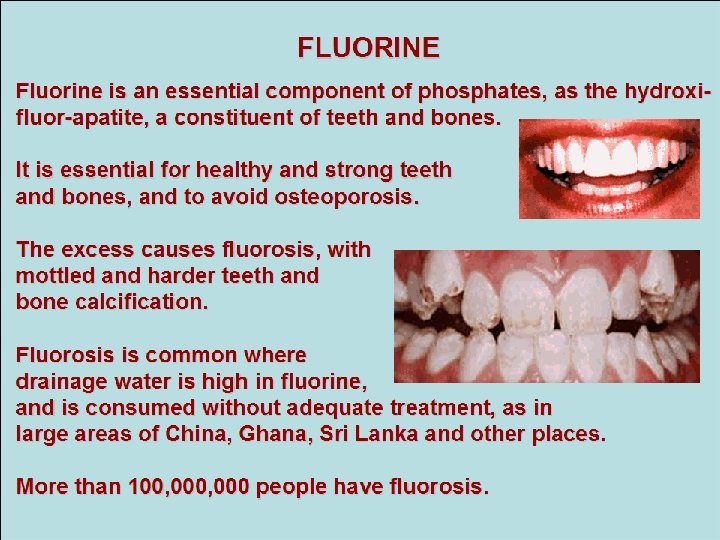
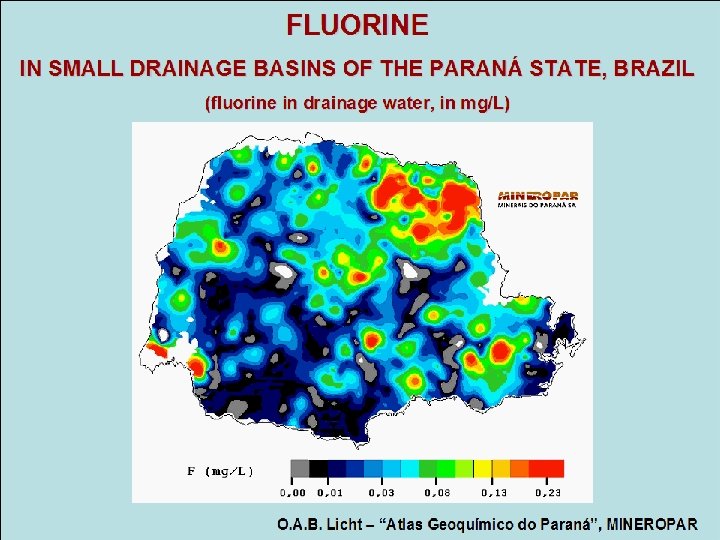
FLUORINE Fluorine is an essential component of phosphates, as the hydroxifluor-apatite, a constituent of teeth and bones. It is essential for healthy and strong teeth and bones, and to avoid osteoporosis. The excess causes fluorosis, with mottled and harder teeth and bone calcification. Fluorosis is common where drainage water is high in fluorine, and is consumed without adequate treatment, as in large areas of China, Ghana, Sri Lanka and other places. More than 100, 000 people have fluorosis.
FLUORINE IN SMALL DRAINAGE BASINS OF THE PARANÁ STATE, BRAZIL (fluorine in drainage water, in mg/L) O. A. B. Licht – “Atlas Geoquímico do Paraná”, MINEROPAR
ARSENIC As 5+ is more toxic than As 3+ and inorganic (salt As) is more harmful than organic (methilated As). When ingested in small doses, organic As is eliminated with urine. The excess could be fixed in vital organs, from where it could also be eliminated, as long as the excessive ingestion is not continued. Inorganic As fixes itself easier in the organism than organic As, although part of it is transformed into organic by methilation. Toxic effects appear when As is ingested in excess for long periods, resulting in cancer, cutaneous malignancies, etc. In Chile, Argentine, Mexico, India, and other countries, where there are sites with anomalously high concentration of As in the water, the population that drinks that water presents high values of As in blood, hair, nails, and body organs.
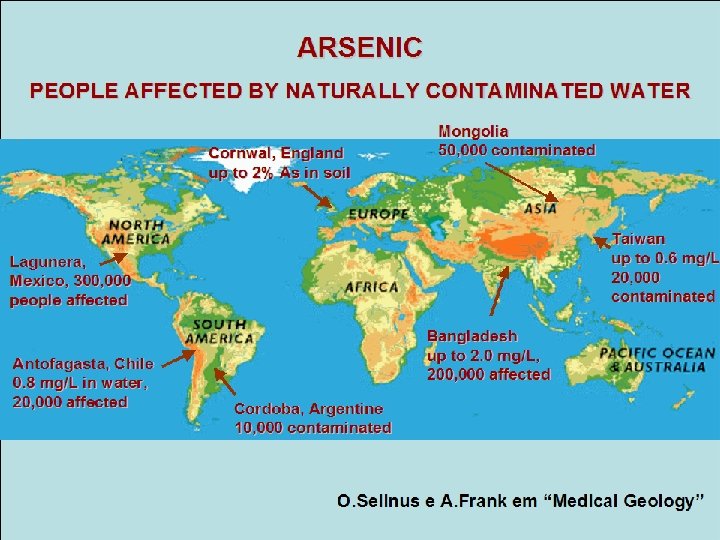
ARSENIC PEOPLE AFFECTED BY NATURALLY CONTAMINATED WATER Cornwal, England up to 2% As in soil Mongolia 50, 000 contaminated Taiwan up to 0. 6 mg/L, mg/L 20, 000 contaminated Lagunera, Mexico, 300, 000 people affected Antofagasta, Chile 0. 8 mg/L in water, 20, 000 affected Bangladesh up to 2. 0 mg/L, 200, 000 affected Cordoba, Argentine 10, 000 contaminated O. Selinus e A. Frank em “Medical Geology”
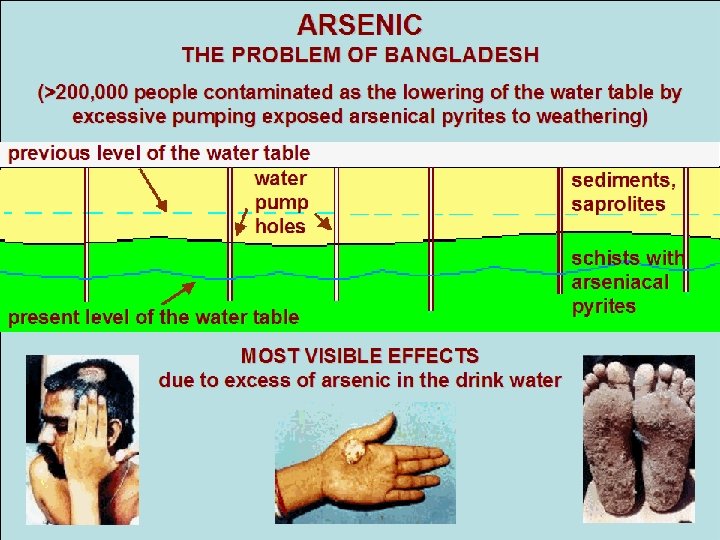
ARSENIC THE PROBLEM OF BANGLADESH (>200, 000 people contaminated as the lowering of the water table by excessive pumping exposed arsenical pyrites to weathering) previous level of the water table water pump holes present level of the water table MOST VISIBLE EFFECTS due to excess of arsenic in the drink water sediments, saprolites schists with arseniacal pyrites
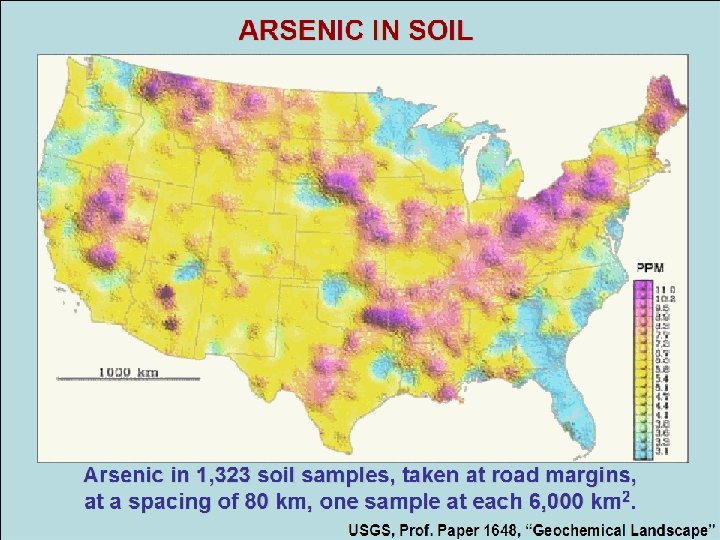
ARSENIC IN SOIL Arsenic in 1, 323 soil samples, taken at road margins, a spacing of 80 km, one sample at each 6, 000 km 2. at USGS, Prof. Paper 1648, “Geochemical Landscape”
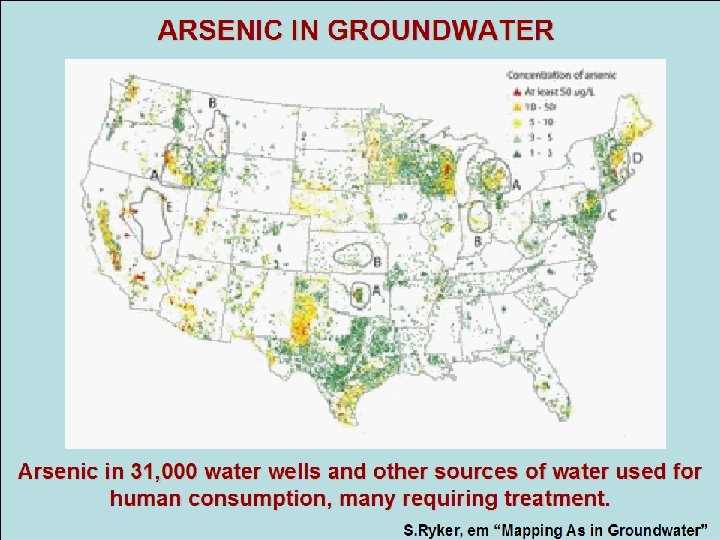
ARSENIC IN GROUNDWATER Arsenic in 31, 000 water wells and other sources of water used for human consumption, many requiring treatment. S. Ryker, em “Mapping As in Groundwater”
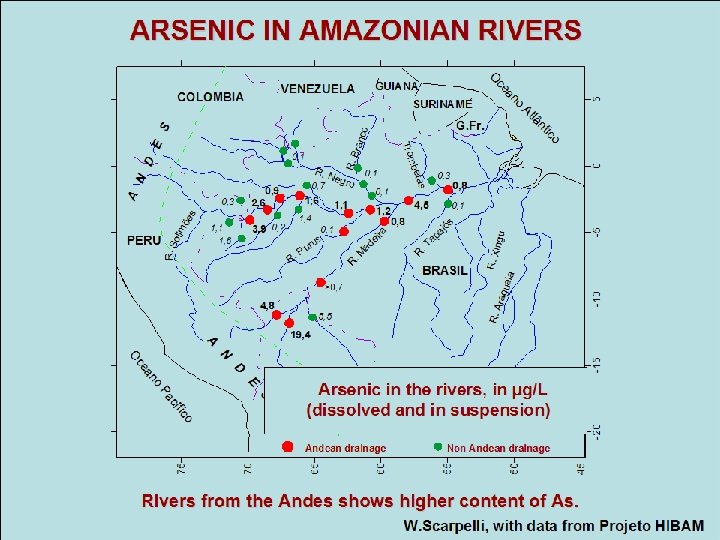
ARSENIC IN AMAZONIAN RIVERS Arsenic in the rivers, in μg/L (dissolved and in suspension) Andean drainage Non Andean drainage Rivers from the Andes shows higher content of As. W. Scarpelli, with data from Projeto HIBAM
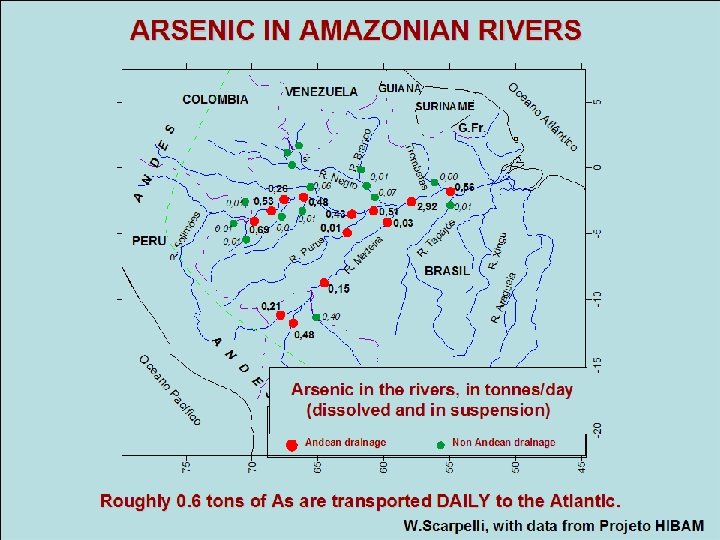
ARSENIC IN AMAZONIAN RIVERS Arsenic in the rivers, in tonnes/day (dissolved and in suspension) Andean drainage Non Andean drainage Roughly 0. 6 tons of As are transported DAILY to the Atlantic. W. Scarpelli, with data from Projeto HIBAM
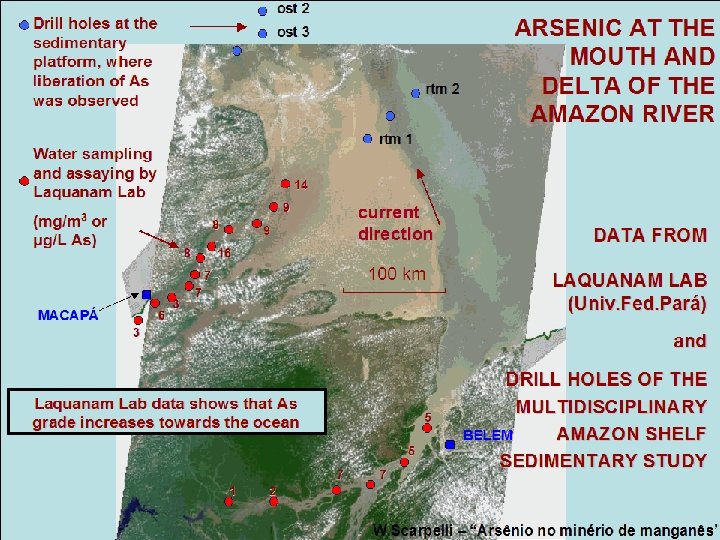
ost 2 Drill holes at the sedimentary platform, where liberation of As was observed ost 3 rtm 2 rtm 1 Water sampling and assaying by Laquanam Lab 14 9 (mg/m 3 or μg/L As) 8 8 current direction 9 6 3 DATA FROM 16 100 km 7 MACAPÁ ARSENIC AT THE MOUTH AND DELTA OF THE AMAZON RIVER 7 3 LAQUANAM LAB (Univ. Fed. Pará) and Laquanam Lab data shows that As grade increases towards the ocean 5 5 7 1 7 DRILL HOLES OF THE MULTIDISCIPLINARY BELEM AMAZON SHELF SEDIMENTARY STUDY 2 W. Scarpelli – “Arsênio no minério de manganês”
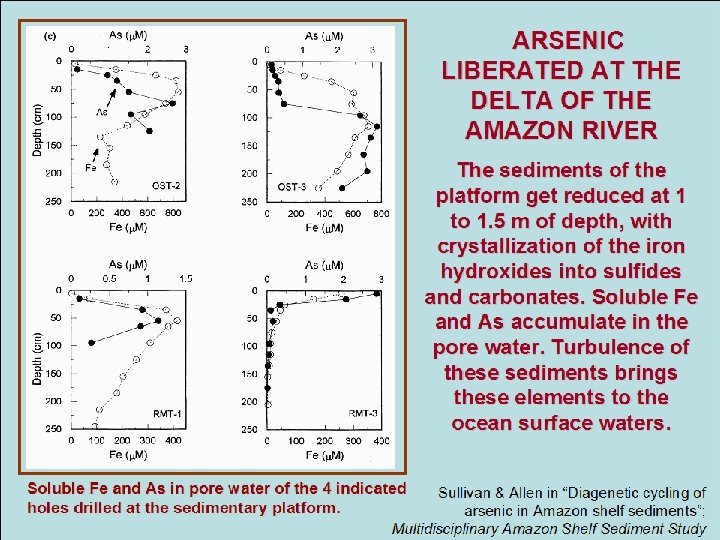
ARSENIC LIBERATED AT THE DELTA OF THE AMAZON RIVER The sediments of the platform get reduced at 1 to 1. 5 m of depth, with crystallization of the iron hydroxides into sulfides and carbonates. Soluble Fe and As accumulate in the pore water. Turbulence of these sediments brings these elements to the ocean surface waters. Soluble Fe and As in pore water of the 4 indicated holes drilled at the sedimentary platform. Sullivan & Allen in “Diagenetic cycling of arsenic in Amazon shelf sediments”; Multidisciplinary Amazon Shelf Sediment Study
SELENIUM Essential for metabolic reactions and for anti-oxidant enzymes, which delay aging. Daily doses of less than 0. 04 mg might be insufficient and greater than 0. 10 mg could be toxic. Sicknesses due to lack of Se occur in extensive areas of China, accompanying some geological structures. Selenium occurs essentially in sulfides, and its chemical characteristics are similar to those of S. Se 6+ solubilizes easily than Se 4+ and as such is more bioavailable. Se 4+ stays mostly within Fe oxides and hydroxides.
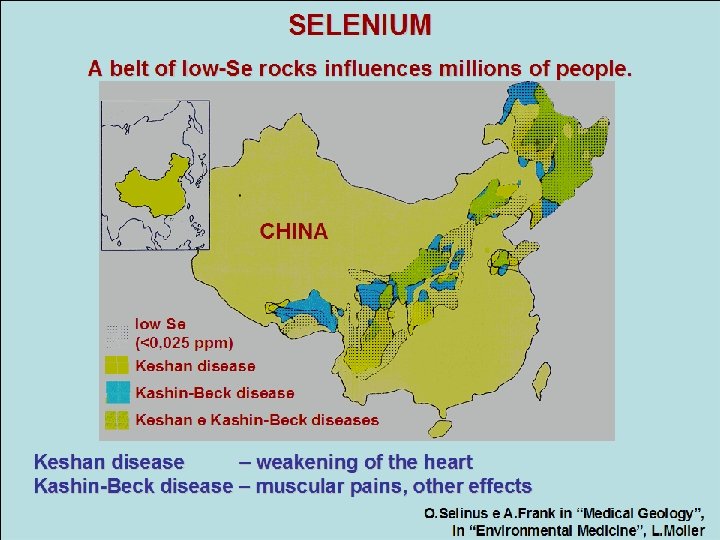
SELENIUM A belt of low-Se rocks influences millions of people. CHINA low Se (<0, 025 ppm) Keshan disease Kashin-Beck disease Keshan e Kashin-Beck diseases Keshan disease – weakening of the heart Kashin-Beck disease – muscular pains, other effects O. Selinus e A. Frank in “Medical Geology”, in “Environmental Medicine”, L. Moller
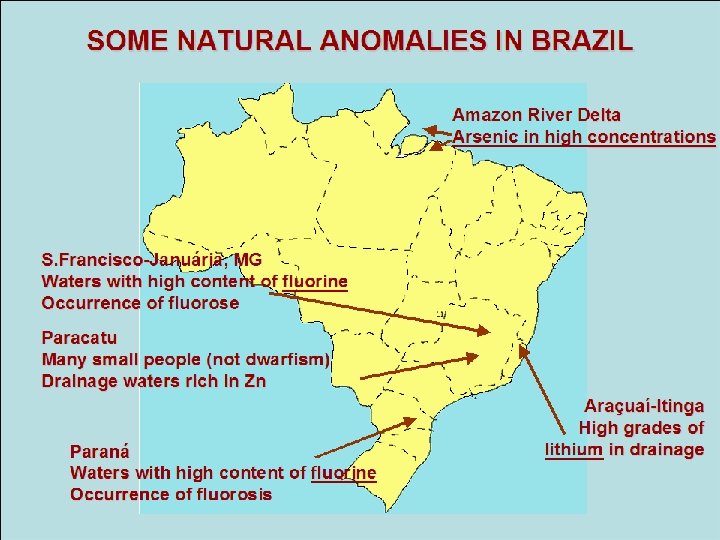
SOME NATURAL ANOMALIES IN BRAZIL Amazon River Delta Arsenic in high concentrations S. Francisco-Januária, MG Francisco. Waters with high content of fluorine Occurrence of o fluorose Paracatu Many small people (not dwarfism) Drainage waters rich in Zn Paraná Waters with high content of fluorine Occurrence Occurren of fluorosis Araçuaí-Itinga High grades of lithium in drainage
HEAVY WATERS In Europe, it was noted that the incidence of sudden heart failures is lower where people consumes heavy waters. These are waters rich in dissolved carbonates. The effect is greater where the ratio Mg: Ca is greater. G. Cortecci – “Geologia e Salute”
DELETERIOUS CHEMICAL ANOMALIES DUE TO HUMAN ACTIVITIES ACID WATERS MERCURY – ARSENIC – CADMIUM - LEAD G. Cortecci – “Geologia e Salute”
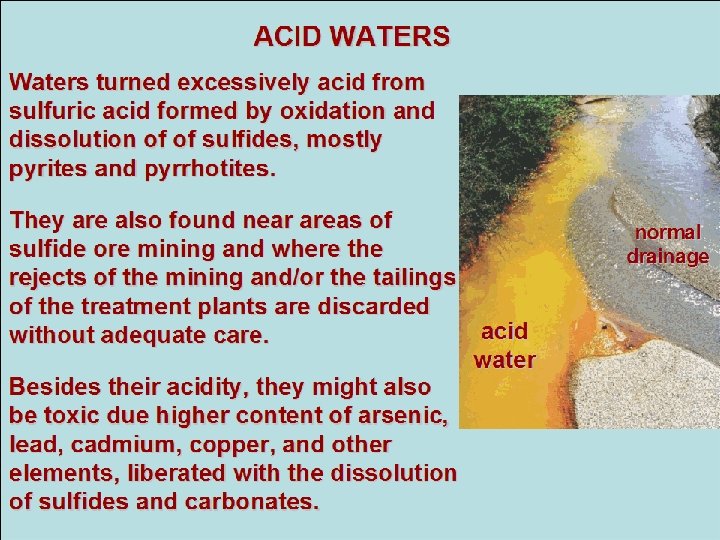
ACID WATERS Waters turned excessively acid from sulfuric acid formed by oxidation and dissolution of of sulfides, mostly pyrites and pyrrhotites. They are also found near areas of sulfide ore mining and where the rejects of the mining and/or the tailings of the treatment plants are discarded acid without adequate care. water Besides their acidity, they might also be toxic due higher content of arsenic, lead, cadmium, copper, and other elements, liberated with the dissolution of sulfides and carbonates. normal drainage
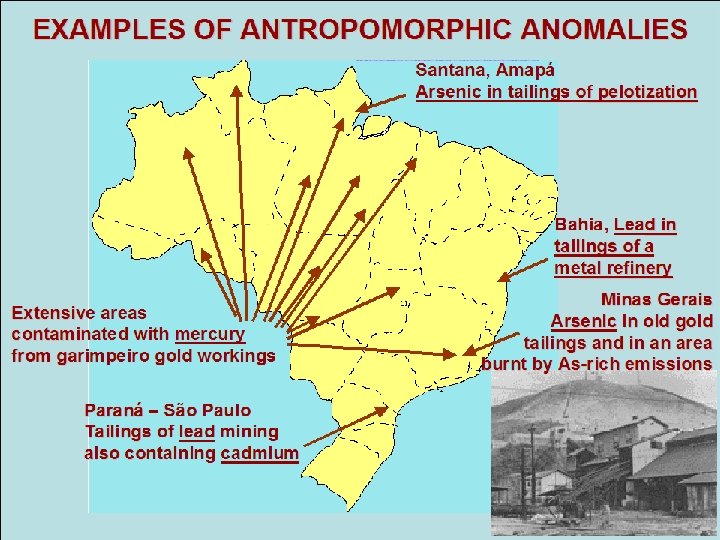
EXAMPLES OF ANTROPOMORPHIC ANOMALIES Santana, Amapá Arsenic in tailings of pelotization Bahia, Lead in tailings of a metal refinery Minas Gerais Arsenic in old gold tailings and in an area burnt by As-rich emissions Extensive Extensiv areas contaminated with mercury contami from garimpeiro gold workings ga Paraná – São Paulo Tailings Tailing of lead mining containing cadmium co also
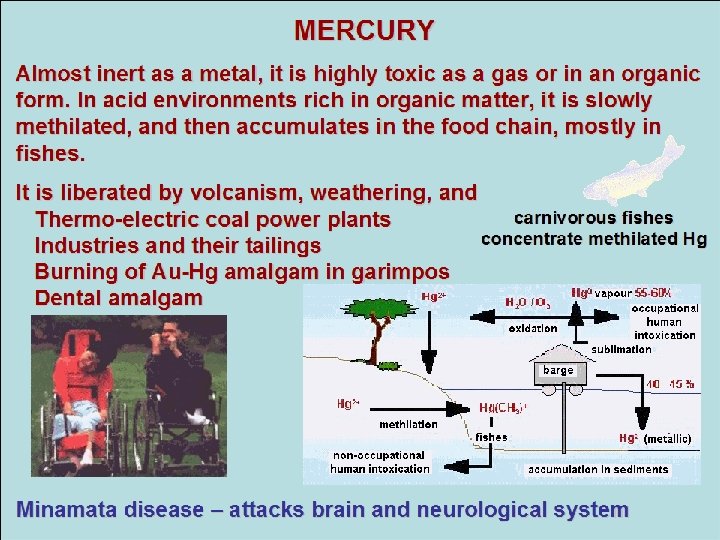
MERCURY Almost inert as a metal, it is highly toxic as a gas or in an organic form. In acid environments rich in organic matter, it is slowly methilated, and then accumulates in the food chain, mostly in fishes. It is liberated by volcanism, weathering, and carnivorous fishes Thermo-electric coal power plants concentrate methilated Hg Industries and their tailings Burning of Au-Hg amalgam in garimpos Dental amalgam Minamata disease – attacks brain and neurological system
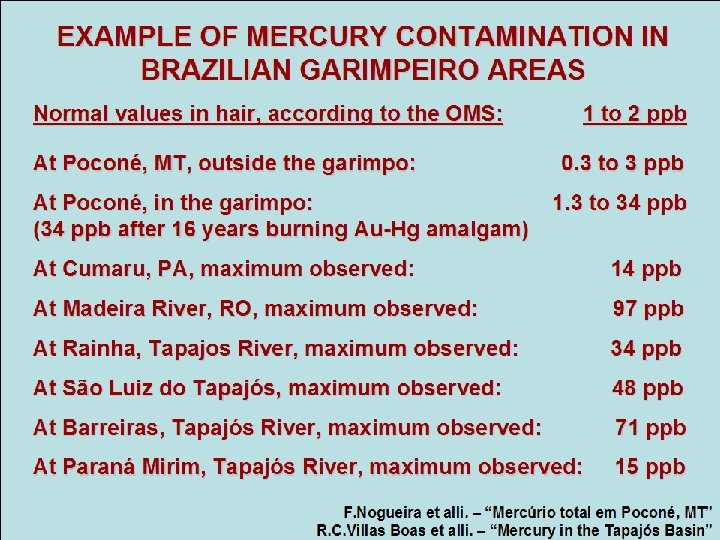
EXAMPLE OF MERCURY CONTAMINATION IN BRAZILIAN GARIMPEIRO AREAS Normal values in hair, according to the OMS: At Poconé, MT, outside the garimpo: 1 to 2 ppb 0. 3 to 3 ppb At Poconé, in the garimpo: 1. 3 to 34 ppb (34 ppb after 16 years burning Au-Hg amalgam) At Cumaru, PA, maximum observed: 14 ppb At Madeira River, RO, maximum observed: 97 ppb At Rainha, Tapajos River, maximum observed: 34 ppb At São Luiz do Tapajós, maximum observed: 48 ppb At Barreiras, Tapajós River, maximum observed: 71 ppb At Paraná Mirim, Tapajós River, maximum observed: 15 ppb F. Nogueira et alli. – “Mercúrio total em Poconé, MT” R. C. Villas Boas et alli. – “Mercury in the Tapajós Basin”
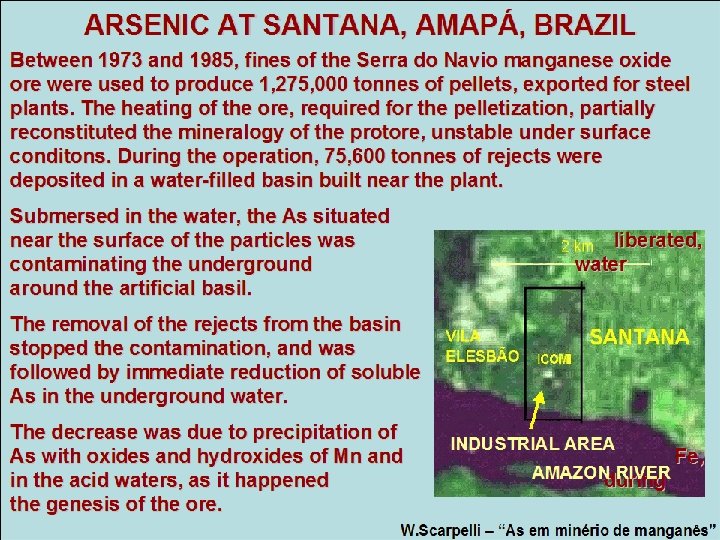
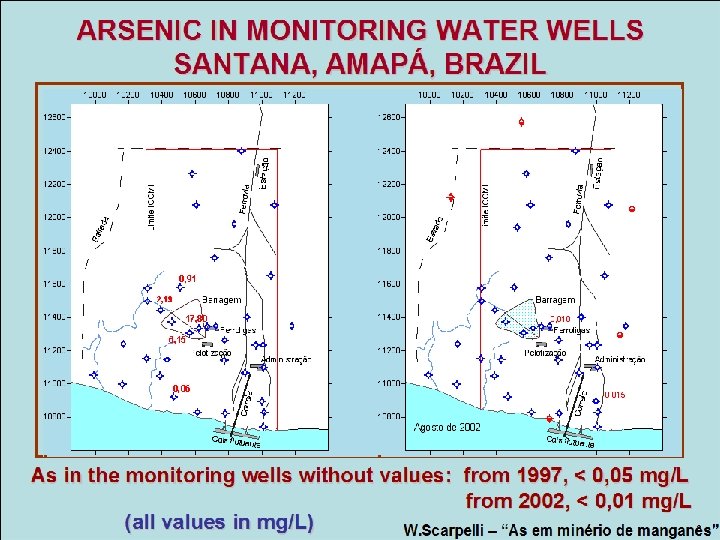
ARSENIC AT SANTANA, AMAPÁ, BRAZIL Between 1973 and 1985, fines of the Serra do Navio manganese oxide ore were used to produce 1, 275, 000 tonnes of pellets, exported for steel plants. The heating of the ore, required for the pelletization, partially reconstituted the mineralogy of the protore, unstable under surface conditons. During the operation, 75, 600 tonnes of rejects were deposited in a water-filled basin built near the plant. Submersed in the water, the As situated near the surface of the particles was liberated, contaminating the underground around the artificial basil. water The removal of the rejects from the basin stopped the contamination, and was followed by immediate reduction of soluble As in the underground water. The decrease was due to precipitation of As with oxides and hydroxides of Mn and Fe, in the acid waters, as it happened during the genesis of the ore. INDUSTRIAL AREA AMAZON RIVER W. Scarpelli – “As em minério de manganês”
ARSENIC IN MONITORING WATER WELLS SANTANA, AMAPÁ, BRAZIL August 1997 August 2002 Agosto de 1977 As in the monitoring wells without values: from 1997, < 0, 05 mg/L from 2002, < 0, 01 mg/L (all values in mg/L) W. Scarpelli – “As em minério de manganês”
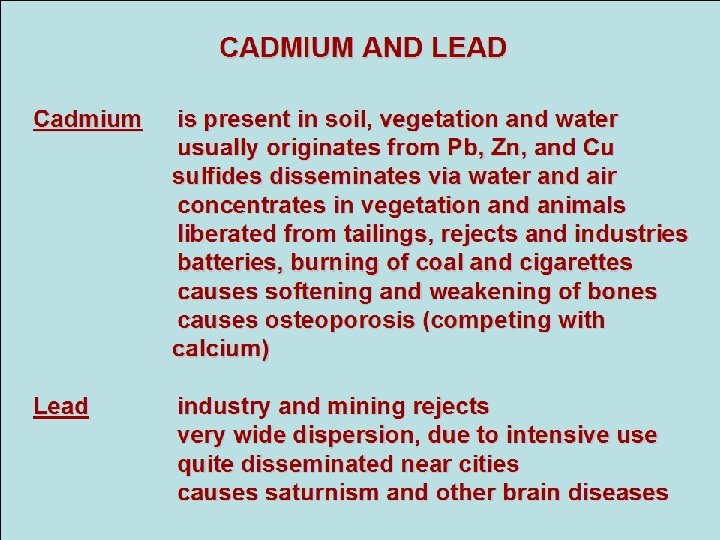
CADMIUM AND LEAD Cadmium is present in soil, vegetation and water usually originates from Pb, Zn, and Cu sulfides disseminates via water and air concentrates in vegetation and animals liberated from tailings, rejects and industries batteries, burning of coal and cigarettes causes softening and weakening of bones causes osteoporosis (competing with calcium) Lead industry and mining rejects very wide dispersion, due to intensive use quite disseminated near cities causes saturnism and other brain diseases
DELETERIOUS PHYSICAL INFLUENCE FROM GEOLOGICAL MATERIALS - Silica dust in the lungs - silicosis (occurs essentially where there is a large quantity of fresh angular fragments of silica, recently formed) - Manganese dust – attack to the nervous system (it is rare, but possible, where there is abundance of manganese dust and no ventilation) - Asbestos - Radon – radioactive gas - Other radioactive elements
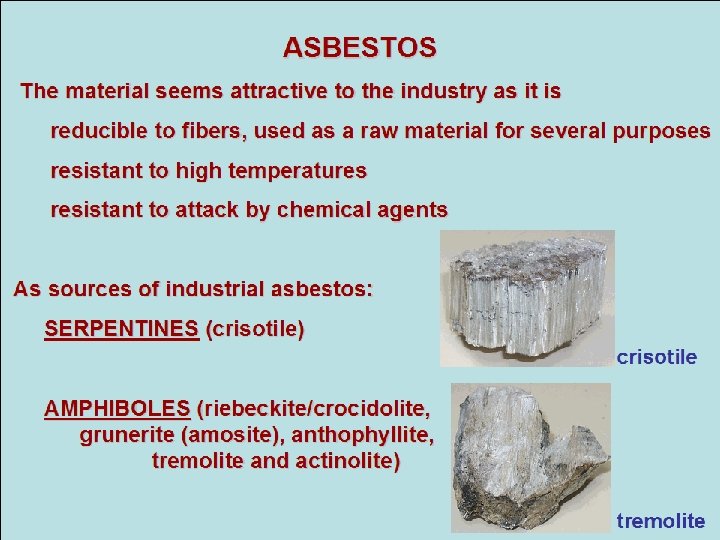
ASBESTOS The material seems attractive to the industry as it is reducible to fibers, used as a raw material for several purposes resistant to high temperatures resistant to attack by chemical agents As sources of industrial asbestos: SERPENTINES (crisotile) crisotile AMPHIBOLES (riebeckite/crocidolite, grunerite (amosite), anthophyllite, tremolite and actinolite) tremolite
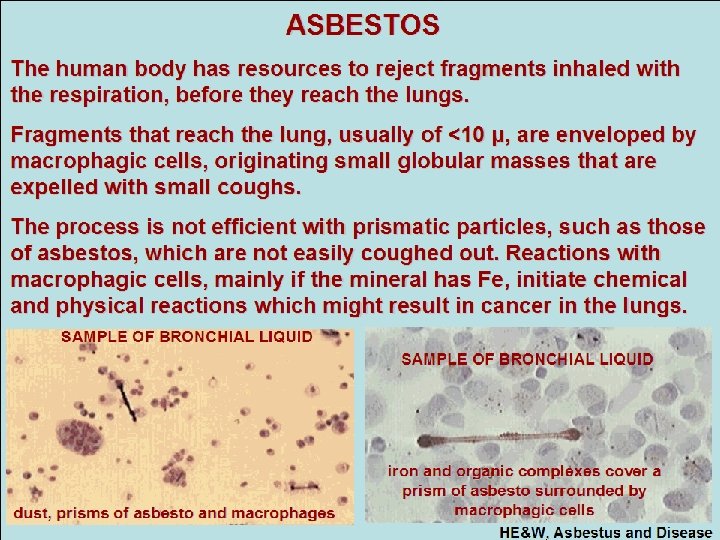
ASBESTOS The human body has resources to reject fragments inhaled with the respiration, before they reach the lungs. Fragments that reach the lung, usually of <10 μ, are enveloped by macrophagic cells, originating small globular masses that are expelled with small coughs. The process is not efficient with prismatic particles, such as those of asbestos, which are not easily coughed out. Reactions with macrophagic cells, mainly if the mineral has Fe, initiate chemical and physical reactions which might result in cancer in the lungs. SAMPLE OF BRONCHIAL LIQUID dust, prisms of asbesto and macrophages iron and organic complexes cover a prism of asbesto surrounded by macrophagic cells HE&W, Asbestus and Disease
ASBESTOS Serpentines are less aggressive than amphiboles, possibly because they contain less iron and are more flexible. The incidence of asbestosis is perceptible essentially with workers of mines and industries which manipulate with large quantities of asbestos, mainly where they are smokers. Cancer appears years after the ingestion of the fibers in the lungs, mainly with smokers.
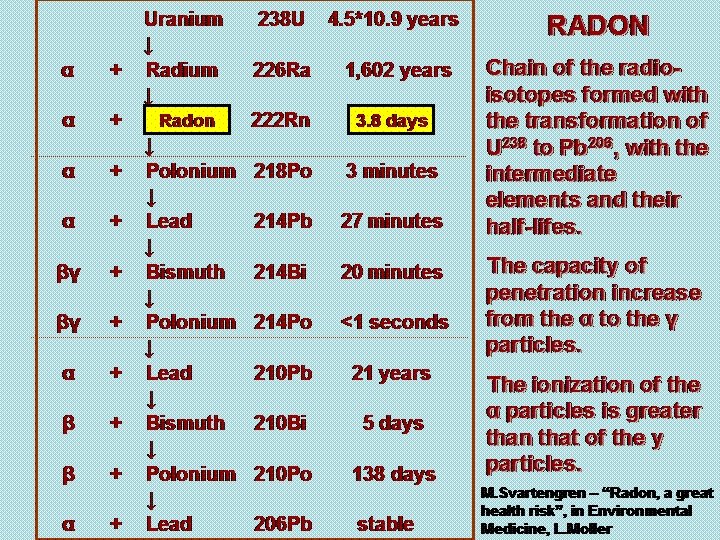
Uranium 238 U 4. 5*10. 9 years RADON 226 Ra 1, 602 years 222 Rn 3. 8 days 218 Po 3 minutes 214 Pb 27 minutes Chain of the radioisotopes formed with the transformation of U 238 to Pb 206, with the intermediate elements and their half-lifes. 214 Bi 20 minutes 214 Po <1 seconds 210 Pb 21 years 210 Bi 5 days 210 Po 138 days α + ↓ Radium ↓ α + Radon α + βγ + α + β + α + ↓ Polonium ↓ Lead ↓ Bismuth ↓ Polonium ↓ Lead 206 Pb stable The capacity of penetration increase from the α to the γ particles. The ionization of the α particles is greater than that of the y particles. M. Svartengren – “Radon, a great health risk”, in Environmental Medicine, L. Moller
RADON Radioactive gas, intermediate in the transformation of U 238 into Pb 206, during which there are solid radioactive phases and intense emission of alfa, beta and gamma rays. It is found in soil, and in surface and underground waters, in areas of granites, gneisses, alkaline rocks, shales and other silicatic rocks, essentially those that contain phosphates. The gas form of radon enables inhalation with the respiration and ingestion with drinking water. It represents a substantial risk in underground mines where there is uranium, in this case requiring strong ventilation. In cold areas, where the houses are closed to preserve heat, radon might penetrate from beneath through small cracks in the floor. That justifies the building of a open basement under the house floors. The risk is smaller in well ventilated environments.
BIOREMEDIATION Stimulated use of natural micro-organisms to consume and neutralize toxic products in soil and water. The action of micro-organisms might be accelerated with addition of nutrients. It requires continued monitoring of the evolution of the process. It is being used by the USGS for organic contaminants (oils, sludge, pesticides, solvents, fertilizers, etc. ) USGS – “Biogradation: Nature’s Way to a Cleaner Environment”
Associação de Ex-Geólogos da Universidade de São Paulo, Brazil Grupo Figueira da Glete WILSON SCARPELLI wiscar@attglobal. net São Paulo, Brazil