
Example The simple pendulum l Suppose we release





- Slides: 9
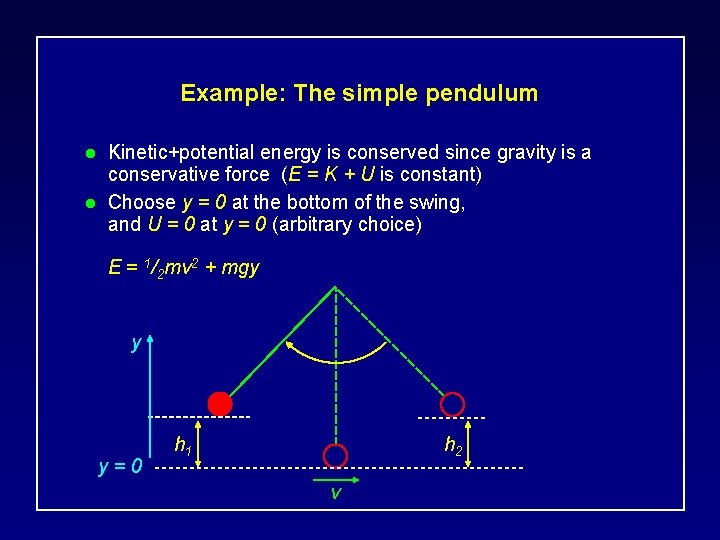
Example: The simple pendulum l Suppose we release a mass m from rest a distance h 1 above its lowest possible point. ç What is the maximum speed of the mass and where does this happen? ç To what height h 2 does it rise on the other side? m h 1 h 2 v
Example: The simple pendulum l l Kinetic+potential energy is conserved since gravity is a conservative force (E = K + U is constant) Choose y = 0 at the bottom of the swing, and U = 0 at y = 0 (arbitrary choice) E = 1/2 mv 2 + mgy y y=0 h 1 h 2 v
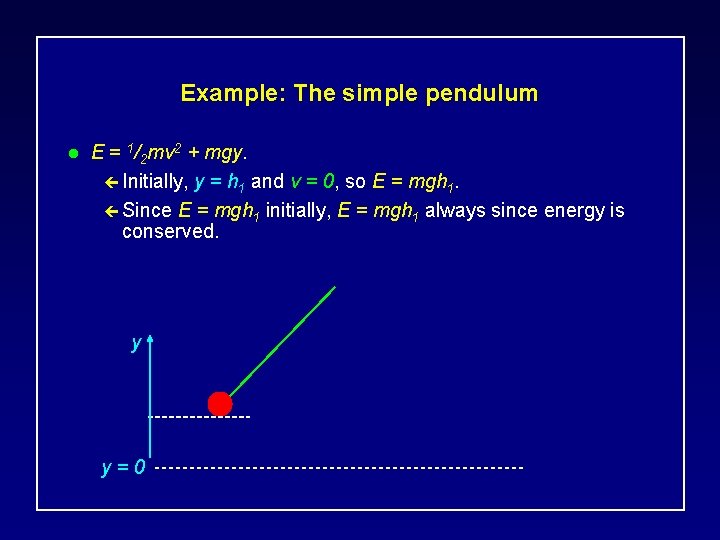
Example: The simple pendulum l E = 1/2 mv 2 + mgy. ç Initially, y = h 1 and v = 0, so E = mgh 1. ç Since E = mgh 1 initially, E = mgh 1 always since energy is conserved. y y=0
Example: The simple pendulum l l 1/ 2 mv will be maximum at the bottom of the swing. 1/ mv 2 = mgh So at y = 0 v 2 = 2 gh 1 2 y y = h 1 y=0 h 1 v
Example: The simple pendulum l l Since E = mgh 1 = 1/2 mv 2 + mgy it is clear that the maximum height on the other side will be at y = h 1 = h 2 and v = 0. The ball returns to its original height. y y = h 1 = h 2 y=0
Example: The simple pendulum l The ball will oscillate back and forth. The limits on its height and speed are a consequence of the sharing of energy between K and U. E = 1/2 mv 2 + mgy = K + U = constant. y
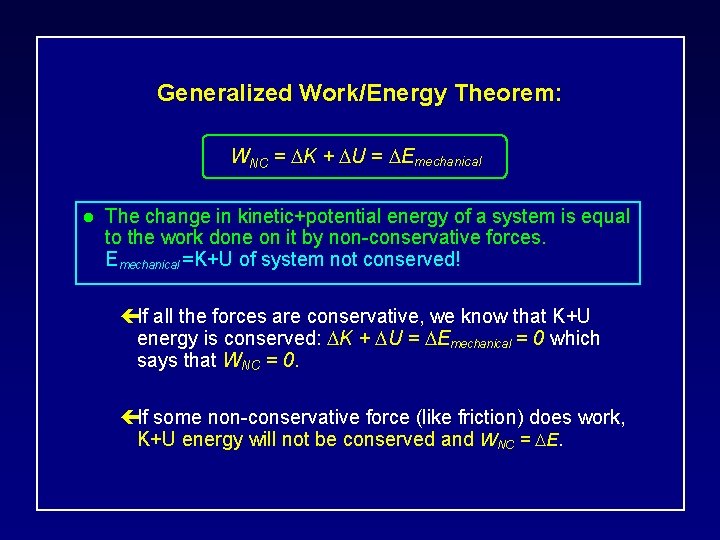
Generalized Work/Energy Theorem: WNC = K + U = Emechanical l The change in kinetic+potential energy of a system is equal to the work done on it by non-conservative forces. Emechanical =K+U of system not conserved! çIf all the forces are conservative, we know that K+U energy is conserved: K + U = Emechanical = 0 which says that WNC = 0. çIf some non-conservative force (like friction) does work, K+U energy will not be conserved and WNC = E.
Problem: Block Sliding with Friction l A block slides down a frictionless ramp. Suppose the horizontal (bottom) portion of the track is rough, such that the coefficient of kinetic friction between the block and the track is k. ç How far, x, does the block go along the bottom portion of the track before stopping? d k x
Problem: Block Sliding with Friction. . . l l l Using WNC = K + U As before, U = -mgd WNC = work done by friction = - kmgx. K = 0 since the block starts out and ends up at rest. WNC = U - kmgx = -mgd x = d / k d k x