
Example Page 321 Draw a graph of the



- Slides: 47
Example, Page 321 Draw a graph of the signed area represented by the integral and compute it using geometry. Rogawski Calculus Copyright © 2008 W. H. Freeman and Company
Example, Page 321 Draw a graph of the signed area represented by the integral and compute it using geometry. Rogawski Calculus Copyright © 2008 W. H. Freeman and Company
Example, Page 321 Draw a graph of the signed area represented by the integral and compute it using geometry. Rogawski Calculus Copyright © 2008 W. H. Freeman and Company
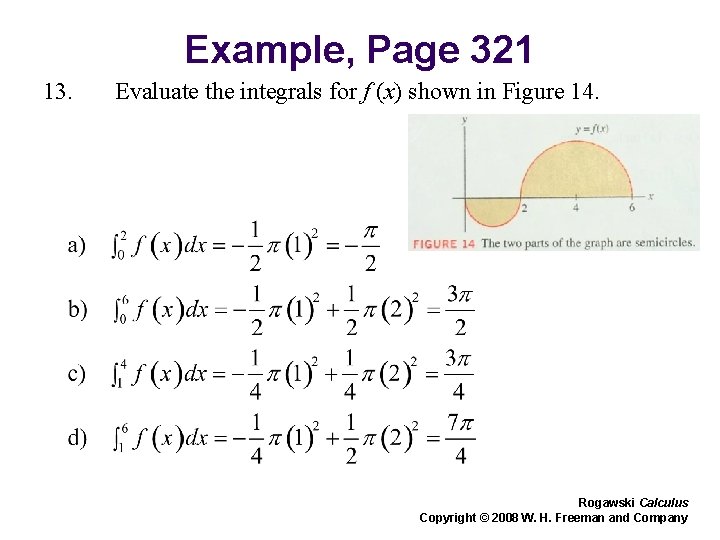
Example, Page 321 13. Evaluate the integrals for f (x) shown in Figure 14. Rogawski Calculus Copyright © 2008 W. H. Freeman and Company
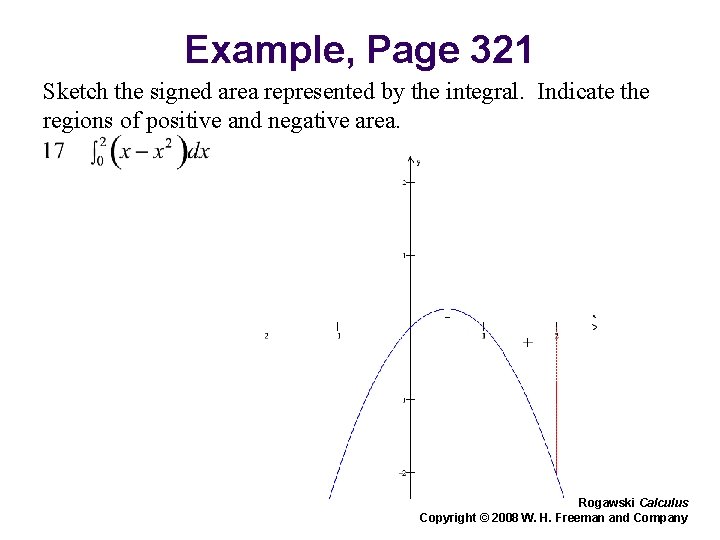
Example, Page 321 Sketch the signed area represented by the integral. Indicate the regions of positive and negative area. Rogawski Calculus Copyright © 2008 W. H. Freeman and Company
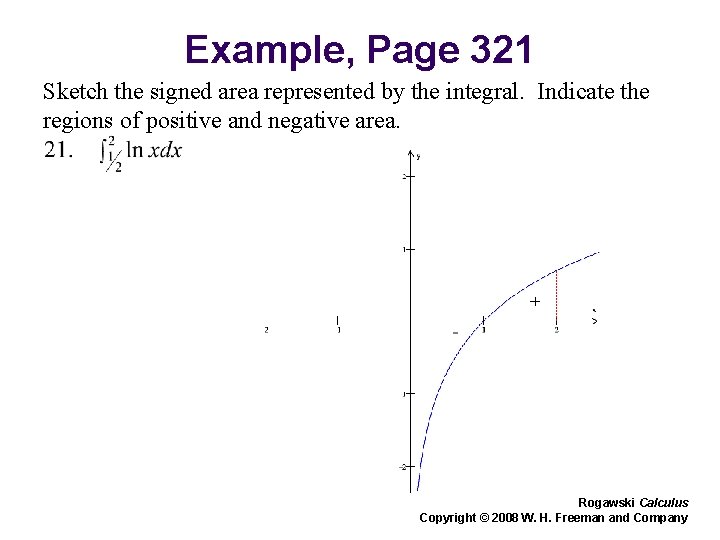
Example, Page 321 Sketch the signed area represented by the integral. Indicate the regions of positive and negative area. Rogawski Calculus Copyright © 2008 W. H. Freeman and Company
Example, Page 321 Determine the sign of the integral without calculating it. Draw a graph if necessary. The sign of the integral is negative. Rogawski Calculus Copyright © 2008 W. H. Freeman and Company
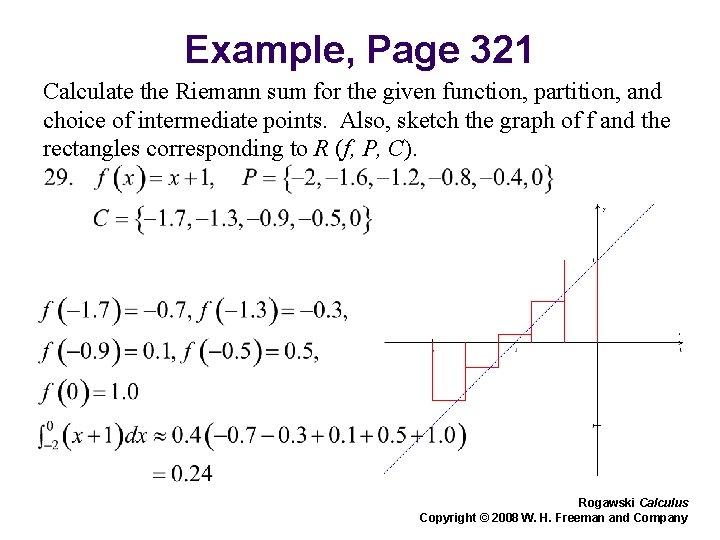
Example, Page 321 Calculate the Riemann sum for the given function, partition, and choice of intermediate points. Also, sketch the graph of f and the rectangles corresponding to R (f, P, C). Rogawski Calculus Copyright © 2008 W. H. Freeman and Company
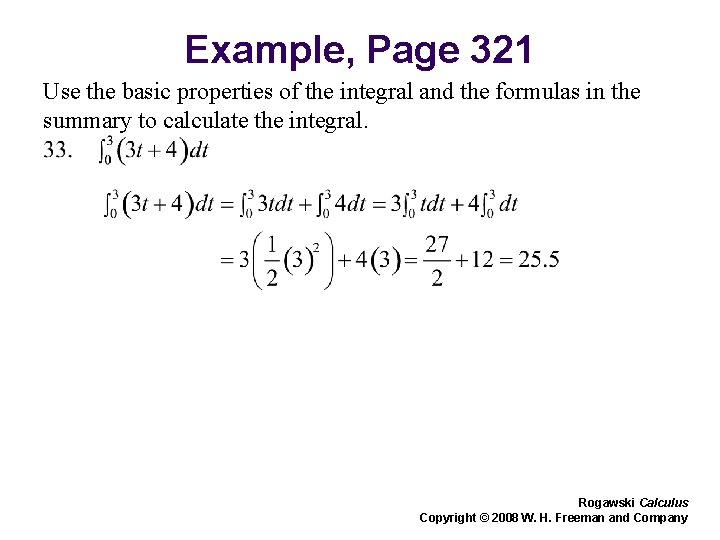
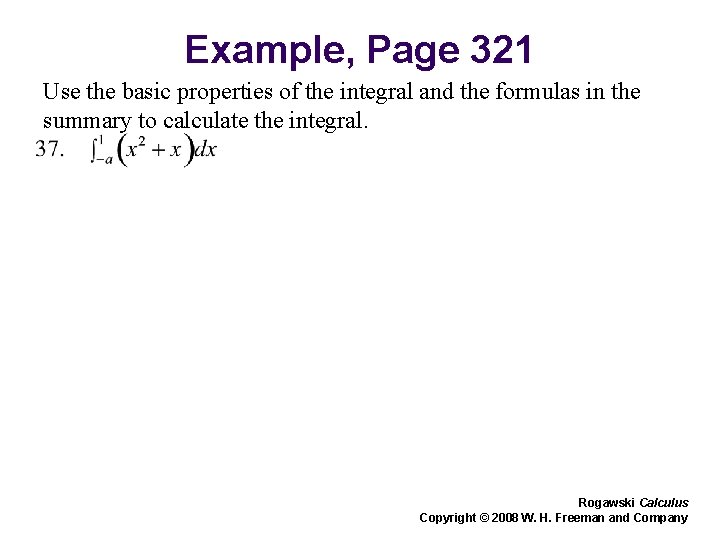
Example, Page 321 Use the basic properties of the integral and the formulas in the summary to calculate the integral. Rogawski Calculus Copyright © 2008 W. H. Freeman and Company
Example, Page 321 Use the basic properties of the integral and the formulas in the summary to calculate the integral. Rogawski Calculus Copyright © 2008 W. H. Freeman and Company
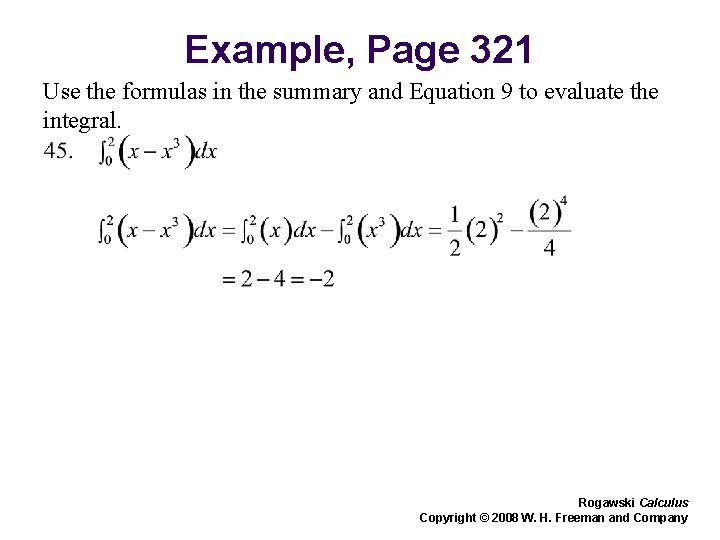
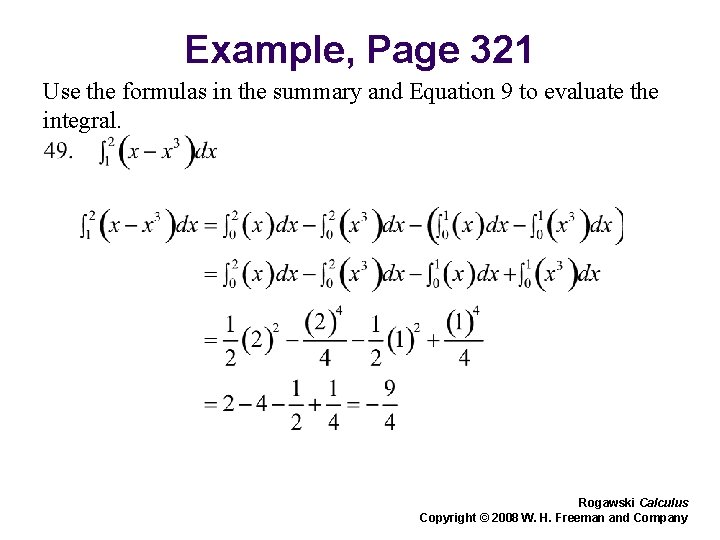
Example, Page 321 Use the formulas in the summary and Equation 9 to evaluate the integral. Rogawski Calculus Copyright © 2008 W. H. Freeman and Company
Example, Page 321 Use the formulas in the summary and Equation 9 to evaluate the integral. Rogawski Calculus Copyright © 2008 W. H. Freeman and Company
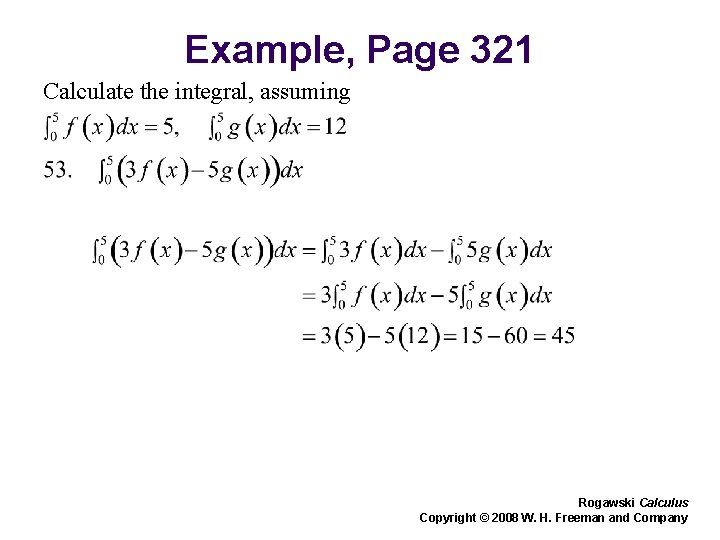
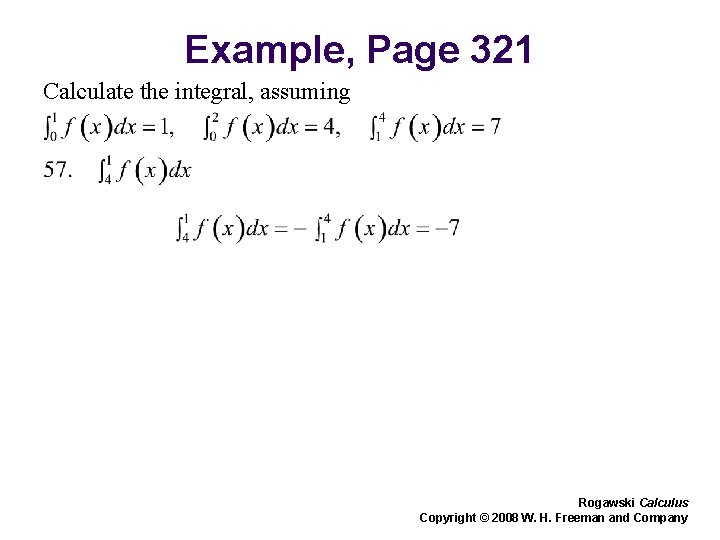
Example, Page 321 Calculate the integral, assuming Rogawski Calculus Copyright © 2008 W. H. Freeman and Company
Example, Page 321 Calculate the integral, assuming Rogawski Calculus Copyright © 2008 W. H. Freeman and Company
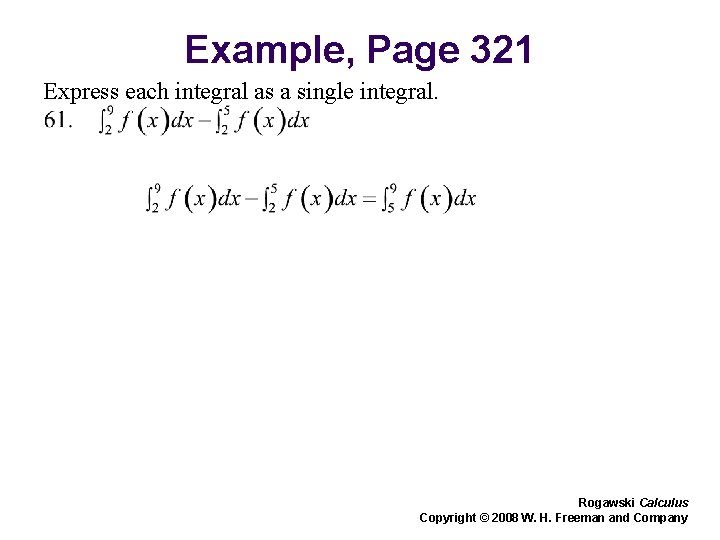
Example, Page 321 Express each integral as a single integral. Rogawski Calculus Copyright © 2008 W. H. Freeman and Company
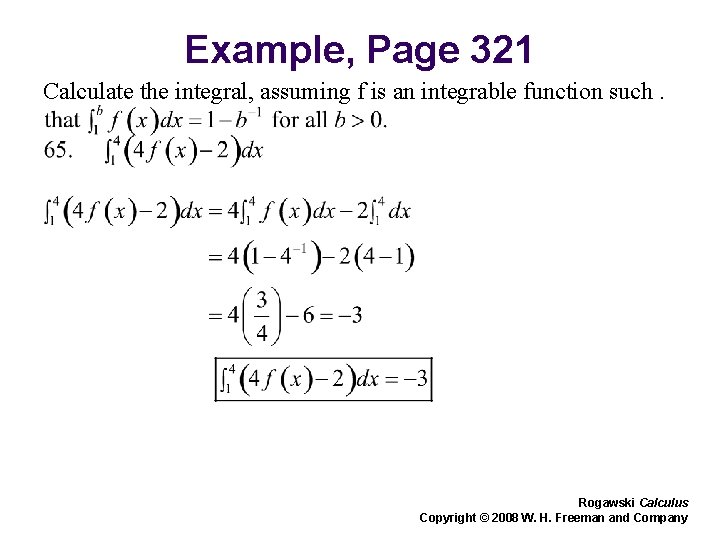
Example, Page 321 Calculate the integral, assuming f is an integrable function such. Rogawski Calculus Copyright © 2008 W. H. Freeman and Company
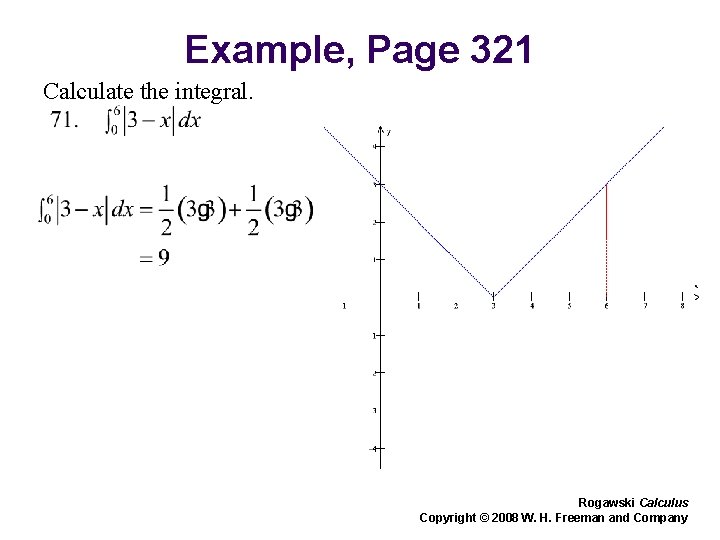
Example, Page 321 Calculate the integral. Rogawski Calculus Copyright © 2008 W. H. Freeman and Company
Jon Rogawski Calculus, ET First Edition Chapter 5: The Integral Section 5. 3: The Fundamental Theorem of Calculus, Part I Rogawski Calculus Copyright © 2008 W. H. Freeman and Company
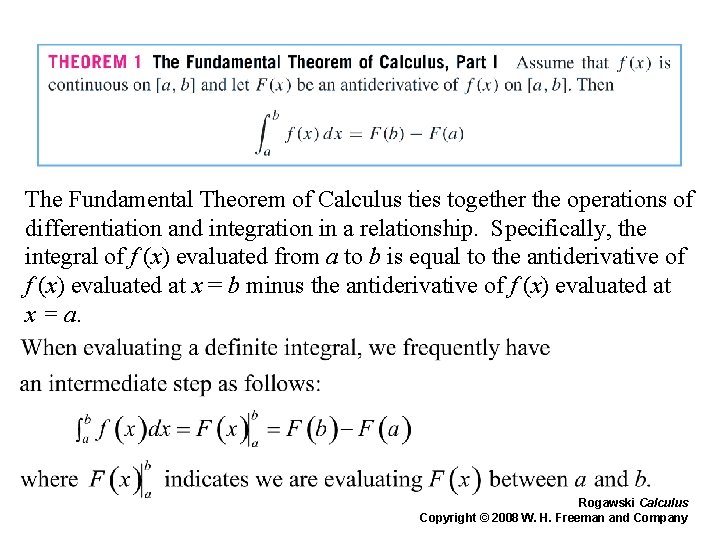
The Fundamental Theorem of Calculus ties together the operations of differentiation and integration in a relationship. Specifically, the integral of f (x) evaluated from a to b is equal to the antiderivative of f (x) evaluated at x = b minus the antiderivative of f (x) evaluated at x = a. Rogawski Calculus Copyright © 2008 W. H. Freeman and Company
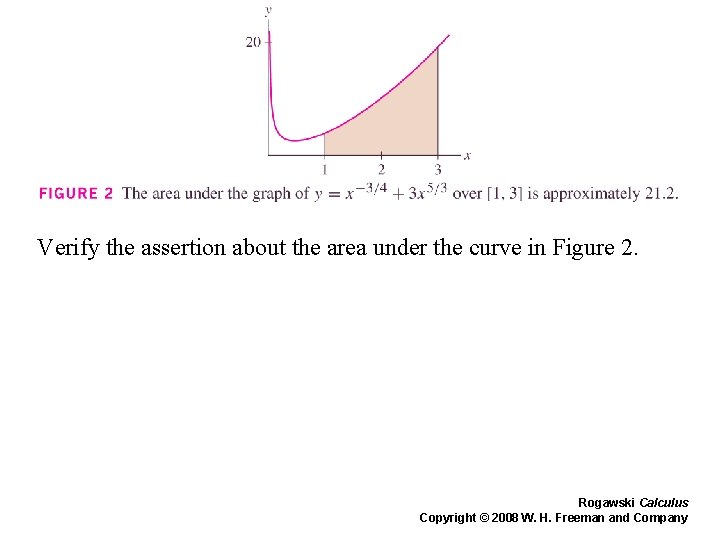
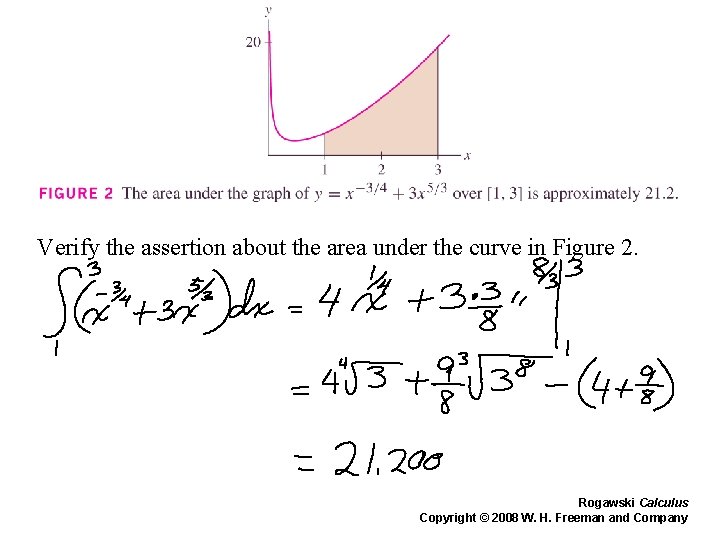
Verify the assertion about the area under the curve in Figure 2. Rogawski Calculus Copyright © 2008 W. H. Freeman and Company
Verify the assertion about the area under the curve in Figure 2. Rogawski Calculus Copyright © 2008 W. H. Freeman and Company
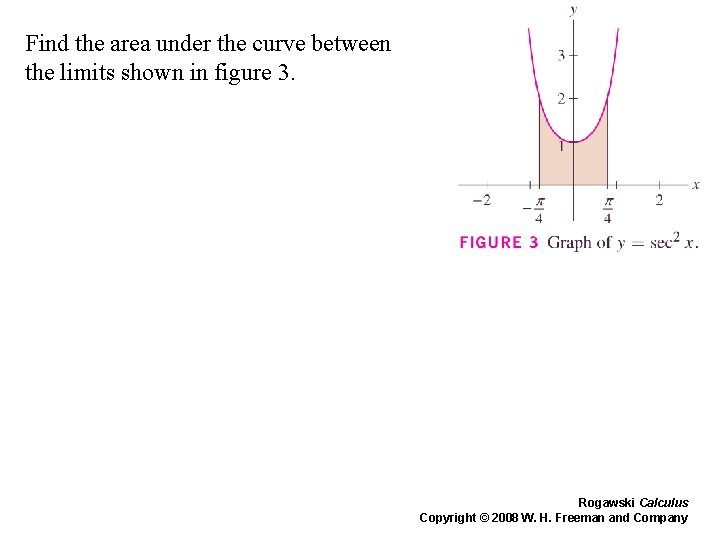
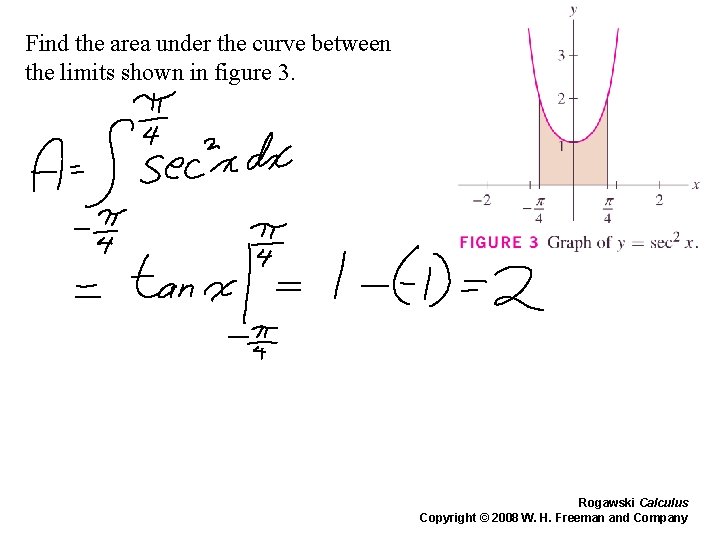
Find the area under the curve between the limits shown in figure 3. Rogawski Calculus Copyright © 2008 W. H. Freeman and Company
Find the area under the curve between the limits shown in figure 3. Rogawski Calculus Copyright © 2008 W. H. Freeman and Company
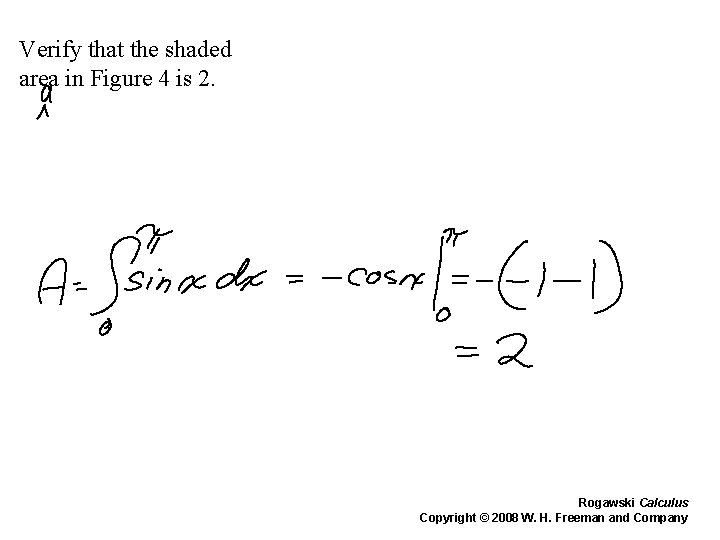
Verify that the shaded area in Figure 4 is 2. Rogawski Calculus Copyright © 2008 W. H. Freeman and Company
Verify that the shaded area in Figure 4 is 2. Rogawski Calculus Copyright © 2008 W. H. Freeman and Company
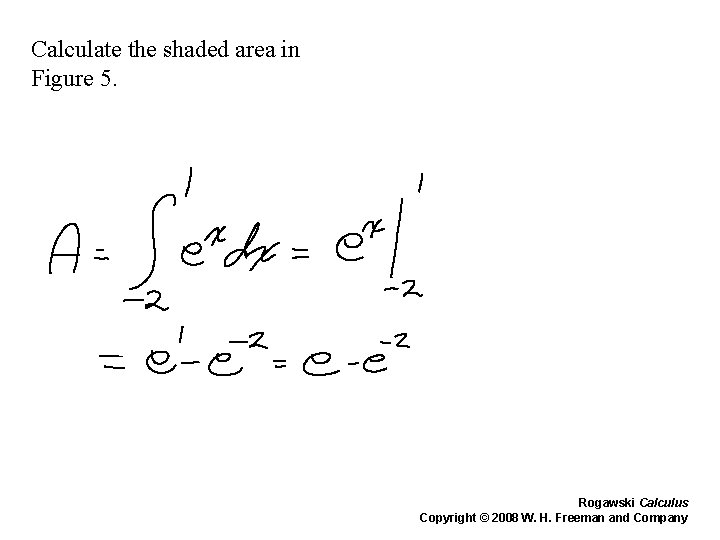
Calculate the shaded area in Figure 5. Rogawski Calculus Copyright © 2008 W. H. Freeman and Company
Calculate the shaded area in Figure 5. Rogawski Calculus Copyright © 2008 W. H. Freeman and Company
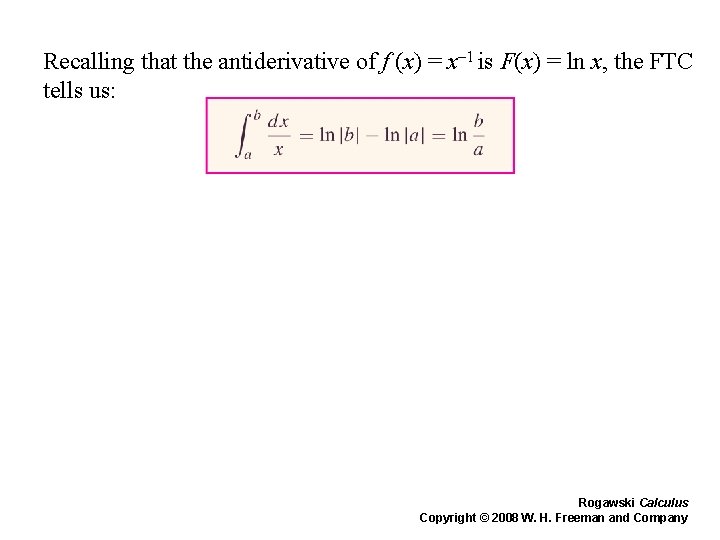
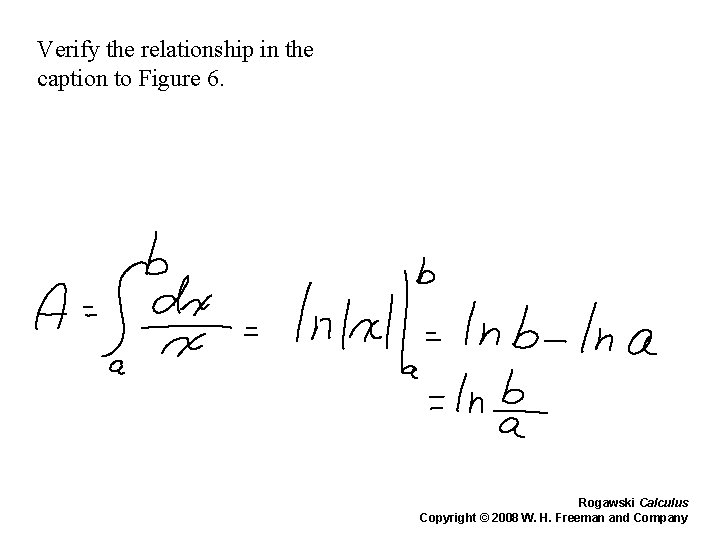
Recalling that the antiderivative of f (x) = x– 1 is F(x) = ln x, the FTC tells us: Rogawski Calculus Copyright © 2008 W. H. Freeman and Company
Verify the relationship in the caption to Figure 6. Rogawski Calculus Copyright © 2008 W. H. Freeman and Company
Verify the relationship in the caption to Figure 6. Rogawski Calculus Copyright © 2008 W. H. Freeman and Company
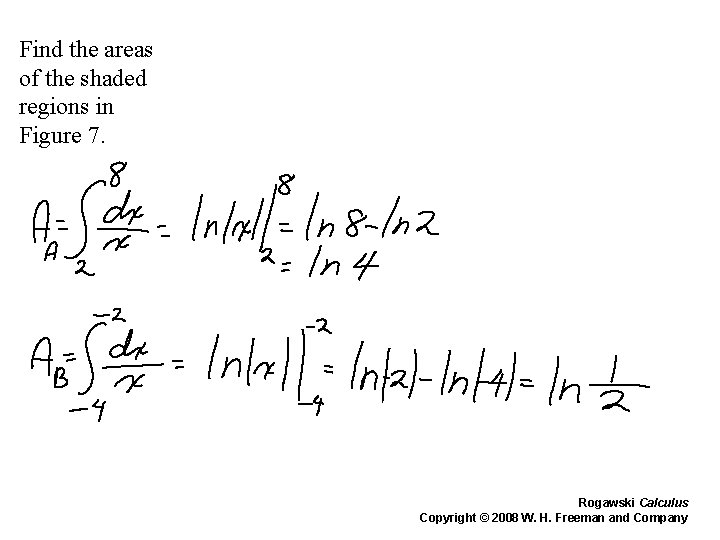
Find the areas of the shaded regions in Figure 7. Rogawski Calculus Copyright © 2008 W. H. Freeman and Company
Find the areas of the shaded regions in Figure 7. Rogawski Calculus Copyright © 2008 W. H. Freeman and Company
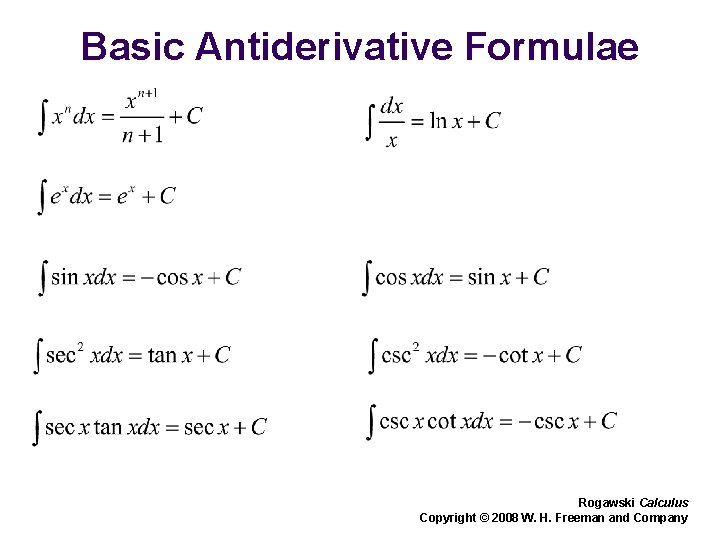
Basic Antiderivative Formulae Rogawski Calculus Copyright © 2008 W. H. Freeman and Company
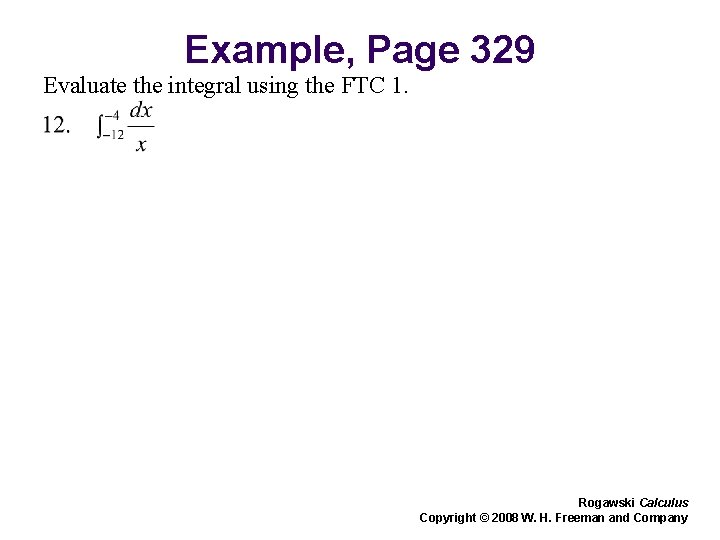
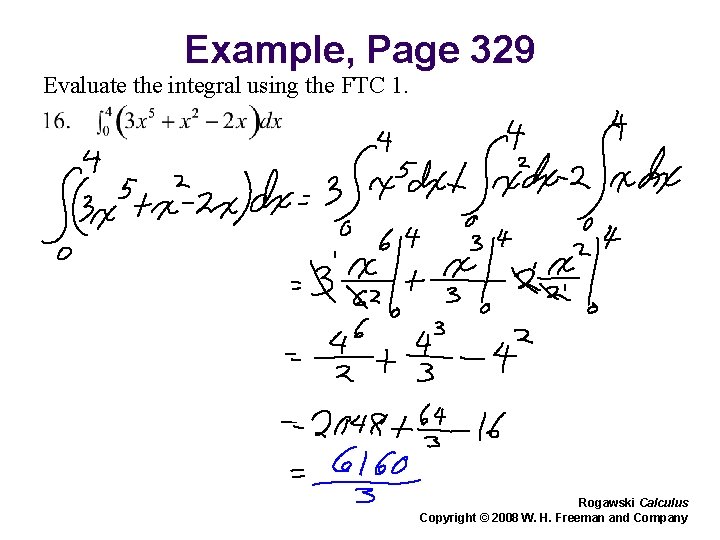
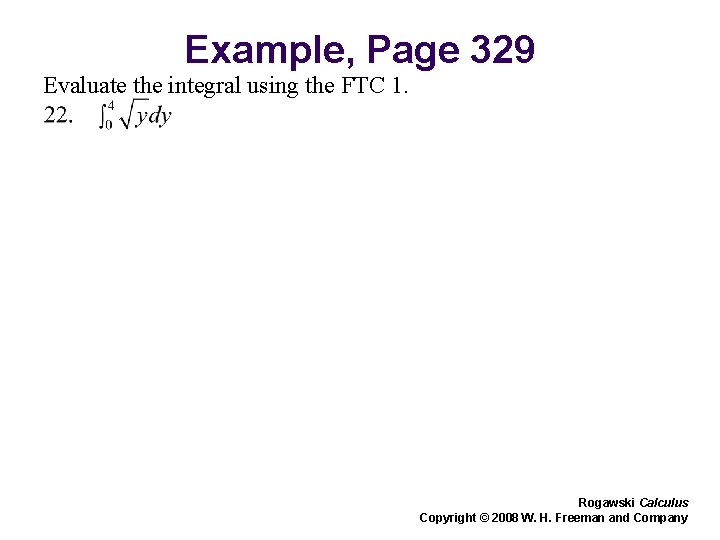
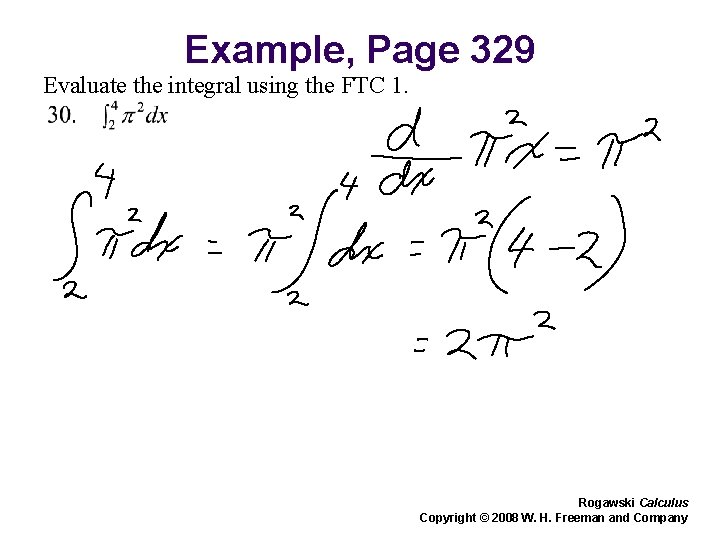
Example, Page 329 Evaluate the integral using the FTC 1. Rogawski Calculus Copyright © 2008 W. H. Freeman and Company
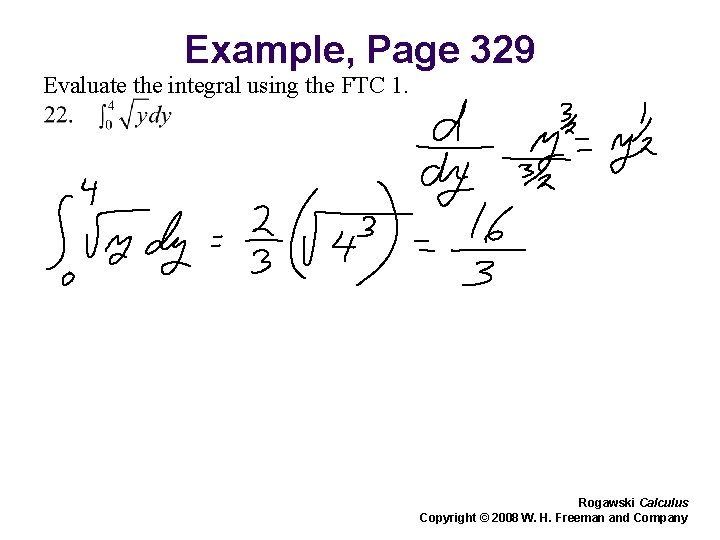
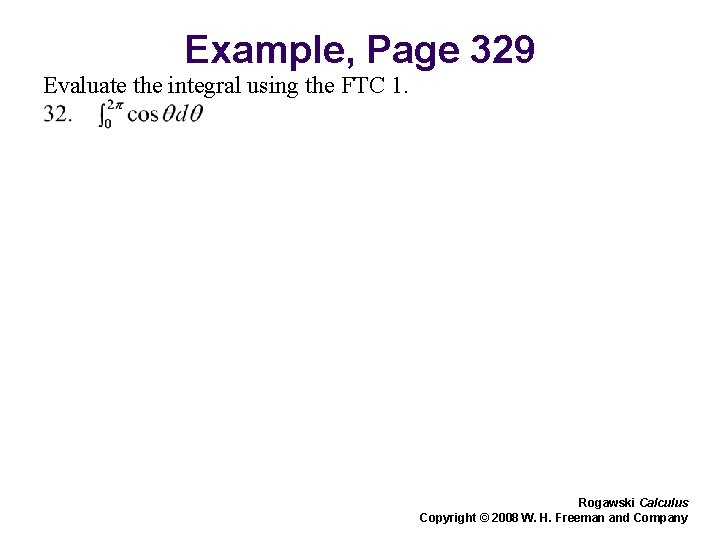
Example, Page 329 Evaluate the integral using the FTC 1. Rogawski Calculus Copyright © 2008 W. H. Freeman and Company
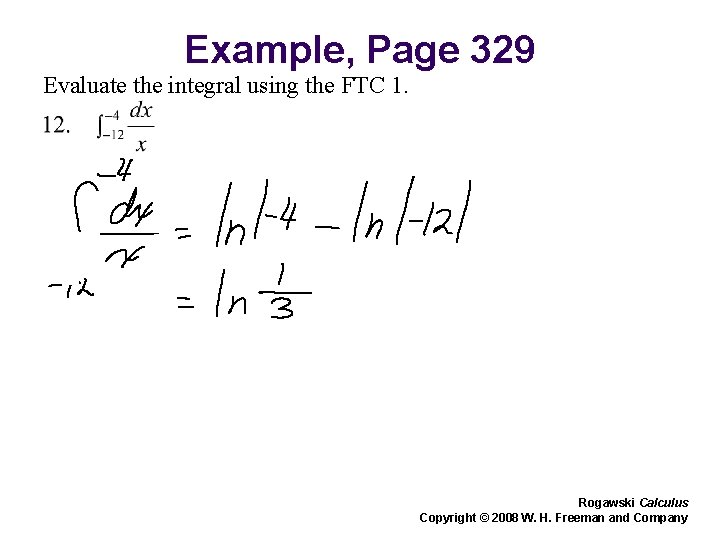
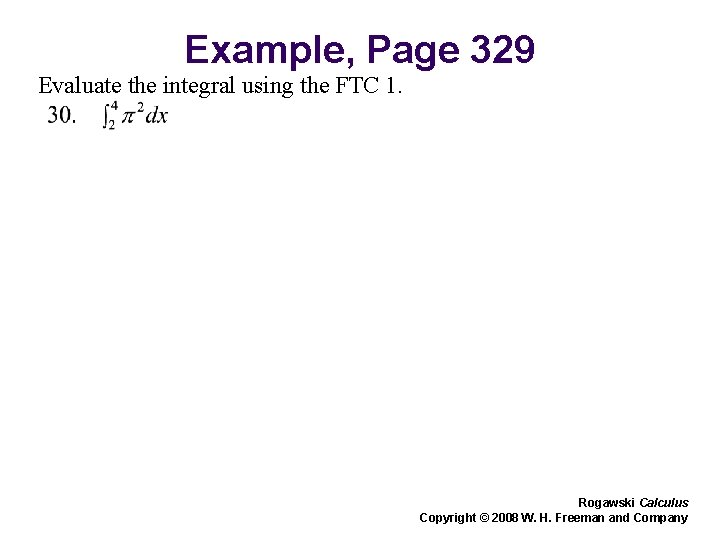
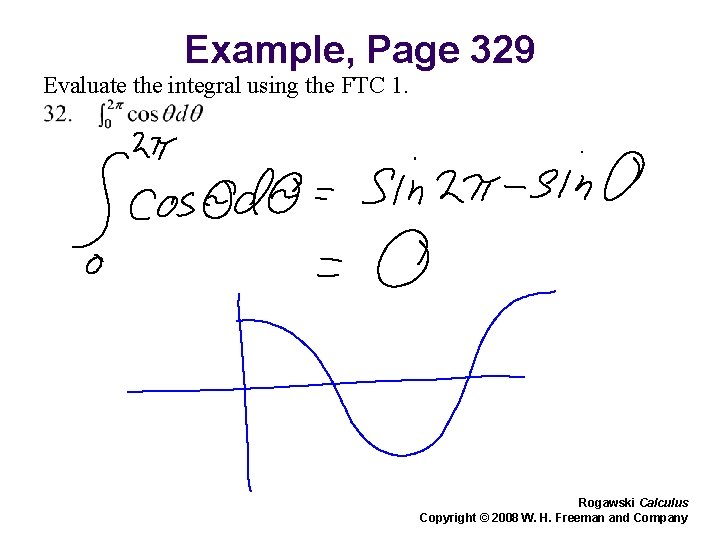
Example, Page 329 Evaluate the integral using the FTC 1. Rogawski Calculus Copyright © 2008 W. H. Freeman and Company
Example, Page 329 Evaluate the integral using the FTC 1. Rogawski Calculus Copyright © 2008 W. H. Freeman and Company
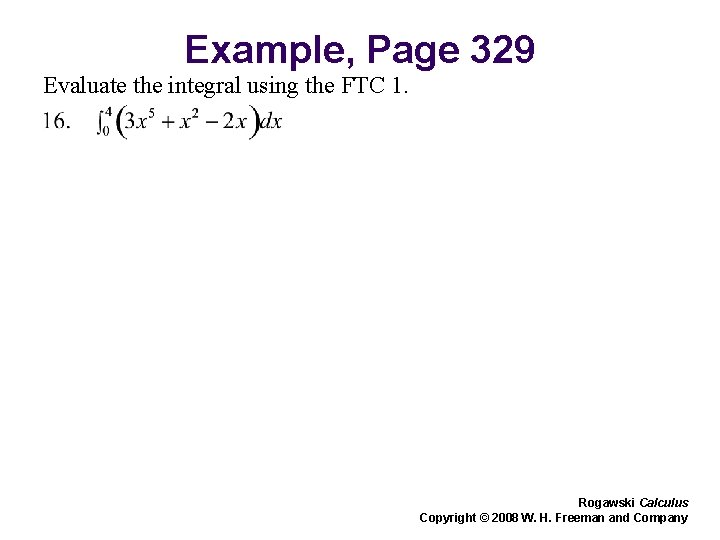
Example, Page 329 Evaluate the integral using the FTC 1. Rogawski Calculus Copyright © 2008 W. H. Freeman and Company
Example, Page 329 Evaluate the integral using the FTC 1. Rogawski Calculus Copyright © 2008 W. H. Freeman and Company
Example, Page 329 Evaluate the integral using the FTC 1. Rogawski Calculus Copyright © 2008 W. H. Freeman and Company
Example, Page 329 Evaluate the integral using the FTC 1. Rogawski Calculus Copyright © 2008 W. H. Freeman and Company
Example, Page 329 Evaluate the integral using the FTC 1. Rogawski Calculus Copyright © 2008 W. H. Freeman and Company
Example, Page 329 Evaluate the integral using the FTC 1. Rogawski Calculus Copyright © 2008 W. H. Freeman and Company
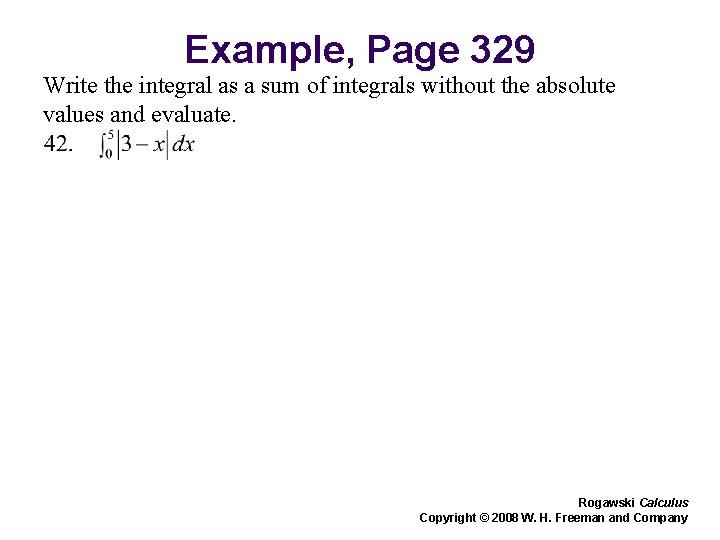
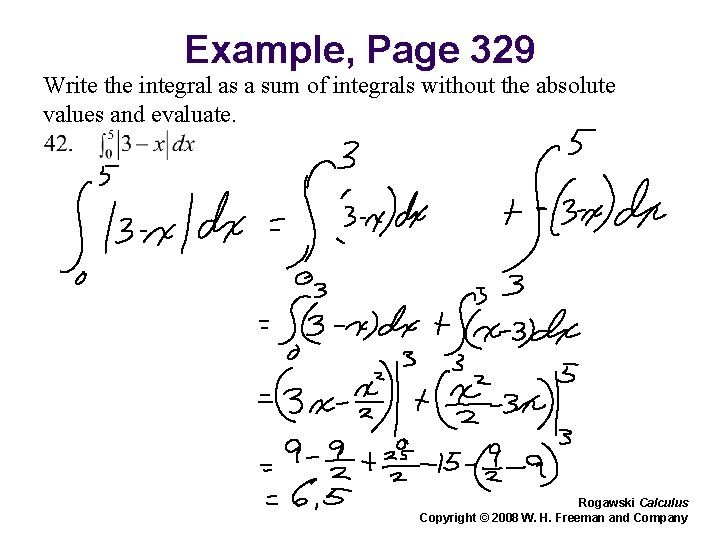
Example, Page 329 Write the integral as a sum of integrals without the absolute values and evaluate. Rogawski Calculus Copyright © 2008 W. H. Freeman and Company
Example, Page 329 Write the integral as a sum of integrals without the absolute values and evaluate. Rogawski Calculus Copyright © 2008 W. H. Freeman and Company
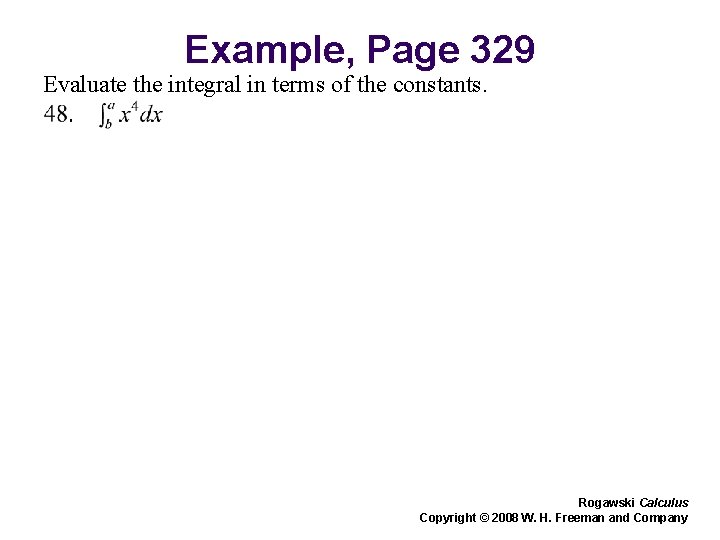
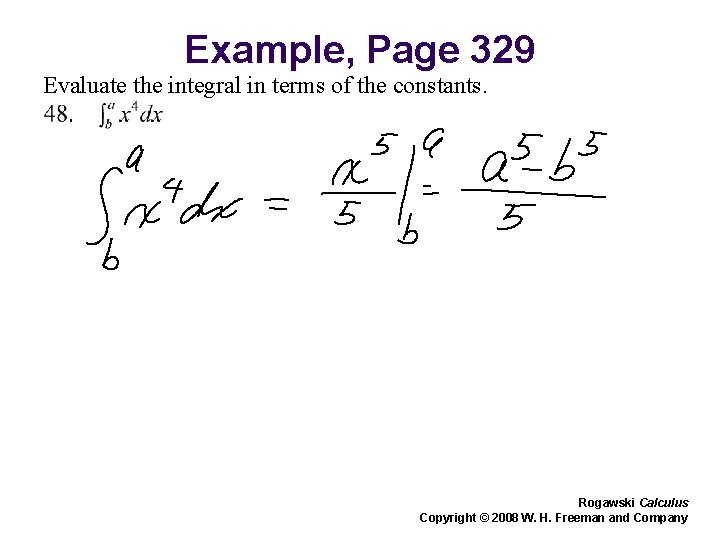
Example, Page 329 Evaluate the integral in terms of the constants. Rogawski Calculus Copyright © 2008 W. H. Freeman and Company
Example, Page 329 Evaluate the integral in terms of the constants. Rogawski Calculus Copyright © 2008 W. H. Freeman and Company