
EXAMPLE OVERVIEW OF STUDENT RISK SCREENING SCALE SRSS
- Slides: 19
EXAMPLE: OVERVIEW OF STUDENT RISK SCREENING SCALE (SRSS) STEVE POLEGA DIRECTOR OF COMPLIANCE AND SPECIAL EDUCATION SERVICES CHERIE A. WAGER ASSISTANT SUPERINTENDENT SPECIAL EDUCATION SERVICES
Universal Screening Universal screening is the systematic assessment of all students on academic and social-emotional indicators for the purpose of identifying students who are at-risk, and may require support that varies in terms of level, intensity and duration. 2
Universal Screening of Behavior • Many schools are doing a great job collecting universal screening data for reading and in many cases for math as well • Fewer schools are collecting universal screening data for behavior • Office Discipline Referrals (ODRs) are not a universal screener 3
Catching All Students in Need • Schools have students who would benefit from intervention support for behavioral and/or socialemotional needs • Not all of these students end up with behavioral referrals – but the need is there 4
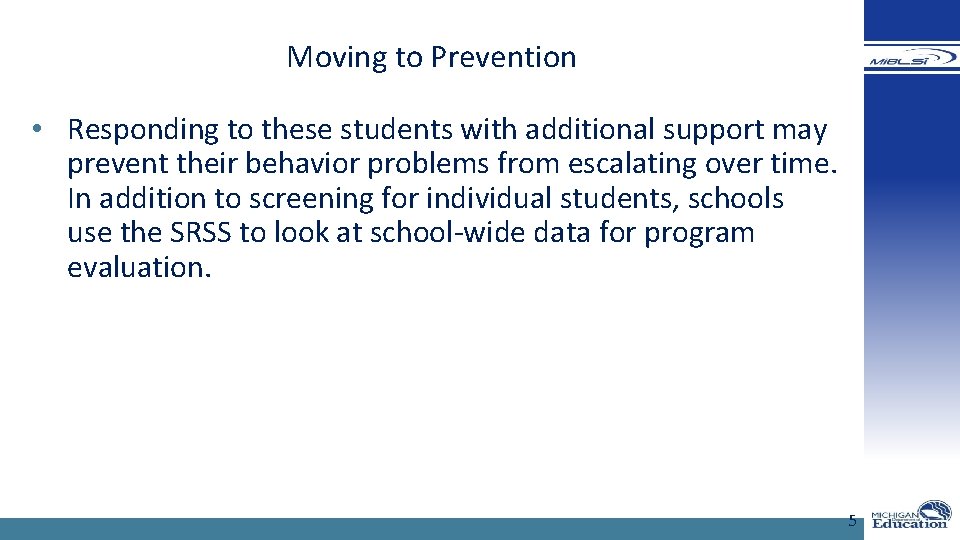
Moving to Prevention • Responding to these students with additional support may prevent their behavior problems from escalating over time. In addition to screening for individual students, schools use the SRSS to look at school-wide data for program evaluation. 5
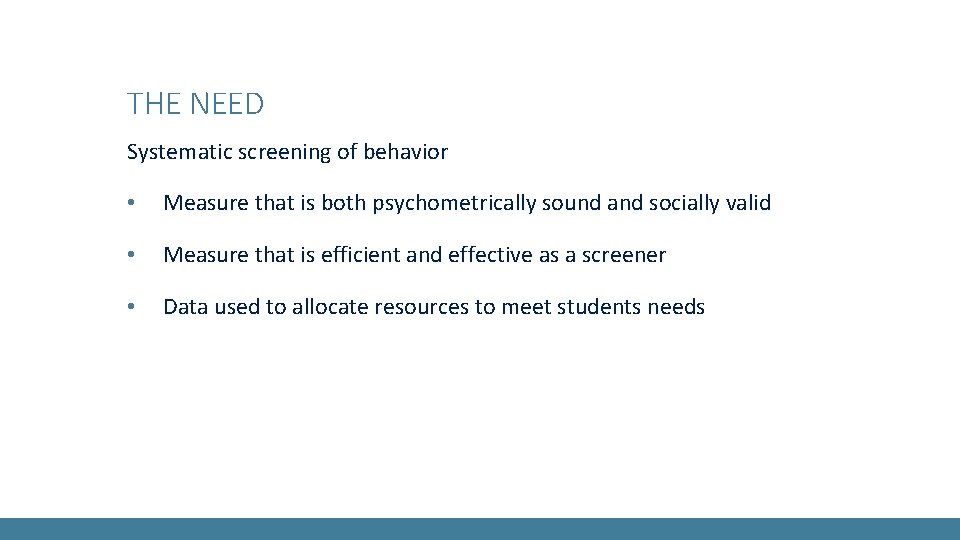
THE NEED Systematic screening of behavior • Measure that is both psychometrically sound and socially valid • Measure that is efficient and effective as a screener • Data used to allocate resources to meet students needs
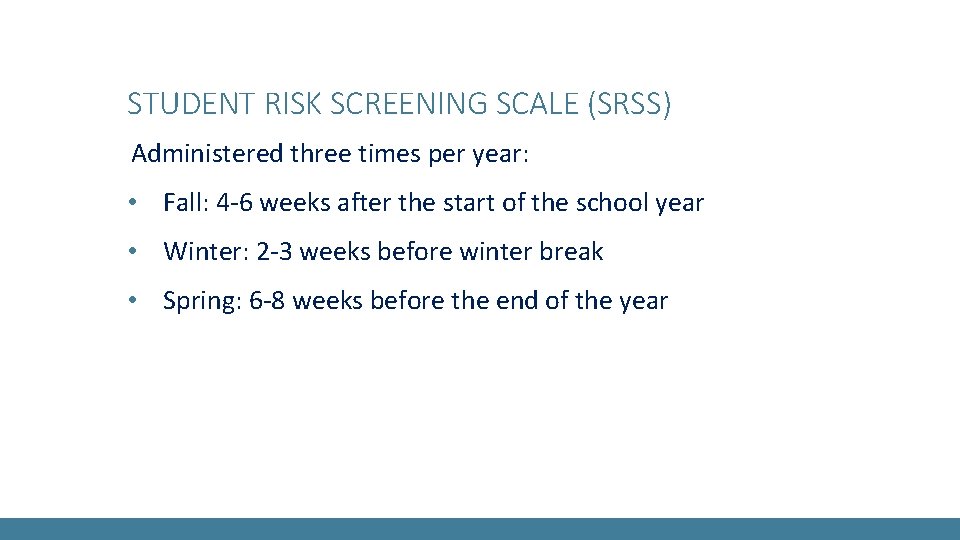
STUDENT RISK SCREENING SCALE (SRSS) Administered three times per year: • Fall: 4 -6 weeks after the start of the school year • Winter: 2 -3 weeks before winter break • Spring: 6 -8 weeks before the end of the year
At the Elementary level Each teacher will complete the SRSS for their class 9
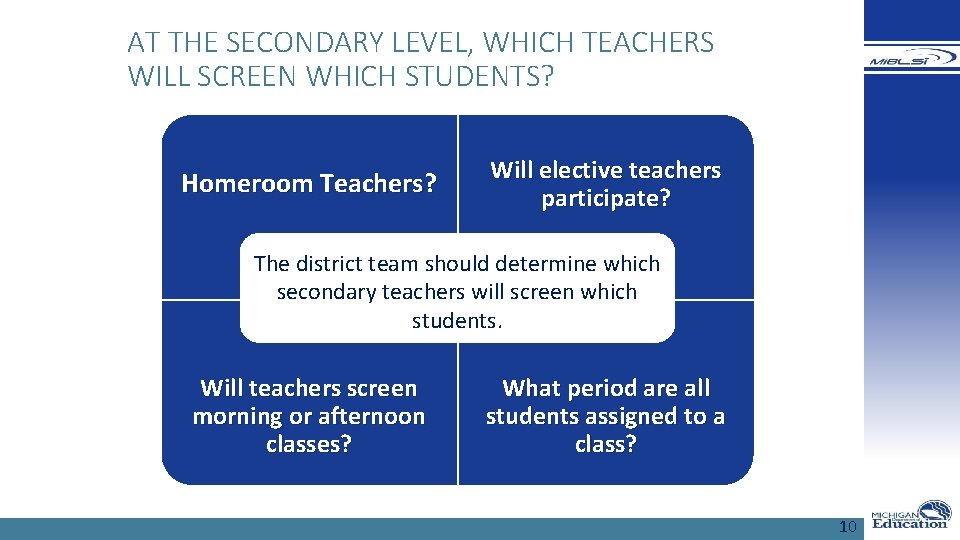
AT THE SECONDARY LEVEL, WHICH TEACHERS WILL SCREEN WHICH STUDENTS? Homeroom Teachers? Will elective teachers participate? The district team should determine which secondary teachers will screen which students. Will teachers screen morning or afternoon classes? What period are all students assigned to a class? 10
CAUTION SRSS class sheets should be in a secure location • Please do not email to teachers • Involve staff of technology department as part of this process SRSS class sheets should be check several times for accuracy to ensure items are correct • Adding or changing items or the rating scales renders the screener INVALID 11
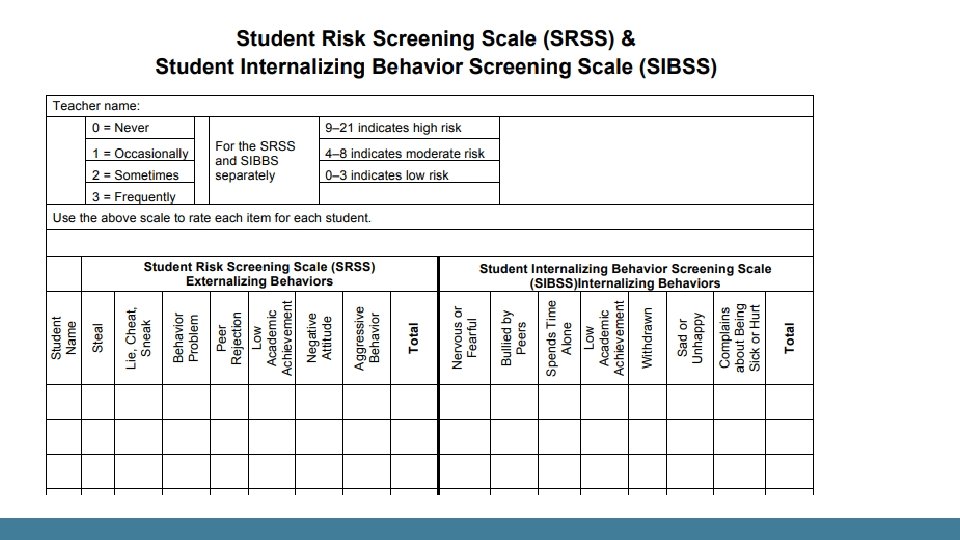
Administration 1. All teachers meet in the computer lab or other room with computer access 2. Each teacher opens their SRSS spreadsheet on the secure drive 3. Check that all items are included, the scale is included, and the right students are listed 4. Rate each student going horizontally 5. Rate each student using the 0, 1, 2, 3 scale 6. Refer to anchors on the screener 7. If a student has been enrolled for fewer than 30 days, do not rate that student 12
Administration • Teachers should independently screen students on their own class lists. • Teachers should not discuss their students with each other during the screening. 13
A Word of Caution: The SRSS provides an overall rating of risk (low, moderate, or high) but is not intended to be analyzed at the individual item level Do not use individual items as entry criteria for Tier 2 or Tier 3 interventions 14
SRSS The SRSS is: • used to inform instruction • used to determine access to interventions The SRSS is NOT: • used for special education eligibility • used to exclude students • a mental health rating 15
SRSS Data Analysis 1. PBIS Leadership Team ▪ Maximum 2 weeks after data collection team will look at school-wide and grade level results ▪ Will develop a summary for next staff meeting ▪ Will consider further Tier 1 PBIS/behavioral/social emotional supports 2. Grade Level Data Meeting at PLC ▪ ▪ ▪ Will receive results Consider further in classroom or Tier 1 PBIS/behavioral/social emotional supports Sort students, consider why students are struggling Use the why to match students to interventions/supports Recommend students who may be in need of Tier 3 and wraparound supports 16
Your Turn What questions do you have? 17
Additional Resources • Access Mi. BLSi’s measurement page on the SRSS for more information and a voiceover Power. Point from Dr. Kathleen Lane • Lane, K. L. , Menzies, H. M, Oakes, W. P. , & Kalberg, J. R. (2012). Systematic screenings of behavior to support instruction: From preschool to high school. New York, NY: Guilford Press. 18
GISD BOARD OF EDUCATION Cindy A. Gansen, President Dale A. Green, Vice President Lawrence P. Ford, Secretary Jerry G. Ragsdale, Treasurer Richard E. Hill, Trustee GISD ADMINISTRATION Dr. Lisa A. Hagel, Superintendent Cherie A. Wager, Assistant Superintendent for Special Education Services