
Example in SSA in X Y op Z
- Slides: 37
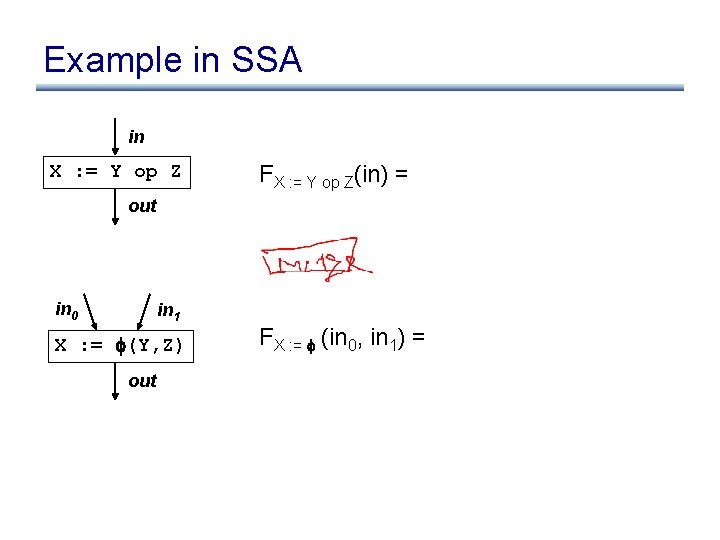
Example in SSA in X : = Y op Z FX : = Y op Z(in) = out in 0 in 1 X : = (Y, Z) out FX : = (in 0, in 1) =
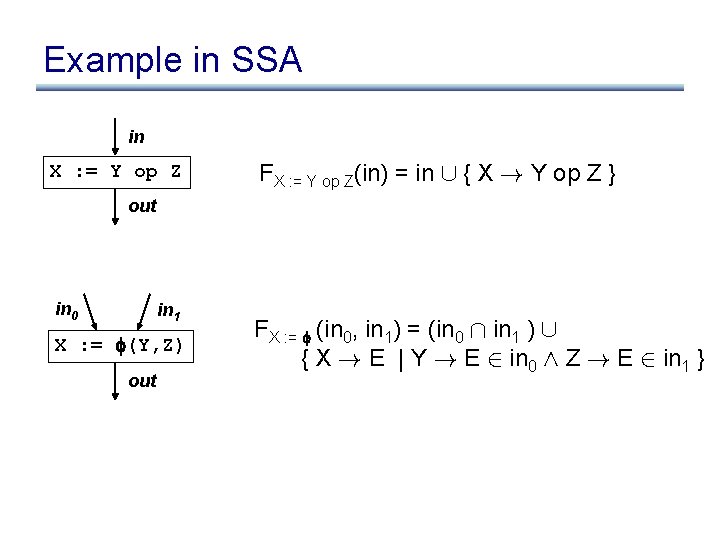
Example in SSA in X : = Y op Z FX : = Y op Z(in) = in [ { X ! Y op Z } out in 0 in 1 X : = (Y, Z) out FX : = (in 0, in 1) = (in 0 Å in 1 ) [ { X ! E | Y ! E 2 in 0 Æ Z ! E 2 in 1 }
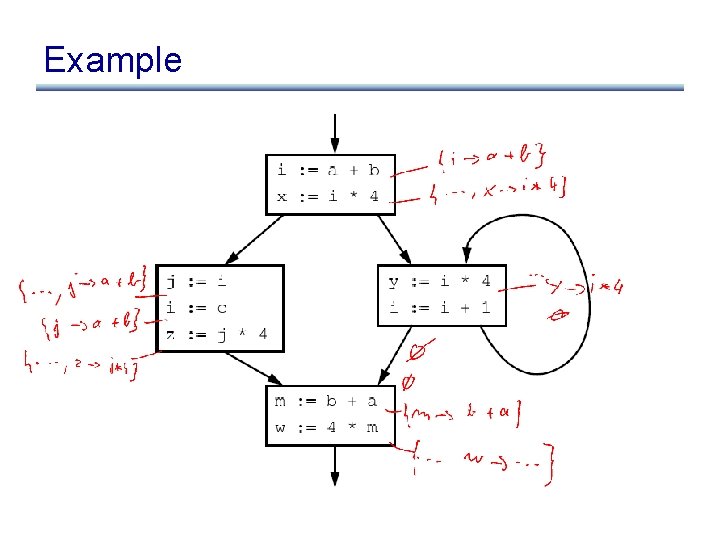
Example
Example
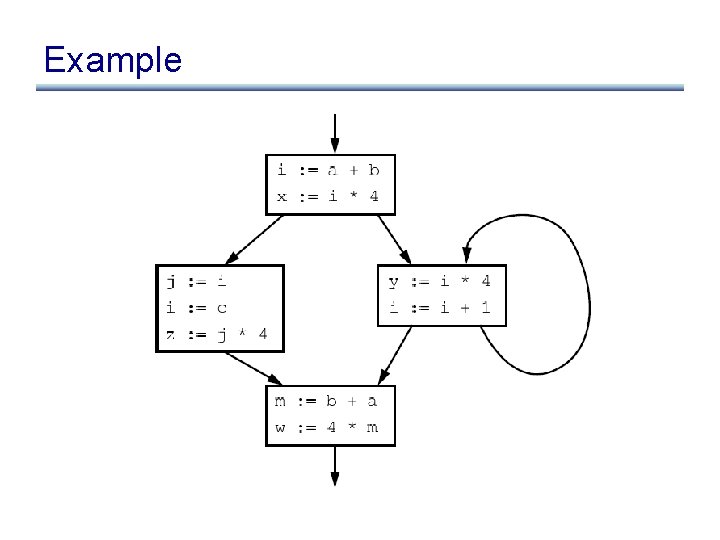
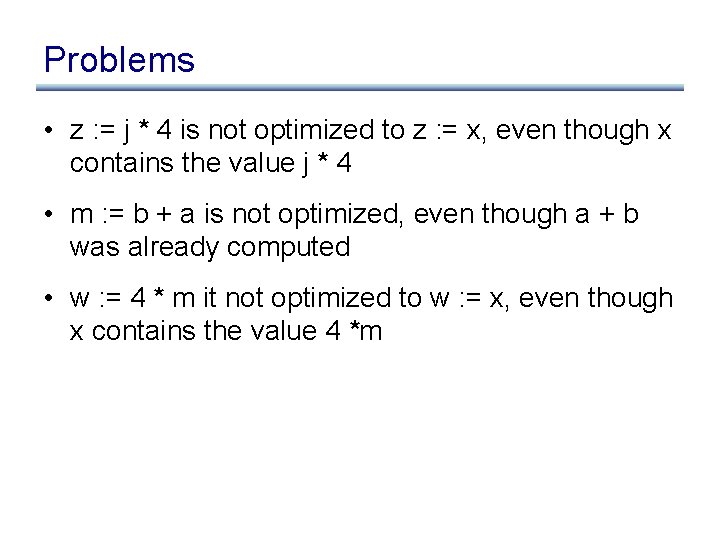
Problems • z : = j * 4 is not optimized to z : = x, even though x contains the value j * 4 • m : = b + a is not optimized, even though a + b was already computed • w : = 4 * m it not optimized to w : = x, even though x contains the value 4 *m
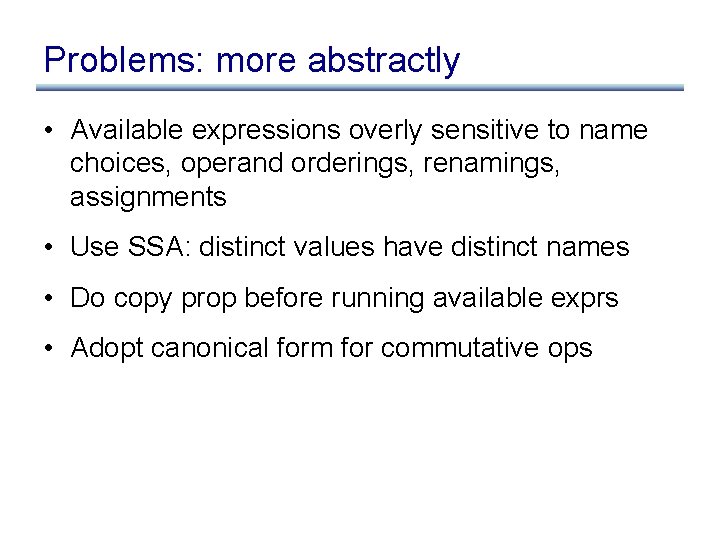
Problems: more abstractly • Available expressions overly sensitive to name choices, operand orderings, renamings, assignments • Use SSA: distinct values have distinct names • Do copy prop before running available exprs • Adopt canonical form for commutative ops
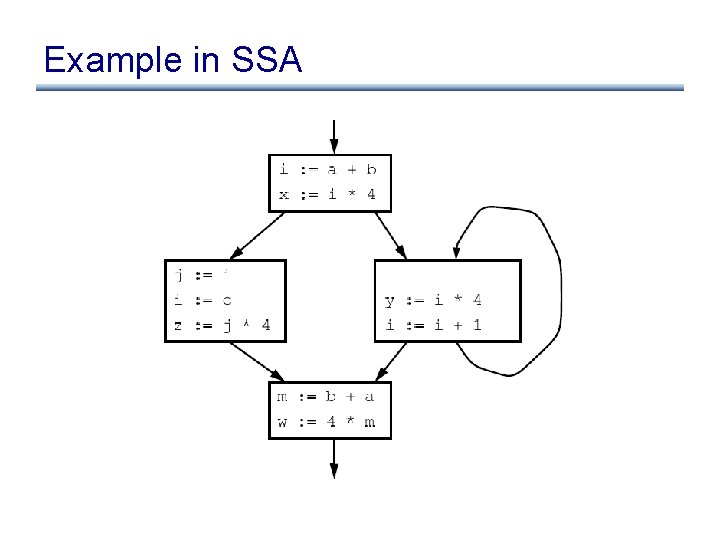
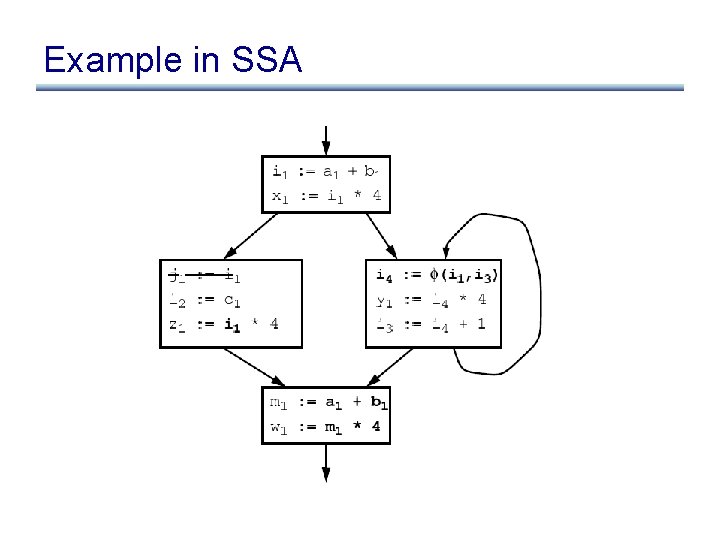
Example in SSA
Example in SSA
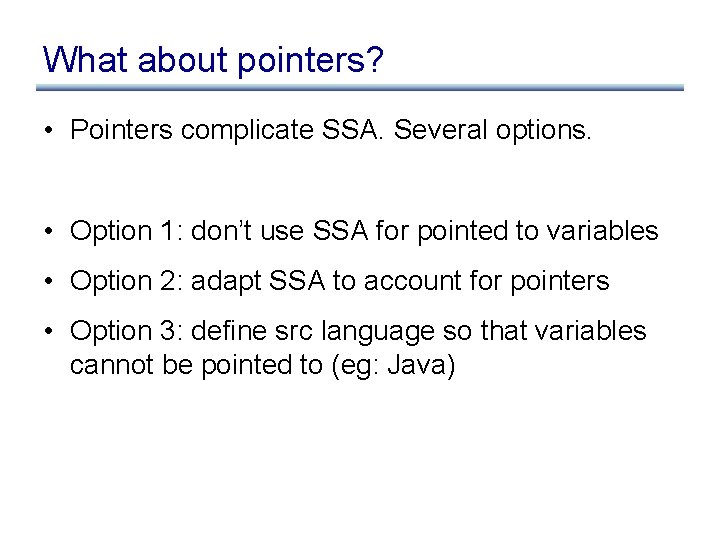
What about pointers? • Pointers complicate SSA. Several options. • Option 1: don’t use SSA for pointed to variables • Option 2: adapt SSA to account for pointers • Option 3: define src language so that variables cannot be pointed to (eg: Java)
SSA helps us with CSE • Let’s see what else SSA can help us with • Loop-invariant code motion
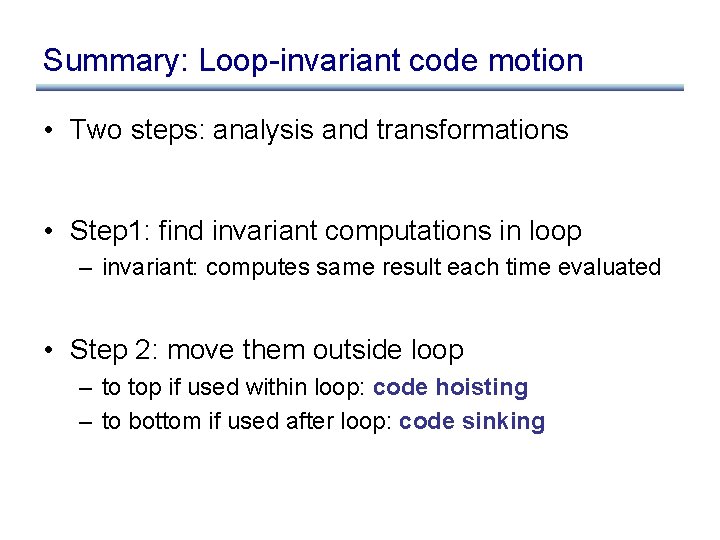
Loop-invariant code motion • Two steps: analysis and transformations • Step 1: find invariant computations in loop – invariant: computes same result each time evaluated • Step 2: move them outside loop – to top if used within loop: code hoisting – to bottom if used after loop: code sinking
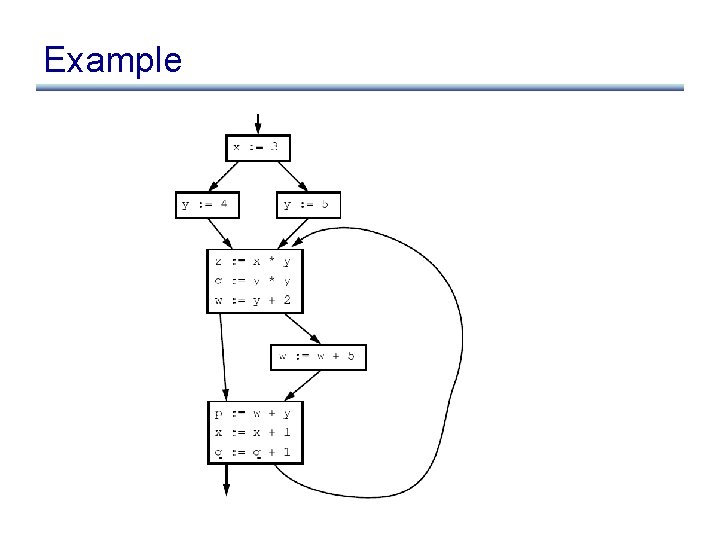
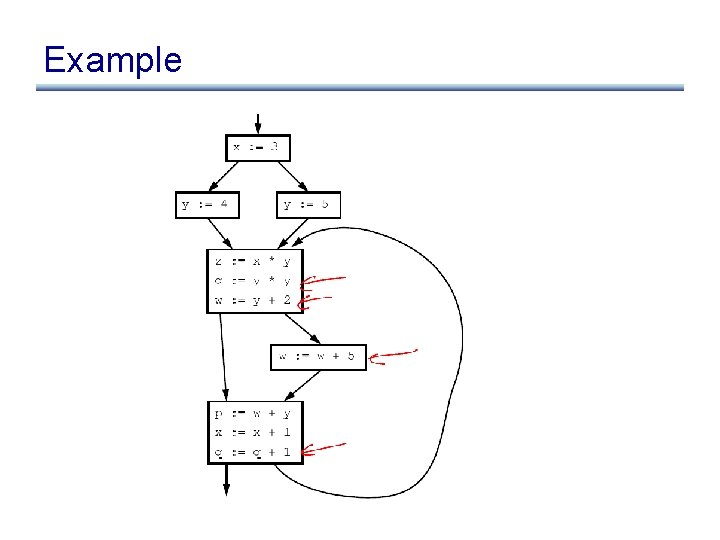
Example
Example
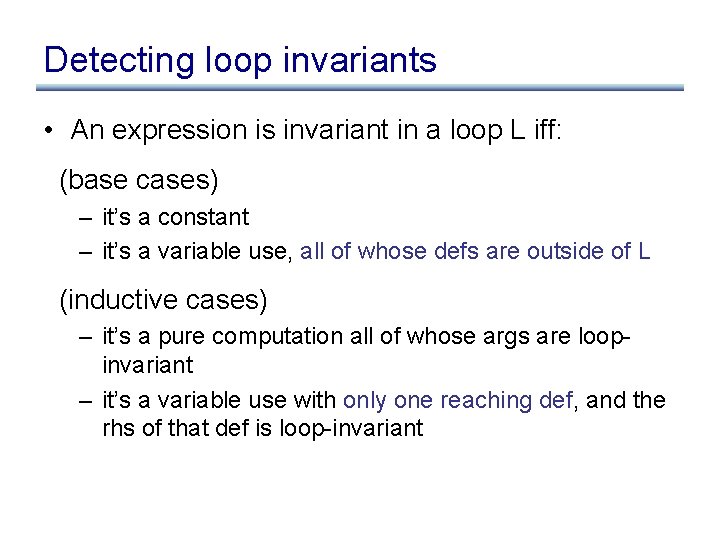
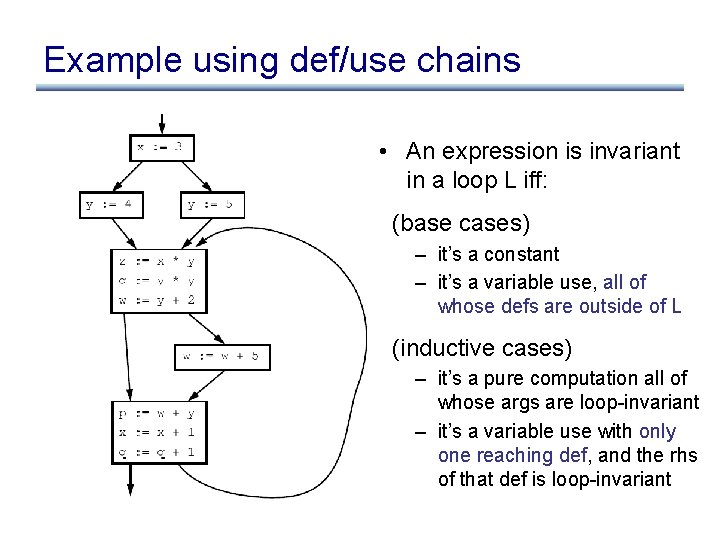
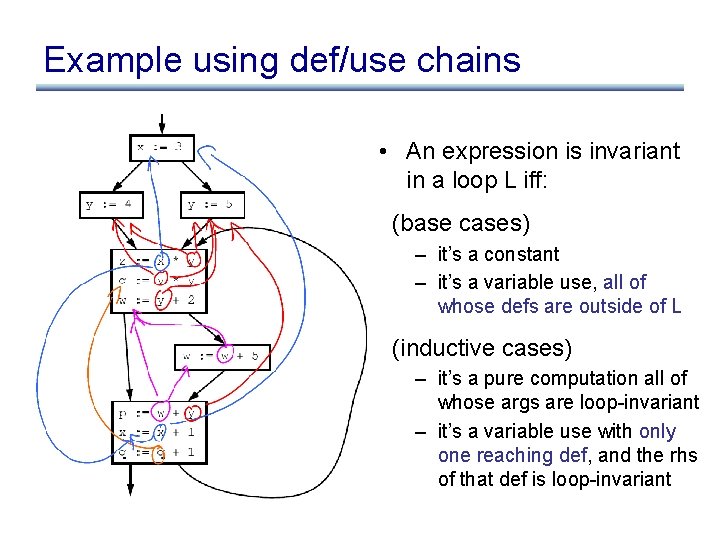
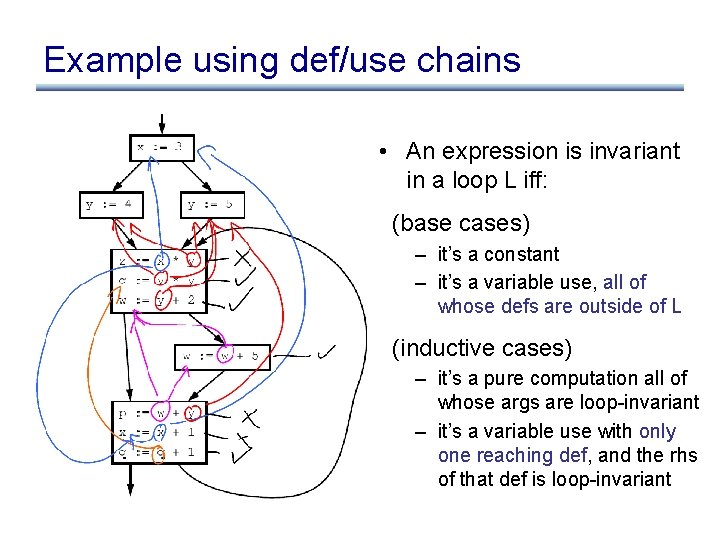
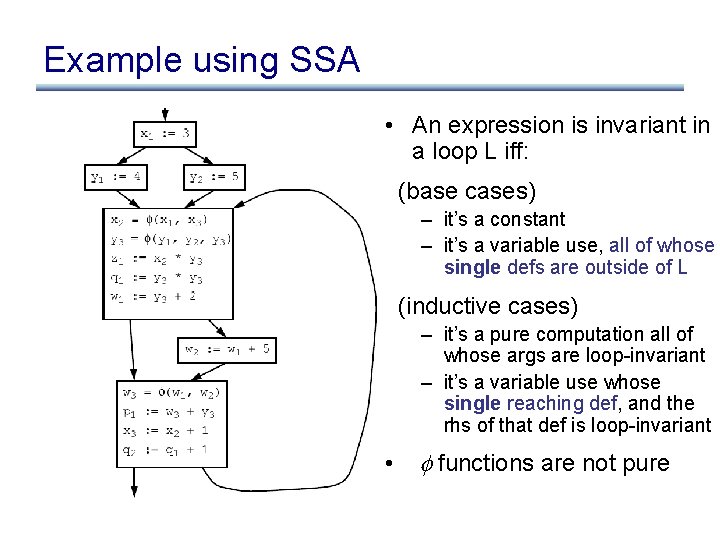
Detecting loop invariants • An expression is invariant in a loop L iff: (base cases) – it’s a constant – it’s a variable use, all of whose defs are outside of L (inductive cases) – it’s a pure computation all of whose args are loopinvariant – it’s a variable use with only one reaching def, and the rhs of that def is loop-invariant
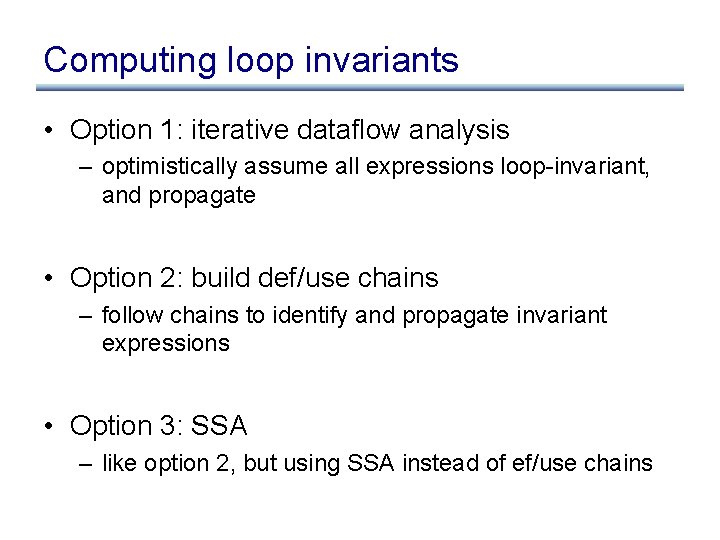
Computing loop invariants • Option 1: iterative dataflow analysis – optimistically assume all expressions loop-invariant, and propagate • Option 2: build def/use chains – follow chains to identify and propagate invariant expressions • Option 3: SSA – like option 2, but using SSA instead of ef/use chains
Example using def/use chains • An expression is invariant in a loop L iff: (base cases) – it’s a constant – it’s a variable use, all of whose defs are outside of L (inductive cases) – it’s a pure computation all of whose args are loop-invariant – it’s a variable use with only one reaching def, and the rhs of that def is loop-invariant
Example using def/use chains • An expression is invariant in a loop L iff: (base cases) – it’s a constant – it’s a variable use, all of whose defs are outside of L (inductive cases) – it’s a pure computation all of whose args are loop-invariant – it’s a variable use with only one reaching def, and the rhs of that def is loop-invariant
Example using def/use chains • An expression is invariant in a loop L iff: (base cases) – it’s a constant – it’s a variable use, all of whose defs are outside of L (inductive cases) – it’s a pure computation all of whose args are loop-invariant – it’s a variable use with only one reaching def, and the rhs of that def is loop-invariant
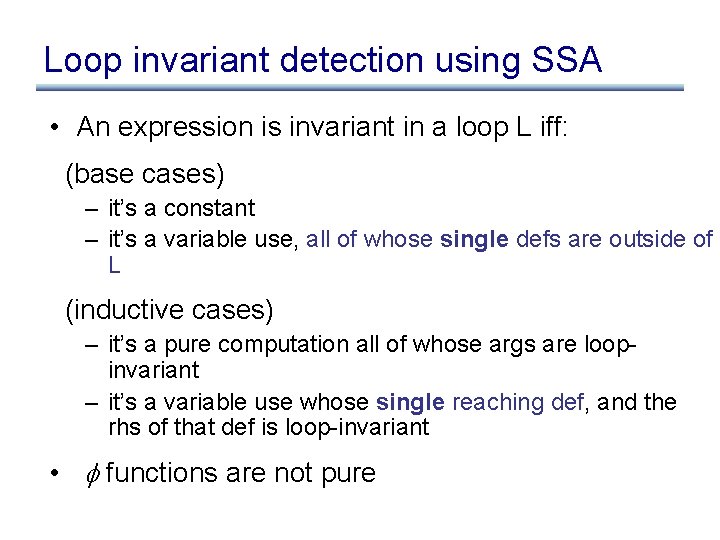
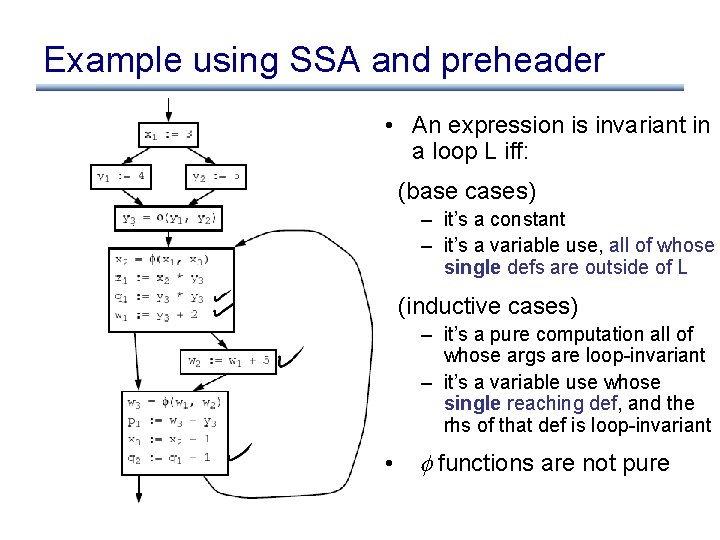
Loop invariant detection using SSA • An expression is invariant in a loop L iff: (base cases) – it’s a constant – it’s a variable use, all of whose single defs are outside of L (inductive cases) – it’s a pure computation all of whose args are loopinvariant – it’s a variable use whose single reaching def, and the rhs of that def is loop-invariant • functions are not pure
Example using SSA • An expression is invariant in a loop L iff: (base cases) – it’s a constant – it’s a variable use, all of whose single defs are outside of L (inductive cases) – it’s a pure computation all of whose args are loop-invariant – it’s a variable use whose single reaching def, and the rhs of that def is loop-invariant • functions are not pure
Example using SSA and preheader • An expression is invariant in a loop L iff: (base cases) – it’s a constant – it’s a variable use, all of whose single defs are outside of L (inductive cases) – it’s a pure computation all of whose args are loop-invariant – it’s a variable use whose single reaching def, and the rhs of that def is loop-invariant • functions are not pure
Summary: Loop-invariant code motion • Two steps: analysis and transformations • Step 1: find invariant computations in loop – invariant: computes same result each time evaluated • Step 2: move them outside loop – to top if used within loop: code hoisting – to bottom if used after loop: code sinking
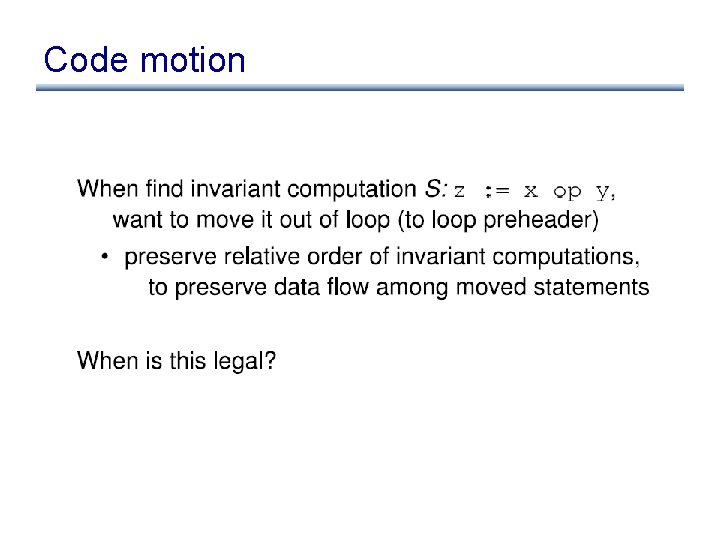
Code motion
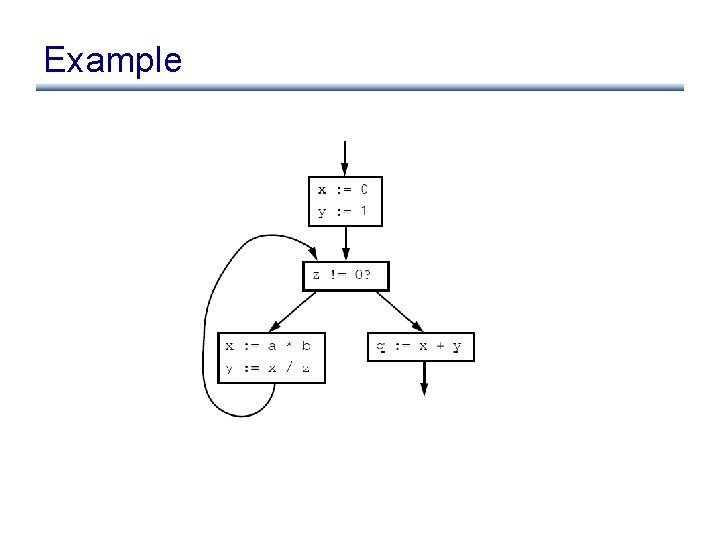
Example
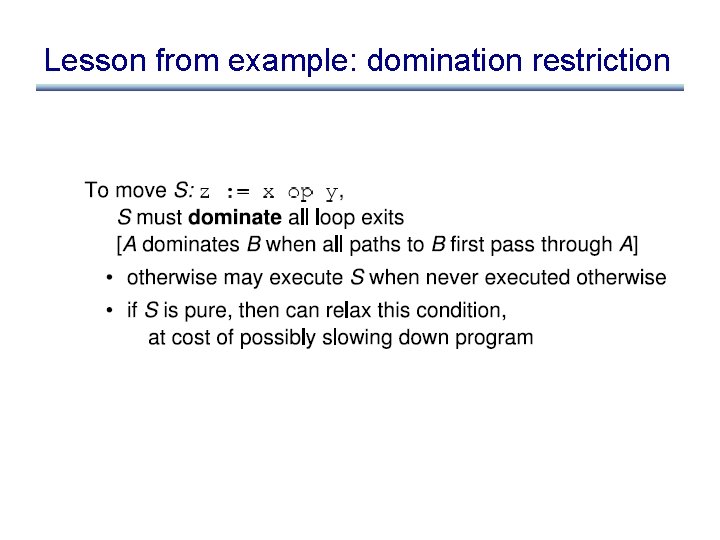
Lesson from example: domination restriction
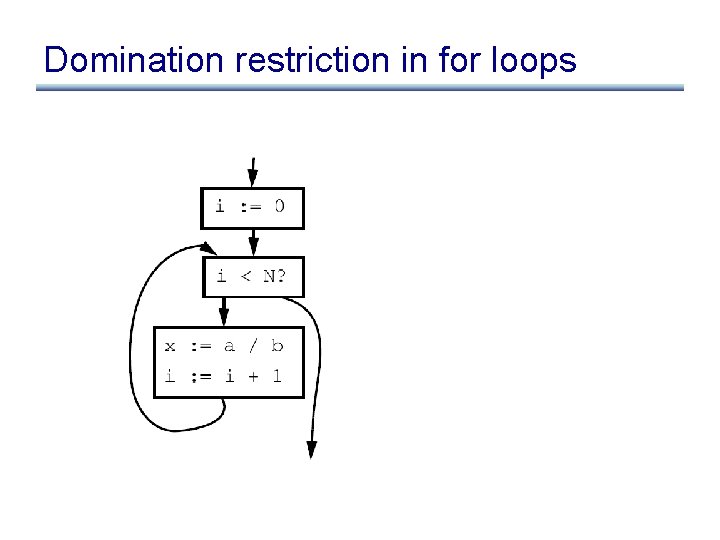
Domination restriction in for loops
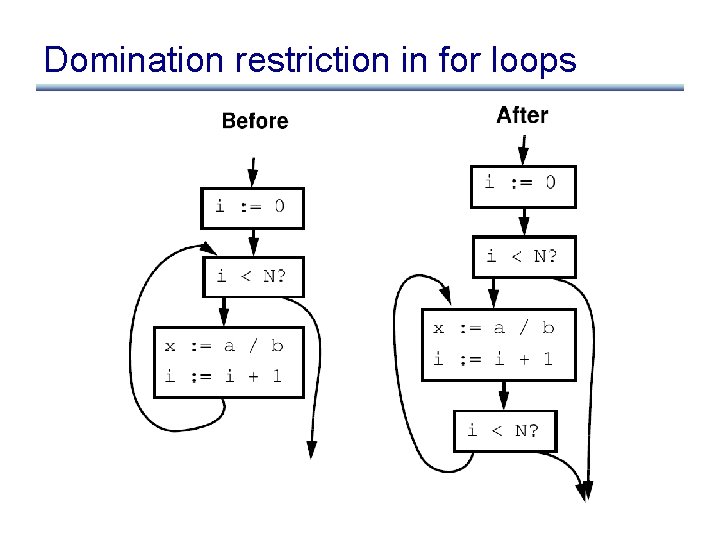
Domination restriction in for loops
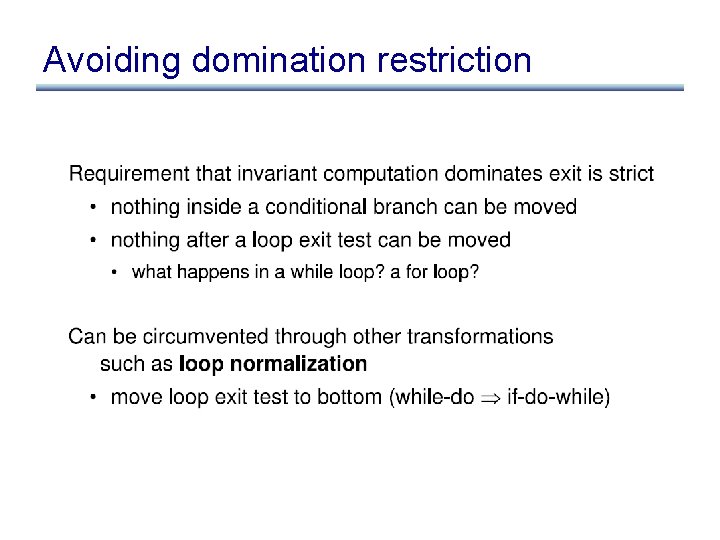
Avoiding domination restriction
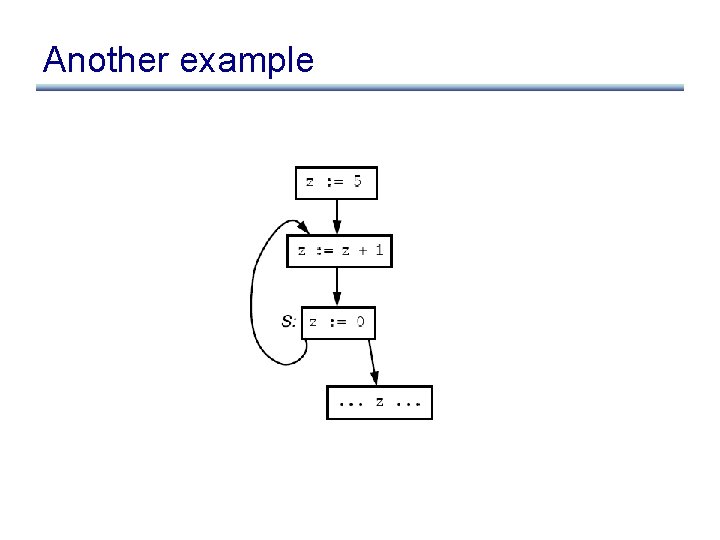
Another example
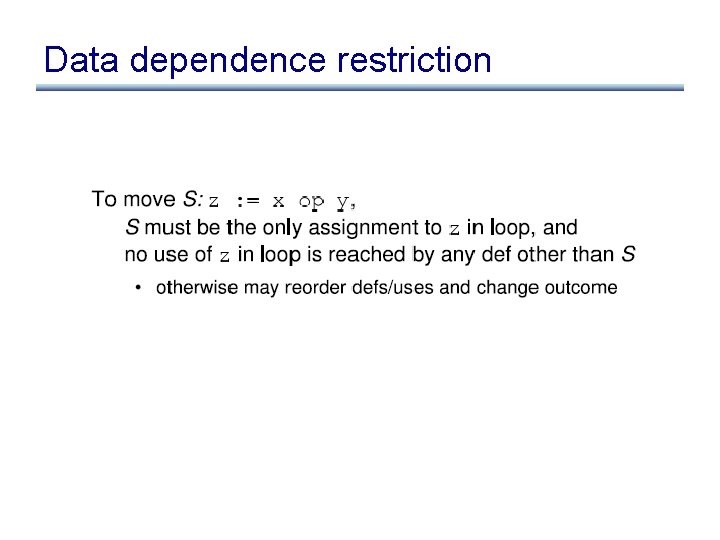
Data dependence restriction
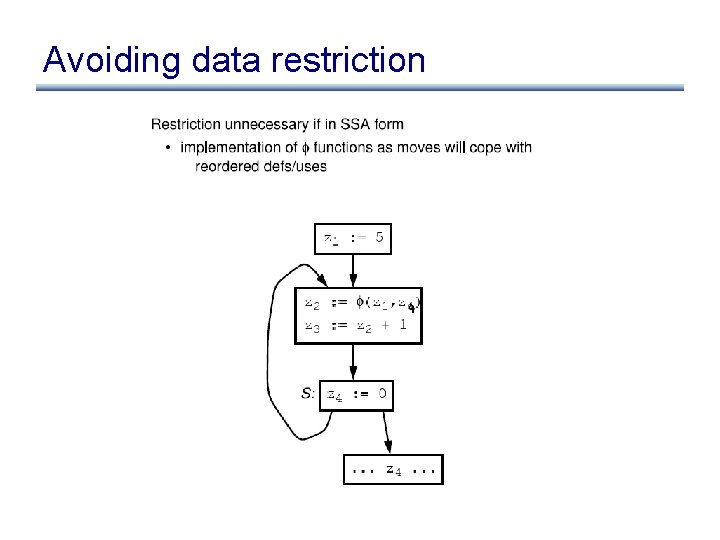
Avoiding data restriction
Summary of Data dependencies • We’ve seen SSA, a way to encode data dependencies better than just def/use chains – makes CSE easier – makes loop invariant detection easier – makes code motion easier • Now we move on to looking at how to encode control dependencies
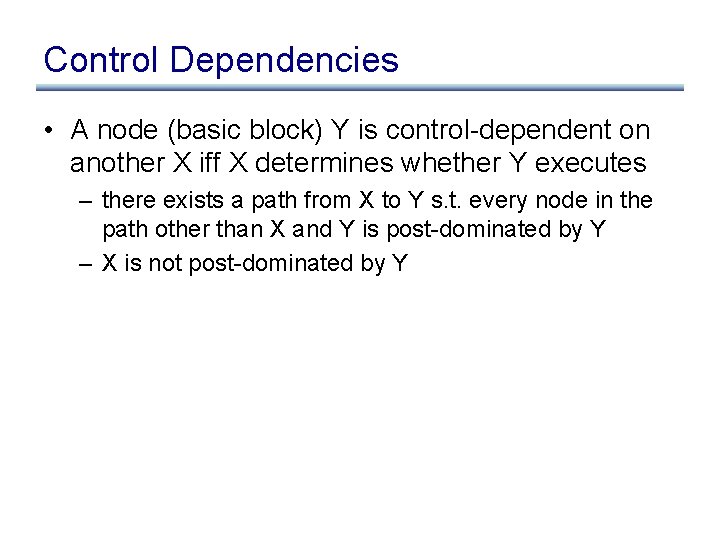
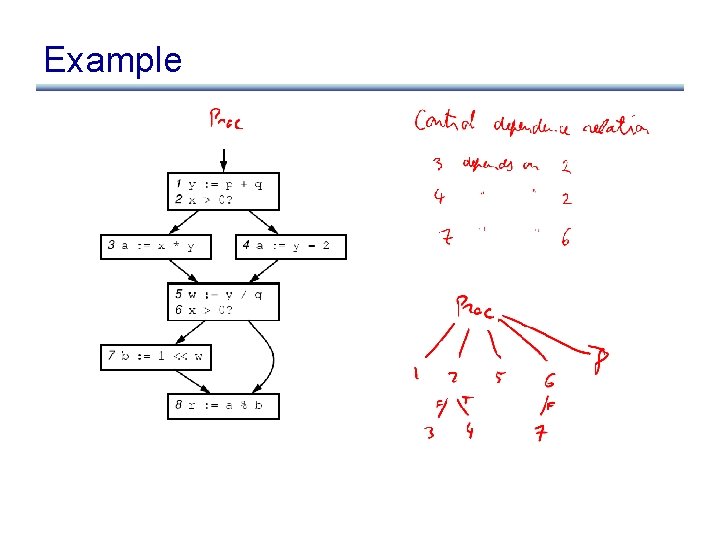
Control Dependencies • A node (basic block) Y is control-dependent on another X iff X determines whether Y executes – there exists a path from X to Y s. t. every node in the path other than X and Y is post-dominated by Y – X is not post-dominated by Y
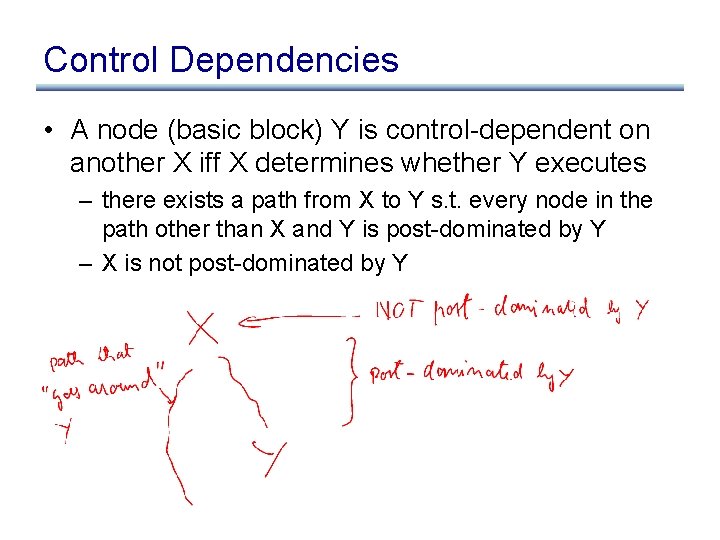
Control Dependencies • A node (basic block) Y is control-dependent on another X iff X determines whether Y executes – there exists a path from X to Y s. t. every node in the path other than X and Y is post-dominated by Y – X is not post-dominated by Y
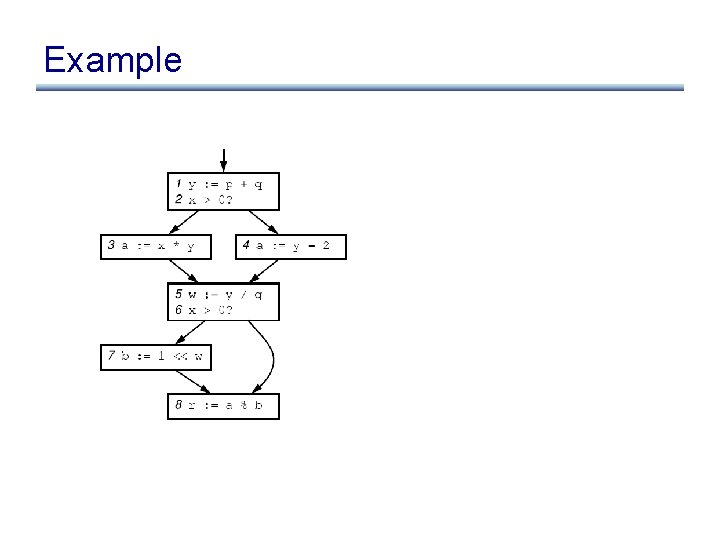
Example
Example