
Example I Traffic to a message switching center


- Slides: 12
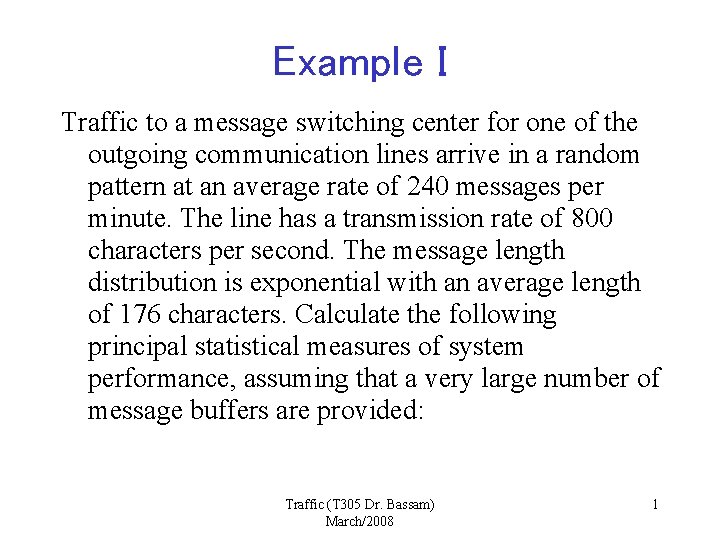
Example I Traffic to a message switching center for one of the outgoing communication lines arrive in a random pattern at an average rate of 240 messages per minute. The line has a transmission rate of 800 characters per second. The message length distribution is exponential with an average length of 176 characters. Calculate the following principal statistical measures of system performance, assuming that a very large number of message buffers are provided: Traffic (T 305 Dr. Bassam) March/2008 1
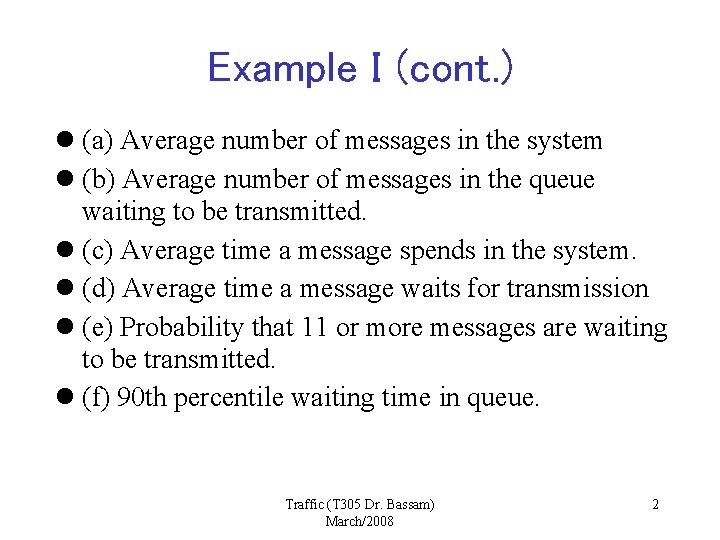
Example I (cont. ) l (a) Average number of messages in the system l (b) Average number of messages in the queue waiting to be transmitted. l (c) Average time a message spends in the system. l (d) Average time a message waits for transmission l (e) Probability that 11 or more messages are waiting to be transmitted. l (f) 90 th percentile waiting time in queue. Traffic (T 305 Dr. Bassam) March/2008 2
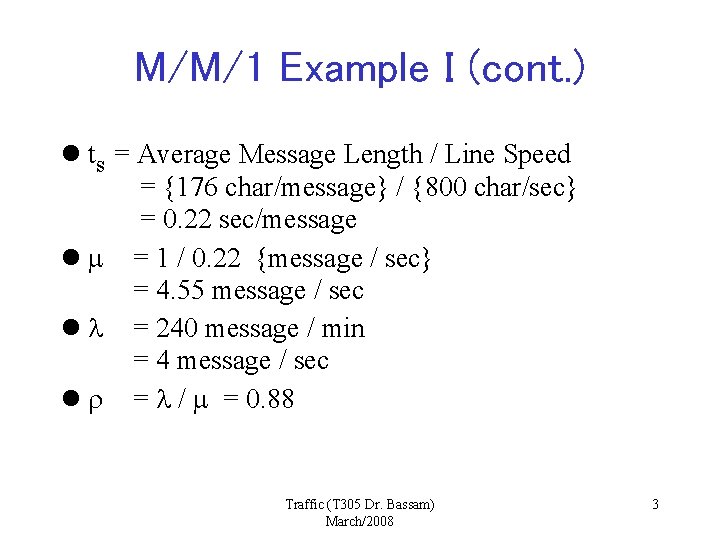
M/M/1 Example I (cont. ) l ts = Average Message Length / Line Speed = {176 char/message} / {800 char/sec} = 0. 22 sec/message l m = 1 / 0. 22 {message / sec} = 4. 55 message / sec l l = 240 message / min = 4 message / sec l r = l / m = 0. 88 Traffic (T 305 Dr. Bassam) March/2008 3
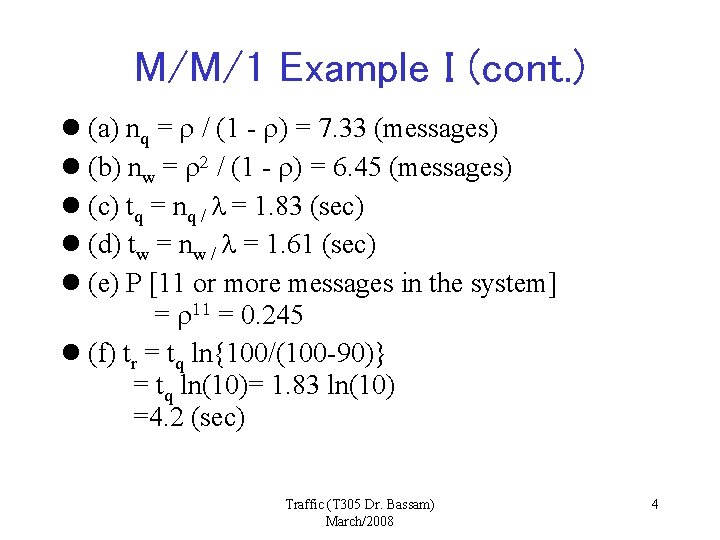
M/M/1 Example I (cont. ) l (a) nq = r / (1 - r) = 7. 33 (messages) l (b) nw = r 2 / (1 - r) = 6. 45 (messages) l (c) tq = nq / l = 1. 83 (sec) l (d) tw = nw / l = 1. 61 (sec) l (e) P [11 or more messages in the system] = r 11 = 0. 245 l (f) tr = tq ln{100/(100 -90)} = tq ln(10)= 1. 83 ln(10) =4. 2 (sec) Traffic (T 305 Dr. Bassam) March/2008 4
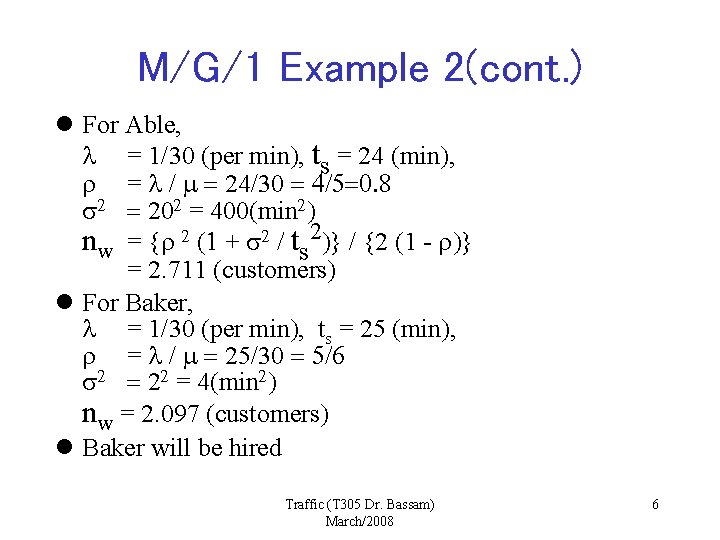
Example 2 There are two workers competing for a job. Able claims an average service time which is faster than Baker’s, but Baker claims to be more consistent, if not as fast. The arrivals occur according to a Poisson process at a rate of l= 2 per hour. (1/30 per minute). Able’s statistics are an average service time of 24 minutes with a standard deviation of 20 minutes. Baker’s service statistics are an average service time of 25 minutes, but a standard deviation of only 2 minutes. If the average length of the queue is the criterion for hiring, which worker should be hired? Traffic (T 305 Dr. Bassam) March/2008 5
M/G/1 Example 2(cont. ) l For Able, l = 1/30 (per min), ts = 24 (min), r = l / m = 24/30 = 4/5=0. 8 s 2 = 202 = 400(min 2) nw = {r 2 (1 + s 2 / ts 2)} / {2 (1 - r)} = 2. 711 (customers) l For Baker, l = 1/30 (per min), ts = 25 (min), r = l / m = 25/30 = 5/6 s 2 = 22 = 4(min 2) nw = 2. 097 (customers) l Baker will be hired Traffic (T 305 Dr. Bassam) March/2008 6
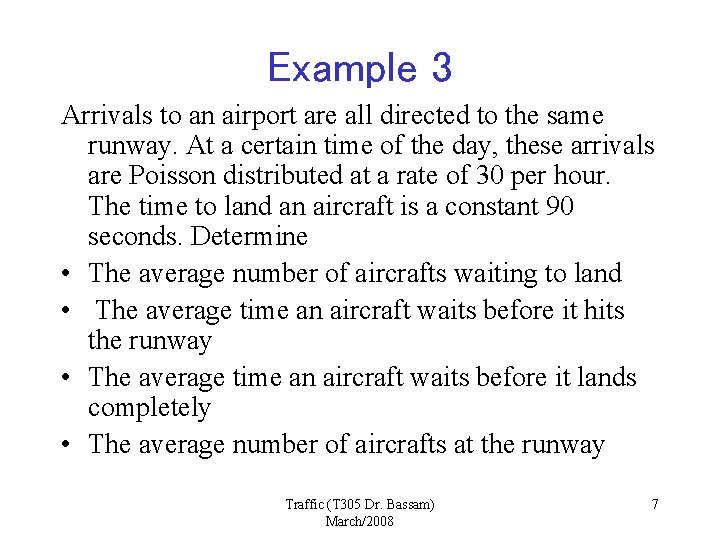
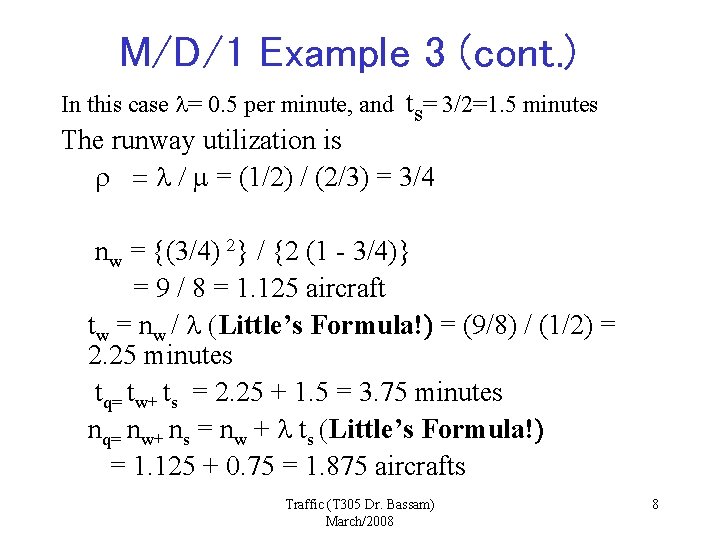
Example 3 Arrivals to an airport are all directed to the same runway. At a certain time of the day, these arrivals are Poisson distributed at a rate of 30 per hour. The time to land an aircraft is a constant 90 seconds. Determine • The average number of aircrafts waiting to land • The average time an aircraft waits before it hits the runway • The average time an aircraft waits before it lands completely • The average number of aircrafts at the runway Traffic (T 305 Dr. Bassam) March/2008 7
M/D/1 Example 3 (cont. ) In this case l= 0. 5 per minute, and ts= 3/2=1. 5 minutes The runway utilization is r = l / m = (1/2) / (2/3) = 3/4 nw = {(3/4) 2} / {2 (1 - 3/4)} = 9 / 8 = 1. 125 aircraft tw = nw / l (Little’s Formula!) = (9/8) / (1/2) = 2. 25 minutes tq= tw+ ts = 2. 25 + 1. 5 = 3. 75 minutes nq= nw+ ns = nw + l ts (Little’s Formula!) = 1. 125 + 0. 75 = 1. 875 aircrafts Traffic (T 305 Dr. Bassam) March/2008 8
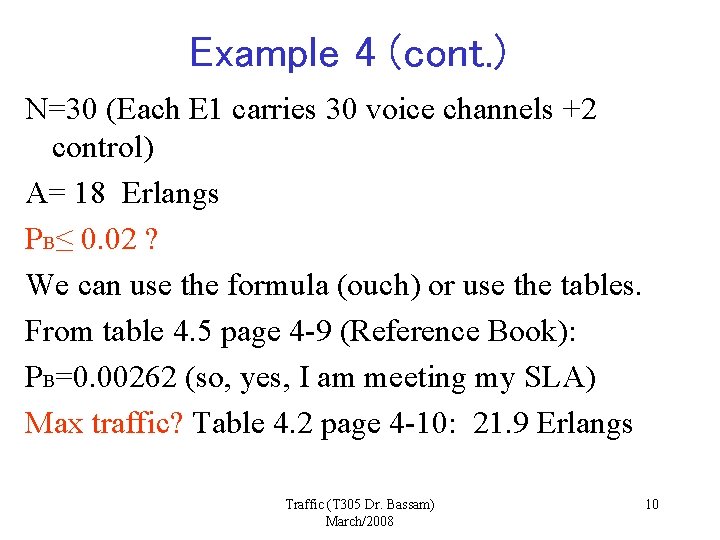
Example 4 My Service Level Objective says that less than 2% of customer calls will get a busy signal. I have an inbound E 1 trunk route and my call centre is carrying 18 Erlangs. Should the incoming route be sufficient to meet my Service Level Objective? What is the maximum traffic I can carry and still meet my SLA (service level agreement)? Note: Erlang B is used to model telephone lines Traffic (T 305 Dr. Bassam) March/2008 9
Example 4 (cont. ) N=30 (Each E 1 carries 30 voice channels +2 control) A= 18 Erlangs PB≤ 0. 02 ? We can use the formula (ouch) or use the tables. From table 4. 5 page 4 -9 (Reference Book): PB=0. 00262 (so, yes, I am meeting my SLA) Max traffic? Table 4. 2 page 4 -10: 21. 9 Erlangs Traffic (T 305 Dr. Bassam) March/2008 10
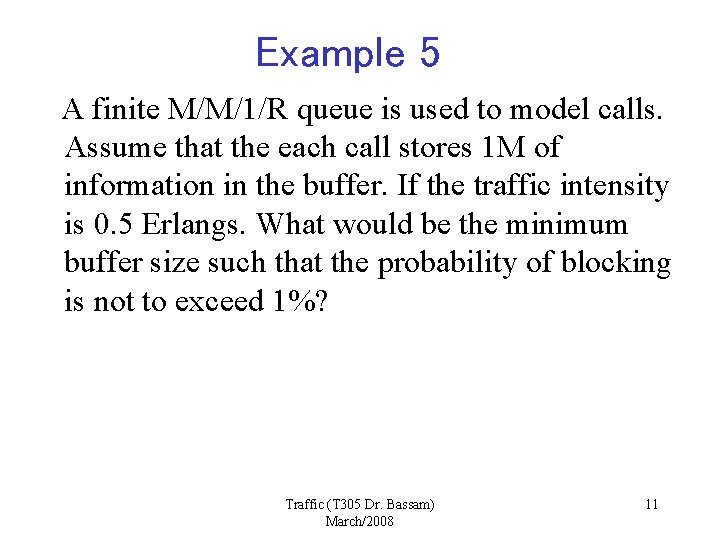
Example 5 A finite M/M/1/R queue is used to model calls. Assume that the each call stores 1 M of information in the buffer. If the traffic intensity is 0. 5 Erlangs. What would be the minimum buffer size such that the probability of blocking is not to exceed 1%? Traffic (T 305 Dr. Bassam) March/2008 11
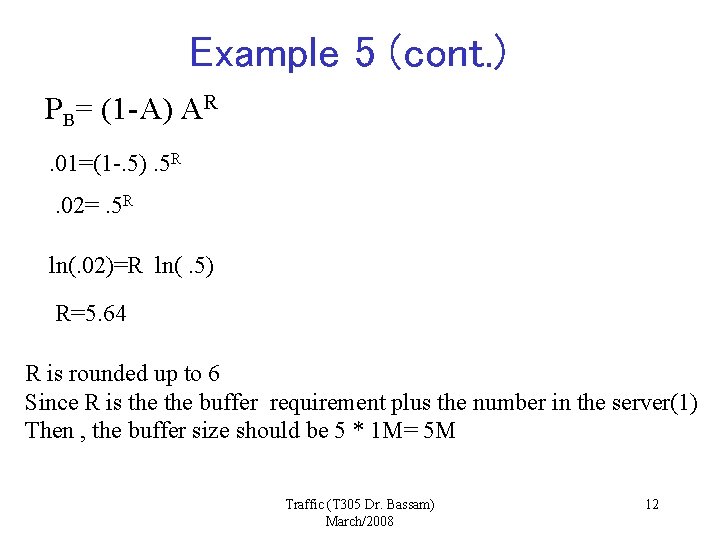
Example 5 (cont. ) PB= (1 -A) AR. 01=(1 -. 5). 5 R. 02=. 5 R ln(. 02)=R ln(. 5) R=5. 64 R is rounded up to 6 Since R is the buffer requirement plus the number in the server(1) Then , the buffer size should be 5 * 1 M= 5 M Traffic (T 305 Dr. Bassam) March/2008 12