
EXAMPLE Hierarchical Modeling Linking to ScienceSupport Models Groundwater

- Slides: 46
EXAMPLE Hierarchical Modeling Linking to Science-Support Models Groundwater Modeling System RT 3 D and MT 3 DMS FRAMES-2. 0 Workshop U. S. Nuclear Regulatory Commission Bethesda, Maryland November 15 -16, 2007 Pacific Northwest National Laboratory Richland, Washington
Purpose Demonstrate Hierarchical Modeling by Linking to Science-Support Models Perform a 3 -D Numerical RT 3 D Groundwater Simulation Perform a Semi-analytical Groundwater Simulation 2
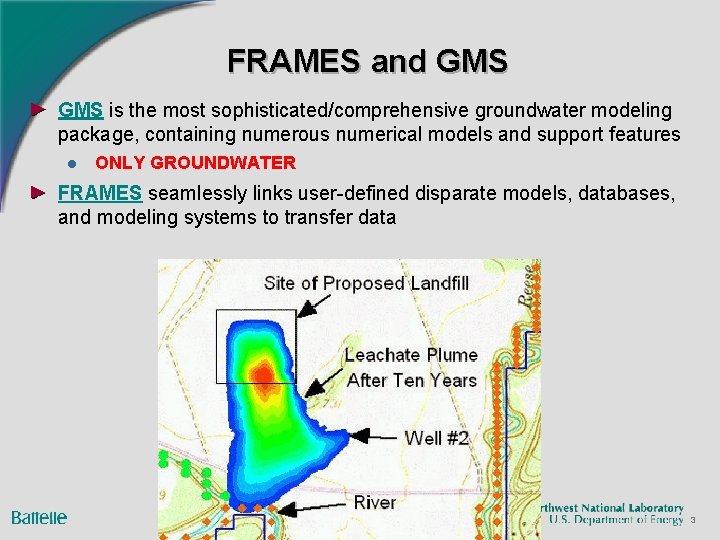
FRAMES and GMS is the most sophisticated/comprehensive groundwater modeling package, containing numerous numerical models and support features l ONLY GROUNDWATER FRAMES seamlessly links user-defined disparate models, databases, and modeling systems to transfer data 3
MT 3 DMS and RT 3 D MT 3 DMS is a modular, 3 -D, multi-species transport model for the simulation of advection, dispersion, and limited chemical reactions l Zero- or first-order decay of individual chemicals (no chain formation) RT 3 D is essentially MT 3 DMS with significantly enhanced reaction capabilities l Multi-species reactive transport with chain formation l Complex reaction kinetics with linked reactions, parallel pathways, etc. l Reaction kinetics for any chemical system of interest, including a mixture of mobile and immobile components 4
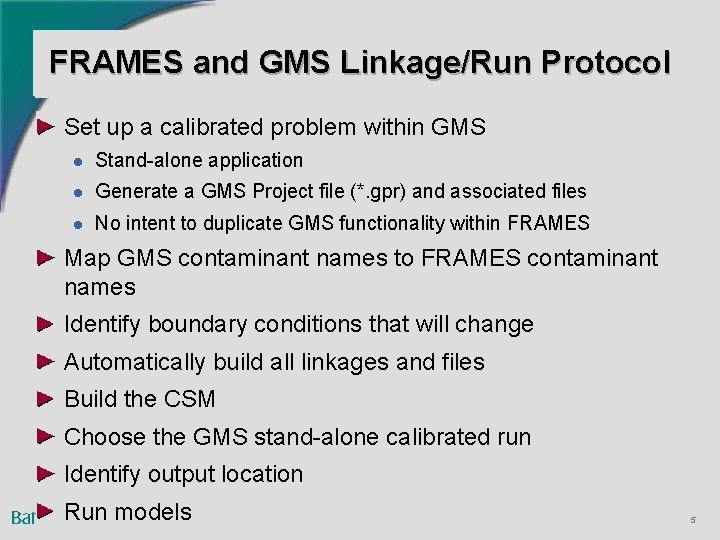
FRAMES and GMS Linkage/Run Protocol Set up a calibrated problem within GMS l Stand-alone application l Generate a GMS Project file (*. gpr) and associated files l No intent to duplicate GMS functionality within FRAMES Map GMS contaminant names to FRAMES contaminant names Identify boundary conditions that will change Automatically build all linkages and files Build the CSM Choose the GMS stand-alone calibrated run Identify output location Run models 5
Discussion Topics Example Application of Hierarchical Modeling l RT 3 D Area Source Simulation l Semi-analytical Groundwater Simulation 6
Example Application of Hierarchical Modeling 7
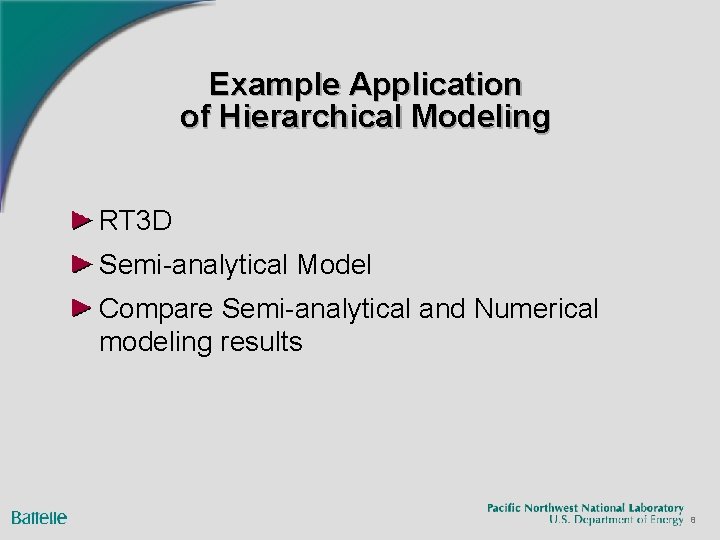
Example Application of Hierarchical Modeling RT 3 D Semi-analytical Model Compare Semi-analytical and Numerical modeling results 8
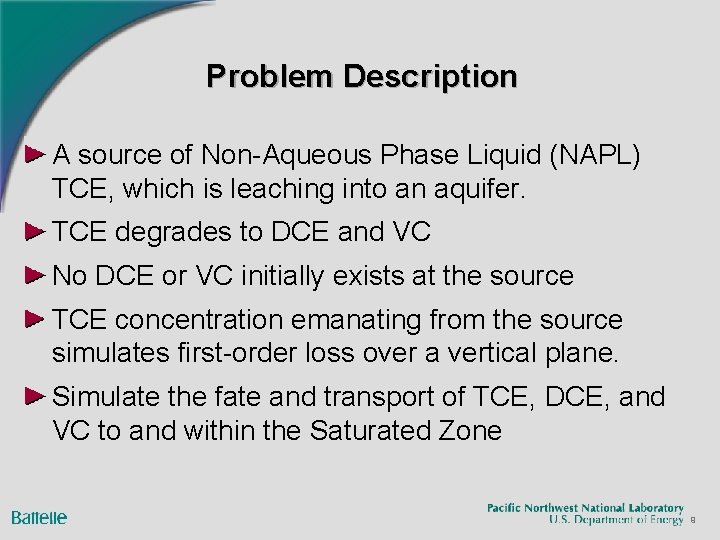
Problem Description A source of Non-Aqueous Phase Liquid (NAPL) TCE, which is leaching into an aquifer. TCE degrades to DCE and VC No DCE or VC initially exists at the source TCE concentration emanating from the source simulates first-order loss over a vertical plane. Simulate the fate and transport of TCE, DCE, and VC to and within the Saturated Zone 9
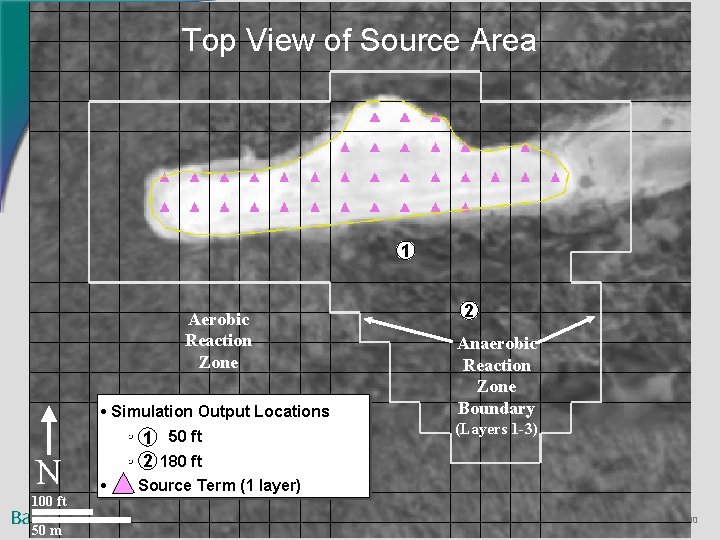
Top View of Source Area 1 Aerobic Reaction Zone • Simulation Output Locations N 100 ft 50 m ◦ 1 50 ft ◦ 2 180 ft • 2 Anaerobic Reaction Zone Boundary (Layers 1 -3) Source Term (1 layer) 10
11
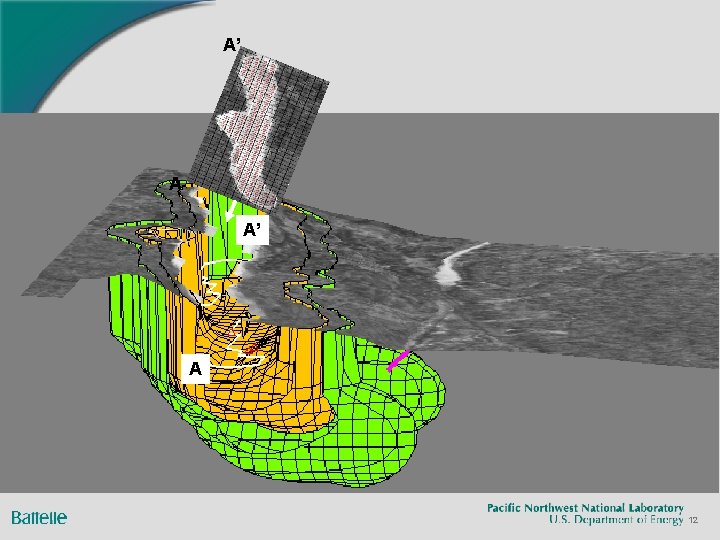
A’ A 12
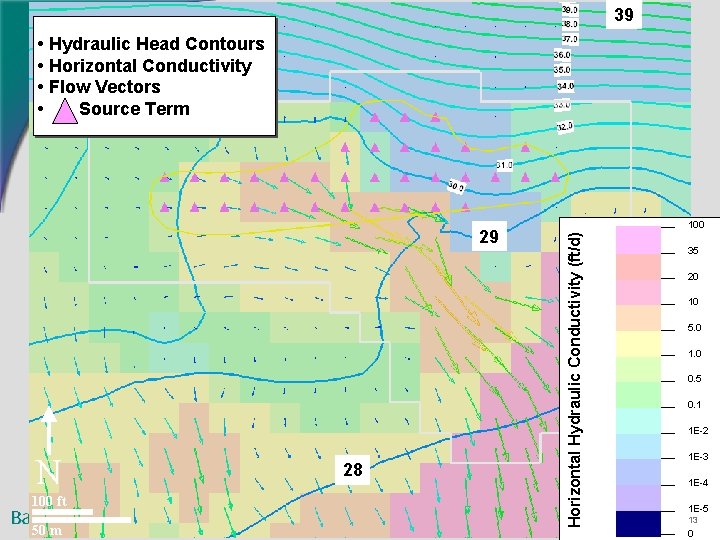
39 • Hydraulic Head Contours • Horizontal Conductivity • Flow Vectors • Source Term 100 ft 50 m 28 Horizontal Hydraulic Conductivity (ft/day) N 100 Horizontal Hydraulic Conductivity (ft/d) 29 35 20 10 5. 0 1. 0 0. 5 0. 1 1 E-2 1 E-3 1 E-4 1 E-5 13 0
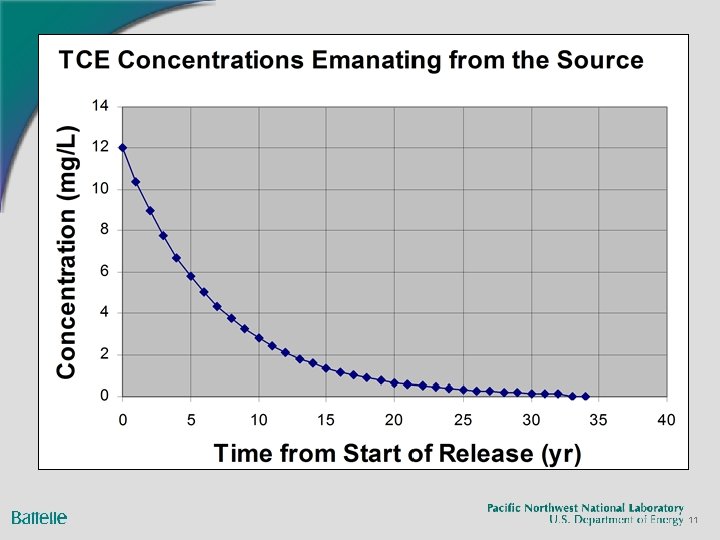
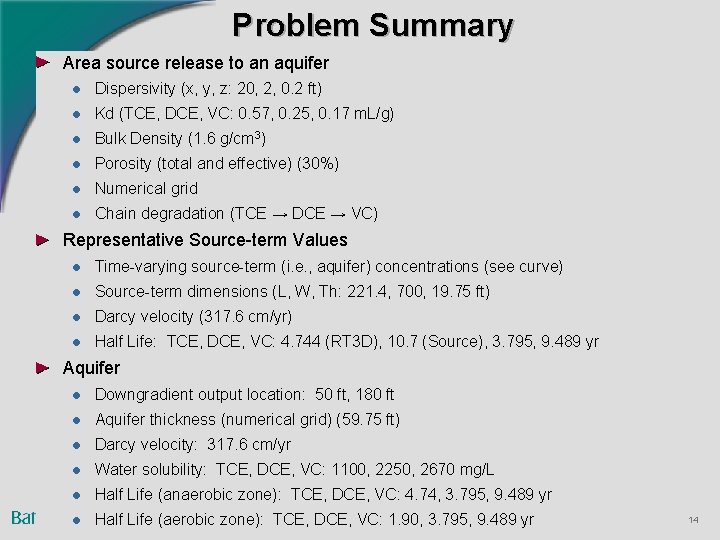
Problem Summary Area source release to an aquifer l Dispersivity (x, y, z: 20, 2, 0. 2 ft) l Kd (TCE, DCE, VC: 0. 57, 0. 25, 0. 17 m. L/g) l Bulk Density (1. 6 g/cm 3) l Porosity (total and effective) (30%) l Numerical grid l Chain degradation (TCE → DCE → VC) Representative Source-term Values l Time-varying source-term (i. e. , aquifer) concentrations (see curve) l Source-term dimensions (L, W, Th: 221. 4, 700, 19. 75 ft) l Darcy velocity (317. 6 cm/yr) l Half Life: TCE, DCE, VC: 4. 744 (RT 3 D), 10. 7 (Source), 3. 795, 9. 489 yr Aquifer l Downgradient output location: 50 ft, 180 ft l Aquifer thickness (numerical grid) (59. 75 ft) l Darcy velocity: 317. 6 cm/yr l Water solubility: TCE, DCE, VC: 1100, 2250, 2670 mg/L l Half Life (anaerobic zone): TCE, DCE, VC: 4. 74, 3. 795, 9. 489 yr l Half Life (aerobic zone): TCE, DCE, VC: 1. 90, 3. 795, 9. 489 yr 14
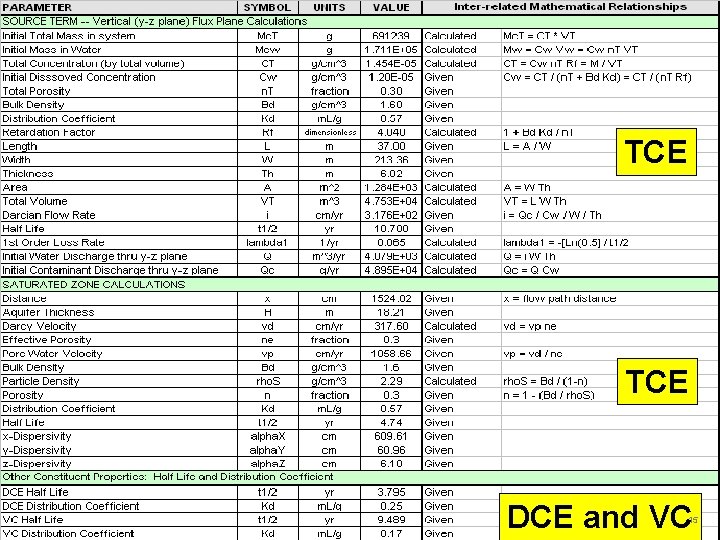
TCE DCE and VC 15
RT 3 D Application 16
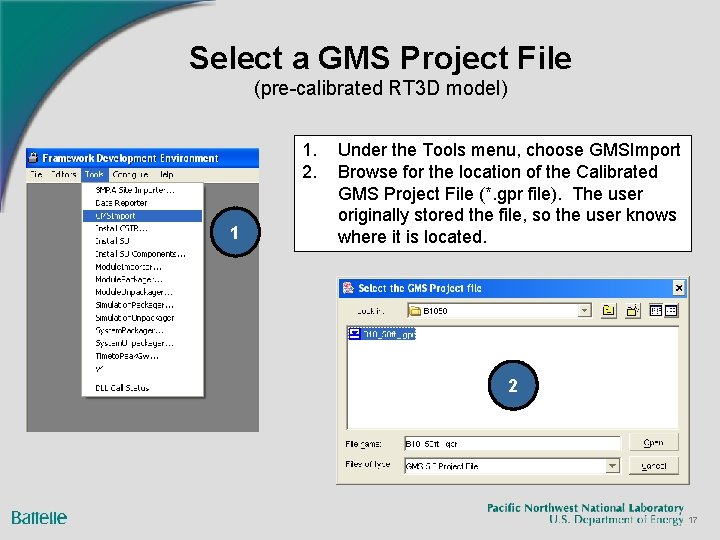
Select a GMS Project File (pre-calibrated RT 3 D model) 1. 2. 1 Under the Tools menu, choose GMSImport Browse for the location of the Calibrated GMS Project File (*. gpr file). The user originally stored the file, so the user knows where it is located. 2 17
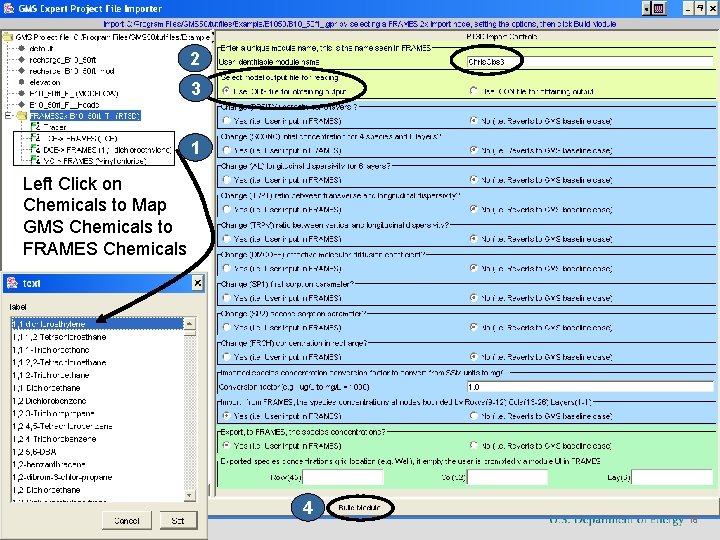
2 3 1 Left Click on Chemicals to Map GMS Chemicals to FRAMES Chemicals 4 18
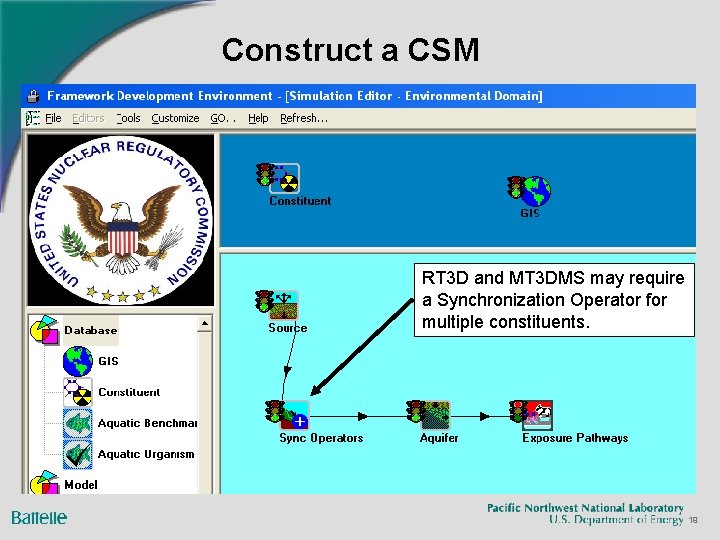
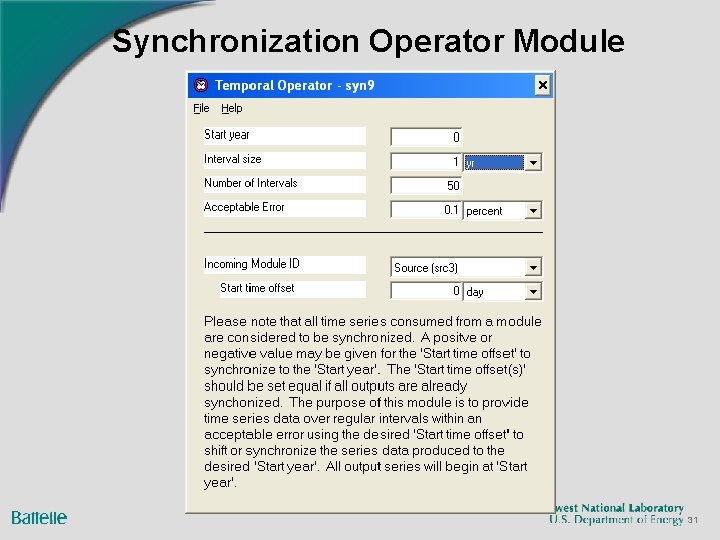
Construct a CSM RT 3 D and MT 3 DMS may require a Synchronization Operator for multiple constituents. 19
Choose Modules 20
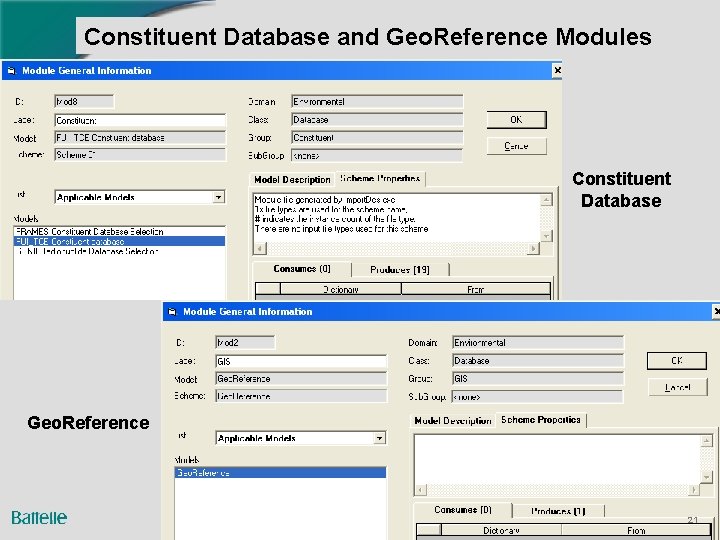
Constituent Database and Geo. Reference Modules Constituent Database Geo. Reference 21
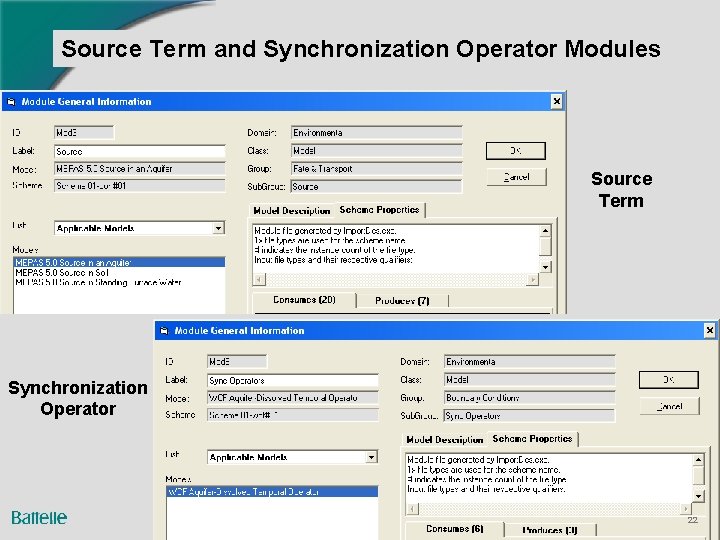
Source Term and Synchronization Operator Modules Source Term Synchronization Operator 22
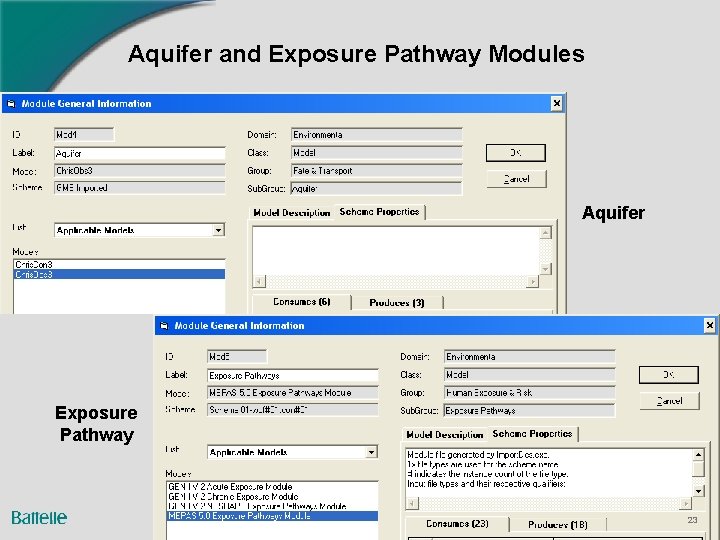
Aquifer and Exposure Pathway Modules Aquifer Exposure Pathway 23
Input Data to Each Module 24
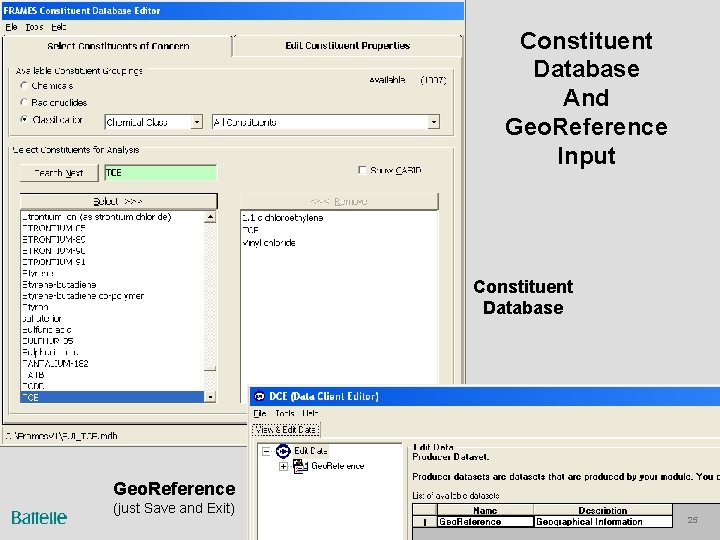
Constituent Database And Geo. Reference Input Constituent Database Geo. Reference (just Save and Exit) 25
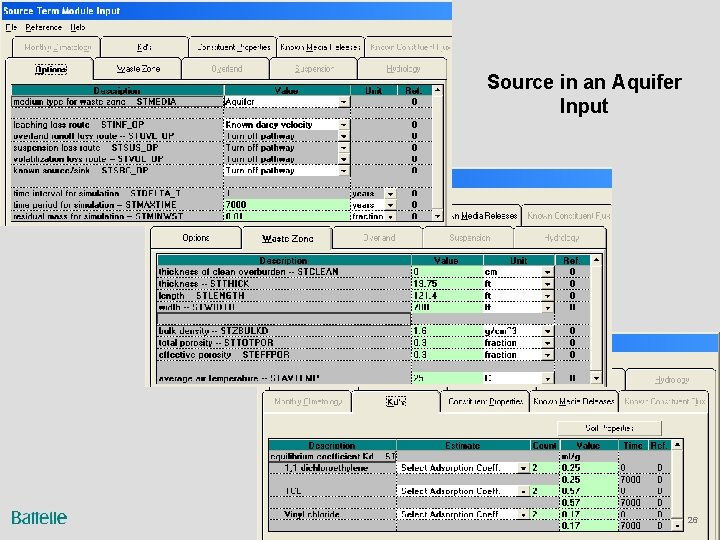
Source in an Aquifer Input 26
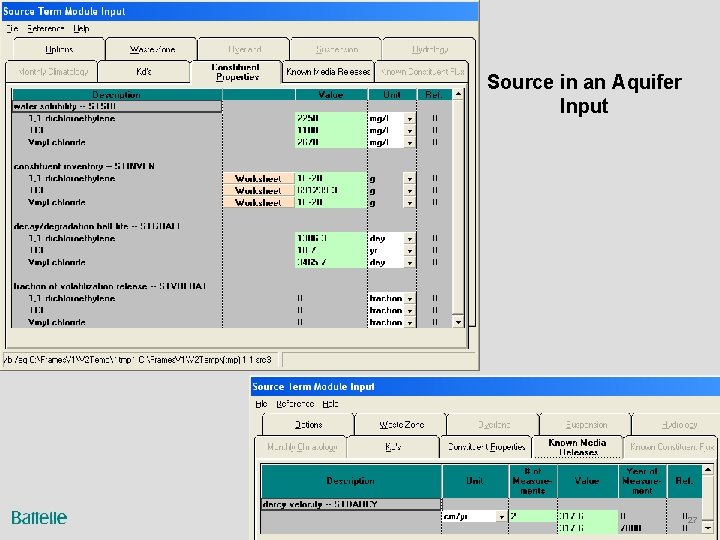
Source in an Aquifer Input 27
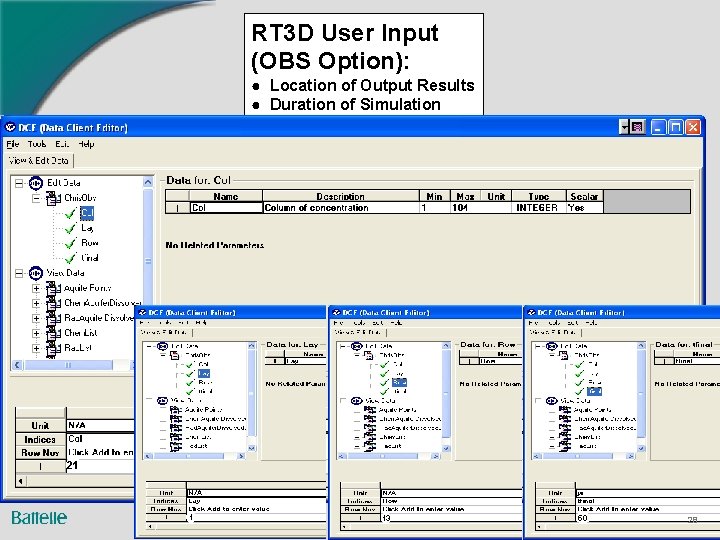
RT 3 D User Input (OBS Option): ● Location of Output Results ● Duration of Simulation 21 1 13 50 28
Run Each Module Constituent Database Geo. Reference Module Source Term Synchronization Operator Aquifer 29
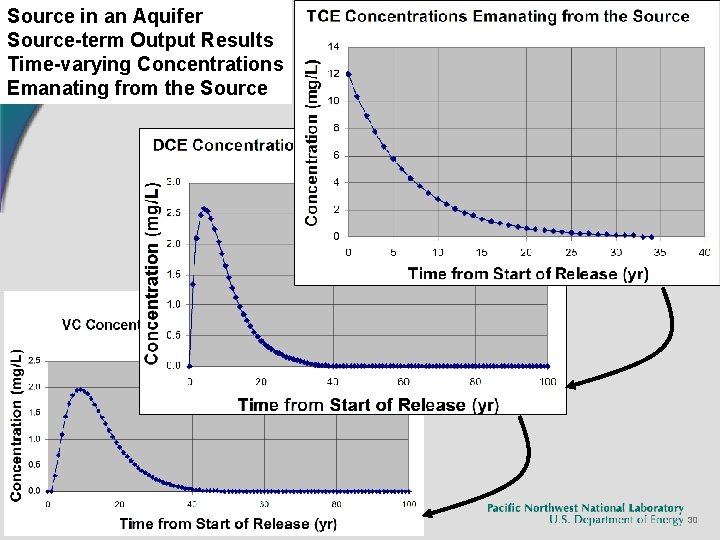
Source in an Aquifer Source-term Output Results Time-varying Concentrations Emanating from the Source 30
Synchronization Operator Module 31
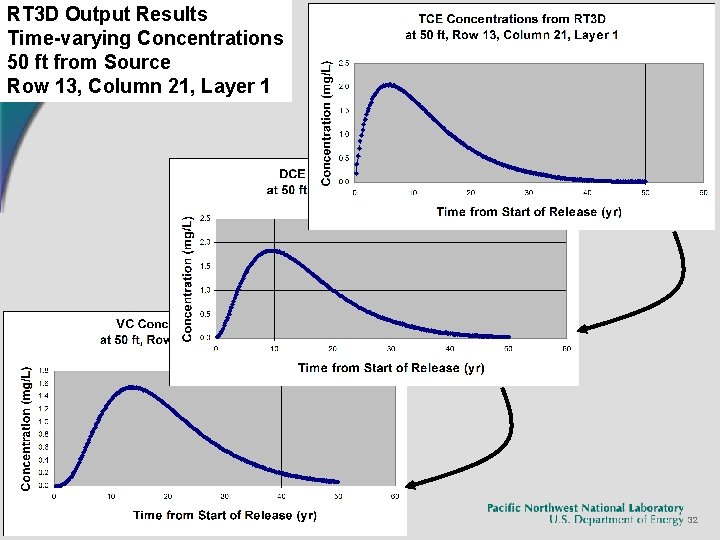
RT 3 D Output Results Time-varying Concentrations 50 ft from Source Row 13, Column 21, Layer 1 32
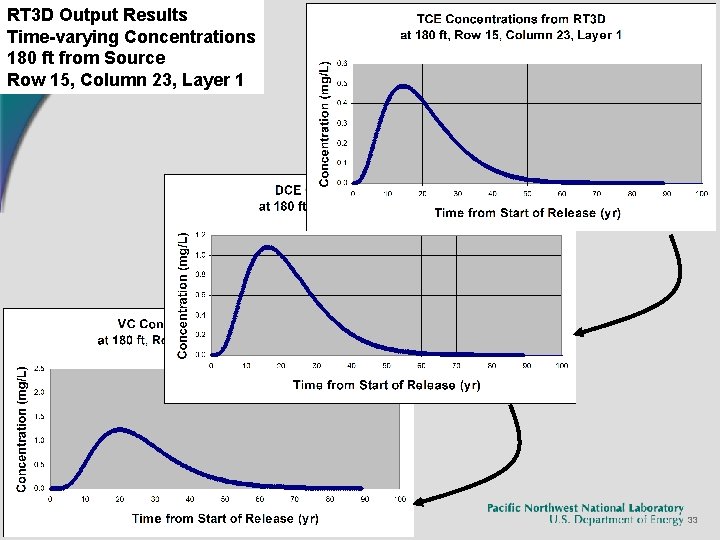
RT 3 D Output Results Time-varying Concentrations 180 ft from Source Row 15, Column 23, Layer 1 33
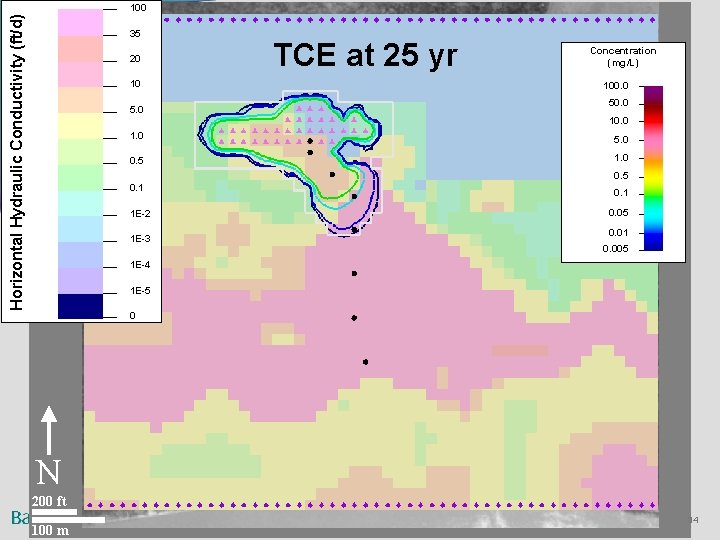
Horizontal Hydraulic Conductivity (ft/d) 100 35 20 10 Horizontal Hydraulic Conductivity (ft/day) 5. 0 TCE at 25 yr Concentration (mg/L) 100. 0 50. 0 1. 0 5. 0 0. 5 1. 0 0. 1 1 E-2 1 E-3 0. 5 0. 1 0. 05 0. 01 0. 005 1 E-4 1 E-5 0 N 200 ft 100 m 34
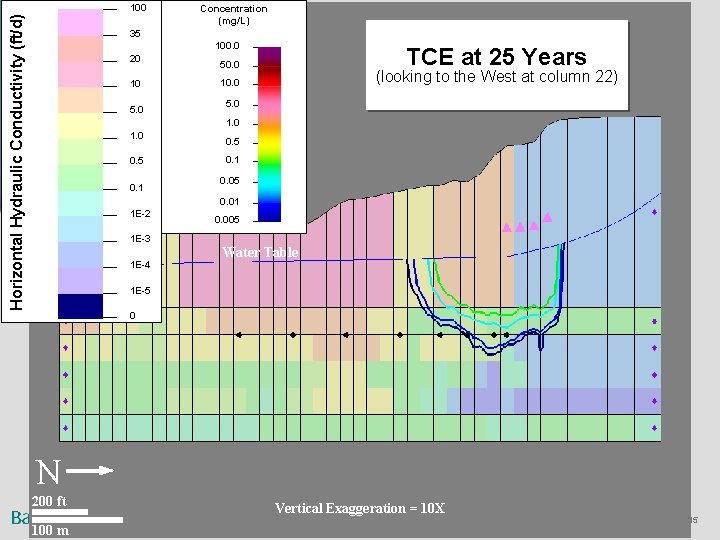
Horizontal Hydraulic Conductivity (ft/d) 100 Concentration (mg/L) 35 100. 0 20 10 Horizontal Hydraulic Conductivity (ft/day) 5. 0 TCE at 25 Years 50. 0 (looking to the West at column 22) 10. 0 5. 0 1. 0 0. 5 0. 1 0. 05 0. 01 1 E-2 1 E-3 1 E-4 0. 005 Water Table 1 E-5 0 N 200 ft 100 m Vertical Exaggeration = 10 X 35
Semi-analytical Aquifer Model Application 36
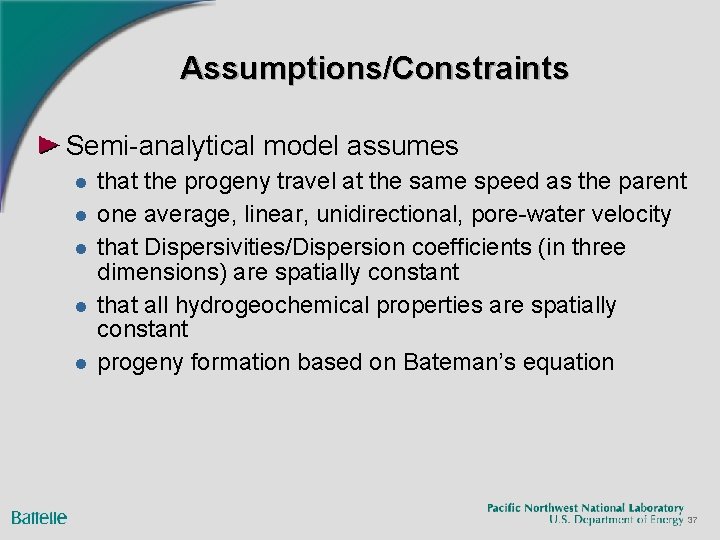
Assumptions/Constraints Semi-analytical model assumes l l l that the progeny travel at the same speed as the parent one average, linear, unidirectional, pore-water velocity that Dispersivities/Dispersion coefficients (in three dimensions) are spatially constant that all hydrogeochemical properties are spatially constant progeny formation based on Bateman’s equation 37
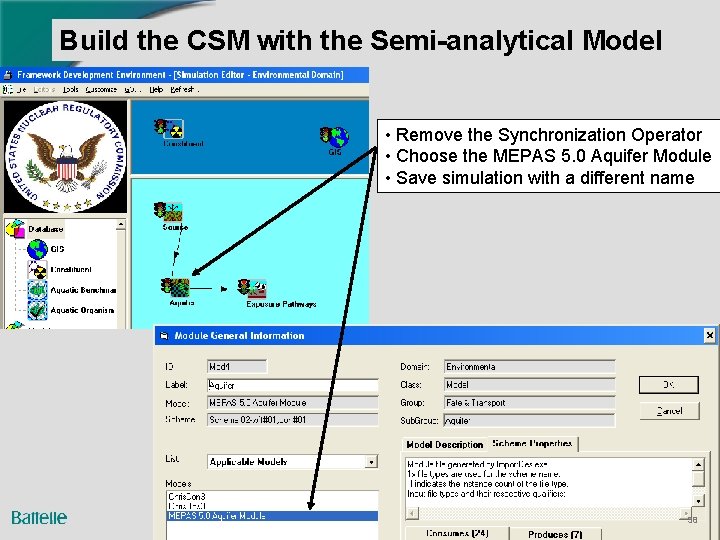
Build the CSM with the Semi-analytical Model • Remove the Synchronization Operator • Choose the MEPAS 5. 0 Aquifer Module • Save simulation with a different name 38
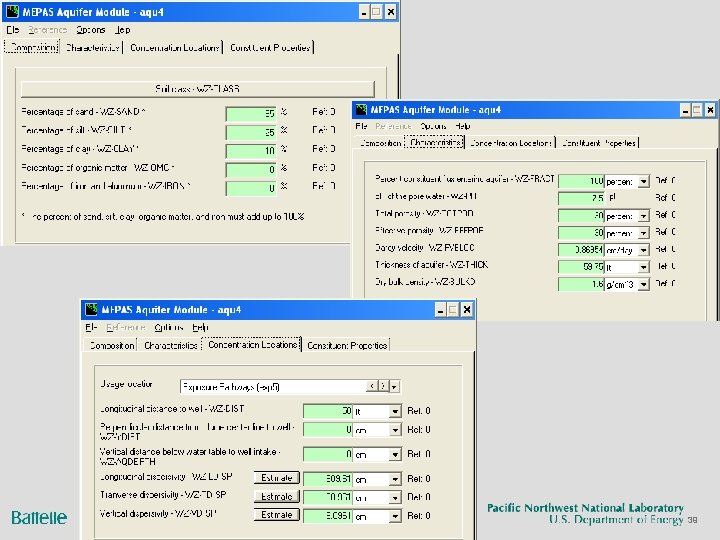
39
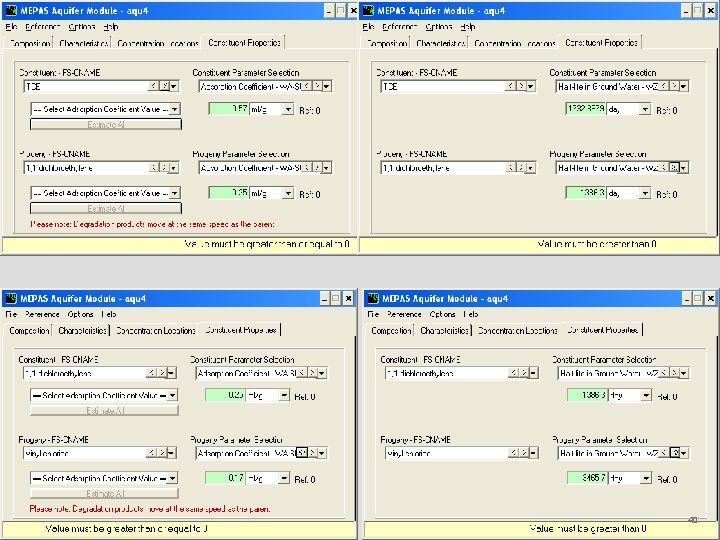
40
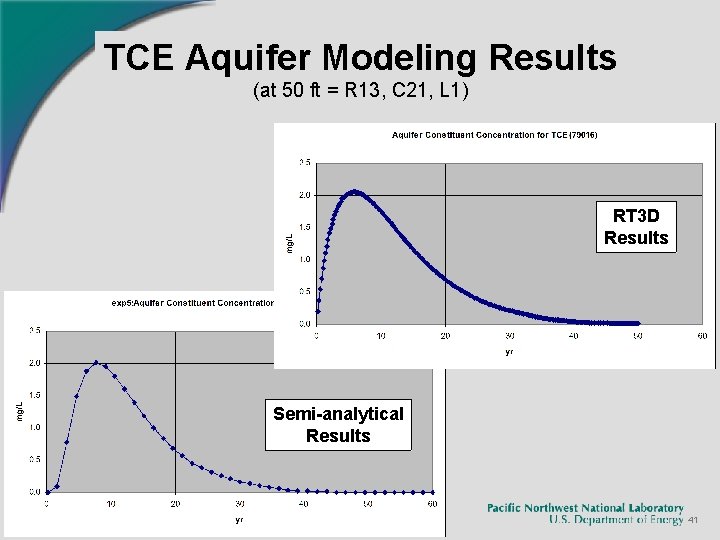
TCE Aquifer Modeling Results (at 50 ft = R 13, C 21, L 1) RT 3 D Results Semi-analytical Results 41
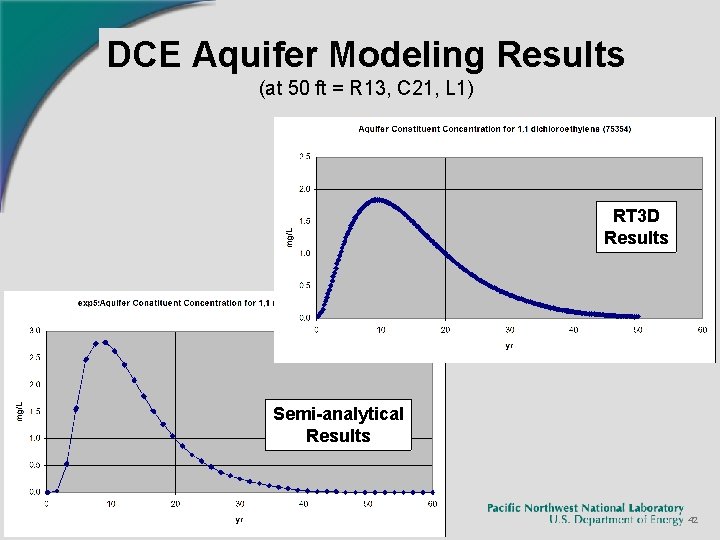
DCE Aquifer Modeling Results (at 50 ft = R 13, C 21, L 1) RT 3 D Results Semi-analytical Results 42
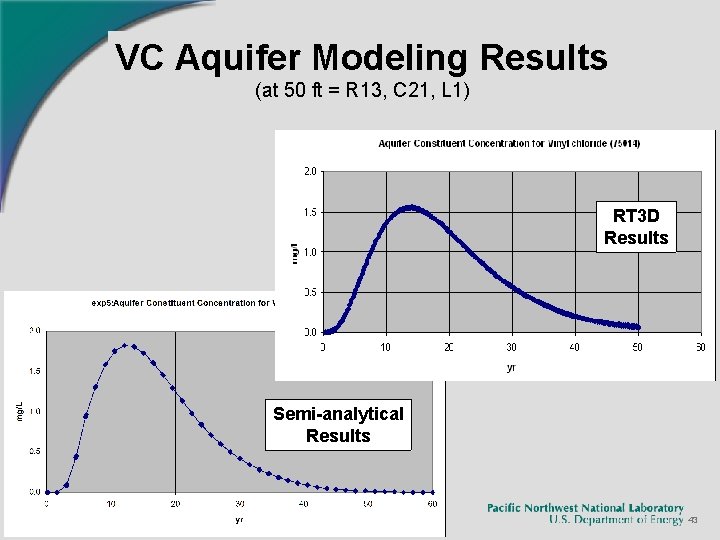
VC Aquifer Modeling Results (at 50 ft = R 13, C 21, L 1) RT 3 D Results Semi-analytical Results 43
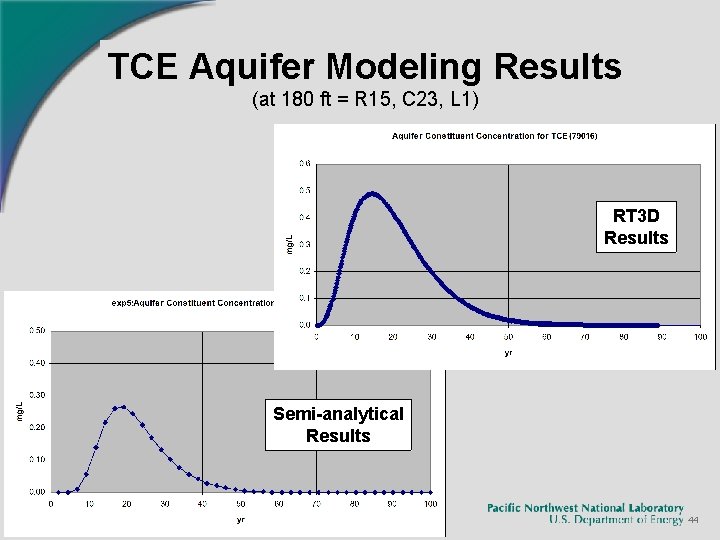
TCE Aquifer Modeling Results (at 180 ft = R 15, C 23, L 1) RT 3 D Results Semi-analytical Results 44
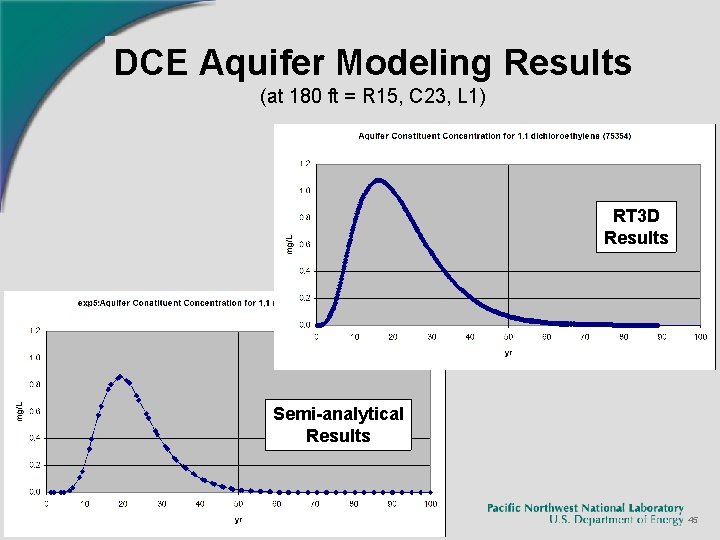
DCE Aquifer Modeling Results (at 180 ft = R 15, C 23, L 1) RT 3 D Results Semi-analytical Results 45
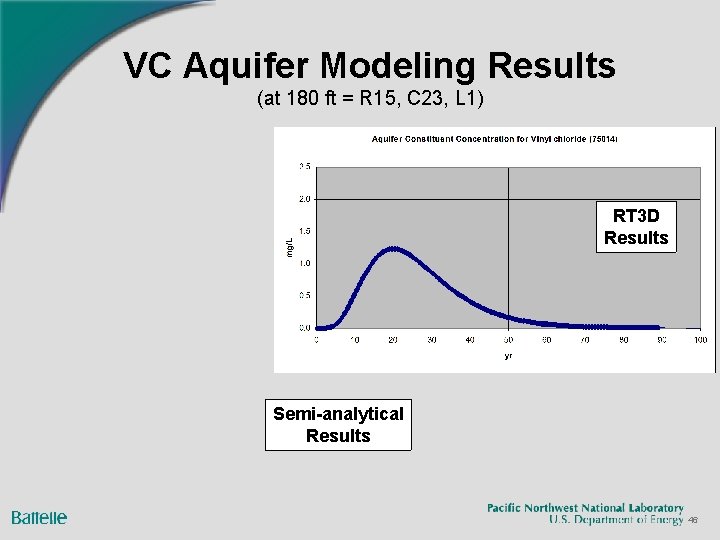
VC Aquifer Modeling Results (at 180 ft = R 15, C 23, L 1) RT 3 D Results Semi-analytical Results 46