
Example Furnace Efficiency Calculation for a Typical Reheating
- Slides: 16
Example: ▬ Furnace Efficiency Calculation for a Typical Reheating Furnace • • 1 An oil-fired reheating furnace has an operating temperature of around 1340°C. Weight of stock (Billet) to be heated is (6000 kg/h), its Specific heat of Billet is (0. 12 kcal/kg/°C). Average fuel consumption is 400 litres/hour. Take Specific gravity of oil is (0. 92), and calorific value of oil is (10000 kcal/kg). The flue gas exit temperature is 750°C, after air pre-heater, theoretical air required to burn 1 kg of oil is (14 kg air/kg oil), and average O 2 percentage in flue gas is (12%). Air is preheated from ambient temperature of (40°C to 190°C) through an air pre-heater. Average surface temperature of heating + soaking zone is (122°C), and average surface temperature of area other than heating and soaking zone is (80°C). Area of heating + soaking zone is (70. 18 m 2), and area other than heating and soaking zone is (12. 6 m 2) The furnace has 460 mm thick wall (x) on the billet extraction outlet side, which is (1 m) high (H) and (1 m) wide. The other data are as given below. Find out the efficiency of the furnace by both (I)Indirect and (II) Direct method. 3 rd Year, Combustion in Furnaces, Chapter 1,
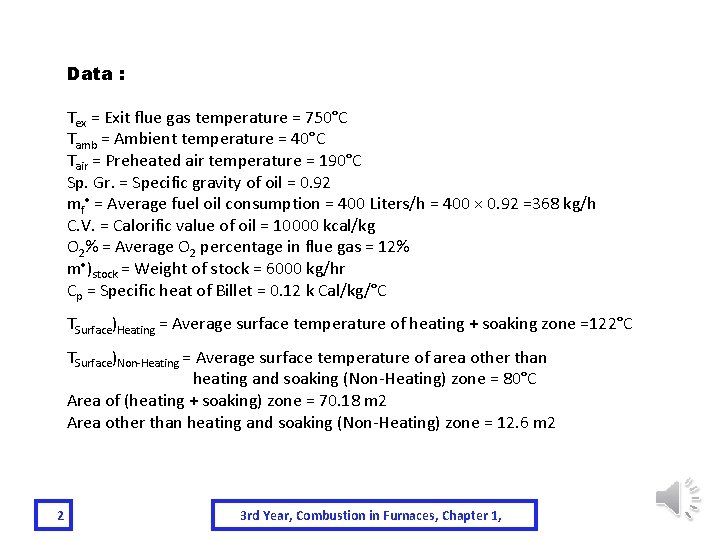
Data : Tex = Exit flue gas temperature = 750°C Tamb = Ambient temperature = 40°C Tair = Preheated air temperature = 190°C Sp. Gr. = Specific gravity of oil = 0. 92 mf = Average fuel oil consumption = 400 Liters/h = 400 × 0. 92 =368 kg/h C. V. = Calorific value of oil = 10000 kcal/kg O 2% = Average O 2 percentage in flue gas = 12% m )stock = Weight of stock = 6000 kg/hr Cp = Specific heat of Billet = 0. 12 k Cal/kg/°C TSurface)Heating = Average surface temperature of heating + soaking zone =122°C TSurface)Non-Heating = Average surface temperature of area other than heating and soaking (Non-Heating) zone = 80°C Area of (heating + soaking) zone = 70. 18 m 2 Area other than heating and soaking (Non-Heating) zone = 12. 6 m 2 2 3 rd Year, Combustion in Furnaces, Chapter 1,
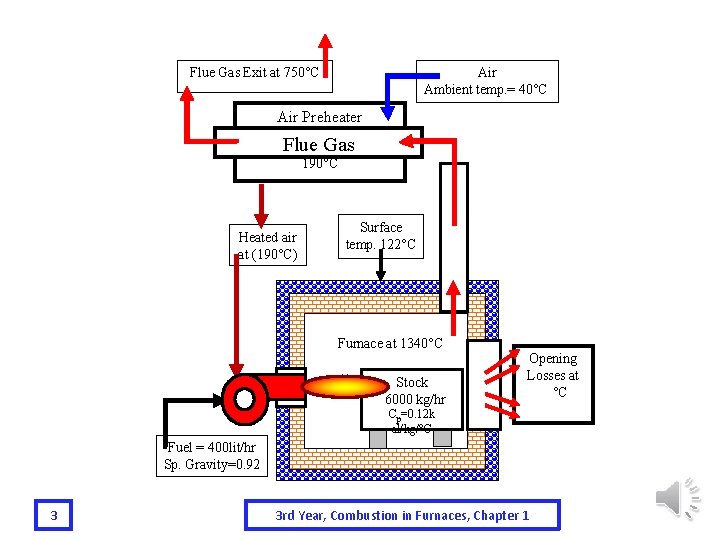
Flue Gas Exit at 750°C Air Ambient temp. = 40°C Air Preheater Flue Gas Air heated from 40 to 190°C Heated air at (190°C) Surface temp. 122°C Furnace at 1340°C Stock 6000 kg/hr Opening Losses at °C Cp=0. 12 k al/kg/°C Fuel = 400 lit/hr Sp. Gravity=0. 92 3 3 rd Year, Combustion in Furnaces, Chapter 1
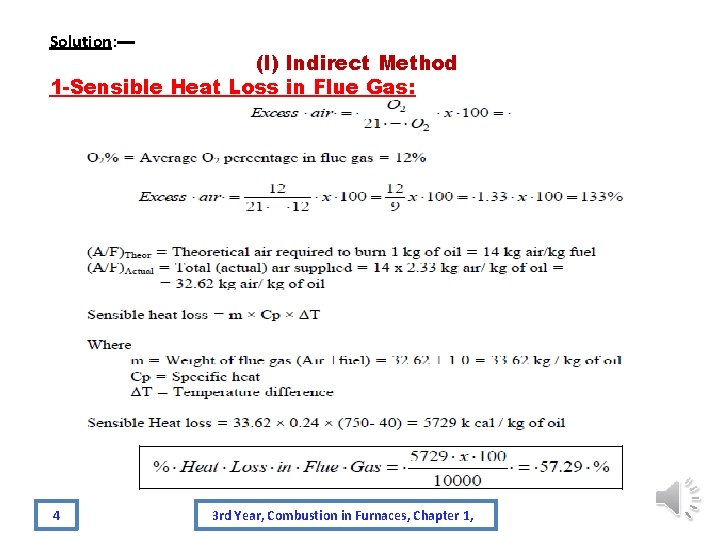
Solution: ▬ (I) Indirect Method 1 -Sensible Heat Loss in Flue Gas: 4 3 rd Year, Combustion in Furnaces, Chapter 1,
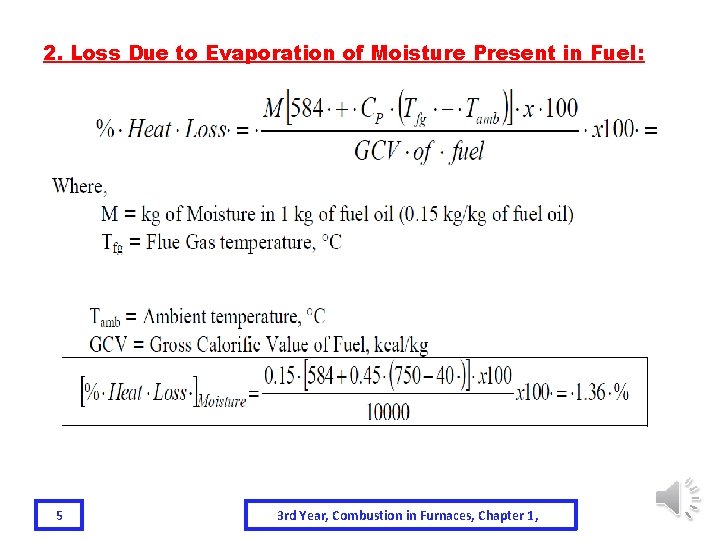
2. Loss Due to Evaporation of Moisture Present in Fuel: 5 3 rd Year, Combustion in Furnaces, Chapter 1,
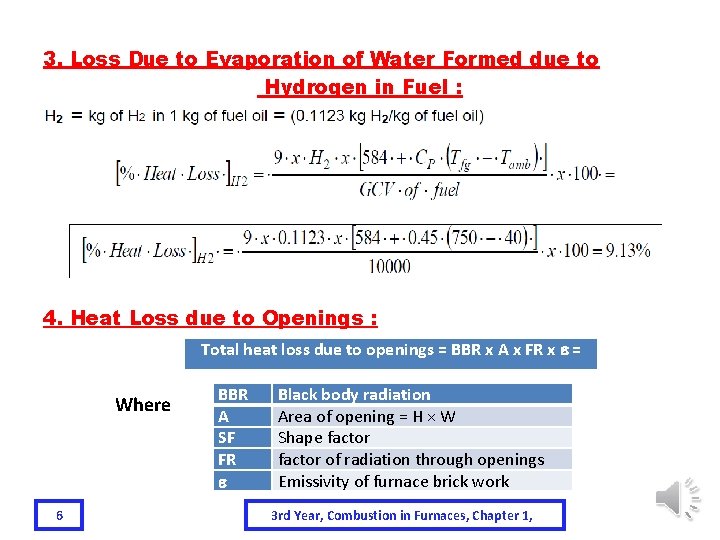
3. Loss Due to Evaporation of Water Formed due to Hydrogen in Fuel : 4. Heat Loss due to Openings : Total heat loss due to openings = BBR x A x FR x = Where 6 BBR A SF FR Black body radiation Area of opening = H × W Shape factor of radiation through openings Emissivity of furnace brick work 3 rd Year, Combustion in Furnaces, Chapter 1,
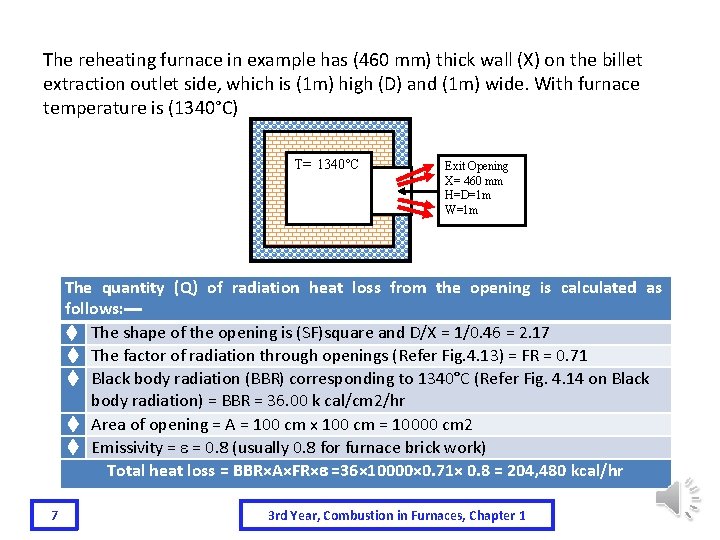
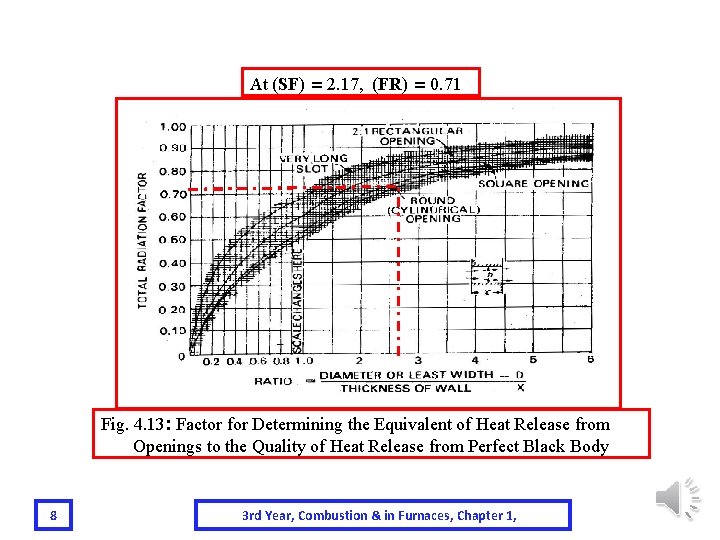
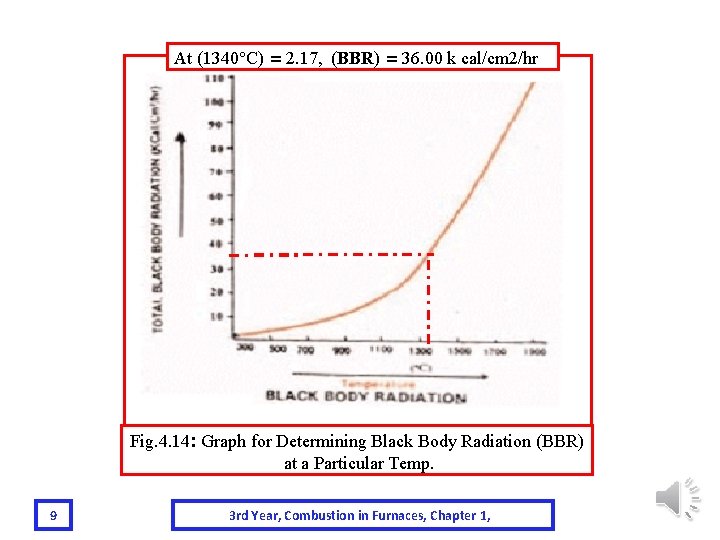
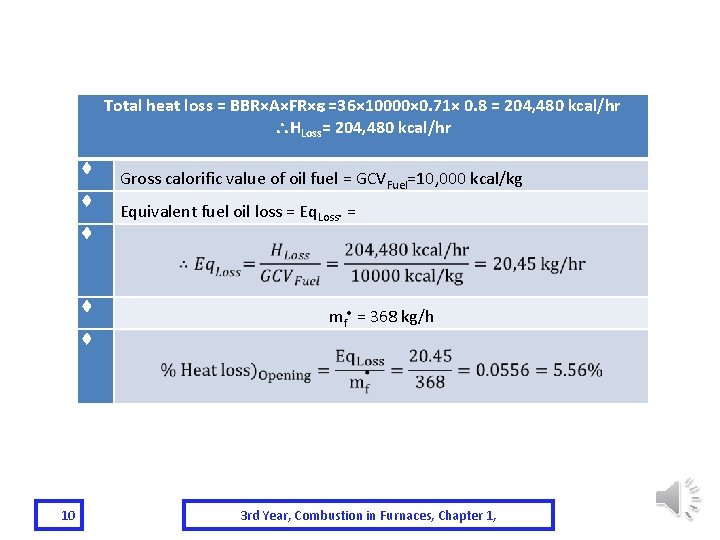
The reheating furnace in example has (460 mm) thick wall (X) on the billet extraction outlet side, which is (1 m) high (D) and (1 m) wide. With furnace temperature is (1340°C) T= 1340°C Exit Opening X= 460 mm H=D=1 m W=1 m The quantity (Q) of radiation heat loss from the opening is calculated as follows: ▬ The shape of the opening is (SF)square and D/X = 1/0. 46 = 2. 17 The factor of radiation through openings (Refer Fig. 4. 13) = FR = 0. 71 Black body radiation (BBR) corresponding to 1340°C (Refer Fig. 4. 14 on Black body radiation) = BBR = 36. 00 k cal/cm 2/hr Area of opening = A = 100 cm x 100 cm = 10000 cm 2 Emissivity = = 0. 8 (usually 0. 8 for furnace brick work) Total heat loss = BBR×A×FR× =36× 10000× 0. 71× 0. 8 = 204, 480 kcal/hr 7 3 rd Year, Combustion in Furnaces, Chapter 1
At (SF) = 2. 17, (FR) = 0. 71 Fig. 4. 13: Factor for Determining the Equivalent of Heat Release from Openings to the Quality of Heat Release from Perfect Black Body 8 3 rd Year, Combustion & in Furnaces, Chapter 1,
At (1340°C) = 2. 17, (BBR) = 36. 00 k cal/cm 2/hr Fig. 4. 14: Graph for Determining Black Body Radiation (BBR) at a Particular Temp. 9 3 rd Year, Combustion in Furnaces, Chapter 1,
Total heat loss = BBR×A×FR× =36× 10000× 0. 71× 0. 8 = 204, 480 kcal/hr HLoss= 204, 480 kcal/hr Gross calorific value of oil fuel = GCVFuel=10, 000 kcal/kg Equivalent fuel oil loss = Eq. Loss. = mf = 368 kg/h 10 3 rd Year, Combustion in Furnaces, Chapter 1,
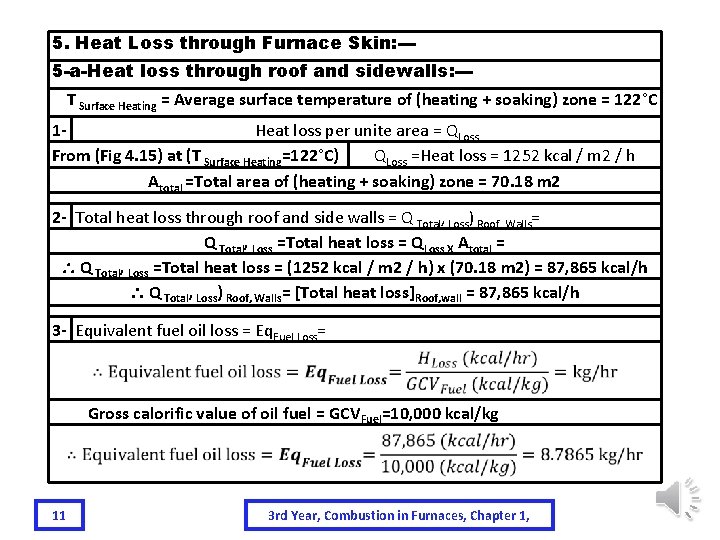
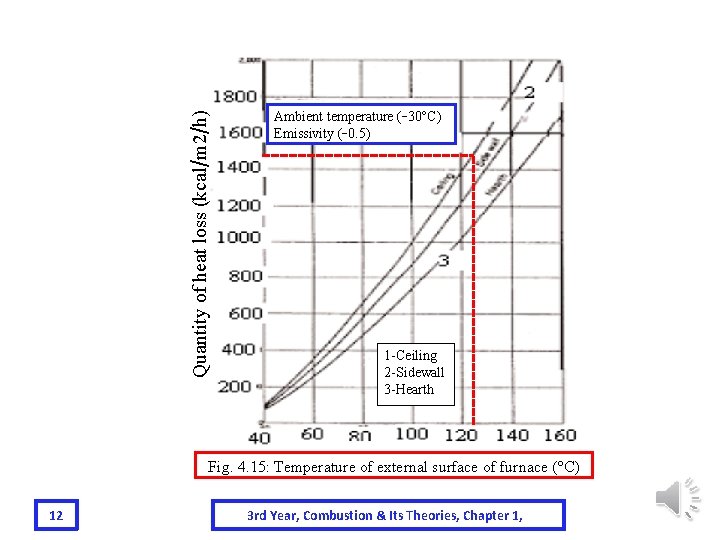
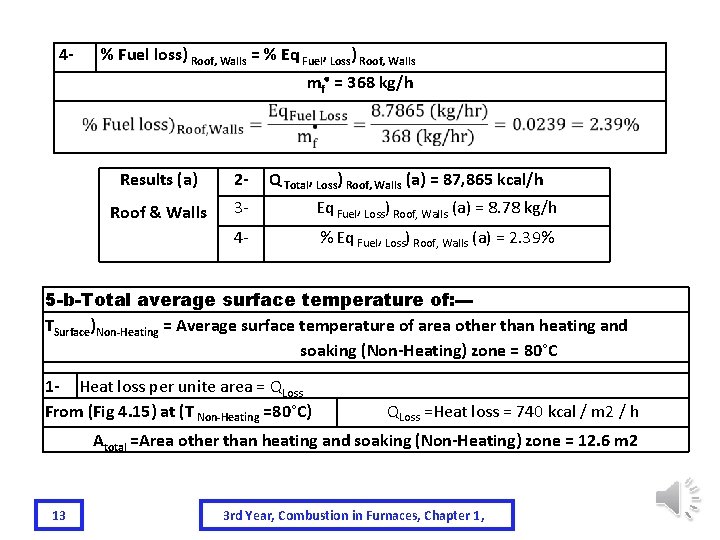
5. Heat Loss through Furnace Skin: ▬ 5 -a-Heat loss through roof and sidewalls: ▬ T Surface Heating = Average surface temperature of (heating + soaking) zone = 122°C 1 Heat loss per unite area = QLoss From (Fig 4. 15) at (T Surface Heating=122°C) QLoss =Heat loss = 1252 kcal / m 2 / h Atotal =Total area of (heating + soaking) zone = 70. 18 m 2 2 - Total heat loss through roof and side walls = Q Total, Loss) Roof, Walls= Q Total, Loss =Total heat loss = QLoss X Atotal = Q Total, Loss =Total heat loss = (1252 kcal / m 2 / h) x (70. 18 m 2) = 87, 865 kcal/h Q Total, Loss) Roof, Walls= [Total heat loss]Roof, wall = 87, 865 kcal/h 3 - Equivalent fuel oil loss = Eq. Fuel, Loss= Gross calorific value of oil fuel = GCVFuel=10, 000 kcal/kg 11 3 rd Year, Combustion in Furnaces, Chapter 1,
Quantity of heat loss (kcal/m 2/h) Ambient temperature (-30 C) Emissivity (-0. 5) 1 -Ceiling 2 -Sidewall 3 -Hearth Fig. 4. 15: Temperature of external surface of furnace ( C) 12 3 rd Year, Combustion & Its Theories, Chapter 1,
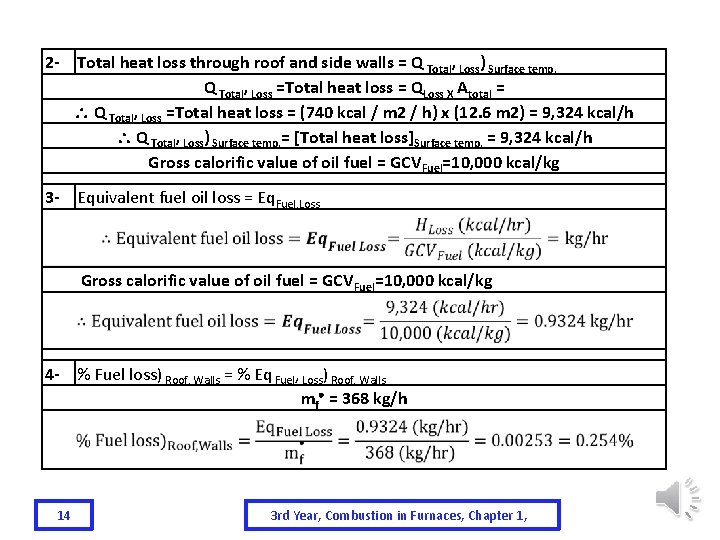
4 - % Fuel loss) Roof, Walls = % Eq Fuel, Loss) Roof, Walls mf = 368 kg/h Results (a) 2 - Q Total, Loss) Roof, Walls (a) = 87, 865 kcal/h Roof & Walls 3 - Eq Fuel, Loss) Roof, Walls (a) = 8. 78 kg/h 4 - % Eq Fuel, Loss) Roof, Walls (a) = 2. 39% 5 -b-Total average surface temperature of: ▬ TSurface)Non-Heating = Average surface temperature of area other than heating and soaking (Non-Heating) zone = 80°C 1 - Heat loss per unite area = QLoss From (Fig 4. 15) at (T Non-Heating =80°C) QLoss =Heat loss = 740 kcal / m 2 / h Atotal =Area other than heating and soaking (Non-Heating) zone = 12. 6 m 2 13 3 rd Year, Combustion in Furnaces, Chapter 1,
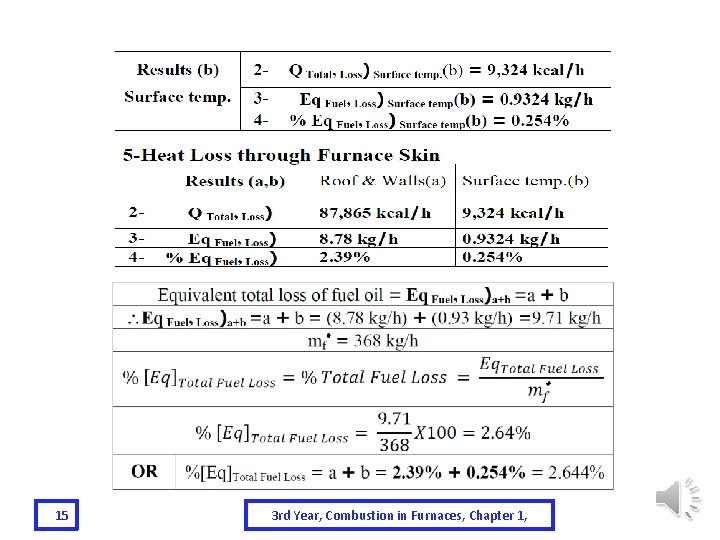
2 - Total heat loss through roof and side walls = Q Total, Loss) Surface temp. Q Total, Loss =Total heat loss = QLoss X Atotal = Q Total, Loss =Total heat loss = (740 kcal / m 2 / h) x (12. 6 m 2) = 9, 324 kcal/h Q Total, Loss) Surface temp. = [Total heat loss]Surface temp. = 9, 324 kcal/h Gross calorific value of oil fuel = GCVFuel=10, 000 kcal/kg 3 - Equivalent fuel oil loss = Eq. Fuel, Loss Gross calorific value of oil fuel = GCVFuel=10, 000 kcal/kg 4 - 14 % Fuel loss) Roof, Walls = % Eq Fuel, Loss) Roof, Walls mf = 368 kg/h 3 rd Year, Combustion in Furnaces, Chapter 1,
15 3 rd Year, Combustion in Furnaces, Chapter 1,
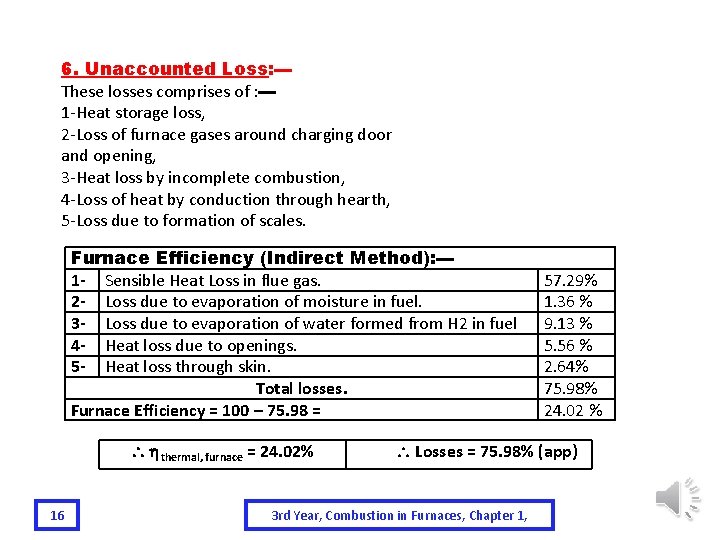
6. Unaccounted Loss: ▬ These losses comprises of : ▬ 1 -Heat storage loss, 2 -Loss of furnace gases around charging door and opening, 3 -Heat loss by incomplete combustion, 4 -Loss of heat by conduction through hearth, 5 -Loss due to formation of scales. Furnace Efficiency (Indirect Method): ▬ 1 - Sensible Heat Loss in flue gas. 2 - Loss due to evaporation of moisture in fuel. 3 - Loss due to evaporation of water formed from H 2 in fuel 4 - Heat loss due to openings. 5 - Heat loss through skin. Total losses. Furnace Efficiency = 100 – 75. 98 = thermal, furnace = 24. 02% 16 57. 29% 1. 36 % 9. 13 % 5. 56 % 2. 64% 75. 98% 24. 02 % Losses = 75. 98% (app) 3 rd Year, Combustion in Furnaces, Chapter 1,