
Example Exercise 4 1 Atomic Notation Given the
- Slides: 23
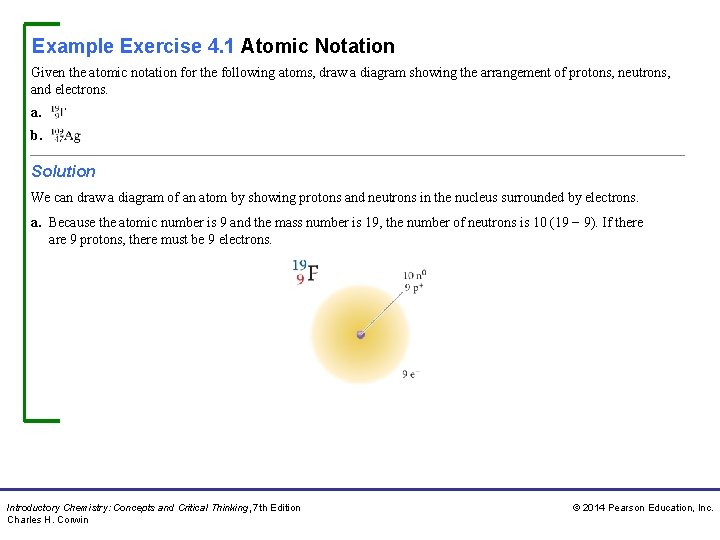
Example Exercise 4. 1 Atomic Notation Given the atomic notation for the following atoms, draw a diagram showing the arrangement of protons, neutrons, and electrons. a. b. Solution We can draw a diagram of an atom by showing protons and neutrons in the nucleus surrounded by electrons. a. Because the atomic number is 9 and the mass number is 19, the number of neutrons is 10 (19 − 9). If there are 9 protons, there must be 9 electrons. Introductory Chemistry: Concepts and Critical Thinking, 7 th Edition Charles H. Corwin © 2014 Pearson Education, Inc.
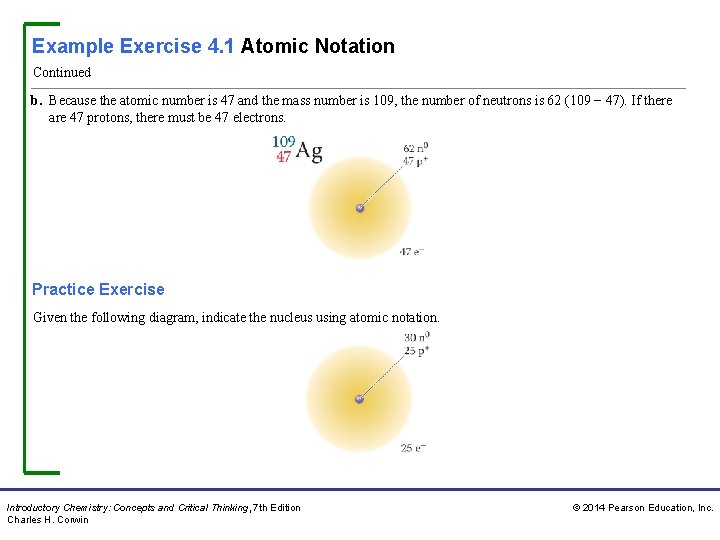
Example Exercise 4. 1 Atomic Notation Continued b. Because the atomic number is 47 and the mass number is 109, the number of neutrons is 62 (109 − 47). If there are 47 protons, there must be 47 electrons. Practice Exercise Given the following diagram, indicate the nucleus using atomic notation. Introductory Chemistry: Concepts and Critical Thinking, 7 th Edition Charles H. Corwin © 2014 Pearson Education, Inc.
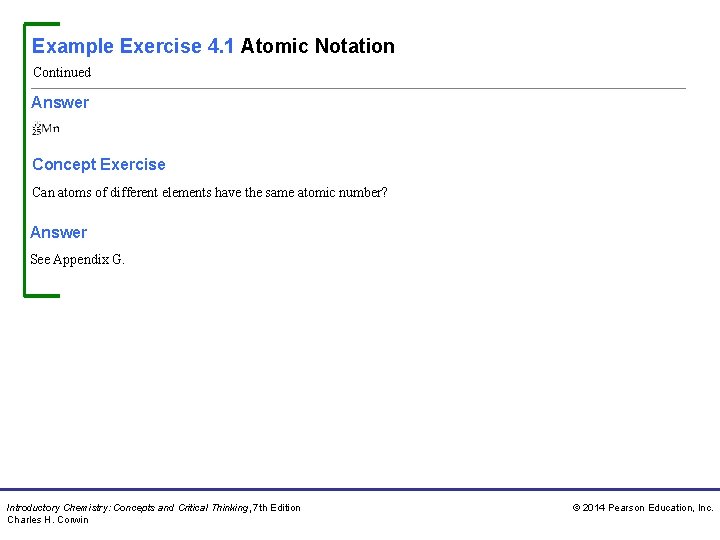
Example Exercise 4. 1 Atomic Notation Continued Answer Concept Exercise Can atoms of different elements have the same atomic number? Answer See Appendix G. Introductory Chemistry: Concepts and Critical Thinking, 7 th Edition Charles H. Corwin © 2014 Pearson Education, Inc.
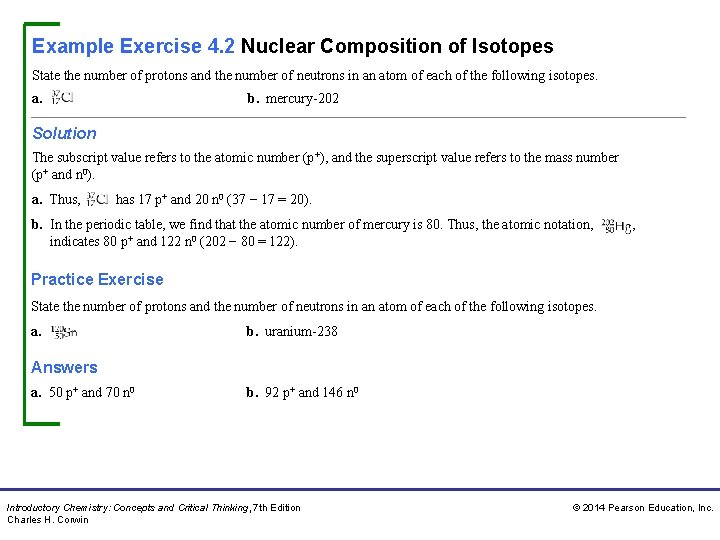
Example Exercise 4. 2 Nuclear Composition of Isotopes State the number of protons and the number of neutrons in an atom of each of the following isotopes. a. b. mercury-202 Solution The subscript value refers to the atomic number (p+), and the superscript value refers to the mass number (p+ and n 0). a. Thus, has 17 p+ and 20 n 0 (37 − 17 = 20). b. In the periodic table, we find that the atomic number of mercury is 80. Thus, the atomic notation, indicates 80 p+ and 122 n 0 (202 − 80 = 122). , Practice Exercise State the number of protons and the number of neutrons in an atom of each of the following isotopes. a. b. uranium-238 Answers a. 50 p+ and 70 n 0 b. 92 p+ and 146 n 0 Introductory Chemistry: Concepts and Critical Thinking, 7 th Edition Charles H. Corwin © 2014 Pearson Education, Inc.
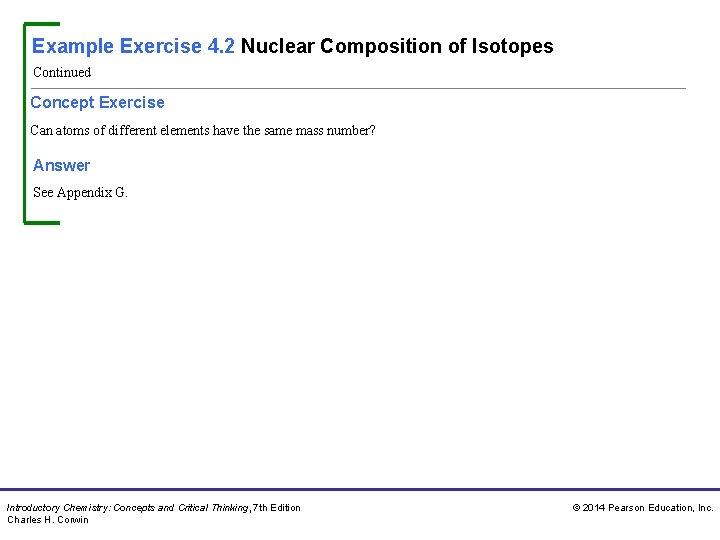
Example Exercise 4. 2 Nuclear Composition of Isotopes Continued Concept Exercise Can atoms of different elements have the same mass number? Answer See Appendix G. Introductory Chemistry: Concepts and Critical Thinking, 7 th Edition Charles H. Corwin © 2014 Pearson Education, Inc.
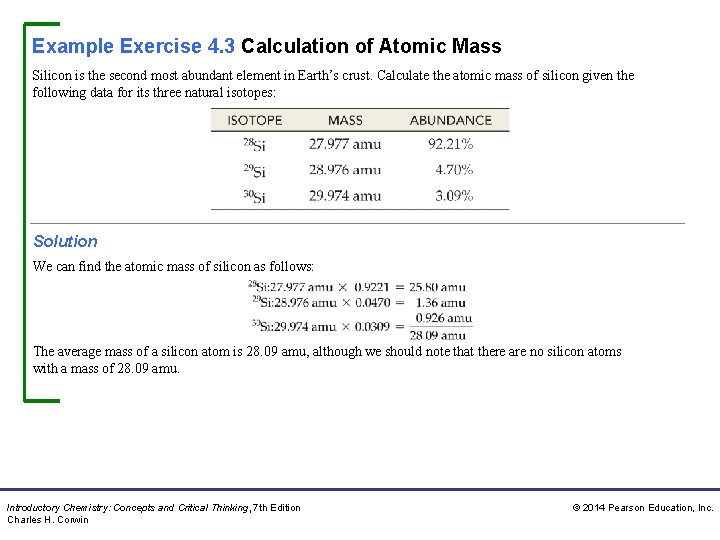
Example Exercise 4. 3 Calculation of Atomic Mass Silicon is the second most abundant element in Earth’s crust. Calculate the atomic mass of silicon given the following data for its three natural isotopes: Solution We can find the atomic mass of silicon as follows: The average mass of a silicon atom is 28. 09 amu, although we should note that there are no silicon atoms with a mass of 28. 09 amu. Introductory Chemistry: Concepts and Critical Thinking, 7 th Edition Charles H. Corwin © 2014 Pearson Education, Inc.
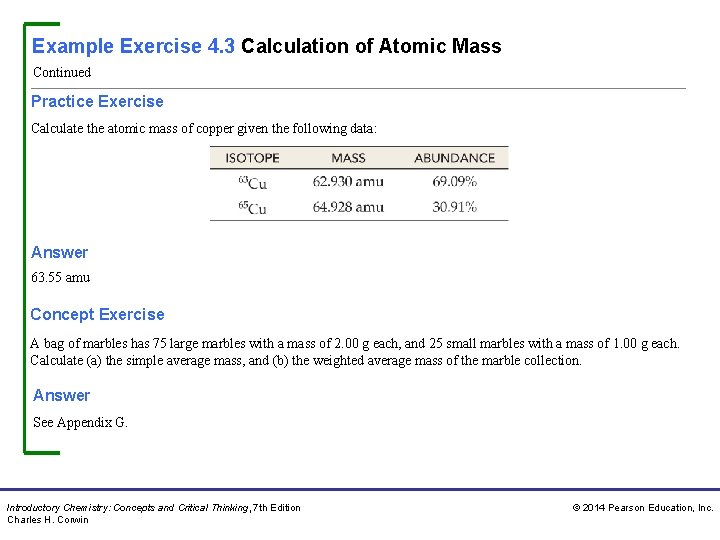
Example Exercise 4. 3 Calculation of Atomic Mass Continued Practice Exercise Calculate the atomic mass of copper given the following data: Answer 63. 55 amu Concept Exercise A bag of marbles has 75 large marbles with a mass of 2. 00 g each, and 25 small marbles with a mass of 1. 00 g each. Calculate (a) the simple average mass, and (b) the weighted average mass of the marble collection. Answer See Appendix G. Introductory Chemistry: Concepts and Critical Thinking, 7 th Edition Charles H. Corwin © 2014 Pearson Education, Inc.
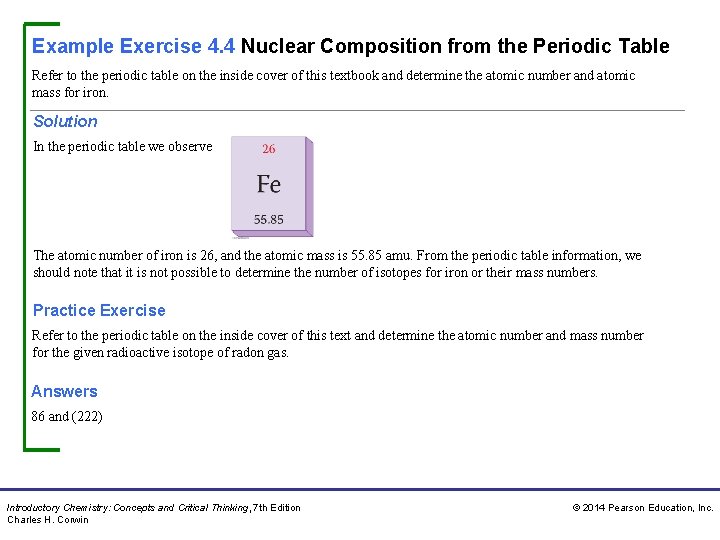
Example Exercise 4. 4 Nuclear Composition from the Periodic Table Refer to the periodic table on the inside cover of this textbook and determine the atomic number and atomic mass for iron. Solution In the periodic table we observe The atomic number of iron is 26, and the atomic mass is 55. 85 amu. From the periodic table information, we should note that it is not possible to determine the number of isotopes for iron or their mass numbers. Practice Exercise Refer to the periodic table on the inside cover of this text and determine the atomic number and mass number for the given radioactive isotope of radon gas. Answers 86 and (222) Introductory Chemistry: Concepts and Critical Thinking, 7 th Edition Charles H. Corwin © 2014 Pearson Education, Inc.
Example Exercise 4. 4 Nuclear Composition from the Periodic Table Continued Concept Exercise Which of the following is never a whole number value: atomic number, atomic mass, or mass number? Answer See Appendix G. Introductory Chemistry: Concepts and Critical Thinking, 7 th Edition Charles H. Corwin © 2014 Pearson Education, Inc.
Example Exercise 4. 5 Properties of Light Considering blue light and yellow light, which has the a. longer wavelength? b. higher frequency? c. higher energy? Solution Referring to Figure 4. 9, we notice that the wavelength of yellow light is about 600 nm and that of blue light is about 500 nm. Thus, a. yellow light has a longer wavelength than blue light. b. blue light has a higher frequency because it has a shorter wavelength. c. blue light has a higher energy because it has a higher frequency. Practice Exercise Considering infrared light and ultraviolet light, which has the a. longer wavelength? b. higher frequency? c. higher energy? Introductory Chemistry: Concepts and Critical Thinking, 7 th Edition Charles H. Corwin © 2014 Pearson Education, Inc.
Example Exercise 4. 5 Properties of Light Continued Answer a. infrared b. ultraviolet c. ultraviolet Concept Exercise The energy of light (increases/decreases) as the wavelength increases. The energy of light (increases/decreases) as the frequency increases. Answer See Appendix G. Introductory Chemistry: Concepts and Critical Thinking, 7 th Edition Charles H. Corwin © 2014 Pearson Education, Inc.
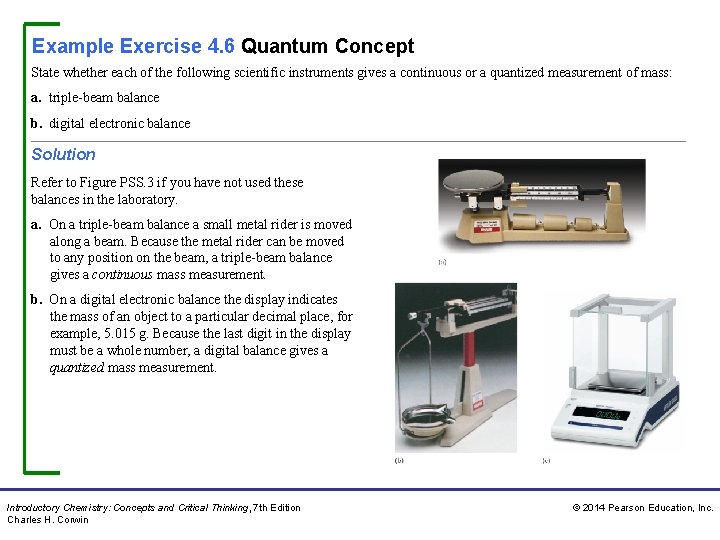
Example Exercise 4. 6 Quantum Concept State whether each of the following scientific instruments gives a continuous or a quantized measurement of mass: a. triple-beam balance b. digital electronic balance Solution Refer to Figure PSS. 3 if you have not used these balances in the laboratory. a. On a triple-beam balance a small metal rider is moved along a beam. Because the metal rider can be moved to any position on the beam, a triple-beam balance gives a continuous mass measurement. b. On a digital electronic balance the display indicates the mass of an object to a particular decimal place, for example, 5. 015 g. Because the last digit in the display must be a whole number, a digital balance gives a quantized mass measurement. Introductory Chemistry: Concepts and Critical Thinking, 7 th Edition Charles H. Corwin © 2014 Pearson Education, Inc.
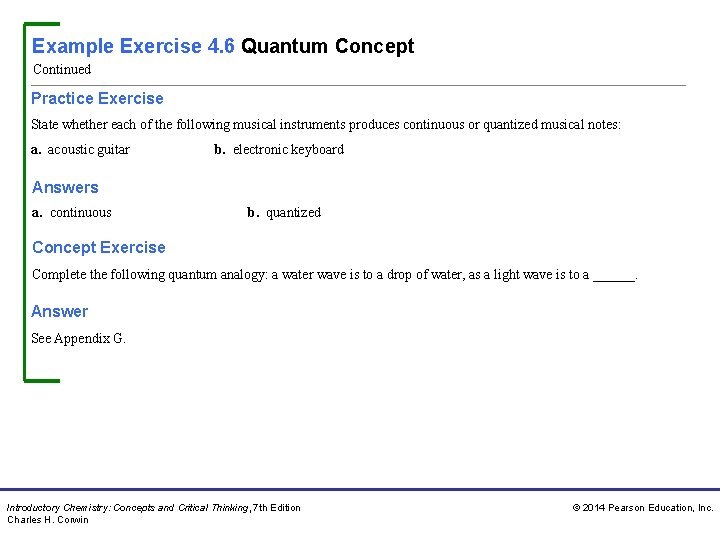
Example Exercise 4. 6 Quantum Concept Continued Practice Exercise State whether each of the following musical instruments produces continuous or quantized musical notes: a. acoustic guitar b. electronic keyboard Answers a. continuous b. quantized Concept Exercise Complete the following quantum analogy: a water wave is to a drop of water, as a light wave is to a ______. Answer See Appendix G. Introductory Chemistry: Concepts and Critical Thinking, 7 th Edition Charles H. Corwin © 2014 Pearson Education, Inc.
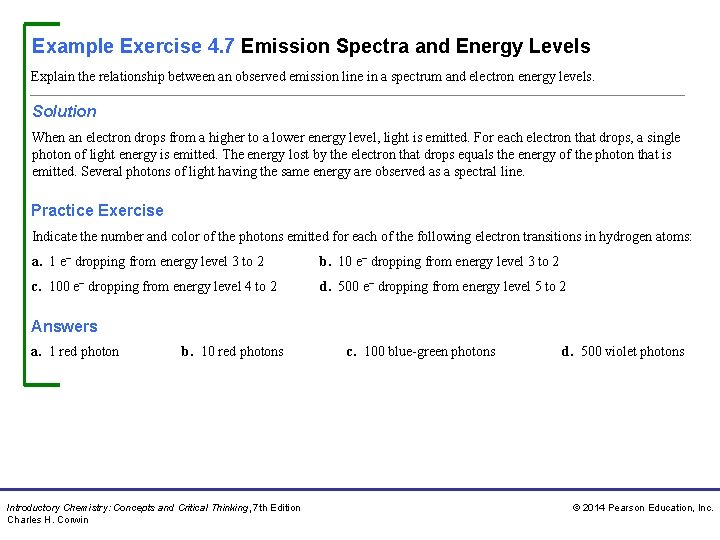
Example Exercise 4. 7 Emission Spectra and Energy Levels Explain the relationship between an observed emission line in a spectrum and electron energy levels. Solution When an electron drops from a higher to a lower energy level, light is emitted. For each electron that drops, a single photon of light energy is emitted. The energy lost by the electron that drops equals the energy of the photon that is emitted. Several photons of light having the same energy are observed as a spectral line. Practice Exercise Indicate the number and color of the photons emitted for each of the following electron transitions in hydrogen atoms: a. 1 e− dropping from energy level 3 to 2 b. 10 e− dropping from energy level 3 to 2 c. 100 e− dropping from energy level 4 to 2 d. 500 e− dropping from energy level 5 to 2 Answers a. 1 red photon b. 10 red photons Introductory Chemistry: Concepts and Critical Thinking, 7 th Edition Charles H. Corwin c. 100 blue-green photons d. 500 violet photons © 2014 Pearson Education, Inc.
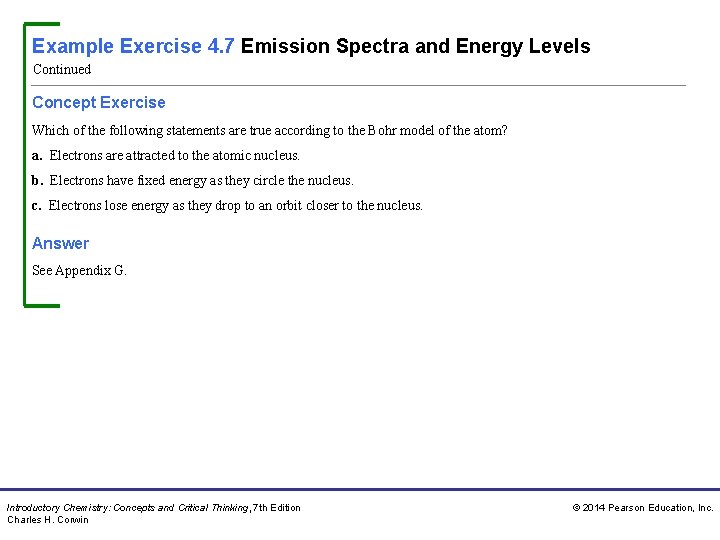
Example Exercise 4. 7 Emission Spectra and Energy Levels Continued Concept Exercise Which of the following statements are true according to the Bohr model of the atom? a. Electrons are attracted to the atomic nucleus. b. Electrons have fixed energy as they circle the nucleus. c. Electrons lose energy as they drop to an orbit closer to the nucleus. Answer See Appendix G. Introductory Chemistry: Concepts and Critical Thinking, 7 th Edition Charles H. Corwin © 2014 Pearson Education, Inc.
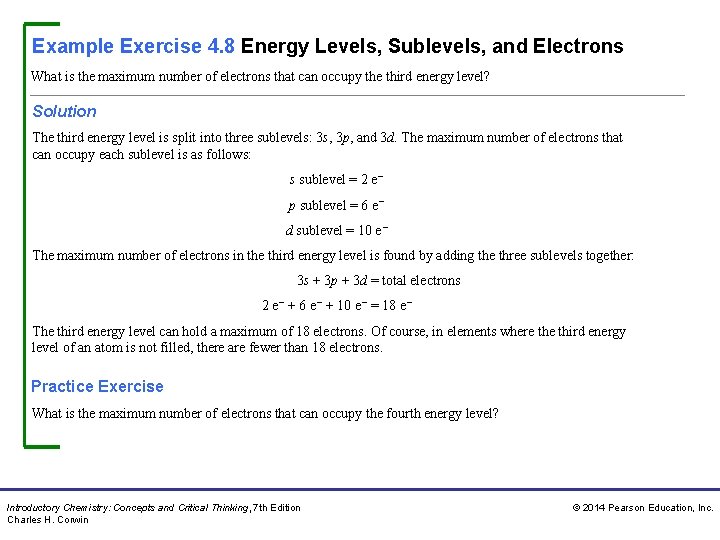
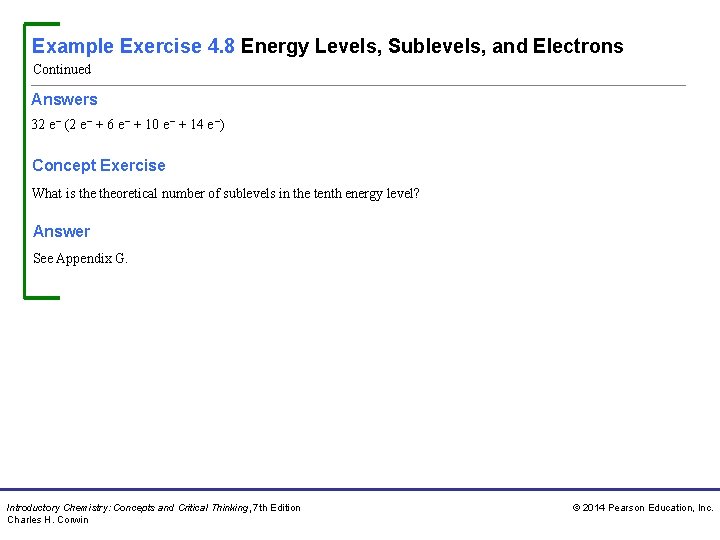
Example Exercise 4. 8 Energy Levels, Sublevels, and Electrons What is the maximum number of electrons that can occupy the third energy level? Solution The third energy level is split into three sublevels: 3 s, 3 p, and 3 d. The maximum number of electrons that can occupy each sublevel is as follows: s sublevel = 2 e− p sublevel = 6 e− d sublevel = 10 e− The maximum number of electrons in the third energy level is found by adding the three sublevels together: 3 s + 3 p + 3 d = total electrons 2 e− + 6 e− + 10 e− = 18 e− The third energy level can hold a maximum of 18 electrons. Of course, in elements where third energy level of an atom is not filled, there are fewer than 18 electrons. Practice Exercise What is the maximum number of electrons that can occupy the fourth energy level? Introductory Chemistry: Concepts and Critical Thinking, 7 th Edition Charles H. Corwin © 2014 Pearson Education, Inc.
Example Exercise 4. 8 Energy Levels, Sublevels, and Electrons Continued Answers 32 e− (2 e− + 6 e− + 10 e− + 14 e−) Concept Exercise What is theoretical number of sublevels in the tenth energy level? Answer See Appendix G. Introductory Chemistry: Concepts and Critical Thinking, 7 th Edition Charles H. Corwin © 2014 Pearson Education, Inc.
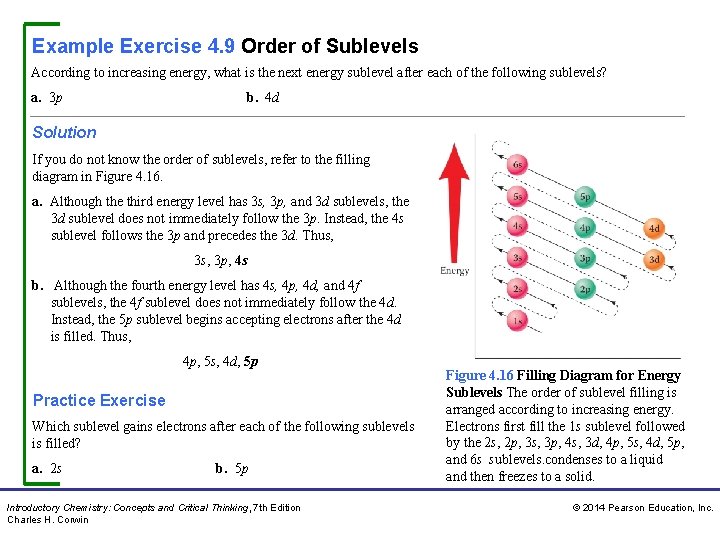
Example Exercise 4. 9 Order of Sublevels According to increasing energy, what is the next energy sublevel after each of the following sublevels? a. 3 p b. 4 d Solution If you do not know the order of sublevels, refer to the filling diagram in Figure 4. 16. a. Although the third energy level has 3 s, 3 p, and 3 d sublevels, the 3 d sublevel does not immediately follow the 3 p. Instead, the 4 s sublevel follows the 3 p and precedes the 3 d. Thus, 3 p, 4 s b. Although the fourth energy level has 4 s, 4 p, 4 d, and 4 f sublevels, the 4 f sublevel does not immediately follow the 4 d. Instead, the 5 p sublevel begins accepting electrons after the 4 d is filled. Thus, 4 p, 5 s, 4 d, 5 p Practice Exercise Which sublevel gains electrons after each of the following sublevels is filled? a. 2 s b. 5 p Introductory Chemistry: Concepts and Critical Thinking, 7 th Edition Charles H. Corwin Figure 4. 16 Filling Diagram for Energy Sublevels The order of sublevel filling is arranged according to increasing energy. Electrons first fill the 1 s sublevel followed by the 2 s, 2 p, 3 s, 3 p, 4 s, 3 d, 4 p, 5 s, 4 d, 5 p, and 6 s sublevels. condenses to a liquid and then freezes to a solid. © 2014 Pearson Education, Inc.
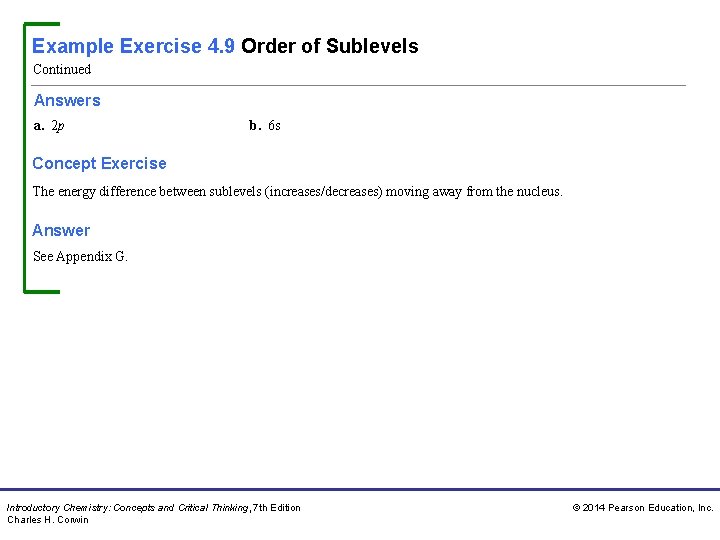
Example Exercise 4. 9 Order of Sublevels Continued Answers a. 2 p b. 6 s Concept Exercise The energy difference between sublevels (increases/decreases) moving away from the nucleus. Answer See Appendix G. Introductory Chemistry: Concepts and Critical Thinking, 7 th Edition Charles H. Corwin © 2014 Pearson Education, Inc.
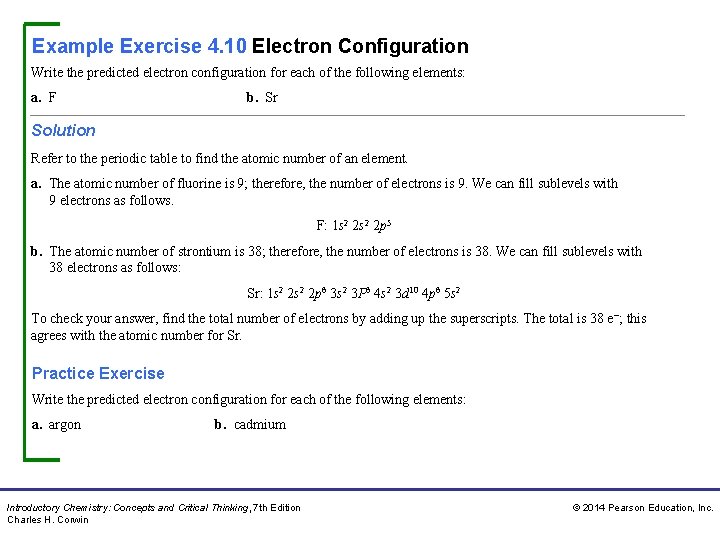
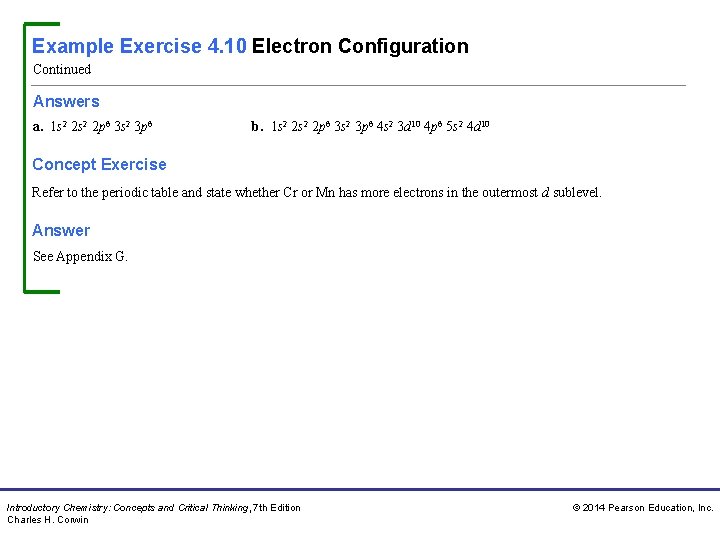
Example Exercise 4. 10 Electron Configuration Write the predicted electron configuration for each of the following elements: a. F b. Sr Solution Refer to the periodic table to find the atomic number of an element. a. The atomic number of fluorine is 9; therefore, the number of electrons is 9. We can fill sublevels with 9 electrons as follows. F: 1 s 2 2 p 5 b. The atomic number of strontium is 38; therefore, the number of electrons is 38. We can fill sublevels with 38 electrons as follows: Sr: 1 s 2 2 p 6 3 s 2 3 P 6 4 s 2 3 d 10 4 p 6 5 s 2 To check your answer, find the total number of electrons by adding up the superscripts. The total is 38 e −; this agrees with the atomic number for Sr. Practice Exercise Write the predicted electron configuration for each of the following elements: a. argon b. cadmium Introductory Chemistry: Concepts and Critical Thinking, 7 th Edition Charles H. Corwin © 2014 Pearson Education, Inc.
Example Exercise 4. 10 Electron Configuration Continued Answers a. 1 s 2 2 p 6 3 s 2 3 p 6 b. 1 s 2 2 p 6 3 s 2 3 p 6 4 s 2 3 d 10 4 p 6 5 s 2 4 d 10 Concept Exercise Refer to the periodic table and state whether Cr or Mn has more electrons in the outermost d sublevel. Answer See Appendix G. Introductory Chemistry: Concepts and Critical Thinking, 7 th Edition Charles H. Corwin © 2014 Pearson Education, Inc.
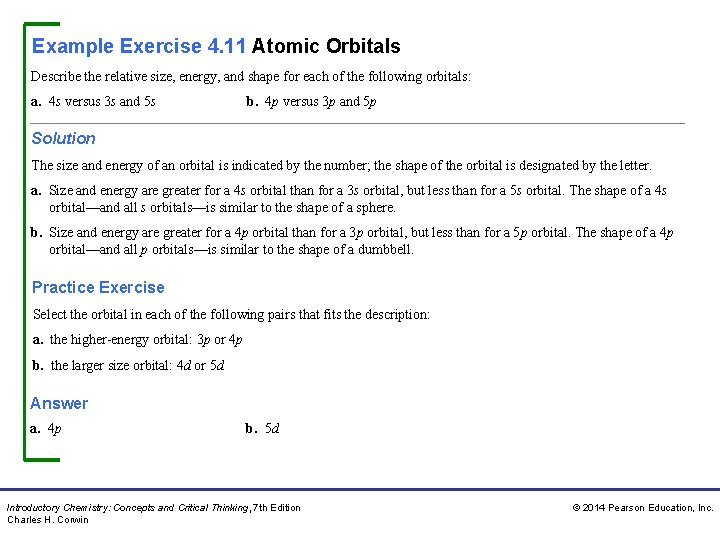
Example Exercise 4. 11 Atomic Orbitals Describe the relative size, energy, and shape for each of the following orbitals: a. 4 s versus 3 s and 5 s b. 4 p versus 3 p and 5 p Solution The size and energy of an orbital is indicated by the number; the shape of the orbital is designated by the letter. a. Size and energy are greater for a 4 s orbital than for a 3 s orbital, but less than for a 5 s orbital. The shape of a 4 s orbital—and all s orbitals—is similar to the shape of a sphere. b. Size and energy are greater for a 4 p orbital than for a 3 p orbital, but less than for a 5 p orbital. The shape of a 4 p orbital—and all p orbitals—is similar to the shape of a dumbbell. Practice Exercise Select the orbital in each of the following pairs that fits the description: a. the higher-energy orbital: 3 p or 4 p b. the larger size orbital: 4 d or 5 d Answer a. 4 p b. 5 d Introductory Chemistry: Concepts and Critical Thinking, 7 th Edition Charles H. Corwin © 2014 Pearson Education, Inc.
Example Exercise 4. 11 Atomic Orbitals Continued Concept Exercise Which of the following statements are true according to the quantum mechanical model of the atom? a. Orbitals represent quantum energy levels for electrons. b. Orbitals represent probability boundaries for electrons. c. Orbitals can have different shapes. Answer See Appendix G. Introductory Chemistry: Concepts and Critical Thinking, 7 th Edition Charles H. Corwin © 2014 Pearson Education, Inc.