
Example Exercise 3 1 Meteric Basic Units and
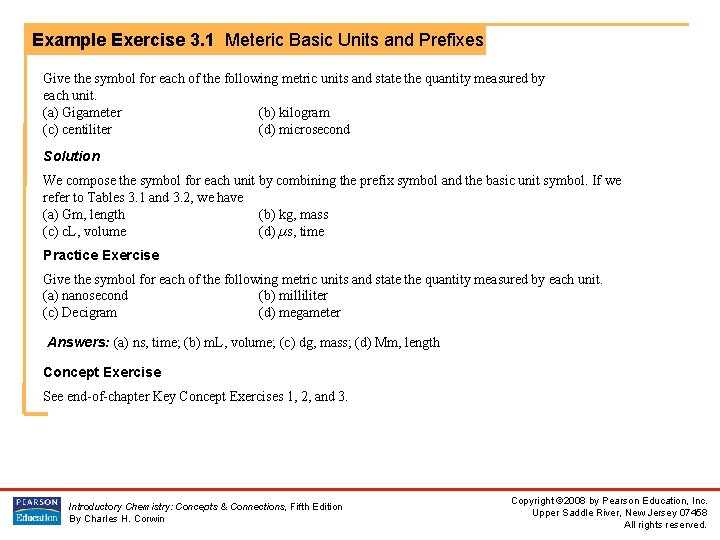
Example Exercise 3. 1 Meteric Basic Units and Prefixes Give the symbol for each of the following metric units and state the quantity measured by each unit. (a) Gigameter (b) kilogram (c) centiliter (d) microsecond Solution We compose the symbol for each unit by combining the prefix symbol and the basic unit symbol. If we refer to Tables 3. 1 and 3. 2, we have (a) Gm, length (b) kg, mass (c) c. L, volume (d) µs, time Practice Exercise Give the symbol for each of the following metric units and state the quantity measured by each unit. (a) nanosecond (b) milliliter (c) Decigram (d) megameter Answers: (a) ns, time; (b) m. L, volume; (c) dg, mass; (d) Mm, length Concept Exercise See end-of-chapter Key Concept Exercises 1, 2, and 3. Introductory Chemistry: Concepts & Connections, Fifth Edition By Charles H. Corwin Copyright © 2008 by Pearson Education, Inc. Upper Saddle River, New Jersey 07458 All rights reserved.
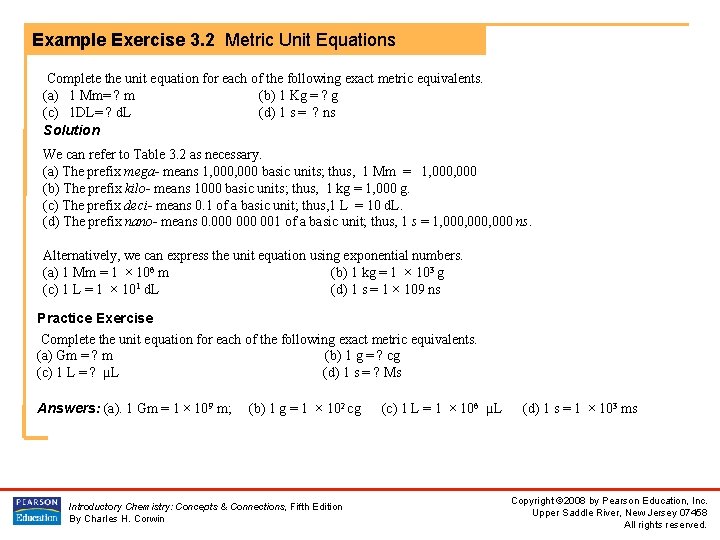
Example Exercise 3. 2 Metric Unit Equations Complete the unit equation for each of the following exact metric equivalents. (a) 1 Mm= ? m (b) 1 Kg = ? g (c) 1 DL= ? d. L (d) 1 s = ? ns Solution We can refer to Table 3. 2 as necessary. (a) The prefix mega- means 1, 000 basic units; thus, 1 Mm = 1, 000 (b) The prefix kilo- means 1000 basic units; thus, 1 kg = 1, 000 g. (c) The prefix deci- means 0. 1 of a basic unit; thus, 1 L = 10 d. L. (d) The prefix nano- means 0. 000 001 of a basic unit; thus, 1 s = 1, 000, 000 ns. Alternatively, we can express the unit equation using exponential numbers. (a) 1 Mm = 1 × 10⁶ m (b) 1 kg = 1 × 10³ g (c) 1 L = 1 × 101 d. L (d) 1 s = 1 × 10⁹ ns Practice Exercise Complete the unit equation for each of the following exact metric equivalents. (a) Gm = ? m (b) 1 g = ? cg (c) 1 L = ? µL (d) 1 s = ? Ms Answers: (a). 1 Gm = 1 × 10⁹ m; (b) 1 g = 1 × 10² cg Introductory Chemistry: Concepts & Connections, Fifth Edition By Charles H. Corwin (c) 1 L = 1 × 10⁶ µL (d) 1 s = 1 × 10³ ms Copyright © 2008 by Pearson Education, Inc. Upper Saddle River, New Jersey 07458 All rights reserved.
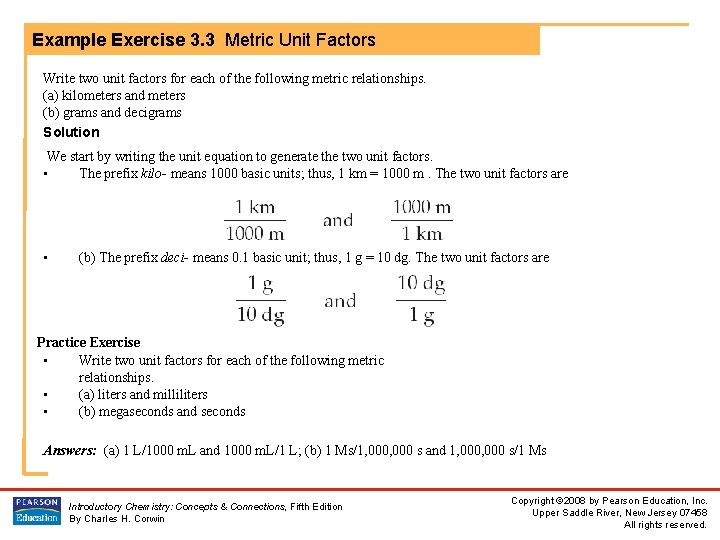
Example Exercise 3. 3 Metric Unit Factors Write two unit factors for each of the following metric relationships. (a) kilometers and meters (b) grams and decigrams Solution We start by writing the unit equation to generate the two unit factors. • The prefix kilo- means 1000 basic units; thus, 1 km = 1000 m. The two unit factors are • (b) The prefix deci- means 0. 1 basic unit; thus, 1 g = 10 dg. The two unit factors are Practice Exercise • Write two unit factors for each of the following metric relationships. • (a) liters and milliliters • (b) megaseconds and seconds Answers: (a) 1 L/1000 m. L and 1000 m. L/1 L; (b) 1 Ms/1, 000 s and 1, 000 s/1 Ms Introductory Chemistry: Concepts & Connections, Fifth Edition By Charles H. Corwin Copyright © 2008 by Pearson Education, Inc. Upper Saddle River, New Jersey 07458 All rights reserved.
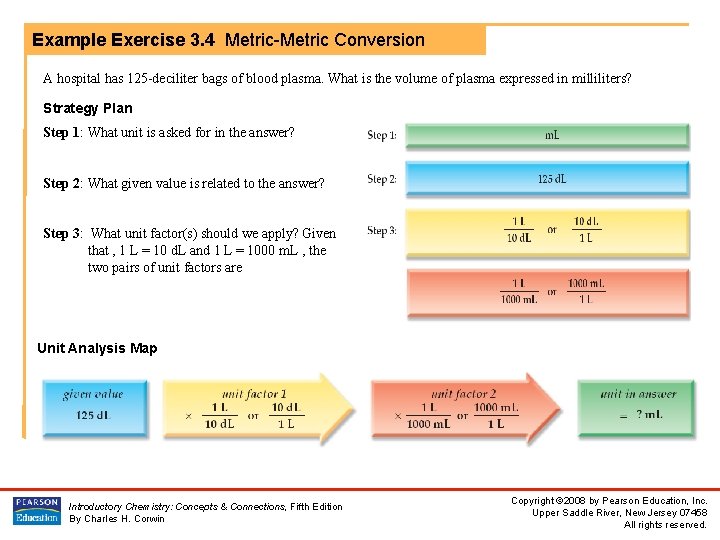
Example Exercise 3. 4 Metric-Metric Conversion A hospital has 125 -deciliter bags of blood plasma. What is the volume of plasma expressed in milliliters? Strategy Plan Step 1: What unit is asked for in the answer? Step 2: What given value is related to the answer? Step 3: What unit factor(s) should we apply? Given that , 1 L = 10 d. L and 1 L = 1000 m. L , the two pairs of unit factors are Unit Analysis Map Introductory Chemistry: Concepts & Connections, Fifth Edition By Charles H. Corwin Copyright © 2008 by Pearson Education, Inc. Upper Saddle River, New Jersey 07458 All rights reserved.
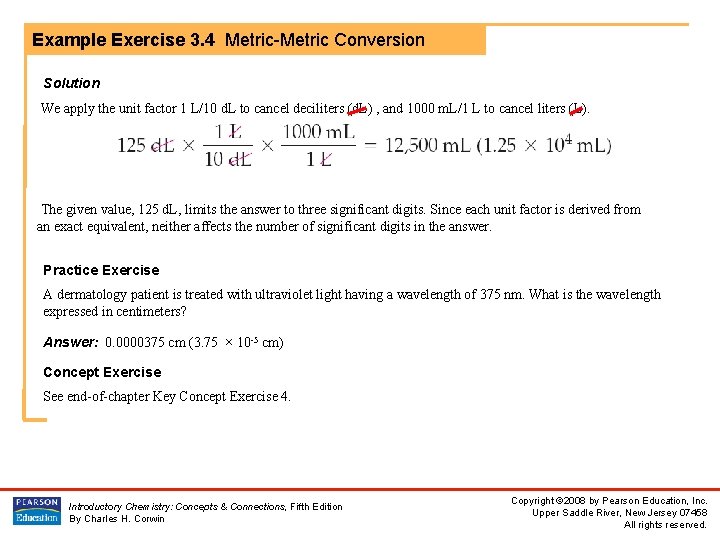
Example Exercise 3. 4 Metric-Metric Conversion Solution We apply the unit factor 1 L/10 d. L to cancel deciliters (d. L) , and 1000 m. L/1 L to cancel liters (L). The given value, 125 d. L, limits the answer to three significant digits. Since each unit factor is derived from an exact equivalent, neither affects the number of significant digits in the answer. Practice Exercise A dermatology patient is treated with ultraviolet light having a wavelength of 375 nm. What is the wavelength expressed in centimeters? Answer: 0. 0000375 cm (3. 75 × 10 -5 cm) Concept Exercise See end-of-chapter Key Concept Exercise 4. Introductory Chemistry: Concepts & Connections, Fifth Edition By Charles H. Corwin Copyright © 2008 by Pearson Education, Inc. Upper Saddle River, New Jersey 07458 All rights reserved.
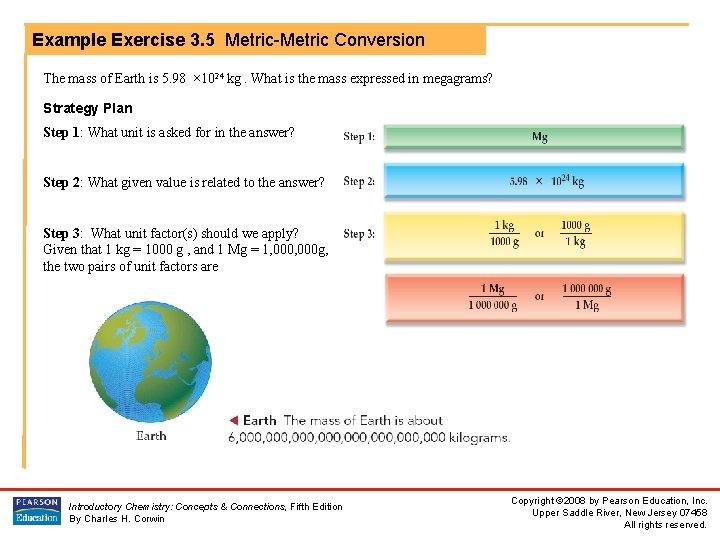
Example Exercise 3. 5 Metric-Metric Conversion The mass of Earth is 5. 98 × 1024 kg. What is the mass expressed in megagrams? Strategy Plan Step 1: What unit is asked for in the answer? Step 2: What given value is related to the answer? Step 3: What unit factor(s) should we apply? Given that 1 kg = 1000 g , and 1 Mg = 1, 000 g, the two pairs of unit factors are Introductory Chemistry: Concepts & Connections, Fifth Edition By Charles H. Corwin Copyright © 2008 by Pearson Education, Inc. Upper Saddle River, New Jersey 07458 All rights reserved.
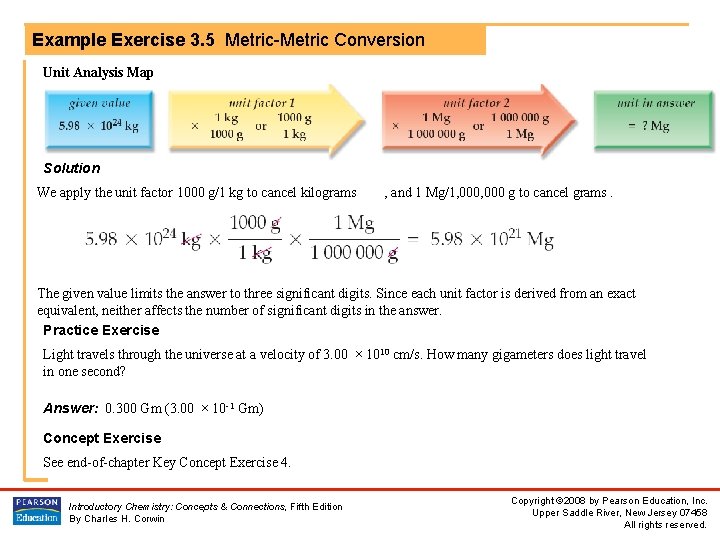
Example Exercise 3. 5 Metric-Metric Conversion Unit Analysis Map Solution We apply the unit factor 1000 g/1 kg to cancel kilograms , and 1 Mg/1, 000 g to cancel grams. The given value limits the answer to three significant digits. Since each unit factor is derived from an exact equivalent, neither affects the number of significant digits in the answer. Practice Exercise Light travels through the universe at a velocity of 3. 00 × 1010 cm/s. How many gigameters does light travel in one second? Answer: 0. 300 Gm (3. 00 × 10 -1 Gm) Concept Exercise See end-of-chapter Key Concept Exercise 4. Introductory Chemistry: Concepts & Connections, Fifth Edition By Charles H. Corwin Copyright © 2008 by Pearson Education, Inc. Upper Saddle River, New Jersey 07458 All rights reserved.

Example Exercise 3. 6 Metric-English Conversion A half-gallon carton contains 64. 0 fl oz of milk. How many milliliters of milk are in a carton? (Given: 1 qt = 32 fl oz ) Strategy Plan Step 1: What unit is asked for in the answer? Step 2: What given value is related to the answer? Step 3: What unit factor(s) should we apply? Given that 1 qt = 32 fl oz; and that in Table 3. 3 we find that 1 qt = 946 m. L. The two pairs of unit factors are Unit Analysis Map Introductory Chemistry: Concepts & Connections, Fifth Edition By Charles H. Corwin Copyright © 2008 by Pearson Education, Inc. Upper Saddle River, New Jersey 07458 All rights reserved.
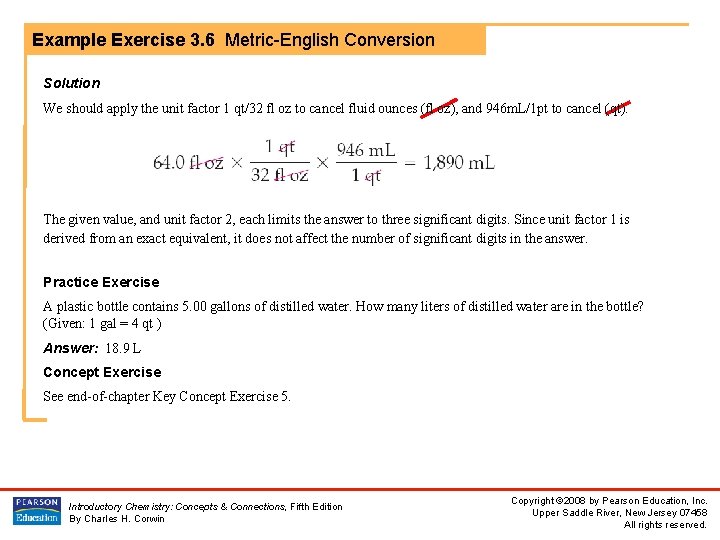
Example Exercise 3. 6 Metric-English Conversion Solution We should apply the unit factor 1 qt/32 fl oz to cancel fluid ounces (fl oz), and 946 m. L/1 pt to cancel (qt). The given value, and unit factor 2, each limits the answer to three significant digits. Since unit factor 1 is derived from an exact equivalent, it does not affect the number of significant digits in the answer. Practice Exercise A plastic bottle contains 5. 00 gallons of distilled water. How many liters of distilled water are in the bottle? (Given: 1 gal = 4 qt ) Answer: 18. 9 L Concept Exercise See end-of-chapter Key Concept Exercise 5. Introductory Chemistry: Concepts & Connections, Fifth Edition By Charles H. Corwin Copyright © 2008 by Pearson Education, Inc. Upper Saddle River, New Jersey 07458 All rights reserved.
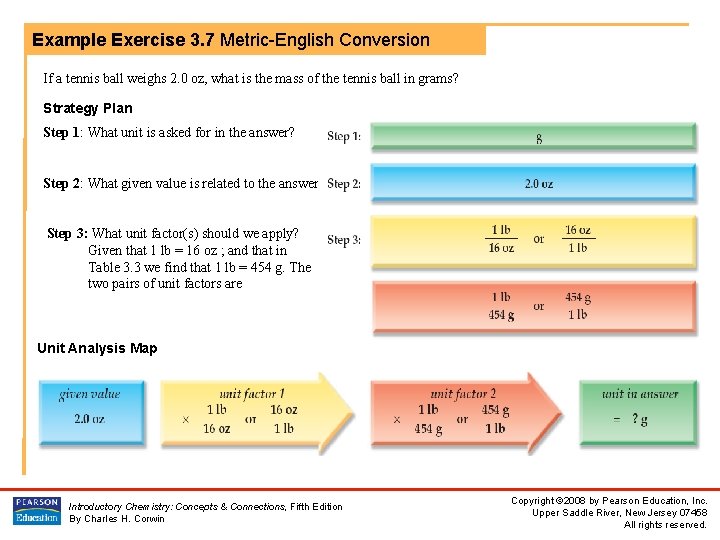
Example Exercise 3. 7 Metric-English Conversion If a tennis ball weighs 2. 0 oz, what is the mass of the tennis ball in grams? Strategy Plan Step 1: What unit is asked for in the answer? Step 2: What given value is related to the answer? Step 3: What unit factor(s) should we apply? Given that 1 lb = 16 oz ; and that in Table 3. 3 we find that 1 lb = 454 g. The two pairs of unit factors are Unit Analysis Map Introductory Chemistry: Concepts & Connections, Fifth Edition By Charles H. Corwin Copyright © 2008 by Pearson Education, Inc. Upper Saddle River, New Jersey 07458 All rights reserved.
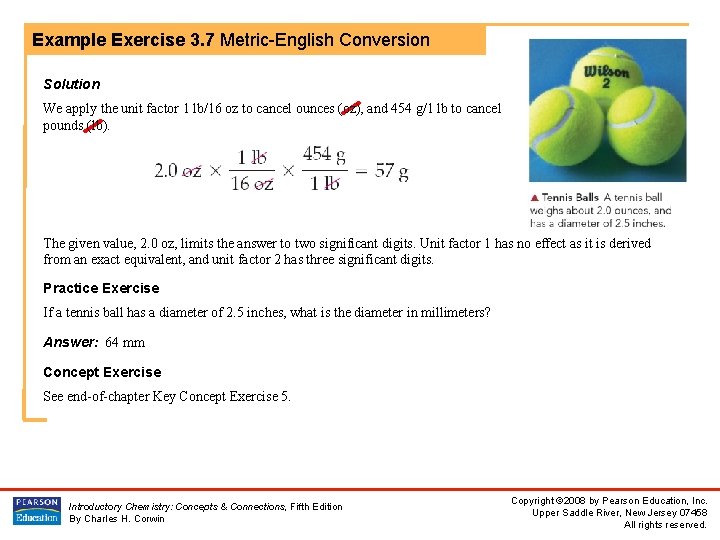
Example Exercise 3. 7 Metric-English Conversion Solution We apply the unit factor 1 lb/16 oz to cancel ounces (oz), and 454 g/1 lb to cancel pounds (lb). The given value, 2. 0 oz, limits the answer to two significant digits. Unit factor 1 has no effect as it is derived from an exact equivalent, and unit factor 2 has three significant digits. Practice Exercise If a tennis ball has a diameter of 2. 5 inches, what is the diameter in millimeters? Answer: 64 mm Concept Exercise See end-of-chapter Key Concept Exercise 5. Introductory Chemistry: Concepts & Connections, Fifth Edition By Charles H. Corwin Copyright © 2008 by Pearson Education, Inc. Upper Saddle River, New Jersey 07458 All rights reserved.
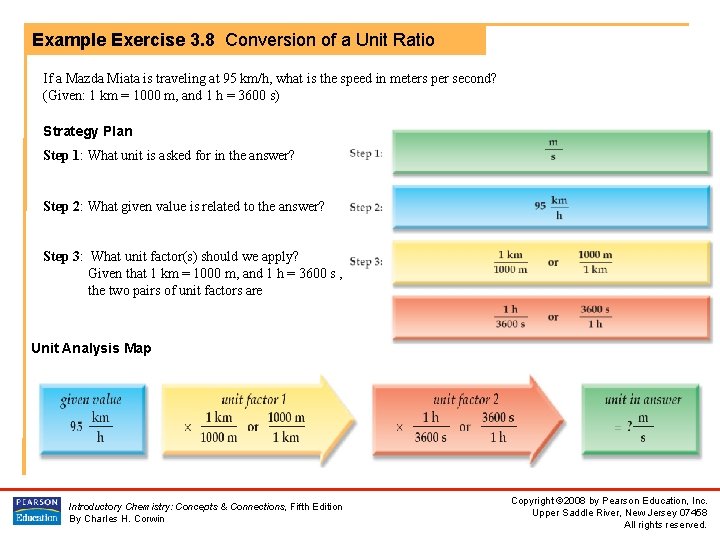
Example Exercise 3. 8 Conversion of a Unit Ratio If a Mazda Miata is traveling at 95 km/h, what is the speed in meters per second? (Given: 1 km = 1000 m, and 1 h = 3600 s) Strategy Plan Step 1: What unit is asked for in the answer? Step 2: What given value is related to the answer? Step 3: What unit factor(s) should we apply? Given that 1 km = 1000 m, and 1 h = 3600 s , the two pairs of unit factors are Unit Analysis Map Introductory Chemistry: Concepts & Connections, Fifth Edition By Charles H. Corwin Copyright © 2008 by Pearson Education, Inc. Upper Saddle River, New Jersey 07458 All rights reserved.
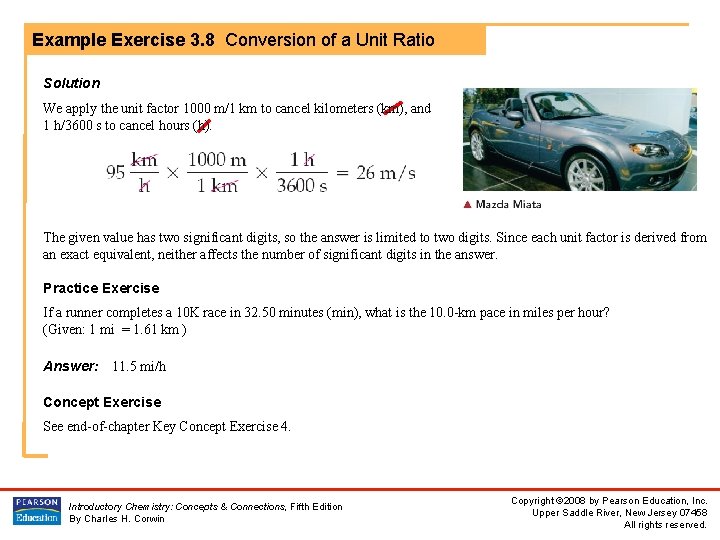
Example Exercise 3. 8 Conversion of a Unit Ratio Solution We apply the unit factor 1000 m/1 km to cancel kilometers (km), and 1 h/3600 s to cancel hours (h). The given value has two significant digits, so the answer is limited to two digits. Since each unit factor is derived from an exact equivalent, neither affects the number of significant digits in the answer. Practice Exercise If a runner completes a 10 K race in 32. 50 minutes (min), what is the 10. 0 -km pace in miles per hour? (Given: 1 mi = 1. 61 km ) Answer: 11. 5 mi/h Concept Exercise See end-of-chapter Key Concept Exercise 4. Introductory Chemistry: Concepts & Connections, Fifth Edition By Charles H. Corwin Copyright © 2008 by Pearson Education, Inc. Upper Saddle River, New Jersey 07458 All rights reserved.
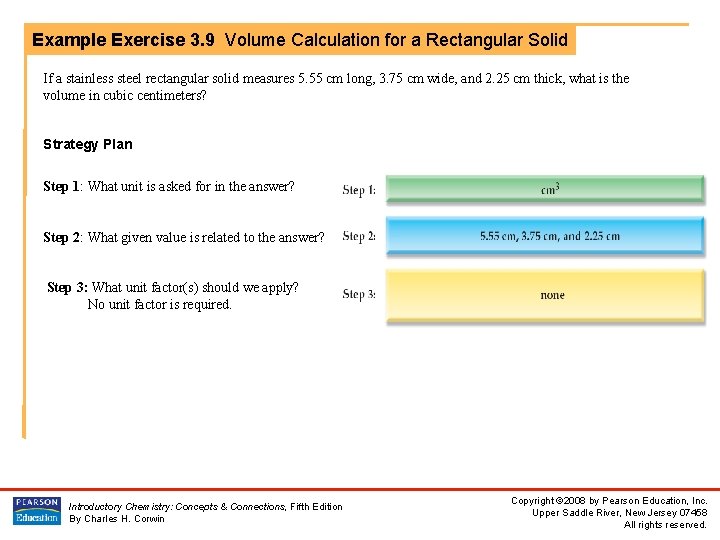
Example Exercise 3. 9 Volume Calculation for a Rectangular Solid If a stainless steel rectangular solid measures 5. 55 cm long, 3. 75 cm wide, and 2. 25 cm thick, what is the volume in cubic centimeters? Strategy Plan Step 1: What unit is asked for in the answer? Step 2: What given value is related to the answer? Step 3: What unit factor(s) should we apply? No unit factor is required. Introductory Chemistry: Concepts & Connections, Fifth Edition By Charles H. Corwin Copyright © 2008 by Pearson Education, Inc. Upper Saddle River, New Jersey 07458 All rights reserved.
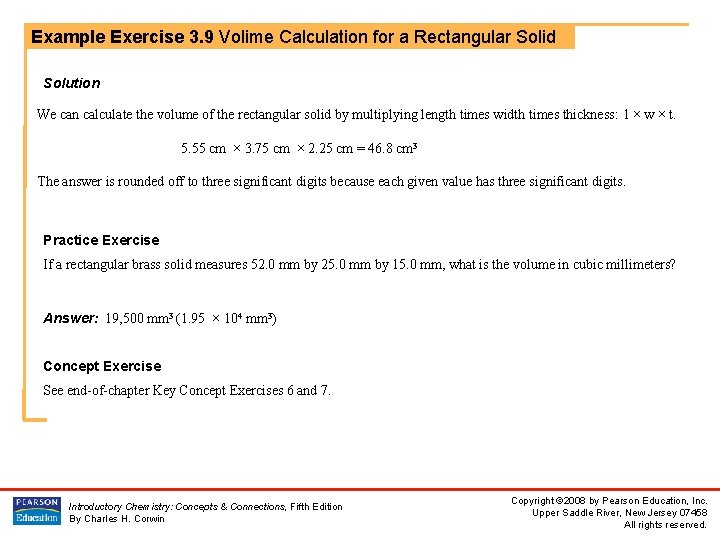
Example Exercise 3. 9 Volime Calculation for a Rectangular Solid Solution We can calculate the volume of the rectangular solid by multiplying length times width times thickness: l × w × t. 5. 55 cm × 3. 75 cm × 2. 25 cm = 46. 8 cm 3 The answer is rounded off to three significant digits because each given value has three significant digits. Practice Exercise If a rectangular brass solid measures 52. 0 mm by 25. 0 mm by 15. 0 mm, what is the volume in cubic millimeters? Answer: 19, 500 mm 3 (1. 95 × 104 mm 3) Concept Exercise See end-of-chapter Key Concept Exercises 6 and 7. Introductory Chemistry: Concepts & Connections, Fifth Edition By Charles H. Corwin Copyright © 2008 by Pearson Education, Inc. Upper Saddle River, New Jersey 07458 All rights reserved.
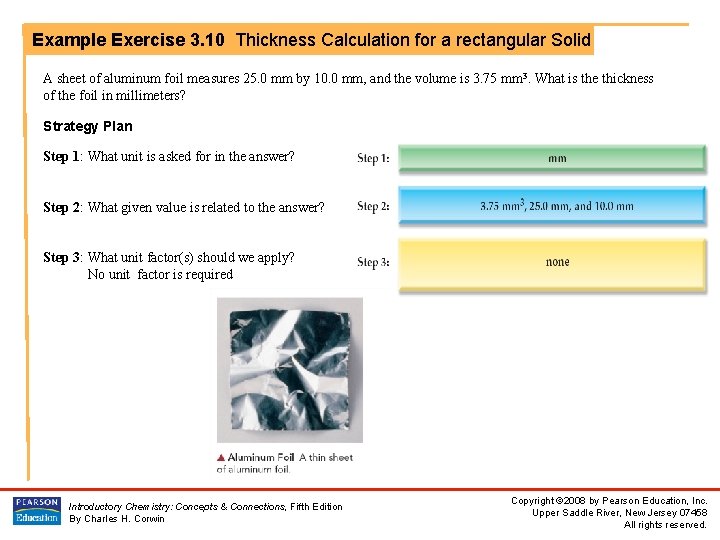
Example Exercise 3. 10 Thickness Calculation for a rectangular Solid A sheet of aluminum foil measures 25. 0 mm by 10. 0 mm, and the volume is 3. 75 mm 3. What is the thickness of the foil in millimeters? Strategy Plan Step 1: What unit is asked for in the answer? Step 2: What given value is related to the answer? Step 3: What unit factor(s) should we apply? No unit factor is required Introductory Chemistry: Concepts & Connections, Fifth Edition By Charles H. Corwin Copyright © 2008 by Pearson Education, Inc. Upper Saddle River, New Jersey 07458 All rights reserved.
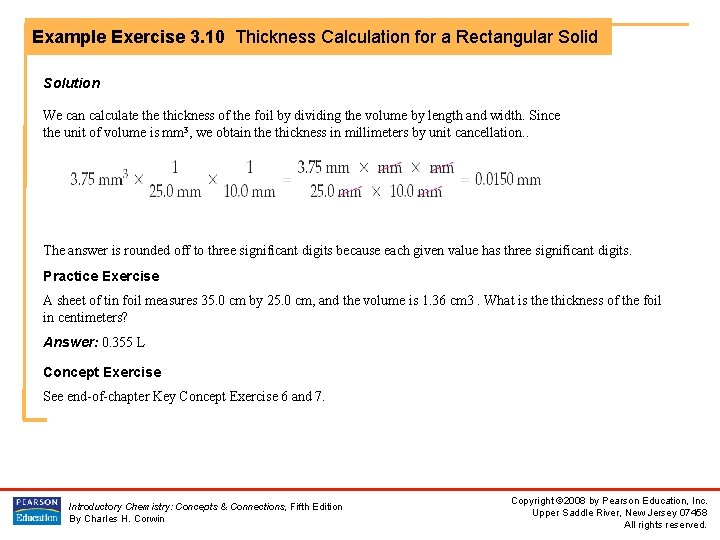
Example Exercise 3. 10 Thickness Calculation for a Rectangular Solid Solution We can calculate thickness of the foil by dividing the volume by length and width. Since the unit of volume is mm 3, we obtain the thickness in millimeters by unit cancellation. . The answer is rounded off to three significant digits because each given value has three significant digits. Practice Exercise A sheet of tin foil measures 35. 0 cm by 25. 0 cm, and the volume is 1. 36 cm 3. What is the thickness of the foil in centimeters? Answer: 0. 355 L Concept Exercise See end-of-chapter Key Concept Exercise 6 and 7. Introductory Chemistry: Concepts & Connections, Fifth Edition By Charles H. Corwin Copyright © 2008 by Pearson Education, Inc. Upper Saddle River, New Jersey 07458 All rights reserved.
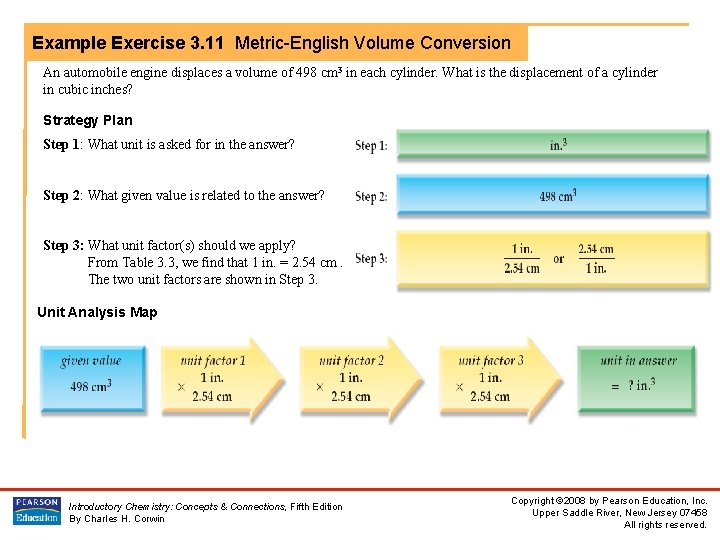
Example Exercise 3. 11 Metric-English Volume Conversion An automobile engine displaces a volume of 498 cm 3 in each cylinder. What is the displacement of a cylinder in cubic inches? Strategy Plan Step 1: What unit is asked for in the answer? Step 2: What given value is related to the answer? Step 3: What unit factor(s) should we apply? From Table 3. 3, we find that 1 in. = 2. 54 cm. The two unit factors are shown in Step 3. Unit Analysis Map Introductory Chemistry: Concepts & Connections, Fifth Edition By Charles H. Corwin Copyright © 2008 by Pearson Education, Inc. Upper Saddle River, New Jersey 07458 All rights reserved.
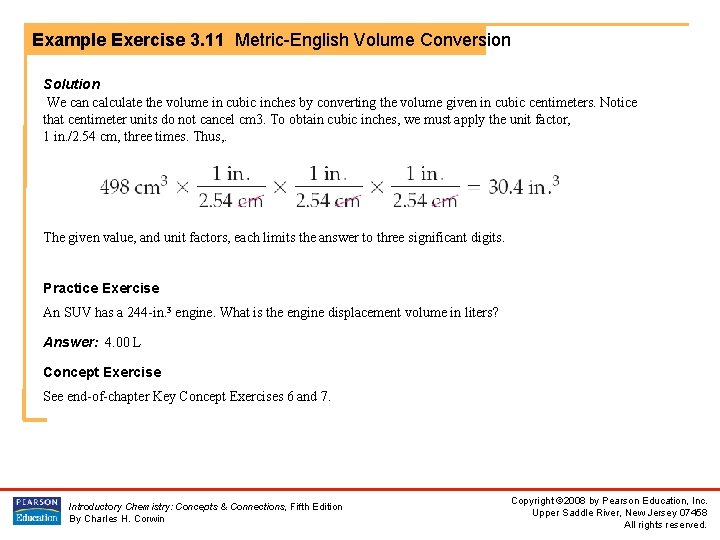
Example Exercise 3. 11 Metric-English Volume Conversion Solution We can calculate the volume in cubic inches by converting the volume given in cubic centimeters. Notice that centimeter units do not cancel cm 3. To obtain cubic inches, we must apply the unit factor, 1 in. /2. 54 cm, three times. Thus, . The given value, and unit factors, each limits the answer to three significant digits. Practice Exercise An SUV has a 244 -in. 3 engine. What is the engine displacement volume in liters? Answer: 4. 00 L Concept Exercise See end-of-chapter Key Concept Exercises 6 and 7. Introductory Chemistry: Concepts & Connections, Fifth Edition By Charles H. Corwin Copyright © 2008 by Pearson Education, Inc. Upper Saddle River, New Jersey 07458 All rights reserved.
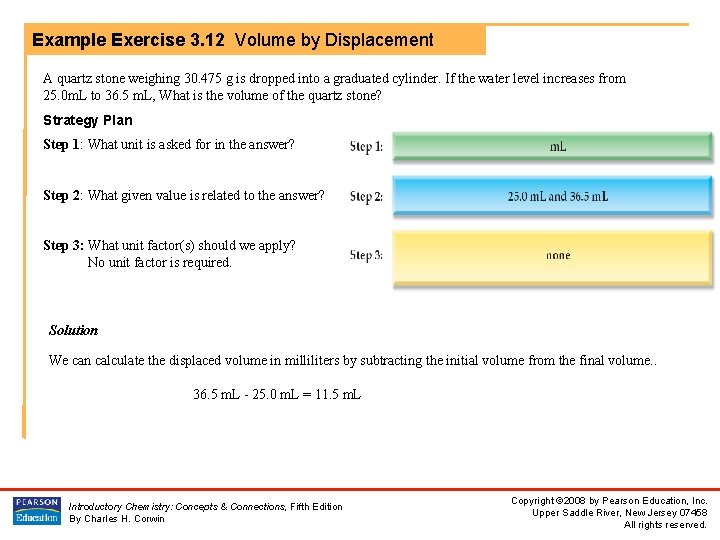
Example Exercise 3. 12 Volume by Displacement A quartz stone weighing 30. 475 g is dropped into a graduated cylinder. If the water level increases from 25. 0 m. L to 36. 5 m. L, What is the volume of the quartz stone? Strategy Plan Step 1: What unit is asked for in the answer? Step 2: What given value is related to the answer? Step 3: What unit factor(s) should we apply? No unit factor is required. Solution We can calculate the displaced volume in milliliters by subtracting the initial volume from the final volume. . 36. 5 m. L - 25. 0 m. L = 11. 5 m. L Introductory Chemistry: Concepts & Connections, Fifth Edition By Charles H. Corwin Copyright © 2008 by Pearson Education, Inc. Upper Saddle River, New Jersey 07458 All rights reserved.
Example Exercise 3. 12 Volume by Displacement Practice Exercise Hydrogen peroxide decomposes to give oxygen gas, which displaces a volume of water into a beaker. If the water level in the beaker increases from 50. 0 m. L to 105. 5 m. L, what is volume of oxygen gas? Answer: 55. 5 m. L Concept Exercise See end-of-chapter Key Concept Exercise 8. Introductory Chemistry: Concepts & Connections, Fifth Edition By Charles H. Corwin Copyright © 2008 by Pearson Education, Inc. Upper Saddle River, New Jersey 07458 All rights reserved.
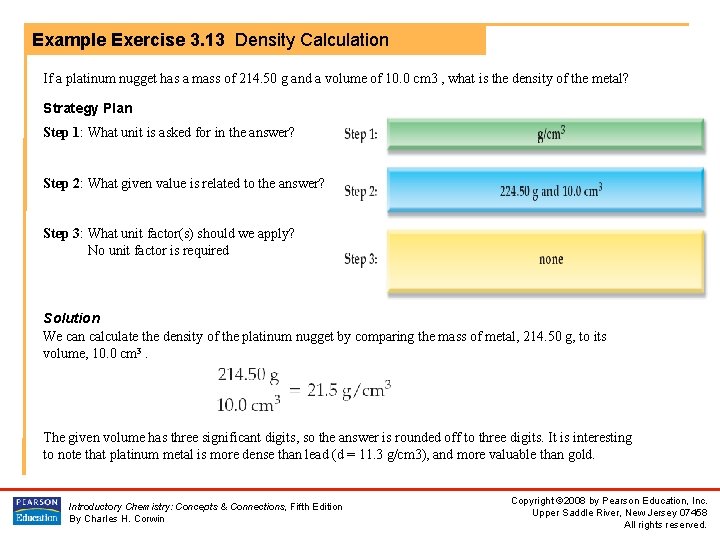
Example Exercise 3. 13 Density Calculation If a platinum nugget has a mass of 214. 50 g and a volume of 10. 0 cm 3 , what is the density of the metal? Strategy Plan Step 1: What unit is asked for in the answer? Step 2: What given value is related to the answer? Step 3: What unit factor(s) should we apply? No unit factor is required Solution We can calculate the density of the platinum nugget by comparing the mass of metal, 214. 50 g, to its volume, 10. 0 cm 3. The given volume has three significant digits, so the answer is rounded off to three digits. It is interesting to note that platinum metal is more dense than lead (d = 11. 3 g/cm 3), and more valuable than gold. Introductory Chemistry: Concepts & Connections, Fifth Edition By Charles H. Corwin Copyright © 2008 by Pearson Education, Inc. Upper Saddle River, New Jersey 07458 All rights reserved.
Example Exercise 3. 13 Density Calculation Practice Exercise Carbon tetrachloride is a solvent used for degreasing electronic parts. If 25. 0 m. L of carbon tetrachloride has a mass of 39. 75 g, what is the density of the liquid? Answer: 1. 59 g/m. L Concept Exercise See end-of-chapter Key Concept Exercise 8. Introductory Chemistry: Concepts & Connections, Fifth Edition By Charles H. Corwin Copyright © 2008 by Pearson Education, Inc. Upper Saddle River, New Jersey 07458 All rights reserved.
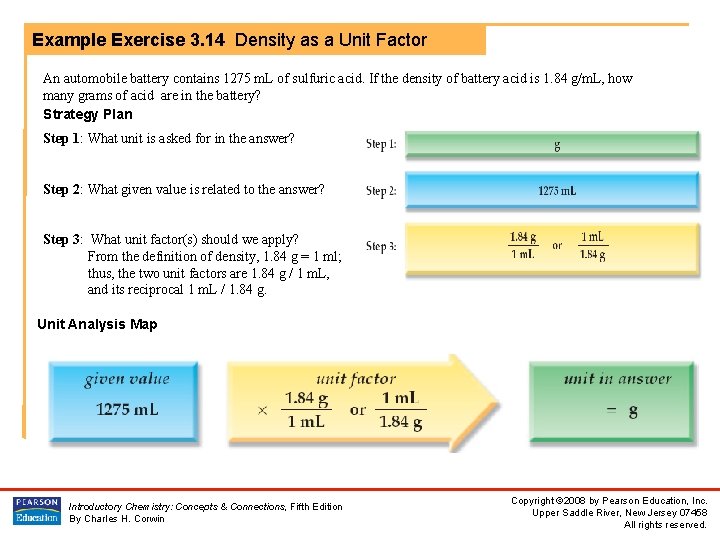
Example Exercise 3. 14 Density as a Unit Factor An automobile battery contains 1275 m. L of sulfuric acid. If the density of battery acid is 1. 84 g/m. L, how many grams of acid are in the battery? Strategy Plan Step 1: What unit is asked for in the answer? Step 2: What given value is related to the answer? Step 3: What unit factor(s) should we apply? From the definition of density, 1. 84 g = 1 ml; thus, the two unit factors are 1. 84 g / 1 m. L, and its reciprocal 1 m. L / 1. 84 g. Unit Analysis Map Introductory Chemistry: Concepts & Connections, Fifth Edition By Charles H. Corwin Copyright © 2008 by Pearson Education, Inc. Upper Saddle River, New Jersey 07458 All rights reserved.
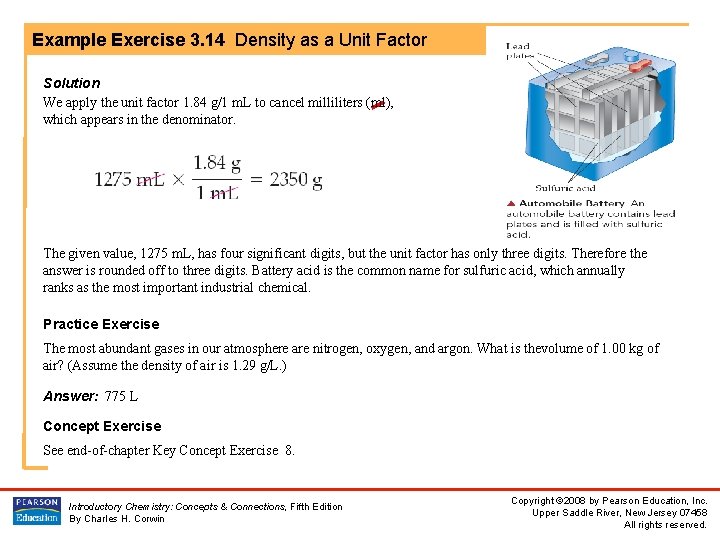
Example Exercise 3. 14 Density as a Unit Factor Solution We apply the unit factor 1. 84 g/1 m. L to cancel milliliters (ml), which appears in the denominator. The given value, 1275 m. L, has four significant digits, but the unit factor has only three digits. Therefore the answer is rounded off to three digits. Battery acid is the common name for sulfuric acid, which annually ranks as the most important industrial chemical. Practice Exercise The most abundant gases in our atmosphere are nitrogen, oxygen, and argon. What is thevolume of 1. 00 kg of air? (Assume the density of air is 1. 29 g/L. ) Answer: 775 L Concept Exercise See end-of-chapter Key Concept Exercise 8. Introductory Chemistry: Concepts & Connections, Fifth Edition By Charles H. Corwin Copyright © 2008 by Pearson Education, Inc. Upper Saddle River, New Jersey 07458 All rights reserved.
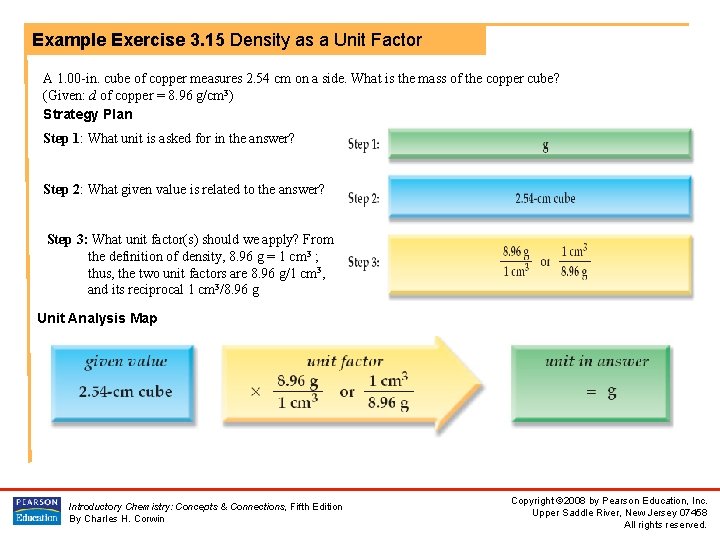
Example Exercise 3. 15 Density as a Unit Factor A 1. 00 -in. cube of copper measures 2. 54 cm on a side. What is the mass of the copper cube? (Given: d of copper = 8. 96 g/cm 3) Strategy Plan Step 1: What unit is asked for in the answer? Step 2: What given value is related to the answer? Step 3: What unit factor(s) should we apply? From the definition of density, 8. 96 g = 1 cm 3 ; thus, the two unit factors are 8. 96 g/1 cm 3, and its reciprocal 1 cm 3/8. 96 g Unit Analysis Map Introductory Chemistry: Concepts & Connections, Fifth Edition By Charles H. Corwin Copyright © 2008 by Pearson Education, Inc. Upper Saddle River, New Jersey 07458 All rights reserved.
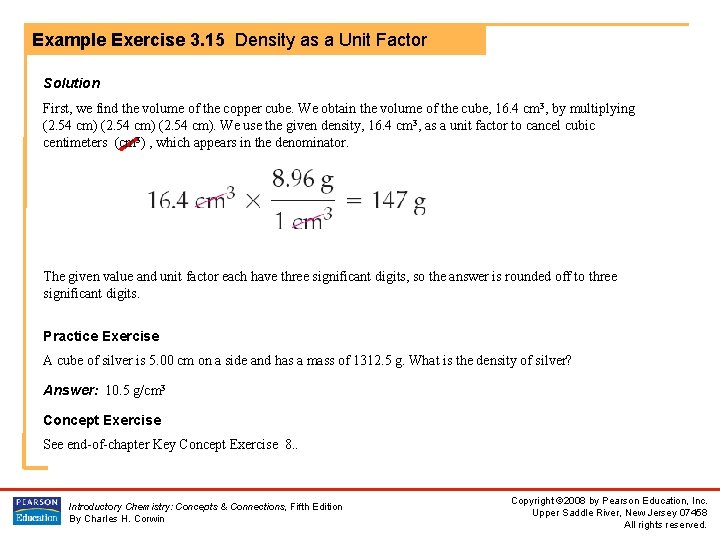
Example Exercise 3. 15 Density as a Unit Factor Solution First, we find the volume of the copper cube. We obtain the volume of the cube, 16. 4 cm 3, by multiplying (2. 54 cm). We use the given density, 16. 4 cm 3, as a unit factor to cancel cubic centimeters (cm 3) , which appears in the denominator. The given value and unit factor each have three significant digits, so the answer is rounded off to three significant digits. Practice Exercise A cube of silver is 5. 00 cm on a side and has a mass of 1312. 5 g. What is the density of silver? Answer: 10. 5 g/cm 3 Concept Exercise See end-of-chapter Key Concept Exercise 8. . Introductory Chemistry: Concepts & Connections, Fifth Edition By Charles H. Corwin Copyright © 2008 by Pearson Education, Inc. Upper Saddle River, New Jersey 07458 All rights reserved.
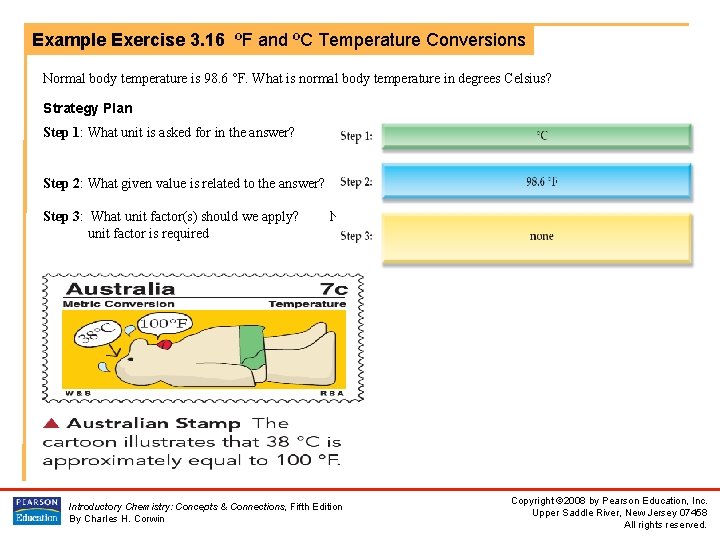
Example Exercise 3. 16 ºF and ºC Temperature Conversions Normal body temperature is 98. 6 °F. What is normal body temperature in degrees Celsius? Strategy Plan Step 1: What unit is asked for in the answer? Step 2: What given value is related to the answer? Step 3: What unit factor(s) should we apply? unit factor is required No Introductory Chemistry: Concepts & Connections, Fifth Edition By Charles H. Corwin Copyright © 2008 by Pearson Education, Inc. Upper Saddle River, New Jersey 07458 All rights reserved.
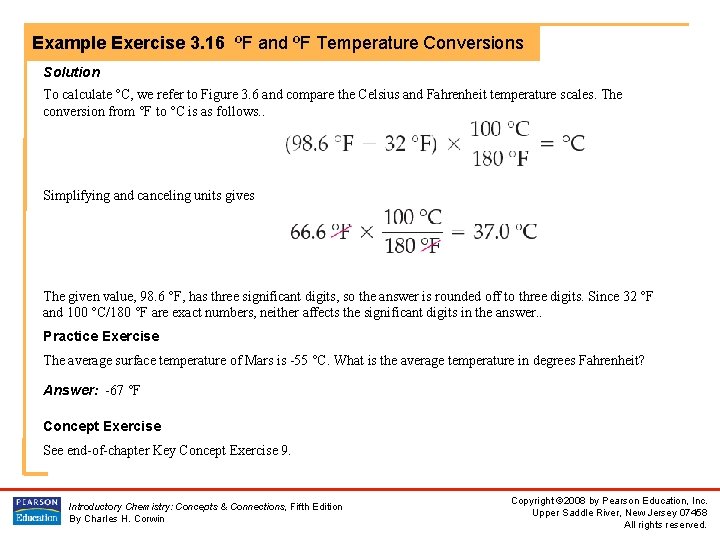
Example Exercise 3. 16 ºF and ºF Temperature Conversions Solution To calculate °C, we refer to Figure 3. 6 and compare the Celsius and Fahrenheit temperature scales. The conversion from °F to °C is as follows. . Simplifying and canceling units gives The given value, 98. 6 °F, has three significant digits, so the answer is rounded off to three digits. Since 32 °F and 100 °C/180 °F are exact numbers, neither affects the significant digits in the answer. . Practice Exercise The average surface temperature of Mars is -55 °C. What is the average temperature in degrees Fahrenheit? Answer: -67 °F Concept Exercise See end-of-chapter Key Concept Exercise 9. Introductory Chemistry: Concepts & Connections, Fifth Edition By Charles H. Corwin Copyright © 2008 by Pearson Education, Inc. Upper Saddle River, New Jersey 07458 All rights reserved.
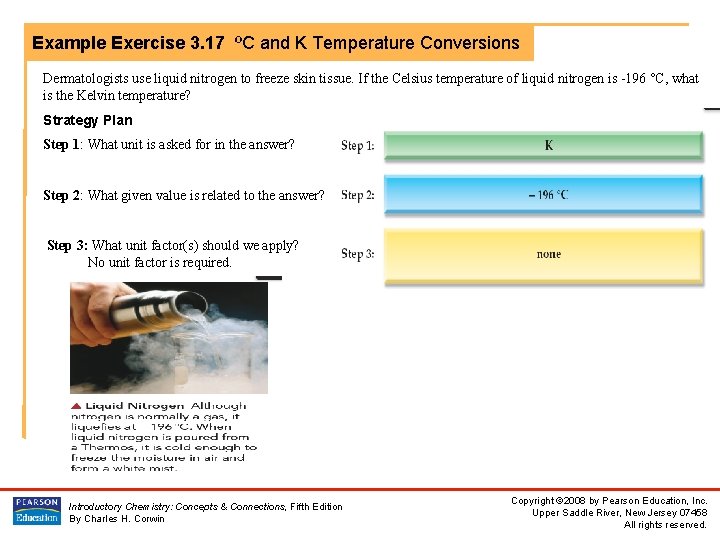
Example Exercise 3. 17 ºC and K Temperature Conversions Dermatologists use liquid nitrogen to freeze skin tissue. If the Celsius temperature of liquid nitrogen is -196 °C, what is the Kelvin temperature? Strategy Plan Step 1: What unit is asked for in the answer? Step 2: What given value is related to the answer? Step 3: What unit factor(s) should we apply? No unit factor is required. Introductory Chemistry: Concepts & Connections, Fifth Edition By Charles H. Corwin Copyright © 2008 by Pearson Education, Inc. Upper Saddle River, New Jersey 07458 All rights reserved.
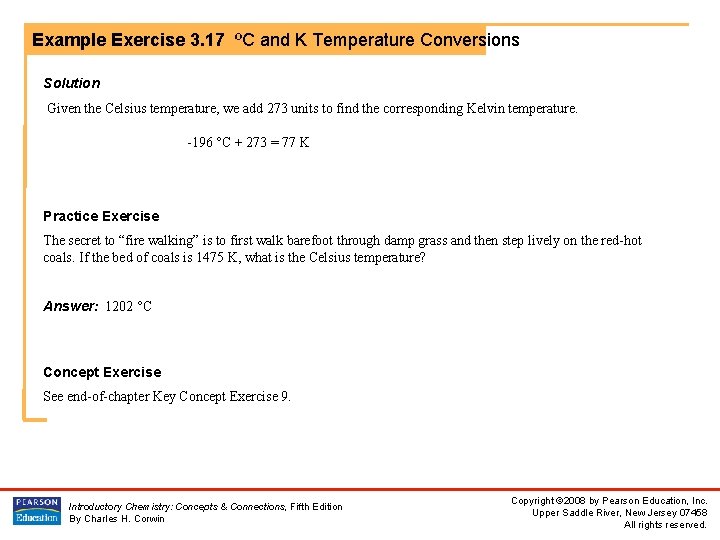
Example Exercise 3. 17 ºC and K Temperature Conversions Solution Given the Celsius temperature, we add 273 units to find the corresponding Kelvin temperature. -196 °C + 273 = 77 K Practice Exercise The secret to “fire walking” is to first walk barefoot through damp grass and then step lively on the red-hot coals. If the bed of coals is 1475 K, what is the Celsius temperature? Answer: 1202 °C Concept Exercise See end-of-chapter Key Concept Exercise 9. Introductory Chemistry: Concepts & Connections, Fifth Edition By Charles H. Corwin Copyright © 2008 by Pearson Education, Inc. Upper Saddle River, New Jersey 07458 All rights reserved.
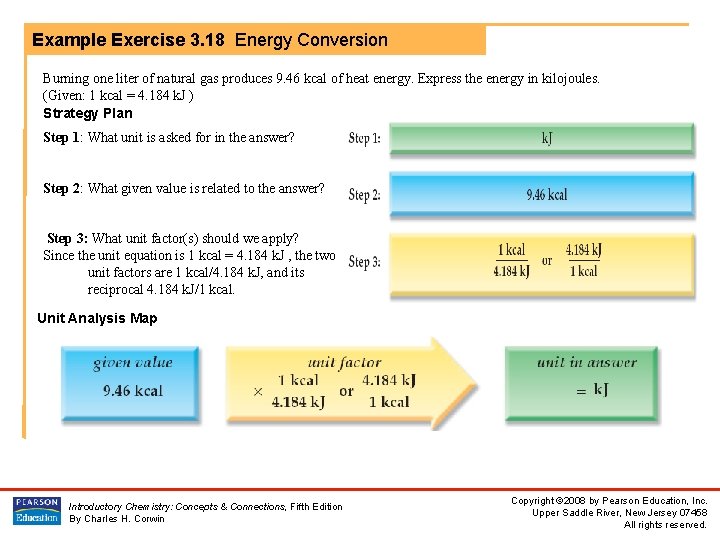
Example Exercise 3. 18 Energy Conversion Burning one liter of natural gas produces 9. 46 kcal of heat energy. Express the energy in kilojoules. (Given: 1 kcal = 4. 184 k. J ) Strategy Plan Step 1: What unit is asked for in the answer? Step 2: What given value is related to the answer? Step 3: What unit factor(s) should we apply? Since the unit equation is 1 kcal = 4. 184 k. J , the two unit factors are 1 kcal/4. 184 k. J, and its reciprocal 4. 184 k. J/1 kcal. Unit Analysis Map Introductory Chemistry: Concepts & Connections, Fifth Edition By Charles H. Corwin Copyright © 2008 by Pearson Education, Inc. Upper Saddle River, New Jersey 07458 All rights reserved.
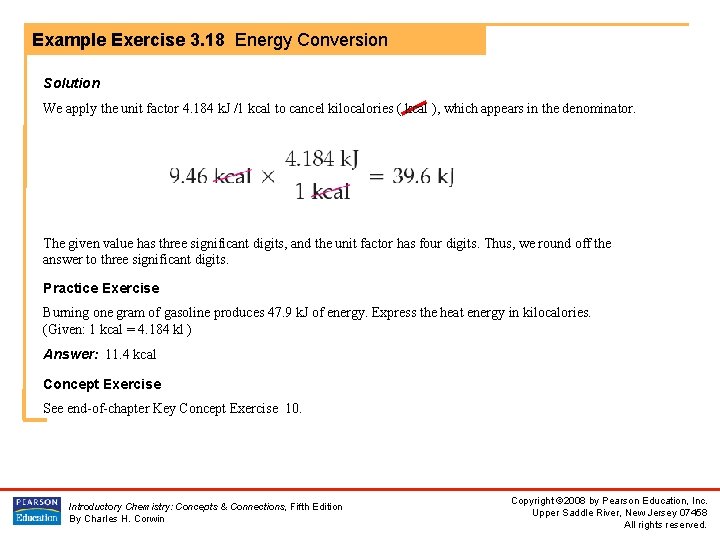
Example Exercise 3. 18 Energy Conversion Solution We apply the unit factor 4. 184 k. J /1 kcal to cancel kilocalories ( kcal ), which appears in the denominator. The given value has three significant digits, and the unit factor has four digits. Thus, we round off the answer to three significant digits. Practice Exercise Burning one gram of gasoline produces 47. 9 k. J of energy. Express the heat energy in kilocalories. (Given: 1 kcal = 4. 184 kl ) Answer: 11. 4 kcal Concept Exercise See end-of-chapter Key Concept Exercise 10. Introductory Chemistry: Concepts & Connections, Fifth Edition By Charles H. Corwin Copyright © 2008 by Pearson Education, Inc. Upper Saddle River, New Jersey 07458 All rights reserved.
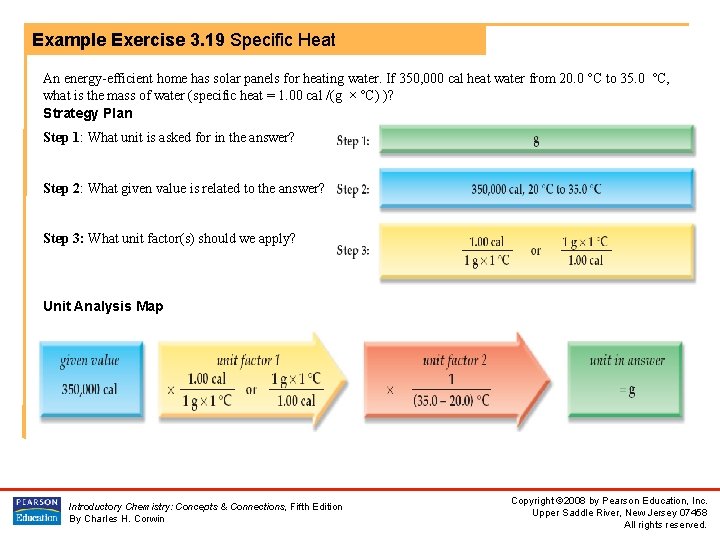
Example Exercise 3. 19 Specific Heat An energy-efficient home has solar panels for heating water. If 350, 000 cal heat water from 20. 0 °C to 35. 0 °C, what is the mass of water (specific heat = 1. 00 cal /(g × °C) )? Strategy Plan Step 1: What unit is asked for in the answer? Step 2: What given value is related to the answer? Step 3: What unit factor(s) should we apply? Unit Analysis Map Introductory Chemistry: Concepts & Connections, Fifth Edition By Charles H. Corwin Copyright © 2008 by Pearson Education, Inc. Upper Saddle River, New Jersey 07458 All rights reserved.
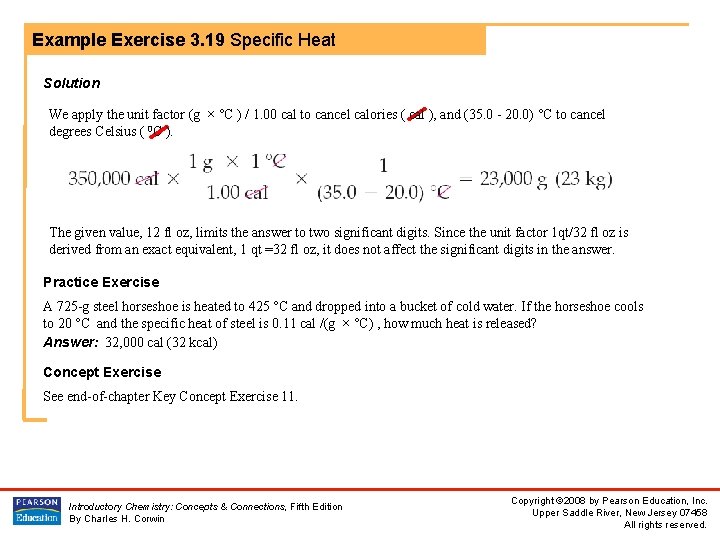
Example Exercise 3. 19 Specific Heat Solution We apply the unit factor (g × °C ) / 1. 00 cal to cancel calories ( cal ), and (35. 0 - 20. 0) °C to cancel degrees Celsius ( 0 C ). The given value, 12 fl oz, limits the answer to two significant digits. Since the unit factor 1 qt/32 fl oz is derived from an exact equivalent, 1 qt =32 fl oz, it does not affect the significant digits in the answer. Practice Exercise A 725 -g steel horseshoe is heated to 425 °C and dropped into a bucket of cold water. If the horseshoe cools to 20 °C and the specific heat of steel is 0. 11 cal /(g × °C) , how much heat is released? Answer: 32, 000 cal (32 kcal) Concept Exercise See end-of-chapter Key Concept Exercise 11. Introductory Chemistry: Concepts & Connections, Fifth Edition By Charles H. Corwin Copyright © 2008 by Pearson Education, Inc. Upper Saddle River, New Jersey 07458 All rights reserved.
- Slides: 35