
Example calculate the electric field at the electrons
- Slides: 6
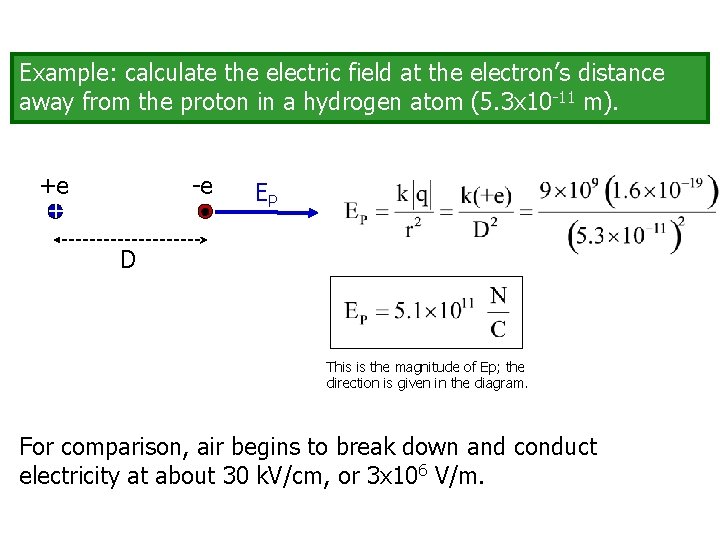
Example: calculate the electric field at the electron’s distance away from the proton in a hydrogen atom (5. 3 x 10 -11 m). +e + -e - EP D This is the magnitude of Ep; the direction is given in the diagram. For comparison, air begins to break down and conduct electricity at about 30 k. V/cm, or 3 x 10⁶ V/m.
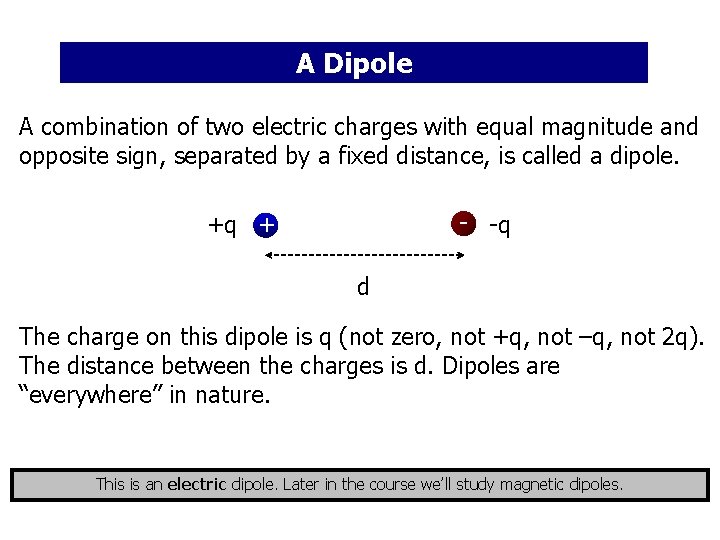
A Dipole A combination of two electric charges with equal magnitude and opposite sign, separated by a fixed distance, is called a dipole. - -q +q + d The charge on this dipole is q (not zero, not +q, not –q, not 2 q). The distance between the charges is d. Dipoles are “everywhere” in nature. This is an electric dipole. Later in the course we’ll study magnetic dipoles.
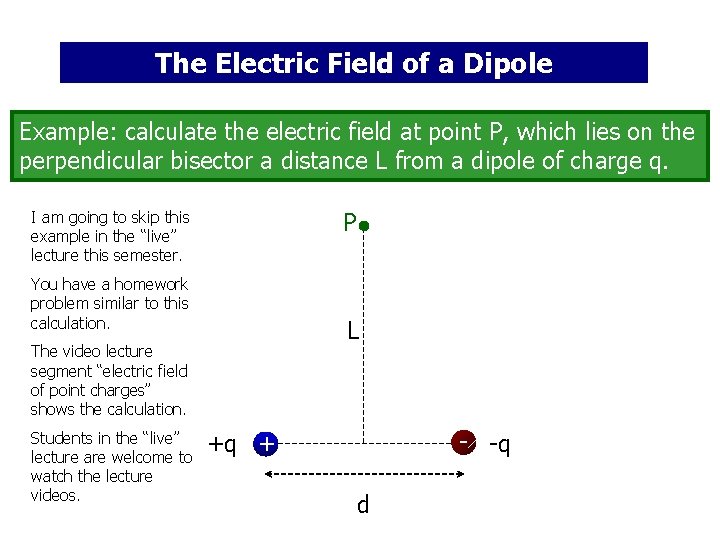
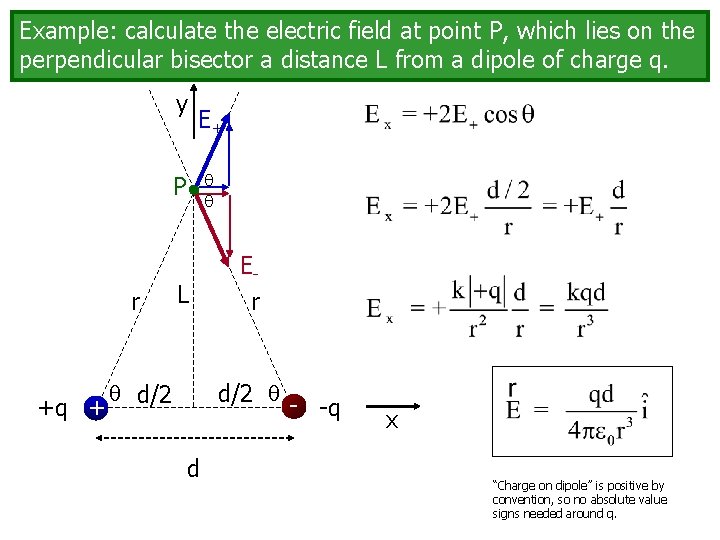
The Electric Field of a Dipole Example: calculate the electric field at point P, which lies on the perpendicular bisector a distance L from a dipole of charge q. I am going to skip this example in the “live” lecture this semester. P You have a homework problem similar to this calculation. L The video lecture segment “electric field of point charges” shows the calculation. Students in the “live” lecture are welcome to watch the lecture videos. - -q +q + d
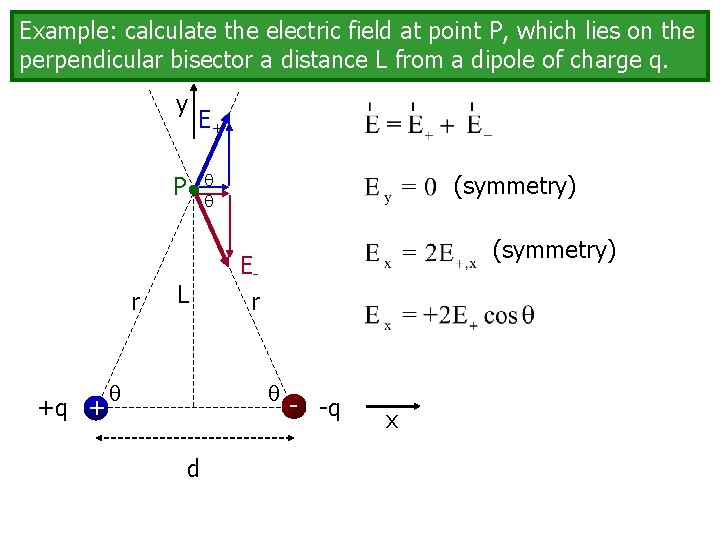
Example: calculate the electric field at point P, which lies on the perpendicular bisector a distance L from a dipole of charge q. y E+ P r +q + L (symmetry) Er d - -q x
Example: calculate the electric field at point P, which lies on the perpendicular bisector a distance L from a dipole of charge q. y E+ P r +q + L d/2 Er d/2 -q d x “Charge on dipole” is positive by convention, so no absolute value signs needed around q.
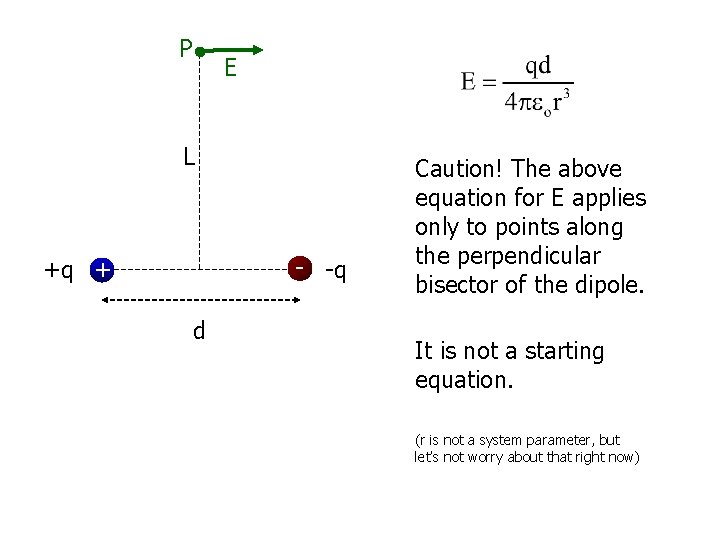
P E L - -q +q + d Caution! The above equation for E applies only to points along the perpendicular bisector of the dipole. It is not a starting equation. (r is not a system parameter, but let’s not worry about that right now)