
Example App Vision Statement Version 3 Tony Heap
- Slides: 11
Example. App Vision Statement Version 3, Tony Heap, 19/10/2009
Purpose (Agenda) • A description of the project, including – Background – Objectives – Scope – Timelines – Delivery approach – Stakeholders – Risks and Issues • A living document
Project Background • Example. App been in existence for 7 years (since 2003) • Grown over that time – 19, 000 users – 15, 000 organisations – 13 organisation types (aka “views”) – 505 individual widgets
Key Issues • Widget set unmanageable – – 500+ XL spreadsheet tabs 1000+ Word docs (Guidance Docs & Checklists) Huge amount of repetition Some inconsistencies • Not very user friendly – Especially for infrequent users – Different user types have different needs • Online/offline usage model issues – Missing features prevent online use – No facility to export for offline use
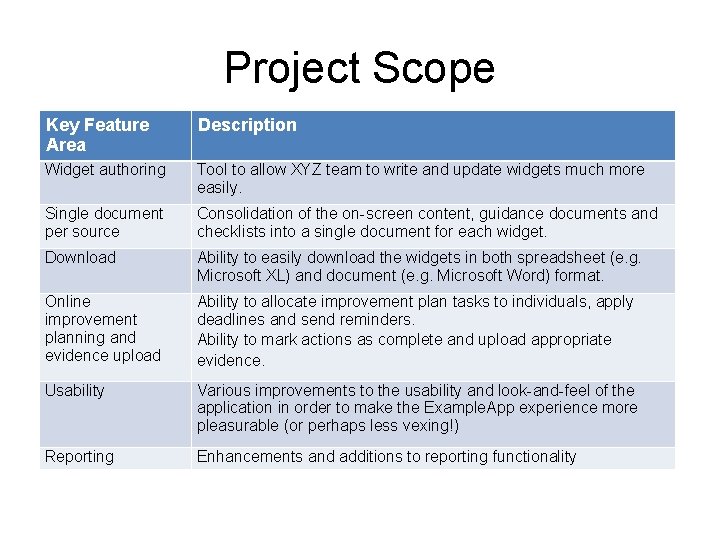
Project Scope Key Feature Area Description Widget authoring Tool to allow XYZ team to write and update widgets much more easily. Single document per source Consolidation of the on-screen content, guidance documents and checklists into a single document for each widget. Download Ability to easily download the widgets in both spreadsheet (e. g. Microsoft XL) and document (e. g. Microsoft Word) format. Online improvement planning and evidence upload Ability to allocate improvement plan tasks to individuals, apply deadlines and send reminders. Ability to mark actions as complete and upload appropriate evidence. Usability Various improvements to the usability and look-and-feel of the application in order to make the Example. App experience more pleasurable (or perhaps less vexing!) Reporting Enhancements and additions to reporting functionality
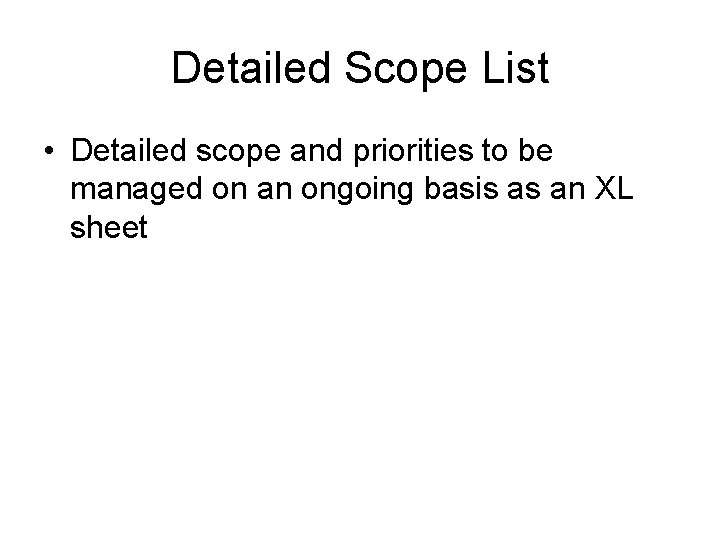
Detailed Scope List • Detailed scope and priorities to be managed on an ongoing basis as an XL sheet
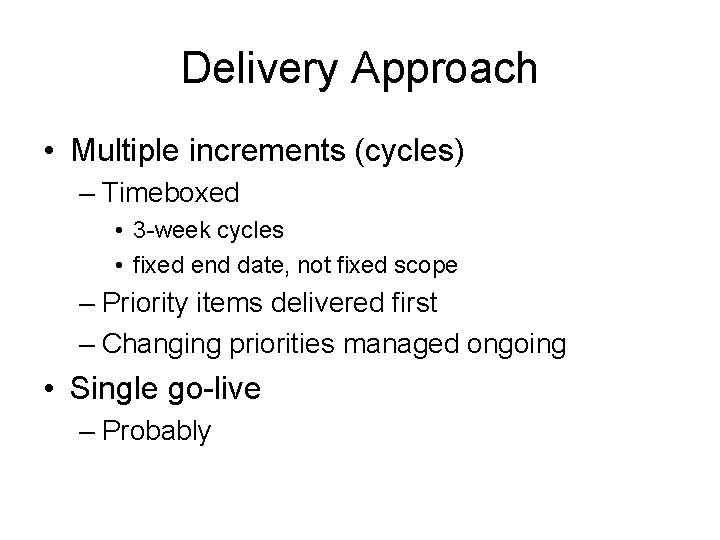
Delivery Approach • Multiple increments (cycles) – Timeboxed • 3 -week cycles • fixed end date, not fixed scope – Priority items delivered first – Changing priorities managed ongoing • Single go-live – Probably
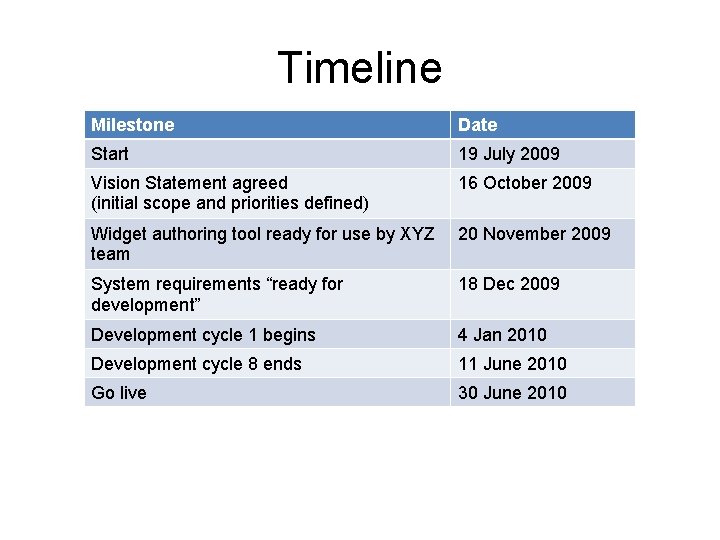
Timeline Milestone Date Start 19 July 2009 Vision Statement agreed (initial scope and priorities defined) 16 October 2009 Widget authoring tool ready for use by XYZ team 20 November 2009 System requirements “ready for development” 18 Dec 2009 Development cycle 1 begins 4 Jan 2010 Development cycle 8 ends 11 June 2010 Go live 30 June 2010
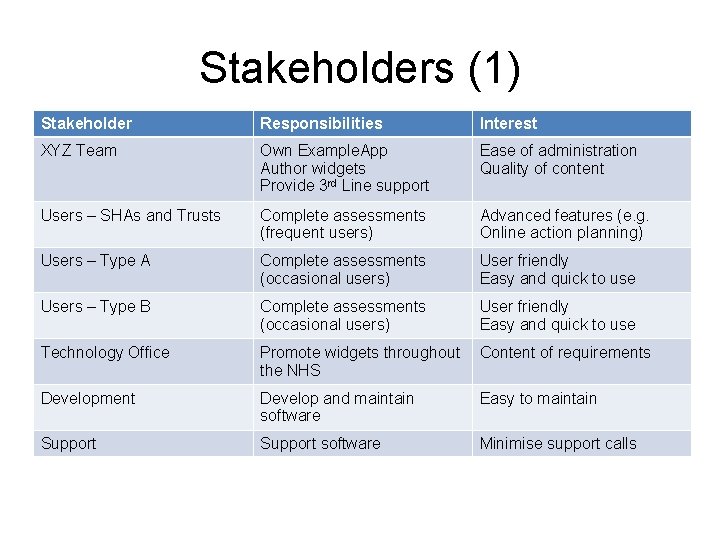
Stakeholders (1) Stakeholder Responsibilities Interest XYZ Team Own Example. App Author widgets Provide 3 rd Line support Ease of administration Quality of content Users – SHAs and Trusts Complete assessments (frequent users) Advanced features (e. g. Online action planning) Users – Type A Complete assessments (occasional users) User friendly Easy and quick to use Users – Type B Complete assessments (occasional users) User friendly Easy and quick to use Technology Office Promote widgets throughout the NHS Content of requirements Development Develop and maintain software Easy to maintain Support software Minimise support calls
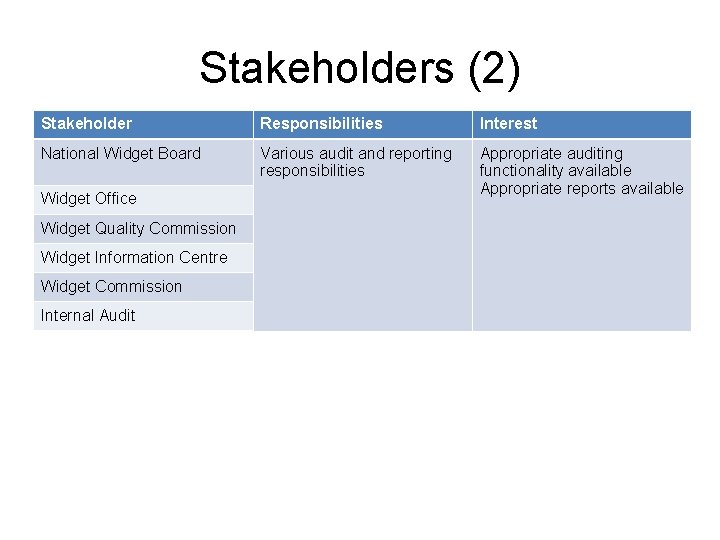
Stakeholders (2) Stakeholder Responsibilities Interest National Widget Board Various audit and reporting responsibilities Appropriate auditing functionality available Appropriate reports available Widget Office Widget Quality Commission Widget Information Centre Widget Commission Internal Audit
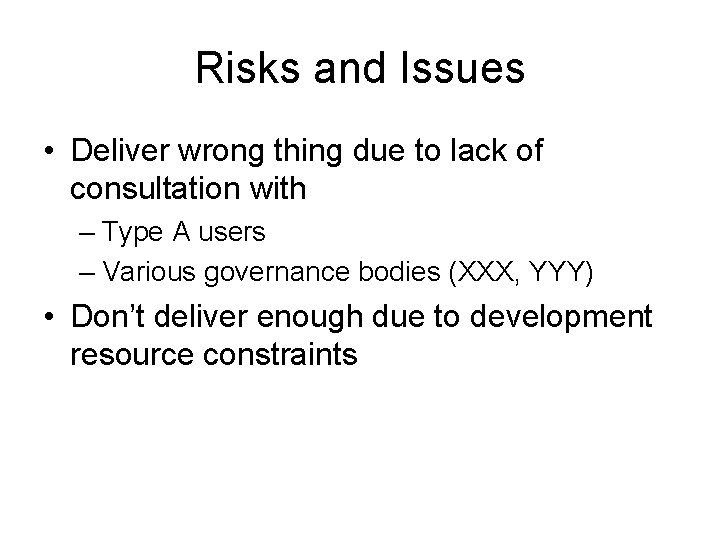
Risks and Issues • Deliver wrong thing due to lack of consultation with – Type A users – Various governance bodies (XXX, YYY) • Don’t deliver enough due to development resource constraints